


 Скачать презентацию E-Marketing 4 E Judy Strauss Adel I El-Ansary and
6cc36f5294d1d412f8e8538c2fde962e.ppt
- Количество слайдов: 22
 E-Marketing 4/E Judy Strauss, Adel I. El-Ansary, and Raymond Frost Chapter 11: Price © 2006 Prentice Hall 11 -1
 Chapter 11 Objectives • After reading Chapter 11 you will be able to: • Identify the main fixed and dynamic pricing strategies used for selling online. • Discuss the buyer’s view of pricing online in relation to real costs and buyer control. • Highlight the seller’s view of pricing online in relation to internal and external factors. • Outline the arguments for and against the Net as an efficient market. © 2006 Prentice Hall 11 -2
 The AOL Story • AOL’s subscription growth has slowed. • 33 million subscribers in 2001 has declined to 20 million in 2004. • International expansion has not spurred growth. • AOL wants to build more wallet share by adding interactive entertainment, communication services and information products. • AOL hopes to increase customer revenue from $19. 95/month today to $159/month for a menu of services in the future. © 2006 Prentice Hall 11 -3
 The AOL Story, cont. • They plan to price broadband services at $30/month to build market share. • AOL believes customers will pay for other services, such as • $20 to add other household computers. • $20 to download music. • $20 to access the Net from cell phones, etc. • Do you think that AOL’s pricing strategy makes sense in today’s competitive online environment? Why or why not? © 2006 Prentice Hall 11 -4
 The Internet Changes Pricing Strategies • Price is the sum of all values that buyers exchange for the benefits of a good or service. • Throughout history, prices were negotiated. • Fixed price policies are a modern (19 th Century) idea. • Results of mass manufacturing and mass retailing • The Internet is taking us back to an era of dynamic pricing—varying prices for individual customers. • The meaning of price depends on the viewpoint of the buyer and the seller. © 2006 Prentice Hall 11 -5
 Buyer View • Buyer’s costs may include time, energy and psychic costs. • But they often enjoy many online cost savings: • • • The Net is convenient. The Net is fast. Self-service saves time. One-stop shopping saves time. Integration saves time. Automation saves energy. © 2006 Prentice Hall 11 -6
 Buyer Control • The change in power from seller to buyer affects pricing strategies. • Buyers set prices and sellers decide whether to accept the prices in a reverse auction. • Request for Proposal • Request for Bids • Buyer power online is also based on the huge quantity of information and products available on the Web. © 2006 Prentice Hall 11 -7
 Seller View • Pricing objectives may be: • profit oriented. • market oriented. • competition oriented. • The Internet is only one sales channel and must be used in concert with other marketing mix elements. • Information technology can place both upward and downward pressure on prices. © 2006 Prentice Hall 11 -8
 The Internet Puts Upward Pressure on Prices • Online customer service is an expensive competitive necessity. • Distribution and shipping costs. • Affiliate programs add commission costs. • Site development and maintenance. • Customer acquisition costs (CAC). • The average CAC is $82 for online retailers. © 2006 Prentice Hall 11 -9
 The Internet Puts Downward Pressure on Prices • Firms can save money by using Internet technology for internal processes. • • • Self-service order processing. Just-in-time inventory. Overhead. Customer service. Printing and mailing. Digital product distribution. © 2006 Prentice Hall 11 -10
 External Factors Affect Online Pricing • Market structure and market efficiency affect pricing strategy. • The seller’s ability to set prices varies by market type: • Pure competition. (many buyers and sellers) • Commodities <> wood prices • Monopolistic competition (many buyers & sellers…differentiated offerings) • Car Sales <> subcompact/sedan/sports/luxury • Truck sales <> work truck/dressed-up truck/sport truck/SUV/luxury • Oligopolistic competition. (few sellers) • Oil Companies • Pure monopoly. (one seller) • At one time AT&T, Microsoft? ? © 2006 Prentice Hall 11 -11
 Efficient Markets • A market is efficient when customers have equal access to information about products, prices and distribution. (Price transparency) • In an efficient market, one would expect to find: • • • Lower prices. High price elasticity. Frequent price changes. Smaller price changes. Narrow price dispersion between highest and lowest price for a product. © 2006 Prentice Hall 11 -12
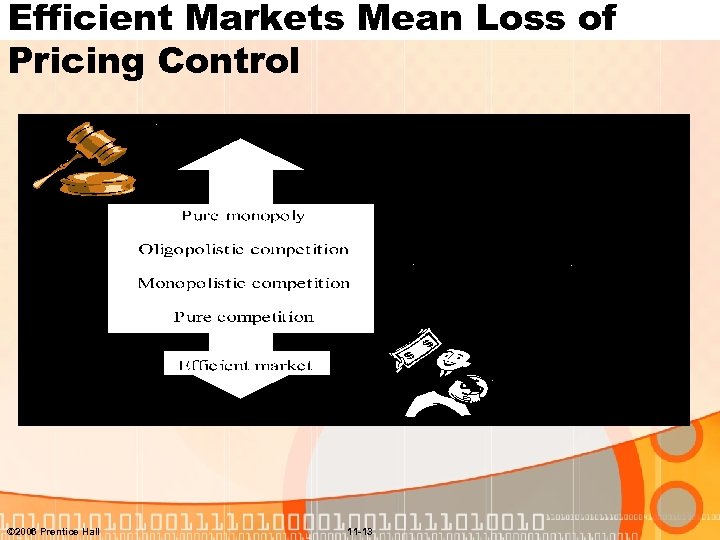 Efficient Markets Mean Loss of Pricing Control © 2006 Prentice Hall 11 -13
 Is the Net an Efficient Market? • External market factors place downward pressure on prices and contribute to efficiency. • • Shopping agents such as Price. Scan. High price elasticity. Reverse auctions. Tax-free zones reduce out of pocket expenditures. Venture capital availability. Competition. Frequent price changes. Smaller price changes. © 2006 Prentice Hall 11 -14
 Is the Net an Inefficient Market? • The Internet does not act like an efficient market regarding narrow price dispersion. • In two studies, greater price spread was found for online purchases than for offline purchases. • Price dispersion may occur, because the online channel is still not completely mature. • Price dispersion may also relate to other issues: • Brand strength. • Differentiation • Delivery options. • Switching Costs • Time-sensitive shoppers. • Second-generation shopping agents © 2006 Prentice Hall 11 -15
 Pricing Strategies • How marketers apply pricing strategy is as important as how much they charge. • Marketers can employ all traditional pricing strategies to the online environment. • Fixed pricing (menu pricing) is when everyone pays the same price. • Two common fixed pricing strategies are: • Price leadership. (Cheapest, Best Value) • Promotional pricing. © 2006 Prentice Hall 11 -16
 Dynamic Pricing • Dynamic pricing is the strategy of offering different prices to different customers. • Firms use dynamic pricing strategy to optimize inventory management and to segment customers. • Airlines have long used dynamic pricing to price air travel. • So have Hotels/motels • There are 2 types of dynamic pricing: • Segmented pricing. • Negotiation. © 2006 Prentice Hall 11 -17
 Segmented Pricing • Pricing levels are set based on order size, timing, demand, supply or other factors. • Pricing according to customer behavior segments is becoming more common as firms collect more behavioral information. • Segmented pricing can be effective when: • The market is segmentable. • Pricing reflects value perceptions of the segment. • Segments exhibit different demand behavior. © 2006 Prentice Hall 11 -18
 Segmented Pricing, cont. • Geographic segment pricing • Pricing differs by geographic area. • May vary by country. • May reflect higher costs of transportation, tariffs, margins, etc. • Value segment pricing • Recognition that not all customers provide equal value to the firm. • Pareto principle: 80% of a firm’s business comes from the top 20% of customers. © 2006 Prentice Hall 11 -19
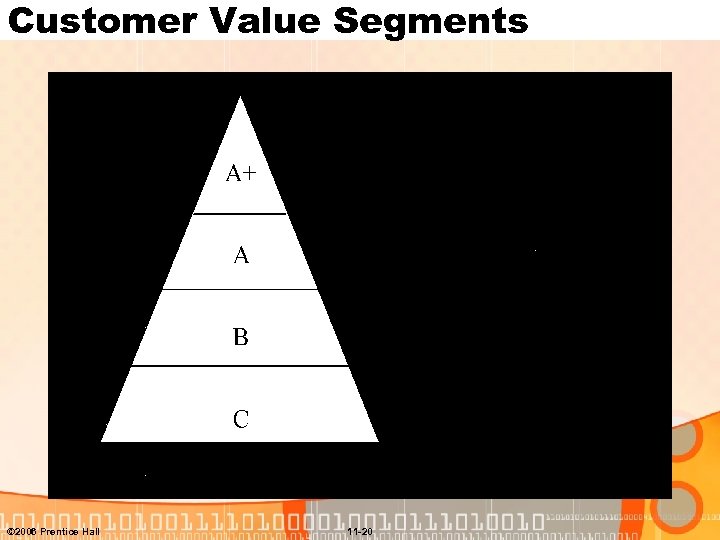 Customer Value Segments © 2006 Prentice Hall 11 -20
 Negotiated Pricing • Through negotiation, the price is set more than once in a back-and-forth discussion. • Online auctions utilize negotiated pricing. • Consumers enjoy the sport and community. • B 2 B auctions are an effective way to unload surplus inventory. © 2006 Prentice Hall 11 -21
 Bartering • Goods or services are exchanged for other products rather than cash. • Users of bartering may enjoy tax benefits. • Bartering is not a profitable pricing strategy. • Exchanging or auctioning used items online can hurt sales of new products. © 2006 Prentice Hall 11 -22