


 Скачать презентацию E lectronic N umerical I ntegrator A nd
8e2ecd71b36981e6bccc9b1a68eb5528.ppt
- Количество слайдов: 37
 E lectronic N umerical I ntegrator A nd C omputer Matthieu-P. Schapranow Origins of Operating Systems Course by Prof. Dr. Andreas Polze Hasso-Plattner-Insitute for IT-Systems Engineering, University of Potsdam
 Agenda n Pre-ENIAC-Era u Babbage’s Analytical Engine u Aiken’s Mark I u Konrad Zuse’s Z 1 -Z 3 n ENIAC-Era u Involved Persons l Dr. John William Mauchly l John Presper Eckert, Jr. l Herrman Heine Goldstine u Upcoming Events u Technical Data u System Structure l Initializing and Cycling Unit l Accumulator l Constant Transmitter & Function Tables l Multiplier l Divider-Square-Rooter n Post-ENIAC-Era u von ã Matthieu-P. Schapranow, Origins of Operation Systems, June 2006, Page 2 Neumann architecture
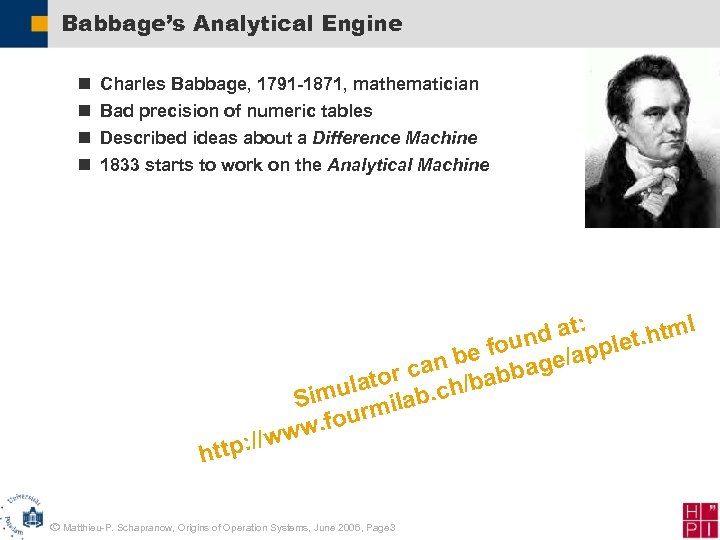 Babbage’s Analytical Engine n n Charles Babbage, 1791 -1871, mathematician Bad precision of numeric tables Described ideas about a Difference Machine 1833 starts to work on the Analytical Machine d at: let. html foun /app e an b bbage c ator. ch/ba imul ilab S m. four w : //ww http ã Matthieu-P. Schapranow, Origins of Operation Systems, June 2006, Page 3
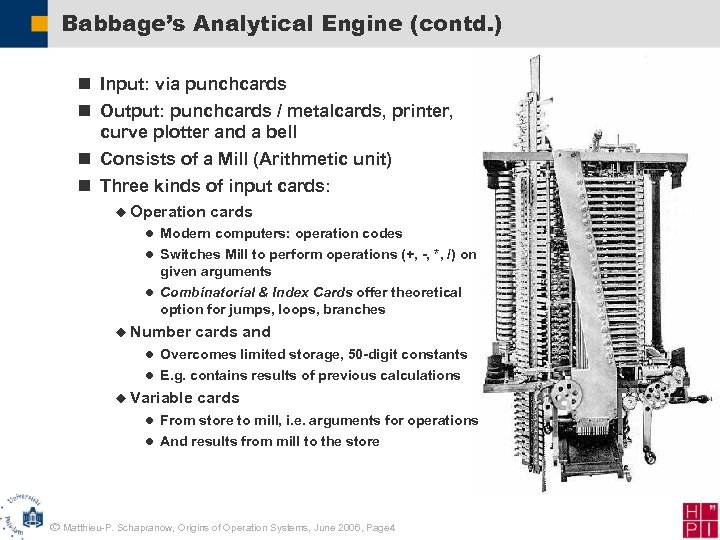 Babbage’s Analytical Engine (contd. ) n Input: via punchcards n Output: punchcards / metalcards, printer, curve plotter and a bell n Consists of a Mill (Arithmetic unit) n Three kinds of input cards: u Operation cards l Modern computers: operation codes l Switches Mill to perform operations (+, -, *, /) on given arguments l Combinatorial & Index Cards offer theoretical option for jumps, loops, branches u Number cards and l Overcomes limited storage, 50 -digit constants l E. g. contains results of previous calculations u Variable cards l From store to mill, i. e. arguments for operations l And results from mill to the store ã Matthieu-P. Schapranow, Origins of Operation Systems, June 2006, Page 4
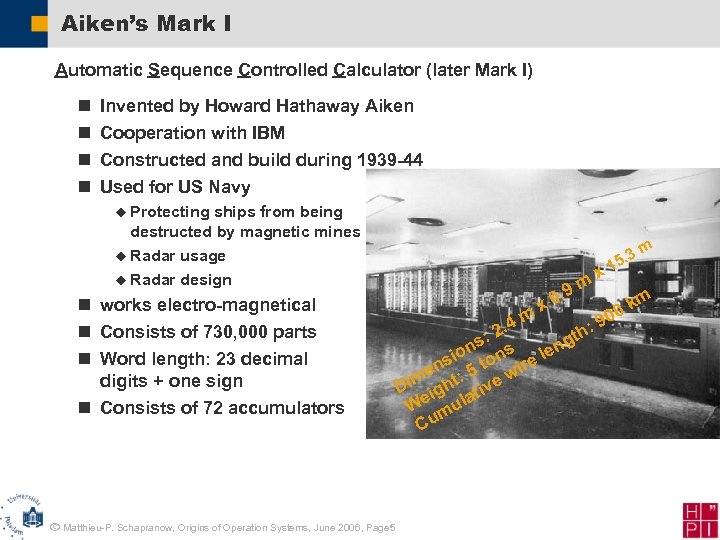 Aiken’s Mark I Automatic Sequence Controlled Calculator (later Mark I) n n Invented by Howard Hathaway Aiken Cooperation with IBM Constructed and build during 1939 -44 Used for US Navy u Protecting ships from being destructed by magnetic mines u Radar usage u Radar design n works electro-magnetical n Consists of 730, 000 parts n Word length: 23 decimal digits + one sign n Consists of 72 accumulators ã Matthieu-P. Schapranow, Origins of Operation Systems, June 2006, Page 5 9 m 0. x m x . 3 15 m m 9. 4 2 h: t : ng ns ns e sio to ire l en 5 im ht: ive w D ig e ulat W m Cu k 00
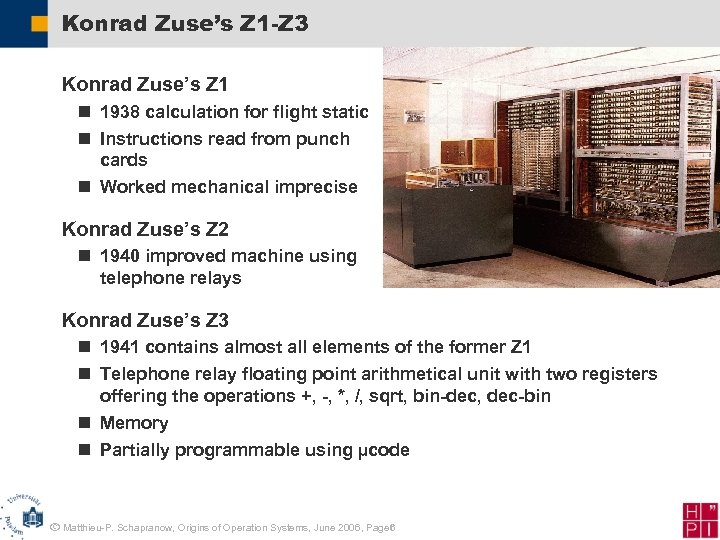 Konrad Zuse’s Z 1 -Z 3 Konrad Zuse’s Z 1 n 1938 calculation for flight static n Instructions read from punch cards n Worked mechanical imprecise Konrad Zuse’s Z 2 n 1940 improved machine using telephone relays Konrad Zuse’s Z 3 n 1941 contains almost all elements of the former Z 1 n Telephone relay floating point arithmetical unit with two registers offering the operations +, -, *, /, sqrt, bin-dec, dec-bin n Memory n Partially programmable using µcode ã Matthieu-P. Schapranow, Origins of Operation Systems, June 2006, Page 6
 Agenda n Pre-ENIAC-Era u Babbage’s Analytical Engine u Aiken’s Mark I u Konrad Zuse’s Z 1 -Z 3 n ENIAC-Era u Involved Persons l Dr. John William Mauchly l John Presper Eckert, Jr. l Herrman Heine Goldstine u Upcoming Events u Technical Data u System Structure l Initializing and Cycling Unit l Accumulator l Constant Transmitter & Function Tables l Multiplier l Divider-Square-Rooter n Post-ENIAC-Era u von ã Matthieu-P. Schapranow, Origins of Operation Systems, June 2006, Page 7 Neumann architecture
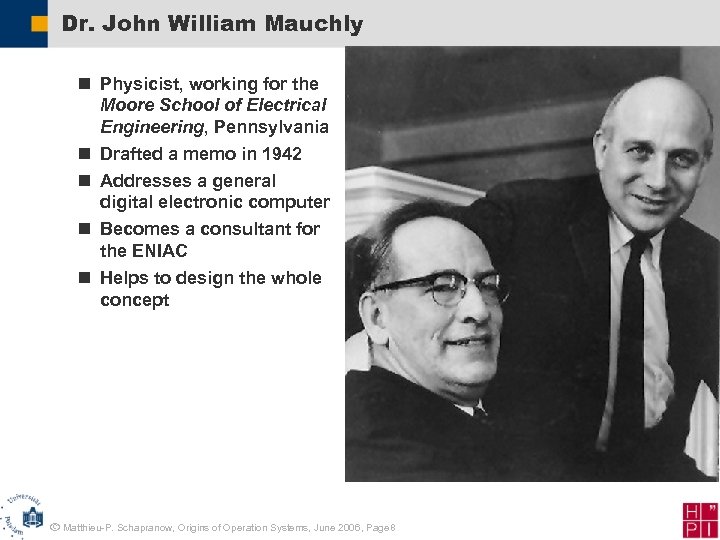 Dr. John William Mauchly n Physicist, working for the Moore School of Electrical Engineering, Pennsylvania n Drafted a memo in 1942 n Addresses a general digital electronic computer n Becomes a consultant for the ENIAC n Helps to design the whole concept ã Matthieu-P. Schapranow, Origins of Operation Systems, June 2006, Page 8
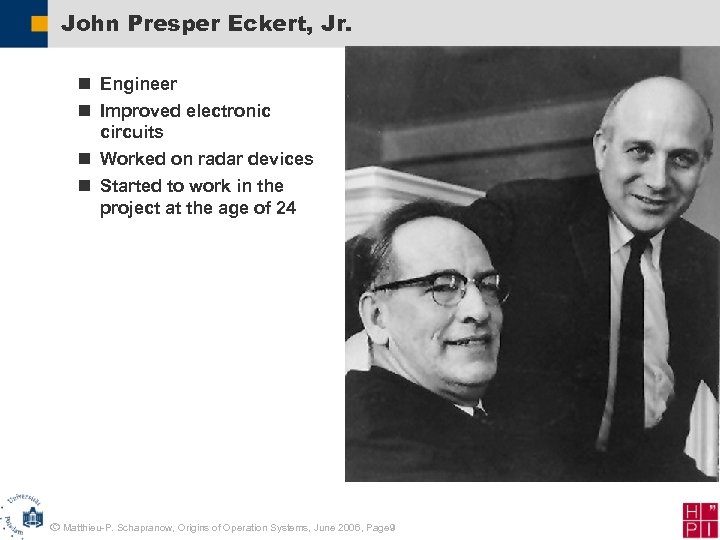 John Presper Eckert, Jr. n Engineer n Improved electronic circuits n Worked on radar devices n Started to work in the project at the age of 24 ã Matthieu-P. Schapranow, Origins of Operation Systems, June 2006, Page 9
 Herman Heine Goldstine n n Mathematician, Ph. D. Introduced flow charts Later Lieutenant at the Ballistic Research Laboratory (BLR) Assessed Mauchly’s knowledge ã Matthieu-P. Schapranow, Origins of Operation Systems, June 2006, Page 10
 Upcoming Events Problem Definition n expensive ballistic computations were done by experts without any automation n Trajectory table consists of approx. 100 trajectories u takes approx. 20 h per trajectory! n Bush Differential Analyzer already installed at BLR in 1935 n Project PX in combination with the Ballistic Research Laboratory (BRL) and the Moore School 1944 -1946 n Budget: $61, 700 4. 22 0 : sts t co tive la jec pro mu Cu ã Matthieu-P. Schapranow, Origins of Operation Systems, June 2006, Page 11 86, 8 $4
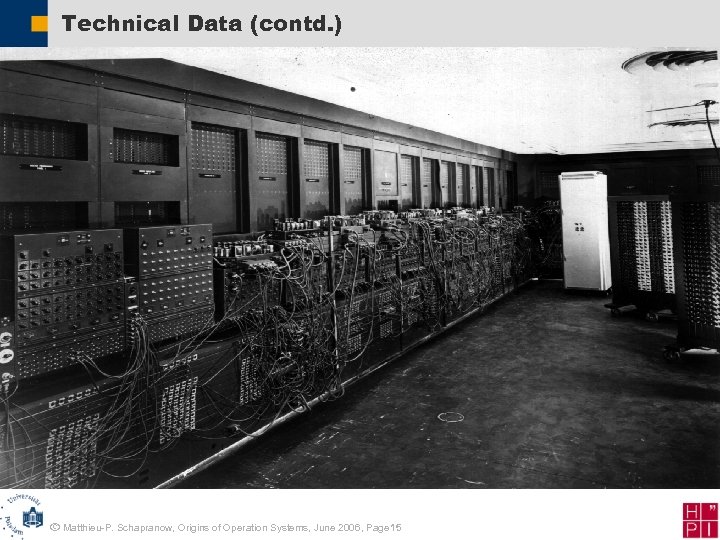
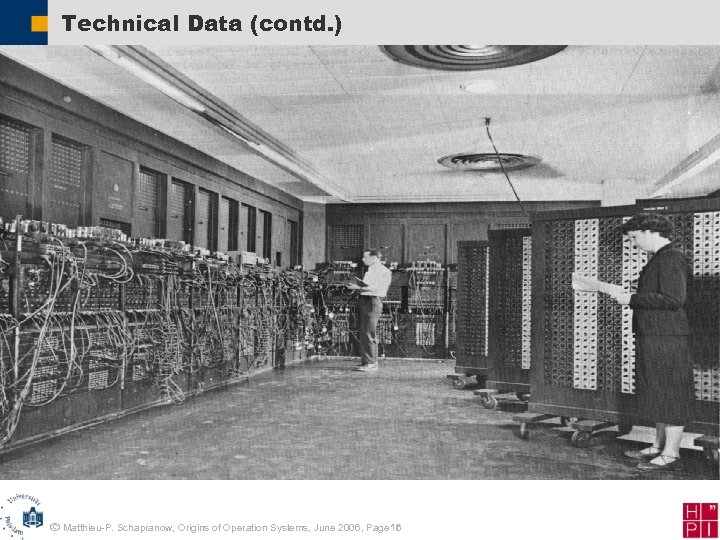
 Technical Data n 17, 468 tubes, 16 different tube types u 9, 000 tubes for division/multiplication and I/O u 8, 800 tubes for one accumulator u 220 tubes for one decimal number u 22 tubes for storing exactly one digit of a decimal number n 7, 200 crystal diodes n 1, 500 relays n 70, 000 resistors n 10, 000 capacitors n 5, 000 hand-soldered joints n Original ENIAC consists of 30 units u 20 Accumulators u One Multiplication Unit u One Division and Square Root Unit u Three Function Tables ã Matthieu-P. Schapranow, Origins of Operation Systems, June 2006, Page 12
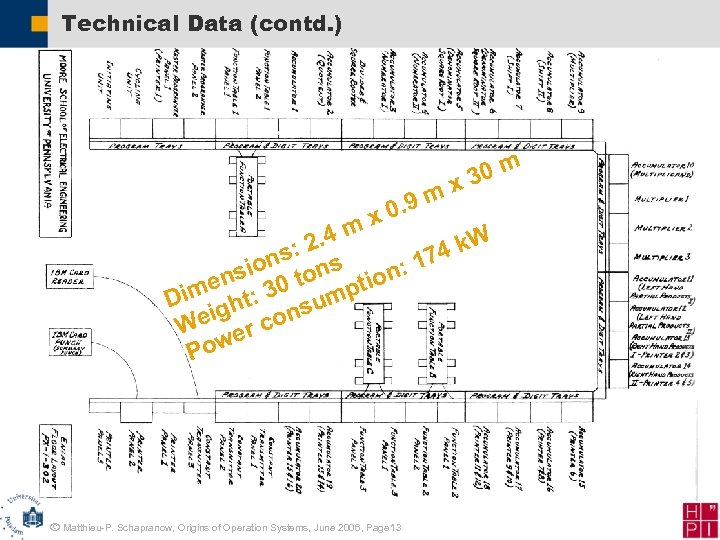 Technical Data (contd. ) . 9 m 0 0 x 3 mx 4 k. W : 2. 4 s ion tons on: 17 ens 30 pti im ht: D g sum i n We er co Pow ã Matthieu-P. Schapranow, Origins of Operation Systems, June 2006, Page 13 m
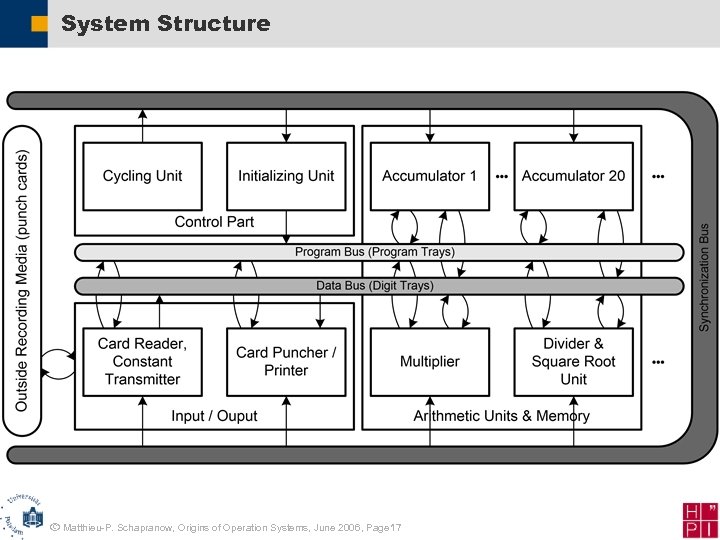
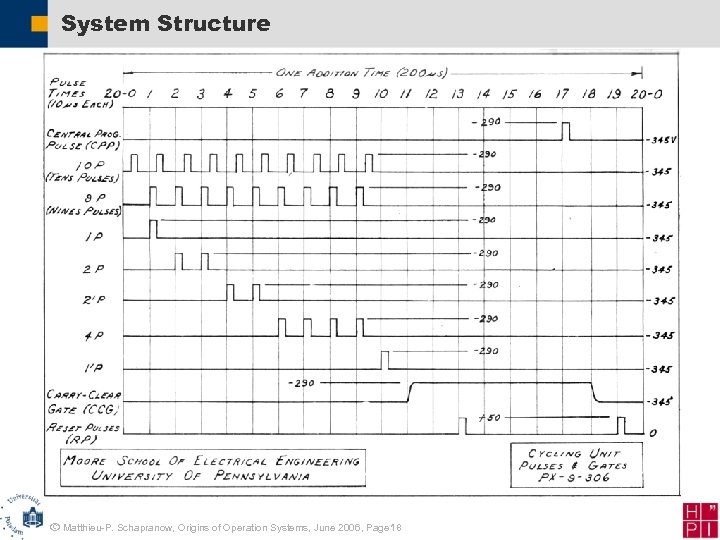
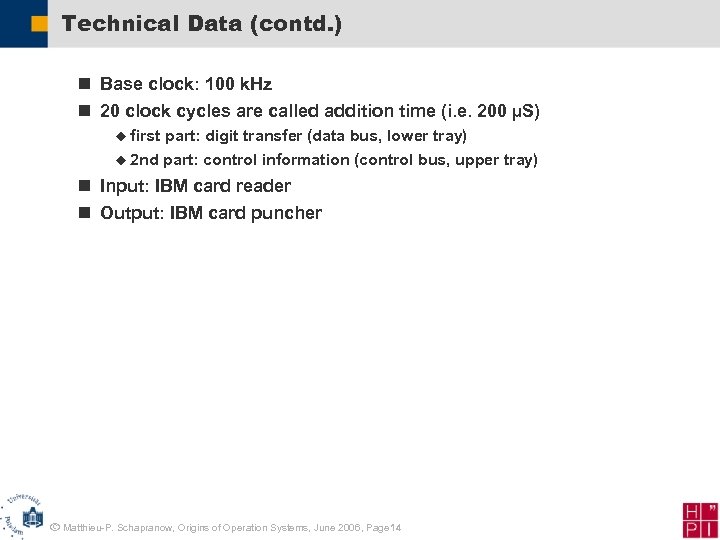 Technical Data (contd. ) n Base clock: 100 k. Hz n 20 clock cycles are called addition time (i. e. 200 µS) u first part: digit transfer (data bus, lower tray) u 2 nd part: control information (control bus, upper tray) n Input: IBM card reader n Output: IBM card puncher ã Matthieu-P. Schapranow, Origins of Operation Systems, June 2006, Page 14
 Technical Data (contd. ) ã Matthieu-P. Schapranow, Origins of Operation Systems, June 2006, Page 15
 Technical Data (contd. ) ã Matthieu-P. Schapranow, Origins of Operation Systems, June 2006, Page 16
 System Structure ã Matthieu-P. Schapranow, Origins of Operation Systems, June 2006, Page 17
 System Structure ã Matthieu-P. Schapranow, Origins of Operation Systems, June 2006, Page 18
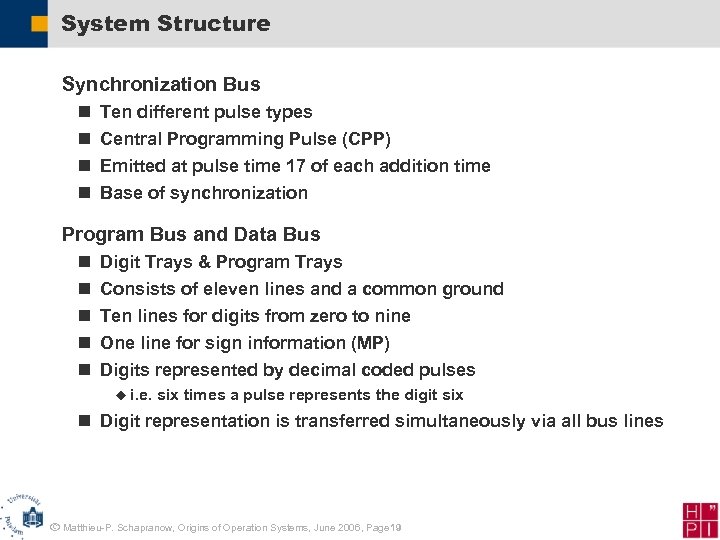 System Structure Synchronization Bus n n Ten different pulse types Central Programming Pulse (CPP) Emitted at pulse time 17 of each addition time Base of synchronization Program Bus and Data Bus n n n Digit Trays & Program Trays Consists of eleven lines and a common ground Ten lines for digits from zero to nine One line for sign information (MP) Digits represented by decimal coded pulses u i. e. six times a pulse represents the digit six n Digit representation is transferred simultaneously via all bus lines ã Matthieu-P. Schapranow, Origins of Operation Systems, June 2006, Page 19
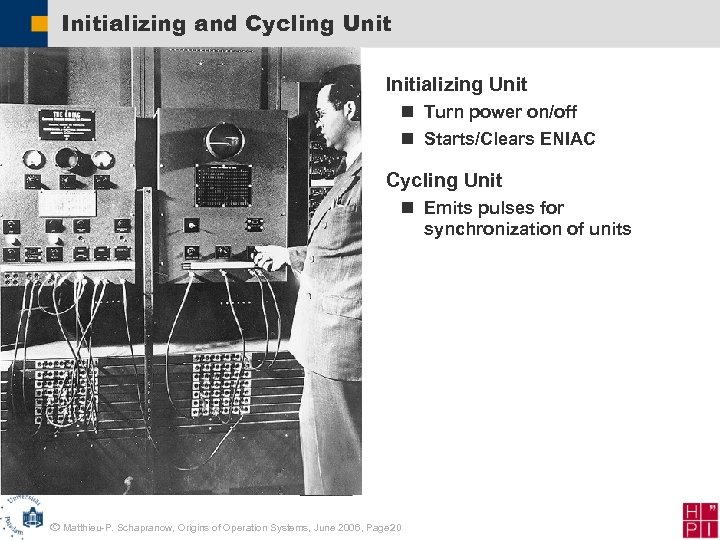 Initializing and Cycling Unit Initializing Unit n Turn power on/off n Starts/Clears ENIAC Cycling Unit n Emits pulses for synchronization of units ã Matthieu-P. Schapranow, Origins of Operation Systems, June 2006, Page 20
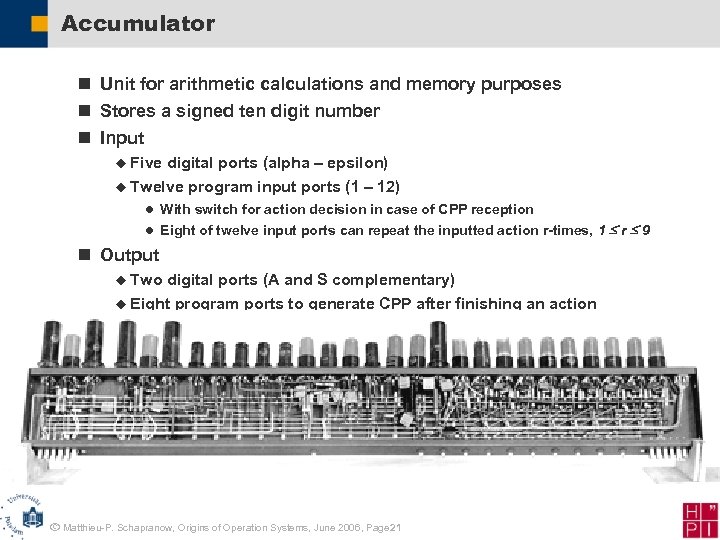 Accumulator n Unit for arithmetic calculations and memory purposes n Stores a signed ten digit number n Input u Five digital ports (alpha – epsilon) u Twelve program input ports (1 – 12) l With switch for action decision in case of CPP reception l Eight of twelve input ports can repeat the inputted action r-times, 1 r 9 n Output u Two digital ports (A and S complementary) u Eight program ports to generate CPP after finishing an action ã Matthieu-P. Schapranow, Origins of Operation Systems, June 2006, Page 21
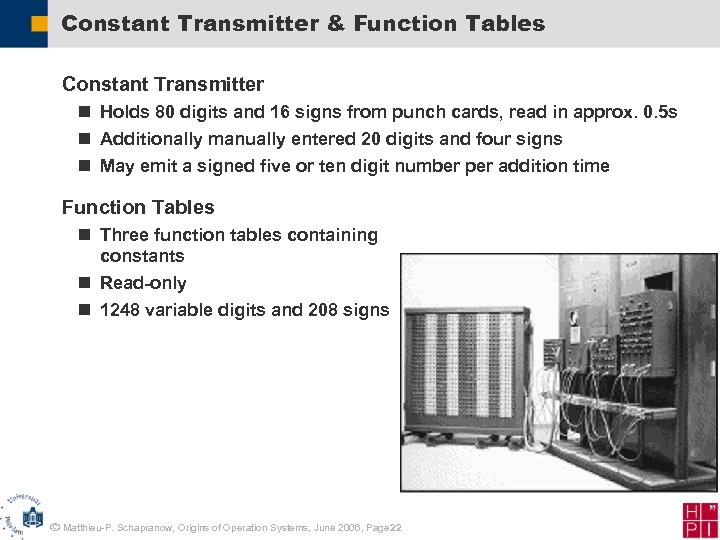 Constant Transmitter & Function Tables Constant Transmitter n Holds 80 digits and 16 signs from punch cards, read in approx. 0. 5 s n Additionally manually entered 20 digits and four signs n May emit a signed five or ten digit number per addition time Function Tables n Three function tables containing constants n Read-only n 1248 variable digits and 208 signs ã Matthieu-P. Schapranow, Origins of Operation Systems, June 2006, Page 22
 Multiplier n Static connected n Input u multiplicand, u Multiplier, signed, up to ten digits signed p digits, 2 p 10 n Addition time: p + 4 ã Matthieu-P. Schapranow, Origins of Operation Systems, June 2006, Page 23
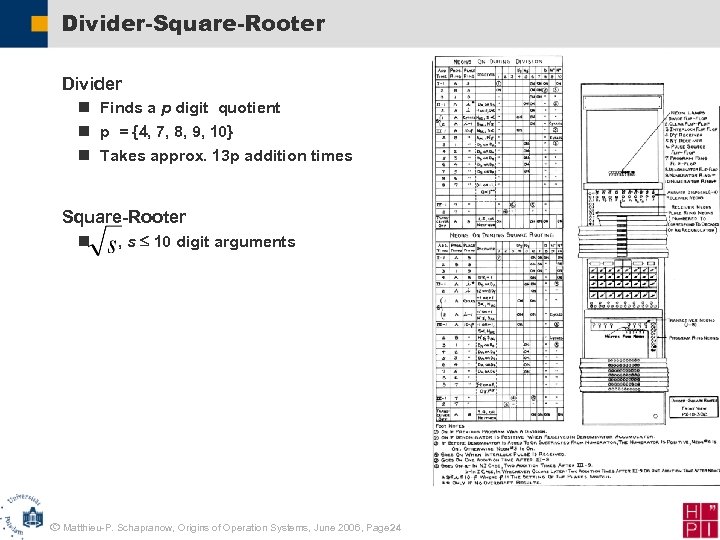 Divider-Square-Rooter Divider n Finds a p digit quotient n p = {4, 7, 8, 9, 10} n Takes approx. 13 p addition times Square-Rooter n , s 10 digit arguments ã Matthieu-P. Schapranow, Origins of Operation Systems, June 2006, Page 24
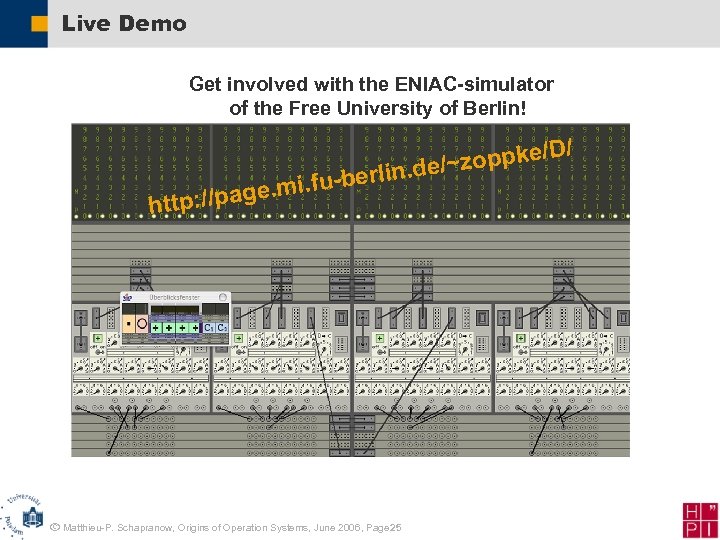 Live Demo Get involved with the ENIAC-simulator of the Free University of Berlin! ppke/D/ zo rlin. de/~ e e. mi. fu-b g http: //pa ã Matthieu-P. Schapranow, Origins of Operation Systems, June 2006, Page 25
 Agenda n Pre-ENIAC-Era u Babbage’s Analytical Engine u Aiken’s Mark I u Konrad Zuse’s Z 1 -Z 3 n ENIAC-Era u Involved Persons l Dr. John William Mauchly l John Presper Eckert, Jr. l Herrman Heine Goldstine u Upcoming Events u Technical Data u System Structure l Initializing and Cycling Unit l Accumulator l Constant Transmitter & Function Tables l Multiplier l Divider-Square-Rooter n Post-ENIAC-Era u von ã Matthieu-P. Schapranow, Origins of Operation Systems, June 2006, Page 26 Neumann architecture
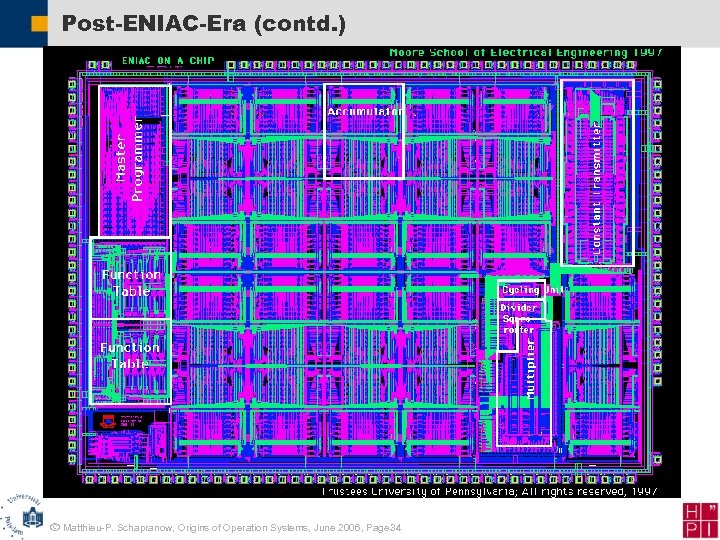
 Post-ENIAC-Era Master Programmer n Extension for simplification n Performs nested loops Printer/Punch n Handles information for 80 digits and 16 signs from Accumulator and Master Programmer, printed within 0. 6 seconds Magnitude Discrimination n First machine doing conditional branching n Connecting data line of one accumulator to control line of another accumulator ã Matthieu-P. Schapranow, Origins of Operation Systems, June 2006, Page 27
 Post-ENIAC-Era (contd. ) n n n n n Major imperfection: no internally stored program. August 1944: Goldstine introduced Dr. John L. v. Neumann June 1945: First Draft of a Report on the EDVAC 1947: Function tables are used to store program code 1948 Research Division at Aberdeen Proving Ground (APG) formed ENIAC to an internally stored-fixed program computer Idea of subroutines by Mauchly: related to inner working of desk calculators 1951: Core memory installed (inspired by the EDVAC) Longest uptime in 1954 approx. 116 h 1948 -1955: total working hours: 80, 223 h u Tasks within this time: ballistics, weather prediction, atomic energy calculations, cosmic ray studies, thermal ignition, random-number studies, wind tunnel design, calculation of thermonuclear chain reactions, and other scientific uses ã Matthieu-P. Schapranow, Origins of Operation Systems, June 2006, Page 28
 Post-ENIAC-Era (contd. ) Binary Automatic Computer n Eckert & Mauchly in 1949 n Only 700 tubes n 4. 25 MHz After 1949 Electronic Controls Company n Eckert-Mauchly Computer Corp. UNIVAC UNISYS Electronic Discrete Variable Computer n EDVAC runs first program in Oct. 1951 n Program code and data are represented by punchcards and loaded during runtime in one common memory Ordnance Variable Automatic Computer n ORDVAC developed in 1952 by von Neumann’s crew at the Institute of Advanced Studies (IAS) ã Matthieu-P. Schapranow, Origins of Operation Systems, June 2006, Page 29
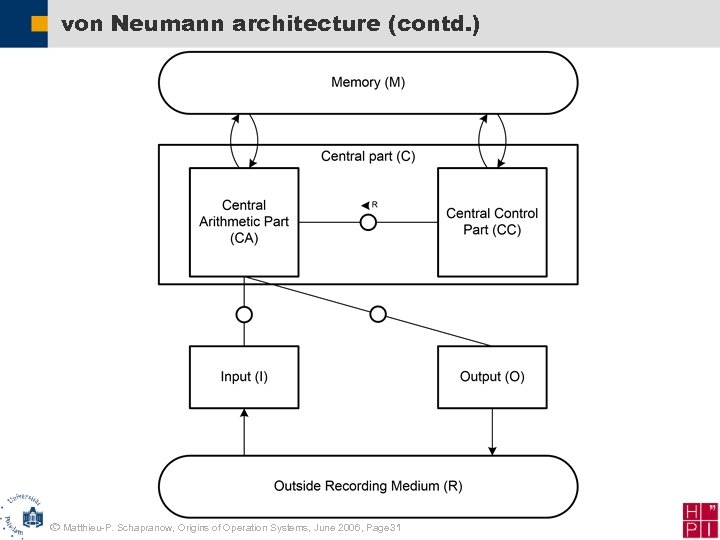
![von Neumann architecture model (stored-program computer) [4] n C u Central Arithmetic Part (CA):](https://present5.com/presentation/8e2ecd71b36981e6bccc9b1a68eb5528/image-30.jpg "von Neumann architecture model (stored-program computer) [4] n C u Central Arithmetic Part (CA):") von Neumann architecture model (stored-program computer) [4] n C u Central Arithmetic Part (CA): +, -, *, /, (sqrt, crt, sgn, | |, log 10, ld, ln, sin, …) works with binary representation u Central Control Part (CC) n Memory (M) contains intermediate results, should only store binary material n Outside Recording Medium (R) contains final result in decimal representation n Input ( I ) (decimal representation) : = R I M n Output (O) (decimal representation) : = M O R ã Matthieu-P. Schapranow, Origins of Operation Systems, June 2006, Page 30
von Neumann architecture model (stored-program computer) [4] n C u Central Arithmetic Part (CA): +, -, *, /, (sqrt, crt, sgn, | |, log 10, ld, ln, sin, …) works with binary representation u Central Control Part (CC) n Memory (M) contains intermediate results, should only store binary material n Outside Recording Medium (R) contains final result in decimal representation n Input ( I ) (decimal representation) : = R I M n Output (O) (decimal representation) : = M O R ã Matthieu-P. Schapranow, Origins of Operation Systems, June 2006, Page 30
 von Neumann architecture (contd. ) ã Matthieu-P. Schapranow, Origins of Operation Systems, June 2006, Page 31
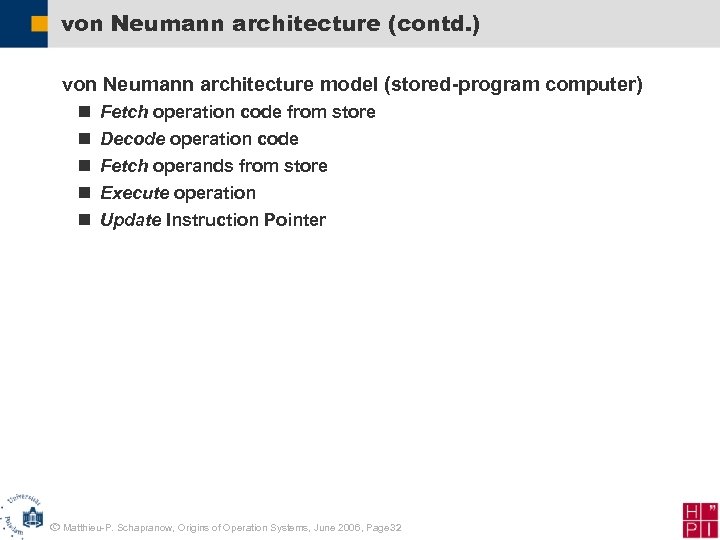 von Neumann architecture (contd. ) von Neumann architecture model (stored-program computer) n n n Fetch operation code from store Decode operation code Fetch operands from store Execute operation Update Instruction Pointer ã Matthieu-P. Schapranow, Origins of Operation Systems, June 2006, Page 32
 Post-ENIAC-Era (contd. ) ã Matthieu-P. Schapranow, Origins of Operation Systems, June 2006, Page 33
 Post-ENIAC-Era (contd. ) ã Matthieu-P. Schapranow, Origins of Operation Systems, June 2006, Page 34
![References n [1] Simulating the ENIAC as a Java Applet, Till Zoppke, Free University](https://present5.com/presentation/8e2ecd71b36981e6bccc9b1a68eb5528/image-35.jpg "References n [1] Simulating the ENIAC as a Java Applet, Till Zoppke, Free University") References n [1] Simulating the ENIAC as a Java Applet, Till Zoppke, Free University of Berlin, Department of Mathematics and Computer Science, June 2004. n [2] The Electronic Numerical Integrator and Computer (ENIAC), H. H. Goldstine and A. Goldstine (1946), In B. Randell (Eds. ), The Origins of Digital Computers, Springer-Verlag (1982). n [3] John W. Mauchly and the Development of the ENIAC Computer, An Exhibition in the Department of Special Collections, Van Pelt Library, University of Pennsylvania, Asaf Goldschmidt and Atsushi Akera, April 23 rd, 2003. n [4] First Draft of a Report on the EDVAC, John von Neumann, Moore School of Electrical Engineering, University of Pennsylvania, June 1945. n [5] A Report on the ENIAC, Report of Work Under Contract No. W-670 ORD-4926 between Ordnance Department, United States Army Washington, D. C. and The University of Pennsylvania Moore School of Electrical Engineering Philadelphia, PA, June 1, 1946. n [6] Babbage’s Analytical Engine, Major-General H. P. Babbage, April 8 th, 1910, from the Monthly Notices of the Royal Astronomical Society 70, 517 -526, 645 [Errata] (1910). ã Matthieu-P. Schapranow, Origins of Operation Systems, June 2006, Page 35
References n [1] Simulating the ENIAC as a Java Applet, Till Zoppke, Free University of Berlin, Department of Mathematics and Computer Science, June 2004. n [2] The Electronic Numerical Integrator and Computer (ENIAC), H. H. Goldstine and A. Goldstine (1946), In B. Randell (Eds. ), The Origins of Digital Computers, Springer-Verlag (1982). n [3] John W. Mauchly and the Development of the ENIAC Computer, An Exhibition in the Department of Special Collections, Van Pelt Library, University of Pennsylvania, Asaf Goldschmidt and Atsushi Akera, April 23 rd, 2003. n [4] First Draft of a Report on the EDVAC, John von Neumann, Moore School of Electrical Engineering, University of Pennsylvania, June 1945. n [5] A Report on the ENIAC, Report of Work Under Contract No. W-670 ORD-4926 between Ordnance Department, United States Army Washington, D. C. and The University of Pennsylvania Moore School of Electrical Engineering Philadelphia, PA, June 1, 1946. n [6] Babbage’s Analytical Engine, Major-General H. P. Babbage, April 8 th, 1910, from the Monthly Notices of the Royal Astronomical Society 70, 517 -526, 645 [Errata] (1910). ã Matthieu-P. Schapranow, Origins of Operation Systems, June 2006, Page 35
![References (contd. ) n [7] On a proposed Analytical Machine, Percy E. Ludgate, April](https://present5.com/presentation/8e2ecd71b36981e6bccc9b1a68eb5528/image-36.jpg "References (contd. ) n [7] On a proposed Analytical Machine, Percy E. Ludgate, April") References (contd. ) n [7] On a proposed Analytical Machine, Percy E. Ludgate, April 28 th, 1909. n [8] Essays on Automatics – Its Definitions – Theoretical Extents of Its Applications, Leonardo Torres Quevedo. n [9] ENIAC-on-a-Chip, Moore School of Electrical Engineering, University of Pennsylvania, http: //www. ee. upenn. edu/~jan/eniacproj. html, May 2006. n [10] The ENIAC Museum Online, http: //www. seas. upenn. edu/~museum/, May 2006. n [11] Konrad Zuse und seine Rechner, http: //irb. cs. tu-berlin. de/~zuse/Konrad_Zuse/index. html, May 2006. n [12] History of Computing Information, The Research Interests of Mike Muuss, http: //ftp. arl. army. mil/~mike/comphist/, May 2006. ã Matthieu-P. Schapranow, Origins of Operation Systems, June 2006, Page 36
References (contd. ) n [7] On a proposed Analytical Machine, Percy E. Ludgate, April 28 th, 1909. n [8] Essays on Automatics – Its Definitions – Theoretical Extents of Its Applications, Leonardo Torres Quevedo. n [9] ENIAC-on-a-Chip, Moore School of Electrical Engineering, University of Pennsylvania, http: //www. ee. upenn. edu/~jan/eniacproj. html, May 2006. n [10] The ENIAC Museum Online, http: //www. seas. upenn. edu/~museum/, May 2006. n [11] Konrad Zuse und seine Rechner, http: //irb. cs. tu-berlin. de/~zuse/Konrad_Zuse/index. html, May 2006. n [12] History of Computing Information, The Research Interests of Mike Muuss, http: //ftp. arl. army. mil/~mike/comphist/, May 2006. ã Matthieu-P. Schapranow, Origins of Operation Systems, June 2006, Page 36
 Questions? Thank you for your attention! Q&A ã Matthieu-P. Schapranow, Origins of Operation Systems, June 2006, Page 37