


 Скачать презентацию E-Learning at the University the case of Tallinn
3843ca6b188a43a1d8a1ed06ae9e779c.ppt
- Количество слайдов: 15
 E-Learning at the University (the case of Tallinn University ) Sirje Klaos Tallinn University
 Content 1. Approach E-Learning -terms 2. Virtual Learning Environments - what we know and will use? 3. The Role of a Teacher in Virtual Learning Environments 3. 1 Teacher’s competence and motivation in Educational Technology 3. 2 Teacher as an activator of students 3. 3 Teacher as a guide to E-Learning and an intermediator on international level 4. Examples of students’ works and Tips
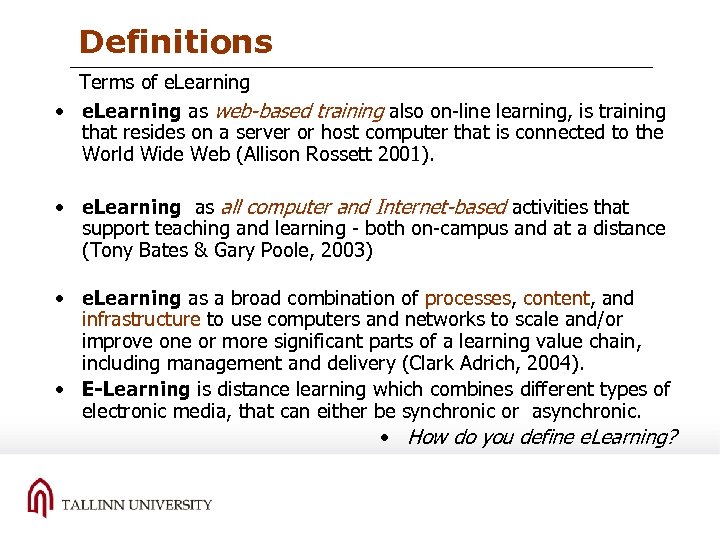 Definitions Terms of e. Learning • e. Learning as web-based training also on-line learning, is training that resides on a server or host computer that is connected to the World Wide Web (Allison Rossett 2001). • e. Learning as all computer and Internet-based activities that support teaching and learning - both on-campus and at a distance (Tony Bates & Gary Poole, 2003) • e. Learning as a broad combination of processes, content, and infrastructure to use computers and networks to scale and/or improve one or more significant parts of a learning value chain, including management and delivery (Clark Adrich, 2004). • E-Learning is distance learning which combines different types of electronic media, that can either be synchronic or asynchronic. • How do you define e. Learning?
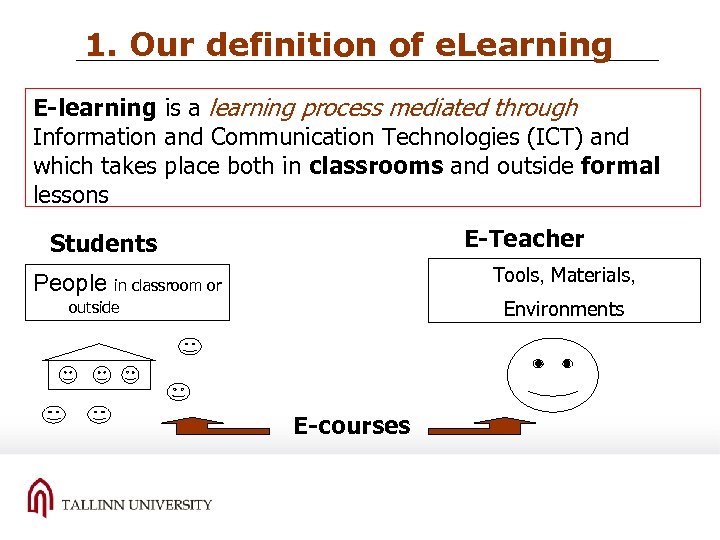 1. Our definition of e. Learning E-learning is a learning process mediated through Information and Communication Technologies (ICT) and which takes place both in classrooms and outside formal lessons E-Teacher Students Tools, Materials, People in classroom or Environments outside E-courses
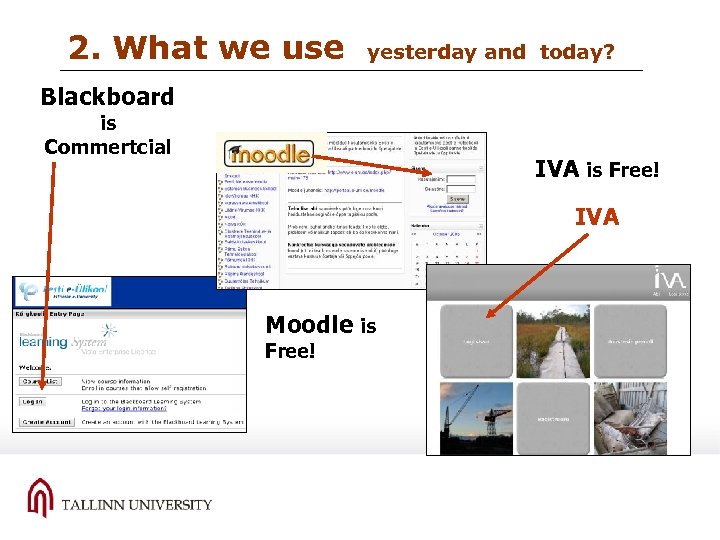 2. What we use yesterday and today? Blackboard is Commertcial IVA is Free! IVA Moodle is Free!
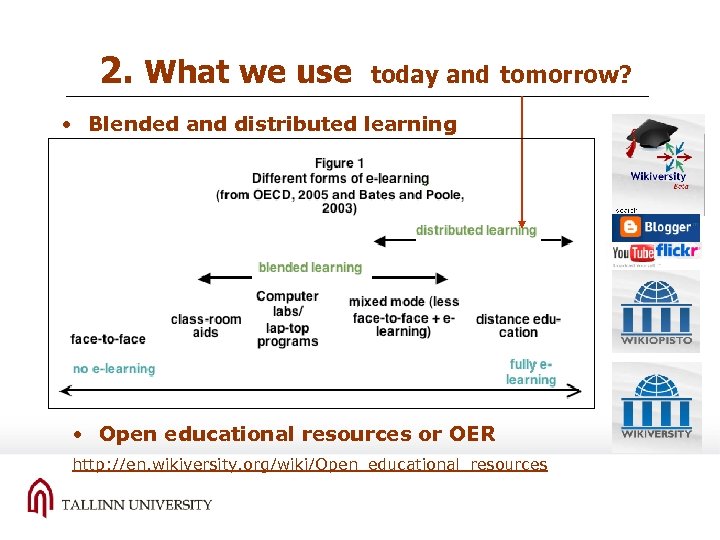 2. What we use today and tomorrow? • Blended and distributed learning • Open educational resources or OER http: //en. wikiversity. org/wiki/Open_educational_resources
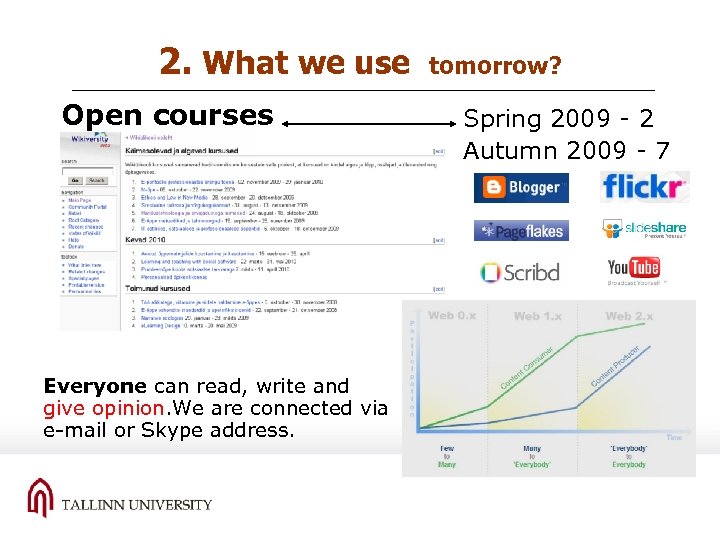 2. What we use Open courses Everyone can read, write and give opinion. We are connected via e-mail or Skype address. tomorrow? Spring 2009 - 2 Autumn 2009 - 7
 2. What we mean by e-Learning? Is that modern possibilities and a necessity? Information society offers an opportunity • To be flexible • To be independent – time – place – location • To be baldfaced • To be engaged in lifelong learning We know that and must be prepared, because our student are waiting for that!
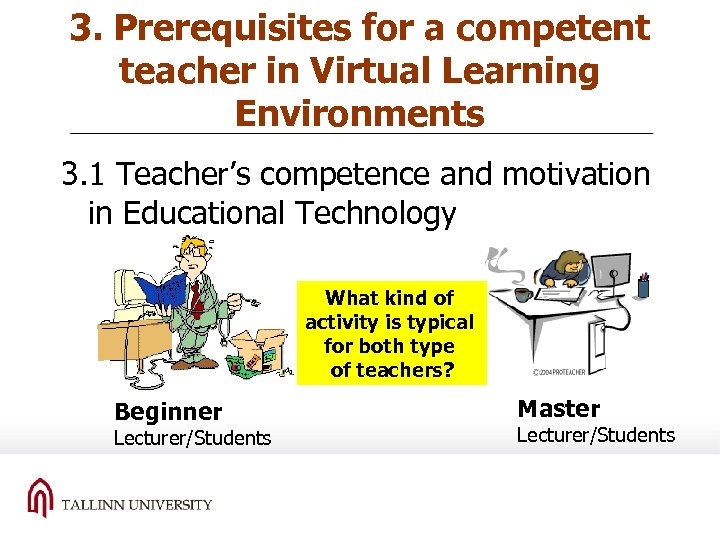 3. Prerequisites for a competent teacher in Virtual Learning Environments 3. 1 Teacher’s competence and motivation in Educational Technology What kind of activity is typical for both type of teachers? Beginner Lecturer/Students Master Lecturer/Students
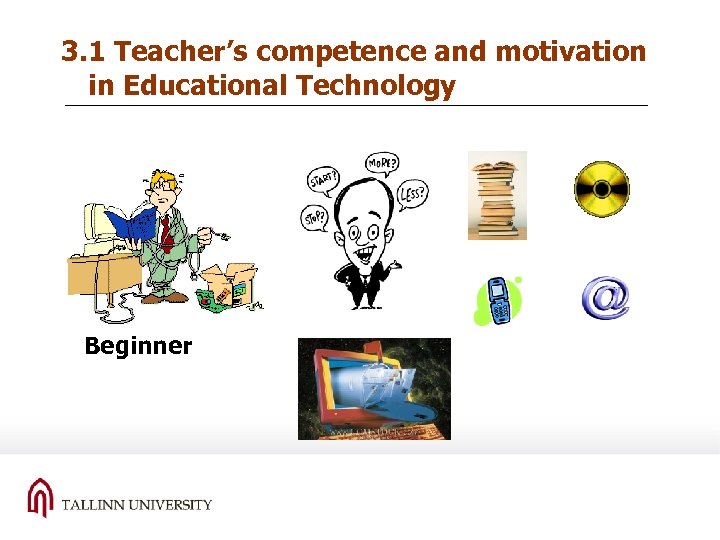 3. 1 Teacher’s competence and motivation in Educational Technology Beginner
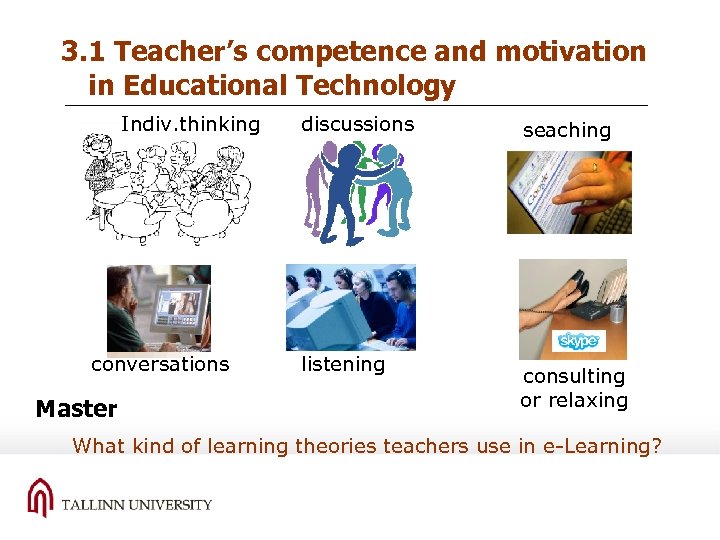 3. 1 Teacher’s competence and motivation in Educational Technology Indiv. thinking conversations Master discussions listening seaching consulting or relaxing What kind of learning theories teachers use in e-Learning?
 3. 2 Teacher as an activator of students • The lessons must be motivating (including sounds and videos, crosswords and pictures) • Teacher should choose average tempo which is appropriate for beginners as well as masters (students/learners) • Teacher must use variety of learning methods (individual -, pair - and groupwork etc)
 3. 3 A Teacher as a guide to ELearning and intermediator on international level • The teacher can promote the discussion between students and encourage their independent work to achieve a common aim (in blogs or forums) • The teacher looks for contacts in an international level to enrich e-learning and include foreigen students into elearning process
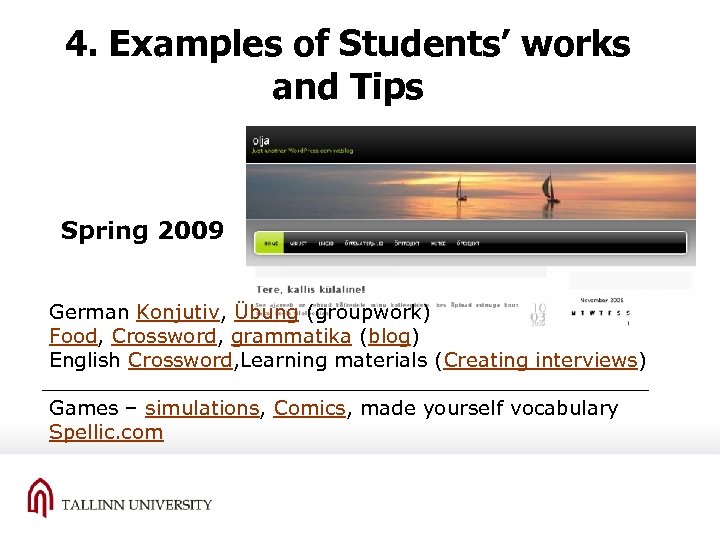 4. Examples of Students’ works and Tips Spring 2009 German Konjutiv, Übung (groupwork) Food, Crossword, grammatika (blog) English Crossword, Learning materials (Creating interviews) Games – simulations, Comics, made yourself vocabulary Spellic. com
 Conclusion: E-Learning can be Free and Open, but depends neverthless on the Teacher and the methods chosen by him/her, as well as the feedback! Thank You!