 Скачать презентацию E-infrastructure shared between Europe and Latin America Authorization
48bed1d2cd3f24c4faf608b7d5892add.ppt
- Количество слайдов: 37



E-infrastructure shared between Europe and Latin America Authorization and Authentication in g. Lite adapted from tutorial slides of Roberto Barbera Univ. of Catania and INFN, Italy www. eu-eela. org FP 6− 2004−Infrastructures− 6 -SSA-026409
Overview E-infrastructure shared between Europe and Latin America • Glossary • Encryption – Symmetric algorithms – Asymmetric algorithms: PKI • Certificates – Digital Signatures – X 509 certificates • Grid Security – Basic concepts – Grid Security Infrastructure – Proxy certificates – Command line interfaces • Virtual Organization – Concept of VO and authorization – VOMS, LCAS, LCMAPS FP 6− 2004−Infrastructures− 6 -SSA-026409 2
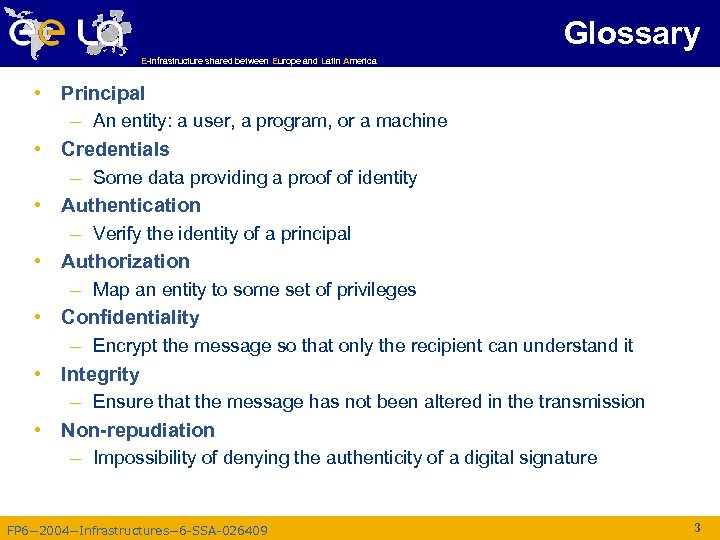
Glossary E-infrastructure shared between Europe and Latin America • Principal – An entity: a user, a program, or a machine • Credentials – Some data providing a proof of identity • Authentication – Verify the identity of a principal • Authorization – Map an entity to some set of privileges • Confidentiality – Encrypt the message so that only the recipient can understand it • Integrity – Ensure that the message has not been altered in the transmission • Non-repudiation – Impossibility of denying the authenticity of a digital signature FP 6− 2004−Infrastructures− 6 -SSA-026409 3
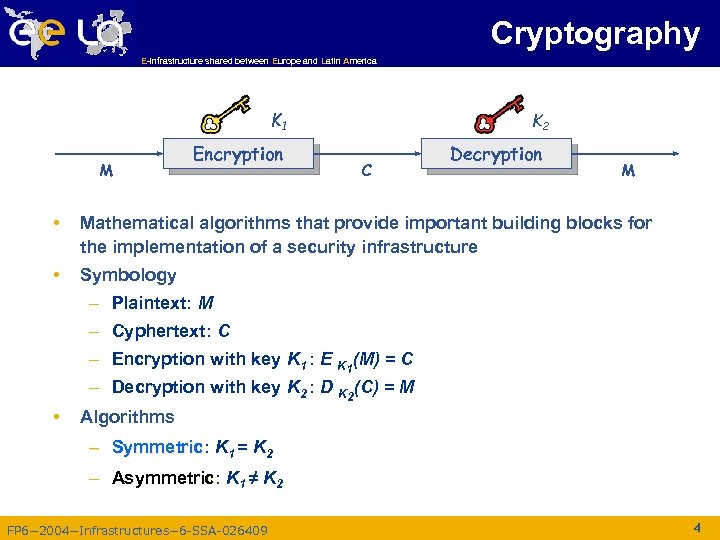
Cryptography E-infrastructure shared between Europe and Latin America K 1 M Encryption K 2 C Decryption M • Mathematical algorithms that provide important building blocks for the implementation of a security infrastructure • Symbology – Plaintext: M – Cyphertext: C – Encryption with key K 1 : E K 1(M) = C – Decryption with key K 2 : D K 2(C) = M • Algorithms – Symmetric: K 1 = K 2 Symmetric – Asymmetric: K 1 ≠ K 2 Asymmetric FP 6− 2004−Infrastructures− 6 -SSA-026409 4
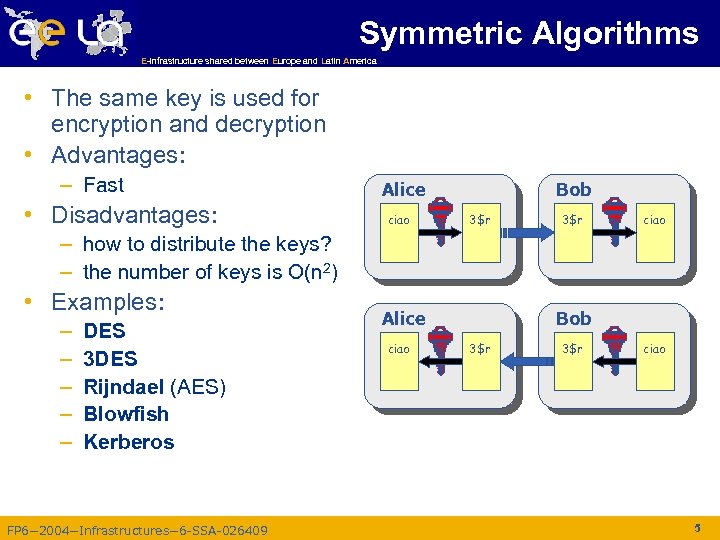
Symmetric Algorithms E-infrastructure shared between Europe and Latin America • The same key is used for encryption and decryption • Advantages: – Fast • Disadvantages: Alice ciao Bob 3$r ciao – how to distribute the keys? – the number of keys is O(n 2) • Examples: – – – DES 3 DES Rijndael (AES) Blowfish Kerberos FP 6− 2004−Infrastructures− 6 -SSA-026409 Alice ciao Bob 3$r ciao 5
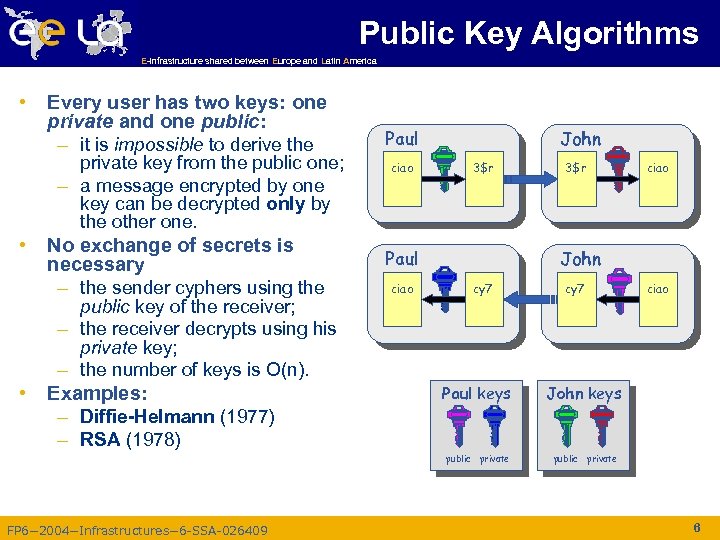
Public Key Algorithms E-infrastructure shared between Europe and Latin America • Every user has two keys: one private and one public: – it is impossible to derive the private key from the public one; – a message encrypted by one key can be decrypted only by the other one. • No exchange of secrets is necessary – the sender cyphers using the public key of the receiver; – the receiver decrypts using his private key; – the number of keys is O(n). Paul ciao John 3$r Paul ciao 3$r John cy 7 Examples: – Diffie-Helmann (1977) – RSA (1978) FP 6− 2004−Infrastructures− 6 -SSA-026409 Paul keys ciao John keys public private • ciao public private 6
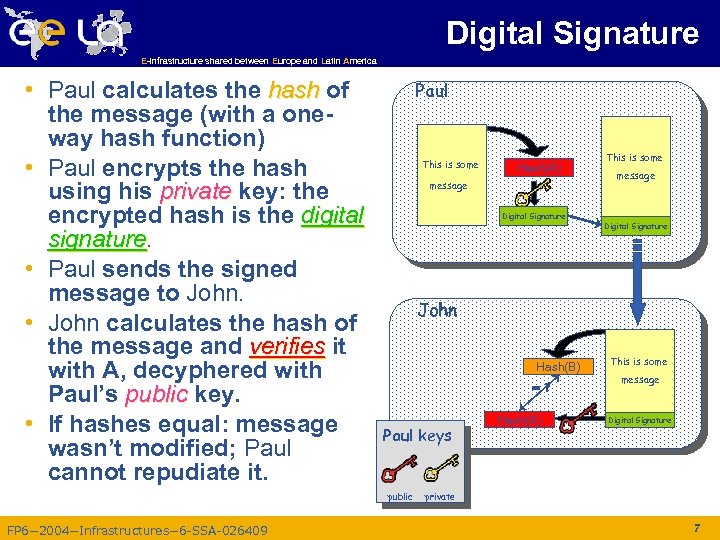
Digital Signature E-infrastructure shared between Europe and Latin America • Paul calculates the hash of the message (with a oneway hash function) • Paul encrypts the hash using his private key: the encrypted hash is the digital signature • Paul sends the signed message to John. • John calculates the hash of the message and verifies it with A, decyphered with Paul’s public key. • If hashes equal: message wasn’t modified; Paul cannot repudiate it. Paul This is some message Digital Signature John Hash(B) =? Paul keys public FP 6− 2004−Infrastructures− 6 -SSA-026409 Hash(A) This is some message Digital Signature private 7
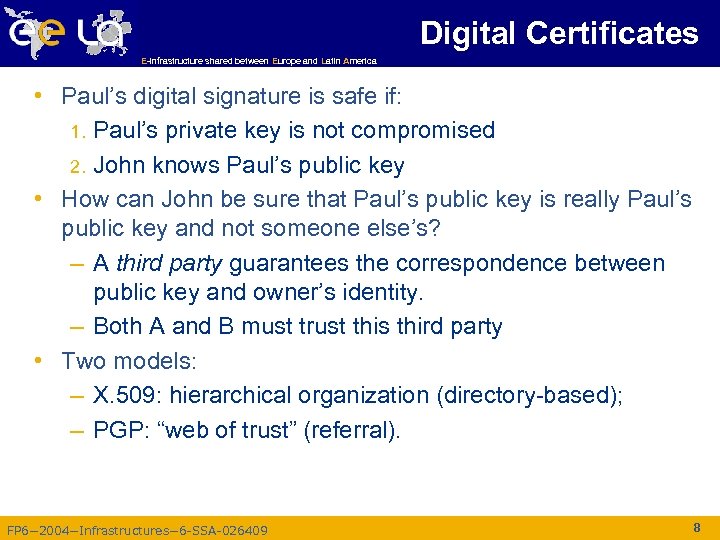
Digital Certificates E-infrastructure shared between Europe and Latin America • Paul’s digital signature is safe if: 1. Paul’s private key is not compromised 2. John knows Paul’s public key • How can John be sure that Paul’s public key is really Paul’s public key and not someone else’s? – A third party guarantees the correspondence between public key and owner’s identity. – Both A and B must trust this third party • Two models: – X. 509: hierarchical organization (directory-based); – PGP: “web of trust” (referral). FP 6− 2004−Infrastructures− 6 -SSA-026409 8
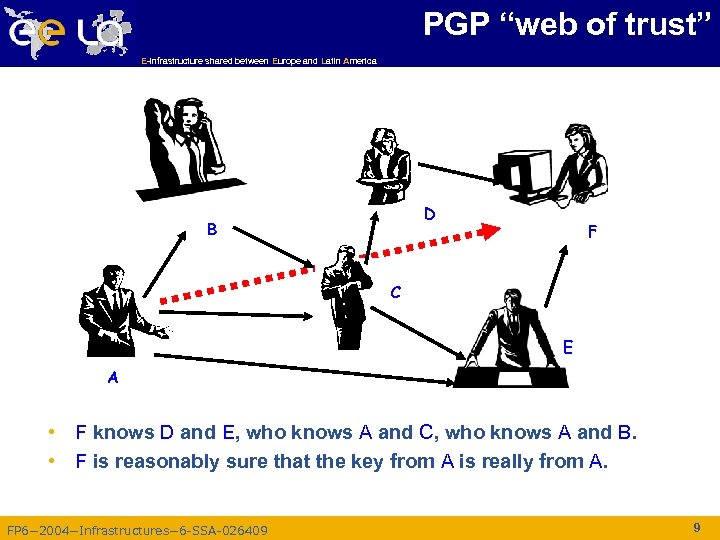
PGP “web of trust” E-infrastructure shared between Europe and Latin America D B F C E A • F knows D and E, who knows A and C, who knows A and B. • F is reasonably sure that the key from A is really from A. FP 6− 2004−Infrastructures− 6 -SSA-026409 9
X. 509 E-infrastructure shared between Europe and Latin America The “third party” is called Certification Authority (CA). • Issue Digital Certificates (containing public key and owner’s ( identity) for users, programs and machines (signed by the CA) • Check identity and the personal data of the requestor – Registration Authorities (RAs) do the actual validation • CA’s periodically publish a list of compromised certificates – Certificate Revocation Lists (CRL): contain all the revoked certificates yet to expire • CA certificates are self-signed FP 6− 2004−Infrastructures− 6 -SSA-026409 10
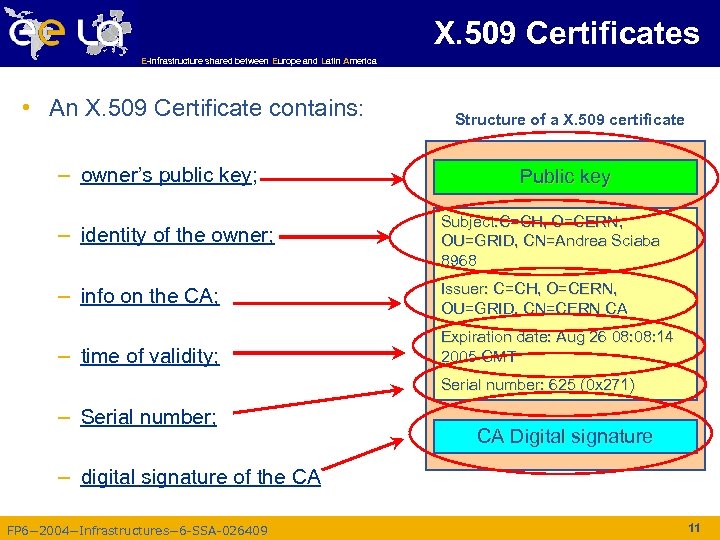
X. 509 Certificates E-infrastructure shared between Europe and Latin America • An X. 509 Certificate contains: – owner’s public key; Structure of a X. 509 certificate Public key – identity of the owner; Subject: C=CH, O=CERN, OU=GRID, CN=Andrea Sciaba 8968 – info on the CA; Issuer: C=CH, O=CERN, OU=GRID, CN=CERN CA – time of validity; Expiration date: Aug 26 08: 14 2005 GMT Serial number: 625 (0 x 271) – Serial number; CA Digital signature – digital signature of the CA FP 6− 2004−Infrastructures− 6 -SSA-026409 11
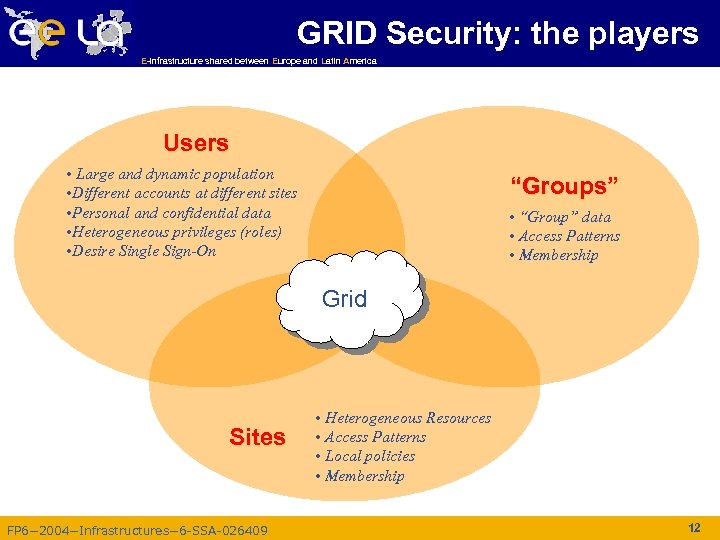
GRID Security: the players E-infrastructure shared between Europe and Latin America Users • Large and dynamic population • Different accounts at different sites • Personal and confidential data • Heterogeneous privileges (roles) • Desire Single Sign-On “Groups” • “Group” data • Access Patterns • Membership Grid Sites FP 6− 2004−Infrastructures− 6 -SSA-026409 • Heterogeneous Resources • Access Patterns • Local policies • Membership 12
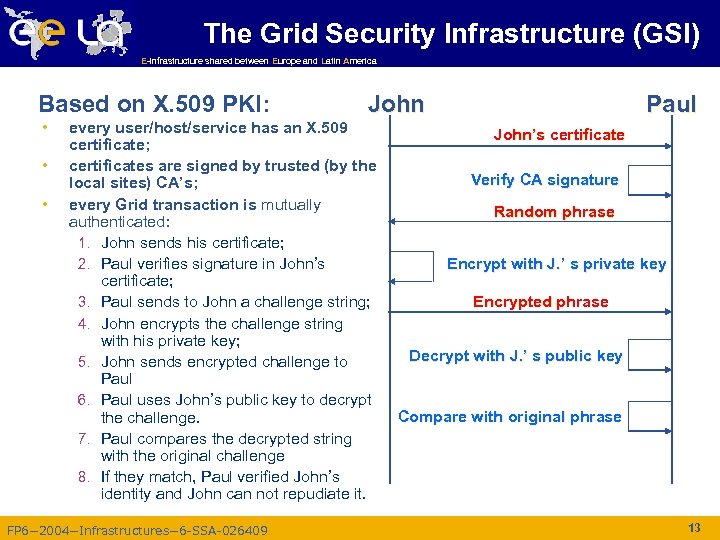
The Grid Security Infrastructure (GSI) E-infrastructure shared between Europe and Latin America Based on X. 509 PKI: • • • John every user/host/service has an X. 509 certificate; certificates are signed by trusted (by the local sites) CA’s; every Grid transaction is mutually authenticated: 1. John sends his certificate; 2. Paul verifies signature in John’s certificate; 3. Paul sends to John a challenge string; 4. John encrypts the challenge string with his private key; 5. John sends encrypted challenge to Paul 6. Paul uses John’s public key to decrypt the challenge. 7. Paul compares the decrypted string with the original challenge 8. If they match, Paul verified John’s identity and John can not repudiate it. FP 6− 2004−Infrastructures− 6 -SSA-026409 Paul John’s certificate Verify CA signature Random phrase Encrypt with J. ’ s private key Encrypted phrase Decrypt with J. ’ s public key Compare with original phrase 13
More on Authentication E-infrastructure shared between Europe and Latin America • In the grid world one single CA usually covers a predefined geographic region or administrative domain: – Organization – Country – A set of countries • A common trust domain for grid computing has been created to join the several existing certification authorities into a single authentication domain and thus enabling sharing of grid resources worldwide. – The International Grid Trust Federation (IGTF) has been created to coordinate and manage this trust domain. – IGTF is divided in three Policy Management Authorities (PMAs) covering the Asia Pacific, Europe and Americas. FP 6− 2004−Infrastructures− 6 -SSA-026409 14
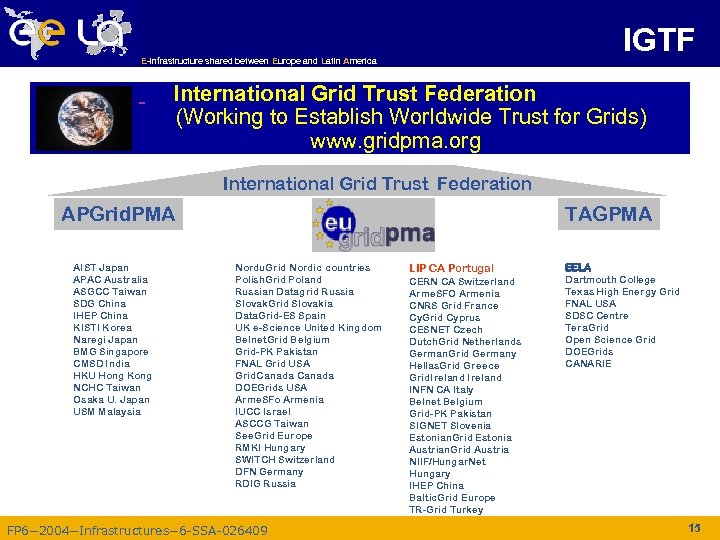
IGTF E-infrastructure shared between Europe and Latin America International Grid Trust Federation (Working to Establish Worldwide Trust for Grids) www. gridpma. org International Grid Trust Federation APGrid. PMA AIST Japan APAC Australia ASGCC Taiwan SDG China IHEP China KISTI Korea Naregi Japan BMG Singapore CMSD India HKU Hong Kong NCHC Taiwan Osaka U. Japan USM Malaysia TAGPMA Nordu. Grid Nordic countries Polish. Grid Poland Russian Datagrid Russia Slovak. Grid Slovakia Data. Grid-ES Spain UK e-Science United Kingdom Belnet. Grid Belgium Grid-PK Pakistan FNAL Grid USA Grid. Canada DOEGrids USA Arme. SFo Armenia IUCC Israel ASCCG Taiwan See. Grid Europe RMKI Hungary SWITCH Switzerland DFN Germany RDIG Russia FP 6− 2004−Infrastructures− 6 -SSA-026409 LIP CA Portugal CERN CA Switzerland Arme. SFO Armenia CNRS Grid France Cy. Grid Cyprus CESNET Czech Dutch. Grid Netherlands German. Grid Germany Hellas. Grid Greece Grid. Ireland INFN CA Italy Belnet Belgium Grid-PK Pakistan SIGNET Slovenia Estonian. Grid Estonia Austrian. Grid Austria NIIF/Hungar. Net Hungary IHEP China Baltic. Grid Europe TR-Grid Turkey EELA Dartmouth College Texas High Energy Grid FNAL USA SDSC Centre Tera. Grid Open Science Grid DOEGrids CANARIE 15
Classic Profile of CA E-infrastructure shared between Europe and Latin America • What is it: – The CA signs and revokes certificates – These are long-term certificates (one year) – The CA has subordinate RAs that just perform the administrative task of checking the subject identity in different organizations or departments • Advantages: – Is the most popular CA profile – A lot of know-how and solutions do exist – Most of the CAs operating today use the classic profile – Is the easiest to support across administrative domains – The profile requirements are stable and controlled by EUgrid. PMA FP 6− 2004−Infrastructures− 6 -SSA-026409 16
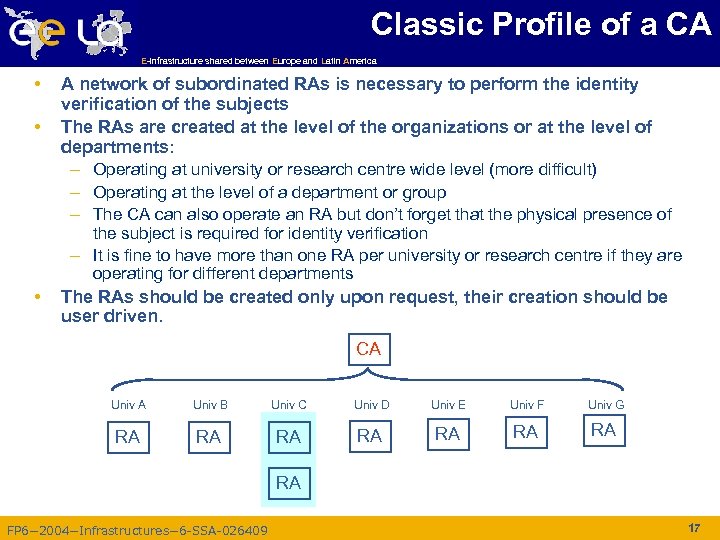
Classic Profile of a CA E-infrastructure shared between Europe and Latin America • • A network of subordinated RAs is necessary to perform the identity verification of the subjects The RAs are created at the level of the organizations or at the level of departments: – Operating at university or research centre wide level (more difficult) – Operating at the level of a department or group – The CA can also operate an RA but don’t forget that the physical presence of the subject is required for identity verification – It is fine to have more than one RA per university or research centre if they are operating for different departments • The RAs should be created only upon request, their creation should be user driven. CA Univ B Univ C Univ D Univ E Univ F Univ G RA RA FP 6− 2004−Infrastructures− 6 -SSA-026409 17
Revocation Lists E-infrastructure shared between Europe and Latin America • The CAs have the obligation of issuing Certificate Revocation Lists (CRL) • The CRLs contain: – a list of the revoked certificates – the date when they were issued – the end date • CRLs are signed with the CA private key • The CRLs must be published so that the relying parties can check the validity of the certificates – Usually available through the CA website FP 6− 2004−Infrastructures− 6 -SSA-026409 18
The Classic CA Profile E-infrastructure shared between Europe and Latin America • There should be a single Certification Authority (CA) organisation per country, large region or international organization. – Provide a short number of stable CAs • CAs must be operated as a long-term commitment – They should remain operational after the end of the project • A network of Registration Authorities (RA) for each CA is responsible for authentication of requests • The CA will handle the task of: – issuing CRLs – signing Certificates/CRLs – revoking Certificates FP 6− 2004−Infrastructures− 6 -SSA-026409 19
CA profile: Identity E-infrastructure shared between Europe and Latin America • Any single subject distinguished name (DN) must be linked to one and only one entity – DNs must be unique • Over the entire lifetime of the CA a DN must not be linked to any other entity • One entity can have more than one subject name for different key usages – One user can have more than one certificate – One server can have more than one certificate • Certificates must not be shared among end entities – A certificate cannot be shared with other users – CAs and RAs must immediately revoke these certificates when such a violation is detected FP 6− 2004−Infrastructures− 6 -SSA-026409 20
CA profile: CP/CPS Identification E-infrastructure shared between Europe and Latin America • Every CA must have a Certification Policy and Certificate Practice Statement • For new CAs the CP/CPS documents must be structured as defined in RFC 3647 (Request For Comments) – This is a new format. Most CP/CPS were written in RFC 2527 – Examples: § Pkiris. Grid § Austrian. Grid • Major CP/CPS changes must be: – announced to the accrediting PMA – approved before signing any certificates under the new CP/CPS • All the CP/CPS under which valid certificates are issued must be available on the web (many examples can be found at http: //www. eugridpma. org/members and http: //www. tagpma. org/members) FP 6− 2004−Infrastructures− 6 -SSA-026409 21
RA operations E-infrastructure shared between Europe and Latin America • • The operation of the RAs must be: – in accordance with the CA CP/CPS – defined in a document for each RA The RA operation in general: – Each RA must have one responsible person (manager) § A deputy is advisable – – – – – The manager can nominate one or more operators Both the manager and the operators can authorize requests All RA personnel must be trained in CA/RA operations and security The selection method of the personnel should be defined The CA must be informed officially of any change of RA personnel (eg: a letter signed and stamped) The first manager must be identified/authenticated by the CA in person Each RA should have a unique namespace (subject DN prefix) to avoid DN name collisions The community supported by the RA must be well defined The method used to identify subjects must be fully described including the enforcement of any additional requirements imposed by the CA or by the RA (eg. relation with an organization) FP 6− 2004−Infrastructures− 6 -SSA-026409 22
CA/RA namespaces E-infrastructure shared between Europe and Latin America • The namespace definition is of the responsibility of the CA however depending on this definition the RA can also be involved eg. (just an example based on the LIP CA namespace. . . ) – /C=PT/O=LIPCA/ § CA prefix should be unique across CAs – /C=PT/O=LIPCA/O=UP § The second /O= designates the organization of the subject and also the RA – /C=PT/O=LIPCA/O=UP/OU=FCUP § The /OU=FCUP in the LIP case is optional and can be used to identify a department within the organization § It is used to designate an RA within the organization when an organization has multiple RAs FP 6− 2004−Infrastructures− 6 -SSA-026409 23
CA/RA namespaces E-infrastructure shared between Europe and Latin America • About the CN and full DN: – /C=PT/O=LIPCA/O=UP/OU=FCUP/CN=Ines de Castro Dutra § each DN must be unique: § § § • Long enough to avoid collisions • Add something (number, . . . ) when duplications are found • Possibly using the person full name is the best option each DN must be bound to the same subject for the lifetime of the CA The CN must have a clear direct relation with the DN Don’t forget that the certificates are for grid computing, don’t create names (or extensions) that may create problems for the middleware Please don’t use accents Some characters may have special meanings for the applications (eg. The “-” character is recognized by globus as an wildcard) Some characters are not allowed (eg. “/” and “. ” in user certificates) FP 6− 2004−Infrastructures− 6 -SSA-026409 24
Renewal E-infrastructure shared between Europe and Latin America • Two types of renewals: – End entities certificate renewals – CA certificate renewals • End entities (EE): – The certificates maximum lifetime is 1 year + 1 month – The idea is that at the end of the year (12 th month) a new certificate is issued – Users (EE) should be warned about the coming expiration and the need to renew – Since the new certificate will be issued at the end of the 12 th month (or beginning of the 13 th) there will be an overlap of two certificates: § this is used to avoid a situation where the certificate will expire rendering the service or the user without grid access § don’t forget there are users submitting jobs that may take days or weeks § during this period there will be two certificates with the same DN – Don’t revoke a certificate to issue a new one unless the certificate has been compromised or the user has ceased his activity or liaison which entitles him to have a certificate FP 6− 2004−Infrastructures− 6 -SSA-026409 25
Renewal E-infrastructure shared between Europe and Latin America • End entities: – During a renewal it is not required to make the EE to pass through the identification procedure: § This is a big advantage for both the EE and the RA § However a maximum renewal number without identification is advisable (for instance: every two years the EE must pass through the identification again) § However the relation with the organization should still be performed (if this requirement is being used) – In order not to pass through the identification the renewal request must be signed with the user certificate, examples: § Email signed with user certificate § CA/RA Web interface that would identify the user certificate – If the user certificate expires before renewal the procedure for a new certificate must be followed FP 6− 2004−Infrastructures− 6 -SSA-026409 26
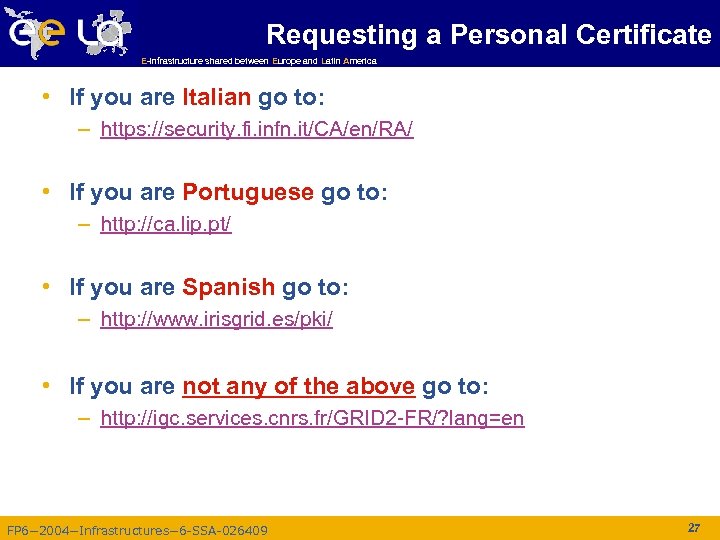
Requesting a Personal Certificate E-infrastructure shared between Europe and Latin America • If you are Italian go to: – https: //security. fi. infn. it/CA/en/RA/ • If you are Portuguese go to: – http: //ca. lip. pt/ • If you are Spanish go to: – http: //www. irisgrid. es/pki/ • If you are not any of the above go to: – http: //igc. services. cnrs. fr/GRID 2 -FR/? lang=en FP 6− 2004−Infrastructures− 6 -SSA-026409 27
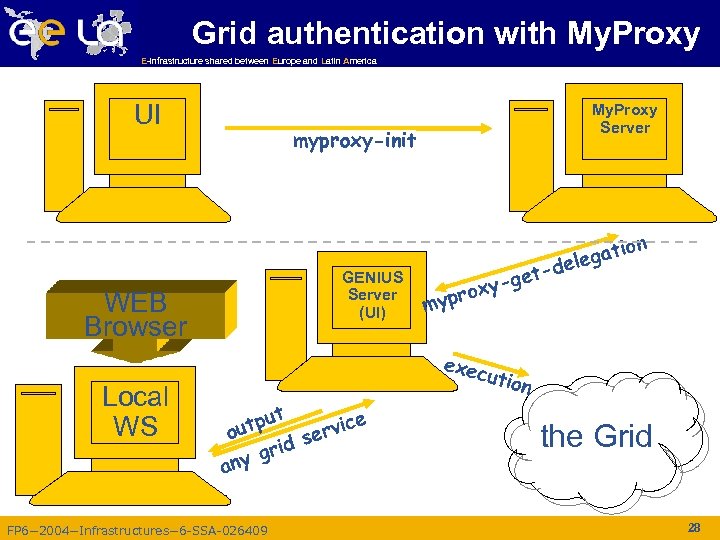
Grid authentication with My. Proxy E-infrastructure shared between Europe and Latin America UI myproxy-init GENIUS Server (UI) WEB Browser Local WS My. Proxy Server -get xy ypro m exec ut e utp rvic o e id s r ny g a FP 6− 2004−Infrastructures− 6 -SSA-026409 on d i egat el ution the Grid 28
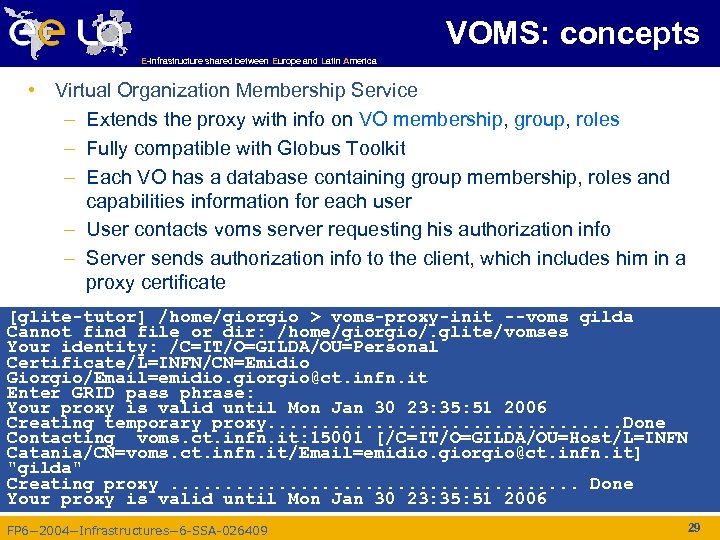
VOMS: concepts E-infrastructure shared between Europe and Latin America • Virtual Organization Membership Service – Extends the proxy with info on VO membership, group, roles – Fully compatible with Globus Toolkit – Each VO has a database containing group membership, roles and capabilities information for each user – User contacts voms server requesting his authorization info – Server sends authorization info to the client, which includes him in a proxy certificate [glite-tutor] /home/giorgio > voms-proxy-init --voms gilda Cannot find file or dir: /home/giorgio/. glite/vomses Your identity: /C=IT/O=GILDA/OU=Personal Certificate/L=INFN/CN=Emidio Giorgio/Email=emidio. giorgio@ct. infn. it Enter GRID pass phrase: Your proxy is valid until Mon Jan 30 23: 35: 51 2006 Creating temporary proxy. . . . Done Contacting voms. ct. infn. it: 15001 [/C=IT/O=GILDA/OU=Host/L=INFN Catania/CN=voms. ct. infn. it/Email=emidio. giorgio@ct. infn. it] "gilda" Creating proxy. . . . . Done Your proxy is valid until Mon Jan 30 23: 35: 51 2006 FP 6− 2004−Infrastructures− 6 -SSA-026409 29
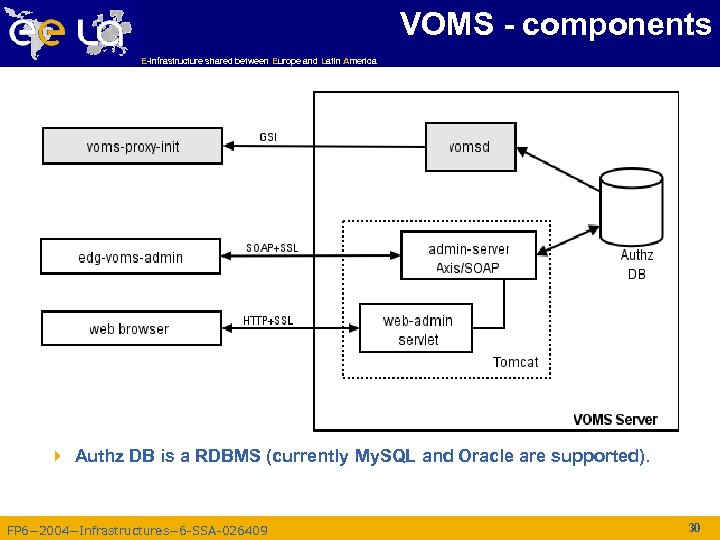
VOMS - components E-infrastructure shared between Europe and Latin America 4 Authz DB is a RDBMS (currently My. SQL and Oracle are supported). FP 6− 2004−Infrastructures− 6 -SSA-026409 30
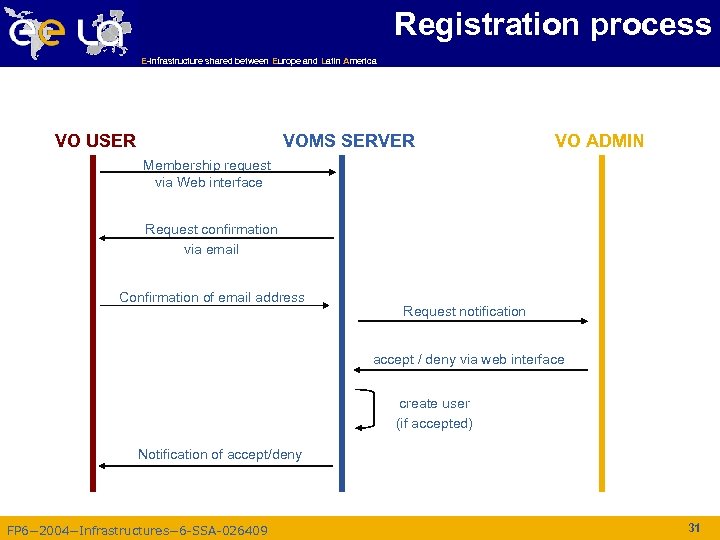
Registration process E-infrastructure shared between Europe and Latin America VO USER VOMS SERVER VO ADMIN Membership request via Web interface Request confirmation via email Confirmation of email address Request notification accept / deny via web interface create user (if accepted) Notification of accept/deny FP 6− 2004−Infrastructures− 6 -SSA-026409 31
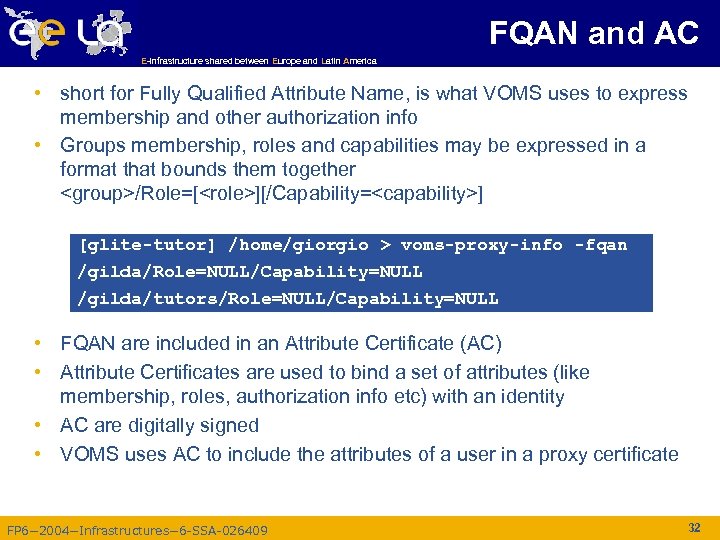
FQAN and AC E-infrastructure shared between Europe and Latin America FQAN and AC • short for Fully Qualified Attribute Name, is what VOMS uses to express membership and other authorization info • Groups membership, roles and capabilities may be expressed in a format that bounds them together <group>/Role=[<role>][/Capability=<capability>] [glite-tutor] /home/giorgio > voms-proxy-info -fqan /gilda/Role=NULL/Capability=NULL /gilda/tutors/Role=NULL/Capability=NULL • FQAN are included in an Attribute Certificate (AC) • Attribute Certificates are used to bind a set of attributes (like membership, roles, authorization info etc) with an identity • AC are digitally signed • VOMS uses AC to include the attributes of a user in a proxy certificate FP 6− 2004−Infrastructures− 6 -SSA-026409 32
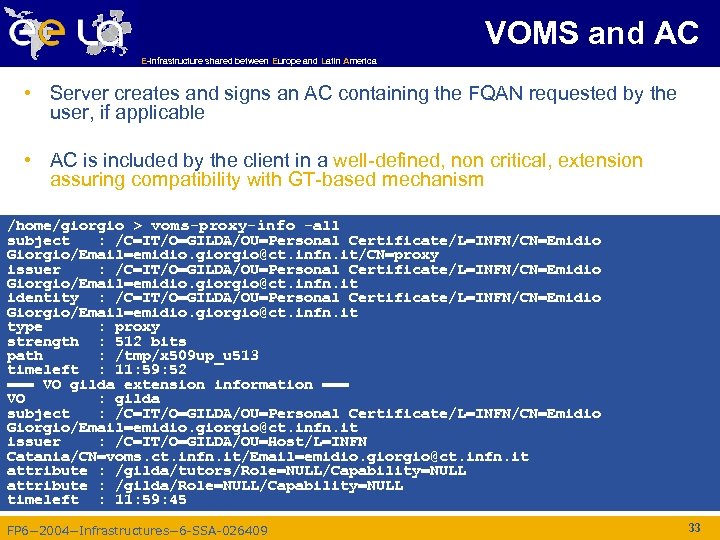
VOMS and AC E-infrastructure shared between Europe and Latin America VOMS and AC • Server creates and signs an AC containing the FQAN requested by the user, if applicable • AC is included by the client in a well-defined, non critical, extension assuring compatibility with GT-based mechanism /home/giorgio > voms-proxy-info -all subject : /C=IT/O=GILDA/OU=Personal Certificate/L=INFN/CN=Emidio Giorgio/Email=emidio. giorgio@ct. infn. it/CN=proxy issuer : /C=IT/O=GILDA/OU=Personal Certificate/L=INFN/CN=Emidio Giorgio/Email=emidio. giorgio@ct. infn. it identity : /C=IT/O=GILDA/OU=Personal Certificate/L=INFN/CN=Emidio Giorgio/Email=emidio. giorgio@ct. infn. it type : proxy strength : 512 bits path : /tmp/x 509 up_u 513 timeleft : 11: 59: 52 === VO gilda extension information === VO : gilda subject : /C=IT/O=GILDA/OU=Personal Certificate/L=INFN/CN=Emidio Giorgio/Email=emidio. giorgio@ct. infn. it issuer : /C=IT/O=GILDA/OU=Host/L=INFN Catania/CN=voms. ct. infn. it/Email=emidio. giorgio@ct. infn. it attribute : /gilda/tutors/Role=NULL/Capability=NULL attribute : /gilda/Role=NULL/Capability=NULL timeleft : 11: 59: 45 FP 6− 2004−Infrastructures− 6 -SSA-026409 33
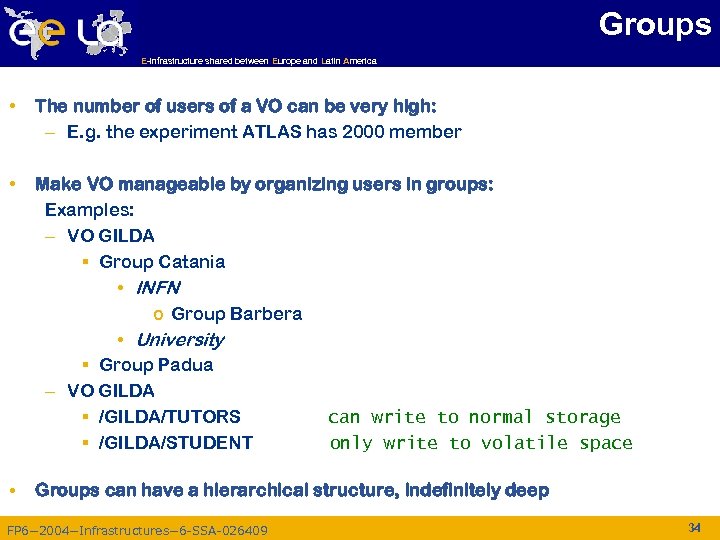
Groups E-infrastructure shared between Europe and Latin America • The number of users of a VO can be very high: – E. g. the experiment ATLAS has 2000 member • Make VO manageable by organizing users in groups: Examples: – VO GILDA § Group Catania • INFN o Group Barbera • University § Group Padua – VO GILDA § /GILDA/TUTORS can write to normal storage § /GILDA/STUDENT only write to volatile space • Groups can have a hierarchical structure, indefinitely deep FP 6− 2004−Infrastructures− 6 -SSA-026409 34
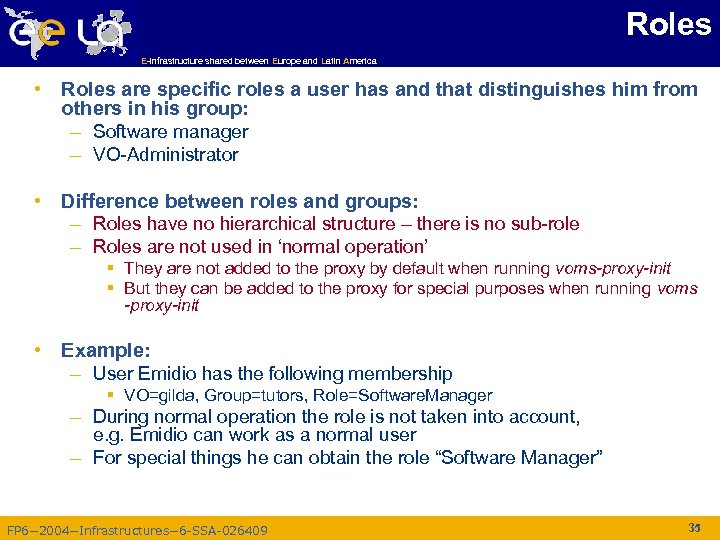
Roles E-infrastructure shared between Europe and Latin America • Roles are specific roles a user has and that distinguishes him from others in his group: – Software manager – VO-Administrator • Difference between roles and groups: – Roles have no hierarchical structure – there is no sub-role – Roles are not used in ‘normal operation’ § They are not added to the proxy by default when running voms-proxy-init § But they can be added to the proxy for special purposes when running voms -proxy-init • Example: – User Emidio has the following membership § VO=gilda, Group=tutors, Role=Software. Manager – During normal operation the role is not taken into account, e. g. Emidio can work as a normal user – For special things he can obtain the role “Software Manager” FP 6− 2004−Infrastructures− 6 -SSA-026409 35
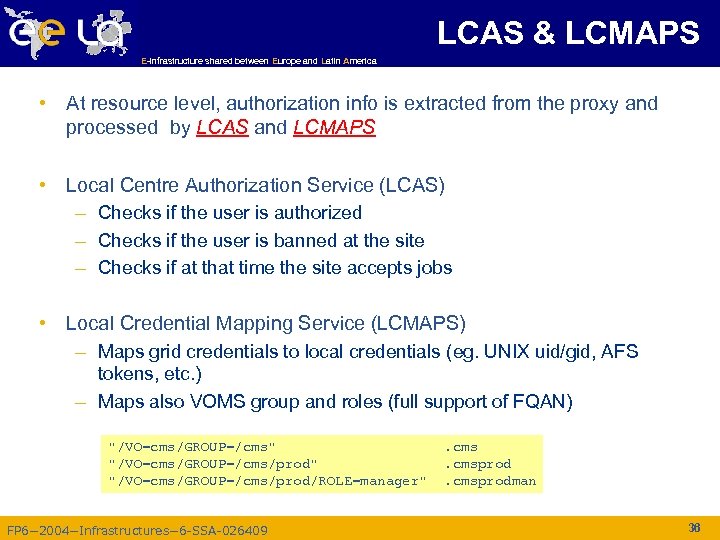
LCAS & LCMAPS E-infrastructure shared between Europe and Latin America LCAS & LCMAPS • At resource level, authorization info is extracted from the proxy and processed by LCAS and LCMAPS • Local Centre Authorization Service (LCAS) – Checks if the user is authorized – Checks if the user is banned at the site – Checks if at that time the site accepts jobs • Local Credential Mapping Service (LCMAPS) – Maps grid credentials to local credentials (eg. UNIX uid/gid, AFS tokens, etc. ) – Maps also VOMS group and roles (full support of FQAN) "/VO=cms/GROUP=/cms" "/VO=cms/GROUP=/cms/prod/ROLE=manager" FP 6− 2004−Infrastructures− 6 -SSA-026409 . cmsprodman 36
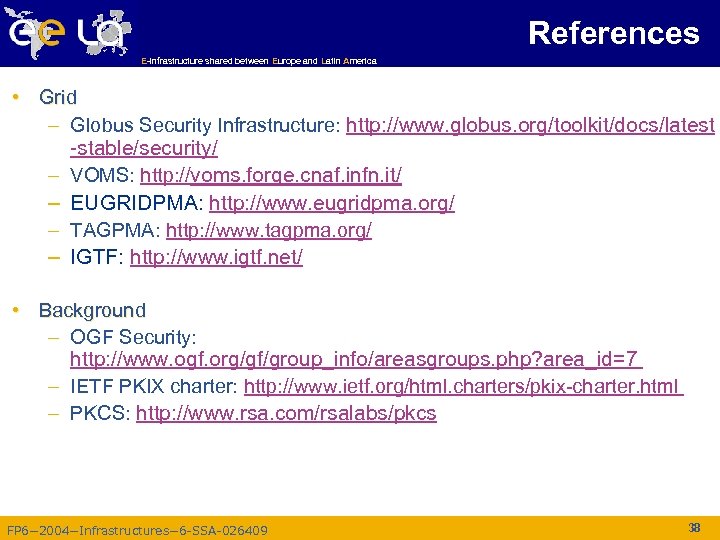
References E-infrastructure shared between Europe and Latin America • Grid – Globus Security Infrastructure: http: //www. globus. org/toolkit/docs/latest -stable/security/ – VOMS: http: //voms. forge. cnaf. infn. it/ – EUGRIDPMA: http: //www. eugridpma. org/ – TAGPMA: http: //www. tagpma. org/ – IGTF: http: //www. igtf. net/ • Background – OGF Security: http: //www. ogf. org/gf/group_info/areasgroups. php? area_id=7 – IETF PKIX charter: http: //www. ietf. org/html. charters/pkix-charter. html – PKCS: http: //www. rsa. com/rsalabs/pkcs FP 6− 2004−Infrastructures− 6 -SSA-026409 38
Скачать презентацию E-infrastructure shared between Europe and Latin America Authorization
48bed1d2cd3f24c4faf608b7d5892add.ppt