



 E IAL UR OC UT G S E F IN TH OT NG OM DI PR IL U B R BY ! E AP TH Y” LE GE LIT “ O BI T O M
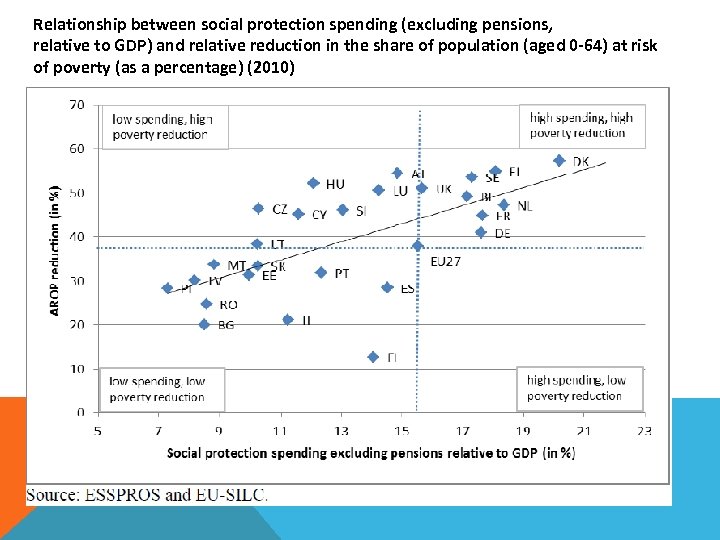 Relationship between social protection spending (excluding pensions, relative to GDP) and relative reduction in the share of population (aged 0 -64) at risk of poverty (as a percentage) (2010)
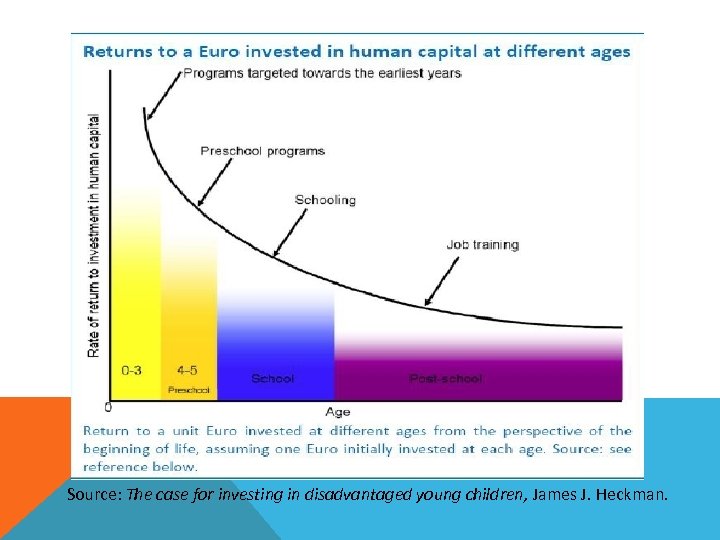 Source: The case for investing in disadvantaged young children, James J. Heckman.
 OBJECTIVES OF LEAP (1) a. Strengthening the Voluntary Sector to foster their role of valid partners of the State in the delivery of social service b. Building Sustainable Communities by reinforcing and improving the quality of services delivered to the community at community level c. Networking the Social Welfare Sector (public, private and social actors) to create synergies and get more efficiency and effectiveness for the system 5
 OBJECTIVES OF LEAP (2) d. Poverty prevention of people threatened by poverty by promoting the development of their social capability of integration e. Support the process of bridging school-labour market for young graduates by qualifying them as socialmentors f. Enabling models of development through Social Policy Reform by accomplishing points a to f g. Promote exchange and peer learning through transnational activities 6
 EXPECTED RESULTS (1) - The setting up of 5 regional social networks (4 in Malta and 1 in Gozo) and local networks (to define according to the needs defined by the regional networks) - A National Anti-Poverty Strategy for 10 years - At least 90 NGOs participating in the social local and regional networks (of 250 NGOs considered social service providers) - At least 520 (from NGOs and professionals of other organisations namely FSWS) persons involved in capacity building 7
 EXPECTED RESULTS (2) - Qualification of 30 persons as social mentors - Contribution to the establishment of a Statistical data pertaining to persons with disability which will then be used for policy incentive measures - At least 20 NGOs will enhance their organisation’s strategic action plan - At least 200 social benefits receivers will be supported by the NGOs placement programme (receiving a complement of income) and the respective social mentoring programme aiming to integrate them in further personal development schemes (i. e. training, education, work) - 8
 EXPECTED RESULTS (3) - A Cooperation agreement will be established between the MFSS and ISS. - A report about the impact of the social investment package in Malta will be produced as a result of the International conference, in which this thematic will be the core of it. - A raising awareness campaign involving the target groups in the project and comprising the organisation of at least 3 round tables. - A final international conference with 200 participants 9
 PARTNERS (1) - MALTA Ministry for Family and Social Solidarity – promoter Ministry for Social Dialogue, Consumer Affairs and Civil Liberties (including MEUSAC, MCVS, and MCESD) Ministry for Gozo Ministry for Tourism (including DLG) Ministry for Education and Employment (including MCAST, ETC, FES, FTS, AZ, Uo. M and NCHE) Malta Business Foundation 10
 PARTNERS (2) - PORTUGAL Institute of Social Security of Portugal (public institute responsible for the implementation of the social policies (Ministry of Labour and Social Solidarity) Employers Association of Viana do Castelo Municipality of Viana do Castelo (public local administration ) ISCTE (University of Lisbon) CRPG – Vocational Rehabilitation Centre of Gaia (developer of the Quality of Life – a strategy for Portugal in the field of people with disabilities) 11
 PARTNERS (3) – OTHER EU COUNTRIES Main. Arbeit – Job Centre Offenbach (in Germany at local level the local employment center and municipal social centers were put together to deliver integrated and holistic services to the community of the people receiving social benefits) POBAL (public organization in Ireland responsible for the management and coordination of the public Programmes related with community development. In this role it is the coordinator of the 52 regional partnerships of Ireland) 12
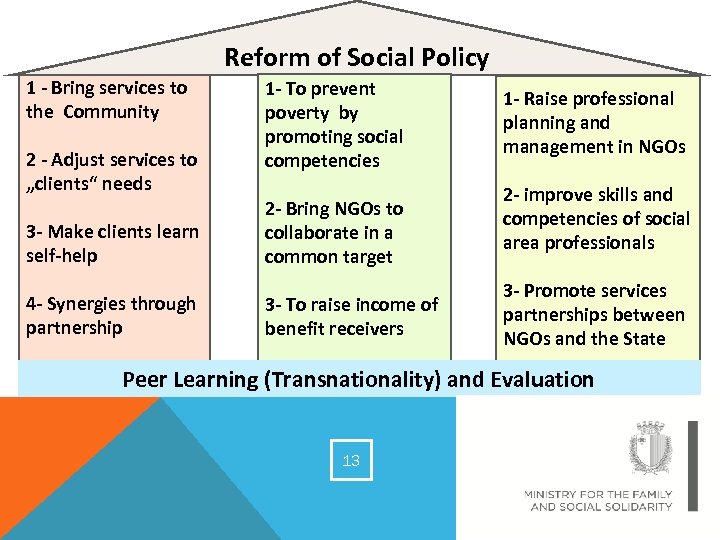 Reform of Social Policy 1 - Bring services to the Community 2 - Adjust services to „clients“ needs 1 - To prevent poverty by promoting social competencies 3 - Make clients learn self-help 2 - Bring NGOs to collaborate in a common target 4 - Synergies through partnership 3 - To raise income of benefit receivers 1 - Raise professional planning and management in NGOs 2 - improve skills and competencies of social area professionals 3 - Promote services partnerships between NGOs and the State Peer Learning (Transnationality) and Evaluation 13
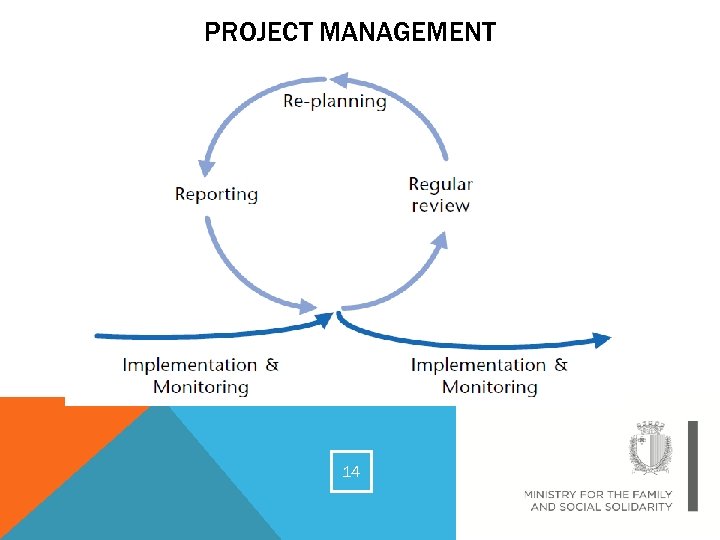 PROJECT MANAGEMENT 14
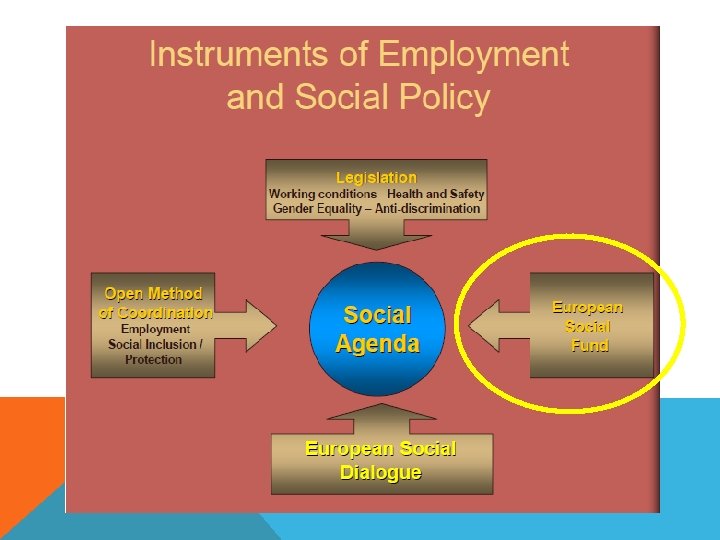
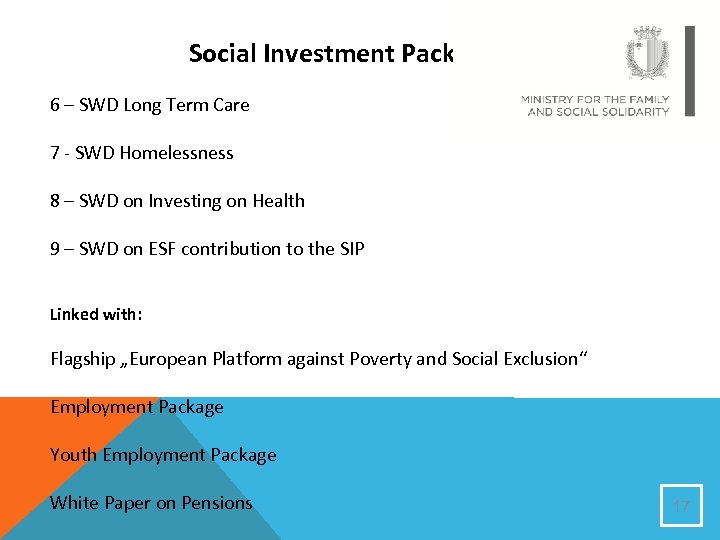
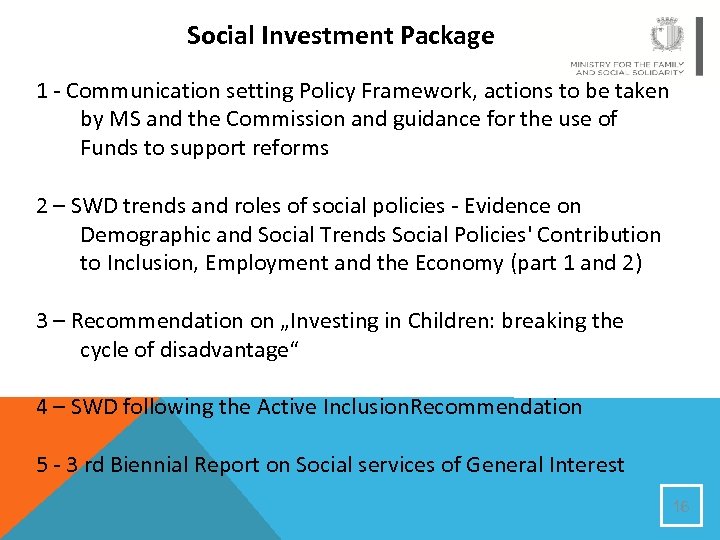 Social Investment Package 1 - Communication setting Policy Framework, actions to be taken by MS and the Commission and guidance for the use of Funds to support reforms 2 – SWD trends and roles of social policies - Evidence on Demographic and Social Trends Social Policies' Contribution to Inclusion, Employment and the Economy (part 1 and 2) 3 – Recommendation on „Investing in Children: breaking the cycle of disadvantage“ 4 – SWD following the Active Inclusion. Recommendation 5 - 3 rd Biennial Report on Social services of General Interest 16
 Social Investment Package 6 – SWD Long Term Care 7 - SWD Homelessness 8 – SWD on Investing on Health 9 – SWD on ESF contribution to the SIP Linked with: Flagship „European Platform against Poverty and Social Exclusion“ Employment Package Youth Employment Package White Paper on Pensions 17
 18
18
 19
19
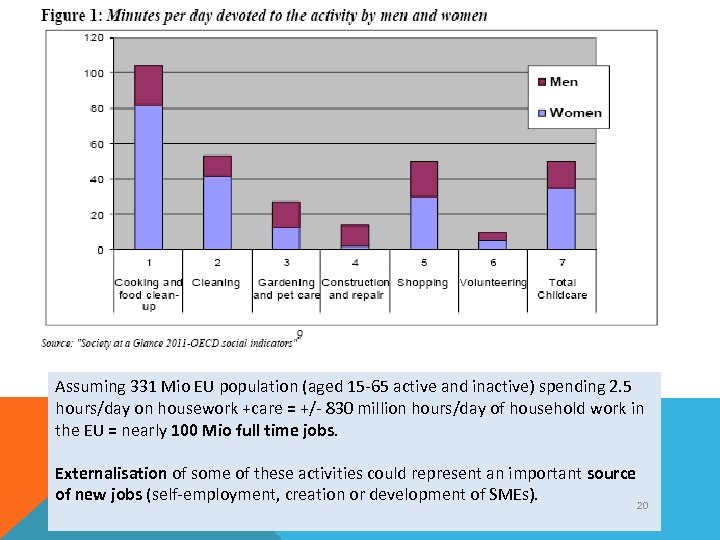 Assuming 331 Mio EU population (aged 15 -65 active and inactive) spending 2. 5 hours/day on housework +care = +/- 830 million hours/day of household work in the EU = nearly 100 Mio full time jobs. Externalisation of some of these activities could represent an important source of new jobs (self-employment, creation or development of SMEs). 20
 THANK YOU! MARIA JOAO RAUCH