



 E how N G L I S H to teach
 Lecture 5 CHER TEA IONS VENT 1 NTER I For 2 nd year masters 2 3
 INTERVENTIONS The things the teacher does or says -central to the creation of the learning environment -small or large -pre-planned or spontaneous -need to be purposeful and effective
 1. Being supportive ation stone to e crucial found Th u do in class everything yo
 Techniques: showing support – make eye aying attention 1/ p contact You have to feel it not role play. Beware of overdoing it
 Techniques: showing support imple, clear, and validate – s 2/ affirm ing comment affirm Be very concise, one short sentence is best. You could start: I really like the way……
 Techniques: showing support espond to a specific – r 3/ be with general t’s work not studen ing specific aise but stat bland pr things you could start: I noticed that you….
 Techniques: showing support ttery – offer pport not fla 4/ su nuine support ge Be careful that what you offer is not unrealistic flattery or vague praise
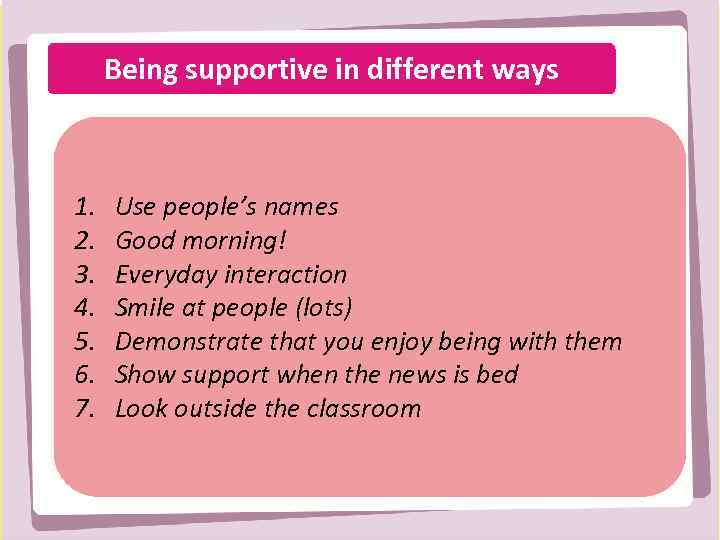 You are a teacher with a Being supportive in different ways multicultural class and there a number of names difficult to say 1. 2. 3. 4. 5. 6. 7. 1 2 Use people’s names Good morning! • Ask to say the na me again Everyday interaction • Ask detailed ques tions about the Smile at people (lots) Demonstrate that pronuncibeing with them you enjoy ation • Tal when about bed Show supportk a bitthe newstise mea h ning • s t classroom Look outside. Ithehere a short v ersion? THE LEARNERS 3
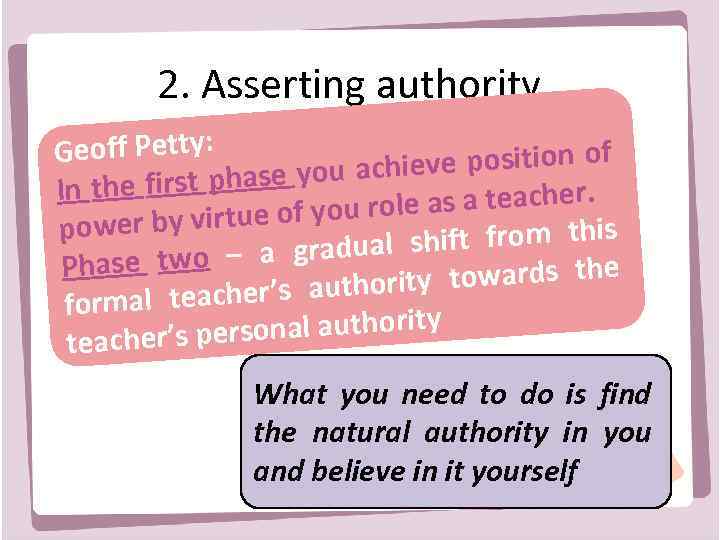 2. Asserting authority Geoff Petty: eve position of st phase you achi In the fir le as a teacher. y virtue of you ro power b hift from this o – a gradual s Phase tw ity towards the teacher’s author formal ersonal authority teacher’s p What you need to do is find the natural authority in you and believe in it yourself
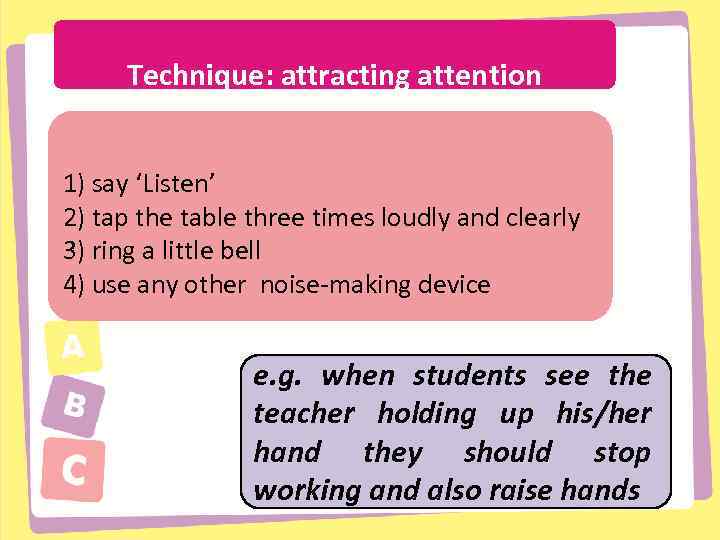 Technique: attracting attention THE OPPOSITE COWLEY SUE 1) say ‘Listen’ 2) tap the table three times loudly and clearly Remember that how you feel inside does 3) ring a little bell not any other noise-making device 4) usematter… Your aim is to develop an air of confidence, self-control and a mastery of everything that happens in your classroom. e. g. when students see the teacher holding up his/her hand they should stop working and also raise hands
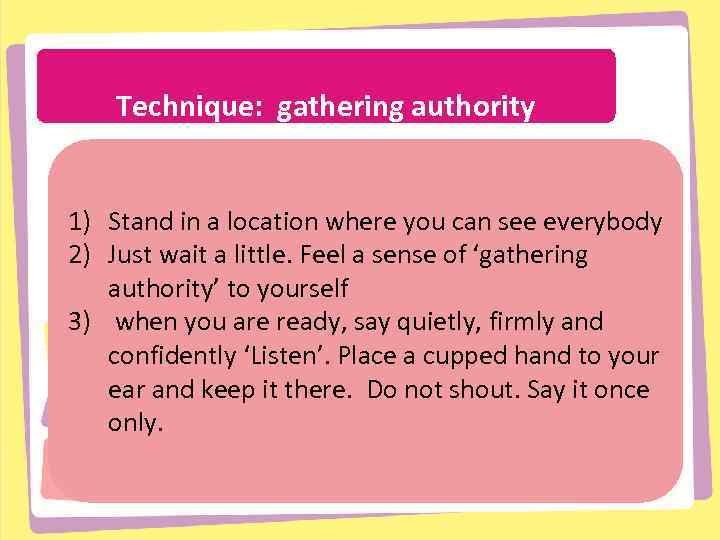 Technique: gathering authority THE OPPOSITE COWLEY SUE 1) Stand in a location where you caninside does Remember that how you feel see everybody 2) Just wait a little. Feel a sense of ‘gathering not matter… Your aim is to develop an air authority’ to yourself of when you are ready, say quietly, mastery 3) confidence, self-control and afirmly and of everything that happens a cuppedclassroom. confidently ‘Listen’. Place in your hand to your ear and keep it there. Do not shout. Say it once only.
 Technique: gathering authority THE OPPOSITE COWLEYDon’t look anxious, SUE calm waiting. 4) return to your Remember that how you feel inside does angry or impatient. 5) it’smatter… Your aim is to develop andown not wonderful when a whole class quietens air from just one ‘Listen’ but don’t a mastery of confidence, self-control andworry if it of doesn’t. Gather authority in your classroom. everything that happens to yourself and say ‘Listen’ again 6) associate a specific place with orders or instructions
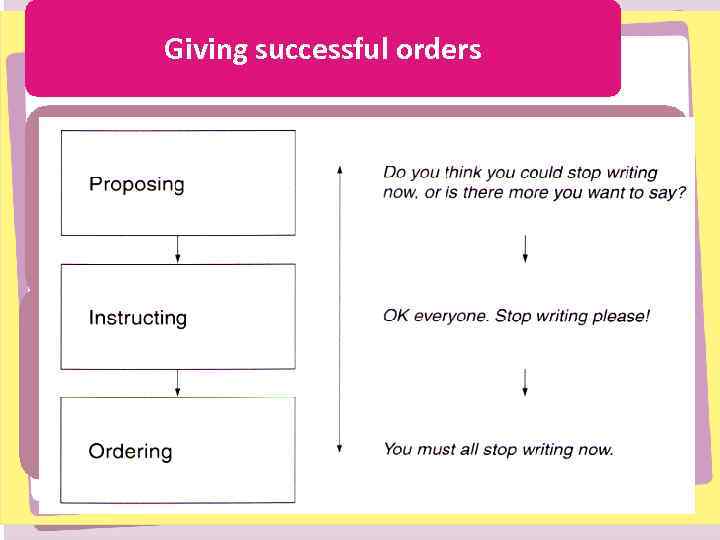 Giving successful orders Helping the group to work together THE OPPOSITE COWLEY SUE Remember that how you feel inside does not matter… Your aim is to develop an air of confidence, self-control and a mastery of everything that happens in your classroom.
 Picture two students who are chatting and laughing in the middle of the classroom while you are trying to explain a piece of grammar, ignoring requests to be quiet. What can you do?
 To give successful orders 1) Don’t speak when angry or irritated 2) You need to get attention. Say ‘Listen’ or the names of the people you want to give the order to 3) Make steady eye contact with the person you want to talk to 4)QUICK FIXES it’s absolutely necessary to be Don’t shout unless TO CHANGE THE heard CLASS MOOD 5) The first time you speak, speak slightly quieter than normal
 To give successful orders 6) Find a firm, matter-of-fact, down-to-earth voice tone 7) Speak slowly 8) Keep what you say brief and to the point 9) Add ‘please’ if you are able to say it honestly QUICK FIXES TO CHANGE THE 10) Avoid ridicule or sarcasm CLASS MOOD 11) Point out how their behaviour is causing a problem for others
 To give successful orders 12) Keep to the current event, avoiding generalizations or statements about other occasions when similar things happened 13) basic order uses an imperative ‘Do this!’ ‘Stop talking!’ ‘Come over here!’ QUICK FIXES TO CHANGE THE 14) To strengthen an order or make it sound CLASS MOOD more formal use modal verbs, e. g. ‘You must stop talking now’, ‘You have to come over here right now’
 3. Giving instructions THE OPPOSITE The times when you give instructions are LE lesson COWany. Y critical moments in SUE Remember that how you feel inside does not matter… Your aim is to develop an air of confidence, self-control andanmastery of Remember: for a instruction everything that happens in youryou will first to be understood, classroom. need to make sure that students are listening to you and paying attention
 TECHNIQUES: GIVING INSTRUCTIONS TO LOWER-LEVEL CLASSES 1. 2. 3. Use Grammar and vocabulary that is at or below the learners’ current level Use short sentences. Don’t put more than one instruction in one sentence. Speak a little more slowly and clearly than you would normally do.
 TECHNIQUES: GIVING INSTRUCTIONS TO LOWER-LEVEL CLASSES 4. 5. 6. Pause after each instruction. Sequence the instructions and use signposting language, e. g. ‘First…. ’, ‘Then…. ’, Finally…. ’ Write a few key words on the board as you speak.
 TECHNIQUES: GIVING INSTRUCTIONS TO LOWER-LEVEL CLASSES 7. It’s often worth checking if an instruction has been understood. Rather than asking ‘Do you understand? ’ ask a question that checks if they caught specific points, e. g. ‘How many questions are you going to answer? ’
 TECHNIQUES: GIVING INSTRUCTIONS TO LOWER-LEVEL CLASSES 8. Don’t let students start doing the task before you have finished giving and checking instructions with the whole class.
 RECOGNIZING ELEMENTS OF AN INSTRUCTION 1. A frame – a way of indicating that the last activity has finished and a new activity is about to begin. Scott Thornbury categorizes a number of possible features of an instruction. Any single instruction could contain all – or more likely some – of these elements
 RECOGNIZING ELEMENTS Perception: concrete – abstract OF AN INSTRUCTION 2. A brief summary of the task and its purpose – such as ‘We are going to play a game to practice asking questions’
 RECOGNIZING ELEMENTS Perception: concrete – abstract OF AN INSTRUCTION 3. The organization – whether the task is going to be done in pairs, groups or individually 4. The procedure – what it is that the learners actually will be doing – such as filling in a questionnaire or rehearsing a dialogue
 RECOGNIZING ELEMENTS Perception: concrete – abstract OF AN INSTRUCTION 5. The mode – whether it is a speaking or a writing task 6. The outcome – what they will be required to do as a result of the task, e. g. report their results to the class, perform the dialogue etc.
 RECOGNIZING ELEMENTS Perception: concrete – abstract OF AN INSTRUCTION 7. A strategy – to adopt in order to facilitate the task, as when the teacher tells learners just to skim a text initially before reading it intensively 8. The timing – how long the learners have to complete the task 9. A cue – such as ‘OK, you can start’ so that learners know when to begin the task
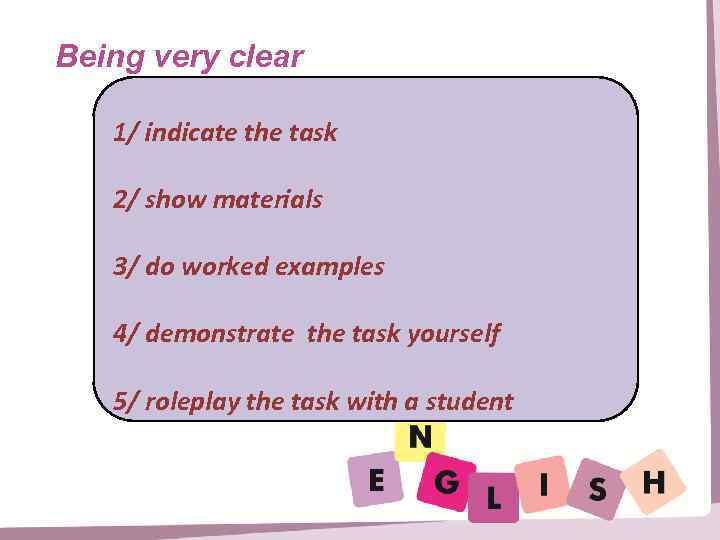 Perception: concrete – abstract Being very clear 1/ indicate the task 2/ show materials 3/ do worked examples 4/ demonstrate the task yourself 5/ roleplay the task with a student
 You are a teacher with a Making up for bad instructions multicultural class and 1 there a number of 2 1. Monitor for potential problems names difficult unobtrusively listening in to 3 Wander around, to say speaking tasks or reading what they are writing • As to say t 2. Avoid multiplekrepetitionhe name again • Ask d students ues asking you If a number ofetailed qkeeptions abo for help ut the because they didn’trunderstandon instructions, p onunciati the • T better to ab yourt it’s usually alk a bit cut ou losses and re-give t he meaning the instructionttoere whole class • Is h the a short version? THE LEARNERS
 You are a teacher with a Useful differences between learner styles multicultural class and 1 3. there a random learners An abstract number of 2 find unstructured work helpful e. g. activities names difficult to say 3 that allow them to explore, discuss, make intuitive leaps and respond creatively • Ask to say the na me again 4. A concretek detai learner random • As led questions abo ut the enjoy planning their own work and its structure pronunciaandnguidelines. rejecting other people’s rules tio • Talk a bit about t hbut eaning They are happy experimenting e malso want to • Is ther that they v be reach definite goalse a short canrsiosatisfied e n? with THE LEARNERS
 GIVING INSTRUCTIONS TO HIGHER -LEVEL CLASSES It is valid to exploit instructiongiving to help tune learners into listening to more natural speech
 Learners give instructions 1/ Learners read from the book 2/ Learners read from cards 3/ Learners correct the teacher 4/ Learners prepare instructions 5/ Learners plan and organize