 Скачать презентацию e Health global perspectives Najeeb Al-Shorbaji Director Knowledge
60de1c024ac6d4de7aa84b005224d117.ppt
- Количество слайдов: 46




e. Health global perspectives Najeeb Al-Shorbaji, Director Knowledge, Ethics and Research World Health Organization
Agenda · · · WHO's Health system framework; e-Health at WHO; Evidence building and evaluation; Partnerships building; e. Health innovations: wearable devices, big data, tele-health, health APPs; · e. Health applications: e. Care, e. Surveillance, e. Management, e. Learning; · Ethical issues and concerns in e. Health · What is needed? e. Health global perspectives 2|
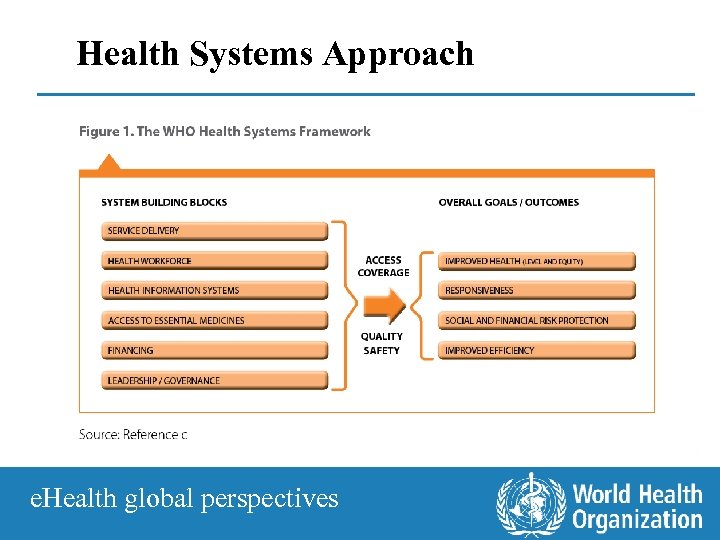
Health Systems Approach e. Health global perspectives 3|
Strategic aims of the Department of Knowledge, Ethics and Research · Manage, disseminate and ensure the quality of WHO’s information products; · Translate evidence into policy and practice; · Develop ethical and evidence-based policies for research; · Coordinate the implementation of the WHO strategy on research for health; · Develop and manage the Global Health R&D Observatory; · Develop, strengthen and promote the use of information and communication technologies for health. e. Health global perspectives 4|
Develop, strengthen and promote the use of information and communication technologies for health (e. Health) · Coordinating e. Health activities throughout WHO; · Collaborating with partners to promote and leverage the use of information and communication technologies in health services and systems; · Developing and implementing interoperability standards, norms and guidelines to support e. Health applications. e. Health global perspectives 5|
e. Health projects and products · · · Global Observatory for e. Health; e. Portuguese Network; Health Academy and e. Learning; National e. Health Roadmap Toolkit; Standardization and interoperability; Commission on Information and Accountability: e. Health and Innovation; · Evidence building and systematic reviews. e. Health global perspectives 6|
Evidence building and evaluation mechanisms · e. Health aims at: · Reducing cost of healthcare delivery; · Improving quality of healthcare services; · Improving equity of access to healthcare services and products. · Is there evidence to support this? · Examples of evidence. e. Health global perspectives 7|
Telemedicine for chronic diseases · Chronic diseases such as hypertension, renal disease, cardiac disease, asthma, other pulmonary diseases, cancer, and psychiatric disorders are routinely followed up and managed through telemedicine with strong evidence of equivalence or superiority in outcomes compared with on-site and face-toface care. Merrell Ronald C. and Doarn Charles R. Disease management in telemedicine and e. Health. Telemedicine and e-Health. August 2014, 20(8): 679 -680. doi: 10. 1089/tmj. 2014. 9984. e. Health global perspectives 8|
Telemedicine doubles screening rates for retinopathy · The use of telemedicine helped a primary care clinic more than double the percentage of diabetic patients undergoing screening for retinopathy over the course of a year, according to a research letter published this month in the Archives of Internal Medicine. Telemedicine and Retinal Imaging for Improving Diabetic Retinopathy Evaluation. Seema Garg, ; Pooja D. Jani; Abhijit V. Kshirsagar; Bradley King; Edward Chaum (in) Arch Intern Med. 2012; (): 1 -2. doi: 10. 1001/archinternmed. 2012. 437 e. Health global perspectives 9|
Mobile phones and HIV · Patients who received SMS support had significantly improved ART adherence and rates of viral suppression compared with the control individuals. Mobile phones might be effective tools to improve patient outcome in resourcelimited settings. RT Lester, et al. Effects of a mobile phone short message service on antiretroviral treatment adherence in Kenya (Wel. Tel Kenya 1): a randomised trial. Lancet. 2010 Nov 27; 376(9755): 1838 -45. Epub 2010 Nov 9. e. Health global perspectives 10 |
Evidence of e. Health impact: the case for e. IMCI in Tanzania · The results from a quantitative and qualitative study of e. IMCI show the impact of electronic support tools on the adherence to clinical protocols, consistency in care across providers, and patient perceptions on quality of care. Source: http: //www. dbmi. pitt. edu/seminar/evidence-ehealth-impact -case-eimci-tanzania e. Health global perspectives 11 |
Web-based treatment of diabetic patients Web-based depression treatment for type 1 and type 2 diabetic patients: a randomized, controlled trial. · The intervention was effective in reducing depressive symptoms. The interventions also reduced emotional stress. Source: ] VAN BASTELAAR, K. M. , POUWER, F. , CUIJPERS, P. , RIPER, H. and SNOEK, F. J. , 2011. Web-based depression treatment for type 1 and type 2 diabetic patients: a randomized, controlled trial. Diabetes care, 34(2), pp. 320 -325. e. Health global perspectives 12 |
e. Health evaluation ''gap'' · It is costly; · It is not an integral part of e. Health project management; · Fear of results (truth hurts); · Lack of evaluation expertise; · Lack of standard approaches or frameworks; · Diversified technologies, environments and applications; · Lack of standard indicators; · Low priority for policy and decision makers; · Conflict between internal and external evaluation. e. Health global perspectives 13 |
Evaluation with scientific vigour · "Health information systems should evaluated with the same rigor as a new drug or treatment program, otherwise decisions about future deployment of ICT in the health sector maybe determined by social, economic and/or political circumstances, rather than by robust scientific evidence". Catwell and Sheikh, 2009. e. Health global perspectives 14 |
The devil is in the details · "e. Health interventions may lie in the technical and scientific world, but e. Health dreams, visions, policies, and programs have personal, social, political, and ideological components, and therefore typically prove fuzzy, slippery, and unstable when we seek to define and control them". Greenhalgh, et al, 2010 e. Health global perspectives 15 |
Comprehensive approach is needed · …in light of the lack of evidence in relation to improvements in patient outcomes, as well as the lack of evidence on their cost-effectiveness, the authors say that future e. Health technologies should be evaluated against a comprehensive set of measures, ideally throughout all stages of the technology's life cycle, and include sociotechnical factors to maximize the likelihood of successful implementation and adoption in a given context". D. Ashly, et al. The Impact of e. Health on the Quality and Safety of Health Care: A Systematic Overview. http: //www. plosmedicine. org/article/info%3 Adoi%2 F 10. 1371%2 Fjournal. pmed. 1000387 e. Health global perspectives 16 |
Partnerships building · Public Private Partnerships (PPP) in e. Health operationalize a commitment by the public and the private sector to work together for the purpose of designing, planning, financing, constructing and/or operating e. Health projects. · There is not a single e. Health PPP model that fits all sizes/ countries/ communities. e. Health global perspectives 17 |
Partnerships building · Entering into a partnership with a technology vendor and/or a technology service provider should not be at the expense of another, and public sector partners should insist on operability for any of the technologies used by the PPP. · The objective of an e. Health project may dictate the type of partnership as from the public sector point of view the “content is king”, while from the perspective of hardware and software manufacturers and vendors the technology is the master e. Health global perspectives 18 |
Partnerships building • Recognising this trend, and as a response to the United Nations Political Declaration on noncommunicable diseases, the International Telecommunication Union and the World Health Organization jointly launched the global m. Health programme: ‘Be Healthy Be Mobile’ in October 2012. • Be He@lthy aims to scale national m. Health programmes across the areas of NCD prevention and treatment within eight member states. 19 |
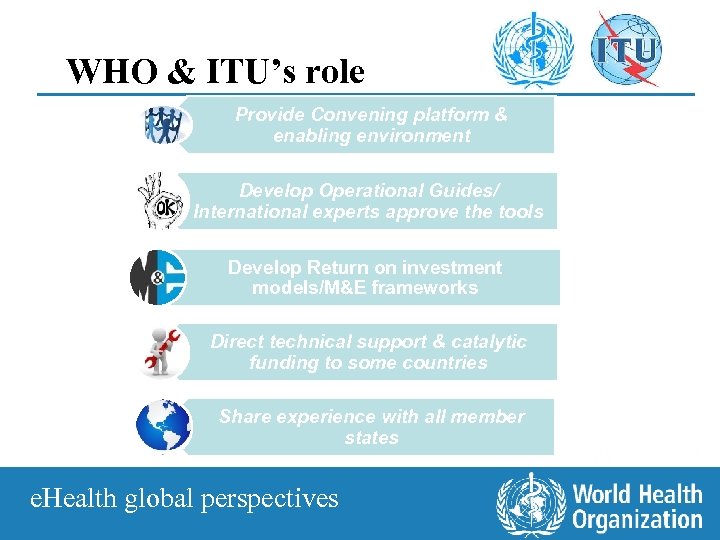
WHO & ITU’s role Provide Convening platform & enabling environment Develop Operational Guides/ International experts approve the tools Develop Return on investment models/M&E frameworks Direct technical support & catalytic funding to some countries Share experience with all member states e. Health global perspectives 20 |
WHO partners in e. Health · UN agencies: ITU, UNICEF, UNFPA · WHO Collaborating Centres: · Asian Pacific Ubiquitous Health Care Research Centre, University of New South Wales · Centro de Relações Internacionais em Saúde (CRIS), Fundação Oswaldo Cruz (FIOCRUZ) · Center for Health Statistics and Information (CHSI), Ministry of Health of the People's Republic of China · Norwegian Centre Telemedicine, University of Hospital of North Norway · Départment d'imagerie et des sciences de l'information medicale, Hôpitaux Universitaires de Genève · Centers for Disease Control and Prevention (CDC), The Center for Global Health, Division of Global Health Protection, Global Health Security Branch, Systems and Planning Team · Center for Consumer Health Informatics Research, College of Pharmacy, Nova Southeastern University e. Health global perspectives 21 |
WHO Partners in e. Health · Non-Governmental Organizations in Official relations with WHO: · International Medical Informatics Association · International Society for Telemedicine and e. Health · Health on the Net Foundation · Private sector. e. Health global perspectives 22 |
e. Health innovations · · Wearable devices, Big data, Tele-health, Health APPs, e. Health global perspectives 23 |
Wearable devices · Wearable technology enabled moving data collection from manual entries in notebooks and spreadsheets to a level of automated tracking; · Continuous monitoring and in an integrated manner; · Direct recording in EHRs, on screens at the healthcare facility and on personal health records; · Data visualization, metrics, better analysis and big data utilization. e. Health global perspectives 24 |
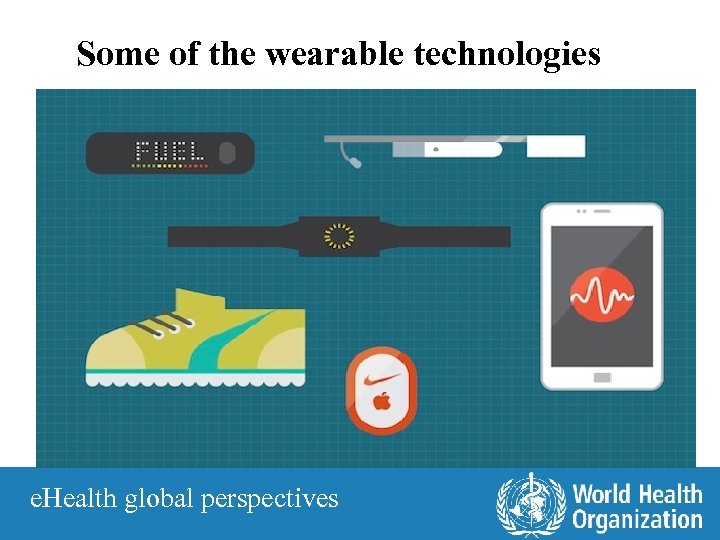
Some of the wearable technologies e. Health global perspectives 25 |
Tele-Health: some benefits · For patients: · · Better outcomes because of timelier access to specialists; Reduce unnecessary admissions or readmissions; Avoid unnecessary transfers to another facility; Reduce the cost on patients and/or payers · For originating site (other than home): · Access to a specialist support network; · Retain some patients rather than transfer them to another facility or system altogether; · Offering services other than Tele-Health solutions. e. Health global perspectives 26 |
Tele-Health: some benefits · For physicians: · Extend reach to patients that otherwise not reachable; · Potential additional income; · Save time of travel and transportation. · For tertiary care facilities: · Develop relationships with underserved care facilities that need their help; · Optimize utilization of facilities and ensuring wider access by transferring patients; · Offering services other than those based on Tele-Health solutions. e. Health global perspectives 27 |
Tele-Health: some benefits · For the health system: · Enables its increasing number of patients with healthcare needs to access the decreasing supply of clinicians; · Experiences reduced costs as timelier access to the right clinician reduces overall inefficiencies in the system. · Offering services other than those based on Tele. Health solutions. Source: http: //www. handsontelehealth. com/past-issues/76 -telehealthbenefits e. Health global perspectives 28 |
Big data, big promises, big problems Big data has important and distinct qualities that differentiate it from “traditional” institutional data, in particular its timeliness. § The size. Huge quantities. Volume. § Multiple sources. Personal, institutional, environmental, geographic, financial. § Changing fast. § Unstructured. Which metadata scheme to use. § Multiple format. Numbers, text, images. § Multiple locations. § Multiple ownership. e. Health global perspectives 29 |
Big data in health · Health has always been data intensive, analytics dependent, multidisciplinary, and collaborative. · Utilization of ”big data” allows discovering new relations (information and knowledge) among data elements that were never considered at the stage of data collection. · Knowledge discovery, therefore, allows health researchers and then decision makers to create knowledge and evidence from data sets of different types and formats. These may include: e. Health global perspectives 30 |
Big data in health · Disease prediction using patterns and models based on data sets related to humans, animals, materials and environment; · Using the tools of public health informatics, medical informatics, bioinformatics and medical imaging to integrate different types of data (patient/personal, public, diseases, molecular); · Integrated approach for health data management (web, m. Health, EHRs, smart cards, database management systems) applying open standards for interoperability. e. Health global perspectives 31 |
Big data in health · Big data has the potential to accelerate research and provide answers to some of the most difficult questions of our time (for example the solution to multi-drug resistant TB). e. Health global perspectives 32 |
Privacy and big data · Social media and crowd sourcing are the major source of big data. Facebook has a total number of 1. 31 billion monthly active users from all countries and territories of the world and has more data on individuals more than any other one country; · Users voluntarily provide personal and location data assuming that others (friends or peers) will benefit from it; · Once data has been collected, individuals have absolutely no control over who uses it or how it is used; · Personal data collected through social media and other personal health records has become of strategic importance, even more important than precious metals. e. Health global perspectives 33 |
What can be done? · Development and adoption of ethical guidelines at national and international levels; · Awareness by individuals, practitioners and policy and lawmakers; · Accountability and transparency principles enforced by national and international bodies; · Balance individual and society rights; · Better understanding and research on the issues; · International collaboration: UN agencies, regional bodies, governments, civil society and private sector. e. Health global perspectives 34 |
Health APPs · Software applications for mobile devices such as mobile (smart) phones, tablet computers; · Apple had , 200, 000 APPs (June 2014); · Android has 1, 346, 114 (August 2014); · There are 5, 820 medical, health and fitness apps available for smartphones today (http: //mobihealthnews. com/research/the-world-of-health-and-medical-apps/) e. Health global perspectives 35 |
Health APPs risks · Danger of misdiagnoses; · No scientific evidence; · Lack of doctor involvement; · Privacy concerns; · Technological and interoperability issues. e. Health global perspectives 36 |
e. Health applications · e. Health as the cost-effective and secure use of information and communication technologies in support of health and health -related fields, including health-care services, health surveillance, health literature, and health education. World Health Assembly Resolution, 2005 e. Health global perspectives 37 |
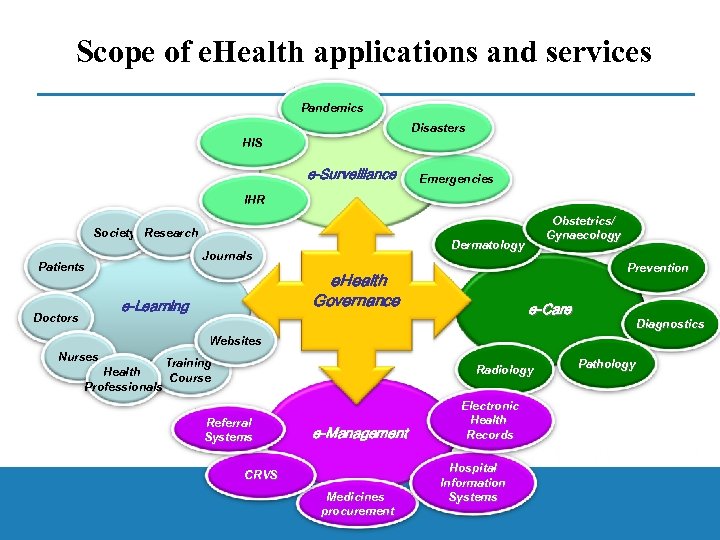
Scope of e. Health applications and services Pandemics Disasters HIS e-Surveillance Emergencies IHR Society Research Prevention e. Health Governance e-Learning Doctors Dermatology Journals Patients Obstetrics/ Gynaecology e-Care Diagnostics Websites Nurses Training Health Course Professionals Radiology Referral Systems e-Management CRVS 38 | Medicines procurement Electronic Health Records Hospital Information Systems Pathology
Ethical issues and concerns in e. Health · Lack of access to the ICT resources by individuals, communities and countries because of cost, politics, expertise, etc. ; · Widening digital divide and knowledge gaps resulting from lack of ICT infrastructures and resources. Ex. Internet penetration in Africa, mobile ownership by gender, mono-lingualism on the Internet, one way flow of scientific and technical information; e. Health global perspectives 39 |
Ethical issues and concerns in e. Health · The haves and the have-nots. Depriving people from access to electronic information resources such as e. Journals, e. Books and e. Learning materials loaded on high speed internet connections and remote servers because of unaffordability, unsuitability, linguistic and cultural limitations. e. Health global perspectives 40 |
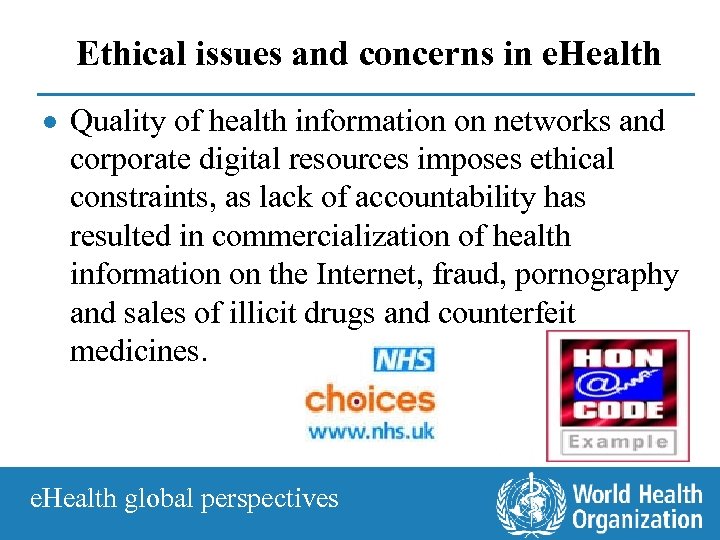
Ethical issues and concerns in e. Health · Quality of health information on networks and corporate digital resources imposes ethical constraints, as lack of accountability has resulted in commercialization of health information on the Internet, fraud, pornography and sales of illicit drugs and counterfeit medicines. e. Health global perspectives 41 |
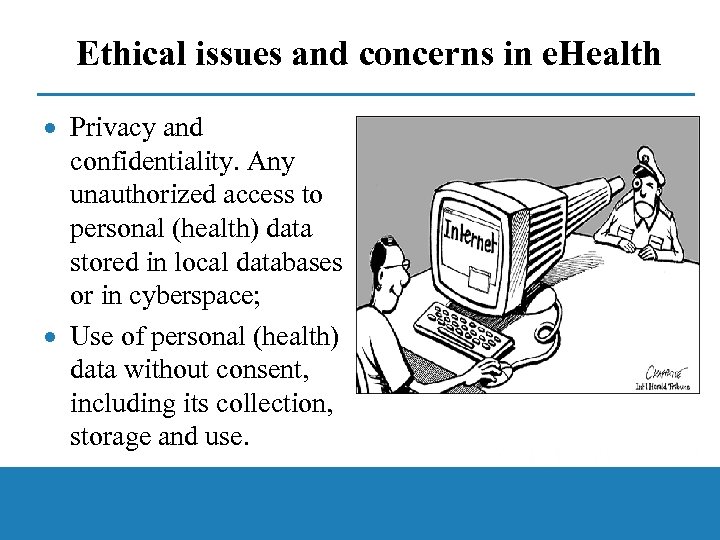
Ethical issues and concerns in e. Health · Privacy and confidentiality. Any unauthorized access to personal (health) data stored in local databases or in cyberspace; · Use of personal (health) data without consent, including its collection, storage and use. 42 |
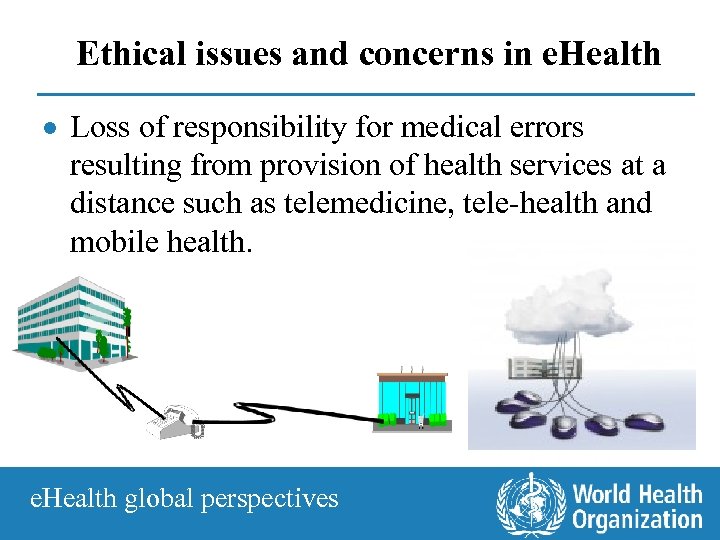
Ethical issues and concerns in e. Health · Loss of responsibility for medical errors resulting from provision of health services at a distance such as telemedicine, tele-health and mobile health. e. Health global perspectives 43 |
Taking e. Health forward: what's needed? · Extensive quantitative and qualitative research to build the evidence; · Close collaboration between research and academic institutions, the public health sector and the private sector; · Development of national e. Health policies and revision of legal and ethical frameworks; · Full utilization of innovative solutions including big data in health, based on research and evidence; e. Health global perspectives 44 |
Taking e. Health forward: What's needed? · Strengthen utilization of standards and interoperability tools at global level; · Introduce health informatics education and training programmes; · Development of demonstration projects based on public-private partnerships to prove value of e. Health; · Establish networking, collaborative and South-South Collaboration programmes; · Ensure e. Health is seamlessly integrated in health systems. e. Health global perspectives 45 |
Thank you Questions & Answers e. Health global perspectives
Скачать презентацию e Health global perspectives Najeeb Al-Shorbaji Director Knowledge
60de1c024ac6d4de7aa84b005224d117.ppt