Скачать презентацию e-Government of Korea Development History and outcomes
e-Goverment of Korea.ppt
- Количество слайдов: 24
 e-Government of Korea : Development History and outcomes National Information Society Agency
 I. Overview of Korea’s e-Government II. Best Practices III. Towards Smart Government
 I. Overview of Korea’s e-Government
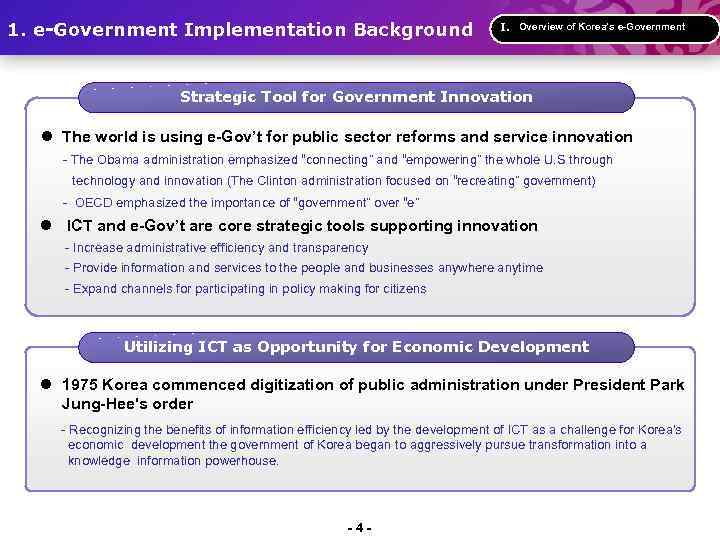 1. e-Government Implementation Background Ⅰ. Overview of Korea’s e-Government Strategic Tool for Government Innovation l The world is using e-Gov’t for public sector reforms and service innovation - The Obama administration emphasized “connecting” and “empowering” the whole U. S through technology and innovation (The Clinton administration focused on “recreating” government) - OECD emphasized the importance of “government” over “e” l ICT and e-Gov’t are core strategic tools supporting innovation - Increase administrative efficiency and transparency - Provide information and services to the people and businesses anywhere anytime - Expand channels for participating in policy making for citizens Utilizing ICT as Opportunity for Economic Development l 1975 Korea commenced digitization of public administration under President Park Jung-Hee's order - Recognizing the benefits of information efficiency led by the development of ICT as a challenge for Korea's economic development the government of Korea began to aggressively pursue transformation into a knowledge information powerhouse. - 4 -
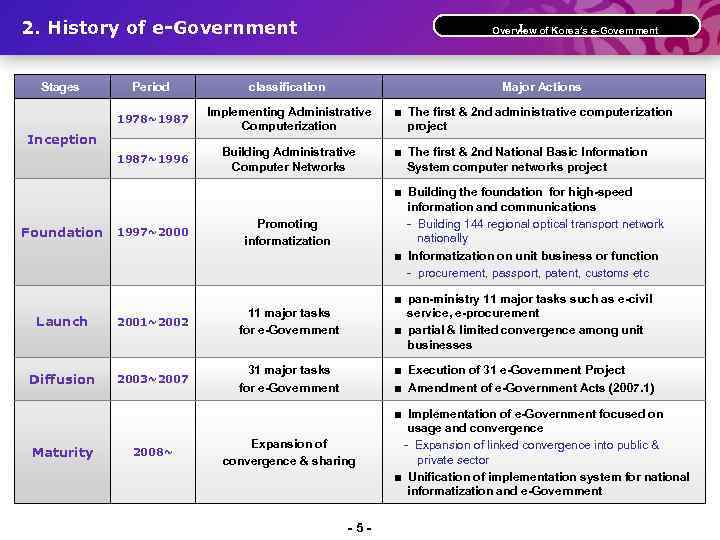 2. History of e-Government Stages Period Ⅰ. Overview of Korea’s e-Government classification Major Actions 1978~1987 Implementing Administrative Computerization 1987~1996 Building Administrative Computer Networks Inception Foundation 1997~2000 ■ The first & 2 nd administrative computerization project ■ The first & 2 nd National Basic Information System computer networks project ■ Building the foundation for high-speed information and communications - Building 144 regional optical transport network nationally ■ Informatization on unit business or function - procurement, passport, patent, customs etc Promoting informatization Launch 2001~2002 11 major tasks for e-Government ■ pan-ministry 11 major tasks such as e-civil service, e-procurement ■ partial & limited convergence among unit businesses Diffusion 2003~2007 31 major tasks for e-Government ■ Execution of 31 e-Government Project ■ Amendment of e-Government Acts (2007. 1) Maturity 2008~ Expansion of convergence & sharing - 5 - ■ Implementation of e-Government focused on usage and convergence - Expansion of linked convergence into public & private sector ■ Unification of implementation system for national informatization and e-Government
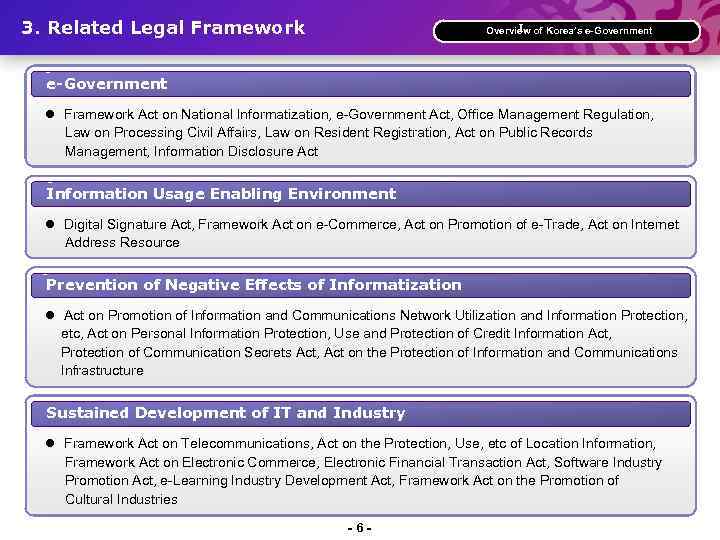 3. Related Legal Framework Ⅰ. Overview of Korea’s e-Government l Framework Act on National Informatization, e-Government Act, Office Management Regulation, Law on Processing Civil Affairs, Law on Resident Registration, Act on Public Records Management, Information Disclosure Act Information Usage Enabling Environment l Digital Signature Act, Framework Act on e-Commerce, Act on Promotion of e-Trade, Act on Internet Address Resource Prevention of Negative Effects of Informatization l Act on Promotion of Information and Communications Network Utilization and Information Protection, etc, Act on Personal Information Protection, Use and Protection of Credit Information Act, Protection of Communication Secrets Act, Act on the Protection of Information and Communications Infrastructure Sustained Development of IT and Industry l Framework Act on Telecommunications, Act on the Protection, Use, etc of Location Information, Framework Act on Electronic Commerce, Electronic Financial Transaction Act, Software Industry Promotion Act, e-Learning Industry Development Act, Framework Act on the Promotion of Cultural Industries - 6 -
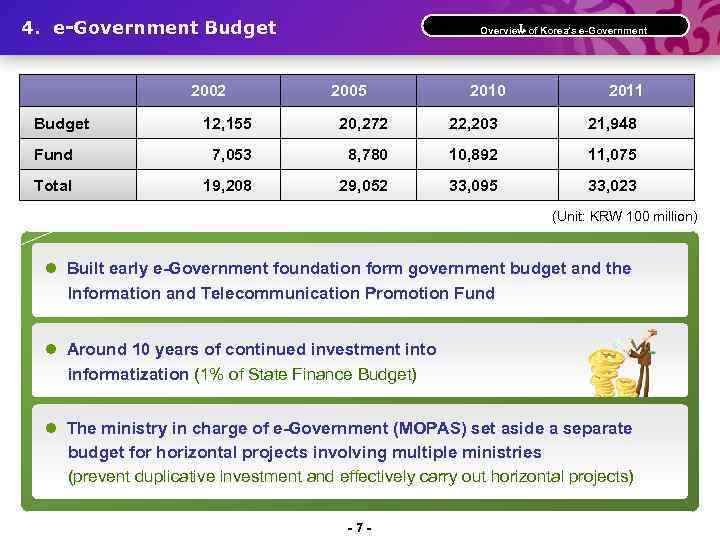 4. e-Government Budget 2002 Budget Ⅰ. Overview of Korea’s e-Government 2005 2010 2011 12, 155 20, 272 22, 203 21, 948 Fund 7, 053 8, 780 10, 892 11, 075 Total 19, 208 29, 052 33, 095 33, 023 (Unit: KRW 100 million) l Built early e-Government foundation form government budget and the Information and Telecommunication Promotion Fund l Around 10 years of continued investment into informatization (1% of State Finance Budget) l The ministry in charge of e-Government (MOPAS) set aside a separate budget for horizontal projects involving multiple ministries (prevent duplicative investment and effectively carry out horizontal projects) - 7 -
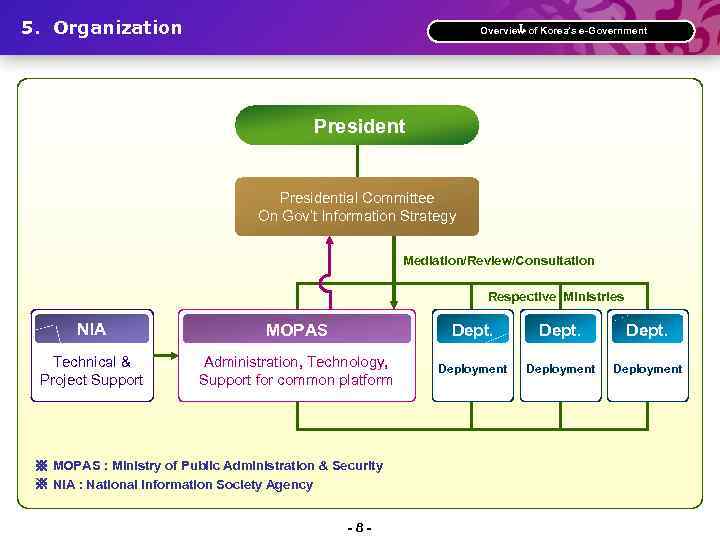 5. Organization Ⅰ. Overview of Korea’s e-Government Presidential Committee On Gov’t Information Strategy Mediation/Review/Consultation Respective Ministries NIA MOPAS NIA Dept. NIA Technical & Project Support Administration, Technology, Support for common platform Deployment ※ MOPAS : Ministry of Public Administration & Security ※ NIA : National Information Society Agency - 8 -
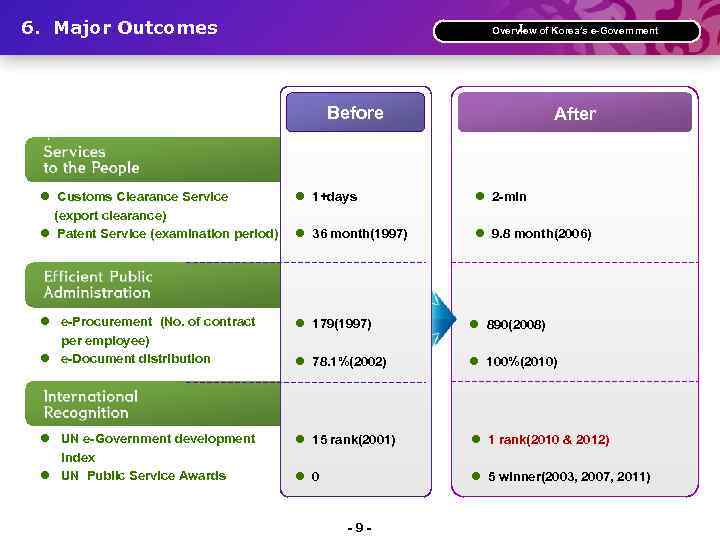 6. Major Outcomes Ⅰ. Overview of Korea’s e-Government Before After l Customs Clearance Service (export clearance) l Patent Service (examination period) l 1+days l 2 -min l 36 month(1997) l 9. 8 month(2006) l e-Procurement (No. of contract per employee) l e-Document distribution l 179(1997) l 890(2008) l 78. 1%(2002) l 100%(2010) l UN e-Government development index l UN Public Service Awards l 15 rank(2001) l 1 rank(2010 & 2012) l 0 l 5 winner(2003, 2007, 2011) - 9 -
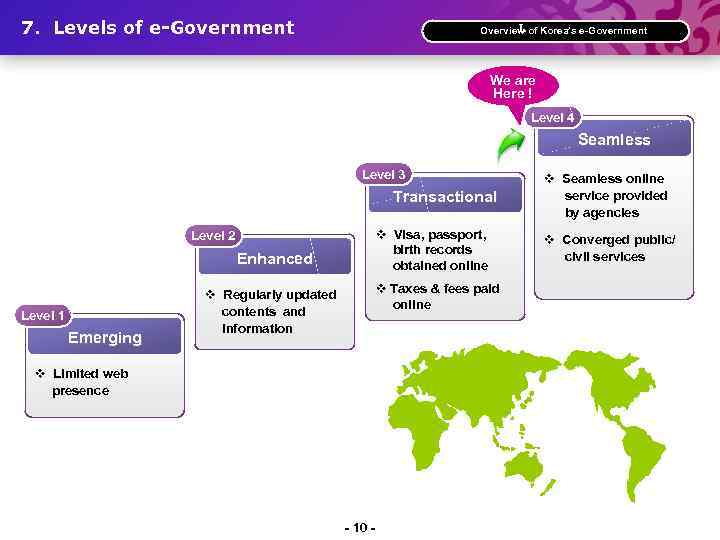 7. Levels of e-Government Ⅰ. Overview of Korea’s e-Government We are Here ! Level 4 Seamless Level 3 Transactional Level 2 Enhanced Level 1 Emerging v Regularly updated contents and information v Visa, passport, birth records obtained online v Taxes & fees paid online v Limited web presence - 10 - v Seamless online service provided by agencies v Converged public/ civil services
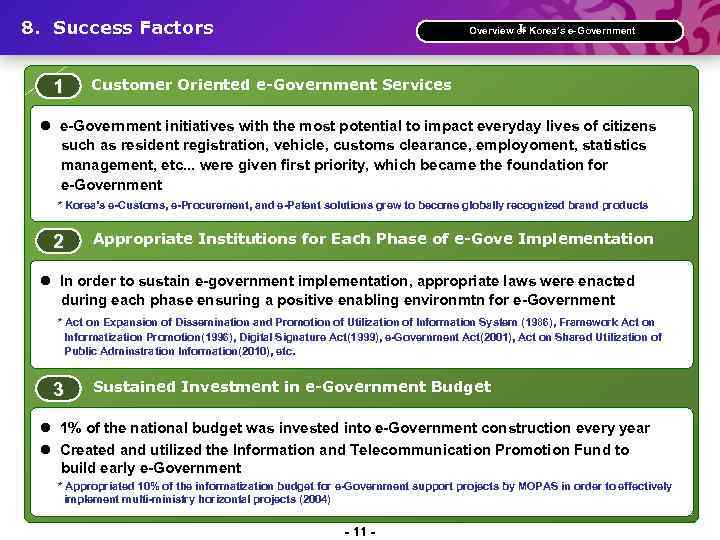 8. Success Factors 1 Ⅰ. Overview of Korea’s e-Government Customer Oriented e-Government Services l e-Government initiatives with the most potential to impact everyday lives of citizens such as resident registration, vehicle, customs clearance, employoment, statistics management, etc. . . were given first priority, which became the foundation for e-Government * Korea's e-Customs, e-Procurement, and e-Patent solutions grew to become globally recognized brand products 2 Appropriate Institutions for Each Phase of e-Gove Implementation l In order to sustain e-government implementation, appropriate laws were enacted during each phase ensuring a positive enabling environmtn for e-Government * Act on Expansion of Dissemination and Promotion of Utilization of Information System (1986), Framework Act on Informatization Promotion(1996), Digital Signature Act(1999), e-Government Act(2001), Act on Shared Utilization of Public Adminstration Information(2010), etc. 3 Sustained Investment in e-Government Budget l 1% of the national budget was invested into e-Government construction every year l Created and utilized the Information and Telecommunication Promotion Fund to build early e-Government * Appropriated 10% of the informatization budget for e-Government support projects by MOPAS in order to effectively implement multi-ministry horizontal projects (2004) - 11 -
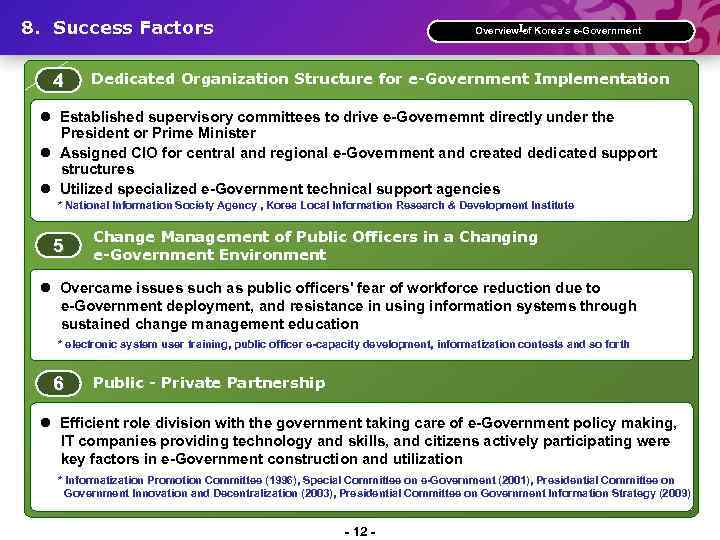 8. Success Factors 4 Ⅰ. Overview of Korea’s e-Government Dedicated Organization Structure for e-Government Implementation l Established supervisory committees to drive e-Governemnt directly under the President or Prime Minister l Assigned CIO for central and regional e-Government and created dedicated support structures l Utilized specialized e-Government technical support agencies * National Information Society Agency , Korea Local Information Research & Development Institute 5 Change Management of Public Officers in a Changing e-Government Environment l Overcame issues such as public officers' fear of workforce reduction due to e-Government deployment, and resistance in using information systems through sustained change management education * electronic system user training, public officer e-capacity development, informatization contests and so forth 6 Public - Private Partnership l Efficient role division with the government taking care of e-Government policy making, IT companies providing technology and skills, and citizens actively participating were key factors in e-Government construction and utilization * Informatization Promotion Committee (1996), Special Committee on e-Government (2001), Presidential Committee on Government Innovation and Decentralization (2003), Presidential Committee on Government Information Strategy (2009) - 12 -
 I. Best Practices II. Best Practices
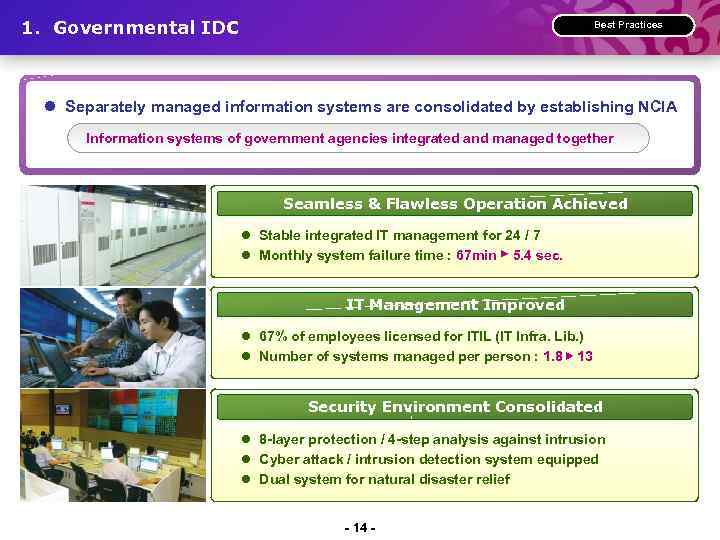 1. Governmental IDC Best Practices l Separately managed information systems are consolidated by establishing NCIA Information systems of government agencies integrated and managed together Seamless & Flawless Operation Achieved l Stable integrated IT management for 24 / 7 l Monthly system failure time : 67 min ▶ 5. 4 sec. IT Management Improved l 67% of employees licensed for ITIL (IT Infra. Lib. ) l Number of systems managed person : 1. 8 ▶ 13 Security Environment Consolidated l 8 -layer protection / 4 -step analysis against intrusion l Cyber attack / intrusion detection system equipped l Dual system for natural disaster relief - 14 -
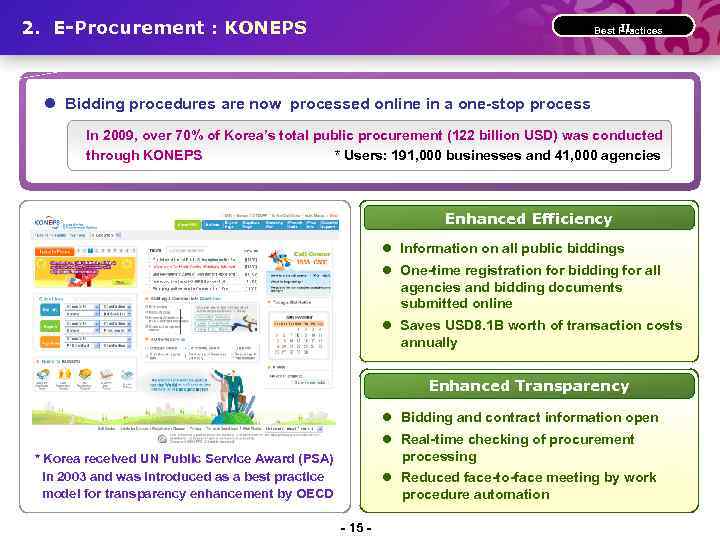 2. E-Procurement : KONEPS Ⅱ. Best Practices l Bidding procedures are now processed online in a one-stop process In 2009, over 70% of Korea’s total public procurement (122 billion USD) was conducted through KONEPS * Users: 191, 000 businesses and 41, 000 agencies Enhanced Efficiency l Information on all public biddings l One-time registration for bidding for all agencies and bidding documents submitted online l Saves USD 8. 1 B worth of transaction costs annually Enhanced Transparency l Bidding and contract information open l Real-time checking of procurement processing * Korea received UN Public Service Award (PSA) in 2003 and was introduced as a best practice model for transparency enhancement by OECD l Reduced face-to-face meeting by work procedure automation - 15 -
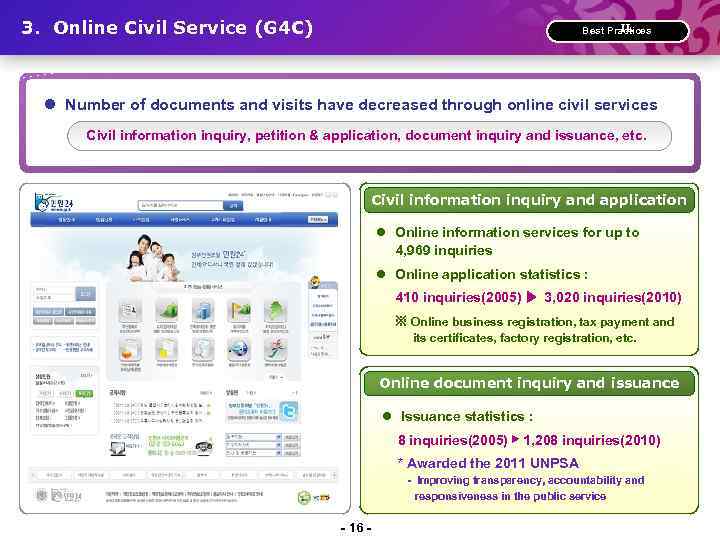 3. Online Civil Service (G 4 C) Ⅱ. Best Practices l Number of documents and visits have decreased through online civil services Civil information inquiry, petition & application, document inquiry and issuance, etc. Civil information inquiry and application l Online information services for up to 4, 969 inquiries l Online application statistics : 410 inquiries(2005) ▶ 3, 020 inquiries(2010) ※ Online business registration, tax payment and its certificates, factory registration, etc. Online document inquiry and issuance l Issuance statistics : 8 inquiries(2005) ▶ 1, 208 inquiries(2010) * Awarded the 2011 UNPSA - Improving transparency, accountability and responsiveness in the public service - 16 -
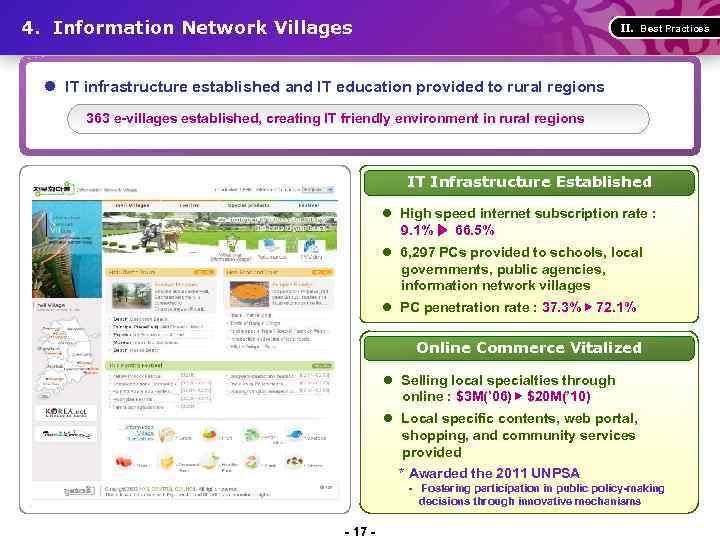 4. Information Network Villages Best Practices Ⅱ. l IT infrastructure established and IT education provided to rural regions 363 e-villages established, creating IT friendly environment in rural regions IT Infrastructure Established l High speed internet subscription rate : 9. 1% ▶ 66. 5% l 6, 297 PCs provided to schools, local governments, public agencies, information network villages l PC penetration rate : 37. 3% ▶ 72. 1% Online Commerce Vitalized l Selling local specialties through online : $3 M(’ 06) ▶ $20 M(’ 10) l Local specific contents, web portal, shopping, and community services provided * Awarded the 2011 UNPSA - Fostering participation in public policy-making decisions through innovative mechanisms - 17 -
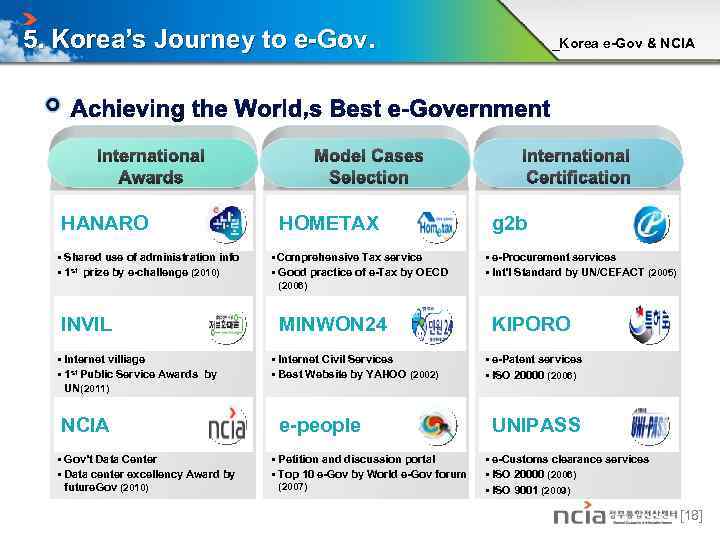 5. Korea’s Journey to e-Gov. HANARO § Shared use of administration info § 1 st prize by e-challenge (2010) HOMETAX §Comprehensive Tax service § Good practice of e-Tax by OECD _Korea e-Gov & NCIA g 2 b § e-Procurement services § Int’l Standard by UN/CEFACT (2005) (2006) INVIL § Internet villiage § 1 st Public Service Awards by UN(2011) NCIA § Gov’t Data Center § Data center excellency Award by future. Gov (2010) MINWON 24 § Internet Civil Services § Best Website by YAHOO (2002) e-people § Petition and discussion portal § Top 10 e-Gov by World e-Gov forum (2007) KIPORO § e-Patent services § ISO 20000 (2006) UNIPASS § e-Customs clearance services § ISO 20000 (2006) § ISO 9001 (2009) [18]
 I. Best Practices III. Towards Smart Government
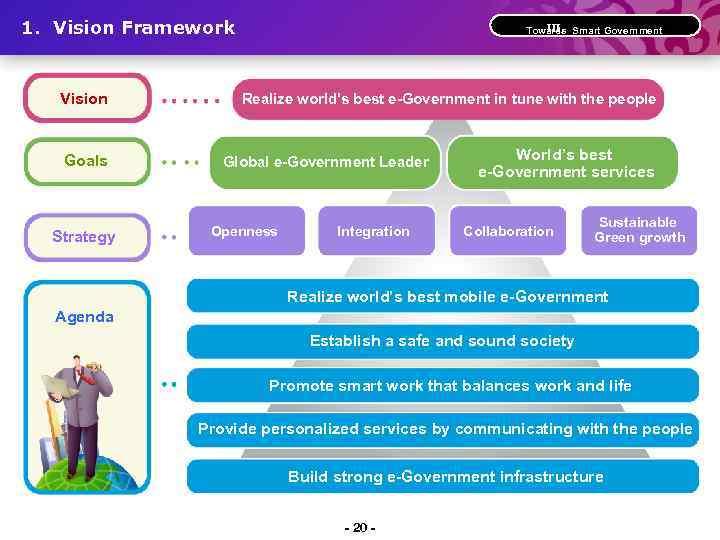 1. Vision Framework Vision Goals Strategy Ⅲ. Towards Smart Government Realize world's best e-Government in tune with the people Global e-Government Leader Openness Integration World’s best e-Government services Collaboration Sustainable Green growth Realize world’s best mobile e-Government Agenda Establish a safe and sound society Promote smart work that balances work and life Provide personalized services by communicating with the people Build strong e-Government infrastructure - 20 -
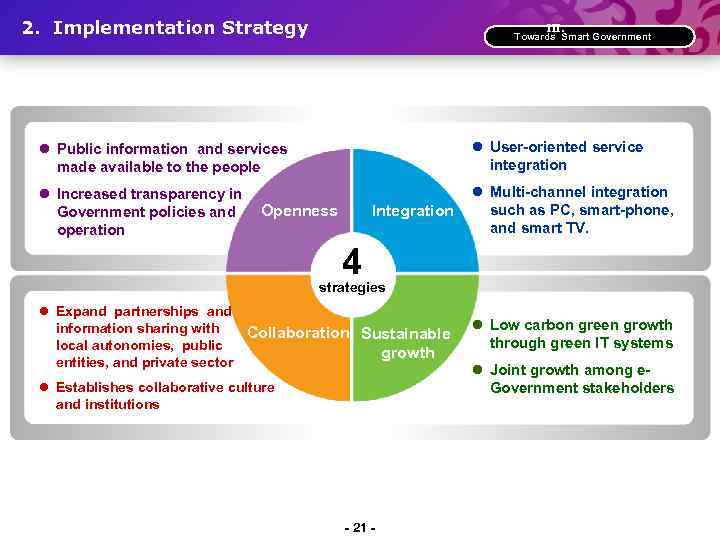 2. Implementation Strategy Ⅲ. Towards Smart Government l Public information and services made available to the people l User-oriented service integration l Increased transparency in Government policies and Openness operation l Multi-channel integration such as PC, smart-phone, and smart TV. Integration 4 strategies l Expand partnerships and information sharing with Collaboration Sustainable local autonomies, public growth entities, and private sector l Establishes collaborative culture and institutions - 21 - l Low carbon green growth through green IT systems l Joint growth among e- Government stakeholders
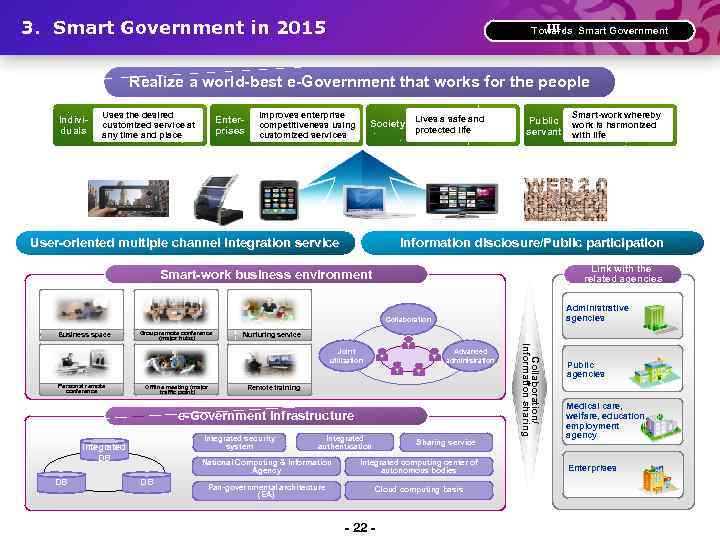 3. Smart Government in 2015 Ⅲ. Towards Smart Government Realize a world-best e-Government that works for the people Individuals Uses the desired customized service at any time and place Enterprises Improves enterprise competitiveness using customized services Society Lives a safe and protected life User-oriented multiple channel integration service Public servant Information disclosure/Public participation Link with the related agencies Smart-work business environment Administrative agencies Collaboration Group remote conference (major hubs) ㅊ Business space Nurturing service Offline meeting (major traffic point) Advanced administration Remote training e-Government infrastructure Integrated Sharing service authentication system National Computing & Information Integrated computing center of Agency autonomous bodies Integrated security system Integrated DB DB DB Pan-governmental architecture (EA) Cloud computing basis - 22 - Collaboration/ Information sharing Joint 공통서비스 utilization Personal remote conference Smart-work whereby work is harmonized with life Public agencies Medical care, welfare, education, employment agency Enterprises
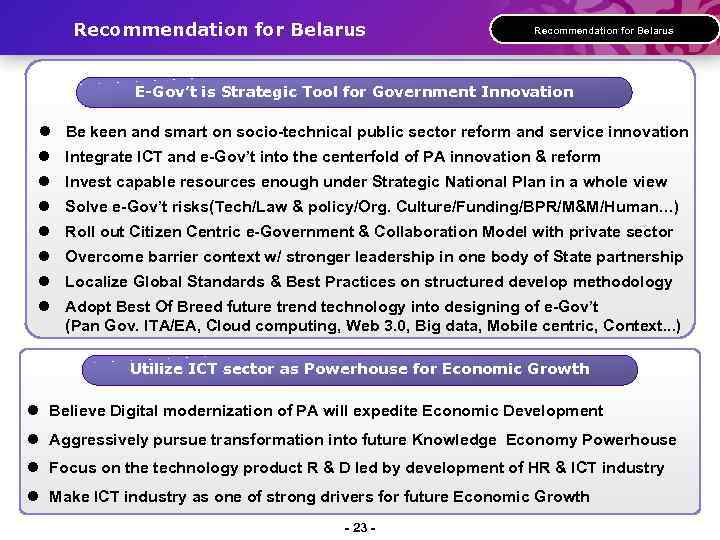 Recommendation for Belarus E-Gov’t is Strategic Tool for Government Innovation l Be keen and smart on socio-technical public sector reform and service innovation l Integrate ICT and e-Gov’t into the centerfold of PA innovation & reform l Invest capable resources enough under Strategic National Plan in a whole view l Solve e-Gov’t risks(Tech/Law & policy/Org. Culture/Funding/BPR/M&M/Human…) l Roll out Citizen Centric e-Government & Collaboration Model with private sector l Overcome barrier context w/ stronger leadership in one body of State partnership l Localize Global Standards & Best Practices on structured develop methodology l Adopt Best Of Breed future trend technology into designing of e-Gov’t (Pan Gov. ITA/EA, Cloud computing, Web 3. 0, Big data, Mobile centric, Context. . . ) Utilize ICT sector as Powerhouse for Economic Growth l Believe Digital modernization of PA will expedite Economic Development l Aggressively pursue transformation into future Knowledge Economy Powerhouse l Focus on the technology product R & D led by development of HR & ICT industry l Make ICT industry as one of strong drivers for future Economic Growth - 23 -