


 Скачать презентацию E E 2315 Circuits I Lecture 1 —
60c417a9da257abccad07be64a01efe2.ppt
- Количество слайдов: 24
 E E 2315 Circuits I Lecture 1 - Introduction to Electric Circuits
 Overview of Electrical Engineering • The electrical engineer combines the physicist’s models of natural phenomena with the mathematician’s tools for manipulating those models to produce systems that meet practical needs. • Electrical systems can be divided into five major classifications.
 5 Linked Classifications of Electrical Systems • Communications Systems • Computer Systems • Control Systems • Power Systems • Signal Processing Systems
 Communications Systems • Telephony – Analog and Digital – Switched Channels • Radio – Broadcast AM, FM, & SW – Two-Way • Television
 Computer Systems • Programmable Microcircuits • High-speed switching of logic circuits • Used for – Computation – Control
 Control Systems • Automated • Adaptable • Faster Operation than Manual • More Reliable than Manual • Modern high-performance aircraft rely on automated control systems
 Power Systems • Large networks connected by low frequency a-c transmission lines • Small networks in aircraft and spacecraft • Electromechanical Energy Conversion • Power Electronics – High frequency switching converters – High efficiency, high power density
 Signal Processing Systems • Transform and manipulate signals and the information they contain • Image processing – Data from weather satellites – MRI scans of the human body • Noise reduction • Encryption
 Circuit Theory • Mathematical modeling of physical phenomena • Circuit theory is a special case of electromagnetic field theory – General EM theory is more complex than circuit theory – General EM theory requires more complex mathematics
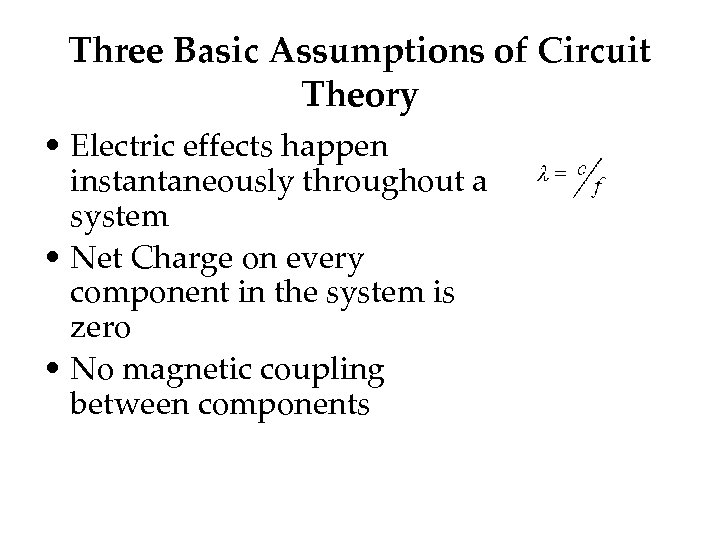 Three Basic Assumptions of Circuit Theory • Electric effects happen instantaneously throughout a system • Net Charge on every component in the system is zero • No magnetic coupling between components
 Problem Solving • Identify what is given and what is to be found. • Sketch a circuit diagram or other visual model • Think of several solution methods and a way of choosing between them • Calculate a solution
 Problem Solving (continued) • Use your creativity – If your efforts are not converging to a solution, you may want to rethink your assumptions. • Test your solution – Is your answer reasonable? – Does your answer validate your assumptions?
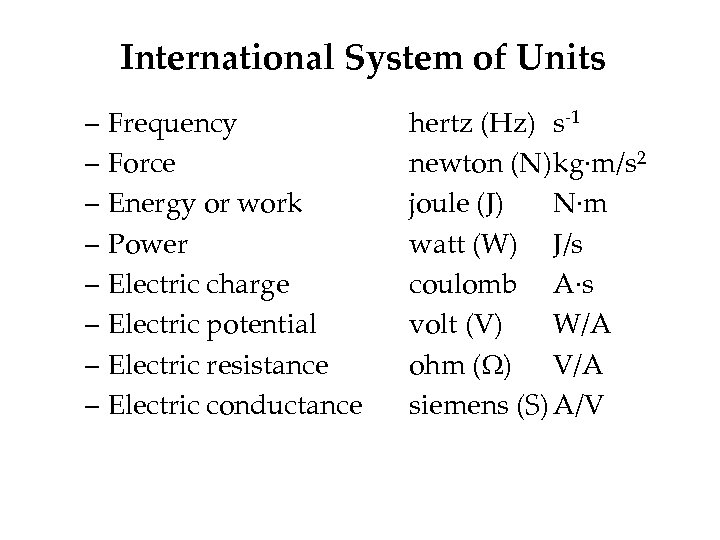 International System of Units – Frequency – Force – Energy or work – Power – Electric charge – Electric potential – Electric resistance – Electric conductance hertz (Hz) s-1 newton (N)kg·m/s 2 joule (J) N·m watt (W) J/s coulomb A·s volt (V) W/A ohm ( ) V/A siemens (S) A/V
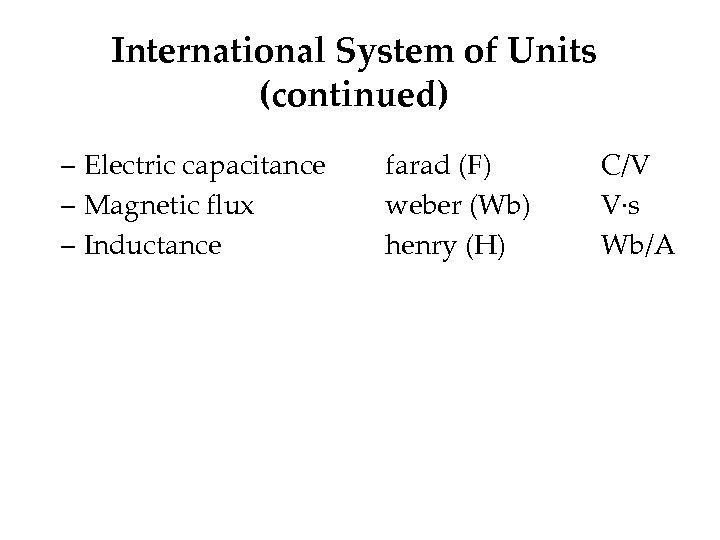 International System of Units (continued) – Electric capacitance – Magnetic flux – Inductance farad (F) weber (Wb) henry (H) C/V V·s Wb/A
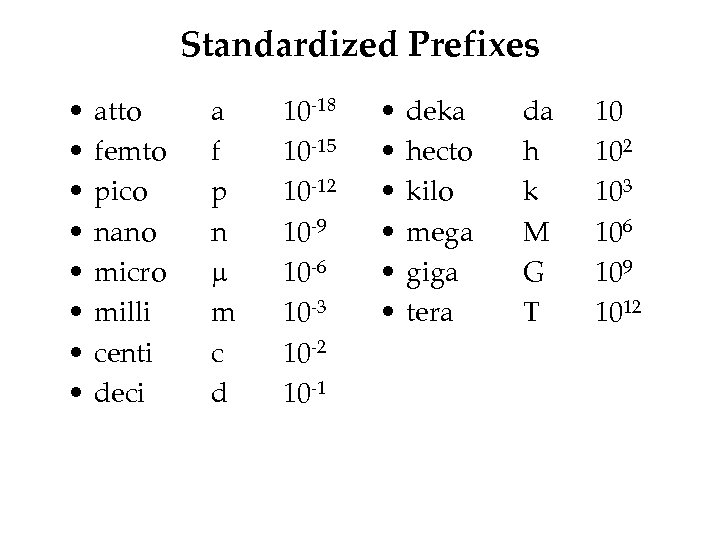 Standardized Prefixes • • atto femto pico nano micro milli centi deci a f p n m c d 10 -18 10 -15 10 -12 10 -9 10 -6 10 -3 10 -2 10 -1 • • • deka hecto kilo mega giga tera da h k M G T 10 102 103 106 109 1012
 Circuit Analysis: An Overview • A circuit model is used to connect our visualization to our analysis of a physical system • The elements of our circuit model are ideal circuit components. • The behavior of output parameters is governed by physical/mathematical laws for the elements of the circuit model.
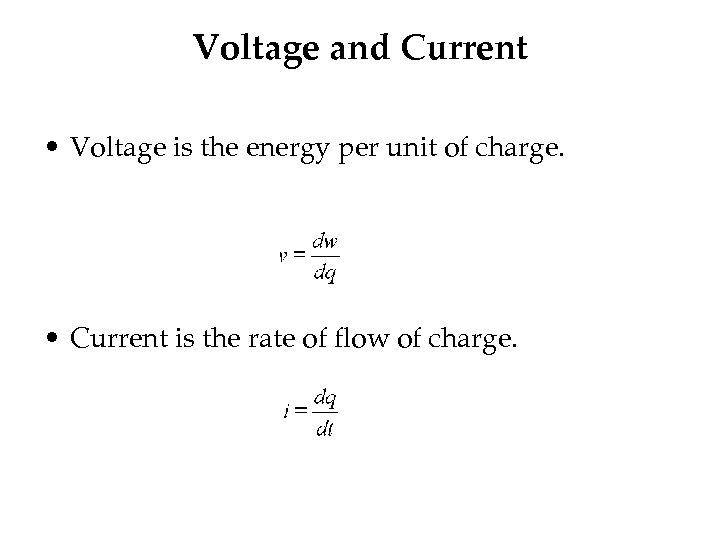 Voltage and Current • Voltage is the energy per unit of charge. • Current is the rate of flow of charge.
 Voltage and Current (continued) • The relationship between voltage and current in a circuit element defines that circuit element. • Both voltage and current have associated polarities. • These polarities determine the direction of power flow.
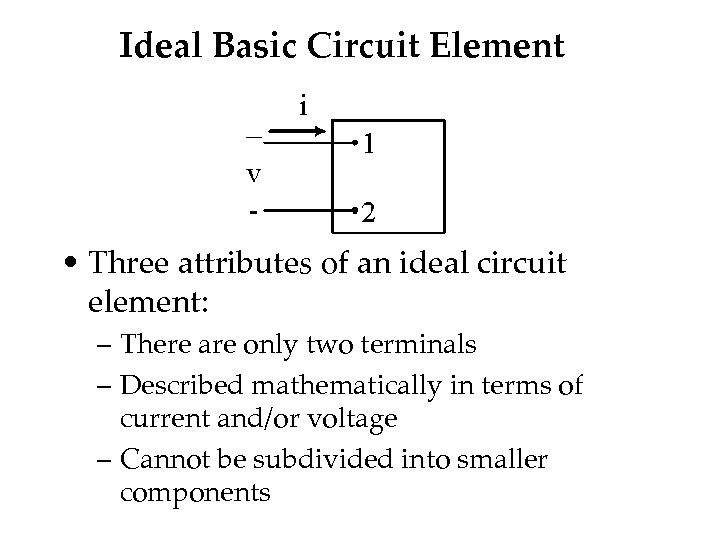 Ideal Basic Circuit Element • Three attributes of an ideal circuit element: – There are only two terminals – Described mathematically in terms of current and/or voltage – Cannot be subdivided into smaller components
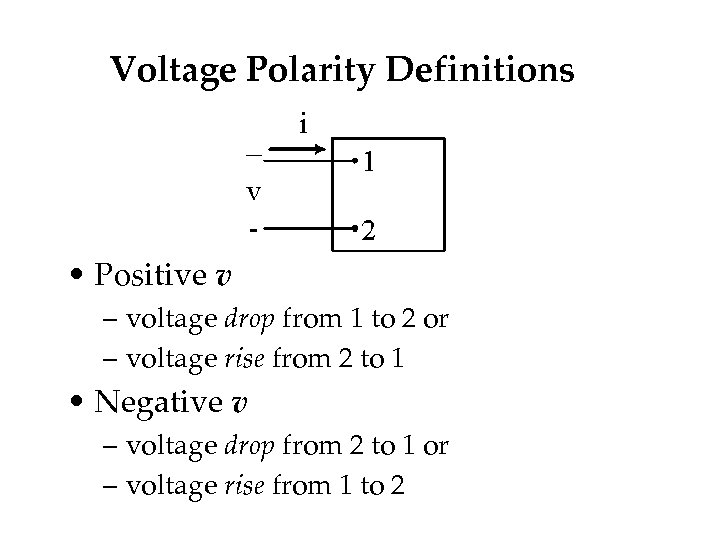 Voltage Polarity Definitions • Positive v – voltage drop from 1 to 2 or – voltage rise from 2 to 1 • Negative v – voltage drop from 2 to 1 or – voltage rise from 1 to 2
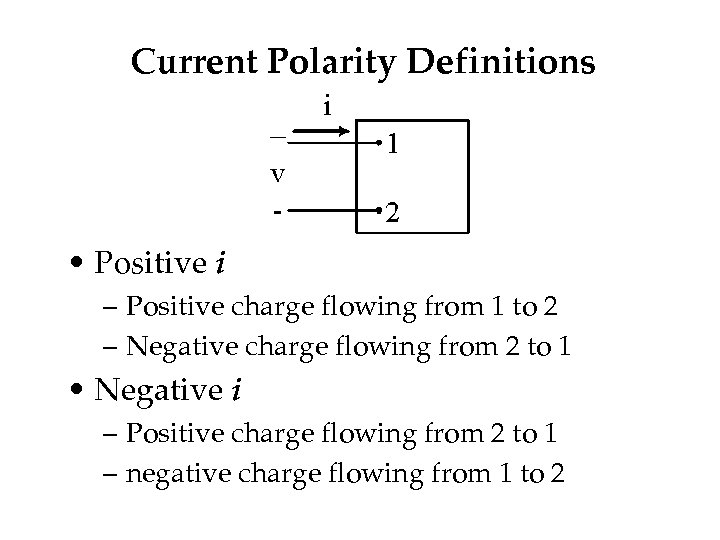 Current Polarity Definitions • Positive i – Positive charge flowing from 1 to 2 – Negative charge flowing from 2 to 1 • Negative i – Positive charge flowing from 2 to 1 – negative charge flowing from 1 to 2
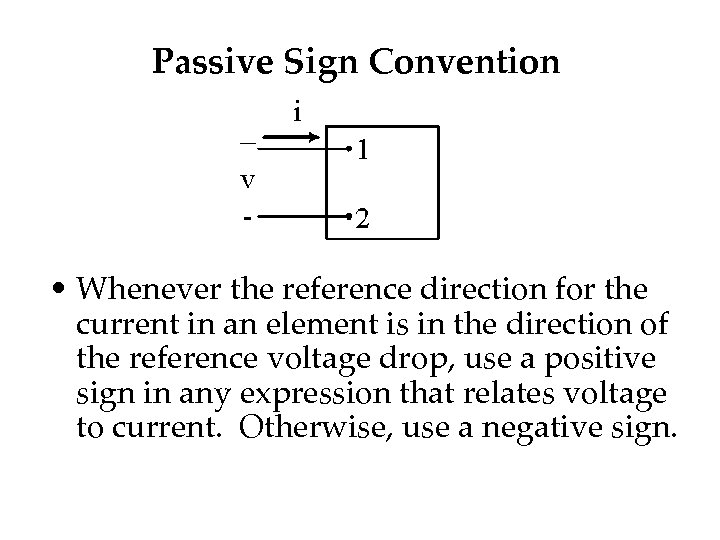 Passive Sign Convention • Whenever the reference direction for the current in an element is in the direction of the reference voltage drop, use a positive sign in any expression that relates voltage to current. Otherwise, use a negative sign.
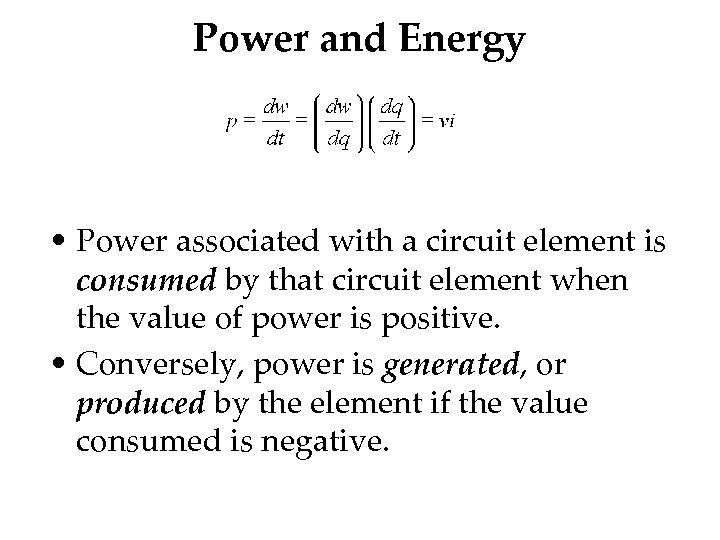 Power and Energy • Power associated with a circuit element is consumed by that circuit element when the value of power is positive. • Conversely, power is generated, or produced by the element if the value consumed is negative.
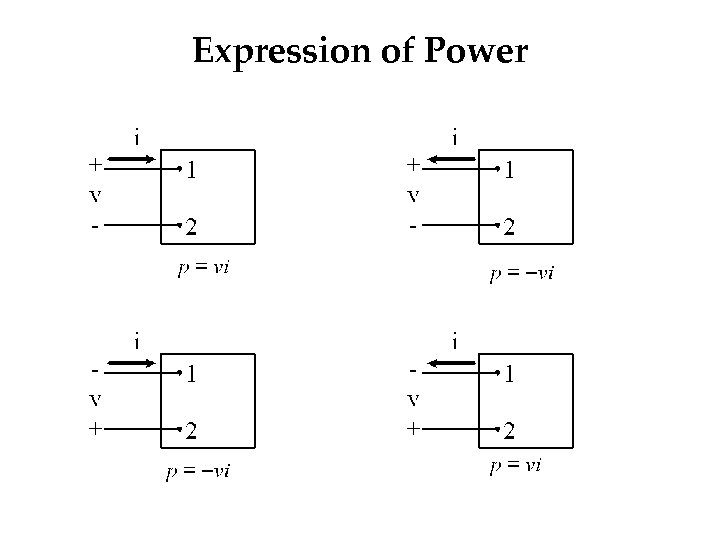 Expression of Power