


 Скачать презентацию E-Commerce Trends in Asia Kurt Cavano Chairman and
e641a2b82bb0ba2c0986939216d35f7a.ppt
- Количество слайдов: 28
 E-Commerce Trends in Asia Kurt Cavano Chairman and CEO, Trade. Card September 2004 Presented at American Chamber of Commerce Taipei
 Ensuring Asia’s Competitive Advantage • Low cost labour is not enough to maintain Asia’s success as workshop of the world; buyers move on to the cheapest location when production costs go up in Asia • Asia’s traders need real-time information to fulfill their buyers’ growing demands for faster turnaround and shorter lead-times • Greater visibility helps to reduce cost and credit risk • Paperless trade through automation ensures better relationships with overseas trading partners • Overseas buyers are only willing to purchase from those vendors that can meet electronic/automated service requirements 2
 B 2 B e. Commerce Trends • In 2004, US$992 billion, or 13% of all B 2 B transactions globally will happen in Asia/Pacific (Gartner Group) • However, security concerns are still a serious impediment to the growth of e-commerce • Pan-regional efforts on the implementation of a secure ecommerce infrastructure for trade, such as the Pan Asian Alliance and APEC’s efforts show, getting rid of paper is key in maintaining a competitive edge in the Asia-Pacific region. 3
 What the Analysts are Saying
 How Ready is Asia for E-Business? The Economist Intelligence Unit produces “E-business readiness rankings” every year whereby countries are assessed according to the following criteria: • Technology infrastructure • General business environment • Degree to which e-business is adopted by consumers and companies • Social and culture conditions that influence Internet usage • Availability of services to support e-businesses 5
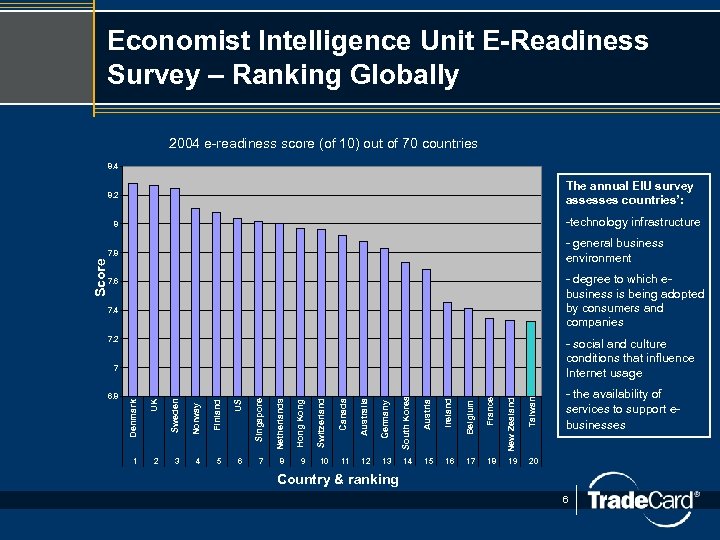 Economist Intelligence Unit E-Readiness Survey – Ranking Globally 2004 e-readiness score (of 10) out of 70 countries 8. 4 The annual EIU survey assesses countries’: 8. 2 -technology infrastructure 8 - general business environment Score 7. 8 - degree to which ebusiness is being adopted by consumers and companies 7. 6 7. 4 7. 2 - social and culture conditions that influence Internet usage UK Sweden Norway Finland US Singapore Netherlands Hong Kong Switzerland Canada Australia Germany South Korea Austria Ireland Belgium France New Zealand Taiwan 6. 8 Denmark 7 1 2 3 4 5 6 7 8 9 10 11 12 13 14 15 16 17 18 19 - the availability of services to support ebusinesses 20 Country & ranking 6
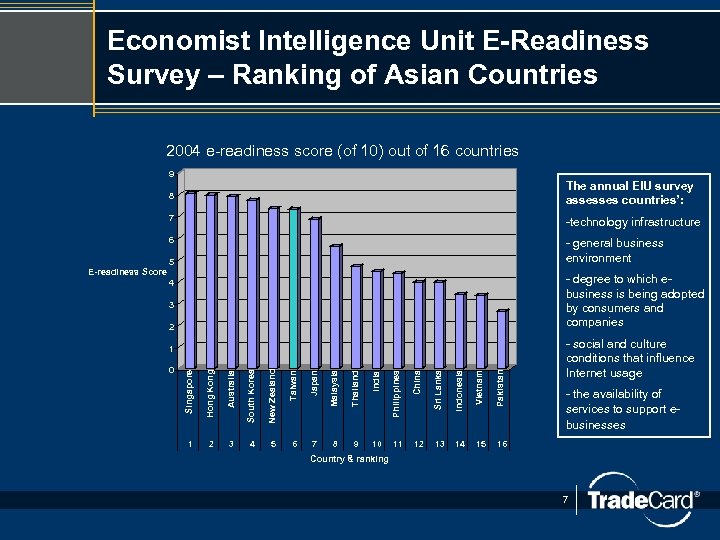 Economist Intelligence Unit E-Readiness Survey – Ranking of Asian Countries 2004 e-readiness score (of 10) out of 16 countries 9 8 The annual EIU survey assesses countries’: 7 -technology infrastructure 6 - general business environment 5 E-readiness Score - degree to which ebusiness is being adopted by consumers and companies 4 3 2 Hong Kong Australia South Korea New Zealand Taiwan Japan Malaysia Thailand India Philippines China Sri Lanka Indonesia Vietnam Pakistan 0 Singapore 1 1 2 3 4 5 6 7 8 9 10 11 12 13 14 15 - social and culture conditions that influence Internet usage 16 - the availability of services to support ebusinesses Country & ranking 7
 Asian Countries are Catching Up* • After Western Europe, Asia-Pacific is the next-best represented region in the 2004 ereadiness rankings. Singapore (7 th) and Hong Kong (9 th) are in the top ten, followed by Australia (12 th), South Korea (14 th), New Zealand (19 th), Taiwan (20 th) and Japan (25 th). • Asian governments are intimately familiar with each other ’s e-development practices and increasingly, there is cooperation at both the national and the industrial level. • Despite the rapid growth of e-trading platforms, particularly in the regional finance and trading hubs of Singapore and Hong Kong, enabling technologies such as digital signatures and digital rights management remain under-utilised by businesses. • This is not for lack of legal infrastructure; even Thailand has passed legislation recognising the legitimacy of digital signatures. But Asian banks, a key link in the e-commerce chain, have not adopted them in their own transactions, let alone mandated them in their clients. *Source: Economist Intelligence Unit, E-readiness rankings 2004 8
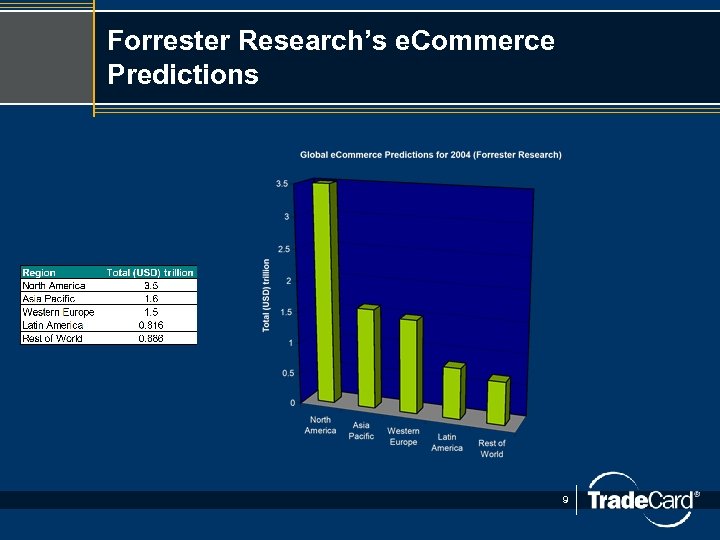 Forrester Research’s e. Commerce Predictions 9
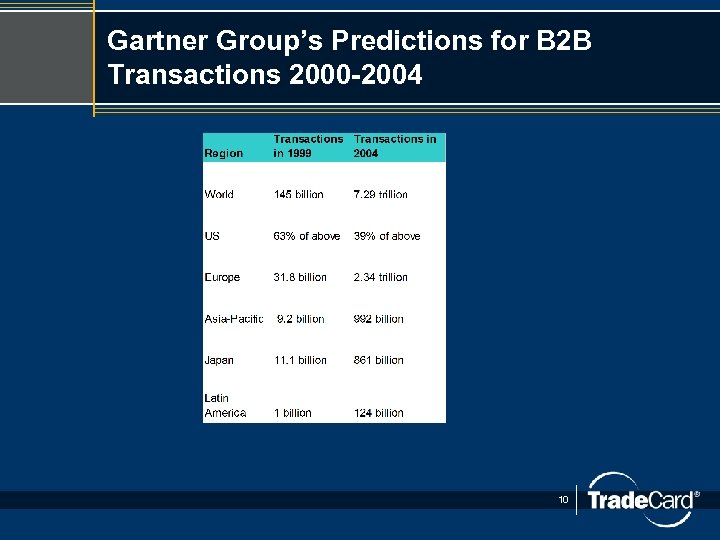 Gartner Group’s Predictions for B 2 B Transactions 2000 -2004 10
 Electronic Trade Initiatives in Asia
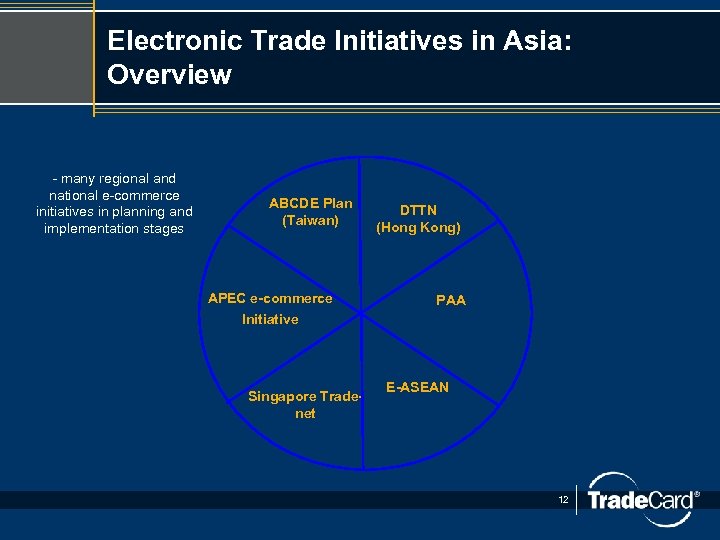 Electronic Trade Initiatives in Asia: Overview - many regional and national e-commerce initiatives in planning and implementation stages ABCDE Plan (Taiwan) APEC e-commerce Initiative Singapore Tradenet DTTN (Hong Kong) PAA E-ASEAN 12
 Taiwan: ABCDE Plan • 1999: implementation of the Industrial Automation and Electronic Business Program (i. Ae. B Program) under the Ministry of Economic Affairs (MOEA) • Aim: help companies in the information industry to establish electronic supply chain systems, as well as to encourage thousands of Taiwanese small and medium enterprises (SMEs) to acquire the basic capabilities needed for business -to-business (B 2 B) e-commerce. • 2001: implementation of Projects C, D and E, building on existing electronic supply chain system as the foundation for further integration of money flow, materials flow and R&D and design • Aim: to provide companies in all segments of the supply chain with e-services for cash flow, delivery system and uniform engineering collaboration, and to strengthen their logistics management capability. 13
 Hong Kong: DTTN • The Digital Trade and Transportation network is an initiative by the HK government and electronic trade services provider Tradelink (42% governmentowned) to help smooth trade flows • DTTN seeks to provide a shared electronic infrastructure to enable the exploration, development, and delivery of innovative value-added services to improve competitiveness in trade and logistics • DTTN will facilitate 10 major processes, from creating sales/purchase contracts and insurance to arrangement/execution of transporation and submission of trade declarations and other licenses. 14
 Asia: Pan Asia e-Commerce Alliance • Aim: Create a regional electronic trade infrastructure for secure e-commerce between traders in PAA member countries or economies which include Hong Kong, Taiwan, Japan, Korea, China, Singapore, Malaysia and Macau. Thailand Indonesia send observers and are potential members. • Activities include – creation of a Secure Cross Border Transaction Service, with a set of electronic trade documents – Pan-Asian Trade Portal • PAA members use PKI (Public Key Infrastructure) for e-commerce security, and are using digital certificates issued by Certificate Authorities under a mutual recognition scheme operated under PAA. • Current PAA cross-border electronic trade chains are claimed to provide cost savings of 40% or more compared with manual methods 15
 Singapore: Trade-net • Nationwide electronic trade documentation system that approves permit applications almost instantaneously • Allows electronic submission of permit applications to multiple government bodies for processing of import, export, and transshipment documentation. • When an application is approved, a permit message will be returned electronically to the sender • Singapore's success in e-government, coupled with its citizens' acceptance of this program, demonstrates yet again their willingness to accept new technology 16
 e-ASEAN Information Infrastructure • Establishment of e-ASEAN information infrastructure and growth of electronic commerce • ASEAN governments commit themselves to foster a favorable legal and policy environment for the development and use of Information and Communication technologies (ICT) • e-ASEAN aims for the liberalization of trade in products and services and the promotion of investments in the production of ICT products and in the provision of ICT services. • Establishment of a system of mutual recognition of digital signatures; secure electronic transactions, payments and settlements; protection of intellectual property rights arising from e-commerce; measures to promote personal data protection and consumer privacy; and dispute settlement mechanisms. • Aim: to reduce the digital divide between developed and developing nations 17
 APEC E-Commerce Steering Committee • APEC member countries are working towards a cross-border paperless trading environment • Through the 1998 APEC Blueprint for Action on e-Commerce, member economies are committed to a goal of achieving “Paperless Trading, ” where possible, by 2005 for developed economies and 2010 for developing economies. • Sixteen economies have now prepared Paperless Trading Individual Action Plans. These outline the steps APEC economies are taking to meet APEC's target to reduce or eliminate the requirement for paper documents needed for customs and other cross-border trade administration and other documents and messages relevant to international sea, air and land transport. 18
 Trends in Global Trade
 Trends in Global Trade Dictate the Use of e. Commerce Technology • Increased sourcing from lower cost regions • Decrease in use of Letters of Credit and increase in open account transactions as payment method • New government programs in the US to ensure security and secure supply of goods (24 -hour manifest rule, C-TPAT etc) • Increasing demand for vendor managed inventory • Increasing demand for more frequent and smaller shipments • Continued adoption of supply chain and payment technologies by overseas buyers • Quota systems demands flexibility 20
 A Unique Opportunity: Financial Supply Chain Management • Asian governments understand the necessity for automating documents, but connecting the physical flow of goods with the financial processes revolutionizes the whole concept of global trade. • “The good news is that $260 billion in cash is concealed in the financial supply chains (of the Global 2000) and it will not be that difficult to liberate. ” (Source: Killen and Associates) 21
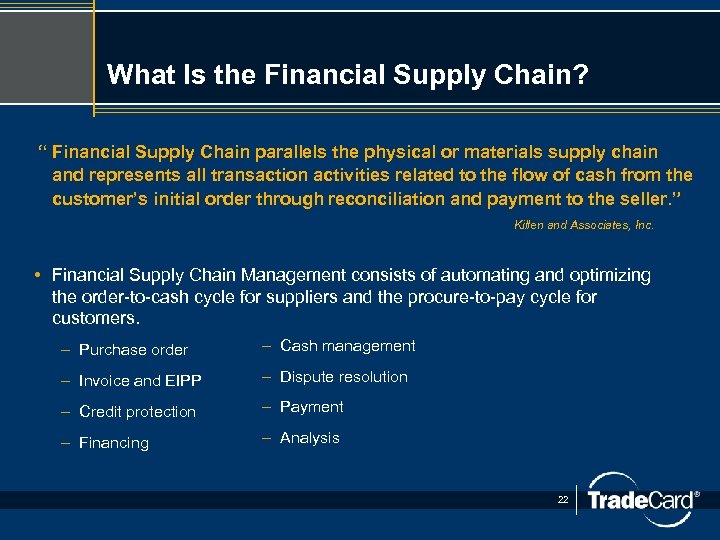 What Is the Financial Supply Chain? “ Financial Supply Chain parallels the physical or materials supply chain and represents all transaction activities related to the flow of cash from the customer’s initial order through reconciliation and payment to the seller. ” Killen and Associates, Inc. • Financial Supply Chain Management consists of automating and optimizing the order-to-cash cycle for suppliers and the procure-to-pay cycle for customers. – Purchase order – Cash management – Invoice and EIPP – Dispute resolution – Credit protection – Payment – Financing – Analysis 22
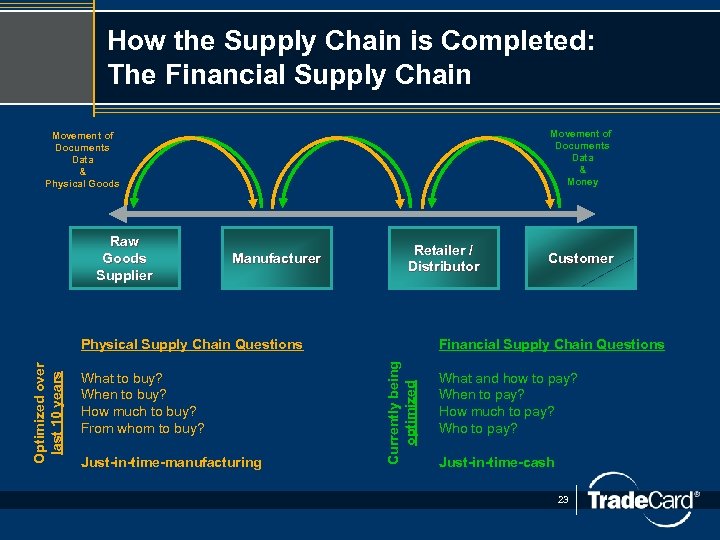 How the Supply Chain is Completed: The Financial Supply Chain Movement of Documents Data & Money Movement of Documents Data & Physical Goods Raw Goods Supplier Manufacturer Retailer / Distributor What to buy? When to buy? How much to buy? From whom to buy? Just-in-time-manufacturing Financial Supply Chain Questions Currently being optimized Optimized over last 10 years Physical Supply Chain Questions Customer What and how to pay? When to pay? How much to pay? Who to pay? Just-in-time-cash 23
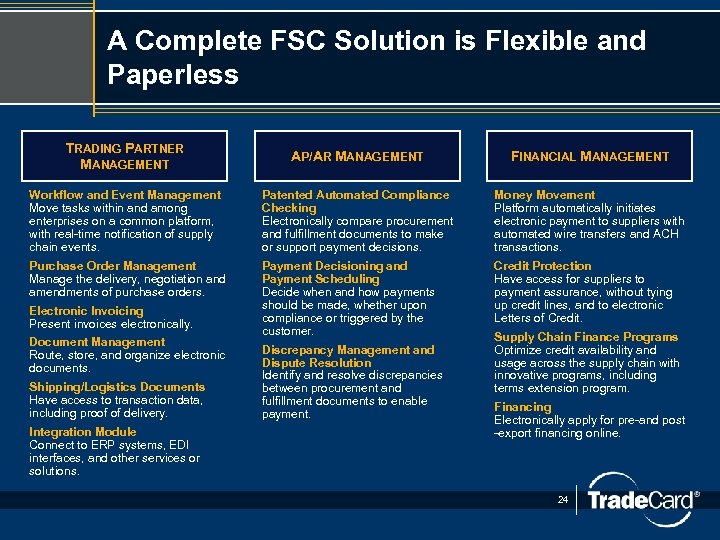 A Complete FSC Solution is Flexible and Paperless TRADING PARTNER MANAGEMENT AP/AR MANAGEMENT TRANSACTION SOLUTIONS FINANCIAL MANAGEMENT Workflow and Event Management Move tasks within and among enterprises on a common platform, with real-time notification of supply chain events. Patented Automated Compliance Checking Electronically compare procurement and fulfillment documents to make or support payment decisions. Money Movement Platform automatically initiates electronic payment to suppliers with automated wire transfers and ACH transactions. Purchase Order Management Manage the delivery, negotiation and amendments of purchase orders. Payment Decisioning and Payment Scheduling Decide when and how payments should be made, whether upon compliance or triggered by the customer. Credit Protection Have access for suppliers to payment assurance, without tying up credit lines, and to electronic Letters of Credit. Electronic Invoicing Present invoices electronically. Document Management Route, store, and organize electronic documents. Shipping/Logistics Documents Have access to transaction data, including proof of delivery. Integration Module Connect to ERP systems, EDI interfaces, and other services or solutions. Discrepancy Management and Dispute Resolution Identify and resolve discrepancies between procurement and fulfillment documents to enable payment. Supply Chain Finance Programs Optimize credit availability and usage across the supply chain with innovative programs, including terms extension program. Financing Electronically apply for pre-and post -export financing online. 24
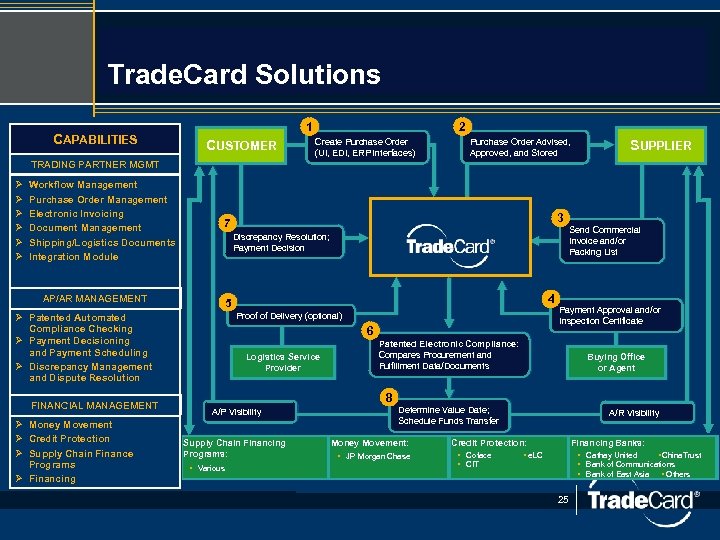 Trading Partner Management AP/AR Management Financial Trade. Card Solutions Management CAPABILITIES 1 1 CUSTOMER 2 2 Create Purchase Order (UI, EDI, ERP interfaces) Purchase Order Advised, Approved, and Stored SUPPLIER TRADING PARTNER MGMT Ø Ø Ø Workflow Management Purchase Order Management Electronic Invoicing Document Management Shipping/Logistics Documents Integration Module AP/AR MANAGEMENT Ø Money Movement Ø Credit Protection Ø Supply Chain Finance Programs Ø Financing 3 3 Send Commercial Invoice and/or Packing List Discrepancy Resolution; Payment Decision 4 4 5 5 Proof of Delivery (optional) Ø Patented Automated Compliance Checking Ø Payment Decisioning and Payment Scheduling Ø Discrepancy Management and Dispute Resolution FINANCIAL MANAGEMENT AP/AR MANAGEMENT TRADING PARTNER MGMT FINANCIAL MANAGEMENT 7 7 6 6 Logistics Service Provider Payment Approval and/or Inspection Certificate Patented Electronic Compliance: Compares Procurement and Fulfillment Data/Documents Buying Office or Agent 8 8 A/P Visibility Supply Chain Financing Programs: • Various Determine Value Date; Schedule Funds Transfer Money Movement: • JP Morgan Chase A/R Visibility Credit Protection: • Coface • CIT Financing Banks: • Cathay United China. Trust • Bank of Communications • Bank of East Asia Others e. LC 25
 Summary • In order to cope with growing global trade volumes, businesses will need to employ new technologies • Web-based technologies offer the most promising prospects in managing the many challenges in today’s trading environment • Asian economies are catching up as their governments provide better national e-commerce infrastructures as well as engaging in regional initiatives • Automated financial supply chain management provides a huge opportunity for businesses and whole economies to save costs and improve their competitiveness 26
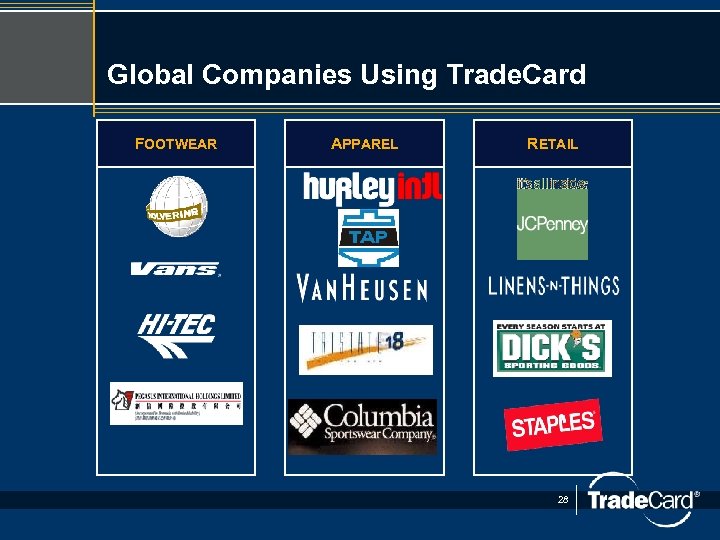
 About Trade. Card • Trade. Card is recognized as the leading web-based platform that enables the global supply chain to conduct trade transactions from purchase order to financial settlement. • More than 800 corporate members have realized value from the Trade. Card platform including Staples, JC Penney, Linens N’ Things, Wolverine Worldwide, Hurley International (a division of Nike), Columbia Sportswear, TAL Apparel, Phillips Van Heusen and Vans. • These customers enjoy access to a suite of innovative financial services offered by our partners JP Morgan Chase, Coface (largest provider of credit insurance), CIT and over 100 logistics firms, to move money, obtain financing, and secure credit protection. • Trade. Card holds a patent for its data compliance engine which enables payment decisions by comparing electronic documents. • Backed by Warburg Pincus, Mitsui & Co. , Mitsubishi Corporation and the World Trade Centers Association, Trade. Card is headquartered in New York with offices in Hong Kong, Taipei, Brussels, Tokyo, Seoul, San Francisco and Shenzhen. • Trade. Card is sustaining double-digit growth every month. 27
 Global Companies Using Trade. Card FOOTWEAR APPAREL RETAIL 28