 Скачать презентацию E-commerce Security Albert Levi Oregon State University Information
28132f8094e6a18b410fba0bb1f3a7d6.ppt
- Количество слайдов: 42



E-commerce Security Albert Levi Oregon State University Information Security Lab Corvallis, Oregon, USA levi@security. ece. orst. edu Albert Levi, E-commerce security and PKIs 1
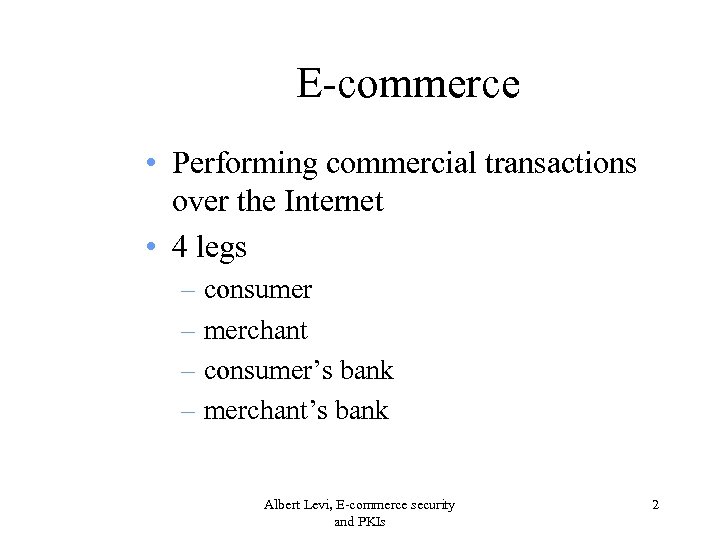
E-commerce • Performing commercial transactions over the Internet • 4 legs – consumer – merchant – consumer’s bank – merchant’s bank Albert Levi, E-commerce security and PKIs 2
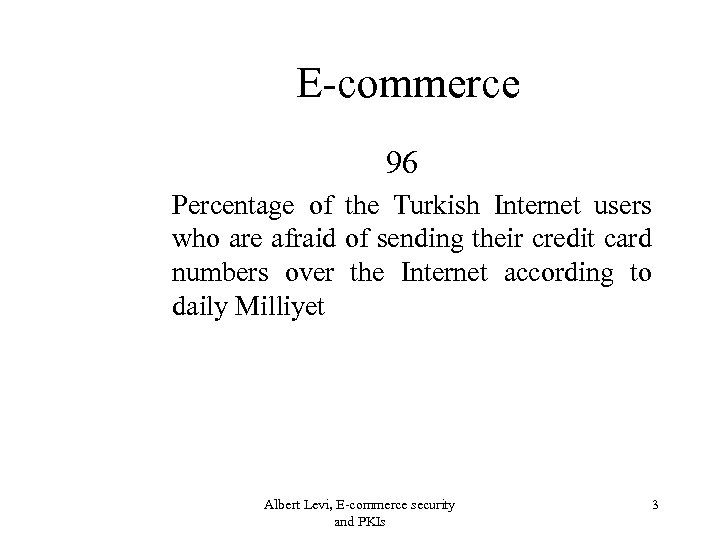
E-commerce 96 Percentage of the Turkish Internet users who are afraid of sending their credit card numbers over the Internet according to daily Milliyet Albert Levi, E-commerce security and PKIs 3
E-commerce Security • Why? – Everybody says so – They do not trust the Internet – They do not know what is going on at the merchant’s site – They think that some hands are in their wallets – They do not trust people in the process Albert Levi, E-commerce security and PKIs 4
Security Requirements • Confidentiality – unauthorized parties must not see the data transmitted • Authentication – parties must make sure each other’s identity Albert Levi, E-commerce security and PKIs 5
Security Requirements • Non-repudiation – nobody should be able to deny sending a message or initiating a transaction later – any possible dispute must be resolved fairly • Integrity – nobody should be able to alter the data while in transit – if altered, that must be sensed Albert Levi, E-commerce security and PKIs 6
Security Mechanisms • Encryption – encode the data so that only the intended party could decode – For confidentiality Albert Levi, E-commerce security and PKIs 7
Security Mechanisms • Digital Signatures – a digital information that can be produced only by the sender – The receiver must be able to verify that signature – For authentication, non-repudiation, integrity Albert Levi, E-commerce security and PKIs 8
Public key Cryptography (PKC) • PKC is the solution to both encryption and digital signatures • One key pair per user – public key • everybody can know it – private key • must be kept secret Albert Levi, E-commerce security and PKIs 9
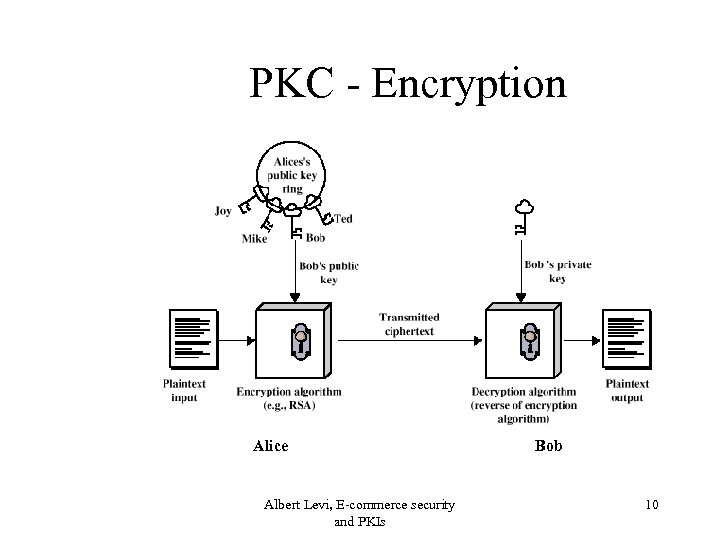
PKC - Encryption Alice Albert Levi, E-commerce security and PKIs Bob 10
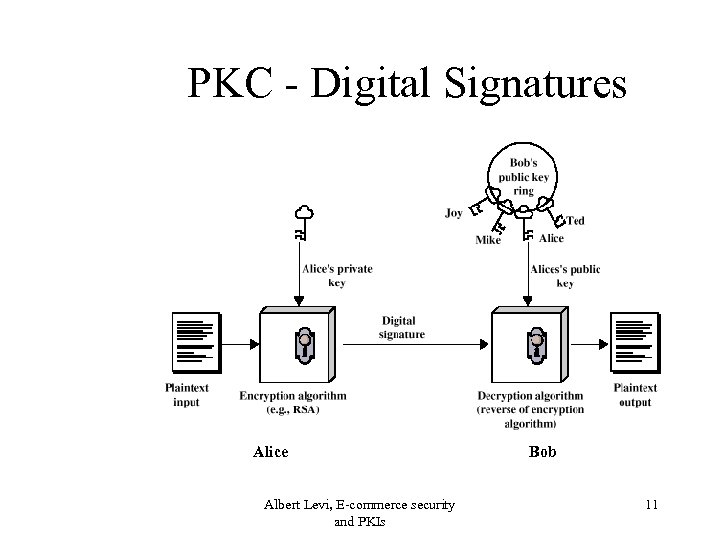
PKC - Digital Signatures Alice Albert Levi, E-commerce security and PKIs Bob 11
Public Key Distribution • Public directories/databases – everybody posts his/her public key – everybody can get others’ public key – everybody can say that “I am Madonna” • Name spoofing problem Albert Levi, E-commerce security and PKIs 12
Public Key Distribution • There must be a trusted binding between the public key and the identity of its owner • “Digital Certificates” are such bindings – issued by trusted Certificate Authorities (CA) after an identity control Albert Levi, E-commerce security and PKIs 13
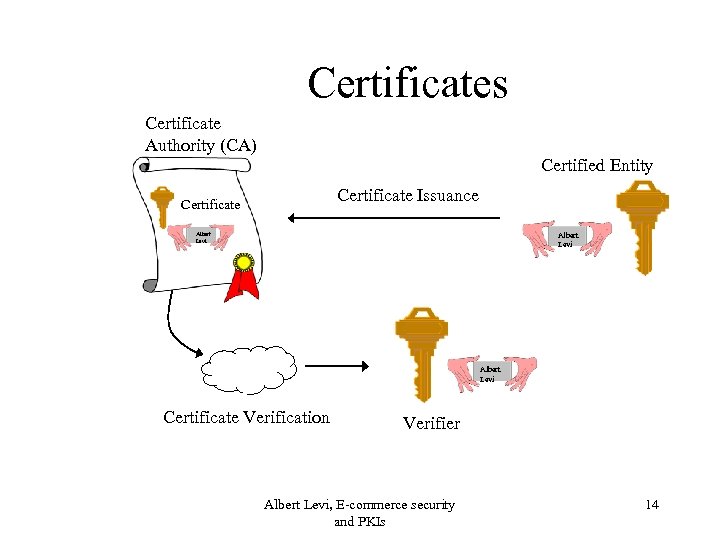
Certificates Certificate Authority (CA) Certified Entity Certificate Issuance Certificate Albert Levi Certificate Verification Verifier Albert Levi, E-commerce security and PKIs 14
E-commerce Security • Practical solution is SSL (Secure Socket Layer) – Security layer over TCP/IP – mostly for HTTP connections • encrypted and authenticated sessions between web servers and web browsers (clients) • web servers must have certificate • client certificate is optional Albert Levi, E-commerce security and PKIs 15
Using SSL in E-commerce • By using SSL we can – make sure about the merchant’s name (assuming the CA of the merchant is trusted) • authentication – make sure that nobody can see the traffic (especially the card number) between consumer and merchant • confidentiality Albert Levi, E-commerce security and PKIs 16
Using SSL in E-commerce • By using SSL we can NOT – provide privacy • merchant sees all information including the card number and name – provide non-repudiation • both parties knows the session key • charge-back cost for merchant’s – guarantee that merchant will behave honestly Albert Levi, E-commerce security and PKIs 17
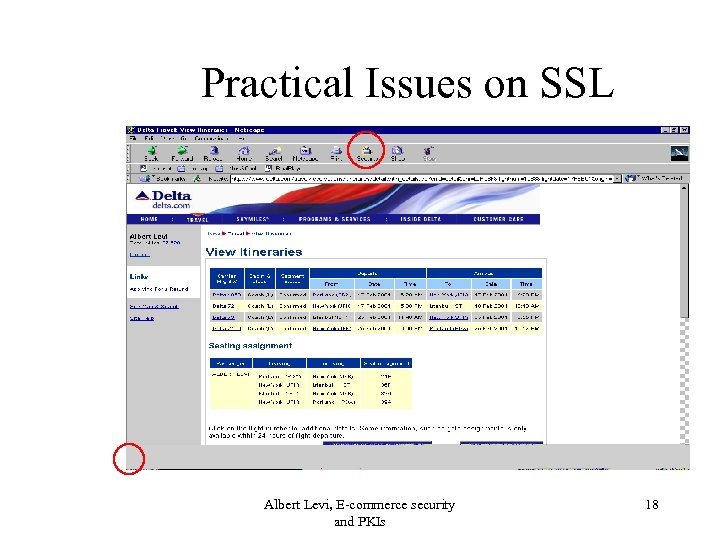
Practical Issues on SSL Albert Levi, E-commerce security and PKIs 18
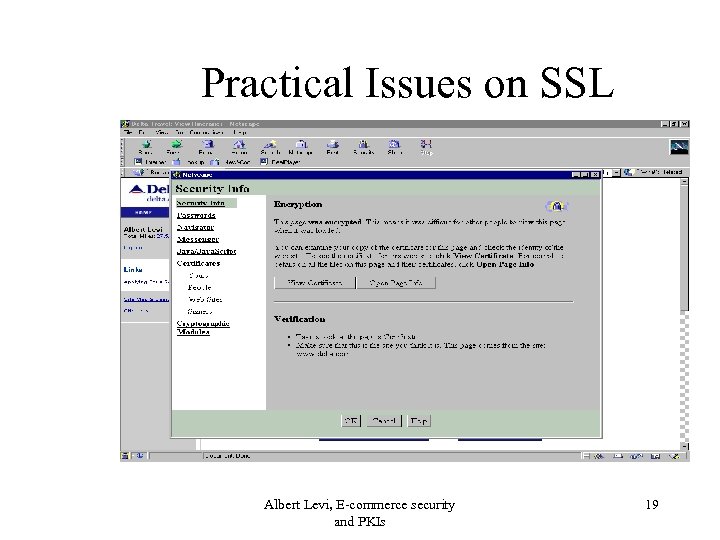
Practical Issues on SSL Albert Levi, E-commerce security and PKIs 19
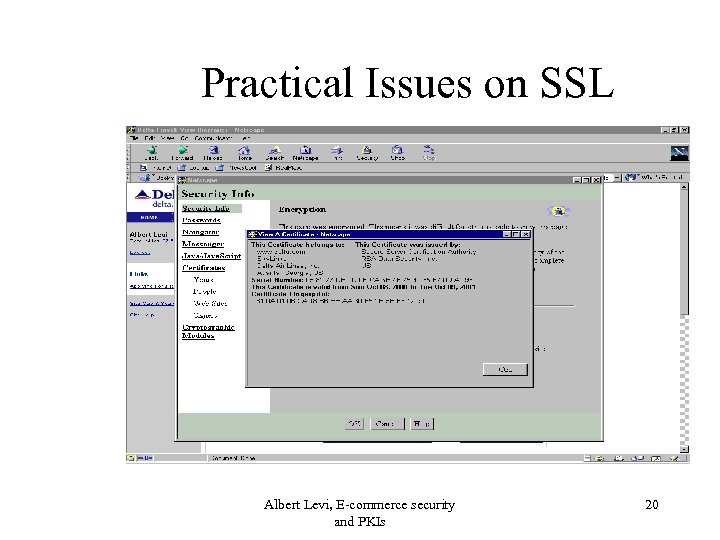
Practical Issues on SSL Albert Levi, E-commerce security and PKIs 20
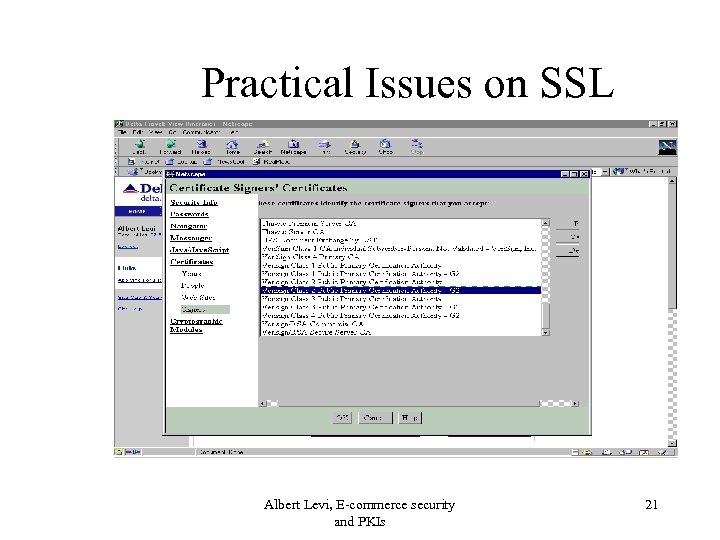
Practical Issues on SSL Albert Levi, E-commerce security and PKIs 21
Using SSL in E-commerce • SSL is not the perfect solution for secure E-commerce • but it is a convenient solution – no need for consumer certificate – just type the card number – minimal change in current business models Albert Levi, E-commerce security and PKIs 22
SET (Secure Electronic Transaction) • More secure card payment protocol • Efforts started in 1996 by the leadership of Visa and Mastercard • Still not common! Albert Levi, E-commerce security and PKIs 23
SET (Secure Electronic Transaction) • Secure, but so complex: not convenient – need-to-know • dual signatures – everybody needs certificates • consumers need to register • 5 level PKI • CAs will get a piece from the cake – time consuming PKC operations Albert Levi, E-commerce security and PKIs 24
A Practical Solution • We need to balance the security vs convenience trade-off • ANSI X 9. 59 Standard – Standardization effort on Electronic Commerce for Financial Services Industry – Financial Institutions (FIs) will take place of the CAs • AIM: no certificates issued by CAs Albert Levi, E-commerce security and PKIs 25
ANSI X 9. 59 Aim • Primary aim is to eliminate Certificate Authority (CA) based digital signatures • CAs are “extra” in the current business models ==> extra cost, complex system • No CA means no change in the current business models ==> no extra cost, simple system Albert Levi, E-commerce security and PKIs 26
ANSI X 9. 59 - Basic Characteristics • No consumer certificate – FIs keep the consumer public-keys in their account records – Consumer signature is verified by its FI, not by the merchant – CFI sends an acknowledgment to merchant Albert Levi, E-commerce security and PKIs 27
ANSI X 9. 59 - Basic Characteristics • X 9. 59 does not offer encrypted communication. • Challenging? Here is the justification: – X 9. 59 uses X 9. 59 -specific PRC (Payment Routing Code) instead of account/card numbers. PRCs are not valid without an accompanying digital signature Albert Levi, E-commerce security and PKIs 28
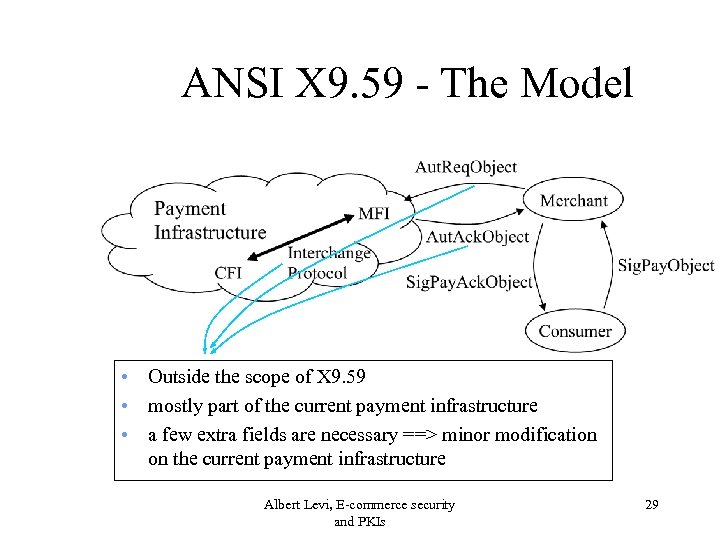
ANSI X 9. 59 - The Model • Outside the scope of X 9. 59 • mostly part of the current payment infrastructure • a few extra fields are necessary ==> minor modification on the current payment infrastructure Albert Levi, E-commerce security and PKIs 29
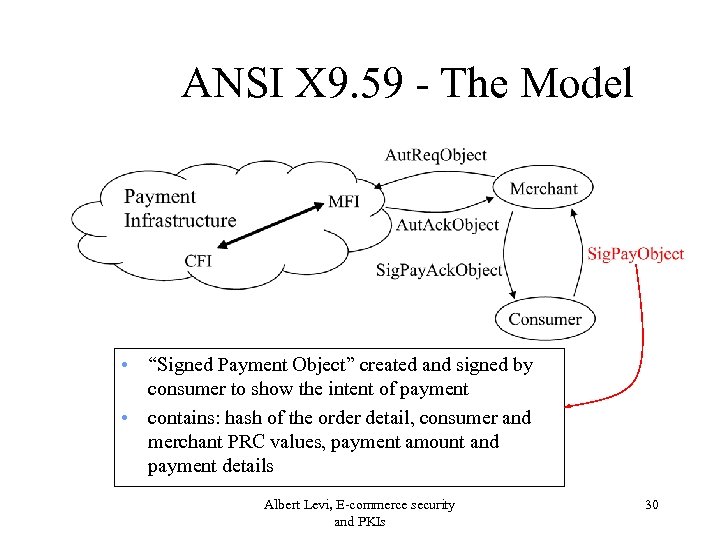
ANSI X 9. 59 - The Model • “Signed Payment Object” created and signed by consumer to show the intent of payment • contains: hash of the order detail, consumer and merchant PRC values, payment amount and payment details Albert Levi, E-commerce security and PKIs 30
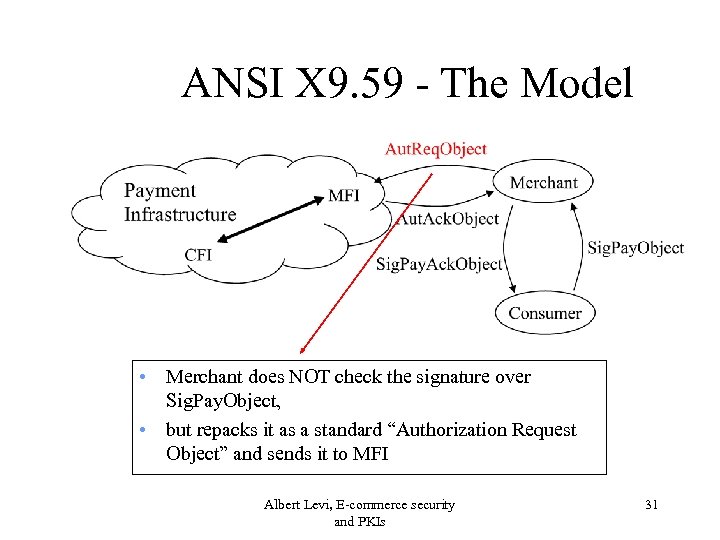
ANSI X 9. 59 - The Model • Merchant does NOT check the signature over Sig. Pay. Object, • but repacks it as a standard “Authorization Request Object” and sends it to MFI Albert Levi, E-commerce security and PKIs 31
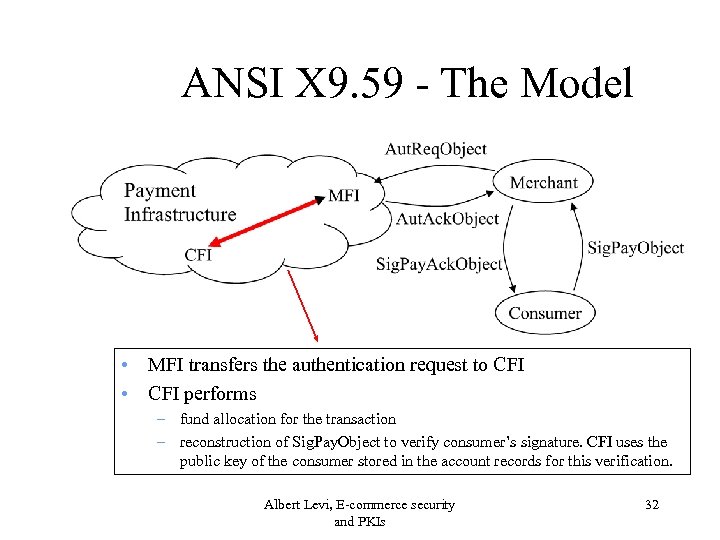
ANSI X 9. 59 - The Model • MFI transfers the authentication request to CFI • CFI performs – fund allocation for the transaction – reconstruction of Sig. Pay. Object to verify consumer’s signature. CFI uses the public key of the consumer stored in the account records for this verification. Albert Levi, E-commerce security and PKIs 32
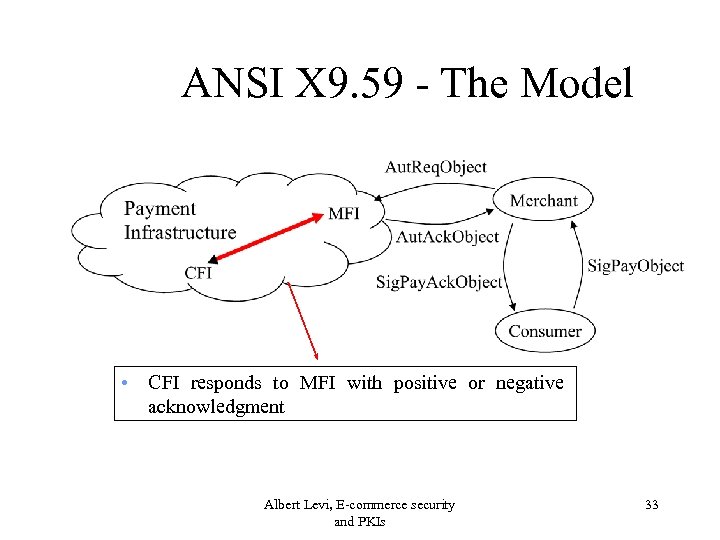
ANSI X 9. 59 - The Model • CFI responds to MFI with positive or negative acknowledgment Albert Levi, E-commerce security and PKIs 33
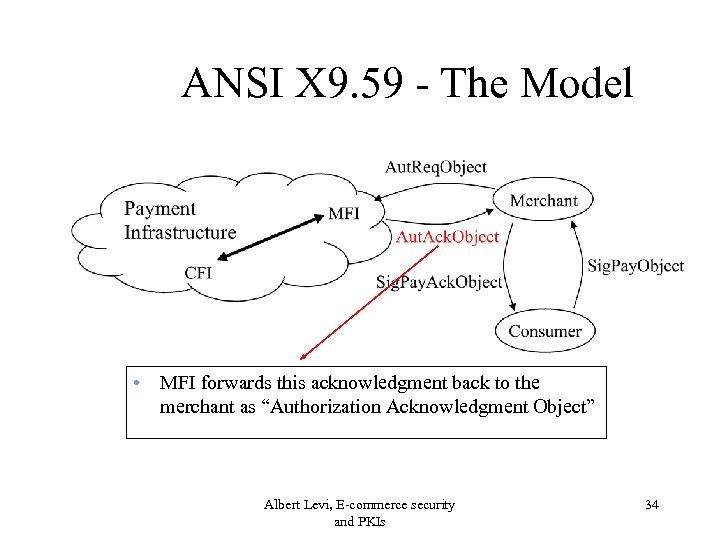
ANSI X 9. 59 - The Model • MFI forwards this acknowledgment back to the merchant as “Authorization Acknowledgment Object” Albert Levi, E-commerce security and PKIs 34
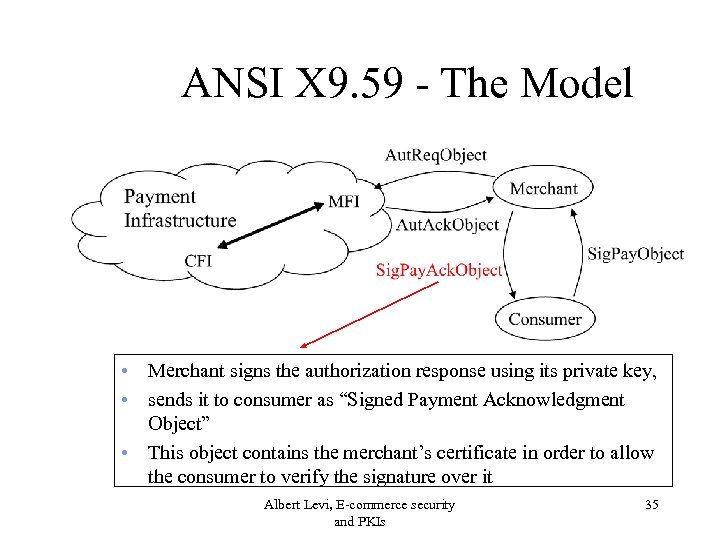
ANSI X 9. 59 - The Model • Merchant signs the authorization response using its private key, • sends it to consumer as “Signed Payment Acknowledgment Object” • This object contains the merchant’s certificate in order to allow the consumer to verify the signature over it Albert Levi, E-commerce security and PKIs 35
ANSI X 9. 59 - Two Remaining Problems • Merchant certificates are still in use – X 9. 59 offers X. 509 certificates and a corresponding PKI is necessary • Lack of encryption – No names exist on objects but PRC consumer/merchant bindings are not secret – Payment amount is sent in cleartext Albert Levi, E-commerce security and PKIs 36
ANSI X 9. 59 - Our Approach • X 9. 59 based e-payment protocol for the Internet – with solution to merchant certificate problem – with optional encryption extensions • COPSEPP (COnvenient and Practically Secure E-Payment Protocol) – our research in going on Albert Levi, E-commerce security and PKIs 37
COPSEPP • Solution to merchant certificate problem – no pre-generated certificates – MFI sends the merchant’s certificate upon request – Attachments to authorization messages • no extra messages – Only one extra signature is sufficient Albert Levi, E-commerce security and PKIs 38
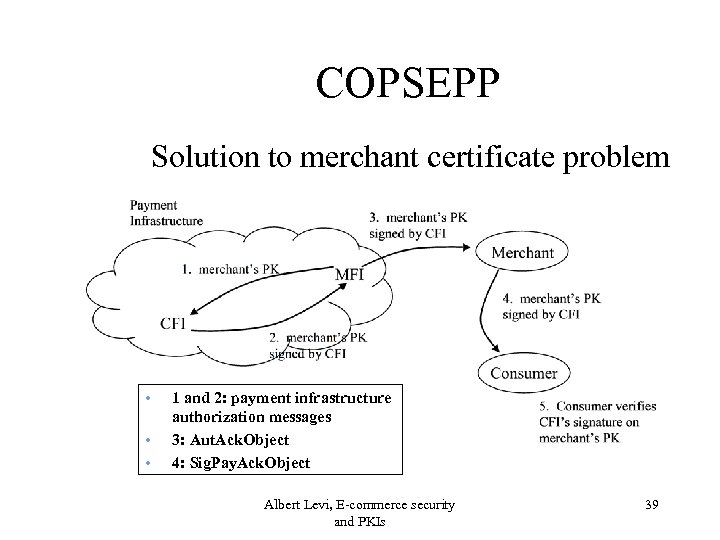
COPSEPP Solution to merchant certificate problem • • • 1 and 2: payment infrastructure authorization messages 3: Aut. Ack. Object 4: Sig. Pay. Ack. Object Albert Levi, E-commerce security and PKIs 39
COPSEPP • Optional encryption extensions – between merchant and MFI • easy, they know each other’s public key – between customer and merchant • difficult but possible without extra messages other than the existing authorization messages Albert Levi, E-commerce security and PKIs 40
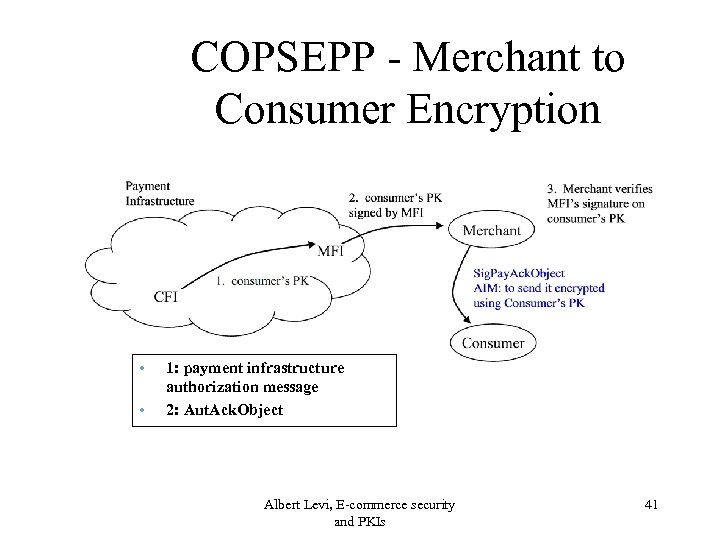
COPSEPP - Merchant to Consumer Encryption • • 1: payment infrastructure authorization message 2: Aut. Ack. Object Albert Levi, E-commerce security and PKIs 41
COPSEPP - Consumer to Merchant Encryption • Encrypting Sig. Pay. Object • Ongoing research – consumer needs to know Merchant’s PK at the beginning • impossible without using extra message rounds – we think a system where Consumer encrypts the object using CFI’s public key and CFI returns the decrypted object to merchant – no extra messages Albert Levi, E-commerce security and PKIs 42
Скачать презентацию E-commerce Security Albert Levi Oregon State University Information
28132f8094e6a18b410fba0bb1f3a7d6.ppt