


 Скачать презентацию E-Commerce Overview and Introduction Jifeng Luo Antai College
bf4914ea701075ce81ae709d1e6faa11.ppt
- Количество слайдов: 34
 E-Commerce: Overview and Introduction Jifeng Luo Antai College of Management, SJTU luojf@sjtu. edu. cn
 Introduction Course Introduction What is E-Commerce? E-Commerce History E-commerce Companies -- Cases
 Course Objectives One track covers IT strategy concepts such as: • Using IT/Internet to influence competition (based on Michael Porter’s Competitive Forces Model) • Using IT/Internet to facilitate value configurations such as the Value Chain • Using IT/Internet to facilitate new business model • Using IT/Internet to engage in e-marketing Another track exposes students to some fundamental issues in the e-commerce environment • Legal, ethical, and international perspectives. • Security issue, like network availability and access control, confidentiality, authentication and message integrity.
 Introduction Instructor: Jifeng Luo / 罗继锋 Class Time: Tuesday 10: 00 am– 12: 40 pm Office Location: 法华镇校区北楼 402 (402 North Building) Phone: 52302519 E-mail: Office Hours: luojf@sjtu. edu. cn Wednesday 10: 00 -12: 00 am or by appointment Class e-mail: sjtuecommerce@gmail. com
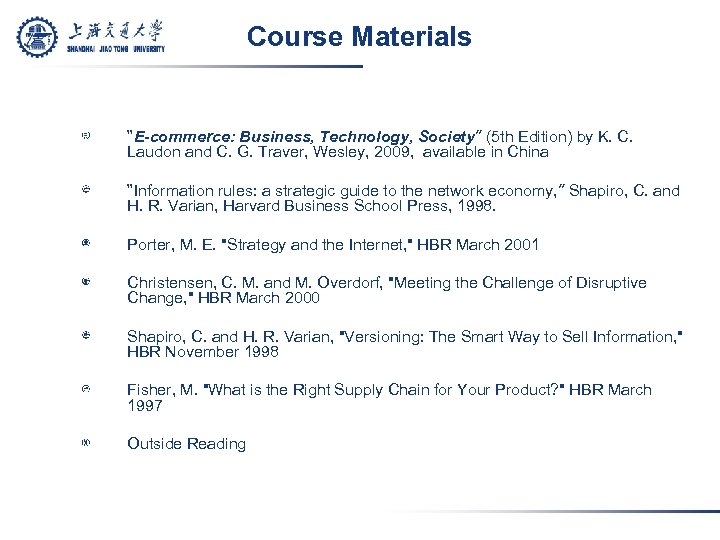 Course Materials “E-commerce: Business, Technology, Society” (5 th Edition) by K. C. Laudon and C. G. Traver, Wesley, 2009, available in China “Information rules: a strategic guide to the network economy, ” Shapiro, C. and H. R. Varian, Harvard Business School Press, 1998. Porter, M. E. "Strategy and the Internet, " HBR March 2001 Christensen, C. M. and M. Overdorf, "Meeting the Challenge of Disruptive Change, " HBR March 2000 Shapiro, C. and H. R. Varian, "Versioning: The Smart Way to Sell Information, " HBR November 1998 Fisher, M. "What is the Right Supply Chain for Your Product? " HBR March 1997 Outside Reading
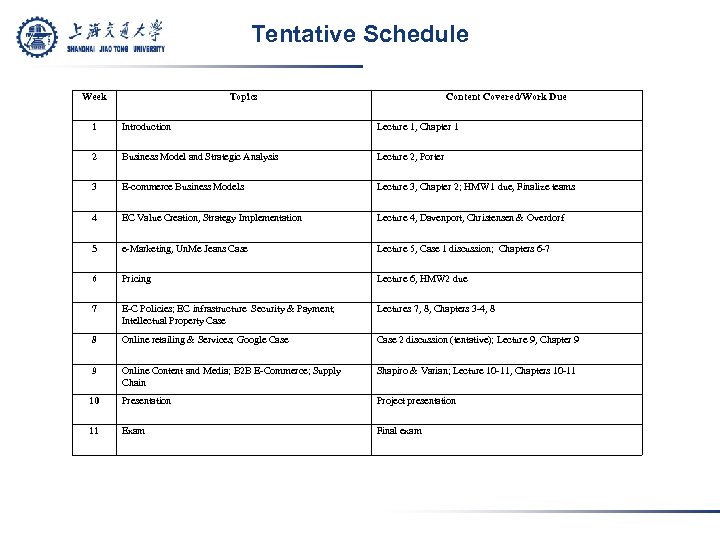 Tentative Schedule Week Topics Content Covered/Work Due 1 Introduction Lecture 1, Chapter 1 2 Business Model and Strategic Analysis Lecture 2, Porter 3 E-commerce Business Models Lecture 3, Chapter 2; HMW 1 due, Finalize teams 4 EC Value Creation, Strategy Implementation Lecture 4, Davenport, Christensen & Overdorf 5 e-Marketing, Un. Me Jeans Case Lecture 5, Case 1 discussion; Chapters 6 -7 6 Pricing Lecture 6, HMW 2 due 7 E-C Policies; EC infrastructure Security & Payment; Intellectual Property Case Lectures 7, 8, Chapters 3 -4, 8 8 Online retailing & Services; Google Case 2 discussion (tentative); Lecture 9, Chapter 9 9 Online Content and Media; B 2 B E-Commerce; Supply Chain Shapiro & Varian; Lecture 10 -11, Chapters 10 -11 10 Presentation Project presentation 11 Exam Final exam
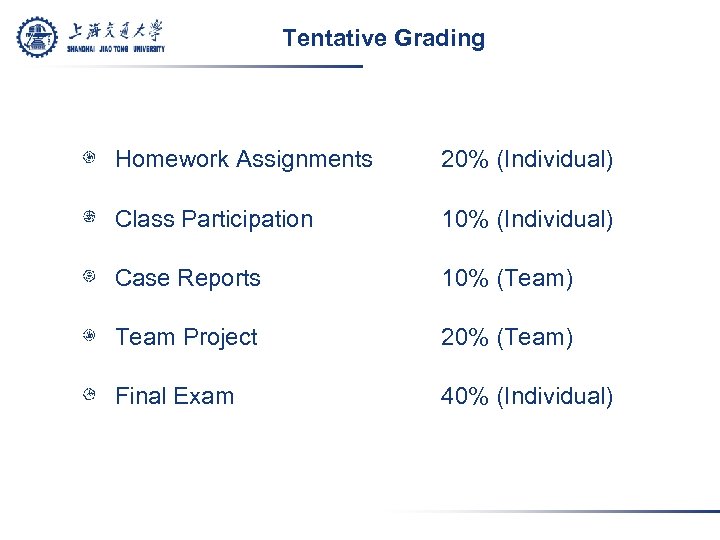 Tentative Grading Homework Assignments 20% (Individual) Class Participation 10% (Individual) Case Reports 10% (Team) Team Project 20% (Team) Final Exam 40% (Individual)
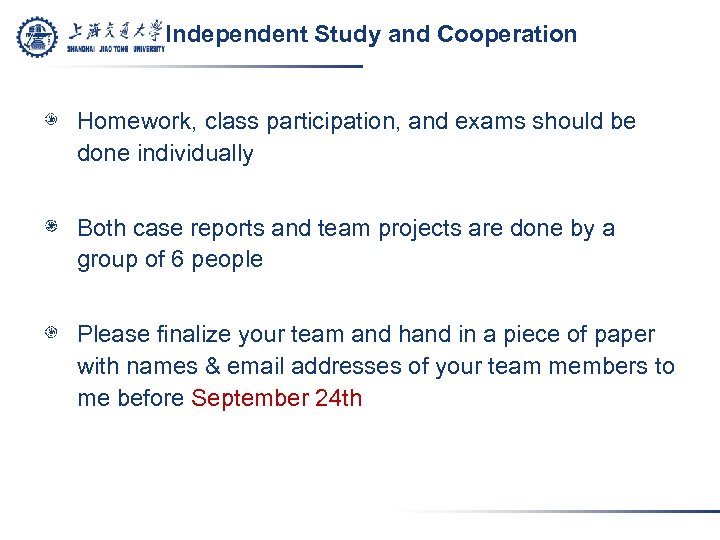 Independent Study and Cooperation Homework, class participation, and exams should be done individually Both case reports and team projects are done by a group of 6 people Please finalize your team and hand in a piece of paper with names & email addresses of your team members to me before September 24 th
 Case discussions Each case discussion will require one or two group to develop a case analysis Discussion in class. You may be asked to summarize your analysis through a presentation to the rest of the class. So you should have 4 -5 slides prepared for each case that respond to the main questions that I will give you. This is group work. Each group will get a chance to present a case. Need to be prepared with each case. Preparation and discussion are important to a case. Quality not quantity of contribution will count toward your participation grade.
 Team Project Analyze an e-commerce company
 Introduction Course Introduction What is E-Commerce? E-commerce History E-commerce Companies -- Cases
 What is Electronic Commerce? Use the Internet, Web or any electronic means to do the following…… • commercial transactions between and among organizations and individuals • include all transactions mediated by digital technology • commercial transactions involve the exchange of value across organizational or individual boundaries in return for products or services
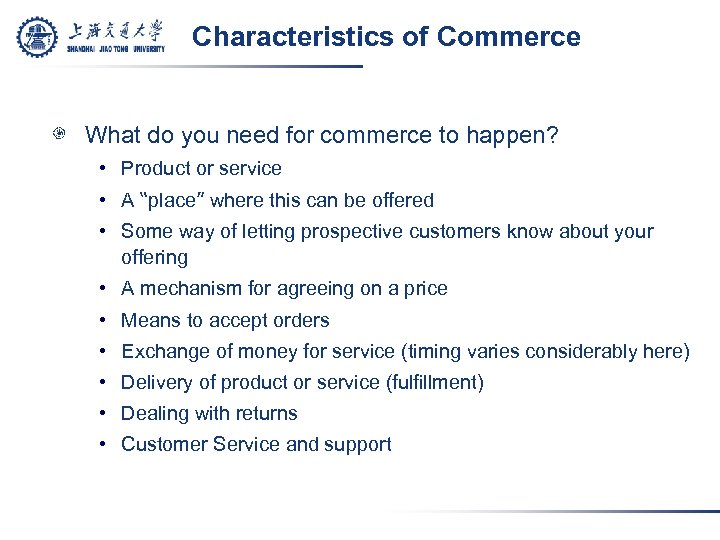 Characteristics of Commerce What do you need for commerce to happen? • Product or service • A “place” where this can be offered • Some way of letting prospective customers know about your offering • A mechanism for agreeing on a price • Means to accept orders • Exchange of money for service (timing varies considerably here) • Delivery of product or service (fulfillment) • Dealing with returns • Customer Service and support
 So, what does “e” bring to the table? Your turn……
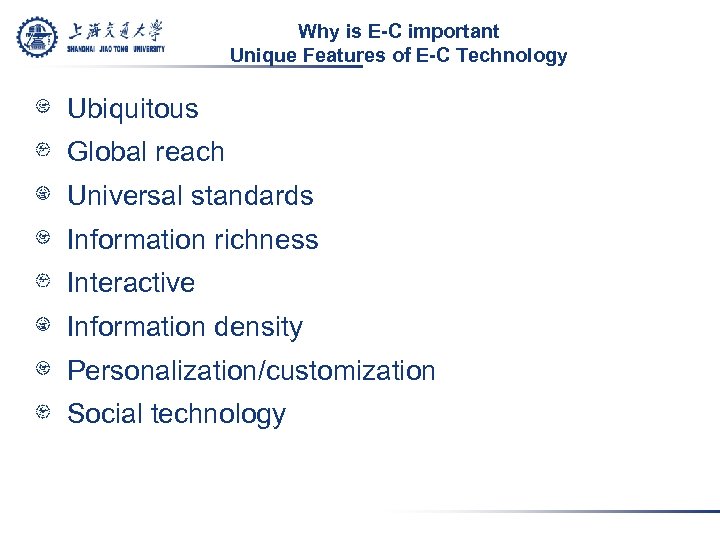 Why is E-C important Unique Features of E-C Technology Ubiquitous Global reach Universal standards Information richness Interactive Information density Personalization/customization Social technology
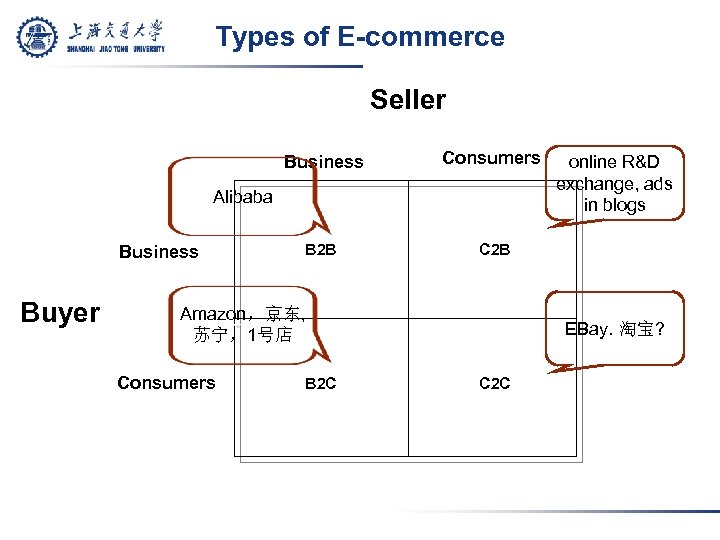 Types of E-commerce Seller Business Consumers B 2 B C 2 B Alibaba Business Buyer Amazon,京东, 苏宁,1号店 Consumers B 2 C online R&D exchange, ads in blogs EBay. 淘宝? C 2 C
 User and open innovations this previously unmeasured type of household sector innovation to be quite large: 6. 1% of UK consumers— nearly 2. 9 million individuals— have engaged in consumer product innovation during the prior three years. In aggregate, consumers’ annual product development expenditures are more than 1. 4 times larger than the annual consumer product R&D expenditures of all firms in the United Kingdom combined. Consumers engage in many small projects that seem complementary to the innovation efforts of incumbent producers. Consumer innovators very seldom protect their innovations via intellectual property, and 17% diffuse to others. 17
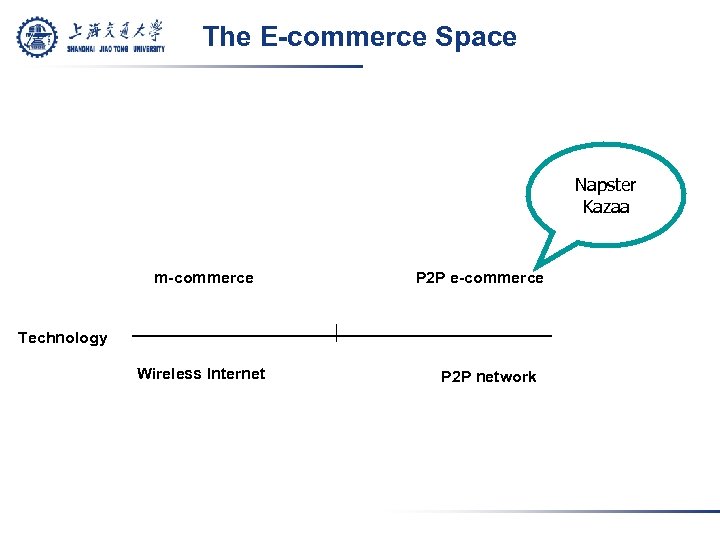 The E-commerce Space Napster Kazaa m-commerce P 2 P e-commerce Technology Wireless Internet P 2 P network
 E-Commerce: Alternate Perspectives Ø Is e. Commerce = e. Business? Ø Is e. Commerce = dot-coms? Ø Is e. Commerce = e-tailing? Ø Is e. Commerce = B 2 B exchanges?
 Introduction Course Introduction What is E-Commerce? E-commerce History E-commerce Companies -- Cases
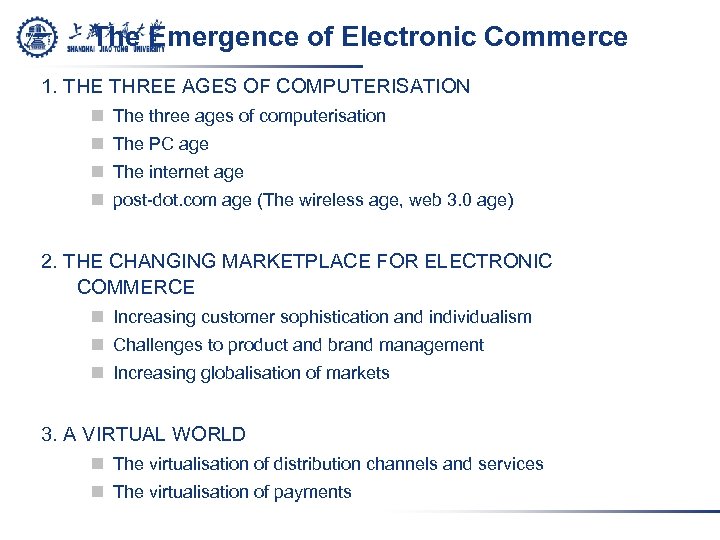 The Emergence of Electronic Commerce 1. THE THREE AGES OF COMPUTERISATION n The three ages of computerisation n The PC age n The internet age n post-dot. com age (The wireless age, web 3. 0 age) 2. THE CHANGING MARKETPLACE FOR ELECTRONIC COMMERCE n Increasing customer sophistication and individualism n Challenges to product and brand management n Increasing globalisation of markets 3. A VIRTUAL WORLD n The virtualisation of distribution channels and services n The virtualisation of payments
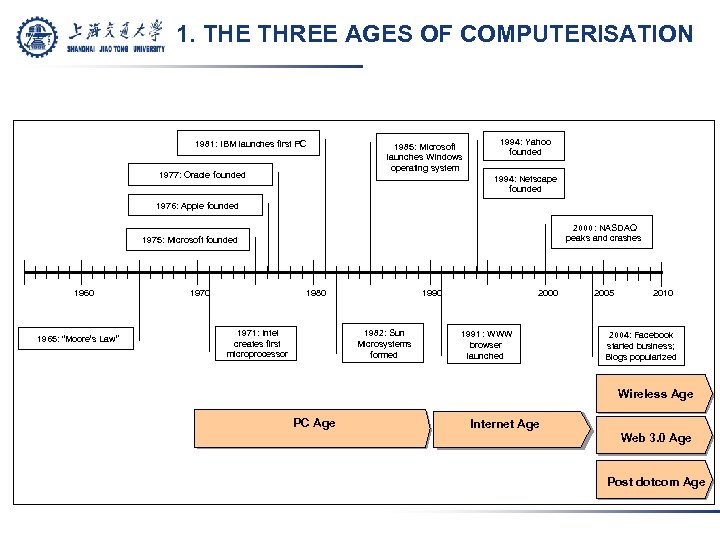 1. THE THREE AGES OF COMPUTERISATION 1981: IBM launches first PC 1977: Oracle founded 1985: Microsoft launches Windows operating system 1994: Yahoo founded 1994: Netscape founded 1976: Apple founded 2000: NASDAQ peaks and crashes 1975: Microsoft founded 1960 1965: “Moore’s Law” 1970 1980 1971: Intel creates first microprocessor 1990 1982: Sun Microsystems formed PC Age 2000 1991 : WWW browser launched Internet Age 2005 2010 2004: Facebook started business; Blogs popularized Wireless Age Internet Age Web 3. 0 Age Post dotcom Age
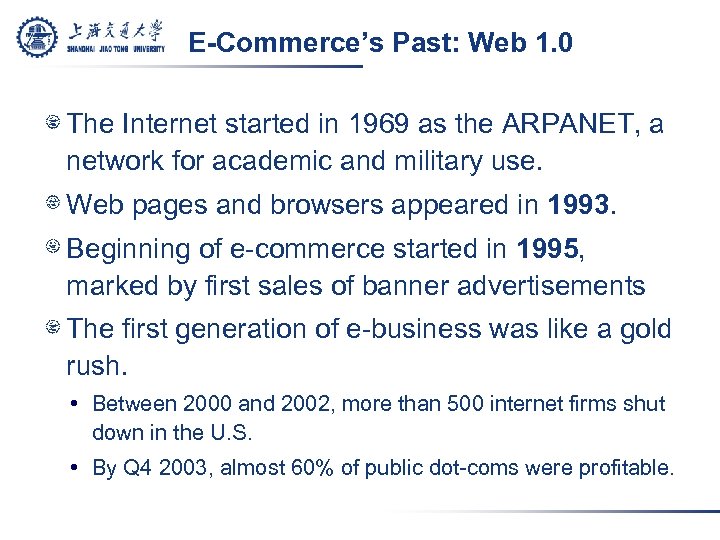 E-Commerce’s Past: Web 1. 0 1 -23 The Internet started in 1969 as the ARPANET, a network for academic and military use. Web pages and browsers appeared in 1993. Beginning of e-commerce started in 1995, marked by first sales of banner advertisements The first generation of e-business was like a gold rush. • Between 2000 and 2002, more than 500 internet firms shut down in the U. S. • By Q 4 2003, almost 60% of public dot-coms were profitable.
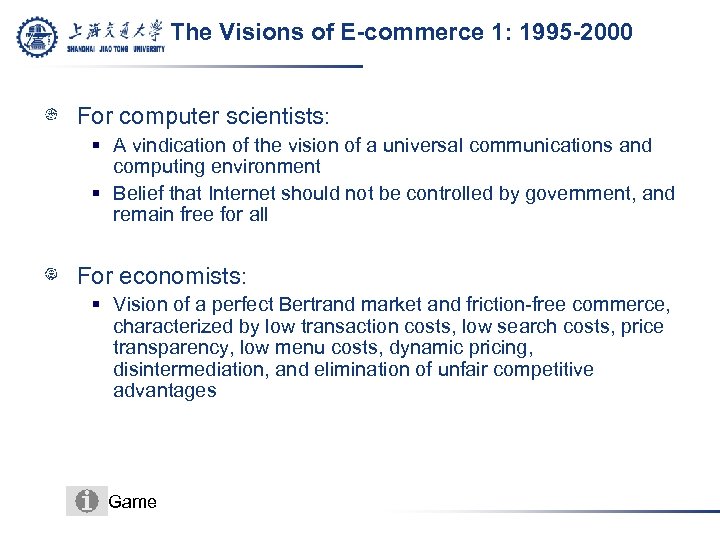 The Visions of E-commerce 1: 1995 -2000 For computer scientists: § A vindication of the vision of a universal communications and computing environment § Belief that Internet should not be controlled by government, and remain free for all For economists: § Vision of a perfect Bertrand market and friction-free commerce, characterized by low transaction costs, low search costs, price transparency, low menu costs, dynamic pricing, disintermediation, and elimination of unfair competitive advantages Game
 The Visions of E-commerce 1: 1995 -2000 (cont’d) For entrepreneurs, e-commerce represented an extraordinary opportunity of return far above normal returns: § Worldwide access to consumers § New marketing communications technologies that were universal, inexpensive and powerful § Ability to segment market § First mover advantages – by building in switching costs § Network effects The view circa 1995 -2000 • We can sell X on the Internet! • The US market is $N billion, we'll capture 10% and make 40% margins for an easy profit of $40 N million per year • We can sell to the rest of the world too • All we need is a server, a programmer, and eyeballs
 Crash of E-commerce 1 Crash in stock market values for ecommerce throughout 2000 marks The end of E-commerce I period Reasons for crash: § Run-up in technology stocks due to enormous information technology capital expenditure of firms rebuilding their internal business systems to withstand Y 2 K § Telecommunications industry had built excess capacity in high-speed fiber optic networks § 1999 Christmas season provided less sales growth that anticipated and demonstrated e-commerce was not easy (e. Toys. com) § Valuations of dot. com and technology companies had risen so high supporters were questioning whether earnings could justify the prices of the shares.
 Assessing E-commerce 1: Successes, Surprises and Failures Stunning technological success A mixed success from business perspective Many early visions not fulfilled • Friction-free commerce • Consumers less price-sensitive than expected • Considerable price dispersion remains • Perfect competition • Transaction costs still high • Intermediaries remain Slide 1 -27
 E-Commerce Today: Web 2. 0 1 -28 Web 1. 0 connected people to networks. Web 2. 0 connected people with machines and each other. Web 2. 0 is the second generation of internet technology and includes: • Blogs • Social networking • Photo, video, and bookmark sharing
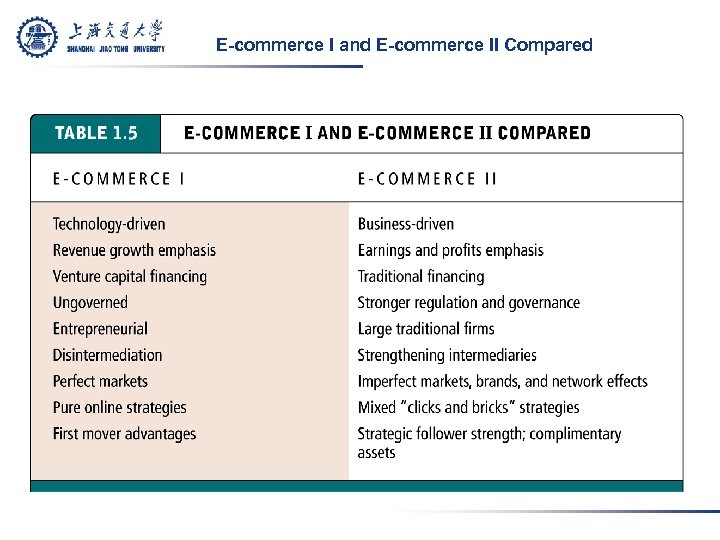 E-commerce I and E-commerce II Compared
 1 -30 The newest technologies allow marketers to focus on user: • Engagement • Participation • Co-creation Online gaming represented over $1 billion in revenue and 15 million players in 2006.
 E-commerce Trends New business models based on social technologies and user-generated content Internet marketing: search engine marketing and other online WOM challenge traditional marketing More and more people/businesses use Internet to conduct commerce Broadband wireless Internet access growing, City-wide access! Continued conflict over copyrights, content regulation, taxation, privacy, Internet fraud and abuse.
 The Future: Web 3. 0/Semantic Web 1 -32 The Semantic Web will utilize a standard definition protocol that will allow users to find information based on its type, such as: • The next available appointment for a doctor. • Details about an upcoming concert. • Menu at the local restaurant. Represents the next huge advance: providing worldwide access to data on demand without effort.
 The Future: Wireless 1 -33 Cell phones, PDAs, and laptops connect to the internet via wireless modem worldwide. • Starbucks • Hotels and airports • Queen Mary II luxury liner • Amtrak train stations Customers will have information, entertainment, and communication when, where, and how they want it.
 Buzz E-words 1. Google 10. User Generated Content 2. Yahoo! 11. Social Bookmarking 3. Priceline/Expedia 12. Music and Video sharing 4. Secondlife. com 13. Vo. IP 5. Myspace/Facebook 14. RFID 6. Youtube 15. Twitter 7. Zopa 8. Photobucket/Flickr 9. Wiki Homework 1