


 Скачать презентацию E-Commerce and Its Effect on Pricing and Strategic
1871683da28aa2a32395771754e7393c.ppt
- Количество слайдов: 41
 E-Commerce and Its Effect on Pricing and Strategic Positioning July 30, 2001 216 -792
 Impact of E-Commerce u Good news and Bad news!
 Smart competitors grow stronger, dumb competitors grow weaker
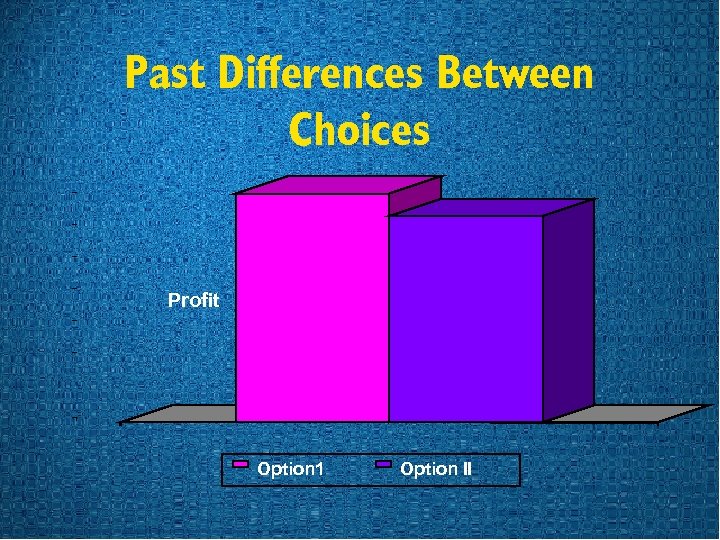 Past Differences Between Choices Profit Option 1 Option II
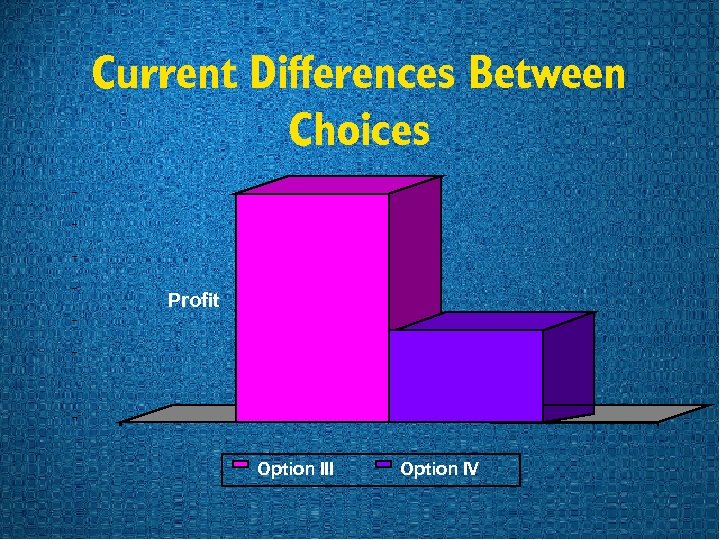 Current Differences Between Choices Profit Option III Option IV
 Competition
 Profits will increasingly diverge!
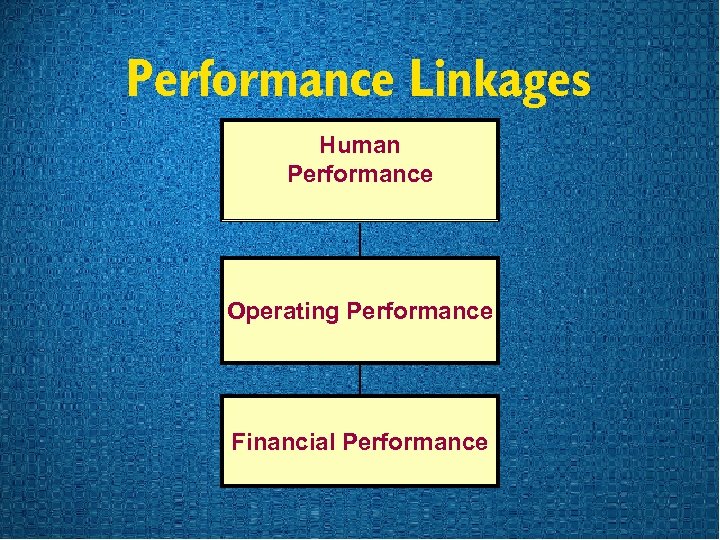 Performance Linkages Human Performance Operating Performance Financial Performance
 Profitability Dispersion
 E-Commerce Impacts u Lower communication costs for sellers u Sometimes lower logistics & service costs for sellers u Lower search & acquisition costs for buyers u More exposure to buyers for sellers u More exposure to sellers for buyers u Less “total friction” in the transaction system
 Changes in Transportation & Communication Time & Cost u The wheel u Domesticated animals u Sails u Roads u Engines u Rails u Telegraph u Telephone u Electronic media
 Interesting Examples u Swift replaces Allan’s Butcher Shop u Amazon. com clips Barnes & Noble u Free. Markets On. Linecuts supplier margins 15% u E-mail reduces usage for Post Office
![Transportation & Communication Costs [Past, Present & Future]](https://present5.com/presentation/1871683da28aa2a32395771754e7393c/image-13.jpg "Transportation & Communication Costs [Past, Present & Future]") Transportation & Communication Costs [Past, Present & Future]
Transportation & Communication Costs [Past, Present & Future]
 Speculation on the E-Commerce Impact u Custom structural steel u Business software upgrades u Pornographic videotapes u Retail landscaping services u Construction services: large commercial buildings u Remote diagnostic services for industrial machinery u Commercial crushed rock u Worldwide travel weather information u Rare stamps for serious collectors u Retail fruits & vegetables
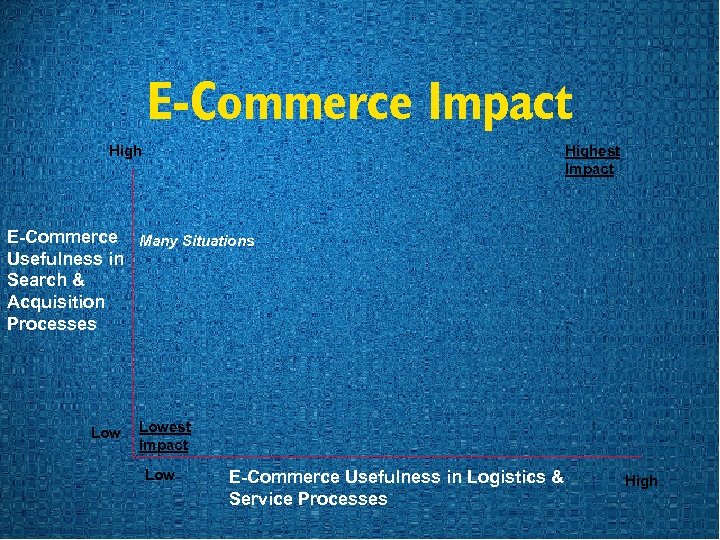 E-Commerce Impact Highest Impact E-Commerce Many Situations Usefulness in Search & Acquisition Processes Lowest Impact Low E-Commerce Usefulness in Logistics & Service Processes High
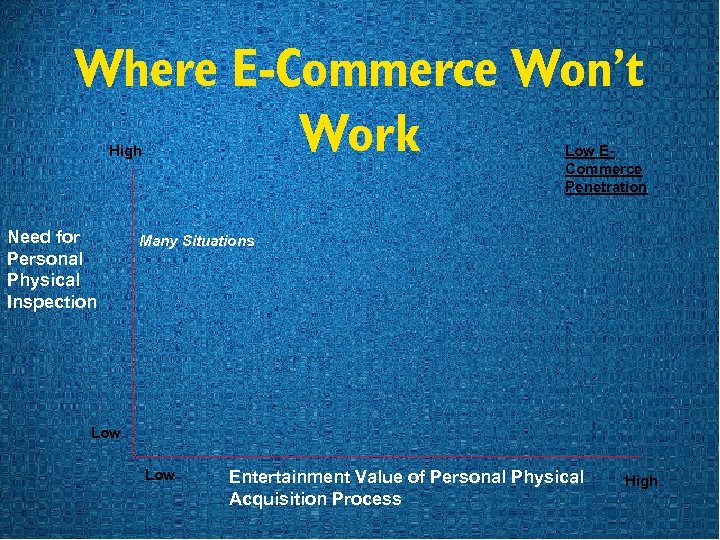 Where E-Commerce Won’t Work High Need for Personal Physical Inspection Low ECommerce Penetration Many Situations Low Entertainment Value of Personal Physical Acquisition Process High
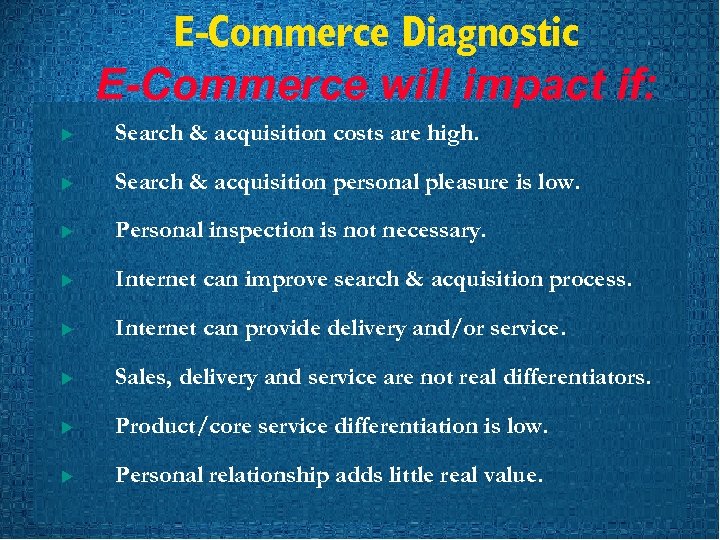 E-Commerce Diagnostic E-Commerce will impact if: u Search & acquisition costs are high. u Search & acquisition personal pleasure is low. u Personal inspection is not necessary. u Internet can improve search & acquisition process. u Internet can provide delivery and/or service. u Sales, delivery and service are not real differentiators. u Product/core service differentiation is low. u Personal relationship adds little real value.
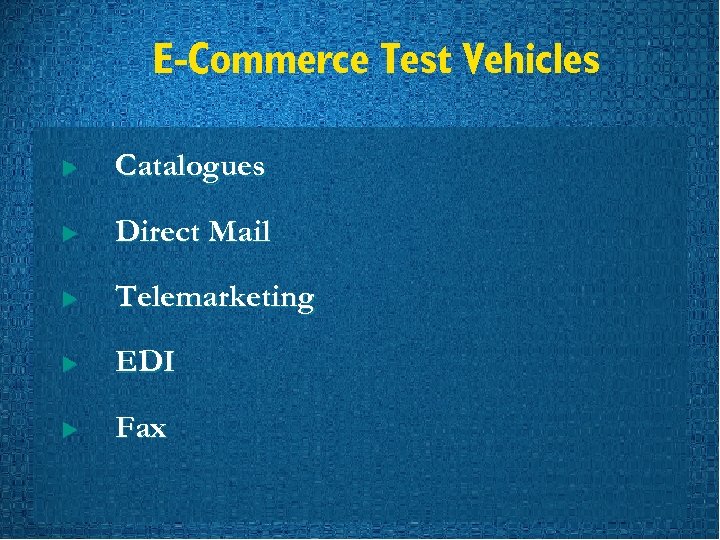 E-Commerce Test Vehicles u Catalogues u Direct Mail u Telemarketing u EDI u Fax
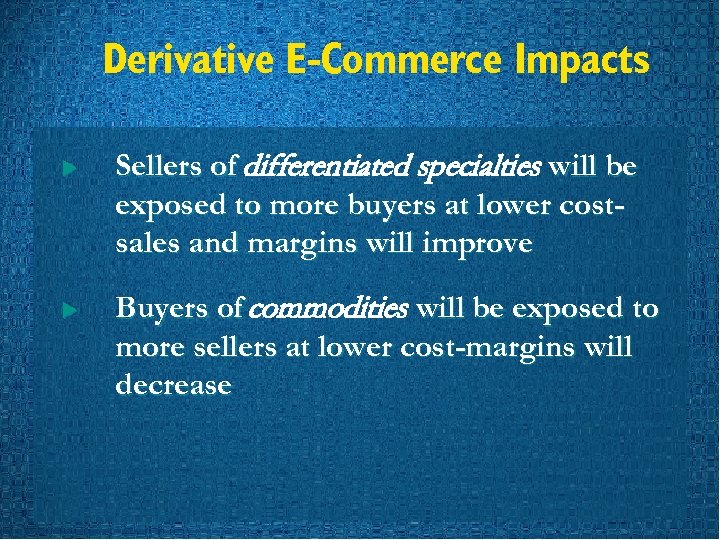 Derivative E-Commerce Impacts u u Sellers of differentiated specialties will be exposed to more buyers at lower costsales and margins will improve Buyers of commodities will be exposed to more sellers at lower cost-margins will decrease
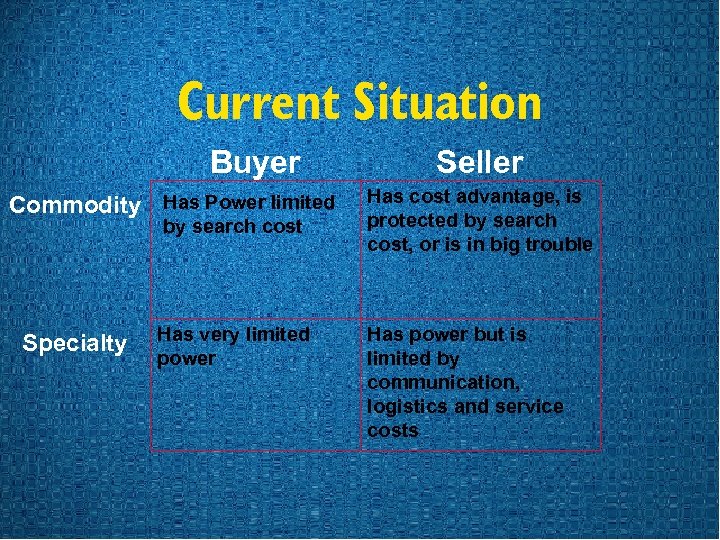 Current Situation Buyer Commodity Has Power limited by search cost Specialty Has very limited power Seller Has cost advantage, is protected by search cost, or is in big trouble Has power but is limited by communication, logistics and service costs
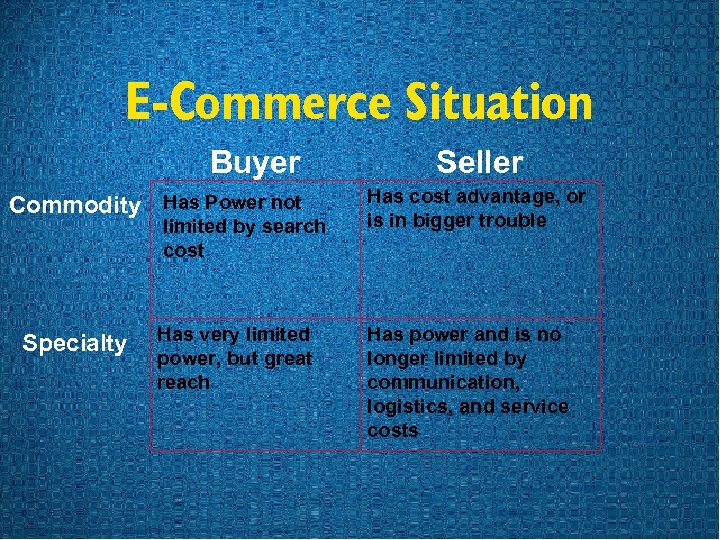 E-Commerce Situation Buyer Commodity Has Power not limited by search cost Specialty Has very limited power, but great reach Seller Has cost advantage, or is in bigger trouble Has power and is no longer limited by communication, logistics, and service costs
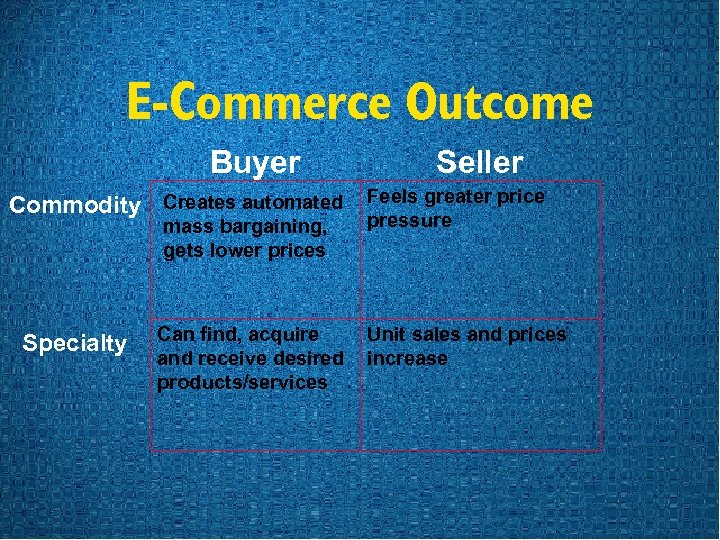 E-Commerce Outcome Buyer Commodity Creates automated mass bargaining, gets lower prices Specialty Can find, acquire and receive desired products/services Seller Feels greater price pressure Unit sales and prices increase
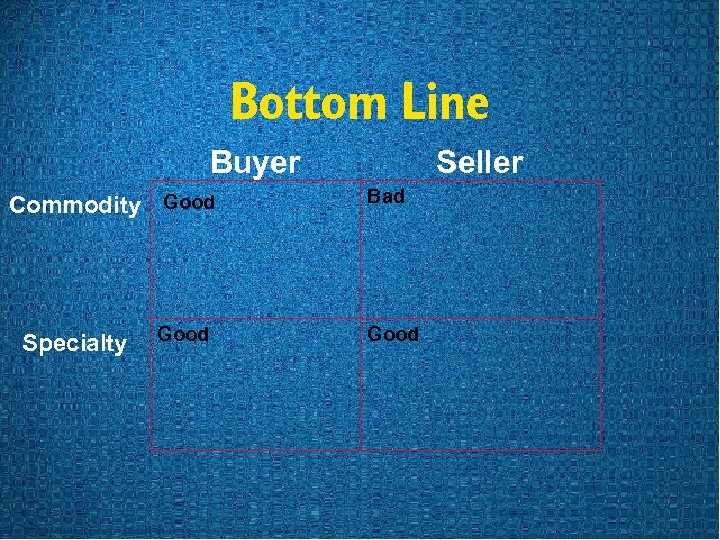 Bottom Line Buyer Commodity Good Specialty Good Seller Bad Good
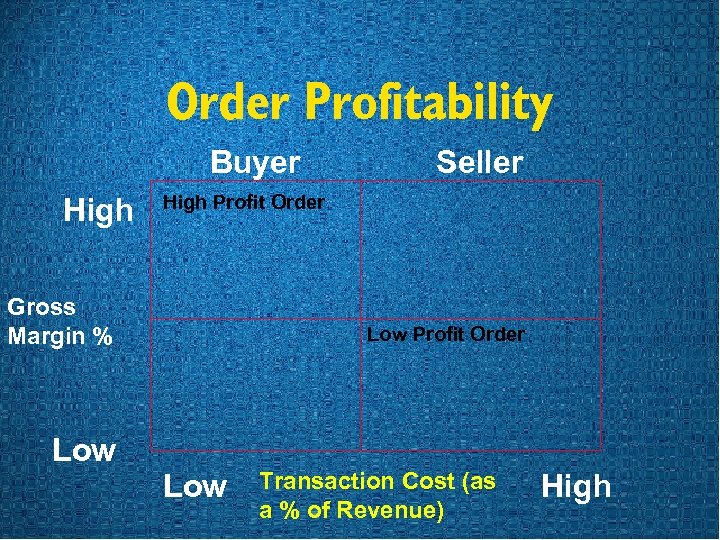 Order Profitability Buyer High Seller High Profit Order Gross Margin % Low Profit Order Low Transaction Cost (as a % of Revenue) High
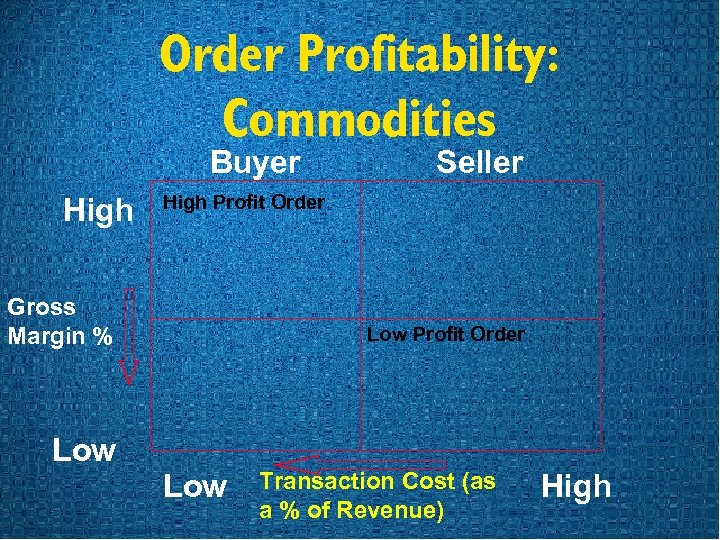 Order Profitability: Commodities Buyer High Seller High Profit Order Gross Margin % Low Profit Order Low Transaction Cost (as a % of Revenue) High
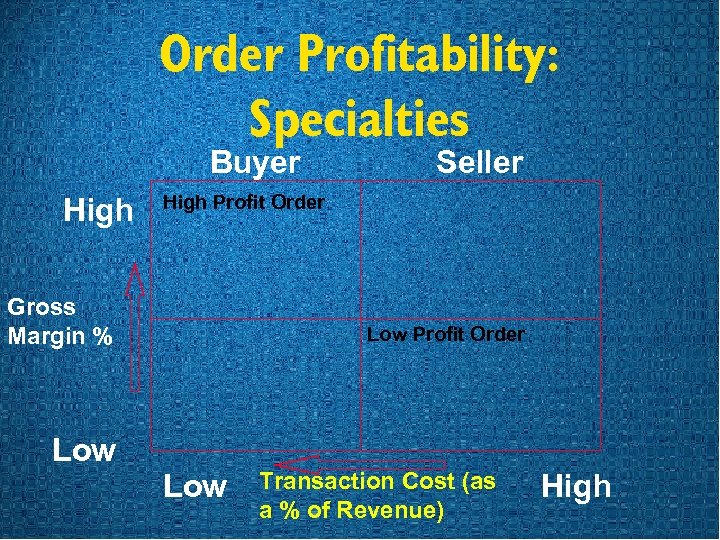 Order Profitability: Specialties Buyer High Seller High Profit Order Gross Margin % Low Profit Order Low Transaction Cost (as a % of Revenue) High
 Why are large companies generally doing better than small companies in profit growth, and stock price-to-earnings ratios?
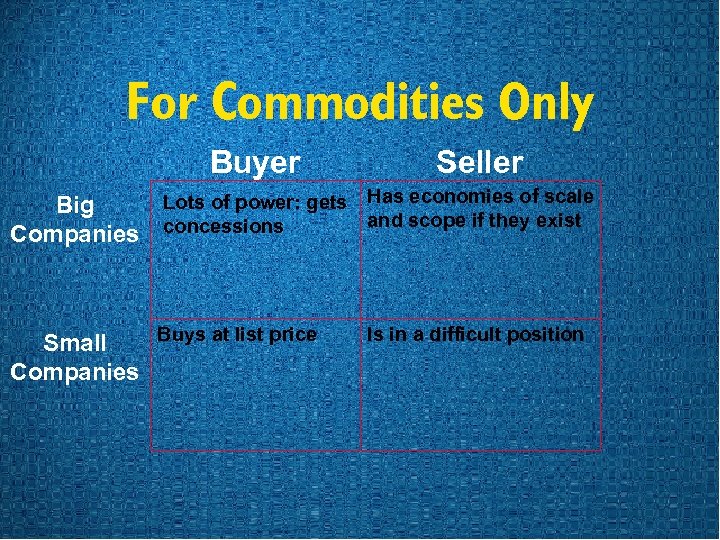 For Commodities Only Buyer Seller Lots of power: gets Has economies of scale Big and scope if they exist concessions Companies Buys at list price Small Companies Is in a difficult position
 Likely Outcome u Specialty sellers make more money: higher unit volume at higher gross margins with lower transaction costs. u Commodity sellers make less money unless they have a cost advantage: lower gross margins but with lower transaction cost. u Low cost commodity sellers prosper : if their increased unit volume and lower transaction costs more than compensate for lower gross margins. High fixed cost structures help.
 E-Commerce Questions: Offense u Can I use E-Commerce to reach new prospects? u Can I use E-Commerce to manage order flow? u Can I add value to my sales effort (e. g. , customer advice, design, etc. ) with E-Commerce? u Can I deliver products/services with E-Commerce? u Can I provide post sales service with E-Commerce? u Can I support distributors/dealers/salespeople with E-Commerce? u Can I influenceinfluentialswith E-Commerce? u Can I reduce costs with E-Commerce?
 E-Commerce Questions: Defense u Are my products/services differentiated? u Is my differentiation increasing or decreasing? u What are my competitors doing with E-Commerce? u What are potential competitors doing with ECommerce? u What are my suppliers, customers and distributors doing with E-Commerce? u Will I be “commoditized ”? u Will I be “disintermediated ”?
 Some Emerging Traps u Customers price shop u Customers product/service shop u Competitive myopia u Relationship to incumbent distribution channels u Relationship to incumbent sales forces u Relationship to service organizations u Obsolete logistics/support thinking u Customer value & differentiation distraction u Non-system thinking u Ignoring profits
 Leverage Points u Customer Value u “Go to Market” architecture u Precision Pricing u Jurisdictional Integration u Execution Speed & Precision u Relationship “Equity”
 Customer Value u Convenience u Availability u Function u Relationship u Price
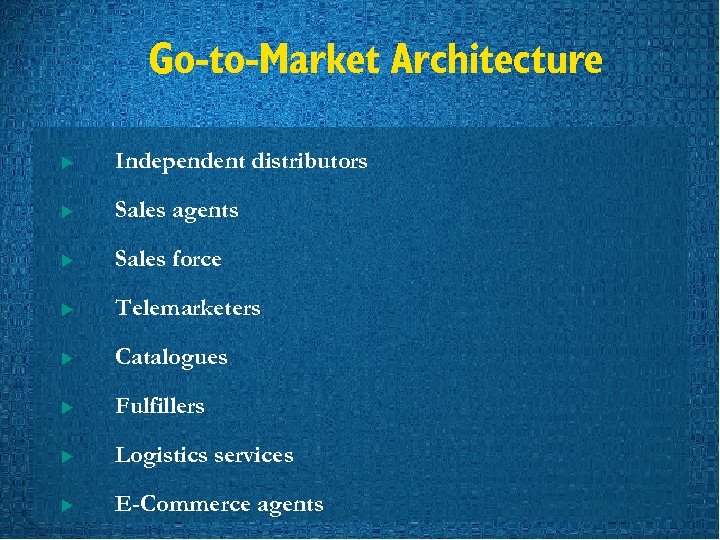 Go-to-Market Architecture u Independent distributors u Sales agents u Sales force u Telemarketers u Catalogues u Fulfillers u Logistics services u E-Commerce agents
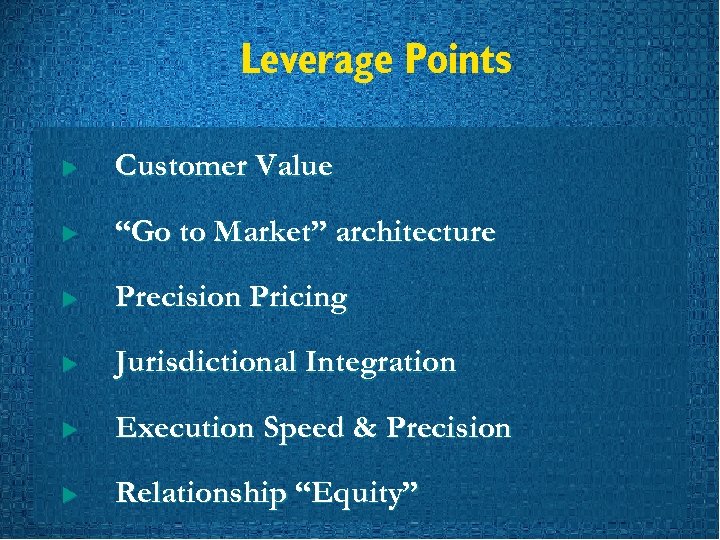 Leverage Points u Customer Value u “Go to Market” architecture u Precision Pricing u Jurisdictional Integration u Execution Speed & Precision u Relationship “Equity”
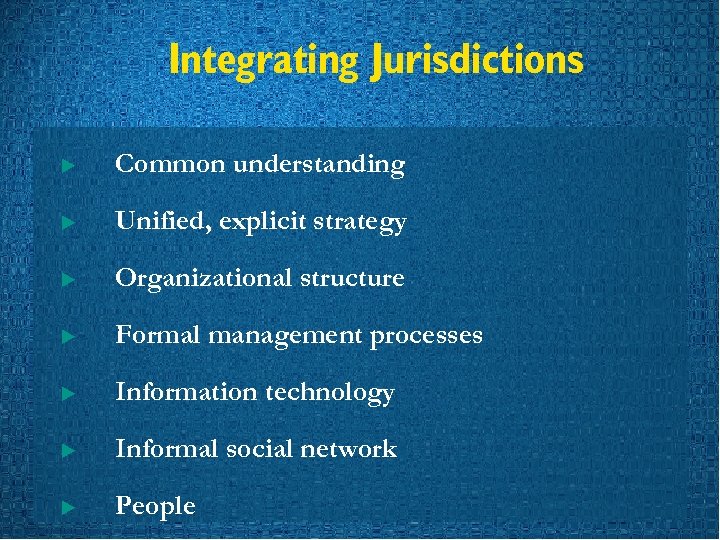 Integrating Jurisdictions u Common understanding u Unified, explicit strategy u Organizational structure u Formal management processes u Information technology u Informal social network u People
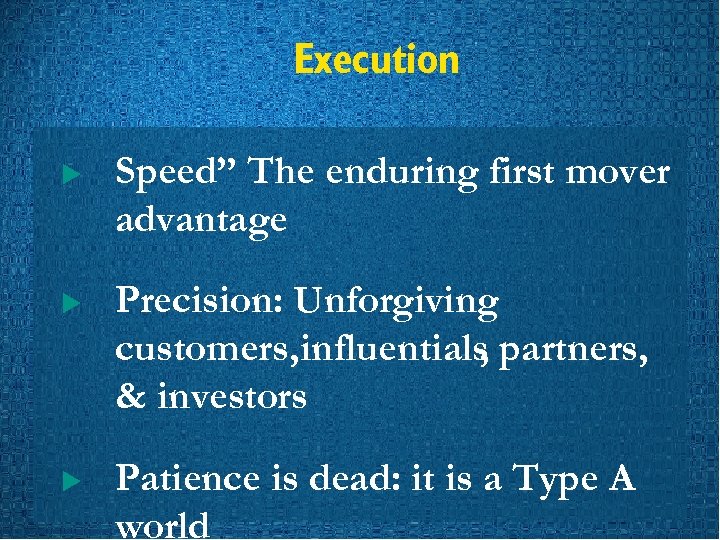 Execution u Speed” The enduring first mover advantage u Precision: Unforgiving customers, influentials partners, , & investors u Patience is dead: it is a Type A world
 Relationship Equity: The Enduring Assets u Customer relationships: “brand” equity u The organization & its people
 Attention!! Tectonic Changes Ahead u Great Opportunity u Catastrophic Threats
 Questions?