 Скачать презентацию E-commerce 2014 business technology society tenth edition Kenneth
bf8065404bfe4b8b64a7a399388896fb.ppt
- Количество слайдов: 42



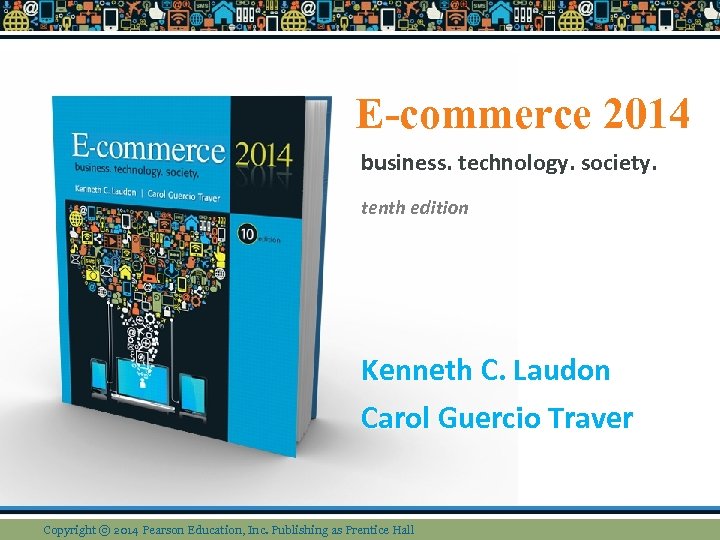
E-commerce 2014 business. technology. society. tenth edition Kenneth C. Laudon Carol Guercio Traver Copyright © 2014 Pearson Education, Inc. Publishing as Prentice Hall
Chapter 2 E-commerce Business Models and Concepts Copyright © 2014 Pearson Education, Inc. Publishing as Prentice Hall
Class Discussion Tweet: Twitter’s Business Model What characteristics or benchmarks can be used to assess the business value of a company such as Twitter? n Have you used Twitter to communicate with friends or family? What are your thoughts on this service? n What are Twitter’s most important assets? n Which of the various methods described for monetizing Twitter’s assets do you feel might be most successful? n Copyright © 2014 Pearson Education, Inc. Publishing as Prentice Hall Slide 2 -3
E-commerce Business Models n Business model v Set of planned activities designed to result in a profit in a marketplace n Business plan v Describes a firm’s business model n E-commerce business model v Uses/leverages unique qualities of Internet and Web Copyright © 2014 Pearson Education, Inc. Publishing as Prentice Hall Slide 2 -4
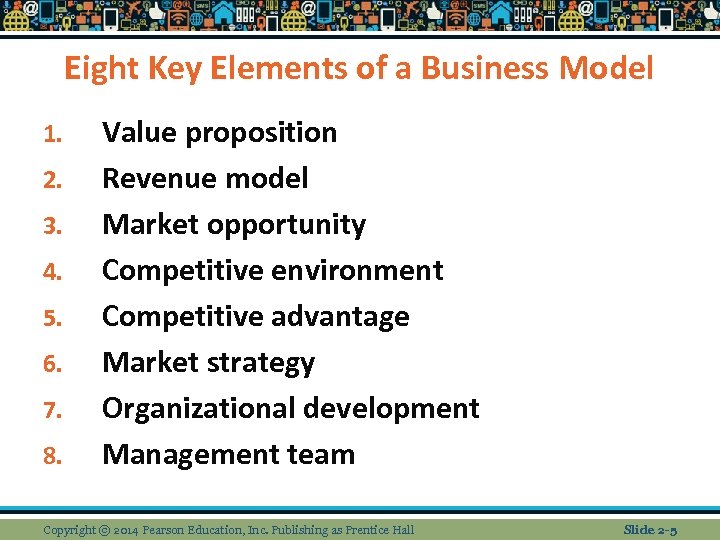
Eight Key Elements of a Business Model 1. 2. 3. 4. 5. 6. 7. 8. Value proposition Revenue model Market opportunity Competitive environment Competitive advantage Market strategy Organizational development Management team Copyright © 2014 Pearson Education, Inc. Publishing as Prentice Hall Slide 2 -5
1. Value Proposition n “Why should the customer buy from you? ” n Successful e-commerce value propositions: v Personalization/customization v Reduction of product search, price discovery costs v Facilitation of transactions by managing product delivery Copyright © 2014 Pearson Education, Inc. Publishing as Prentice Hall Slide 2 -6
2. Revenue Model n “How will you earn money? ” n Major types of revenue models: v Advertising revenue model v Subscription revenue model v Transaction fee revenue model v Sales revenue model v Affiliate revenue model Copyright © 2014 Pearson Education, Inc. Publishing as Prentice Hall Slide 2 -7
Insight on Society: Class Discussion Foursquare: Check Your Privacy at the Door n What revenue model does Foursquare use? What other revenue models might be appropriate? n Are privacy concerns the only shortcoming of location-based mobile services? n Should business firms be allowed to call cell phones with advertising messages based on location? Copyright © 2014 Pearson Education, Inc. Publishing as Prentice Hall Slide 2 -8
3. Market Opportunity n “What marketspace do you intend to serve and what is its size? ” v Marketspace: Area of actual or potential commercial value in which company intends to operate v Realistic market opportunity: Defined by revenue potential in each market niche in which company hopes to compete n Market opportunity typically divided into smaller niches Copyright © 2014 Pearson Education, Inc. Publishing as Prentice Hall Slide 2 -9
4. Competitive Environment n “Who else occupies your intended marketspace? ” v Other companies selling similar products in the same marketspace v Includes both direct and indirect competitors n Influenced by: v Number and size of active competitors v Each competitor’s market share v Competitors’ profitability v Competitors’ pricing Copyright © 2014 Pearson Education, Inc. Publishing as Prentice Hall Slide 2 -10
5. Competitive Advantage n “What special advantages does your firm bring to the marketspace? ” v Is your product superior to or cheaper to produce than your competitors’? n Important concepts: v Asymmetries v First-mover advantage, complementary resources v Unfair competitive advantage v Leverage v Perfect markets Copyright © 2014 Pearson Education, Inc. Publishing as Prentice Hall Slide 2 -11
6. Market Strategy n “How do you plan to promote your products or services to attract your target audience? ” v Details how a company intends to enter market and attract customers v Best business concepts will fail if not properly marketed to potential customers Copyright © 2014 Pearson Education, Inc. Publishing as Prentice Hall Slide 2 -12
7. Organizational Development n “What types of organizational structures within the firm are necessary to carry out the business plan? ” n Describes how firm will organize work v Typically, divided into functional departments v As company grows, hiring moves from generalists to specialists Copyright © 2014 Pearson Education, Inc. Publishing as Prentice Hall Slide 2 -13
8. Management Team n “What kind of backgrounds should the company’s leaders have? ” n A strong management team: v Can make the business model work v Can give credibility to outside investors v Has market-specific knowledge v Has experience in implementing business plans Copyright © 2014 Pearson Education, Inc. Publishing as Prentice Hall Slide 2 -14
Raising Capital n Seed capital n Traditional sources v Incubators v Commercial banks v Angel investors v Venture capital firms v Strategic partners n Crowdfunding v JOBS Act Copyright © 2014 Pearson Education, Inc. Publishing as Prentice Hall Slide 2 -15
Insight on Business: Class Discussion Crowdfunding Takes Off n What types of projects and companies might be able to most successfully use crowdfunding? n Are there any negative aspects to crowdfunding? n What obstacles are presented in the use of crowdfunding as a method to fund start-ups? Copyright © 2014 Pearson Education, Inc. Publishing as Prentice Hall Slide 2 -16
Categorizing E-commerce Business Models n No one correct way n Text categorizes according to: v E-commerce sector (e. g. , B 2 B) v E-commerce technology (e. g. , m-commerce) n Similar business models appear in more than one sector n Some companies use multiple business models (e. g. , e. Bay) Copyright © 2014 Pearson Education, Inc. Publishing as Prentice Hall Slide 2 -17
B 2 C Business Models n E-tailer n Community provider (social network) n Content provider n Portal n Transaction broker n Market creator n Service provider Copyright © 2014 Pearson Education, Inc. Publishing as Prentice Hall Slide 2 -18
B 2 C Models: E-tailer n Online version of traditional retailer n Revenue model: Sales n Variations: v Virtual merchant v Bricks-and-clicks v Catalog merchant v Manufacturer-direct n Low barriers to entry Copyright © 2014 Pearson Education, Inc. Publishing as Prentice Hall Slide 2 -19
B 2 C Models: Community Provider n Provide online environment (social network) where people with similar interests can transact, share content, and communicate v Examples: Facebook, Linked. In, Twitter, Pinterest n Revenue models: v Typically hybrid, combining advertising, subscriptions, sales, transaction fees, and so on Copyright © 2014 Pearson Education, Inc. Publishing as Prentice Hall Slide 2 -20
B 2 C Models: Content Provider n Digital content on the Web: v News, music, video, text, artwork n Revenue models: v Subscription; pay per download (micropayment); advertising; affiliate referral n Variations: v Syndication v Web aggregators Copyright © 2014 Pearson Education, Inc. Publishing as Prentice Hall Slide 2 -21
Insight on Technology: Class Discussion Battle of the Titans: Music in the Cloud n Have you purchased music online or subscribed to a music service? What was your experience? n What revenue models do cloud music services use? n Do cloud music services provide a clear advantage over download and subscription services? n Of the cloud services from Google, Amazon, and Apple, which would you prefer to use, and why? Copyright © 2014 Pearson Education, Inc. Publishing as Prentice Hall Slide 2 -22
B 2 C Business Models: Portal n Search plus an integrated package of content and services n Revenue models: v Advertising, referral fees, transaction fees, subscriptions n Variations: v Horizontal/general v Vertical/specialized (vortal) v Search Copyright © 2014 Pearson Education, Inc. Publishing as Prentice Hall Slide 2 -23
B 2 C Models: Transaction Broker n Process online transactions for consumers v Primary value proposition—saving time and money n Revenue model: v Transaction fees n Industries using this model: v Financial services v Travel services v Job placement services Copyright © 2014 Pearson Education, Inc. Publishing as Prentice Hall Slide 2 -24
B 2 C Models: Market Creator n Create digital environment where buyers and sellers can meet and transact n Examples: v Priceline v e. Bay n Revenue model: Transaction fees, fees to merchants for access Copyright © 2014 Pearson Education, Inc. Publishing as Prentice Hall Slide 2 -25
B 2 C Models: Service Provider n Online services v Example: Google—Google Maps, Gmail, and so on n Value proposition v Valuable, convenient, time-saving, low-cost alternatives to traditional service providers n Revenue models: v Sales of services, subscription fees, advertising, sales of marketing data Copyright © 2014 Pearson Education, Inc. Publishing as Prentice Hall Slide 2 -26
B 2 B Business Models n Net marketplaces v E-distributor v E-procurement v Exchange v Industry consortium n Private industrial network Copyright © 2014 Pearson Education, Inc. Publishing as Prentice Hall Slide 2 -27
B 2 B Models: E-distributor n Version of retail and wholesale store, MRO goods, and indirect goods n Owned by one company seeking to serve many customers n Revenue model: Sales of goods n Example: Grainger. com Copyright © 2014 Pearson Education, Inc. Publishing as Prentice Hall Slide 2 -28
B 2 B Models: E-procurement n Creates digital markets where participants transact for indirect goods v B 2 B service providers, application service providers (ASPs) n Revenue model: v Service fees, supply-chain management, fulfillment services n Example: Ariba Copyright © 2014 Pearson Education, Inc. Publishing as Prentice Hall Slide 2 -29
B 2 B Models: Exchanges n Independently owned vertical digital marketplace for direct inputs n Revenue model: Transaction, commission fees n Create powerful competition between suppliers n Tend to force suppliers into powerful price competition; number of exchanges has dropped dramatically Copyright © 2014 Pearson Education, Inc. Publishing as Prentice Hall Slide 2 -30
B 2 B Models: Industry Consortia n Industry-owned vertical digital marketplace open to select suppliers n More successful than exchanges v Sponsored by powerful industry players v Strengthen traditional purchasing behavior n Revenue model: Transaction, commission fees n Example: Exostar Copyright © 2014 Pearson Education, Inc. Publishing as Prentice Hall Slide 2 -31
Private Industrial Networks n Digital network used to coordinate among firms engaged in business together n Typically evolve out of company’s internal enterprise system n Example: Walmart’s network for suppliers n Cost absorbed by network owner and recovered through production and distribution efficiencies Copyright © 2014 Pearson Education, Inc. Publishing as Prentice Hall Slide 2 -32
E-commerce Enablers: The Gold Rush Model n E-commerce infrastructure companies have profited the most: v Hardware, software, networking, security v E-commerce software systems, payment systems v Media solutions, performance enhancement v CRM software v Databases v Hosting services, and so on Copyright © 2014 Pearson Education, Inc. Publishing as Prentice Hall Slide 2 -33
How E-commerce Changes Business n E-commerce changes industry structure by changing: v Rivalry among existing competitors v Barriers to entry v Threat of new substitute products v Strength of suppliers v Bargaining power of buyers Copyright © 2014 Pearson Education, Inc. Publishing as Prentice Hall Slide 2 -34
Industry Value Chains n Set of activities performed by suppliers, manufacturers, transporters, distributors, and retailers that transform raw inputs into final products and services n Internet reduces cost of information and other transactional costs n Leads to greater operational efficiencies, lowering cost, prices, adding value for customers Copyright © 2014 Pearson Education, Inc. Publishing as Prentice Hall Slide 2 -35
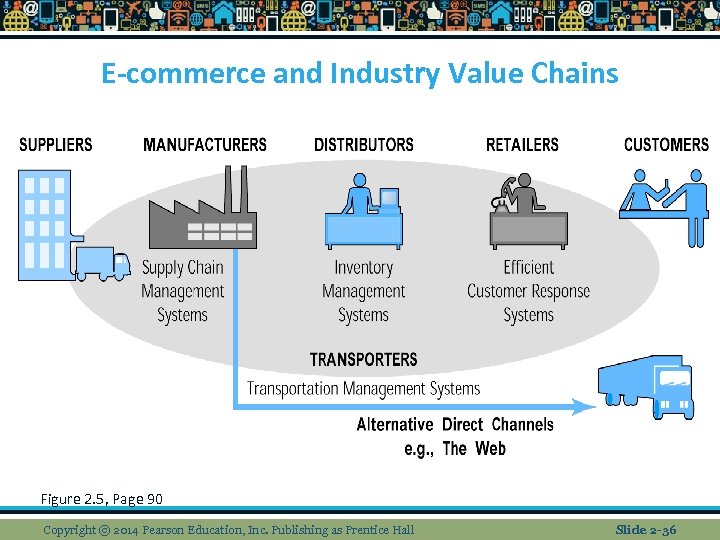
E-commerce and Industry Value Chains Figure 2. 5, Page 90 Copyright © 2014 Pearson Education, Inc. Publishing as Prentice Hall Slide 2 -36
Firm Value Chains n Activities that a firm engages in to create final products from raw inputs n Each step adds value n Effect of Internet: v Increases operational efficiency v Enables product differentiation v Enables precise coordination of steps in chain Copyright © 2014 Pearson Education, Inc. Publishing as Prentice Hall Slide 2 -37
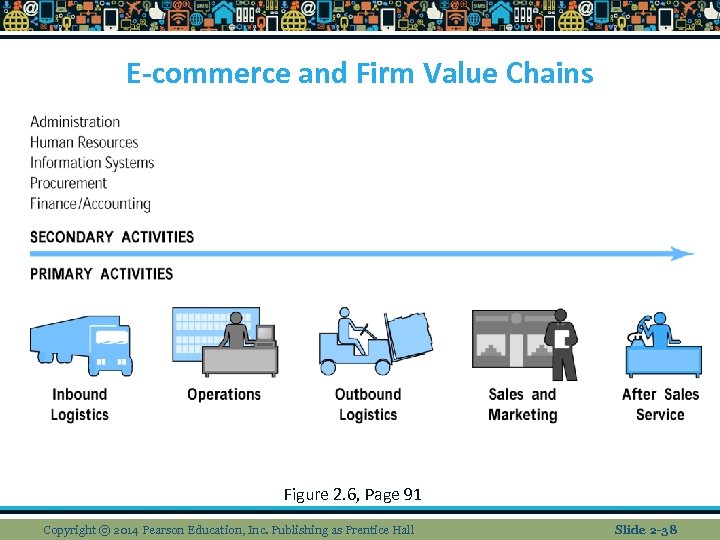
E-commerce and Firm Value Chains Figure 2. 6, Page 91 Copyright © 2014 Pearson Education, Inc. Publishing as Prentice Hall Slide 2 -38
Firm Value Webs n Networked business ecosystem n Uses Internet technology to coordinate the value chains of business partners n Coordinates a firm’s suppliers with its own production needs using an Internet -based supply chain management system Copyright © 2014 Pearson Education, Inc. Publishing as Prentice Hall Slide 2 -39
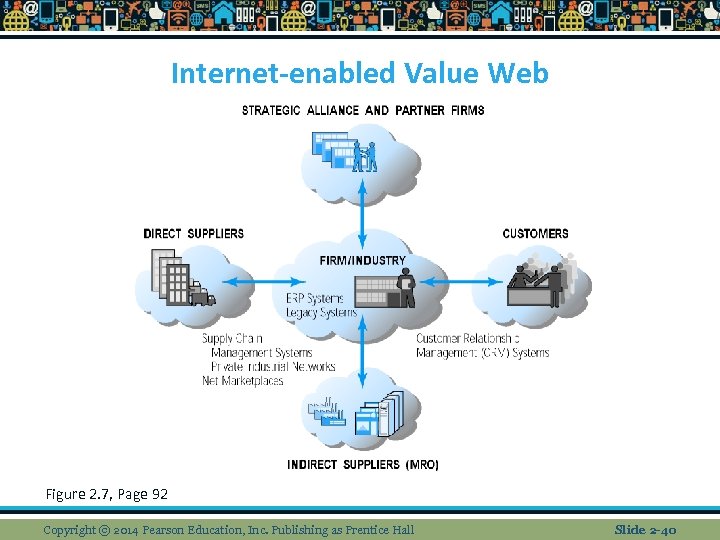
Internet-enabled Value Web Figure 2. 7, Page 92 Copyright © 2014 Pearson Education, Inc. Publishing as Prentice Hall Slide 2 -40
Business Strategy n Plan for achieving superior long-term returns on capital invested: that is, profit n Five generic strategies v Product/service differentiation v Cost competition v Scope v Focus v Customer intimacy Copyright © 2014 Pearson Education, Inc. Publishing as Prentice Hall Slide 2 -41
Copyright © 2014 Pearson Education, Inc. Publishing as Prentice Hall Slide 2 -42
Скачать презентацию E-commerce 2014 business technology society tenth edition Kenneth
bf8065404bfe4b8b64a7a399388896fb.ppt