


 Скачать презентацию E C Reminder Write and or draw your own
ff821b0dac7ecb329a241ad0e72d3c50.ppt
- Количество слайдов: 23
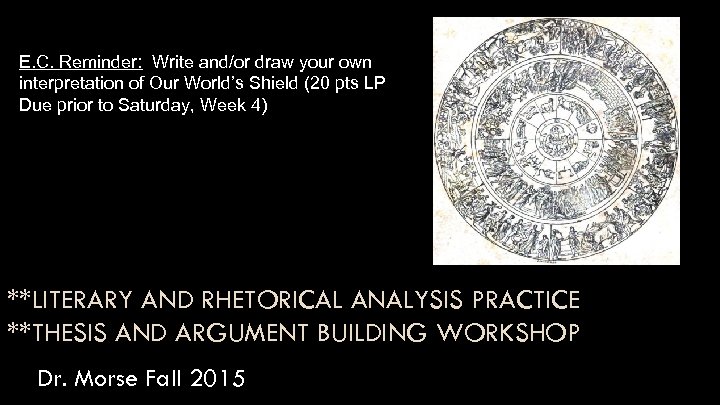 E. C. Reminder: Write and/or draw your own interpretation of Our World’s Shield (20 pts LP Due prior to Saturday, Week 4) **LITERARY AND RHETORICAL ANALYSIS PRACTICE **THESIS AND ARGUMENT BUILDING WORKSHOP Dr. Morse Fall 2015
 Today’s Goals and Announcements Lecture Review through Close-Reading “Poetics” in the Iliad Discussion of Rhetorical and Literary Analysis On-going (time permitting) Discussion of S. Weil’s Essay. Thesis and Argument Building Group Work Revised thesis statement uploaded by midnight tonight Upload Revised thesis-intro/body paragraph or pre-draft to class web site assignment for feedback by Wednesday Complete Draft Due in class and uploaded by Saturday
 Lecture Review “Warm Up” Strategy Poetics and Ekphrasis Techne – poem as a made thing, an artifact Artifactuality gives us a rich, material culture The poet and the artist have the power to ensure Kleos Pause – Why should a poem describe Achilles’ shield at the climactic part of the poem? The artifact is not just an object but an instruction manual The Iliad as the picture of picturing Doubling
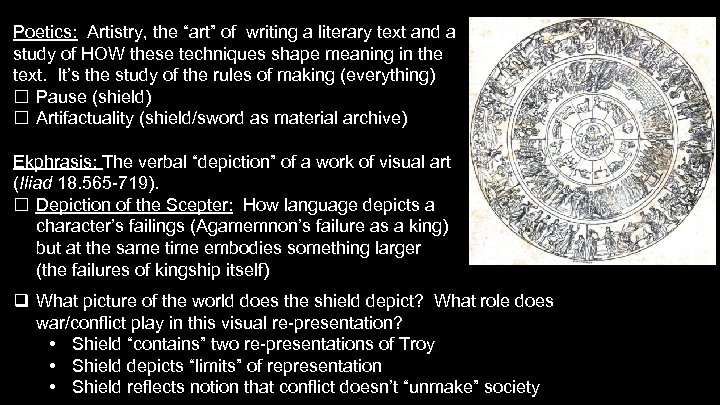 Poetics: Artistry, the “art” of writing a literary text and a study of HOW these techniques shape meaning in the text. It’s the study of the rules of making (everything) Pause (shield) Artifactuality (shield/sword as material archive) Ekphrasis: The verbal “depiction” of a work of visual art (Iliad 18. 565 -719). Depiction of the Scepter: How language depicts a character’s failings (Agamemnon’s failure as a king) but at the same time embodies something larger (the failures of kingship itself) q What picture of the world does the shield depict? What role does war/conflict play in this visual re-presentation? • Shield “contains” two re-presentations of Troy • Shield depicts “limits” of representation • Shield reflects notion that conflict doesn’t “unmake” society
 How do you close-read? Strategies? Fundamentals: Genre/Time-Place Written/Audience How do these shape meaning in the text? Look for literary devices (repetition, metaphor, hyperbole, allusions, imagery, simile, etc. ) Click Here Look for or set up binaries (male/female, shame/guilt…) Look for connections to course themes/concepts Look for rhetorical and other appeals (gender obligations) Which words in text show it? Explain HOW and So What?
 Rhetoric (ELP) and “Poetics” in the Iliad Rhetoric? Rhetoric “HOW is the art of persuasion Click Here one says something conveys meaning as much as what one says. ” How Prof. I using the term “Poetics”? Using language in a way that heightens or shapes meaning or stylizes the conveyed message for a purpose (by appealing to senses, for
 Rhetorical Devices Ethos: language that builds up or tears down an individual’s character, authority or credibility according to a particular value system Pathos: language used to elicit an emotional response or to make an emotional appeal with intent to persuade Logos: 1) the structure of an argument 2) the argument itself (central message or point)
 Rhetoric (ELP) and “Poetics” in the Iliad “Ajax bent on glory … shouted, ‘Friends – the lot is mine and it fills my heart with joy! I know I can overpower the dazzling Hector. But come, while I strap my battle-armor on, all of you pray to Cronus’ son, almighty Zeus. Pray to yourselves in silence, so Trojans cannot hear – no, pray out loud!’” (Iliad 7. 216 -225).
 Rhetoric (ELP) and “Poetics” in the Iliad “A flash of his helmet as rangy Hector shook his head: ‘Ajax, royal son of Telamon, captain of armies, don’t toy with me like a puny, weak-kneed boy or a woman never trained in works of war! War – I know it well, and the butchery of men … I know it all, how to charge in the rush of plunging horses – I know how to stand fight to the finish, twist and lunge in the War-god’s deadly dance’” (Iliad 7. 271 -
 Rhetoric (ELP) and “Poetics” in the Iliad “…so raging Diomedes mauled the Trojans. Therehe killed Astynous, then Hypiron, a frontline captain. One he stabbed with a bronze lance above the nipple, the other his heavy sword hacked at the collarbone, right on the shoulder, cleaving the whole shoulder clear of neck and back. And he left them there, dead, and he made a rush at Abas and Polyidus, sons of Eurydamus … an old prophet” (3. 158 -167).
 Rhetoric (ELP) and “Poetics” in the Iliad “A shattering war cry! Diomedes killed off Axylus, Teuthras’ son who had lived in rock-built Arisbe, a man of means and a friend to all mankind, at his roadside house he’d warm all corner in. But who of his guests would greet his enemy now, meet him faceto-face and ward off his grisly death? Diomedes killed the man and his aide-in-arms at once, Axylus and Calesius who always drove his team – both at a stroke he drove beneath the earth” (11. 14 -22).
 Figures of Speech in The Iliad Notice the syntax (how does that shape meaning)? Metaphor: A comparison made by referring to one thing as another (2 things have something important in common). “Hector…charged them both full force with a savage shout and Trojan battalions churning in his wake. Diomedes shuddered to see him coming on, the lord of the war cry called out to Odysseus, ’We’re in for shipwreck-- / a breaker rolling down on us, look, this massive Hector! / Brace for him, stand our ground together-beat him back!’” (11. 406 -408).
 Figures of Speech in The Iliad Hyperbole: Rhetorical exaggeration. Hyperbole is often accomplished via comparisons, similes, and metaphors. (for emphasis or heightened effect). “Here was the ugliest man who ever came to Troy. / Bandy-legged he was, with one foot clubbed, / both shoulders humped together, curving over / his caved-in chest, and bobbing above them / his skull warped to a point, / sprouting clumps of scraggly, wooly hair” (II. 250 -55).
 Figures of Speech in The Iliad Personification: Reference to abstractions or inanimate objects as though they had human qualities or abilities. “You are intractable, Achilles! … You heart of iron! He was not your father, the horseman Peleus - Thetis was not your mother. Never. The salt gray sunless ocean gave you birth and the towering blank rocks – your temper’s so relentless. ” (16. 38).
 Thesis Building Reminders Let’s review the prompt requirements and the steps in building a thesis https: //canvas. eee. uci. edu/courses/919/assignments /18299 Questions? Let’s do thesis building exercise
 What does Weil assert here, and what larger argument about war in general does she make? “But the auditors of the Iliad knew that the death of Hector would be but a brief joy to Achilles, and the death of Achilles but a brief joy to the Trojans, and the destruction of Troy but a brief joy to the Achaeans. Thus violence obliterates anybody who feels its touch. It comes to seem just as external to its employer as to its victim …from this spring the idea of a destiny … before which conquered and conqueror are brothers in the same distress” (HCC Reader 36).
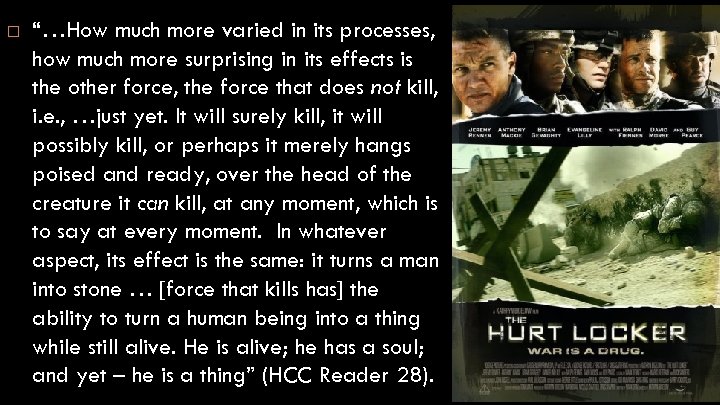 “…How much more varied in its processes, how much more surprising in its effects is the other force, the force that does not kill, i. e. , …just yet. It will surely kill, it will possibly kill, or perhaps it merely hangs poised and ready, over the head of the creature it can kill, at any moment, which is to say at every moment. In whatever aspect, its effect is the same: it turns a man into stone … [force that kills has] the ability to turn a human being into a thing while still alive. He is alive; he has a soul; and yet – he is a thing” (HCC Reader 28).
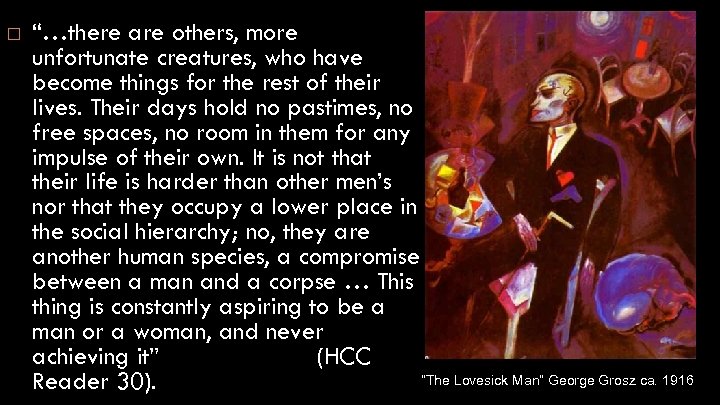 “…there are others, more unfortunate creatures, who have become things for the rest of their lives. Their days hold no pastimes, no free spaces, no room in them for any impulse of their own. It is not that their life is harder than other men’s nor that they occupy a lower place in the social hierarchy; no, they are another human species, a compromise between a man and a corpse … This thing is constantly aspiring to be a man or a woman, and never achieving it” (HCC “The Lovesick Man” George Grosz ca. 1916 Reader 30).
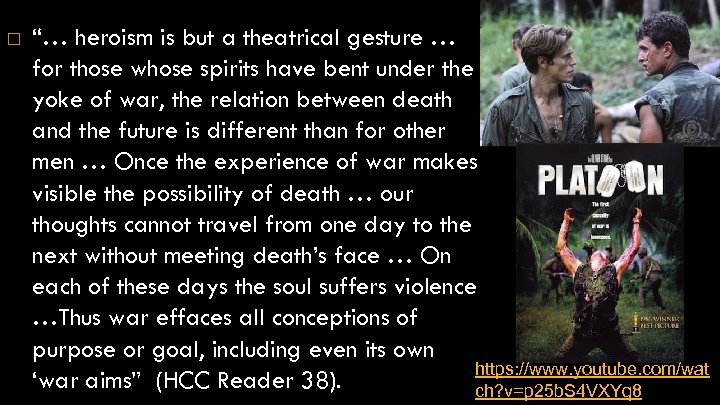 “… heroism is but a theatrical gesture … for those whose spirits have bent under the yoke of war, the relation between death and the future is different than for other men … Once the experience of war makes visible the possibility of death … our thoughts cannot travel from one day to the next without meeting death’s face … On each of these days the soul suffers violence …Thus war effaces all conceptions of purpose or goal, including even its own https: //www. youtube. com/wat ‘war aims” (HCC Reader 38). ch? v=p 25 b. S 4 VXYq 8
 Homeric Epic Simile: an extended simile (reveals unexpected likeness between two unlike or seemingly unlike things) to intensify the heroic stature of the subject or for added stylistic effect. A tool of thought or way of seeing (a metaphor for seeing) Lengthy comparison between two highly complex objects, actions or relations (Think Alice Oswald – HOW are they used differently? ) “So in a rush each Argive captain killed his man. As ravenous wolves come swooping down on lambs or kids to snatch them away from right amidst their flock – all lost when a careless shepherd leaves them straggling down the hills, and quickly spotting a chance the wolf pack picks them off, no heart for the flight” (11. 414 -420).
 Figures of Speech in The Iliad Epic Simile: "The similes in Homer are treasure troves. They describe scenes of Greek life that are not presented in their simplest form anywhere else: landscapes and seascapes, storms and calm weather, fighting among animals, aspects of civic life such as settlements of disputes, athletic contests, horse races, community entertainment, women carrying on their daily lives and men running their farms and orchards. But the similes also show Homer dealing with his tradition. They are additions to the narrative showing how the Greeks found and developed parallels between two scenes, each of which elucidated and interpreted the other, and then expressed those scenes in effective poetic language. “ Scott, William C. The Artistry of the Homeric Simile. Hanover, N. H: Dartmouth College Library and Dartmouth College Press, 2009. Print.
 “Artistry” in The Iliad – Epic Simile (Find one to share in the next class) “High-hearted son of Tydeus, why ask about my birth? Like the generations of leaves, the lives of mortal men, Now the wind scatters the old leaves across the earth, now the living timber bursts with the new buds and spring comes round again. And so with men: as one generation comes to life, another dies away. But about my birth, If you’d like to learn it well, first to last – though many people know it – here’s my story …” (11. 169 -177).
 Rhetoric (ELP) and “Poetics” in the Iliad “A flash of his helmet as Hector shot back, “Impossible man! How could anyone fair and just underrate your work in battle? You’re a good soldier. But you hang back of your own accord, refuse to fight. And that, that’s why the heart inside me aches when I hear our Trojans heap contempt on you, the men who bear such struggles all for you” (11. 620 -626).