 Скачать презентацию E C Directive 1999 44 EC CASE STUDY- Guarantees Belgrade
fcf398b37c3cd01bf71564f624e6b26e.ppt
- Количество слайдов: 16



E C Directive 1999/44/EC CASE STUDY- Guarantees Belgrade, Serbia 29 -30 March 2011 drd. Mircea POPA

GUARANTEES The purpose of the provisions concerning guarantees is to avoid that consumers be misled by seller's promises expressed either in the guarantee statement or in the respective advertisements. It must also be ensured that the enforcement of rights provided to consumers by the Directive can not be hindered by producers or sellers.
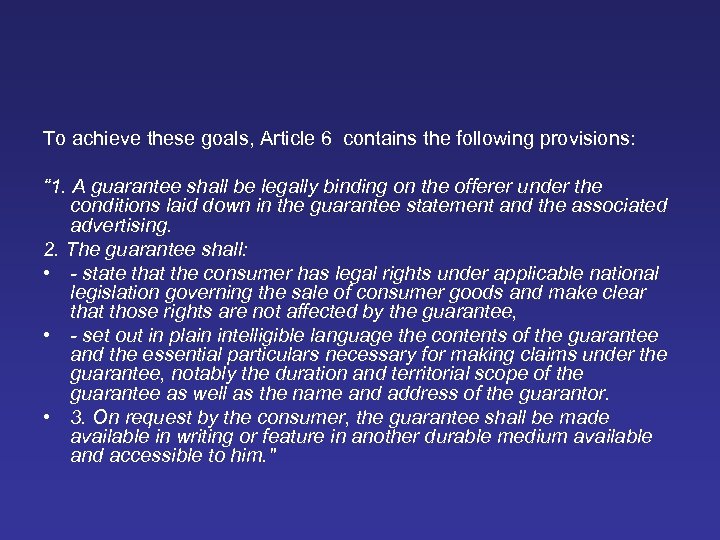
To achieve these goals, Article 6 contains the following provisions: “ 1. A guarantee shall be legally binding on the offerer under the conditions laid down in the guarantee statement and the associated advertising. 2. The guarantee shall: • - state that the consumer has legal rights under applicable national legislation governing the sale of consumer goods and make clear that those rights are not affected by the guarantee, • - set out in plain intelligible language the contents of the guarantee and the essential particulars necessary for making claims under the guarantee, notably the duration and territorial scope of the guarantee as well as the name and address of the guarantor. • 3. On request by the consumer, the guarantee shall be made available in writing or feature in another durable medium available and accessible to him. "
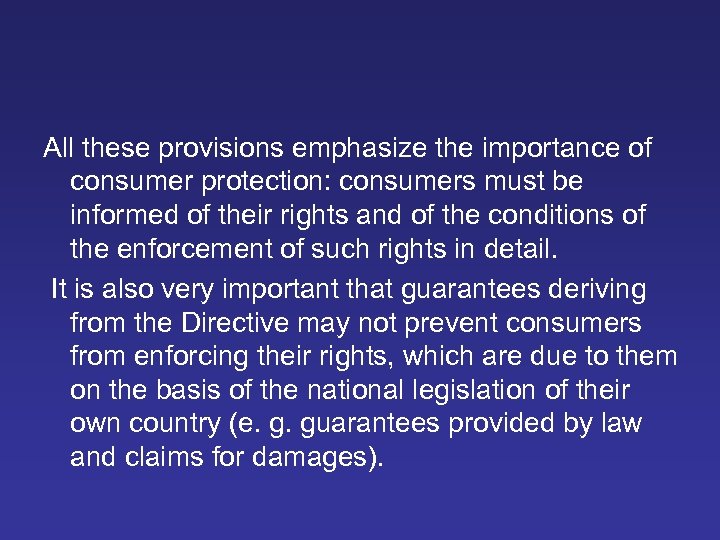
All these provisions emphasize the importance of consumer protection: consumers must be informed of their rights and of the conditions of the enforcement of such rights in detail. It is also very important that guarantees deriving from the Directive may not prevent consumers from enforcing their rights, which are due to them on the basis of the national legislation of their own country (e. g. guarantees provided by law and claims for damages).
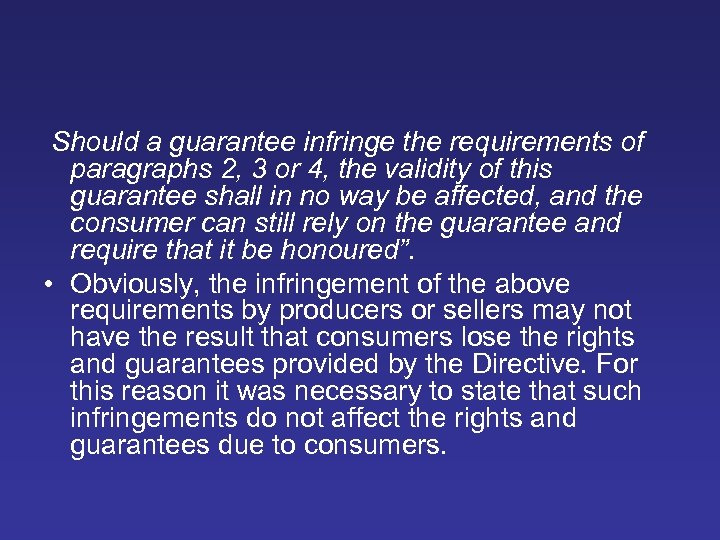
Should a guarantee infringe the requirements of paragraphs 2, 3 or 4, the validity of this guarantee shall in no way be affected, and the consumer can still rely on the guarantee and require that it be honoured”. • Obviously, the infringement of the above requirements by producers or sellers may not have the result that consumers lose the rights and guarantees provided by the Directive. For this reason it was necessary to state that such infringements do not affect the rights and guarantees due to consumers.
• It appears that retailers’ and manufacturers’ guarantees influence consumers’ views of their rights. In some situations they encourage a belief that remedies can last for a long time, such as those who thought that they can get a refund for faulty products for a full year. • On the other hand, some shops’ policies may have led some consumers to underestimate their rights, for example to believe that all consumer rights are limited to 30 days. • The Consumers organizations suggested that consumer rights should be publicised and that key rights should be posted in prominent positions in stores.
COMMUNICATION FROM THE COMMISSION TO THE COUNCIL AND THE EUROPEAN PARLIAMENT on the implementation of Directive 1999/44/EC of the European Parliament and of the Council of 25 May 1999 on certain aspects of the sale of consumer goods and associated guarantees including analysis of the case for introducing direct producers’ liability
• The consumer may always rely on a commercial guarantee even if it does not comply with the rules of the Directive The provisions of art 6 have generally been literally transposed or in a very similar format in all Member States. Some of them have chosen to complement the rules of the Directive for the benefit of consumers. For example, Malta has provided further substantive rules on commercial guarantees and Estonia has provided for default rules on the content of the guarantee. Hungary and Slovenia continue to use mandatory guarantees and have only partially transposed provisions on commercial guarantees.
• Article 6(4) permits the Member States to require that guarantees are provided in a particular language. • This option has been exercised by Cyprus, Denmark, Estonia, Greece, Hungary (for the mandatory guarantees), Italy, Luxembourg, Malta, Poland, Portugal, Slovenia, Spain and the UK. • Belgium relies on legislation according to which the language of the region where goods are marketed must be used
Practical issue • - the contract must provide sufficient guarantees for the consumers, in a common language: • What's happened if the information to assembling a product is offered in Chinese language or is wrote with the Arabic letters What we can do if: 1. the guarantees is conditioned to keep the original package of the product, and the consumers don't have space to keep this package 2 the guarantees is conditioned to buying supplementary products or to buy more than a specific value 3. for a pc, the instructions to use and assembling instructions are provided on a durable support… CD or DVD? 4. the contract and the guarantees are in conformity with the legislation…. and the economic operator disappear or change his address or change country of residence , outside of EU? Lets see in next slides:
Case 1 The guarantees is conditioned to keep the original package of the product, and the consumers don't have space to keep this package If the volume of the package is small, is not a problem, but if we have a washing machine or a 240 liters fridge , and the consumers have only a small room, without storage room? In some cases this provisions can be considered as an abuses clause in contract because the seller conditionante the consumers rights to do something else witch doesn't have a connection with the product.

Case 2 The guarantees is conditioned to buying supplementary products or to buy more than a specific value In this case, we can use the UCPD. The unfair commercial practices must to be avoided, and the UCPD is very useful in this kind of “conditioned practices”.
Case 3 For a PC, the instructions to use and assembling instructions are provided on a durable support… CD or DVD? The consumer must to ask another kind of durable support to use the product in conformity with his goal.
Case 4 The contract and the guarantees are in conformity with the legislation…. and the economic operator disappear or change his address or change country of residence, outside of EU? The consumer guarantee rights, in such cases, the seller' obligations must be taken by another operator, established and nominated in the guarantee, so that consumer rights are not violated
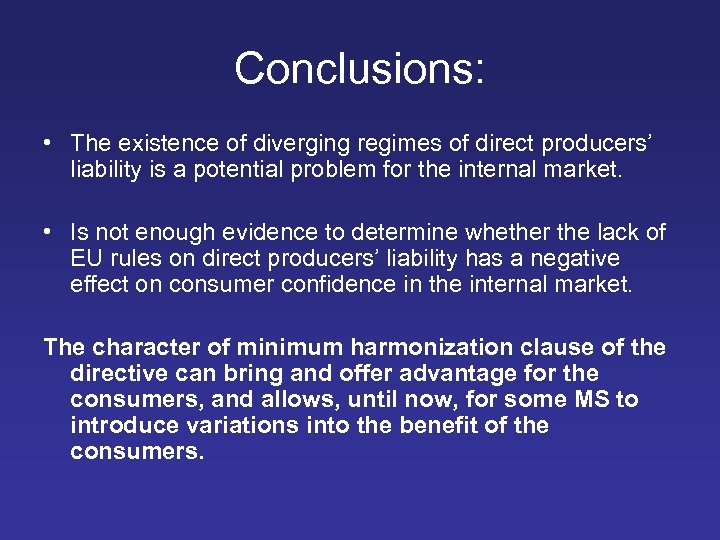
Conclusions: • The existence of diverging regimes of direct producers’ liability is a potential problem for the internal market. • Is not enough evidence to determine whether the lack of EU rules on direct producers’ liability has a negative effect on consumer confidence in the internal market. The character of minimum harmonization clause of the directive can bring and offer advantage for the consumers, and allows, until now, for some MS to introduce variations into the benefit of the consumers.

• Thank You!
Скачать презентацию E C Directive 1999 44 EC CASE STUDY- Guarantees Belgrade
fcf398b37c3cd01bf71564f624e6b26e.ppt