 Скачать презентацию e-Business in an international oil company 22 04
e0e5eebbecfef5e61121ed075a5cb442.ppt
- Количество слайдов: 12



“e-Business in an international oil company” 22. 04. 2002 WTO Seminar on “e-Business” Geneva Morten Sven Johannessen, Statoil mosvejo@statoil. com
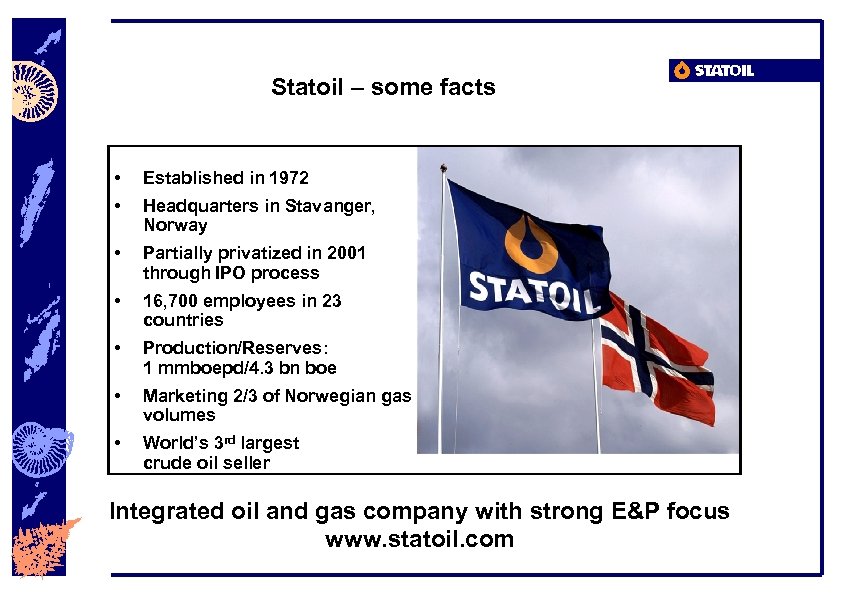
Statoil – some facts • Established in 1972 • Headquarters in Stavanger, Norway • Partially privatized in 2001 through IPO process • 16, 700 employees in 23 countries • Production/Reserves: 1 mmboepd/4. 3 bn boe • Marketing 2/3 of Norwegian gas volumes • World’s 3 rd largest crude oil seller Integrated oil and gas company with strong E&P focus www. statoil. com
Why does Statoil need e-Business? • Globalisation of industry. • Reduce cost of extracting, refining and marketing oil and gas. • Maximize usage of scarce and disbursed resources. • Take advantage of technical advances in IT and telecommunications. • Reduce risk and mitigate best practice in operations and Health Safety and Environment (HSE). • Offer training and consistency in information distribution throughout the company, regardless of geography and time-zones.
e-Business in Statoil le-business –e-commerce ƒ b 2 c (business to consumer) ƒ b 2 b (business to business) ƒ b 2 e (business to enterprise, business to employee) –e-collaboration –e-learning
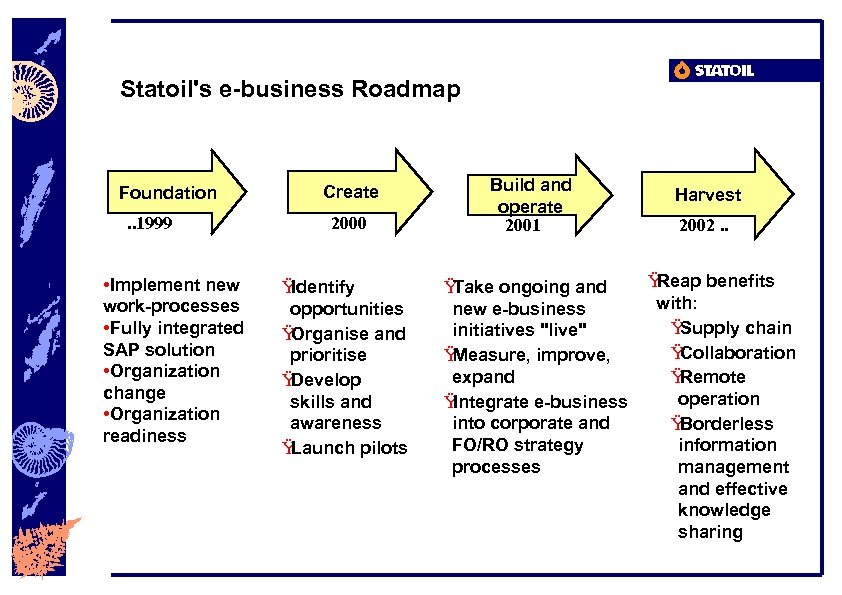
Statoil's e-business Roadmap Foundation. . 1999 • Implement new work-processes • Fully integrated SAP solution • Organization change • Organization readiness Create 2000 Ÿ Identify opportunities Ÿ Organise and prioritise Ÿ Develop skills and awareness Ÿ Launch pilots Build and operate 2001 Ÿ Take ongoing and new e-business initiatives "live" Ÿ Measure, improve, expand Ÿ Integrate e-business into corporate and FO/RO strategy processes Harvest 2002. . Ÿ Reap benefits with: Ÿ Supply chain Ÿ Collaboration Ÿ Remote operation Ÿ Borderless information management and effective knowledge sharing
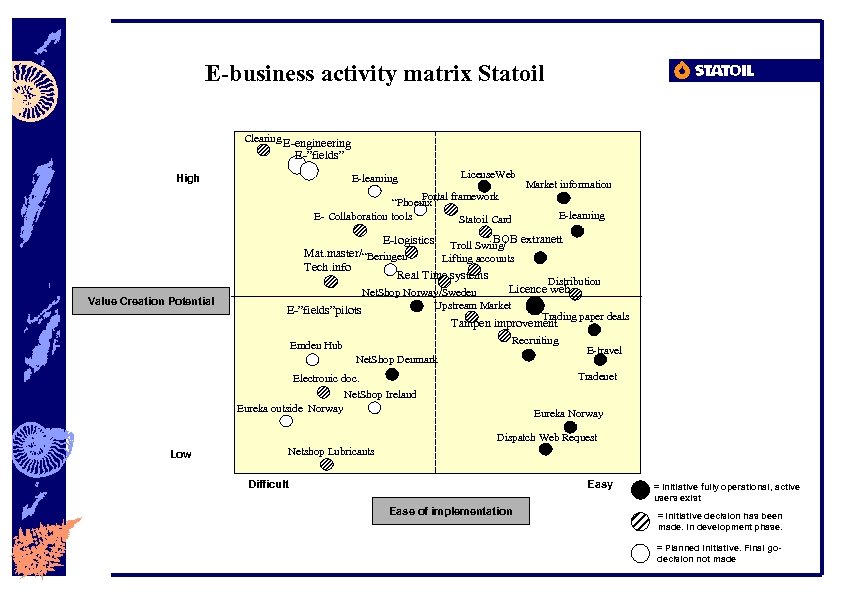
E-business activity matrix Statoil Clearing E-engineering E-”fields” E-learning High License. Web Portal framework “Phoenix” E- Collaboration tools Statoil Card E-logistics Market information E-learning BOB extranett Troll Swing/ Lifting accounts Mat. master/“Beringen” Tech. info Real Time systems Value Creation Potential Distribution Licence web Net. Shop Norway/Sweden Upstream Market E-”fields”pilots Trading paper deals Tampen improvement Recruiting Emden Hub Net. Shop Denmark E-travel Tradenet Electronic doc. Net. Shop Ireland Eureka outside Norway Eureka Norway Dispatch Web Request Low Netshop Lubricants Difficult Easy Ease of implementation = Initiative fully operational, active users exist = Initiative decision has been made. In development phase. = Planned initiative. Final godecision not made
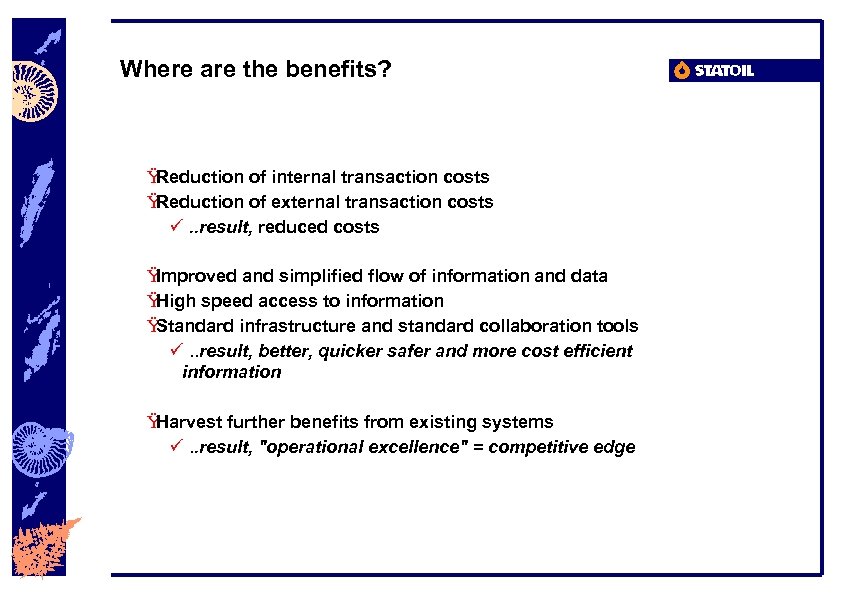
Where are the benefits? Ÿ Reduction of internal transaction costs Ÿ Reduction of external transaction costs ü. . result, reduced costs Ÿ Improved and simplified flow of information and data Ÿ High speed access to information Ÿ Standard infrastructure and standard collaboration tools ü. . result, better, quicker safer and more cost efficient information Ÿ Harvest further benefits from existing systems ü. . result, "operational excellence" = competitive edge
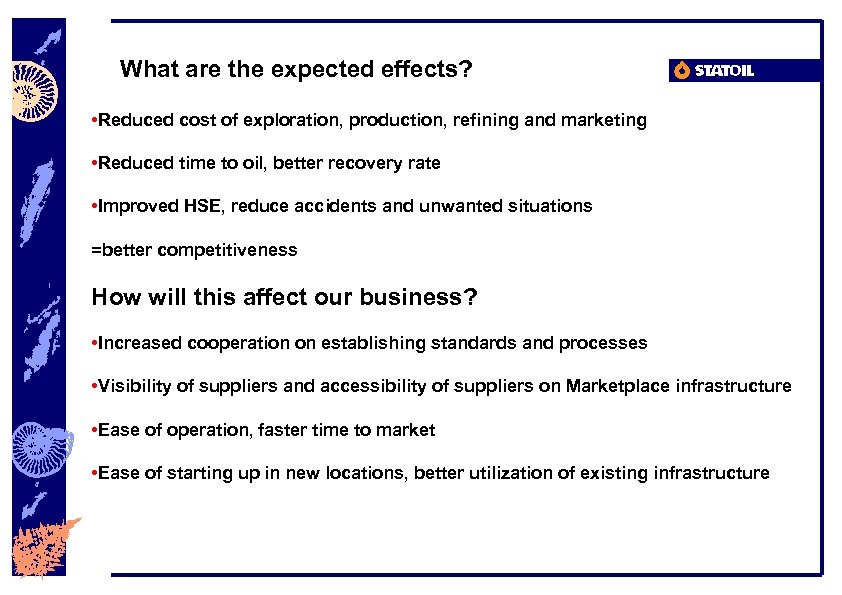
What are the expected effects? • Reduced cost of exploration, production, refining and marketing • Reduced time to oil, better recovery rate • Improved HSE, reduce accidents and unwanted situations =better competitiveness How will this affect our business? • Increased cooperation on establishing standards and processes • Visibility of suppliers and accessibility of suppliers on Marketplace infrastructure • Ease of operation, faster time to market • Ease of starting up in new locations, better utilization of existing infrastructure
Effects of taxation on business transactions crossing borders Effects on procurement of tangible goods across borders ØNo intended effects, –but may lead to consolidation of suppliers, –creates an opportunity for good local suppliers in new markets Effects on procurement of in- tangible goods across borders ØInternet as delivery platform, –Intellectual property will be distributed using the Internet, Intranet and Extranet, difficult to track. Companies will optimise according to need, i. e. on managing access through corporate wide Intranet ØInternet as business driver for new products and services Tangible goods become digitised and transformed into services, i. e. valves machinery, pipelines. Physical goods will become value add services managed over the net
Effects of taxation on business transactions crossing borders Effects on services ØGeographically disburse –Best of breed services bought where services are offered, i. e. engineering and IT from India, service centres (call centres) from Eire. Using the Internet as transaction, delivery and communication tool Bottom line, we optimise as we have always done, but do not exploit the net to avoid taxes

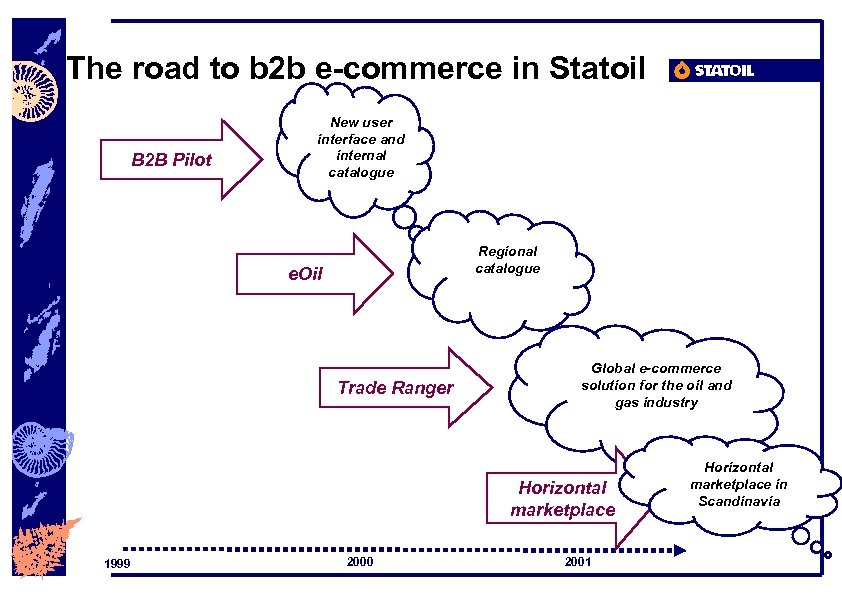
The road to b 2 b e-commerce in Statoil B 2 B Pilot New user interface and internal catalogue Regional catalogue e. Oil Trade Ranger Global e-commerce solution for the oil and gas industry Horizontal marketplace 1999 2000 2001 Horizontal marketplace in Scandinavia
Скачать презентацию e-Business in an international oil company 22 04
e0e5eebbecfef5e61121ed075a5cb442.ppt