


 Скачать презентацию E 9 -1 -1 Stakeholder Council for Deaf
fc7c23b0ce0a9ac7376fe38b614604f0.ppt
- Количество слайдов: 16
 E 9 -1 -1 Stakeholder Council for Deaf, HH, STS Consumers CHAIR, SHERI A. FARINHA TDI, EXECUTIVE DIRECTOR, CLAUDE STOUT
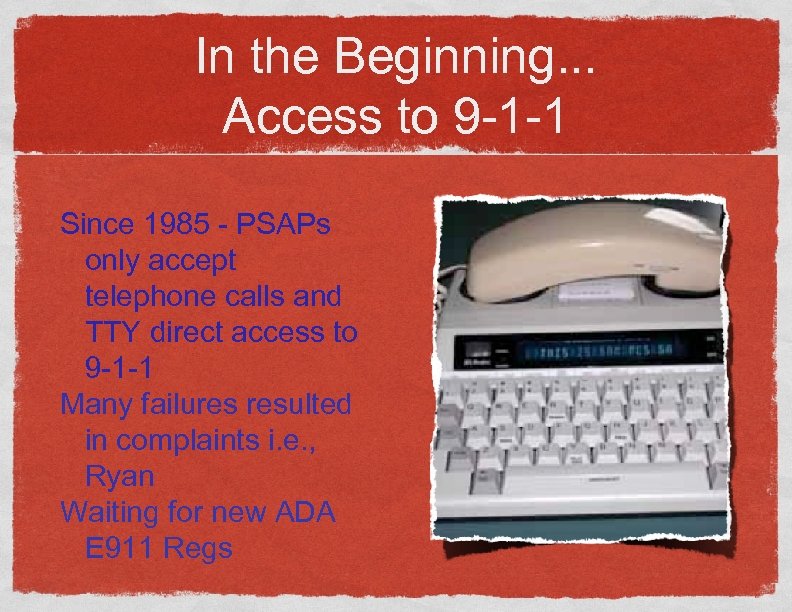 In the Beginning. . . Access to 9 -1 -1 Since 1985 - PSAPs only accept telephone calls and TTY direct access to 9 -1 -1 Many failures resulted in complaints i. e. , Ryan Waiting for new ADA E 911 Regs
 Fast forward to 2005 June 2005 Vo. IP E 911 Order, required providers of interconnected Vo. IP to transmit all 911 calls incl. call back & Callers Registered Location to PSAP. Deaf/HH/STS not included!
 Meanwhile. . From Dec 2001 to Jan 2008 Waivers were extended for Providers of VRS & IP Relay to access 9 -1 -1 NPRM in Nov 2006 asked 21 Questions no one had the answers
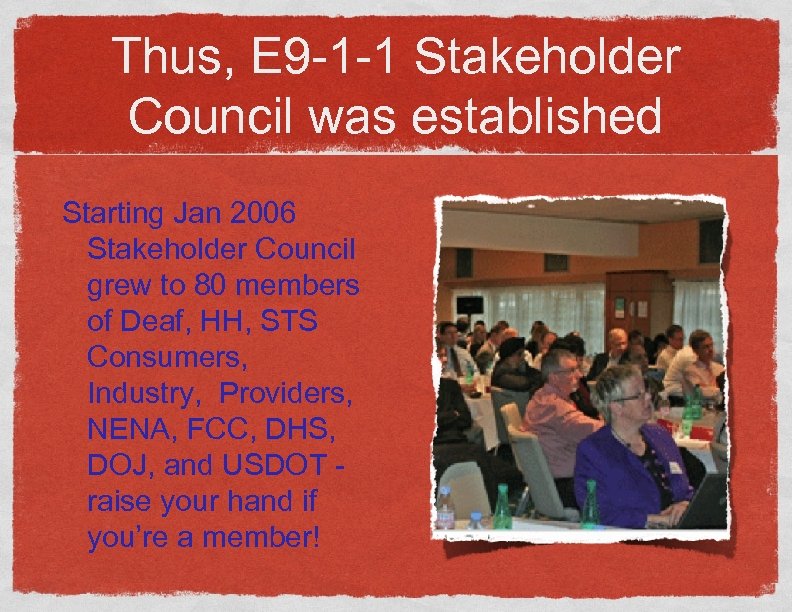 Thus, E 9 -1 -1 Stakeholder Council was established Starting Jan 2006 Stakeholder Council grew to 80 members of Deaf, HH, STS Consumers, Industry, Providers, NENA, FCC, DHS, DOJ, and USDOT raise your hand if you’re a member!
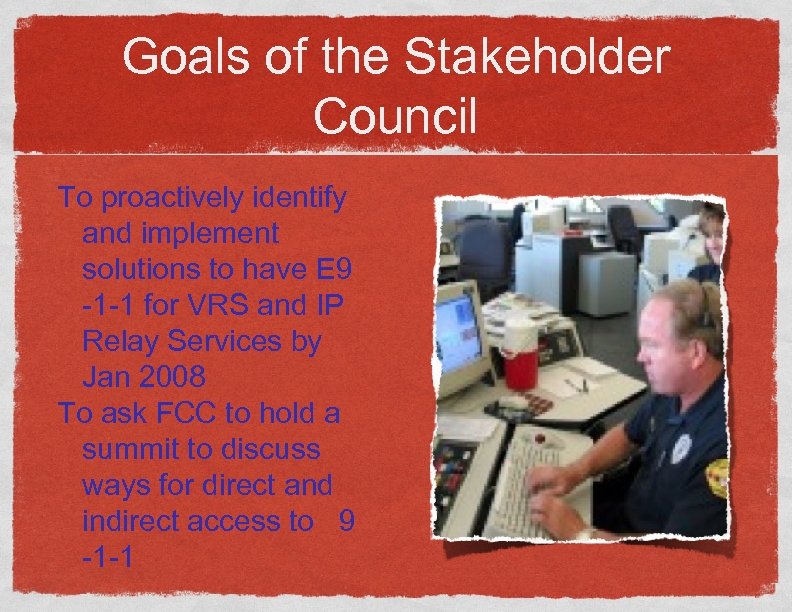 Goals of the Stakeholder Council To proactively identify and implement solutions to have E 9 -1 -1 for VRS and IP Relay Services by Jan 2008 To ask FCC to hold a summit to discuss ways for direct and indirect access to 9 -1 -1
 Priority, priority, make our calls to 9 -1 -1 a PRIORITY! February 2006, Requested a meeting with Secretary Chertoff to demand that access to 9 -1 -1 using the internet become a priority DHS, FCC, DOJ’s commitment to work with E 9 -11 Stakeholder Council FCC hosted first ever Summit on E 9 -1 -1 for Persons with Disabilities DOJ worked on preparing its ANPRM for new regulations to include access to NG 9 -1 -1
 Expectations of Deaf, HH, STS TDI White Paper Core reasons: to explain to FCC that access to 91 -1 for Consumers must become a reality via indirect (relay services) calls and direct calls. To push for solutions to be implemented in time to meet the deadline - no more extensions or waivers were acceptable!
 Success! Implemented by FCC Ten digit numbering where all Consumers must register in order to get a telephone number assigned to their videophone/IP, location information gathered and verified
 Consumer Needs & Expectations TTY via Direct landline or wireless networks Captioned Telephone Internet-based Calls direct and via Relay Video Calls direct and via VRS Relay Vo. IP Instant Messaging Interactive Text (Real-time Text)
 Relay calls must be able to instantly route emergency calls to specific PSAPs thruough 9 -1 -1 Network Automated and instant “call backs” from PSAP to caller must be supported PSAP Technologies must accomodate direct text communications, recording conversations, queuing Operating procedures should be standard nationwide at all levels for users, relay Providers, and PSAPs
 Protocols must be user friendly Special procedures or equipmet just for 9 -1 -1 calls must be avoided Both direct and relay methods for contacting 9 -1 -1 must be supported Any rulemaking on training standards must include Deaf, HH, STS Consumers
 Functionally Equivalent Services: Connection time should be same as voice callers If delays occur in system, users must be informed of this in real-time with the users own technology Relay Centers must develop a method to immediately signal a 9 -1 -1 call is coming thru Critical to establish priority need of Deaf, HH, STS for access to emergency services using any and all technology
 Still Left To Do. . . Ensure “reverse 9 -1 -1” can access calls to Deaf, HH, STS Consumers Ensure access with newer wireless phones, using video, text, voice with speech support, and using apps NENA developed standards which need to be adopted by DOJ for PSAPs, and FCC needs to adopt one for Relay Providers PSAP’s moving toward NG 9 -1 -1 Training for users, Relay Providers, and PSAPs
 EAAC Can help make recommendations to ensure all Consumer needs are met, no matter what device they are using, so that access to 9 -1 -1 becomes a reality.
 THANK YOU!