


 Скачать презентацию E 02 -013 at high Q 2 Status
91c6fca2896141f457541cd8a109780f.ppt
- Количество слайдов: 21
 E 02 -013: at high Q 2 Status of Analysis Sergey Abrahamyan Yerevan Physics Institute for the E 02 -013 collaboration
 Overview Form factors E 02 -013 Experiment 1. 2 Ge. V 2 analysis Status 2 Hall A Collaboration Meeting 6/11/2009
 E 02 -013 Collaboration Universität Basel, CH-4056 Basel, Switzerland; University of Virginia, Charlottesville, VA 22903; Yerevan Physics Institute, Yerevan 375036, Armenia; North Carolina A&T State University, Greensboro, NC 27411; Tel Aviv University, Tel Aviv, 69978 Israel; Florida International University, Miami, FL 33199; University of Maryland, College Park, Maryland 20742; Ohio University, Athens, OH 45071; Thomas Jefferson National Accelerator Facility, Newport News, VA 23606; Mississippi State University, Mississippi State, MI 39762; Hampton University, Hampton, VA 23668; Southern University at New Orleans, LU 70126; Louisiana Tech University, Ruston, LU 71272; North Carolina Central University, Durham, NC 27707; Syracuse University, Syracuse, NY 13244; Kent State University, Kent, OH 44242; Norfolk State University, Norfolk, VA 23504; Old Dominion University, Norfolk, VA 23529; Carnegie Mellon University, Pittsburgh, PA 15213; University of Glasgow, Glasgow G 12 8 QQ, Scotland, U. K. ; California State University Los Angeles, CA 90032; Massachusetts Institute of Technology, Cambridge, MA 02139; Budker Institute for Nuclear Physics Novosibirsk 630090, Russia; Institute for Nuclear Physics Tomsk 634050, Russia; University of New Hampshire, Durham, NH 03824; College of William and Mary, Williamsburg, VA 23187; Temple University, Philadelphia, PA 19122; Kharkov Institute of Physics and Technology Kharkov 61108, Ukraine; St. Petersburg Nuclear Physics Institute Gatchina, 188350, Russia; Duke University and TUNL, Durham, NC 27708; Université Blaise Pascal/IN 2 P 3, F-63177 Aubière, France; IPN Orsay B. P. n○1, F -91406, Orsay, France; CEA Saclay, DAPNIA/SPh. N, F-91191 Gif sur Yvette, France; University of Maryland, College Park, MD 20742; INFN, Sezione di Sanitá and Institute Superiore di Sanitá, I-00161 Rome Italy; Rutgers, The State University of New Jersey, Piscataway, NJ 08854; University of Massachusetts, Amherst, MA 01003; Kyungpook National University, Taegu City, South Korea; Madrid University, Madrid, Spain; University of Kentucky, Lexington, KY 40506; Argonne National Laboratory, Argonne, IL 60439. 3 Hall A Collaboration Meeting 6/11/2009
 Analysis group Spokespersons: • – – – Gordon Cates, University of Virginia Nilanga Liyanage, University of Virginia Bogdan Wojtsekhowski, Jefferson Laboratory Post Docs and analysis coordinators: • – – Robert Feuerbach, Jefferson Laboratory, College of William and Mary Seamus Riordan, Carnegie Mellon University (graduated 2008), University of Virginia Ph. D Students: • – – – Sergey Abrahamyan, Yerevan Physics Institute Brandon Craver, University of Virginia Aidan Kelleher, College of William and Mary Ameya Kolarkar, University of Kentucky (graduated 2007) Jonathan Miller, University of Maryland Master Students: • – 4 Tim Ngo, University of California (graduated 2007) Hall A Collaboration Meeting 6/11/2009
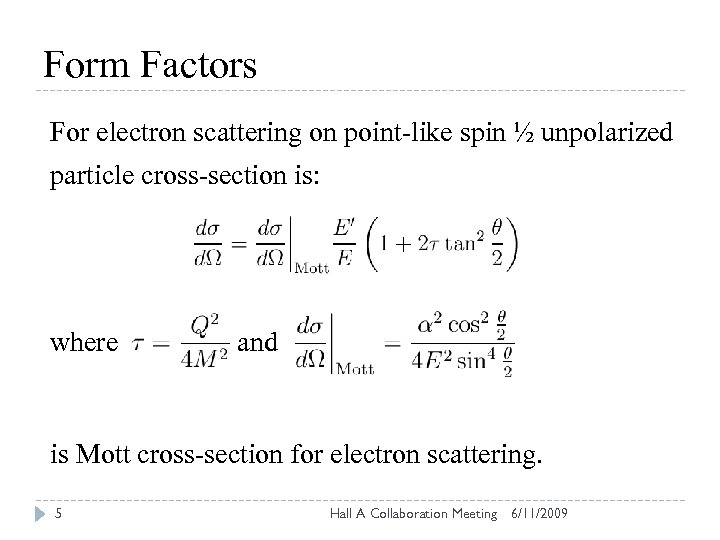 Form Factors For electron scattering on point-like spin ½ unpolarized particle cross-section is: where and is Mott cross-section for electron scattering. 5 Hall A Collaboration Meeting 6/11/2009
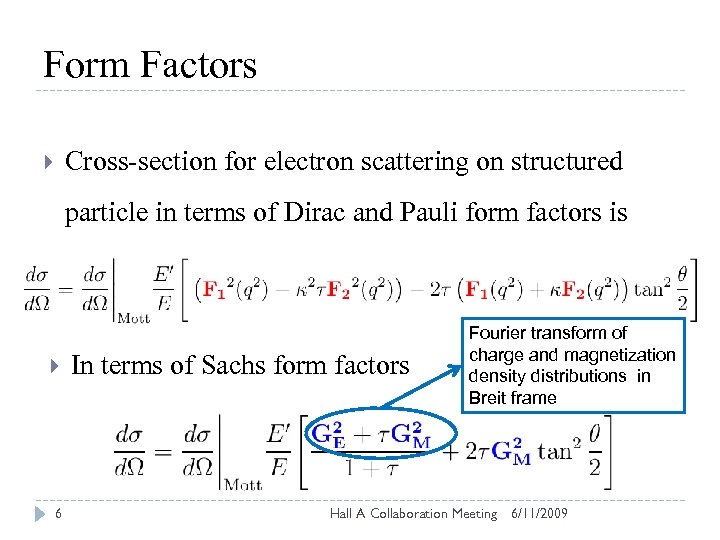 Form Factors Cross-section for electron scattering on structured particle in terms of Dirac and Pauli form factors is 6 In terms of Sachs form factors Fourier transform of charge and magnetization density distributions in Breit frame Hall A Collaboration Meeting 6/11/2009
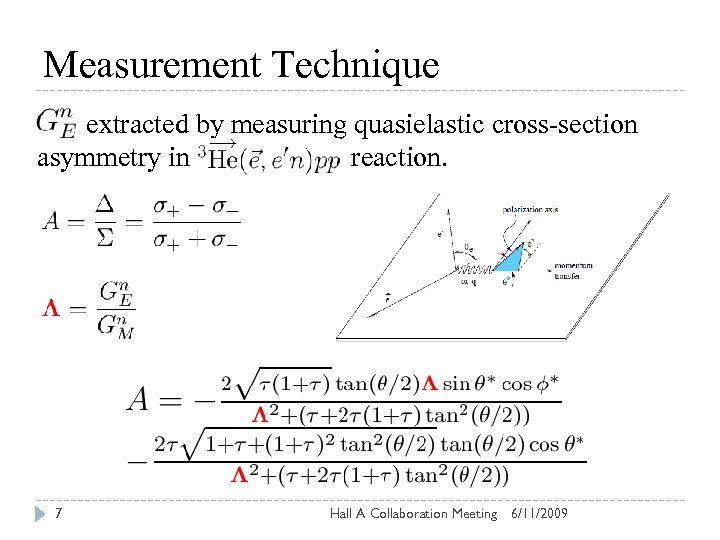 Measurement Technique extracted by measuring quasielastic cross-section asymmetry in reaction. 7 Hall A Collaboration Meeting 6/11/2009
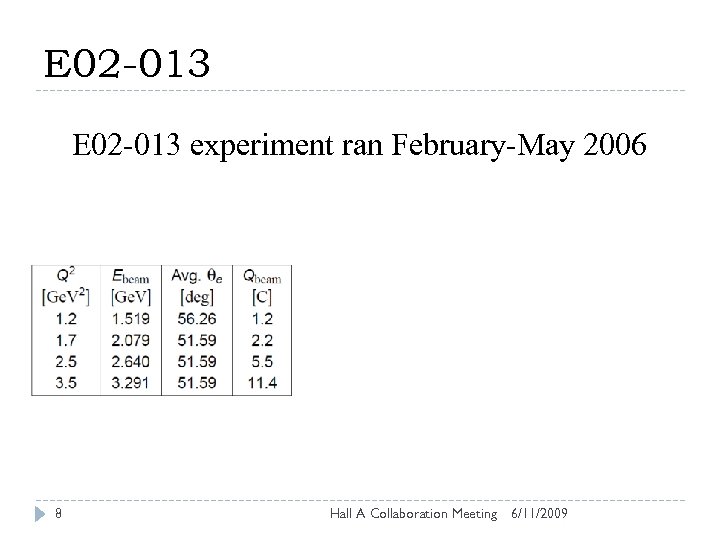 E 02 -013 experiment ran February-May 2006 8 Hall A Collaboration Meeting 6/11/2009
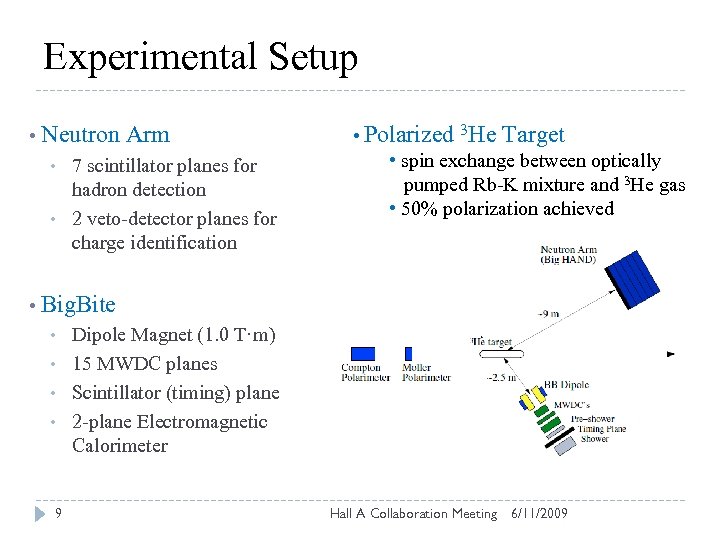 Experimental Setup • Neutron Arm • • • 7 scintillator planes for hadron detection 2 veto-detector planes for charge identification • Polarized 3 He Target • spin exchange between optically pumped Rb-K mixture and 3 He gas • 50% polarization achieved Big. Bite • • 9 Dipole Magnet (1. 0 T·m) 15 MWDC planes Scintillator (timing) plane 2 -plane Electromagnetic Calorimeter Hall A Collaboration Meeting 6/11/2009
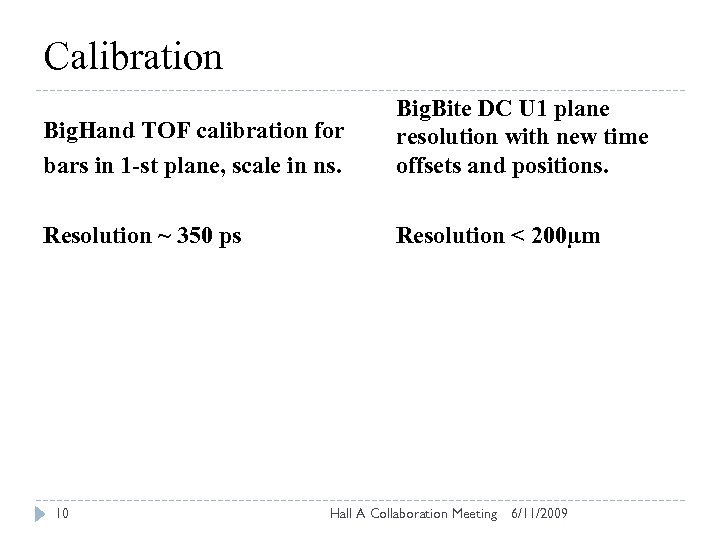 Calibration Big. Hand TOF calibration for bars in 1 -st plane, scale in ns. Big. Bite DC U 1 plane resolution with new time offsets and positions. Resolution ~ 350 ps Resolution < 200µm 10 Hall A Collaboration Meeting 6/11/2009
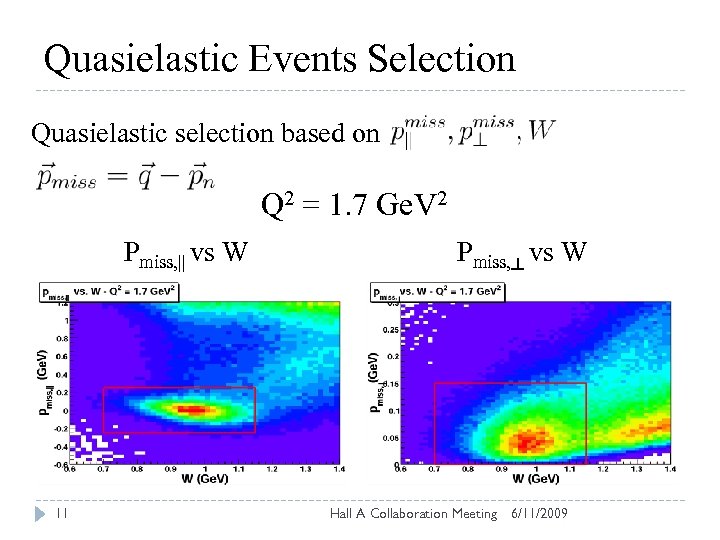 Quasielastic Events Selection Quasielastic selection based on Q 2 = 1. 7 Ge. V 2 Pmiss, || vs W 11 Pmiss, vs W ┴ Hall A Collaboration Meeting 6/11/2009
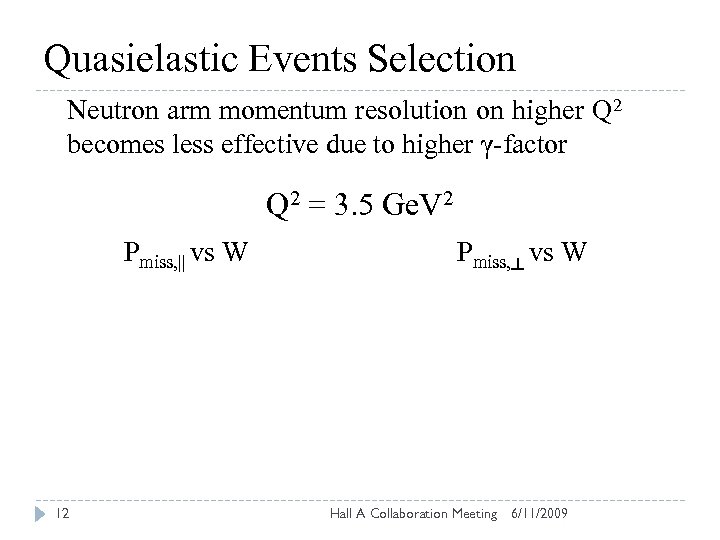 Quasielastic Events Selection Neutron arm momentum resolution on higher Q 2 becomes less effective due to higher γ-factor Q 2 = 3. 5 Ge. V 2 Pmiss, || vs W 12 Pmiss, vs W ┴ Hall A Collaboration Meeting 6/11/2009
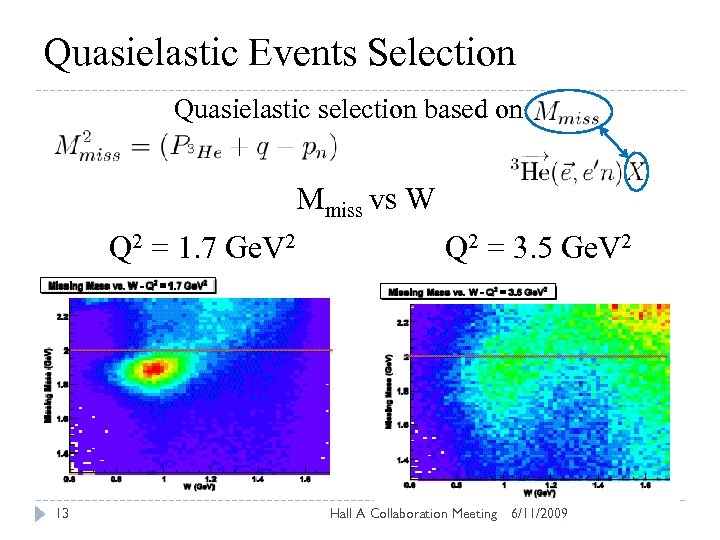 Quasielastic Events Selection Quasielastic selection based on Mmiss vs W Q 2 = 1. 7 Ge. V 2 13 Q 2 = 3. 5 Ge. V 2 Hall A Collaboration Meeting 6/11/2009
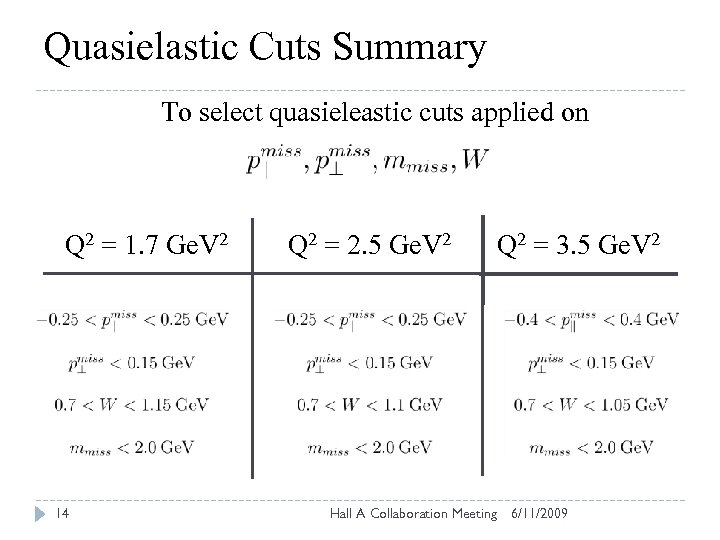 Quasielastic Cuts Summary To select quasieleastic cuts applied on Q 2 = 1. 7 Ge. V 2 14 Q 2 = 2. 5 Ge. V 2 Q 2 = 3. 5 Ge. V 2 Hall A Collaboration Meeting 6/11/2009
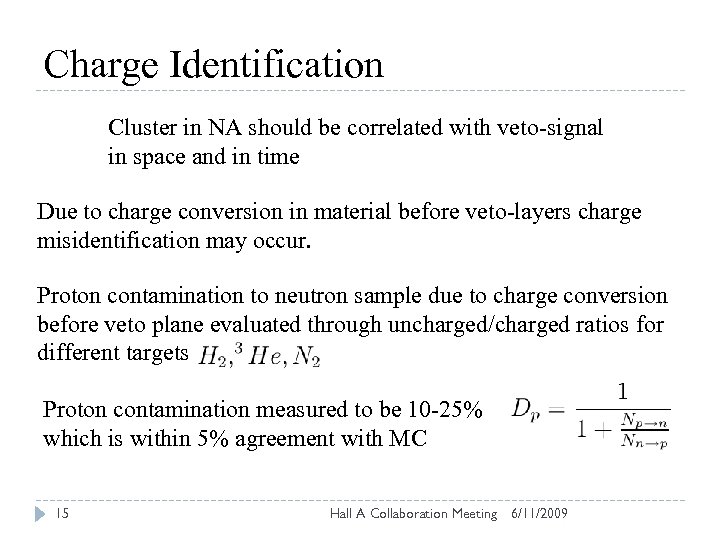 Charge Identification Cluster in NA should be correlated with veto-signal in space and in time Due to charge conversion in material before veto-layers charge misidentification may occur. Proton contamination to neutron sample due to charge conversion before veto plane evaluated through uncharged/charged ratios for different targets Proton contamination measured to be 10 -25% which is within 5% agreement with MC 15 Hall A Collaboration Meeting 6/11/2009
 Target Polarization 50% Target polarization was achieved during E 02 -013 experiment. For most part of the experiment value of target polarization was over 45%. 16 Hall A Collaboration Meeting 6/11/2009
 Collaboration Meeting 6/11/2009 Inelastic contribution and MC
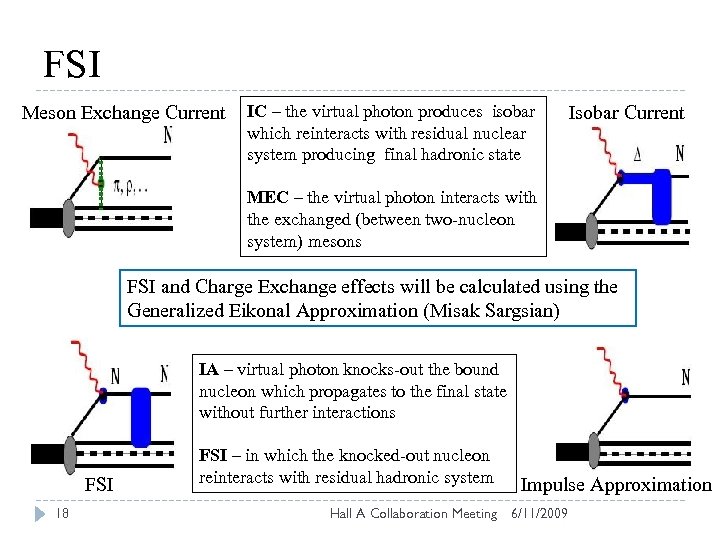 FSI Meson Exchange Current IC – the virtual photon produces isobar which reinteracts with residual nuclear system producing final hadronic state Isobar Current MEC – the virtual photon interacts with the exchanged (between two-nucleon system) mesons FSI and Charge Exchange effects will be calculated using the Generalized Eikonal Approximation (Misak Sargsian) IA – virtual photon knocks-out the bound nucleon which propagates to the final state without further interactions FSI 18 FSI – in which the knocked-out nucleon reinteracts with residual hadronic system Hall A Collaboration Meeting Impulse Approximation 6/11/2009
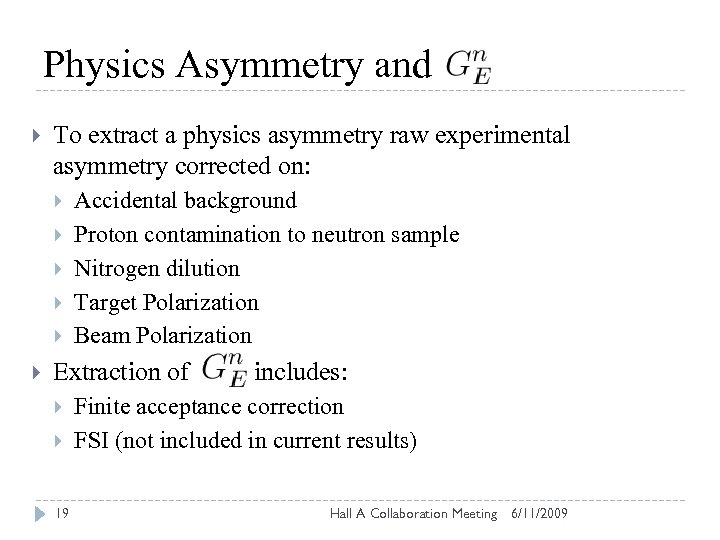 Physics Asymmetry and To extract a physics asymmetry raw experimental asymmetry corrected on: Accidental background Proton contamination to neutron sample Nitrogen dilution Target Polarization Beam Polarization Extraction of 19 includes: Finite acceptance correction FSI (not included in current results) Hall A Collaboration Meeting 6/11/2009
 Results 20 Hall A Collaboration Meeting 6/11/2009
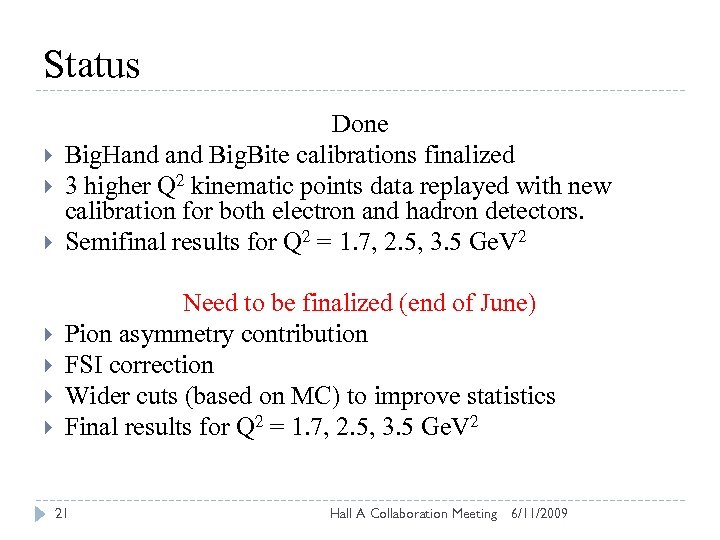 Status Done Big. Hand Big. Bite calibrations finalized 3 higher Q 2 kinematic points data replayed with new calibration for both electron and hadron detectors. Semifinal results for Q 2 = 1. 7, 2. 5, 3. 5 Ge. V 2 Need to be finalized (end of June) Pion asymmetry contribution FSI correction Wider cuts (based on MC) to improve statistics Final results for Q 2 = 1. 7, 2. 5, 3. 5 Ge. V 2 21 Hall A Collaboration Meeting 6/11/2009