 Скачать презентацию Dyslexia Overview Presented by JW Fulton
8181cb958c9f84b6be96114e801b6cdd.ppt
- Количество слайдов: 32



Dyslexia Overview Presented by JW Fulton
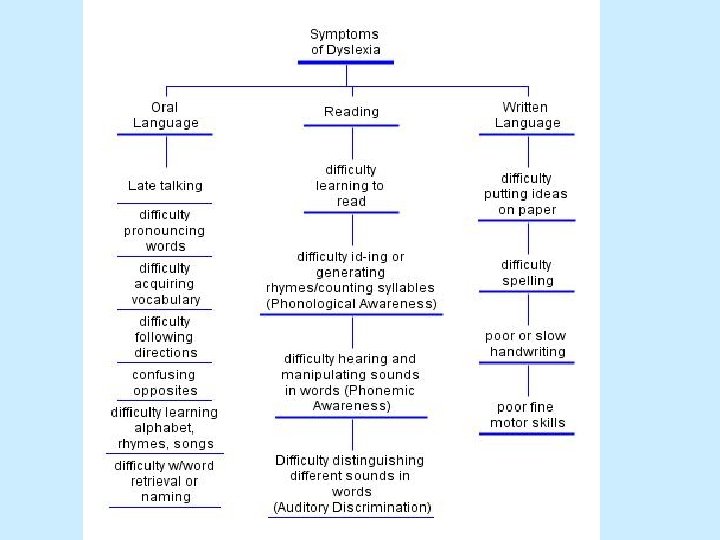
• DEFINITION OF DYSLEXIA Dyslexia is a specific learning disability that is neurological in origin. It is characterized by difficulties with accurate and/or fluent word recognition and by poor spelling and decoding abilities. • These difficulties typically result from a deficit in the phonological component of language that is often unexpected in relation to other cognitive abilities and the provision of effective classroom instruction. – Difficulty identifying or generating rhyming words, or counting syllables in words (Phonological Awareness) – Difficulty with hearing and manipulating sounds in words (Phonemic Awareness) – Difficulty distinguishing different sounds in words; such as “b” or “d”, “ph” or “sh” (Auditory Discrimination) • Secondary consequences may include problems in reading comprehension and reduced reading experience that can impede growth of vocabulary and background knowledge. • (Adopted by the International Dyslexia Association Board of Directors, Nov. 12, 2002)
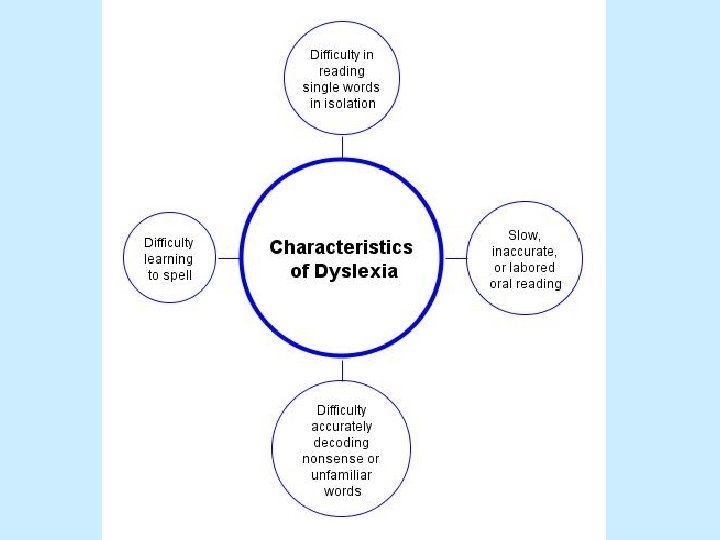
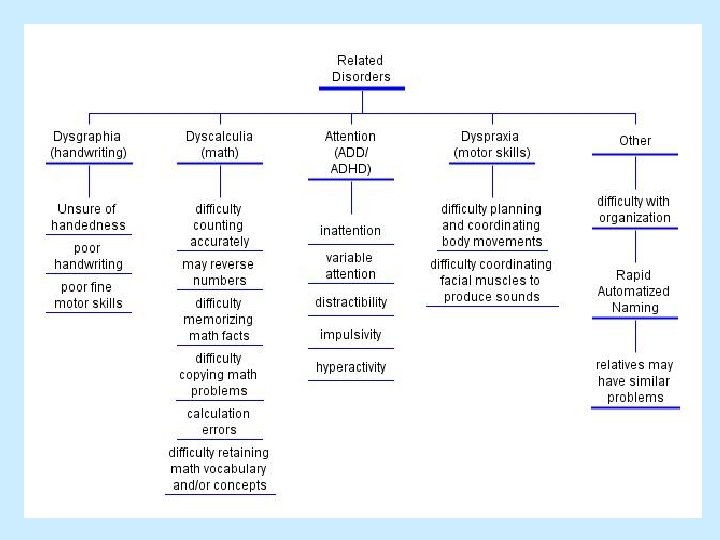
Reading Difficulties • Inability to rhyme or “play with sounds” in words • Problems in learning the names of the letters of the alphabet • Difficulty in learning to decode words (be-cause; Al-a-bam-a; de-ci-sion) • Difficulty with reading comprehension • Lack of reading fluency (speed and accuracy)
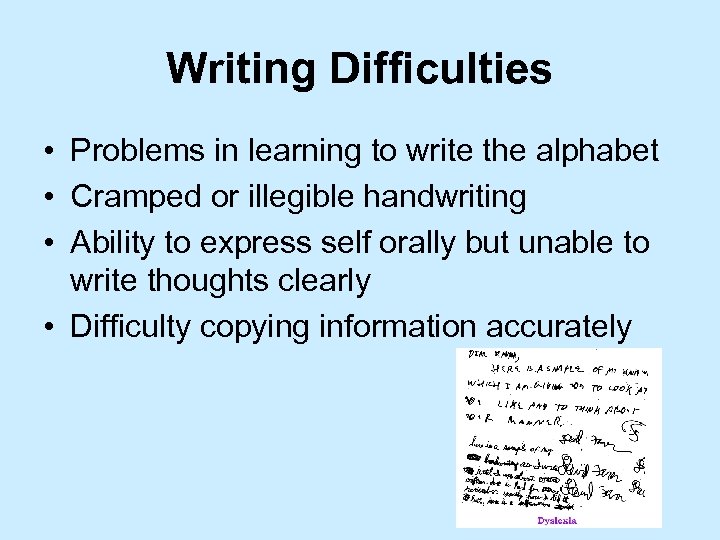
Writing Difficulties • Problems in learning to write the alphabet • Cramped or illegible handwriting • Ability to express self orally but unable to write thoughts clearly • Difficulty copying information accurately
Spelling Difficulties • Repeated erratic spelling errors • Able to perform on a spelling test with a certain list of words but unable to spell the same words correctly in everyday writing.
Sequencing Difficulties • Difficulty with concept of time and temporal sequencing (yesterday/tomorrow/ days of the week/months of the year) • Difficulty with writing the alphabet in proper sequence • Continued reversal of letters or sequences of letters and numbers
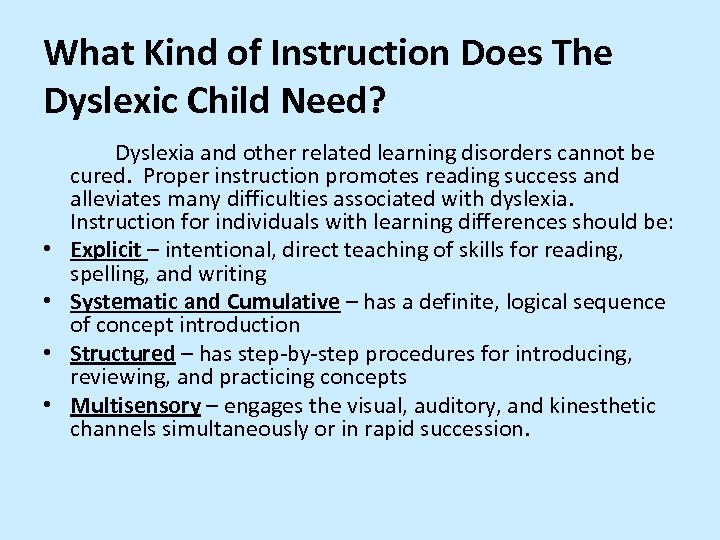
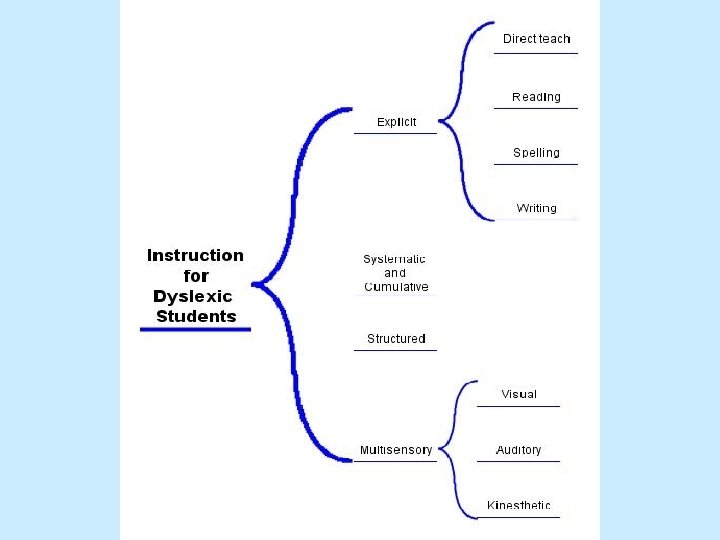
What Kind of Instruction Does The Dyslexic Child Need? • • Dyslexia and other related learning disorders cannot be cured. Proper instruction promotes reading success and alleviates many difficulties associated with dyslexia. Instruction for individuals with learning differences should be: Explicit – intentional, direct teaching of skills for reading, spelling, and writing Systematic and Cumulative – has a definite, logical sequence of concept introduction Structured – has step-by-step procedures for introducing, reviewing, and practicing concepts Multisensory – engages the visual, auditory, and kinesthetic channels simultaneously or in rapid succession.
Dealing with Dyslexia at Home
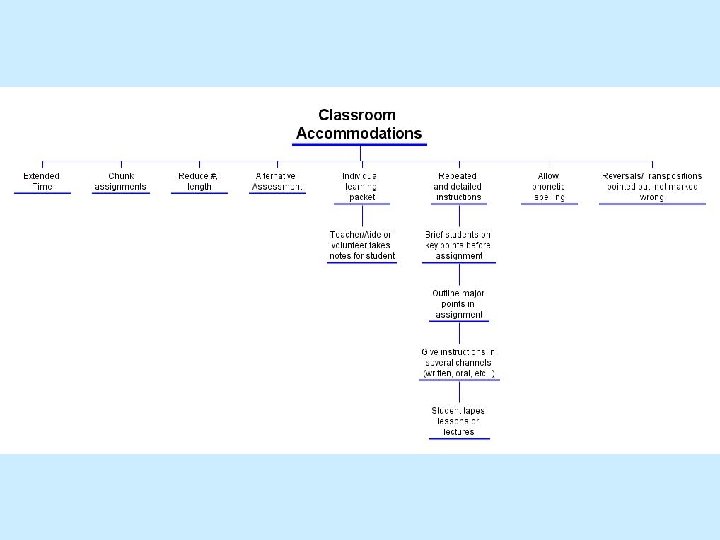
Ways to help at home • • • Read aloud to your child everyday. Listen to your child read easy books everyday. Emphasize your child’s strengths. To assist your child with homework, provide a quiet place with materials/supplies (books, pencils, pens, dictionary). If necessary, read assignments to your child and check for understanding. Act as your child’s secretary—record assignments as your child dictates them to you. Help your child plan break times as needed. Keep instructions simple. Give one direction at a time. Ask your child to repeat instructions aloud to check for understanding. Stay in contact with your child’s teacher. Be aware of accommodations/modifications occurring on the classroom. Seek alternative assignment methods such as computers, tapes, and oral reports rather than written reports for every evaluation.
Think about atmosphere Ways to encourage kids to read: • Give your child quiet time every day to read or write. • Limit time kids spend in front of a screen (including TV, computer, and video games) to help ensure that they have time for reading. • Read together. Offer to read a book aloud, or ask your child to read to you from a favorite magazine. Make a habit of sitting together while you each read your own books, sharing quiet time together
Keep a varied selection Don't limit reading material to books. Kids might also enjoy: • magazines (for kids) • audio books • postcards from relatives • photo albums or scrapbooks • newspapers • comic books • the Internet
Create a special reading place • As kids grow, keep age-appropriate books and magazines on shelves they can reach in their favorite hangouts around the house. • Make these shelves appealing and keep them organized. • Place some of the books with the covers facing out so they're easy to spot. • Put a basket full of books and magazines next to their favorite places to sit. • Create a cozy reading corner, and encourage kids to use it by setting up "reading corner time" each day.
Homework Help Getting Started: • Chunk homework tasks into manageable parts. • Give breaks between tasks. • Encourage your child to produce quality work rather than rushing tasks. • The dyslexic student can become discouraged when faced with large amounts of work.
Organization • Help students develop a comprehensive homework plan. Monitor time spent on homework and results. • Encourage your child to keep their school notes and work together in folders so they don’t get lost or damaged. • Organize notes into subjects, and ensure that they are filed regularly. • Color coding of subjects can greatly assist organization and planning. • If students are not getting their homework down accurately, arrange for them to check with someone in the same class at the end of the day. Or ask teachers to give them written homework instructions for more complex tasks. • Meet with teachers regularly to check that students are completing homework tasks and classwork correctly and are handing in work at school.
Help with Handwriting Dyslexic children sometimes have problems with handwriting. • When learning to read, children first have to link the shape of the word on the page with the sound it makes. • Then, when it comes to writing, they have to recreate that shape back onto paper. • For children with dyslexia, decoding these patterns and making these links can often be very difficult. • As a result, they frequently fail to develop the automatic flow of writing which will help them to express themselves clearly and easily in writing.
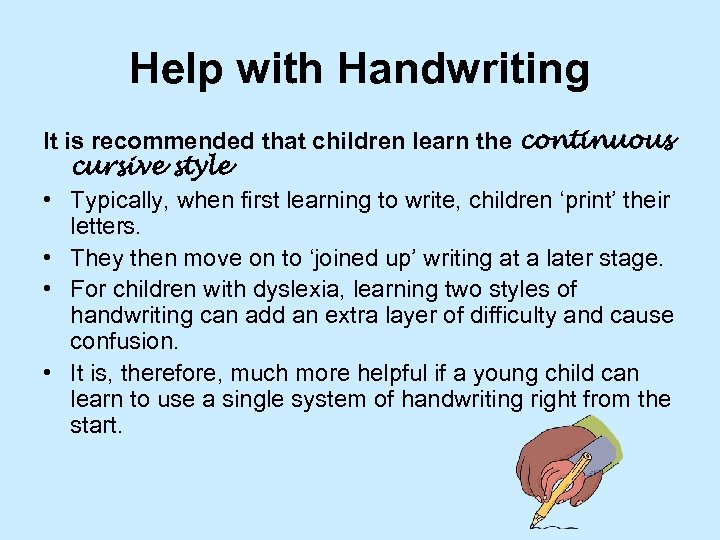
Help with Handwriting It is recommended that children learn the continuous cursive style • Typically, when first learning to write, children ‘print’ their letters. • They then move on to ‘joined up’ writing at a later stage. • For children with dyslexia, learning two styles of handwriting can add an extra layer of difficulty and cause confusion. • It is, therefore, much more helpful if a young child can learn to use a single system of handwriting right from the start.
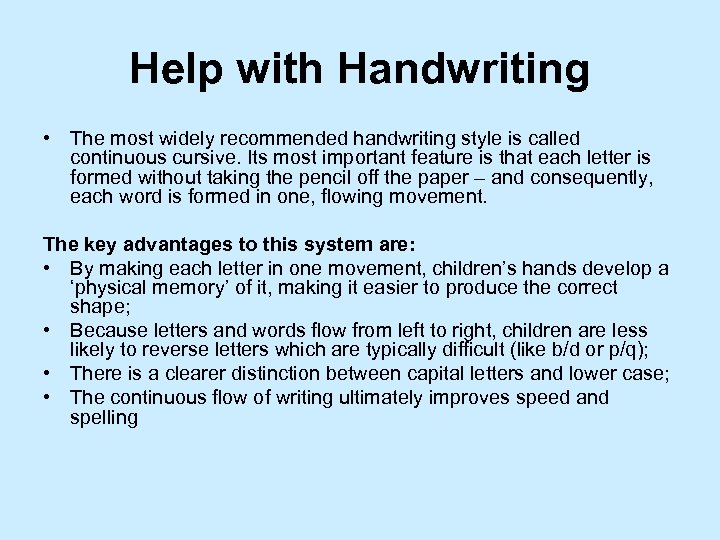
Help with Handwriting • The most widely recommended handwriting style is called continuous cursive. Its most important feature is that each letter is formed without taking the pencil off the paper – and consequently, each word is formed in one, flowing movement. The key advantages to this system are: • By making each letter in one movement, children’s hands develop a ‘physical memory’ of it, making it easier to produce the correct shape; • Because letters and words flow from left to right, children are less likely to reverse letters which are typically difficult (like b/d or p/q); • There is a clearer distinction between capital letters and lower case; • The continuous flow of writing ultimately improves speed and spelling
TV / Computer Time Limit the number of TV-watching hours: • Stock the room in which you have your TV/Computer with plenty of other non-screen entertainment (books, kids' magazines, toys, puzzles, board games, etc. ) to encourage kids to do something other than watch the tube. • Keep TVs/Computers out of kids' bedrooms. • Turn off the TV during meals. • Don't allow your child to watch TV while doing homework. • Treat TV as a privilege that kids need to earn — not a right that they're entitled to. Tell them that TV viewing is allowed only after chores and homework are completed.
TV Time Try a weekday ban. • Schoolwork, sports activities, and job responsibilities make it tough to find extra family time during the week. Record weekday shows or save TV time for weekends, and you'll have more family togetherness time to spend on meals, games, physical activity, and reading during the week.
TV Time Set a good example • Limit your own TV viewing. Watch TV with your child. • If you can't sit through the whole program, at least watch the first few minutes to assess the tone and appropriateness, then check in throughout the show.
TV Time Offer fun alternatives to television. • If your kids want to watch TV but you want them to turn it off, suggest alternatives like playing a board game, starting a game of hide and seek, playing outside, reading, etc… The possibilities for fun without the tube are endless — so turn off the TV and enjoy quality time with your kids.
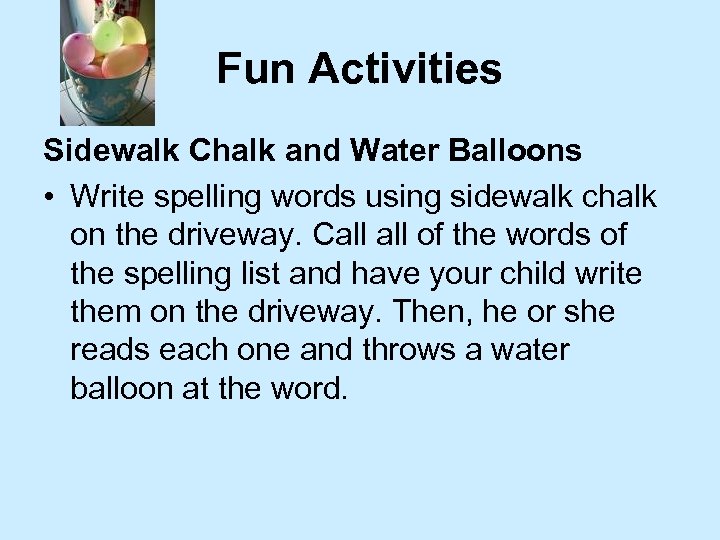
Fun Activities Sidewalk Chalk and Water Balloons • Write spelling words using sidewalk chalk on the driveway. Call of the words of the spelling list and have your child write them on the driveway. Then, he or she reads each one and throws a water balloon at the word.
Fun Activities Using rice for spellings • For spelling words, we use rice, stored in a shoe box and then poured out into the inside of the top cover of the shoebox. Use a sheet of paper with 3 columns. • Do a dry run of the spelling words on paper in the first column, then go over which are incorrect, then trace the word out in the rice. • After each word is 'written' in rice, it's also written again in the second column on paper. • After all the words are done in rice, then retest again in the third column. • This has proven to be a huge help in weekly spelling tests.
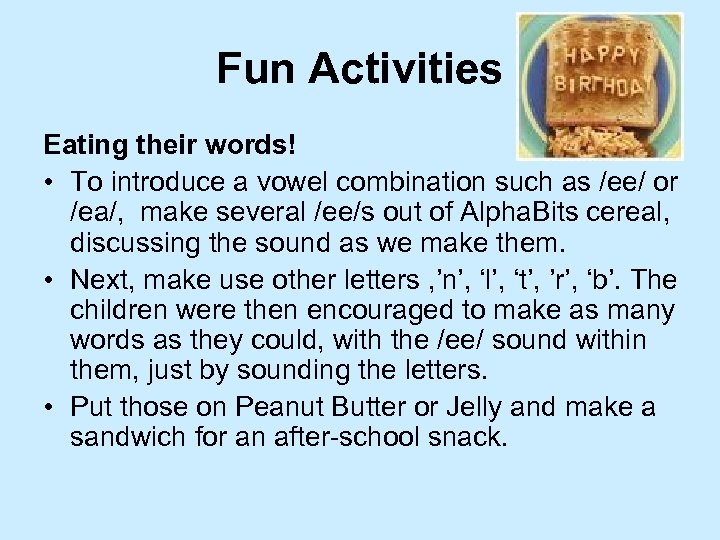
Fun Activities Eating their words! • To introduce a vowel combination such as /ee/ or /ea/, make several /ee/s out of Alpha. Bits cereal, discussing the sound as we make them. • Next, make use other letters , ’n’, ‘l’, ‘t’, ’r’, ‘b’. The children were then encouraged to make as many words as they could, with the /ee/ sound within them, just by sounding the letters. • Put those on Peanut Butter or Jelly and make a sandwich for an after-school snack.
Fun Activities Scrubbing Bubbles! • Have your child spray out spelling words on their shower wall or the side of a bathtub • This gives spelling and handwriting practice while also cleaning the bathroom!
Fun Activities Using Scotch tape • We used a number of multi-sensory approaches, one of them Scotch tape. We have used this simple but very effective material to make numbers and letters on the rug on the floor. • It was very helpful for my dyslexic son to approach this method with numbers and letters he used to keep reversing. • The physical act of creating a number with the tape would jog his memory every time he would have to write it on paper. (Y. Z. , London, UK)
Скачать презентацию Dyslexia Overview Presented by JW Fulton
8181cb958c9f84b6be96114e801b6cdd.ppt