


 Скачать презентацию Dyslexia Memory Training A case study of
10e51c97317ac1102dd7c31e3e903f9f.ppt
- Количество слайдов: 79
 Dyslexia & Memory Training A case study of student O ADSHE Networking Day June 17 th 2010 Sebastian Boo MA in sp. LD student London Metropolitan University
 Helping students to improve their memory skills is important because: • Effective memory skills are fundamental to learning & academic success • Developing memory skills is a frequent recommendation in students’ reports • Students often want to improve their memory skills is rewarding because: • Students do improve significantly & It does not take long • Students are very aware of the improvements in their memory skills and benefits this has for them • It is fun to teach Sebastian Boo June 2010 London Metropolitan University 2
 Workshop Outline 1. The student & the research question 2. Literature review 3. The keyword mnemonic: describe, demonstrate, practise, show student’s before & after results and discuss 4. The loci mnemonic: describe, demonstrate, practise, show student’s before & after results and discuss 5. Discussion & sharing of experiences 6. Summary Sebastian Boo June 2010 London Metropolitan University 3
 Who am I? • Completed the postgraduate certificate in teaching adult dyslexic learners in HE/FE at the London Metropolitan University in February 2010 • Freelance dyslexia support tutor • Working towards the post graduate diploma in assessing for dyslexia and the MA in sp. LD • Personal experience of being a dyslexic student at university Sebastian Boo June 2010 4 London Metropolitan University
 The student’s profile & needs Sebastian Boo June 2010 London Metropolitan University 5
 The Student: O’s profile 3 sources of information 1. interview 2. questionnaire 3. dyslexia assessment report Sebastian Boo June 2010 London Metropolitan University 6
 The Student: O’s profile • From interview – BA (pass) in Business & Law – Applying to MA in International Business – Aspires to owning his own internet company – Motivated young man Sebastian Boo June 2010 London Metropolitan University 7
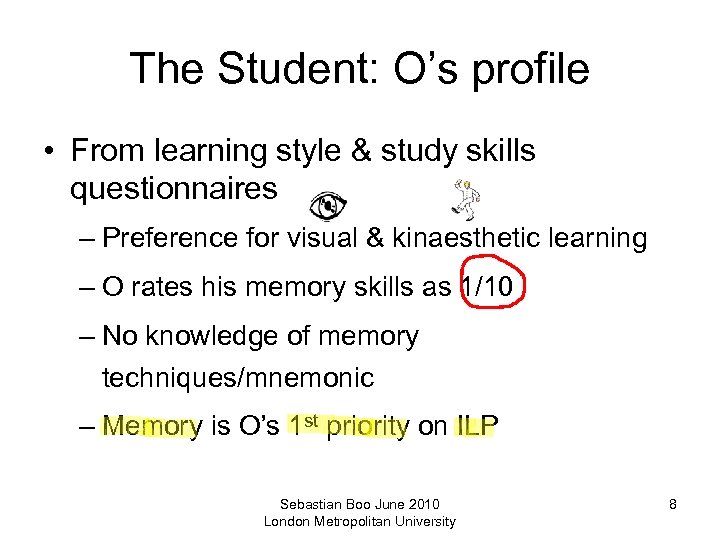 The Student: O’s profile • From learning style & study skills questionnaires – Preference for visual & kinaesthetic learning – O rates his memory skills as 1/10 – No knowledge of memory techniques/mnemonic – Memory is O’s 1 st priority on ILP Sebastian Boo June 2010 London Metropolitan University 8
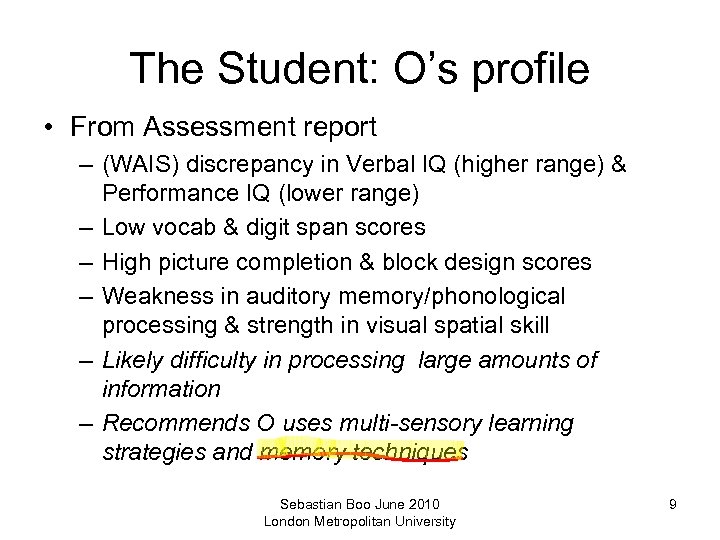 The Student: O’s profile • From Assessment report – (WAIS) discrepancy in Verbal IQ (higher range) & Performance IQ (lower range) – Low vocab & digit span scores – High picture completion & block design scores – Weakness in auditory memory/phonological processing & strength in visual spatial skill – Likely difficulty in processing large amounts of information – Recommends O uses multi-sensory learning strategies and memory techniques Sebastian Boo June 2010 London Metropolitan University 9
 The Student: O’s needs – Improve his memory skills – Succeed on MA course next year – Succeed in other areas of life requiring ability to remember large amounts of new information – From experience on BA course O found: • learning difficult words/terms a challenge • memorising for exams & memorising chapter summaries for seminars very difficult Sebastian Boo June 2010 London Metropolitan University 10
 The Research Question Sebastian Boo June 2010 London Metropolitan University 11
 The Research Question What interventions can I deliver that will, by taking into account O’s cognitive profile and motivations, improve his ability to memorise new information in a way that is relevant and applicable to his needs and circumstances? Sebastian Boo June 2010 London Metropolitan University 12
 Literature Review Sebastian Boo June 2010 London Metropolitan University 13
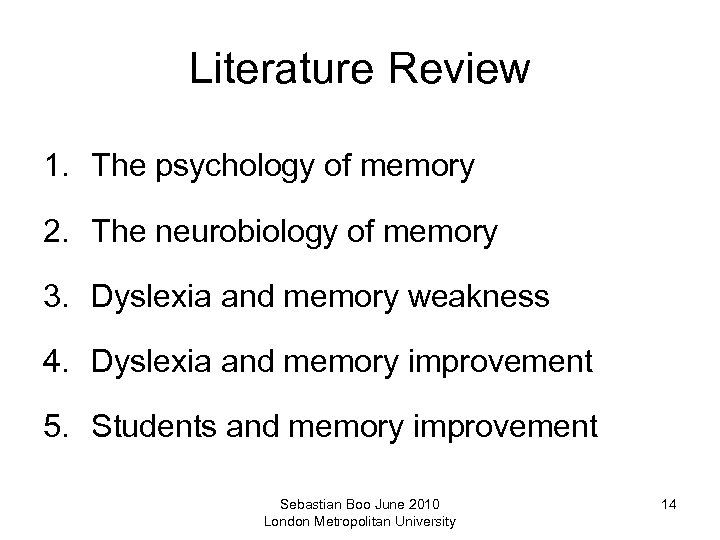 Literature Review 1. The psychology of memory 2. The neurobiology of memory 3. Dyslexia and memory weakness 4. Dyslexia and memory improvement 5. Students and memory improvement Sebastian Boo June 2010 London Metropolitan University 14
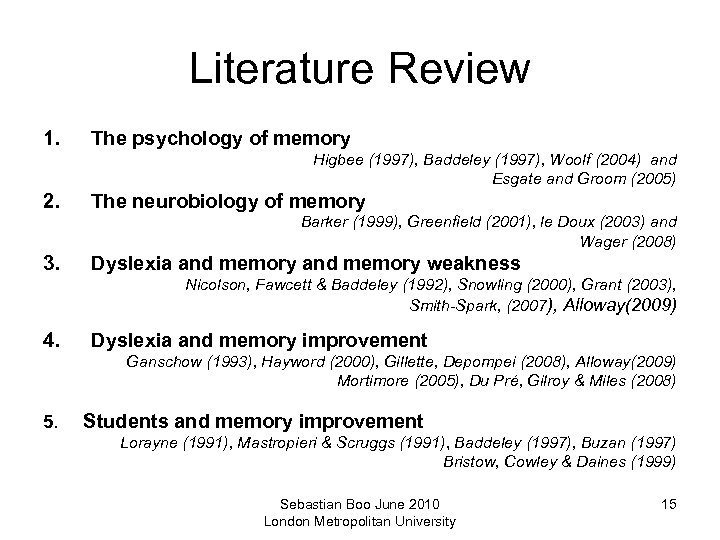 Literature Review 1. The psychology of memory Higbee (1997), Baddeley (1997), Woolf (2004) and Esgate and Groom (2005) 2. The neurobiology of memory Barker (1999), Greenfield (2001), le Doux (2003) and Wager (2008) 3. Dyslexia and memory weakness Nicolson, Fawcett & Baddeley (1992), Snowling (2000), Grant (2003), Smith-Spark, (2007), Alloway(2009) 4. Dyslexia and memory improvement Ganschow (1993), Hayword (2000), Gillette, Depompei (2008), Alloway(2009) Mortimore (2005), Du Pré, Gilroy & Miles (2008) 5. Students and memory improvement Lorayne (1991), Mastropieri & Scruggs (1991), Baddeley (1997), Buzan (1997) Bristow, Cowley & Daines (1999) Sebastian Boo June 2010 London Metropolitan University 15
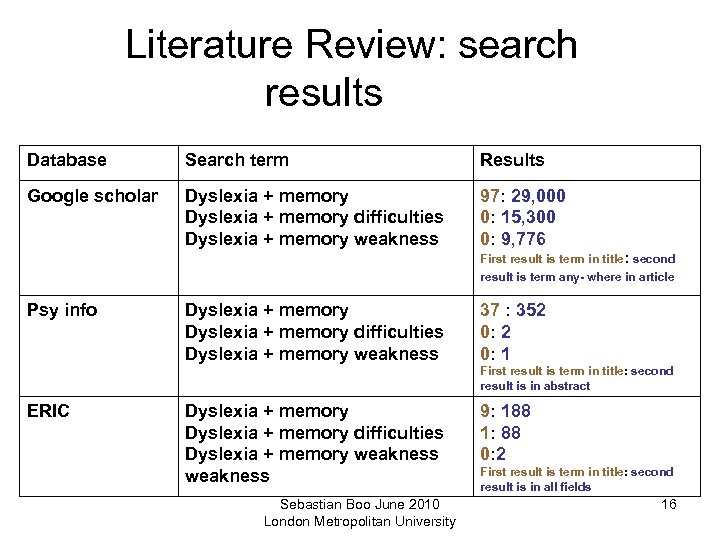 Literature Review: search results Database Search term Results Google scholar Dyslexia + memory difficulties Dyslexia + memory weakness 97: 29, 000 0: 15, 300 0: 9, 776 First result is term in title: second result is term any- where in article Psy info Dyslexia + memory difficulties Dyslexia + memory weakness 37 : 352 0: 1 First result is term in title: second result is in abstract ERIC Dyslexia + memory difficulties Dyslexia + memory weakness Sebastian Boo June 2010 London Metropolitan University 9: 188 1: 88 0: 2 First result is term in title: second result is in all fields 16
 What did I learn from the literature review ?
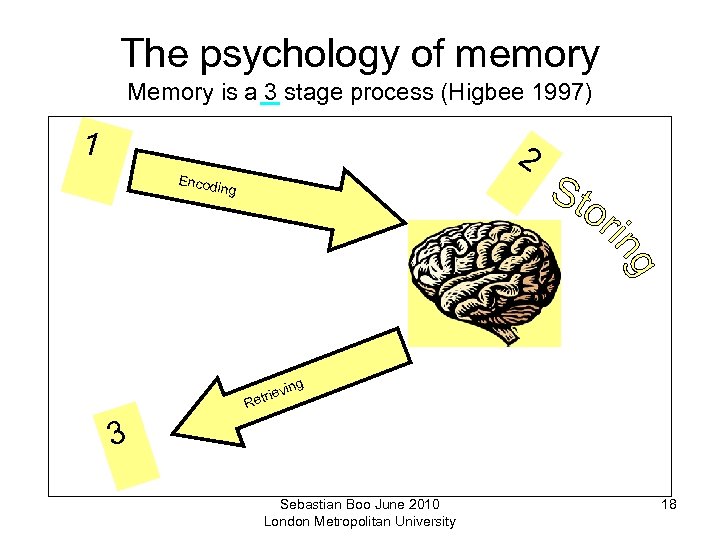 The psychology of memory Memory is a 3 stage process (Higbee 1997) 1 2 Encod ing v etrie R ing 3 Sebastian Boo June 2010 London Metropolitan University 18
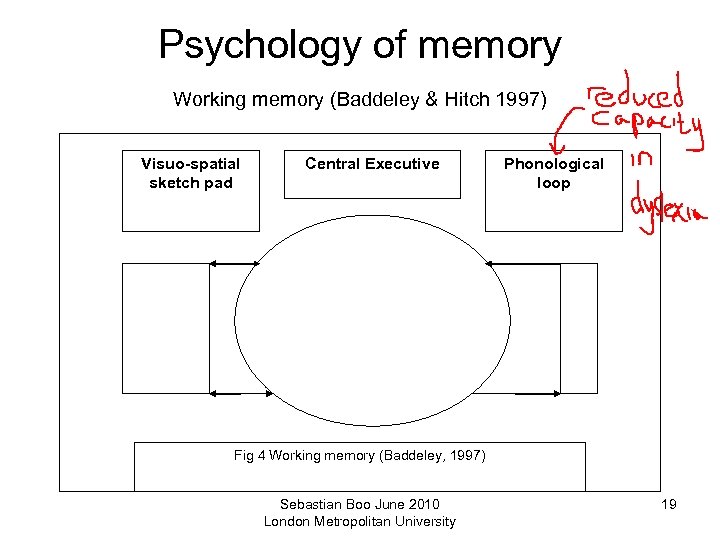 Psychology of memory Working memory (Baddeley & Hitch 1997) Visuo-spatial sketch pad Central Executive Phonological loop Fig 4 Working memory (Baddeley, 1997) Sebastian Boo June 2010 London Metropolitan University 19
 Dyslexia and memory weaknesses That many dyslexic student report difficulty with memorising new information is widely reported in the literature • • • Nicolson, Fawcett & Baddeley (1992) Moritmore (1994, p 104) Snowling (2000) Zdzienski (2001) Grant, D. (2003) Snowling, M. J. (2000) Smith-Spark, Fisk (2007) Du Pré, Gilroy, Miles (2008, p 208) Gillette, Depompei (2008) Alloway (2009) Sebastian Boo June 2010 London Metropolitan University 20
 Dyslexia & memory improvement: the research literature 4 broad categories of suggestions 1. Multisenory learning strategies e. g sparks. Ganschow (1993) 2. Visual learning strategies e. g. Steinbrink, Klatte (2009) 3. Use of personalized note taking methods, e. g. Hayword (2000) 4. Use of assistive technology such as personal digital assistants e. g. Gillette, Depompei (2008) Sebastian Boo June 2010 London Metropolitan University 21
 Research literature is supported by the “practitioner literature” e. g. Dyslexia & learning style Mortimore (2005) & Dyslexia at college Du Pré, Gilroy & Miles (2008) 1. Organising information 2. Using colour and pictures and shapes 3. Summarizing and numbering key points 4. Using visual mnemonics 5. Using multisensory learning Sebastian Boo June 2010 London Metropolitan University 22
 Memory improvement literature e. g. Buzan (1997), Lorayne (1991) • Organise the learning material systemically • Break the information down into discrete sections or chunks • Use verbal and visual mnemonics • Use multisensory learning • Review the learning material at regular intervals (spaced learning) • Make use of mindmaps (concept maps) Sebastian Boo June 2010 London Metropolitan University 23
 The Interventions Sebastian Boo June 2010 London Metropolitan University 24
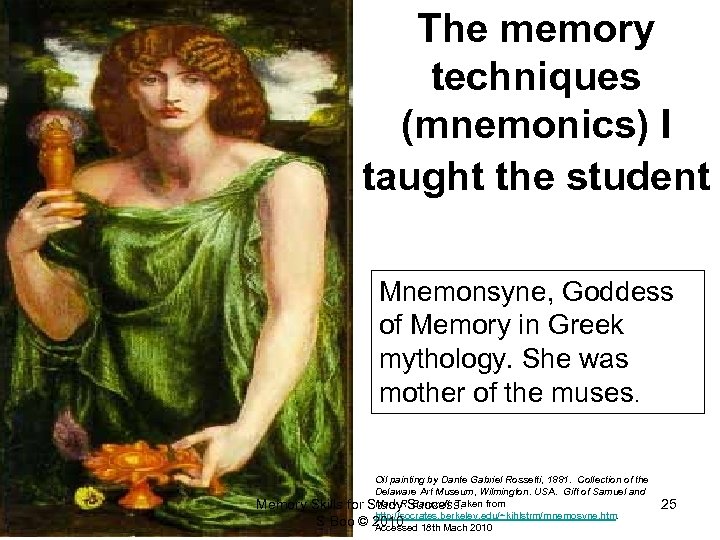 The memory techniques (mnemonics) I taught the student Mnemonsyne, Goddess of Memory in Greek mythology. She was mother of the muses. Oil painting by Dante Gabriel Rossetti, 1881. Collection of the Delaware Art Museum, Wilmington. USA. Gift of Samuel and Mary R. Bancroft. Taken from Memory Skills for Study Success. http: //socrates. berkeley. edu/~kihlstrm/mnemosyne. htm. S Boo © 2010 Accessed 18 th Mach 2010 25
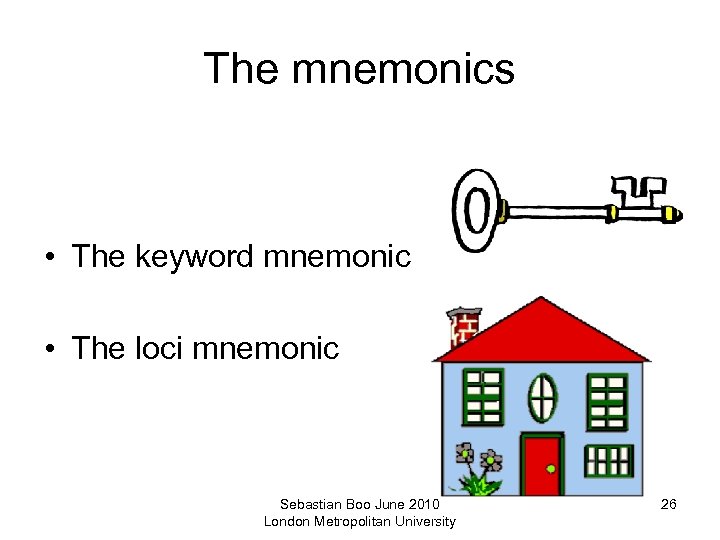 The mnemonics • The keyword mnemonic • The loci mnemonic Sebastian Boo June 2010 London Metropolitan University 26
 The keyword mnemonic Sebastian Boo June 2010 London Metropolitan University 27
 Keyword mnemonic What method for strengthen encoding and retrieval of memories for new words (Montessori, Scruggs 1991). Why did I choose it ? • O had difficulty remembering definitions • Positive accounts of the use of keyword mnemonic in literature e. g. Fritz, Morris et al (2007) • Tutor’s personal experience of using the mnemonic: I felt confident demonstrating it Sebastian Boo June 2010 London Metropolitan University 28
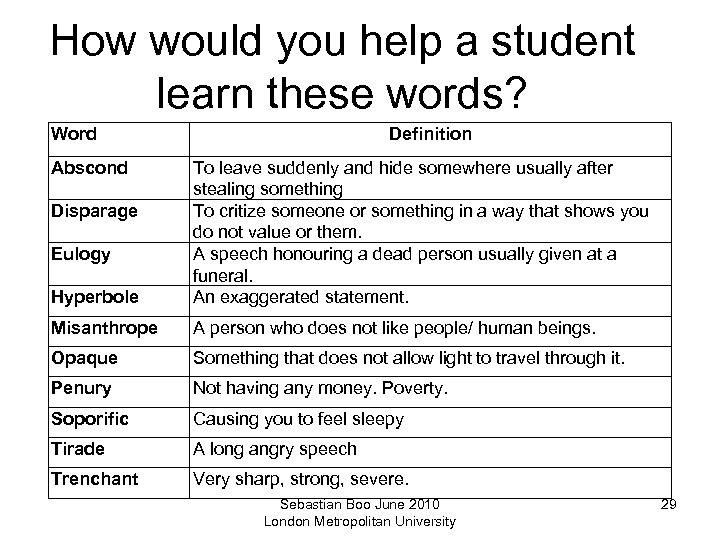 How would you help a student learn these words? Word Abscond Definition Hyperbole To leave suddenly and hide somewhere usually after stealing something To critize someone or something in a way that shows you do not value or them. A speech honouring a dead person usually given at a funeral. An exaggerated statement. Misanthrope A person who does not like people/ human beings. Opaque Something that does not allow light to travel through it. Penury Not having any money. Poverty. Soporific Causing you to feel sleepy Tirade A long angry speech Trenchant Very sharp, strong, severe. Disparage Eulogy Sebastian Boo June 2010 London Metropolitan University 29
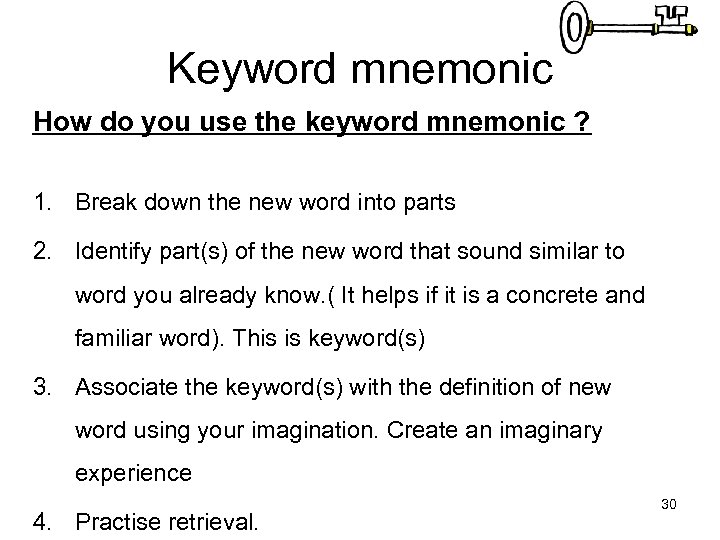 Keyword mnemonic How do you use the keyword mnemonic ? 1. Break down the new word into parts 2. Identify part(s) of the new word that sound similar to word you already know. ( It helps if it is a concrete and familiar word). This is keyword(s) 3. Associate the keyword(s) with the definition of new word using your imagination. Create an imaginary experience 4. Practise retrieval. 30
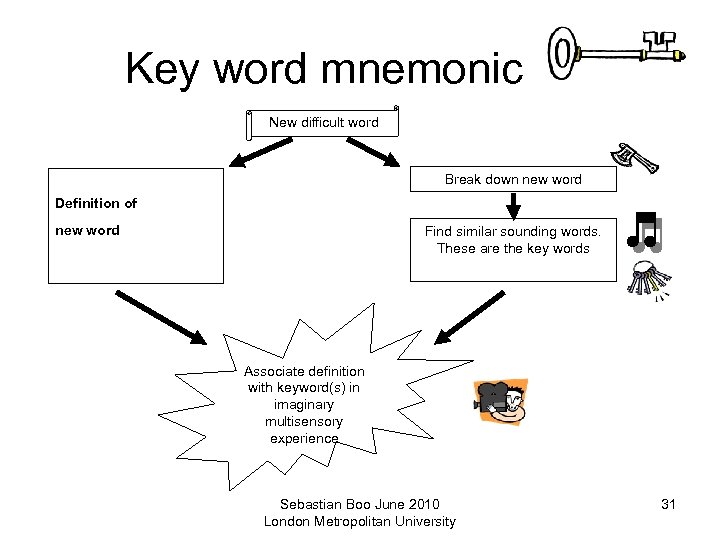 Key word mnemonic New difficult word Break down new word Definition of new word Find similar sounding words. These are the key words Associate definition with keyword(s) in imaginary multisensory experience Sebastian Boo June 2010 London Metropolitan University 31
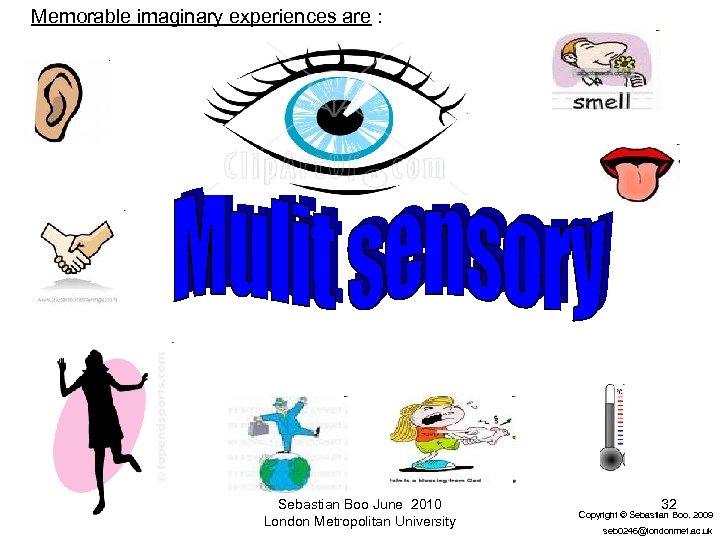 Memorable imaginary experiences are : Sebastian Boo June 2010 London Metropolitan University 32 Copyright © Sebastian Boo. 2009 seb 0246@londonmet. ac. uk
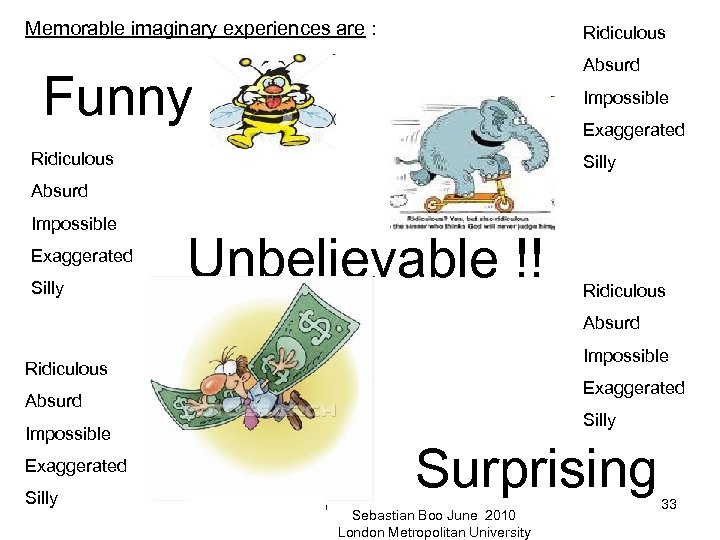 Memorable imaginary experiences are : Ridiculous Absurd Funny Impossible Exaggerated Ridiculous Silly Absurd Impossible Exaggerated Silly Unbelievable !! Ridiculous Absurd Impossible Ridiculous Exaggerated Absurd Impossible Exaggerated Silly Surprising Sebastian Boo June 2010 London Metropolitan University 33
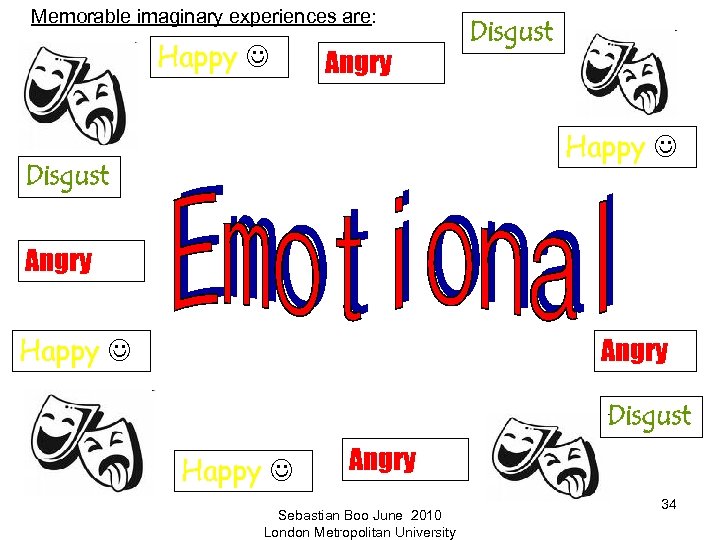 Memorable imaginary experiences are: Happy Angry Disgust Happy Disgust Angry Happy Angry Disgust Happy Angry Sebastian Boo June 2010 London Metropolitan University 34
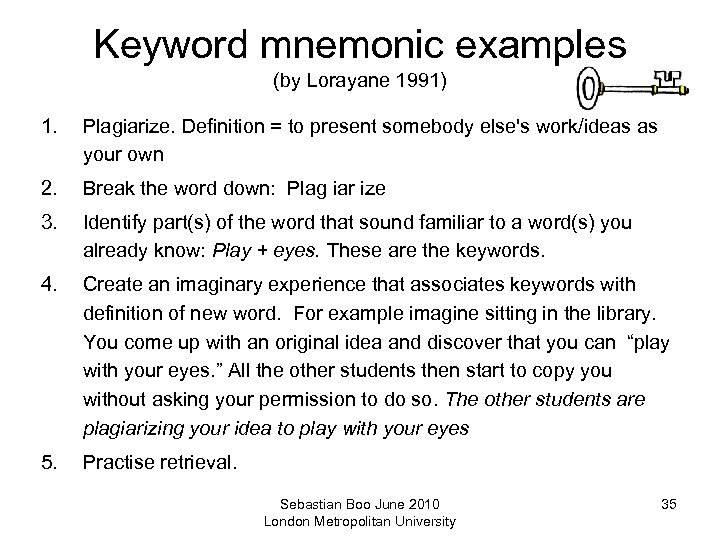 Keyword mnemonic examples (by Lorayane 1991) 1. Plagiarize. Definition = to present somebody else's work/ideas as your own 2. Break the word down: Plag iar ize 3. Identify part(s) of the word that sound familiar to a word(s) you already know: Play + eyes. These are the keywords. 4. Create an imaginary experience that associates keywords with definition of new word. For example imagine sitting in the library. You come up with an original idea and discover that you can “play with your eyes. ” All the other students then start to copy you without asking your permission to do so. The other students are plagiarizing your idea to play with your eyes 5. Practise retrieval. Sebastian Boo June 2010 London Metropolitan University 35
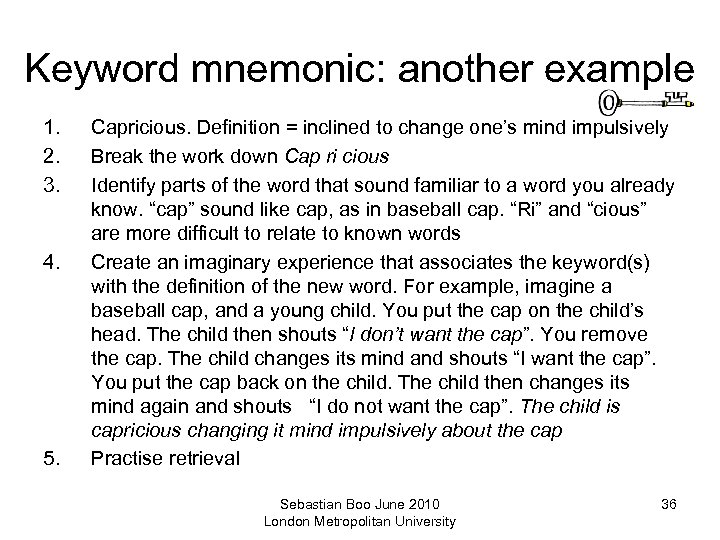 Keyword mnemonic: another example 1. 2. 3. 4. 5. Capricious. Definition = inclined to change one’s mind impulsively Break the work down Cap ri cious Identify parts of the word that sound familiar to a word you already know. “cap” sound like cap, as in baseball cap. “Ri” and “cious” are more difficult to relate to known words Create an imaginary experience that associates the keyword(s) with the definition of the new word. For example, imagine a baseball cap, and a young child. You put the cap on the child’s head. The child then shouts “I don’t want the cap”. You remove the cap. The child changes its mind and shouts “I want the cap”. You put the cap back on the child. The child then changes its mind again and shouts “I do not want the cap”. The child is capricious changing it mind impulsively about the cap Practise retrieval Sebastian Boo June 2010 London Metropolitan University 36
 Did the keyword mnemonic help the student? Sebastian Boo June 2010 London Metropolitan University
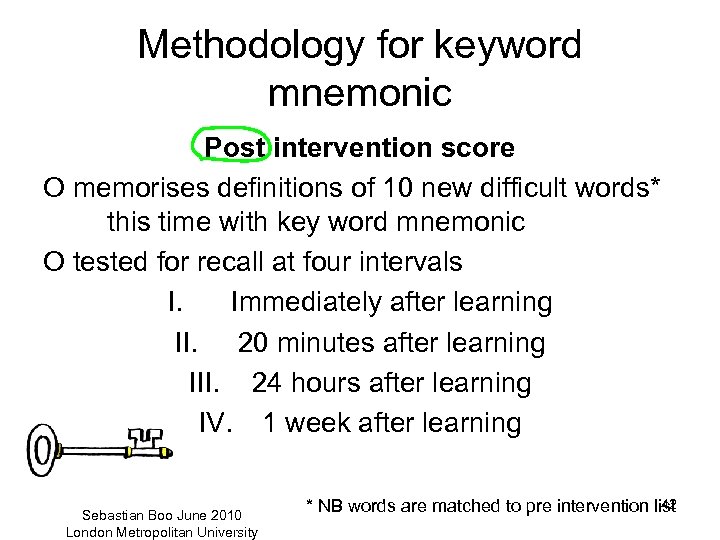
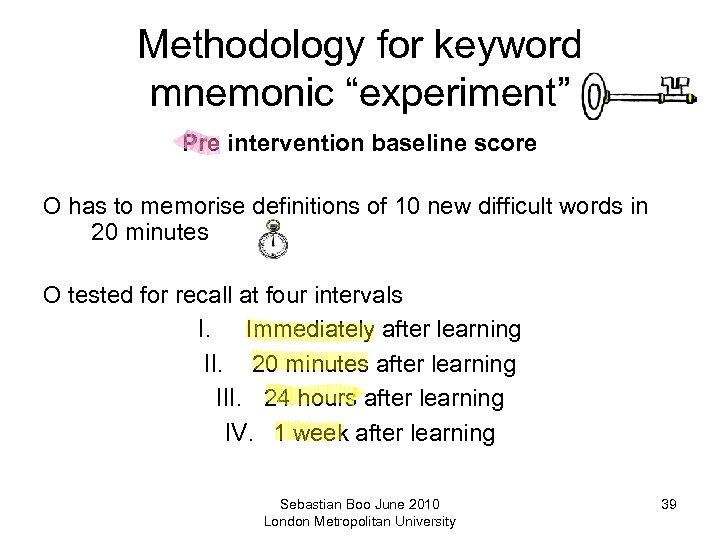 Methodology for keyword mnemonic “experiment” Pre intervention baseline score O has to memorise definitions of 10 new difficult words in 20 minutes O tested for recall at four intervals I. Immediately after learning II. 20 minutes after learning III. 24 hours after learning IV. 1 week after learning Sebastian Boo June 2010 London Metropolitan University 39
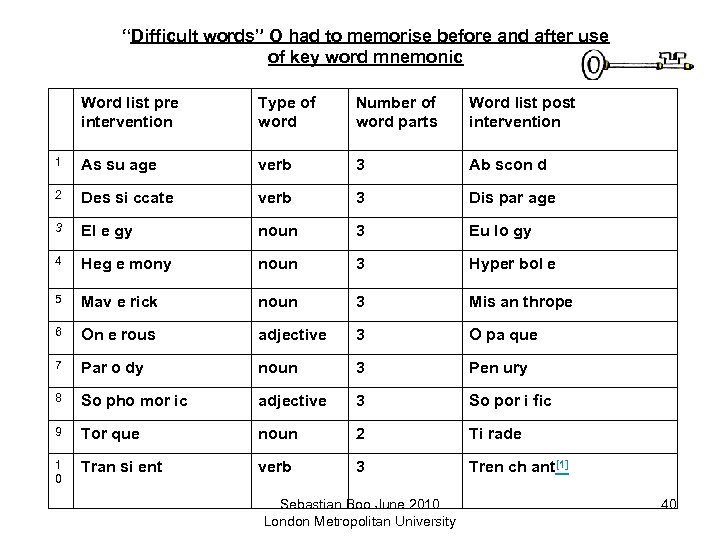 “Difficult words” O had to memorise before and after use of key word mnemonic Word list pre intervention Type of word Number of word parts Word list post intervention 1 As su age verb 3 Ab scon d 2 Des si ccate verb 3 Dis par age 3 El e gy noun 3 Eu lo gy 4 Heg e mony noun 3 Hyper bol e 5 Mav e rick noun 3 Mis an thrope 6 On e rous adjective 3 O pa que 7 Par o dy noun 3 Pen ury 8 So pho mor ic adjective 3 So por i fic 9 Tor que noun 2 Ti rade 1 0 Tran si ent verb 3 Tren ch ant[1] Sebastian Boo June 2010 London Metropolitan University 40
 Methodology for keyword mnemonic Post intervention score O memorises definitions of 10 new difficult words* this time with key word mnemonic O tested for recall at four intervals I. Immediately after learning II. 20 minutes after learning III. 24 hours after learning IV. 1 week after learning Sebastian Boo June 2010 London Metropolitan University 42 * NB words are matched to pre intervention list
 Results for the keyword mnemonic Sebastian Boo June 2010 London Metropolitan University 43
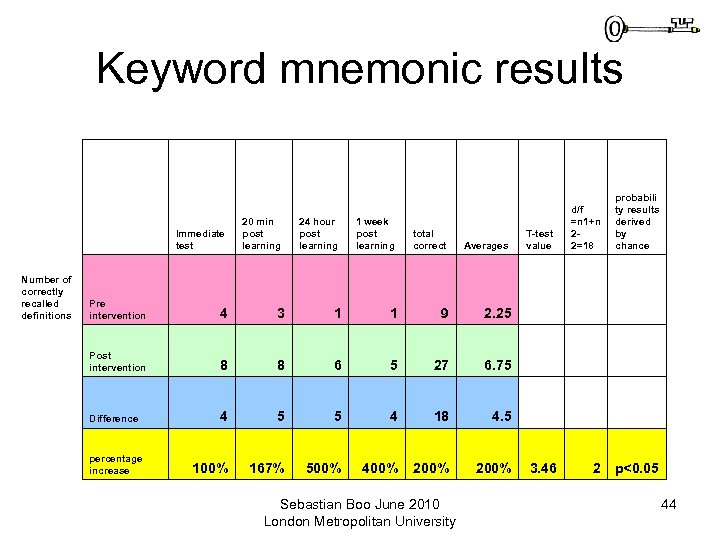 Keyword mnemonic results probabili ty results derived by chance Immediate test 20 min post learning 24 hour post learning 1 week post learning total correct Averages Pre intervention 4 3 1 1 9 2. 25 Post intervention 8 8 6 5 27 6. 75 Difference 4 5 5 4 18 4. 5 100% 167% 500% 400% 200% Number of correctly recalled definitions T-test value d/f =n 1+n 22=18 percentage increase Sebastian Boo June 2010 London Metropolitan University 3. 46 2 p<0. 05 44
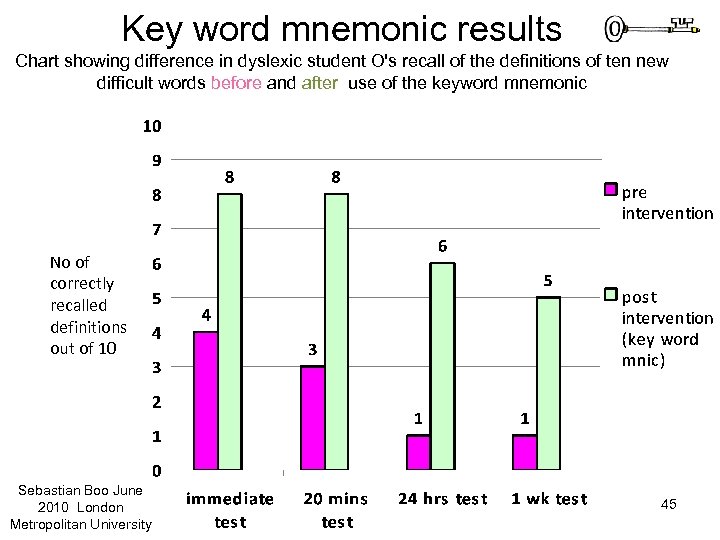 Key word mnemonic results Chart showing difference in dyslexic student O's recall of the definitions of ten new difficult words before and after use of the keyword mnemonic No of correctly recalled definitions out of 10 Sebastian Boo June 2010 London Metropolitan University 45
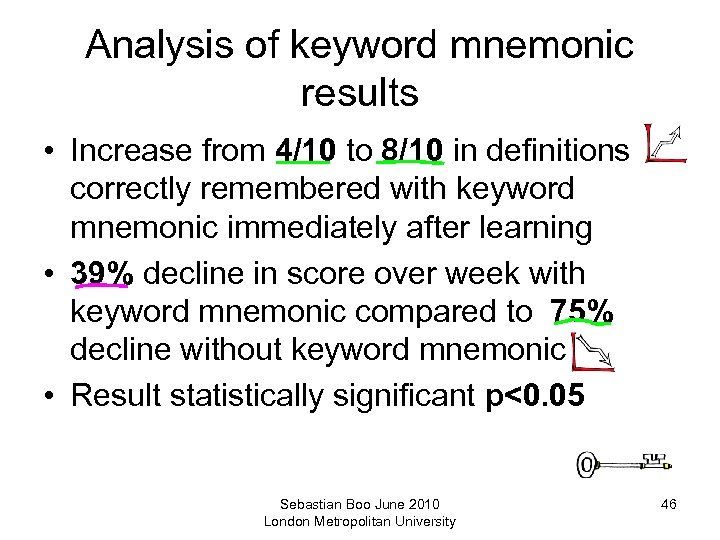 Analysis of keyword mnemonic results • Increase from 4/10 to 8/10 in definitions correctly remembered with keyword mnemonic immediately after learning • 39% decline in score over week with keyword mnemonic compared to 75% decline without keyword mnemonic • Result statistically significant p<0. 05 Sebastian Boo June 2010 London Metropolitan University 46
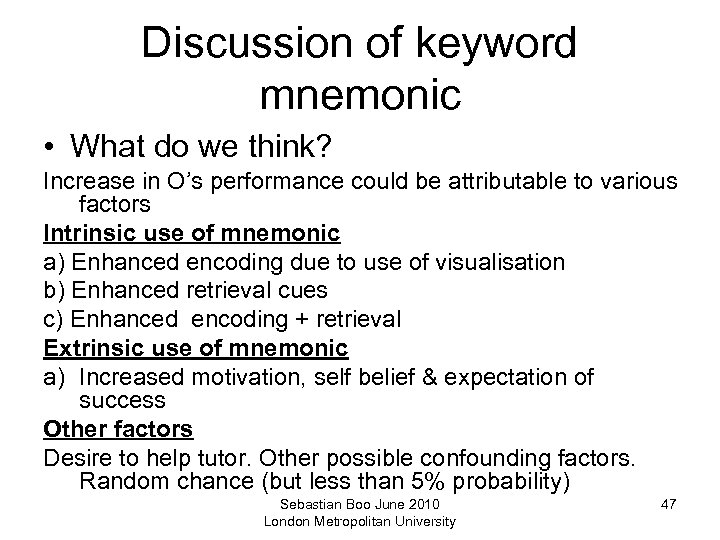 Discussion of keyword mnemonic • What do we think? Increase in O’s performance could be attributable to various factors Intrinsic use of mnemonic a) Enhanced encoding due to use of visualisation b) Enhanced retrieval cues c) Enhanced encoding + retrieval Extrinsic use of mnemonic a) Increased motivation, self belief & expectation of success Other factors Desire to help tutor. Other possible confounding factors. Random chance (but less than 5% probability) Sebastian Boo June 2010 London Metropolitan University 47
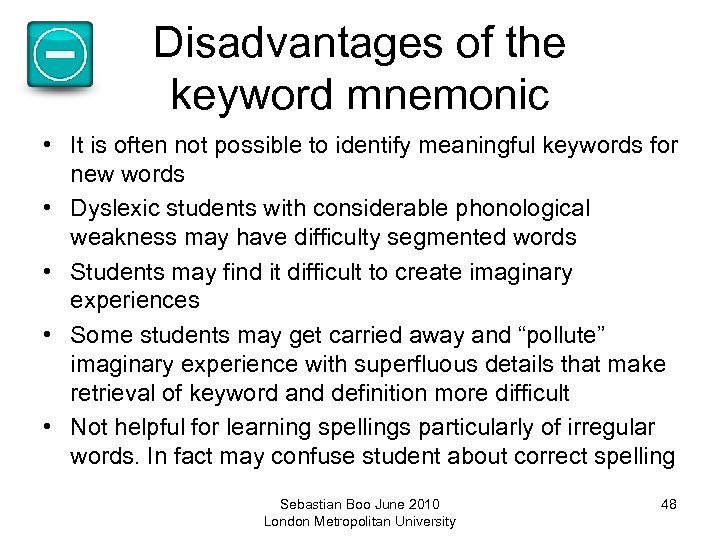 Disadvantages of the keyword mnemonic • It is often not possible to identify meaningful keywords for new words • Dyslexic students with considerable phonological weakness may have difficulty segmented words • Students may find it difficult to create imaginary experiences • Some students may get carried away and “pollute” imaginary experience with superfluous details that make retrieval of keyword and definition more difficult • Not helpful for learning spellings particularly of irregular words. In fact may confuse student about correct spelling Sebastian Boo June 2010 London Metropolitan University 48
 Advantages of the keyword mnemonic • It allows students to encode verbal information in a visual way • It force students to “pay attention” to the word and the meaning of the word • It correlates with improved learning and retention in at least one dyslexic student • There is evidence in the literature that it is a significant help for children in learning new words (Scruggs Mastropierie 1991) and for university students to learn foreign language vocab (Frizt & Morris 2007) Sebastian Boo June 2010 London Metropolitan University 49
 The loci mnemonic Sebastian Boo June 2010 London Metropolitan University 50
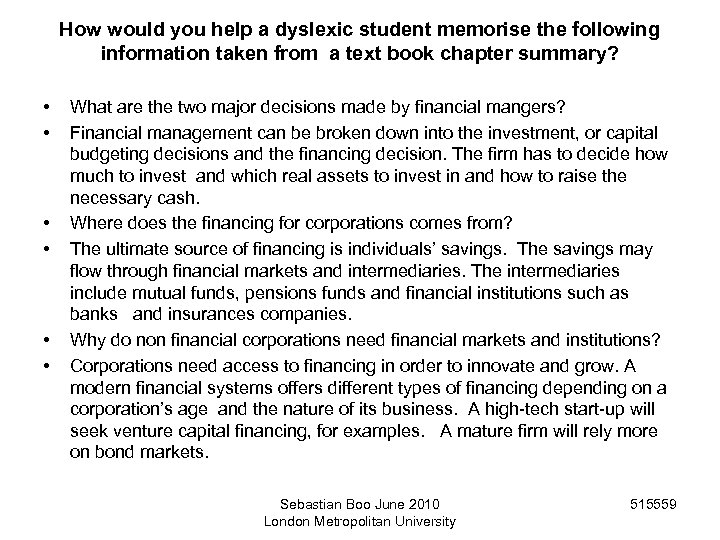 How would you help a dyslexic student memorise the following information taken from a text book chapter summary? • • • What are the two major decisions made by financial mangers? Financial management can be broken down into the investment, or capital budgeting decisions and the financing decision. The firm has to decide how much to invest and which real assets to invest in and how to raise the necessary cash. Where does the financing for corporations comes from? The ultimate source of financing is individuals’ savings. The savings may flow through financial markets and intermediaries. The intermediaries include mutual funds, pensions funds and financial institutions such as banks and insurances companies. Why do non financial corporations need financial markets and institutions? Corporations need access to financing in order to innovate and grow. A modern financial systems offers different types of financing depending on a corporation’s age and the nature of its business. A high-tech start-up will seek venture capital financing, for examples. A mature firm will rely more on bond markets. Sebastian Boo June 2010 London Metropolitan University 515559
 The loci mnemonic What is it? A method for strengthening encoding & retrieval of large amounts of new information in sequence Why did I choose it • Frequently recommend in the study skills literature • Student needed help remembering large amounts of new information in sequence • Tutor’s personal experience of using the mnemonic: I felt confident demonstrating it Sebastian Boo June 2010 London Metropolitan University 52
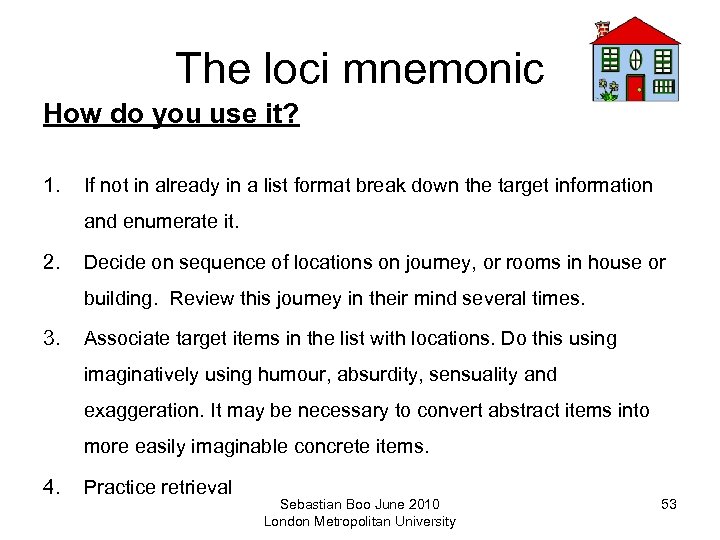 The loci mnemonic How do you use it? 1. If not in already in a list format break down the target information and enumerate it. 2. Decide on sequence of locations on journey, or rooms in house or building. Review this journey in their mind several times. 3. Associate target items in the list with locations. Do this using imaginatively using humour, absurdity, sensuality and exaggeration. It may be necessary to convert abstract items into more easily imaginable concrete items. 4. Practice retrieval Sebastian Boo June 2010 London Metropolitan University 53
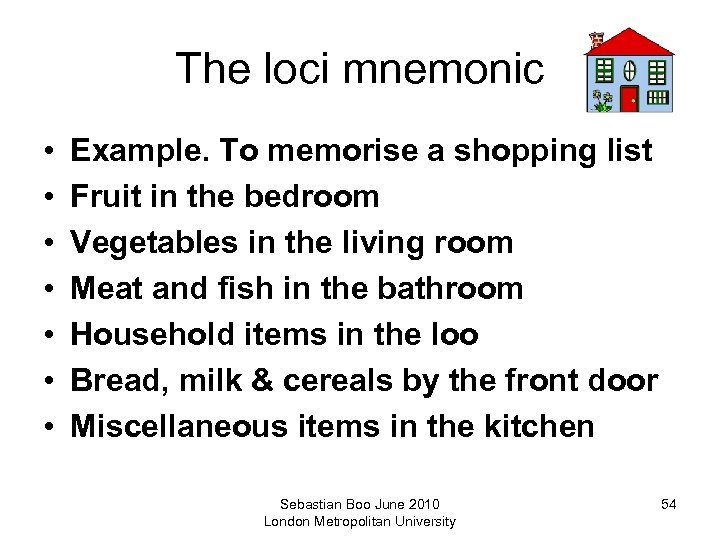 The loci mnemonic • • Example. To memorise a shopping list Fruit in the bedroom Vegetables in the living room Meat and fish in the bathroom Household items in the loo Bread, milk & cereals by the front door Miscellaneous items in the kitchen Sebastian Boo June 2010 London Metropolitan University 54
 Did the loci mnemonic help the student? Sebastian Boo June 2010 London Metropolitan University
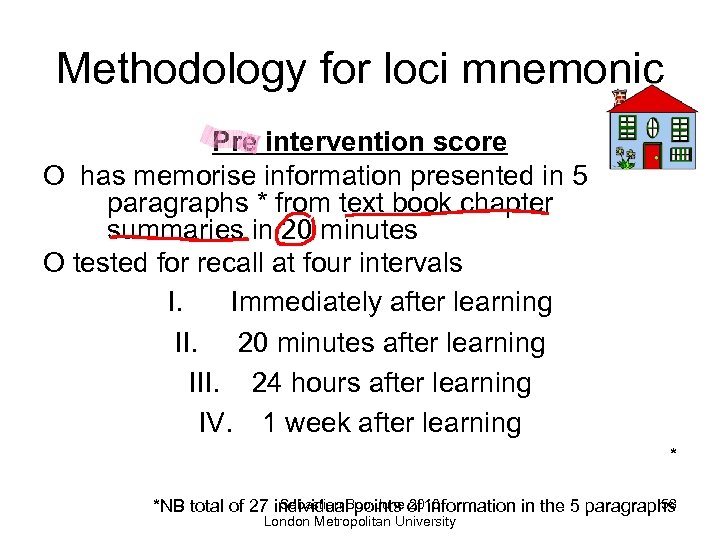 Methodology for loci mnemonic Pre intervention score O has memorise information presented in 5 paragraphs * from text book chapter summaries in 20 minutes O tested for recall at four intervals I. Immediately after learning II. 20 minutes after learning III. 24 hours after learning IV. 1 week after learning * Sebastian Boo June 2010 58 *NB total of 27 individual points of information in the 5 paragraphs London Metropolitan University
 Methodology for loci mnemonic Post intervention score O has memorise information presented in 5 paragraphs* in 20 minutes this time using loci mnemonic O tested for recall at four intervals I. Immediately after learning II. 20 minutes after learning III. 24 hours after learning IV. 1 week after learning * *NB 5 paragraphs are matched to pre intervention paragraphs Sebastian Boo June 2010 London Metropolitan University 59
 Results for the loci mnemonic Sebastian Boo June 2010 London Metropolitan University 60
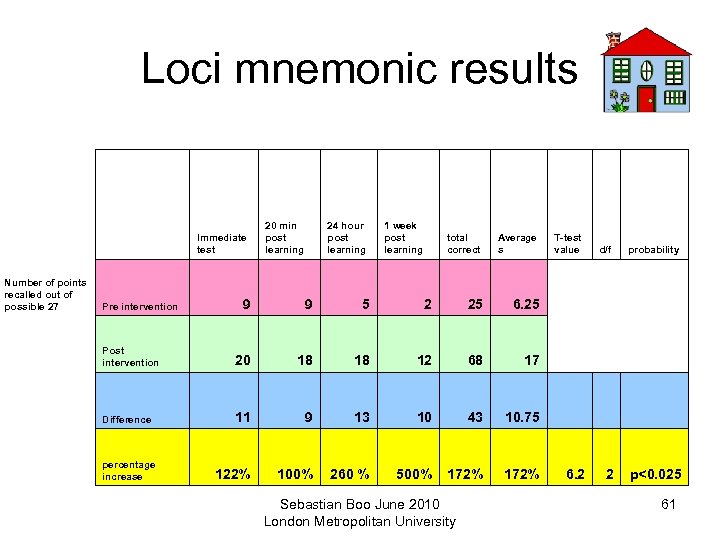 Loci mnemonic results Number of points recalled out of possible 27 Immediate test 20 min post learning 24 hour post learning 1 week post learning total correct Average s T-test value d/f probability 9 9 5 2 25 6. 25 Post intervention 20 18 18 12 68 17 Difference 11 9 13 10 43 10. 75 122% 100% 260 % 500% 172% Pre intervention percentage increase Sebastian Boo June 2010 London Metropolitan University 6. 2 2 p<0. 025 61
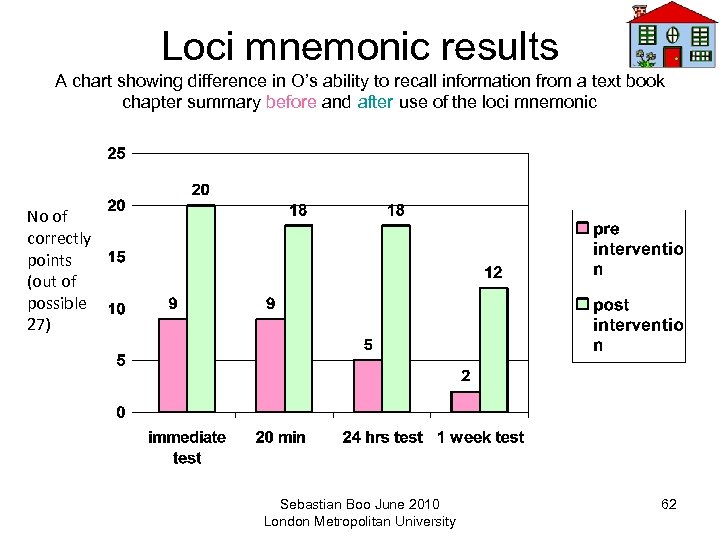 Loci mnemonic results A chart showing difference in O’s ability to recall information from a text book chapter summary before and after use of the loci mnemonic No of correctly points (out of possible 27) Sebastian Boo June 2010 London Metropolitan University 62
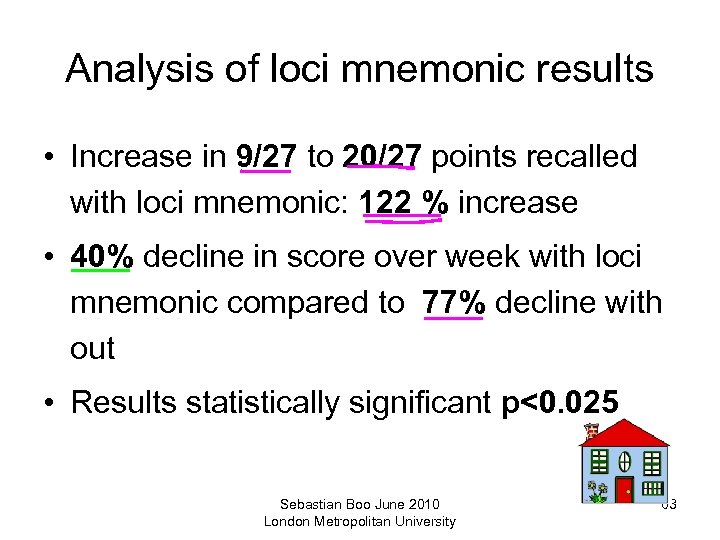 Analysis of loci mnemonic results • Increase in 9/27 to 20/27 points recalled with loci mnemonic: 122 % increase • 40% decline in score over week with loci mnemonic compared to 77% decline with out • Results statistically significant p<0. 025 Sebastian Boo June 2010 London Metropolitan University 63
 Discussion of loci mnemonic • What do we think? Increase in O’s performance could attributable to various factors Intrinsic use of mnemonic a) Enhanced encoding due to use of visual spatial b) Enhanced retrieval c) Enhanced both encoding + retrieval Extrinsic use of mnemonic a) Increased motivation, self belief & expectation of success Other factors Desire to help tutor. Other possible confounding factors. Random chance Sebastian Boo June 2010 London Metropolitan University 64
 Disadvantages of the loci mnemonic • It requires student to have already memorised a sequence of locations. • Using the same sequence of locations for different information may lead to interference and confusion. • Abstract target information needs to be converted into more concrete images. This can lead to confusion during retrieval. • Student who find it hard to visualise will find it difficult to use. • Some students may get carried away and use superfluous details that which makes retrieval of target information more difficult. Sebastian Boo June 2010 London Metropolitan University 65
 Advantages of the loci mnemonic • It allows students to encode verbal information in a visual way • It force students to “pay attention” to the information the want to memorise • If forces student to seek association with the target information and impose organisation on target information • It is a technique commonly used by “memory champions” • It correlates with improved learning and retention and confidence in several of my dyslexic students. Sebastian Boo June 2010 London Metropolitan University 66
 Interpretation of keyword & loci mnemonic results 1 Increase in O’s performance could attributable to various factors Intrinsic use of mnemonic a) Enhanced encoding due to use of visual spatial b) Enhanced retrieval c) Enhanced both encoding + retrieval Extrinsic use of mnemonic a) Increased motivation, self belief & expectation of success Other factors Desire to help tutor. Other possible confounding factors. Random chance Sebastian Boo June 2010 London Metropolitan University 67
 Interpretation of keyword & loci mnemonic results Likeliest interpretation Both intrinsic and extrinsic use of mnemonics increased O’s performance Intrinsic • Mnemonic = strategy enabling visual & kinesthetic (& multisensory) learning • Allows O to capitalise on stronger visual spatial processing ability • Without the mnemonic O solely reliant on weaker phonological processing. Extrinsic • Realisation of improved performance enhances O’s motivation and expectation of success which served to further improve performance generating a virtuous cycle Sebastian Boo June 2010 London Metropolitan University 68
 Mnemonic are not the be all and end all of memory training. Sebastian Boo June 2010 London Metropolitan University 69
 Excellent Encoding 1. Be “in the learning zone” 2. Understand the learning material. 3. Slice up & organise the learning material. 4. Repeat, review & revise. 5. Be excited to learn & make the material exciting to learn. 6. Associate and use memory techniques (mnemonics). Memory Skills for Study Success. S Boo © 2010 70
 Summary Sebastian Boo June 2010 London Metropolitan University 71
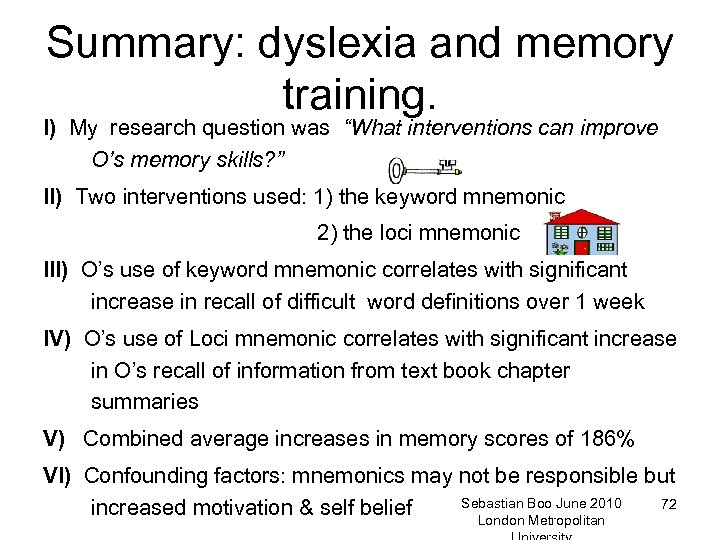 Summary: dyslexia and memory training. I) My research question was “What interventions can improve O’s memory skills? ” II) Two interventions used: 1) the keyword mnemonic 2) the loci mnemonic III) O’s use of keyword mnemonic correlates with significant increase in recall of difficult word definitions over 1 week IV) O’s use of Loci mnemonic correlates with significant increase in O’s recall of information from text book chapter summaries V) Combined average increases in memory scores of 186% VI) Confounding factors: mnemonics may not be responsible but Sebastian Boo June 2010 72 increased motivation & self belief London Metropolitan
 Summary • My interpretation of the results The mnemonics gave O a strategy to shift the cognitive workload of memorising away from his weaker phonological processing to his stronger visual spatial processing ability which resulted in improved encoding and subsequent retrieval of information. Realisation of his improved performance enhanced O’s motivation and expectation of success which served to further improve performance generating a virtuous cycle • Positive change in O’s self concept as learner (Burden 2005) Before intervention O rated his memory skills 1/10 whilst after 7. 58/10 Sebastian Boo June 2010 London Metropolitan University 73
 Conclusion • I believe dyslexic students can make significant improvements in their ability to use their memory which enhances their academic performance and self concept as effective learners • Specialist dyslexia tutors need to be skilled at working with students to help them improve their memory skills. Sebastian Boo June 2010 London Metropolitan University 74
 Thank You Sebastian Boo June 2010 London Metropolitan University 75
 References Sebastian Boo June 2010 London Metropolitan University 76
 References Alloway, T. P. , Rajendran, G. & Archibald, L. M. D. , 2009. Working Memory in Children With Developmental Disorders. Journal of Learning Disabilities, 42(4), 372 -382. Baddeley, A. (1997) Human Memory. Hove: Psychology Press Breadley, R. Myers, S. Marcus, A. ( 2007) Fundamentals of Corporate Finance 6 th Edition. New York. Mc. Graw-Hill Bristow, J. , Cowley, P. & Daines, B. (1999) Memory and Learning. London: David Fulton Publishers Barker, R. , Barashi, S. , Neal, M. J. ( 1999) Neuroscience at a Glance. London. Blackwell Science Buzan, T. (1997) Use Your Memory. London: BBC Books Buzan, T. (1998) Master Your Memory. London: BBC Books Du Pre, L. , Gilroy, D. , Miles, T. (2008) Dyslexia at college 3 rd Edition. London: Routledge Esgate, Al, Groome, D (2005) An Introduction to Cognitive Psychology. Hove Psychology Press Fritz, C. , Morris, P et al (2007) Comparing and combining retrieval practise and the key world mnemonic foreign vocabulary learning. Journal of Applied Cognitive Psychology Vol 21: 499 -526 77
 References Grant, D. (2003) the Dyslexias and Diagnostic Issues in HE. NADO Briefing Document : No 2 b. National association of disability practitioners Northampton. [online] available at http: //nadp-uk. org/resources/publications. php accessed [accessed 15 th November 2009. ] Gillette, Y. & Depompei, R. , 2008. Do PDAs enhance the organization and memory skills of students with cognitive disabilities? Psychology in the Schools, 45(7), 665 -677. Greenfiled, S. (2001) The Human Brain. London Phoenix Hayward, P. A. , 2000. The Dyslexic Student and the Public Speaking Notecard. Conference paper. Available at: http: //www. eric. ed. gov/ERICWeb. Portal/contentdelivery/servlet/ERICServl et? accno=ED 465977 [accessed 1 st December , 2009]. Higbee, K. L. (1997) Your Memory. New York: Marlowe & Company Le. Doux, J. (2003) The Emotional Brain. London. Phoneix Lorayne, H. (1991) Super Memory Super Student. Boston. Little Brown & Company. Mastropieri, M. A. & Scruggs, T. E. (1991) Teaching Students Ways to Remember. Strategies for Learning Mnemonically. Cambridge, MA: Brookline Books Sebastian Boo June 2010 London Metropolitan University 78
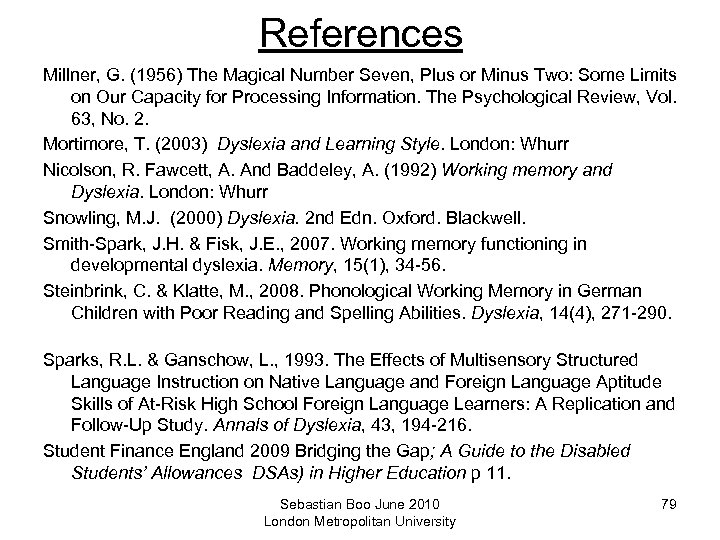 References Millner, G. (1956) The Magical Number Seven, Plus or Minus Two: Some Limits on Our Capacity for Processing Information. The Psychological Review, Vol. 63, No. 2. Mortimore, T. (2003) Dyslexia and Learning Style. London: Whurr Nicolson, R. Fawcett, A. And Baddeley, A. (1992) Working memory and Dyslexia. London: Whurr Snowling, M. J. (2000) Dyslexia. 2 nd Edn. Oxford. Blackwell. Smith-Spark, J. H. & Fisk, J. E. , 2007. Working memory functioning in developmental dyslexia. Memory, 15(1), 34 -56. Steinbrink, C. & Klatte, M. , 2008. Phonological Working Memory in German Children with Poor Reading and Spelling Abilities. Dyslexia, 14(4), 271 -290. Sparks, R. L. & Ganschow, L. , 1993. The Effects of Multisensory Structured Language Instruction on Native Language and Foreign Language Aptitude Skills of At-Risk High School Foreign Language Learners: A Replication and Follow-Up Study. Annals of Dyslexia, 43, 194 -216. Student Finance England 2009 Bridging the Gap; A Guide to the Disabled Students’ Allowances DSAs) in Higher Education p 11. Sebastian Boo June 2010 London Metropolitan University 79
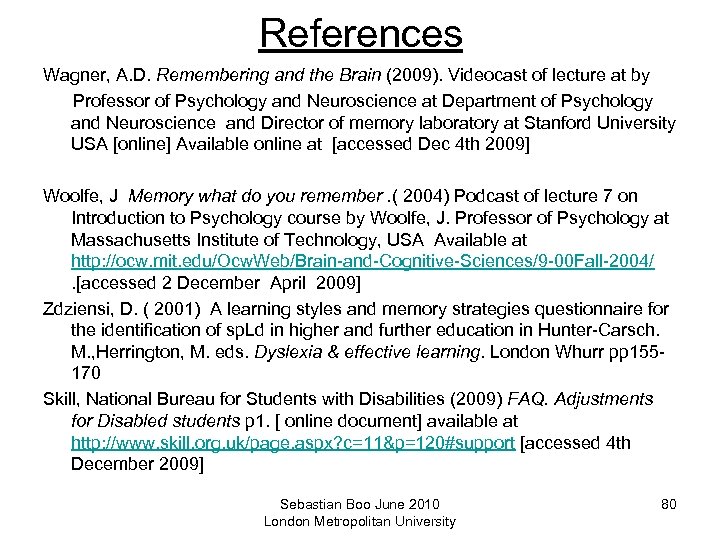 References Wagner, A. D. Remembering and the Brain (2009). Videocast of lecture at by Professor of Psychology and Neuroscience at Department of Psychology and Neuroscience and Director of memory laboratory at Stanford University USA [online] Available online at [accessed Dec 4 th 2009] Woolfe, J Memory what do you remember. ( 2004) Podcast of lecture 7 on Introduction to Psychology course by Woolfe, J. Professor of Psychology at Massachusetts Institute of Technology, USA Available at http: //ocw. mit. edu/Ocw. Web/Brain-and-Cognitive-Sciences/9 -00 Fall-2004/ . [accessed 2 December April 2009] Zdziensi, D. ( 2001) A learning styles and memory strategies questionnaire for the identification of sp. Ld in higher and further education in Hunter-Carsch. M. , Herrington, M. eds. Dyslexia & effective learning. London Whurr pp 155170 Skill, National Bureau for Students with Disabilities (2009) FAQ. Adjustments for Disabled students p 1. [ online document] available at http: //www. skill. org. uk/page. aspx? c=11&p=120#support [accessed 4 th December 2009] Sebastian Boo June 2010 London Metropolitan University 80
 Sebastian Boo June 2010 London Metropolitan University 81
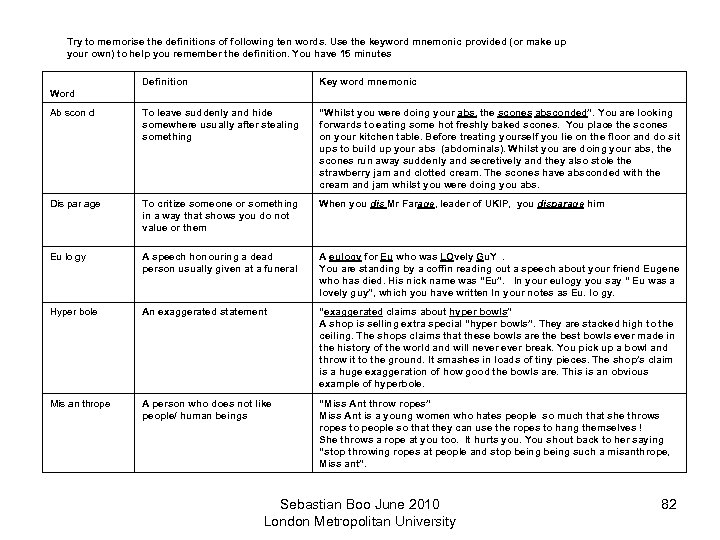 Try to memorise the definitions of following ten words. Use the keyword mnemonic provided (or make up your own) to help you remember the definition. You have 15 minutes Definition Key word mnemonic Ab scon d To leave suddenly and hide somewhere usually after stealing something “Whilst you were doing your abs, the scones absconded”. You are looking forwards to eating some hot freshly baked scones. You place the scones on your kitchen table. Before treating yourself you lie on the floor and do sit ups to build up your abs (abdominals). Whilst you are doing your abs, the scones run away suddenly and secretively and they also stole the strawberry jam and clotted cream. The scones have absconded with the cream and jam whilst you were doing you abs. Dis par age To critize someone or something in a way that shows you do not value or them When you dis Mr Farage, leader of UKIP, you disparage him Eu lo gy A speech honouring a dead person usually given at a funeral A eulogy for Eu who was LOvely Gu. Y . You are standing by a coffin reading out a speech about your friend Eugene who has died. His nick name was “Eu”. In your eulogy you say “ Eu was a lovely guy”, which you have written In your notes as Eu. lo gy. Hyper bole An exaggerated statement “exaggerated claims about hyper bowls” A shop is selling extra special “hyper bowls”. They are stacked high to the ceiling. The shops claims that these bowls are the best bowls ever made in the history of the world and will never break. You pick up a bowl and throw it to the ground. It smashes in loads of tiny pieces. The shop’s claim is a huge exaggeration of how good the bowls are. This is an obvious example of hyperbole. Mis an thrope A person who does not like people/ human beings “Miss Ant throw ropes” Miss Ant is a young women who hates people so much that she throws ropes to people so that they can use the ropes to hang themselves ! She throws a rope at you too. It hurts you. You shout back to her saying “stop throwing ropes at people and stop being such a misanthrope, Miss ant”. Word Sebastian Boo June 2010 London Metropolitan University 82
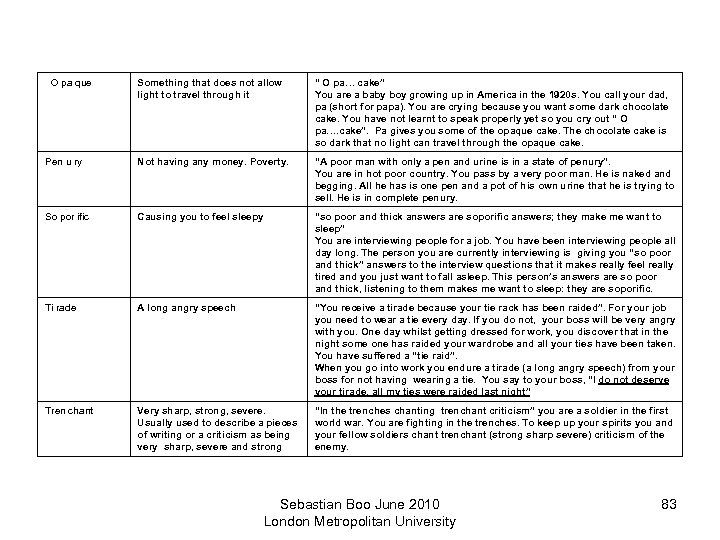 O pa que Something that does not allow light to travel through it “ O pa… cake” You are a baby boy growing up in America in the 1920 s. You call your dad, pa (short for papa). You are crying because you want some dark chocolate cake. You have not learnt to speak properly yet so you cry out “ O pa…. cake”. Pa gives you some of the opaque cake. The chocolate cake is so dark that no light can travel through the opaque cake. Pen u ry Not having any money. Poverty. “A poor man with only a pen and urine is in a state of penury”. You are in hot poor country. You pass by a very poor man. He is naked and begging. All he has is one pen and a pot of his own urine that he is trying to sell. He is in complete penury. So por ific Causing you to feel sleepy “so poor and thick answers are soporific answers; they make me want to sleep” You are interviewing people for a job. You have been interviewing people all day long. The person you are currently interviewing is giving you “so poor and thick” answers to the interview questions that it makes really feel really tired and you just want to fall asleep. This person’s answers are so poor and thick, listening to them makes me want to sleep: they are soporific. Ti rade A long angry speech “You receive a tirade because your tie rack has been raided”. For your job you need to wear a tie every day. If you do not, your boss will be very angry with you. One day whilst getting dressed for work, you discover that in the night some one has raided your wardrobe and all your ties have been taken. You have suffered a “tie raid”. When you go into work you endure a tirade (a long angry speech) from your boss for not having wearing a tie. You say to your boss, “I do not deserve your tirade, all my ties were raided last night” Tren chant Very sharp, strong, severe. Usually used to describe a pieces of writing or a criticism as being very sharp, severe and strong “In the trenches chanting trenchant criticism” you are a soldier in the first world war. You are fighting in the trenches. To keep up your spirits you and your fellow soldiers chant trenchant (strong sharp severe) criticism of the enemy. Sebastian Boo June 2010 London Metropolitan University 83