


 Скачать презентацию DYNAMICS OF OPEN Q-SYSTES FROM A PERSPECTIVE OF
c545854cc4371c784625bb7be78dc4af.ppt
- Количество слайдов: 32
 DYNAMICS OF OPEN Q-SYSTES FROM A PERSPECTIVE OF QIT Vladimír Bužek Research Center for Quantum Information Slovak Academy of Sciences Bratislava, Slovakia Nicolas Gisin, Mario Ziman, Peter Štelmachovič, Valerio Scarani & Mark Hillery IMS, Imperial College, London, 18 January 2007
 Motivation • • Information encoded in a state of a quantum system The system interacts with its (large) environment The information “dilutes” into a reservoir (“equilibrates”) Where the original information goes ? Is the process reversible ? Can we recover diluted information ? Can we derive a master equation? What is the role of quantum correlations in reservoir?
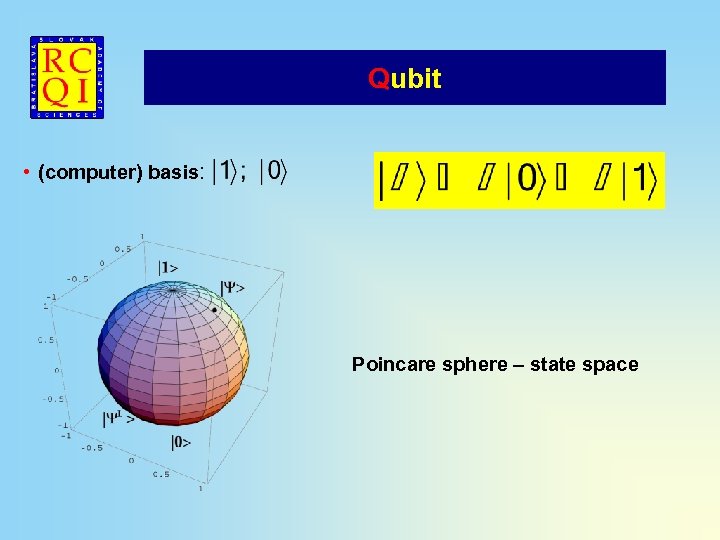 Qubit • (computer) basis: Poincare sphere – state space
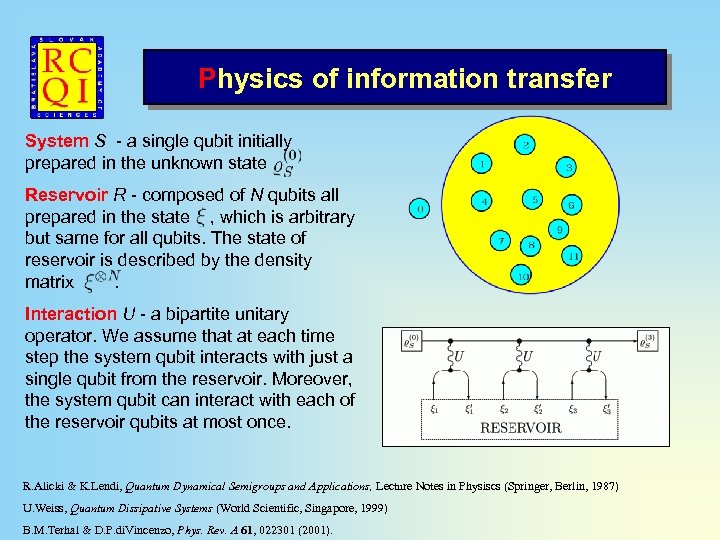 Physics of information transfer System S - a single qubit initially prepared in the unknown state Reservoir R - composed of N qubits all prepared in the state , which is arbitrary but same for all qubits. The state of reservoir is described by the density matrix. Interaction U - a bipartite unitary operator. We assume that at each time step the system qubit interacts with just a single qubit from the reservoir. Moreover, the system qubit can interact with each of the reservoir qubits at most once. R. Alicki & K. Lendi, Quantum Dynamical Semigroups and Applications, Lecture Notes in Physiscs (Springer, Berlin, 1987) U. Weiss, Quantum Dissipative Systems (World Scientific, Singapore, 1999) B. M. Terhal & D. P. di. Vincenzo, Phys. Rev. A 61, 022301 (2001).
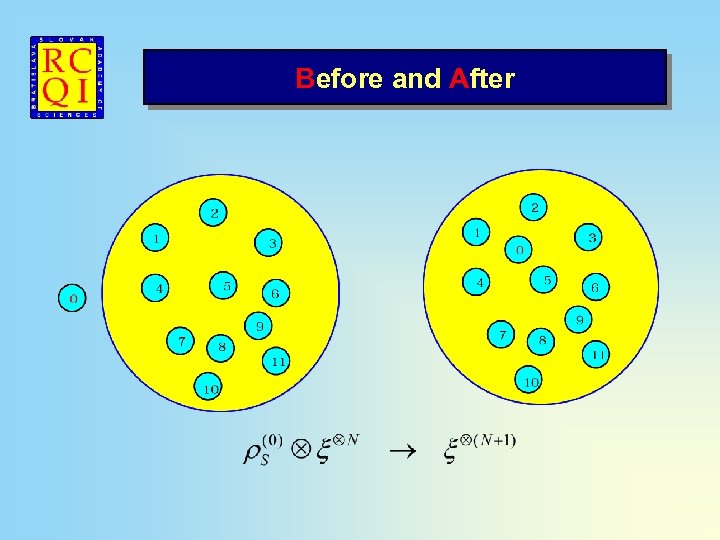 Before and After
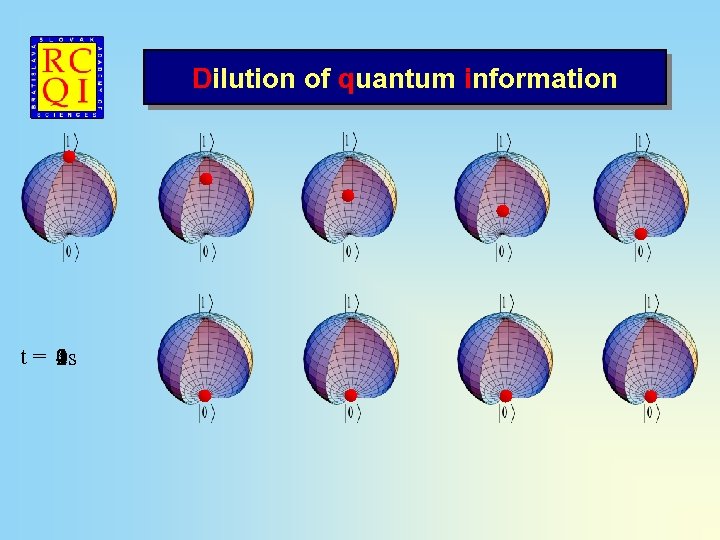 Dilution of quantum information t = 2 s 4 s 1 s 0 s 3 s
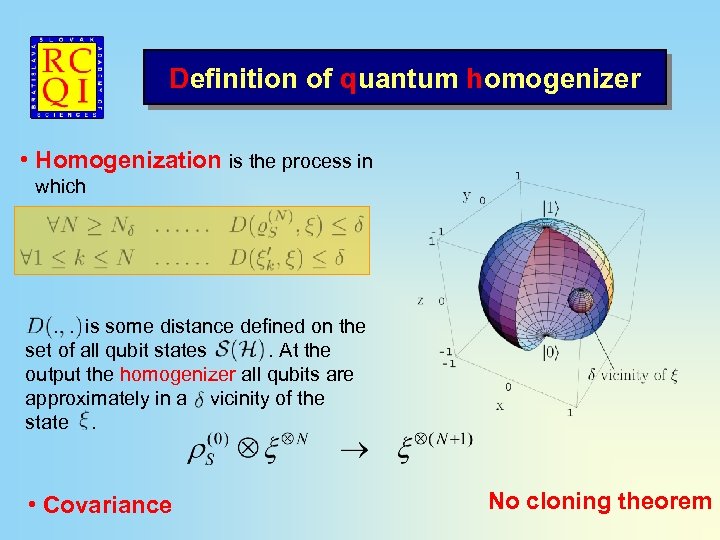 Definition of quantum homogenizer • Homogenization is the process in which is some distance defined on the set of all qubit states. At the output the homogenizer all qubits are approximately in a vicinity of the state. • Covariance No cloning theorem
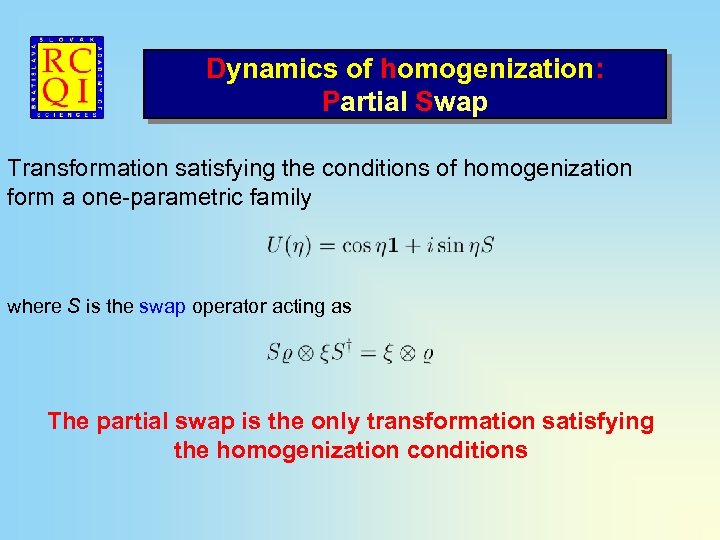 Dynamics of homogenization: Partial Swap Transformation satisfying the conditions of homogenization form a one-parametric family where S is the swap operator acting as The partial swap is the only transformation satisfying the homogenization conditions
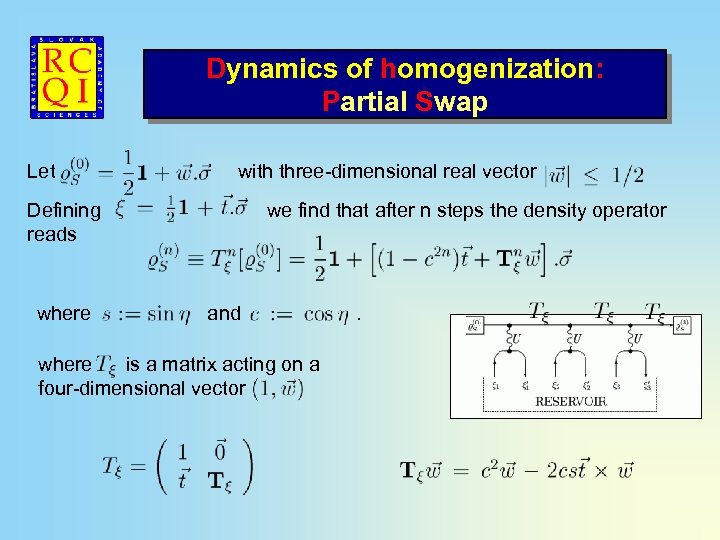 Dynamics of homogenization: Partial Swap Let with three-dimensional real vector Defining reads where we find that after n steps the density operator and where is a matrix acting on a four-dimensional vector .
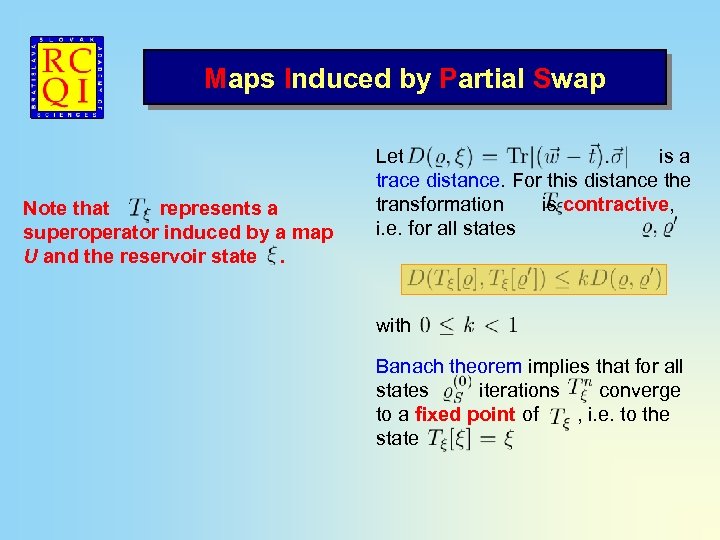 Maps Induced by Partial Swap Note that represents a superoperator induced by a map U and the reservoir state. Let is a trace distance. For this distance the transformation is contractive, i. e. for all states with Banach theorem implies that for all states iterations converge to a fixed point of , i. e. to the state
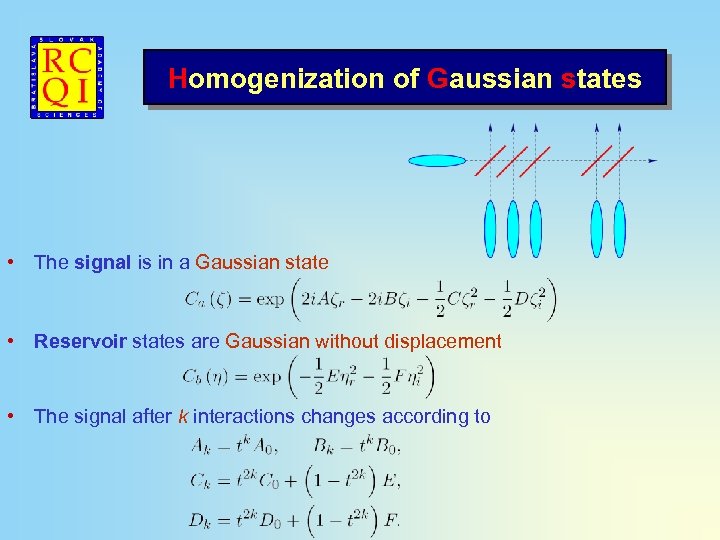 Homogenization of Gaussian states • The signal is in a Gaussian state • Reservoir states are Gaussian without displacement • The signal after k interactions changes according to
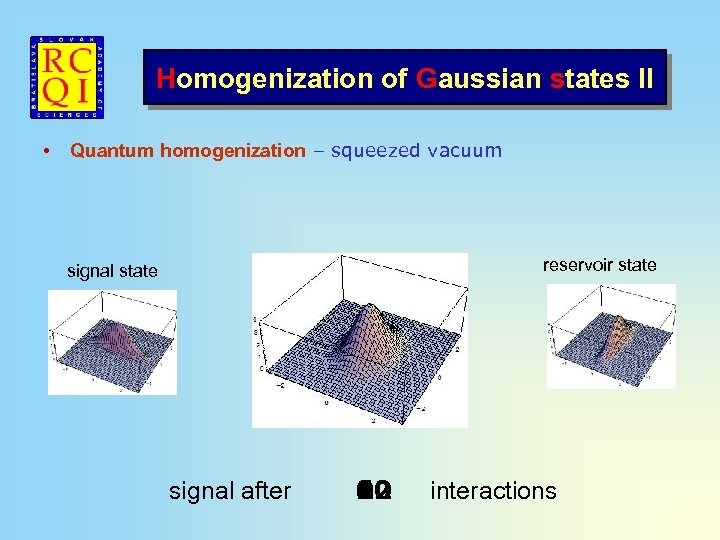 Homogenization of Gaussian states II • Quantum homogenization – squeezed vacuum reservoir state signal after 12 8 6 4 2 1 00 interactions
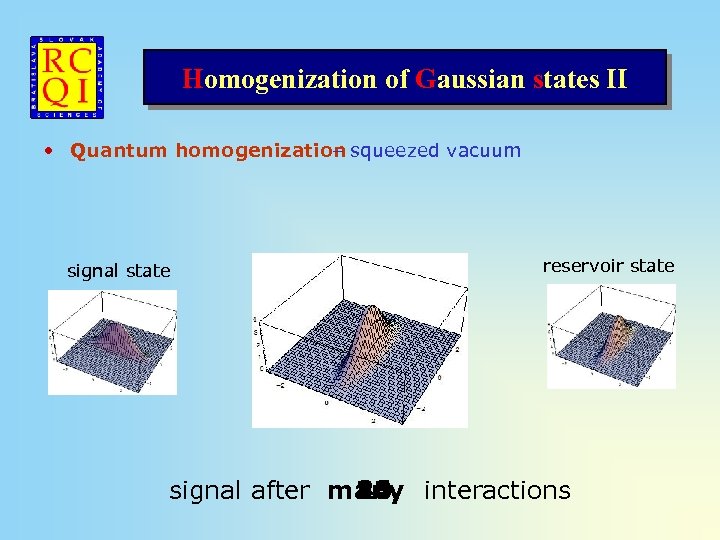 Homogenization of Gaussian states II • Quantum homogenization squeezed vacuum – signal state reservoir state 44 33 26 20 16 14 signal after many interactions
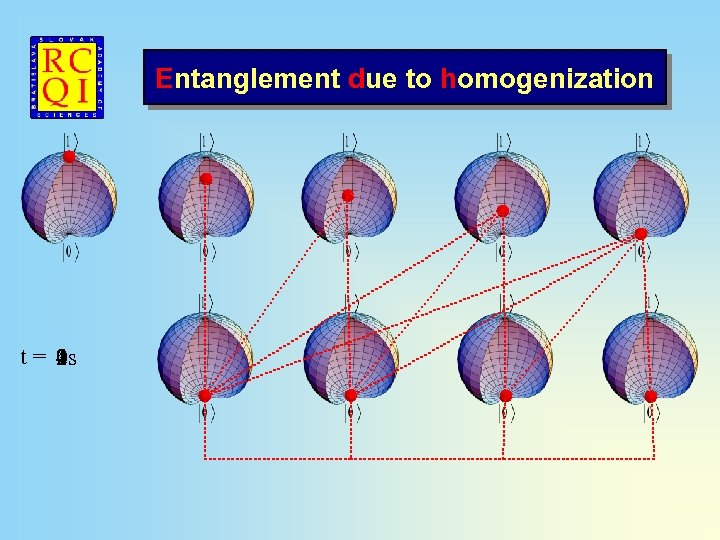 Entanglement due to homogenization t = 2 s 4 s 1 s 0 s 3 s
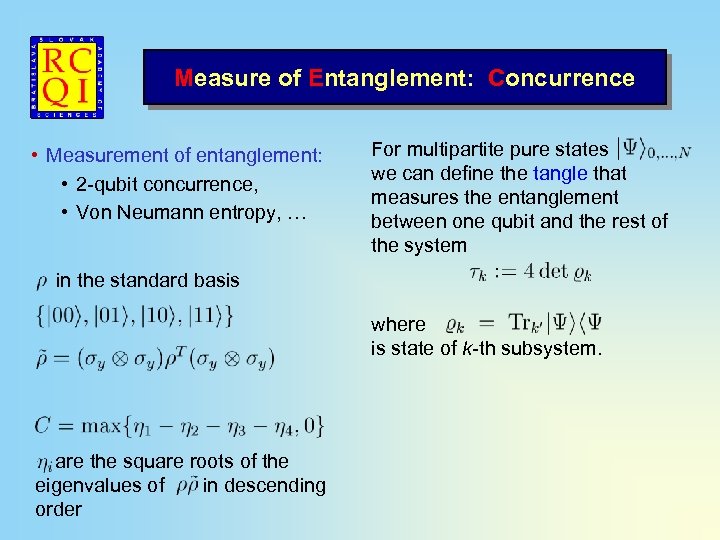 Measure of Entanglement: Concurrence • Measurement of entanglement: • 2 -qubit concurrence, • Von Neumann entropy, … For multipartite pure states we can define the tangle that measures the entanglement between one qubit and the rest of the system in the standard basis where is state of k-th subsystem. are the square roots of the eigenvalues of in descending order
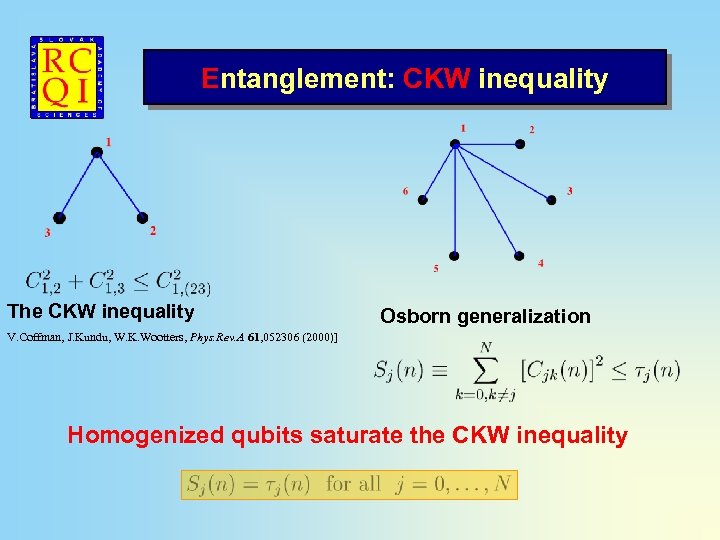 Entanglement: CKW inequality The CKW inequality Osborn generalization V. Coffman, J. Kundu, W. K. Wootters, Phys. Rev. A 61, 052306 (2000)] Homogenized qubits saturate the CKW inequality
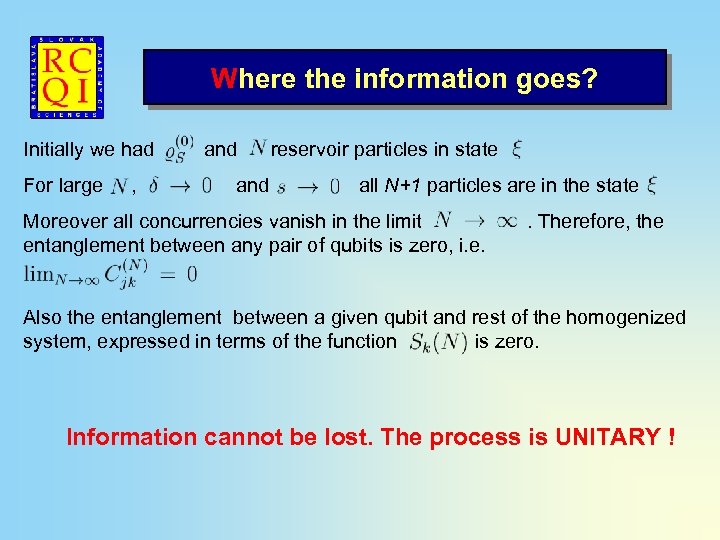 Where the information goes? Initially we had For large , and reservoir particles in state all N+1 particles are in the state Moreover all concurrencies vanish in the limit entanglement between any pair of qubits is zero, i. e. . Therefore, the Also the entanglement between a given qubit and rest of the homogenized system, expressed in terms of the function is zero. Information cannot be lost. The process is UNITARY !
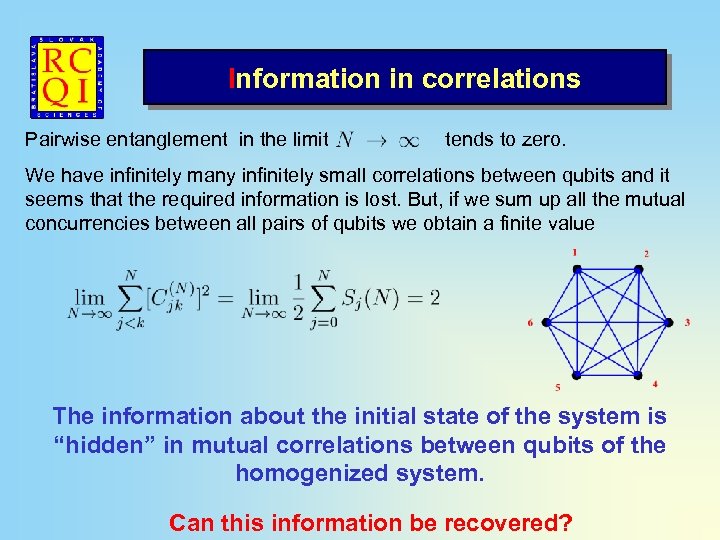 Information in correlations Pairwise entanglement in the limit tends to zero. We have infinitely many infinitely small correlations between qubits and it seems that the required information is lost. But, if we sum up all the mutual concurrencies between all pairs of qubits we obtain a finite value The information about the initial state of the system is “hidden” in mutual correlations between qubits of the homogenized system. Can this information be recovered?
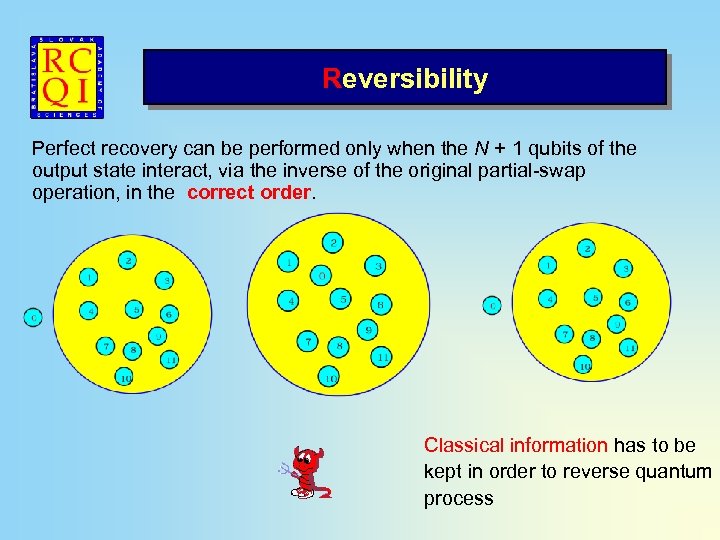 Reversibility Perfect recovery can be performed only when the N + 1 qubits of the output state interact, via the inverse of the original partial-swap operation, in the correct order. Classical information has to be kept in order to reverse quantum process
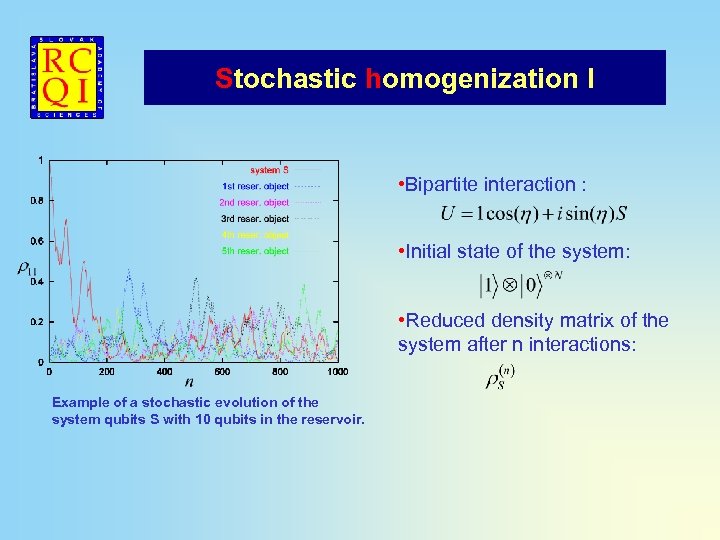 Stochastic homogenization I • Bipartite interaction : • Initial state of the system: • Reduced density matrix of the system after n interactions: Example of a stochastic evolution of the system qubits S with 10 qubits in the reservoir.
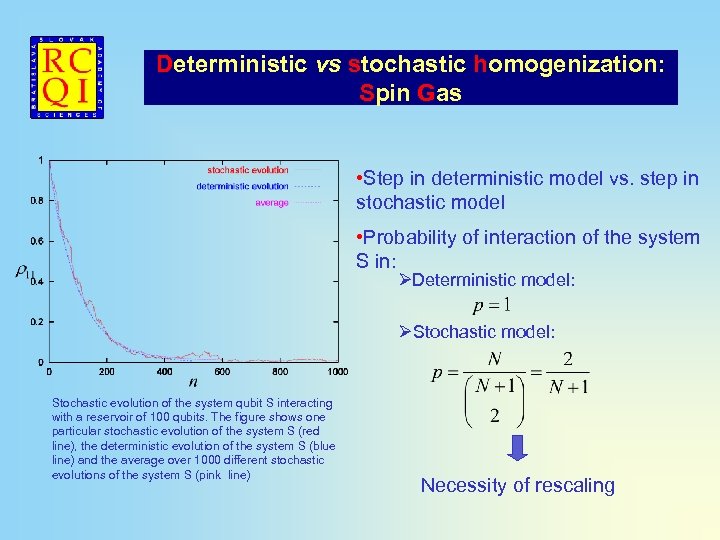 Deterministic vs stochastic homogenization: Spin Gas • Step in deterministic model vs. step in stochastic model • Probability of interaction of the system S in: ØDeterministic model: ØStochastic model: Stochastic evolution of the system qubit S interacting with a reservoir of 100 qubits. The figure shows one particular stochastic evolution of the system S (red line), the deterministic evolution of the system S (blue line) and the average over 1000 different stochastic evolutions of the system S (pink line) Necessity of rescaling
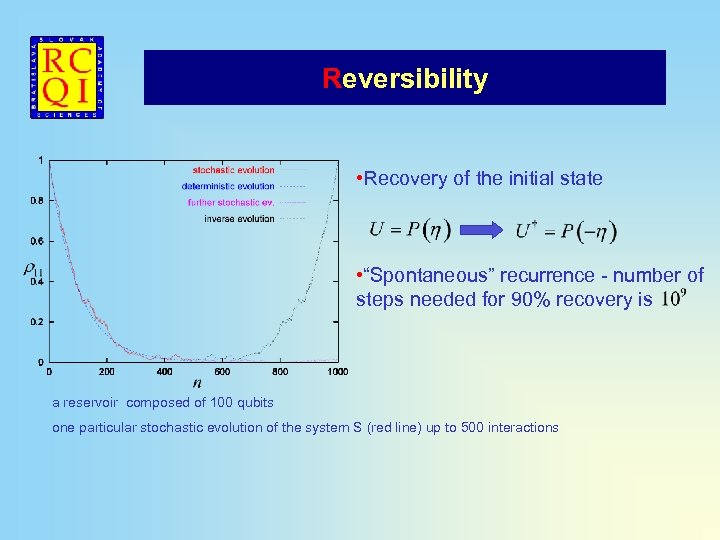 Reversibility • Recovery of the initial state • “Spontaneous” recurrence - number of steps needed for 90% recovery is a reservoir composed of 100 qubits one particular stochastic evolution of the system S (red line) up to 500 interactions
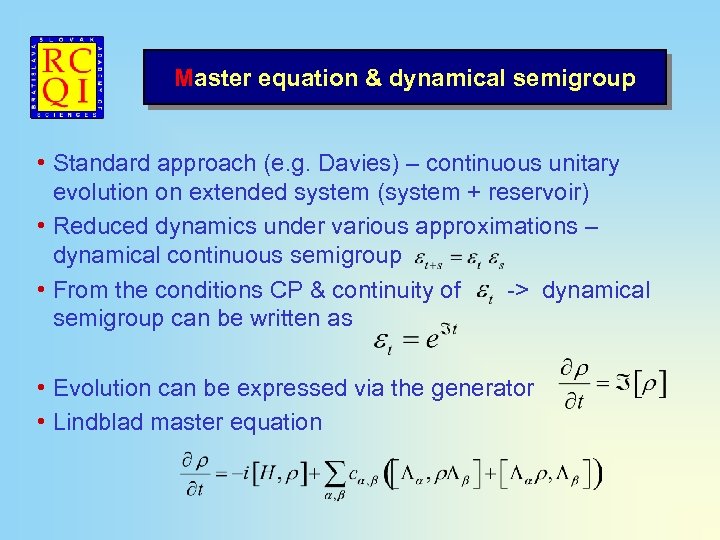 Master equation & dynamical semigroup • Standard approach (e. g. Davies) – continuous unitary evolution on extended system (system + reservoir) • Reduced dynamics under various approximations – dynamical continuous semigroup • From the conditions CP & continuity of -> dynamical semigroup can be written as • Evolution can be expressed via the generator • Lindblad master equation
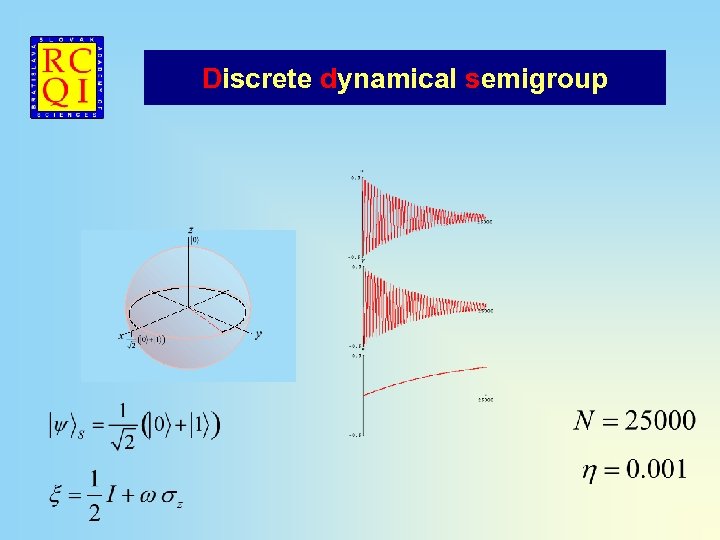
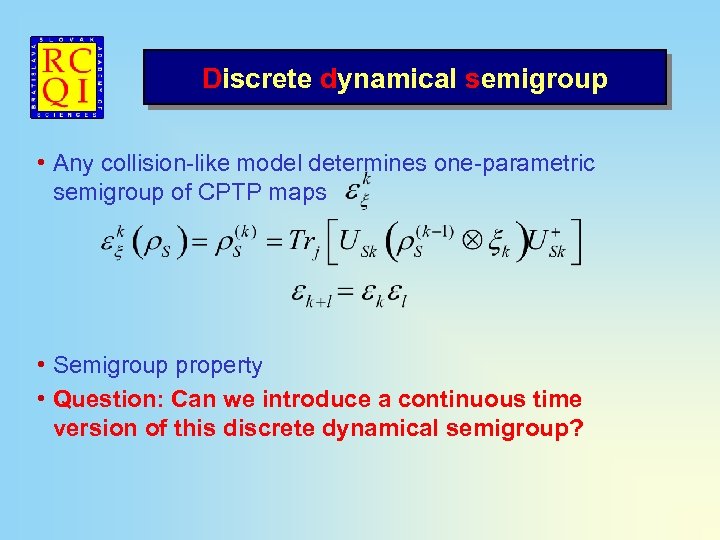 Discrete dynamical semigroup • Any collision-like model determines one-parametric semigroup of CPTP maps • Semigroup property • Question: Can we introduce a continuous time version of this discrete dynamical semigroup?
 Discrete dynamical semigroup
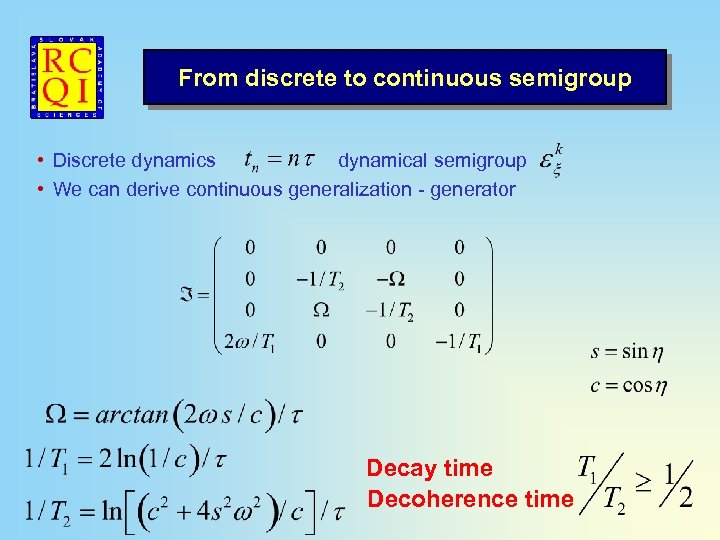 From discrete to continuous semigroup • Discrete dynamics dynamical semigroup • We can derive continuous generalization - generator Decay time Decoherence time
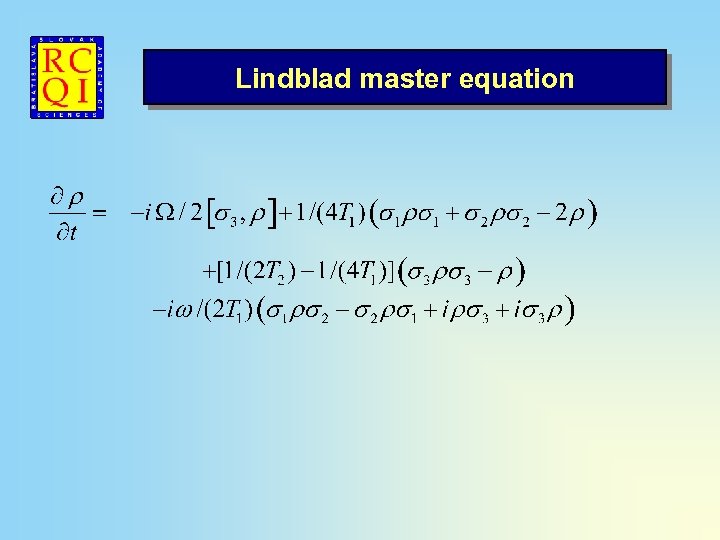 Lindblad master equation
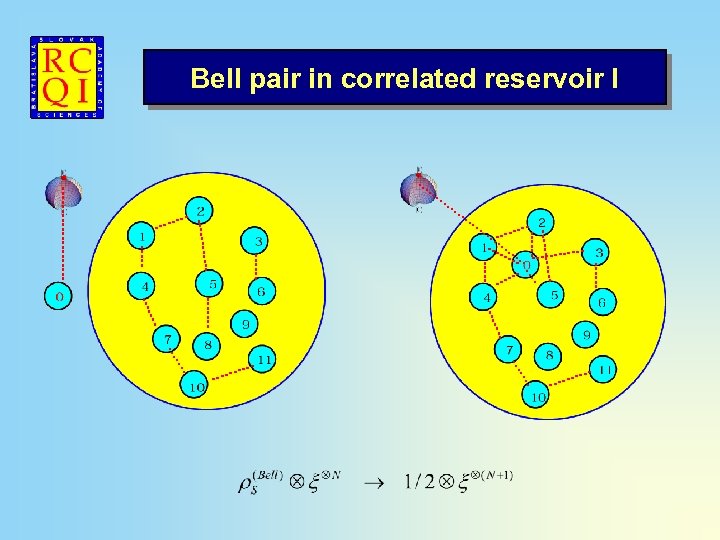
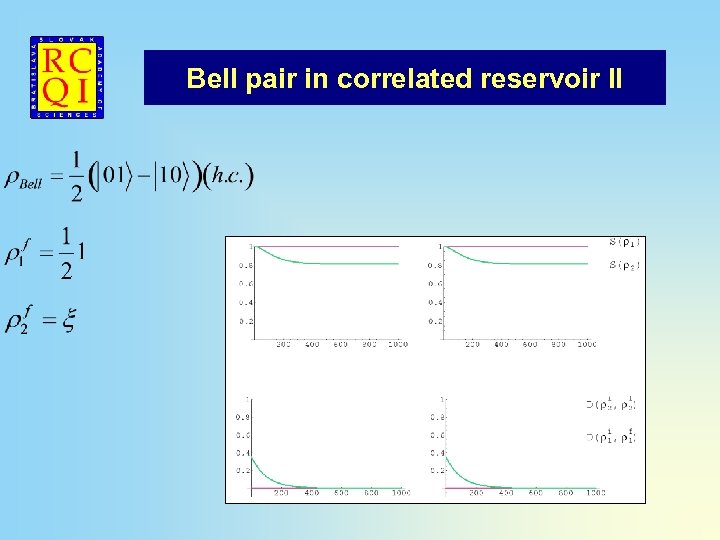
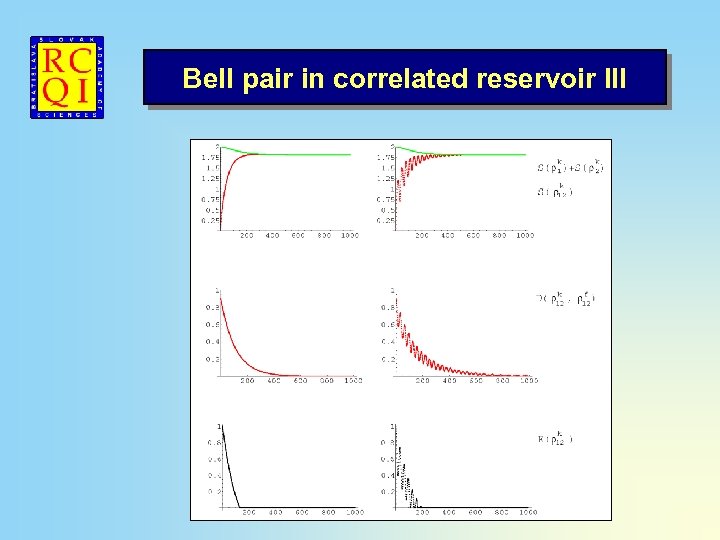
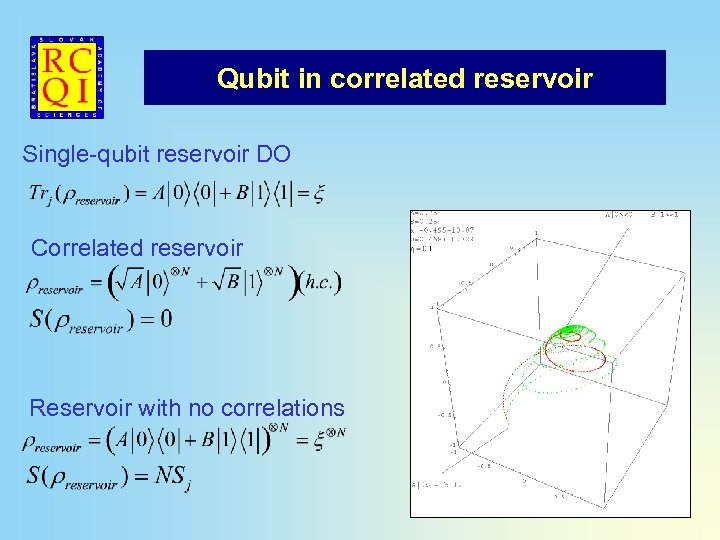 Qubit in correlated reservoir Single-qubit reservoir DO Correlated reservoir Reservoir with no correlations
 Bell pair in correlated reservoir I
 Bell pair in correlated reservoir II
 Bell pair in correlated reservoir III
 Conclusions: Infodynamics • • Dilution of quantum information via homogenization Universality & uniqueness of the partial swap operation Physical realization of contractive maps Reversibility and classical information Stochastic vs deterministic models Lindblad master equation Still many open questions – spin gases, stability of reservoirs Related papers: M. Ziman, P. Stelmachovic, V. Buzek, M. Hillery, V. Scarani, & N. Gisin, Phys. Rev. A 65 , 042105 (2002)] V. Scarani, M. Ziman, P. Stelmachovic, N. Gisin, & V. Buzek, Phys. Rev. Lett. 88, 097905 (2002). D. Nagaj, P. Stelmachovic, V. Buzek, & M. S. Kim, Phys. Rev. A 66, 062307 (2002) M. Ziman, P. Stelmachovic, & V. Buzek, Open Sys. & Info Dyn. 12, 81 (2005) M. Ziman & V. Buzek, Phys. Rev. A 72, 022110 (2005) M. Ziman & V. Buzek, quant-ph 0508106 (2005).