 Скачать презентацию Dynamics of Domestic Violence Presented by The Florida
2e85135273a9769833adf31816d7ed78.ppt
- Количество слайдов: 113




Dynamics of Domestic Violence Presented by: The Florida Regional Community Policing Institute at St. Petersburg College With Funding from: Department of Justice, COPS Office http: //cop. spcollege. edu
RCPI Domestic Violence Investigator (DVI) Series • Part I - Dynamics of Domestic Violence • Part II - Legal Aspects of Domestic Violence • Part III - Resources for Domestic Violence Teams http: //cop. spcollege. edu
Performance Objectives • At the end of this course, students will be able to: – Understand that community policing is a philosophy built upon a specific organizational strategy. – Explain how community policing can prevent domestic violence. – Explain the SARA process and to understand the main components of the four steps of the problem solving model. – Demonstrate knowledge and understanding of the dynamics of domestic violence and its impact on victim safety. – Define and apply the Power and Control Model to understand domestic violence. http: //cop. spcollege. edu
Performance Objectives cont’d. • At the end of this course, students will be able to: – Identify common tactics and techniques of physical, sexual, emotional, and financial abuse that batterers use to gain and maintain power and control over victims. – Understand the impact of the law enforcement response on offender accountability. – Understand the reasons victims of domestic violence maintain relationships with batterers. – Understand the impact of domestic violence on children. – Recognize effective intervention strategies when working with victims and offenders of domestic violence. http: //cop. spcollege. edu
The Development of Modern Policing • To maintain at all times a relationship with the public that gives reality to the historic tradition that the police are the public and the public are the police: the police being only the members of the public that are paid to give full-time attention to the duties which are incumbent on every citizen in the interest of community welfare and existence. • Sir Robert Peel, 19 th Century English statesman and father of modern policing. http: //cop. spcollege. edu
Sir Robert Peel's Nine Principles For Modern Policing • 1. The basic mission for which the police exist is to prevent crime and disorder. • 2. The ability of the police to perform their duties is dependent upon public approval of police actions. • 3. Police must secure the willing cooperation of the public in voluntary observance of the law to be able to secure and maintain the respect of the law. http: //cop. spcollege. edu
Sir Robert Peel's Nine Principles For Modern Policing • 4. The degree of cooperation of the public that can be secured diminishes proportionally to the necessity of the use of force. • 5. Police seek and preserve public favor not by catered public opinion, but by constantly demonstrating absolute impartial service to the law. http: //cop. spcollege. edu
Sir Robert Peel's Nine Principles For Modern Policing • 6. Police use physical force to the extent necessary to secure observance of the law or to restore order only when exercise of persuasion, advice and warning is found to be insufficient. • 7. Police at all times should maintain a relationship with the public that gives reality to the historic tradition; the Police are the public and the public are the police. The police being only full time individuals charged with the duties that are incumbent on all of the citizens. http: //cop. spcollege. edu
Sir Robert Peel's Nine Principles For Modern Policing • 8. Police should always direct their actions strictly towards their functions and never appear to usurp the powers of the judiciary. • 9. The test of police efficiency is the absence of crime and disorder, not the visible evidence of police action in dealing with it. http: //cop. spcollege. edu
Problems with the Professional Model of Policing • Crime began to rise and research suggested that conventional police methods were not effective. • The public experienced increased fear. • Many minority citizens did not perceive their treatment as equitable or adequate. • The anti-war and civil rights movements challenged the police. http: //cop. spcollege. edu
Research on Traditional Policing Strategies • Increasing the number of police does not lower the crime rate or increase the number of crimes solved. • Randomized patrol does not reduce crime nor increase the chance of catching suspects. • Two-person patrol cars are not more effective than one-person cars in lowering of crime rates or catching criminals. http: //cop. spcollege. edu
Research on Traditional Policing Strategies • Saturation patrol does not reduce crime, it displaces it. • The kind of crime that terrifies Americans most is rarely encountered by police on patrol. • Improving response time on calls has no effect on the likelihood of arresting criminals or even in satisfying involved citizens. • Crimes are not usually solved through criminal investigations conducted by police. http: //cop. spcollege. edu
Factors that Influenced the Development of New Police Strategies: • The police field is preoccupied with management, internal pressures, and efficiency to the exclusion of concern for effectiveness in dealing with serious problems. • The police devote most of their resources to responding to calls from citizens, reserving too small a percentage of their time and energy for acting on their own initiative to prevent or reduce community problems. http: //cop. spcollege. edu
Factors that Influenced the Development of New Police Strategies: • The community is a major resource with an enormous potential, largely untapped, for reducing the number and magnitude of problems that otherwise become the business of the police. • Police are not using the time and talent of available rank-and-file officers effectively. • Efforts to improve policing have often failed because they have not been adequately related to the overall policies and structure of the police organization. Herman Goldstein, 1977 http: //cop. spcollege. edu
Community Policing Defined • Herman Goldstein, who has been regarded by many as the father of Community Policing, authored the following definition: – Community policing is an organizational wide philosophy and management approach that promotes community, government and police partnerships; proactive problemsolving; and community engagement to address the causes of crime, fear of crime, and other community issues. http: //cop. spcollege. edu
Major Components of Community Policing • • Citizen Empowerment Officer Empowerment Collaboration Problem Solving http: //cop. spcollege. edu
Core Components of Community Policing • Community policing has two core, equally important components: – Community Partnership – Problem-solving http: //cop. spcollege. edu
Community Policing "Is Not” • It Is Not a Technique or a Program • It Is Not a Limited or Specialized Style of Policing • It Is Not Foot Patrol or Riding a Bicycle • It Is Not "Soft" on Crime • It Is Not a Specialized Unit or Group http: //cop. spcollege. edu
Principles of Community Oriented Policing and Problem Solving • Reassesses who is responsible for public safety and redefines the roles and relationships between the police and the community. • Requires shared ownership, decision making, and accountability, as well as sustained commitment from both the police and the community. • Establishes new public expectations of and measurement standards for police effectiveness. • Increases understanding and trust between police and community members. http: //cop. spcollege. edu
Principles of Community Oriented Policing and Problem Solving • Empowers and strengthens community-based efforts. • Requires constant flexibility to respond to all emerging issues. • Requires an on-going commitment to developing long-term and pro-active programs/strategies to address the underlying conditions that cause community problems. • Requires knowledge of available community resources and how to access and mobilize them, as well as the ability to develop new resources within the community. http: //cop. spcollege. edu
Principles of Community Oriented Policing and Problem Solving • Requires buy-in of the top management of the police and other local government agencies, as well as a commitment from all levels of management. • Decentralizes police services, operations, and management. Encourages innovative and creative problem solving by all - making greater use of the knowledge, skill, and expertise throughout the organization. http: //cop. spcollege. edu
Principles of Community Oriented Policing and Problem Solving • Shifts the focus of police work from responding to individual incidents to addressing problems identified by the community and the police, emphasizing problem-solving approaches to supplement traditional law-enforcement methods. • Requires commitment to developing new skills through training (e. g. , problem-solving, networking, mediation, facilitation, conflict resolution, cultural competency/literacy). http: //cop. spcollege. edu
The Main Principles of Quality Leadership • Maintaining a vision and managing through values rather than rules. • Focusing on teamwork. • Commitment to the problem-solving process with focus on data. • Seeking input before decisions are made. • Asking people who do the work about ways to improve the process. http: //cop. spcollege. edu
The Main Principles of Quality Leadership • Avoiding "top-down" decision making. • A customer orientation. • Focusing on improving systems and processes before blaming individuals. • Encouraging creativity, risk-taking, and tolerance of honest mistakes. • Creating an open climate that encourages providing and accepting feedback. • Developing goals and a plan to achieve them. http: //cop. spcollege. edu
How Citizens Can Help Control Crime • Citizens can watch and report suspicious activity • Citizens can patrol, confront suspicious people, take active involvement • Citizens can reduce their chances of victimization or causing neighborhood deterioration • Citizens can put pressure on others • Citizens can authorize the police to act in their behalf http: //cop. spcollege. edu
The Four Parts of SARA • Scanning – Identify problems • Analysis – Collect and analyze information • Response – Collaboratively develop and implement solutions with other agencies and the public • Assessment – Evaluate strategy effectiveness http: //cop. spcollege. edu
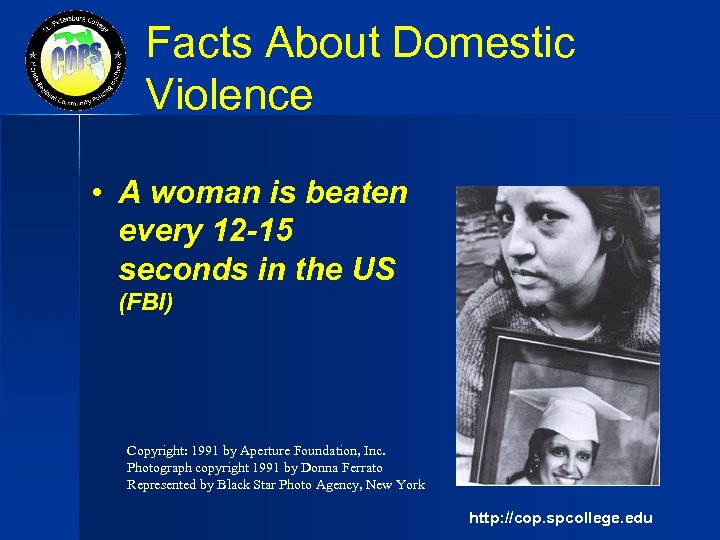
Facts About Domestic Violence • A woman is beaten every 12 -15 seconds in the US (FBI) Copyright: 1991 by Aperture Foundation, Inc. Photograph copyright 1991 by Donna Ferrato Represented by Black Star Photo Agency, New York http: //cop. spcollege. edu
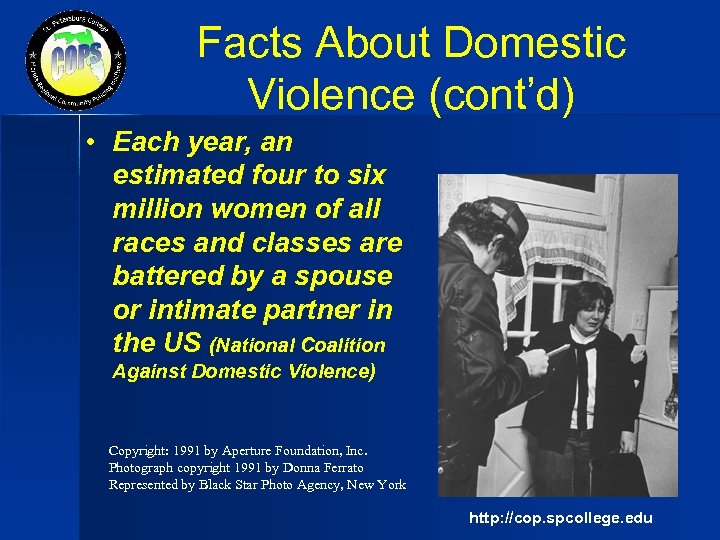
Facts About Domestic Violence (cont’d) • Each year, an estimated four to six million women of all races and classes are battered by a spouse or intimate partner in the US (National Coalition Against Domestic Violence) Copyright: 1991 by Aperture Foundation, Inc. Photograph copyright 1991 by Donna Ferrato Represented by Black Star Photo Agency, New York http: //cop. spcollege. edu
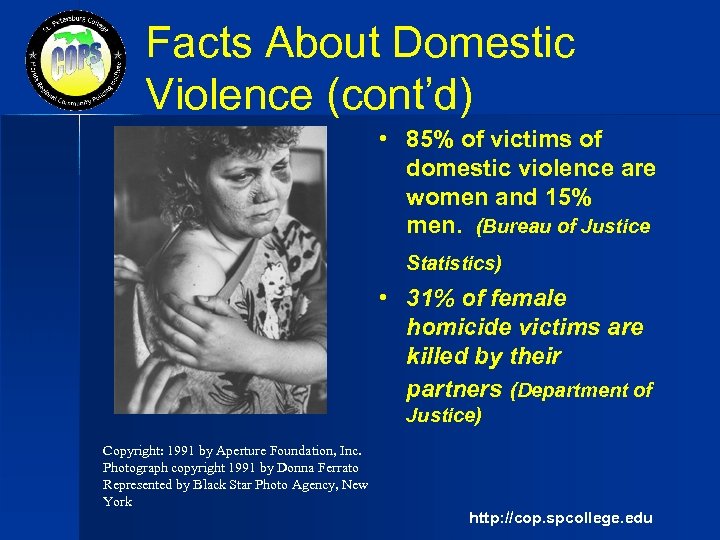
Facts About Domestic Violence (cont’d) • 85% of victims of domestic violence are women and 15% men. (Bureau of Justice Statistics) • 31% of female homicide victims are killed by their partners (Department of Justice) Copyright: 1991 by Aperture Foundation, Inc. Photograph copyright 1991 by Donna Ferrato Represented by Black Star Photo Agency, New York http: //cop. spcollege. edu
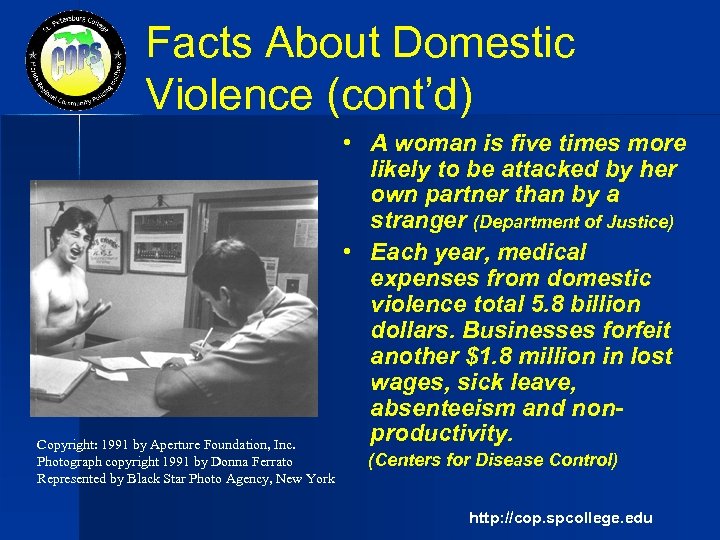
Facts About Domestic Violence (cont’d) Copyright: 1991 by Aperture Foundation, Inc. Photograph copyright 1991 by Donna Ferrato Represented by Black Star Photo Agency, New York • A woman is five times more likely to be attacked by her own partner than by a stranger (Department of Justice) • Each year, medical expenses from domestic violence total 5. 8 billion dollars. Businesses forfeit another $1. 8 million in lost wages, sick leave, absenteeism and nonproductivity. (Centers for Disease Control) http: //cop. spcollege. edu
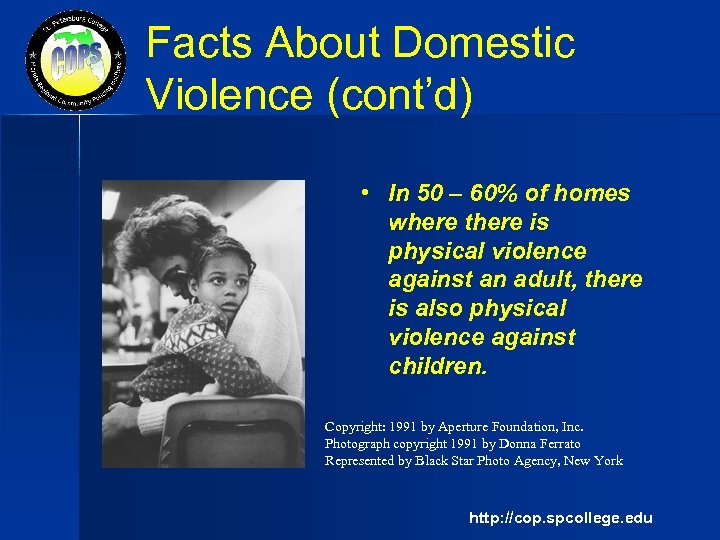
Facts About Domestic Violence (cont’d) • In 50 – 60% of homes where there is physical violence against an adult, there is also physical violence against children. Copyright: 1991 by Aperture Foundation, Inc. Photograph copyright 1991 by Donna Ferrato Represented by Black Star Photo Agency, New York http: //cop. spcollege. edu
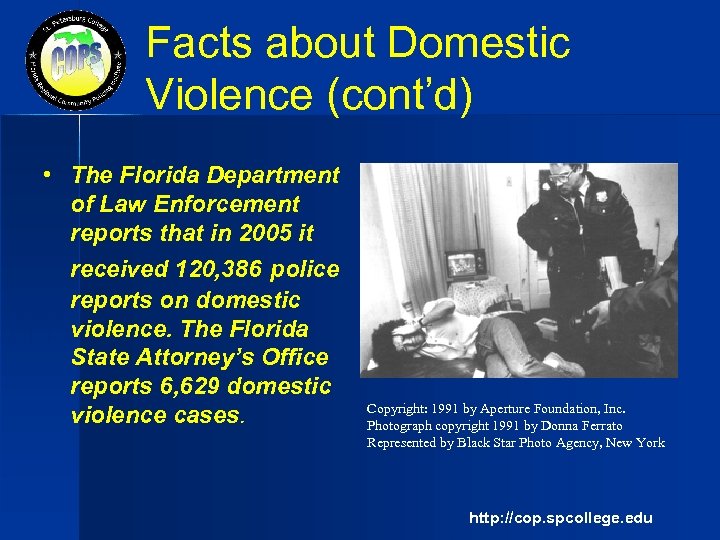
Facts about Domestic Violence (cont’d) • The Florida Department of Law Enforcement reports that in 2005 it received 120, 386 police reports on domestic violence. The Florida State Attorney’s Office reports 6, 629 domestic violence cases. Copyright: 1991 by Aperture Foundation, Inc. Photograph copyright 1991 by Donna Ferrato Represented by Black Star Photo Agency, New York http: //cop. spcollege. edu
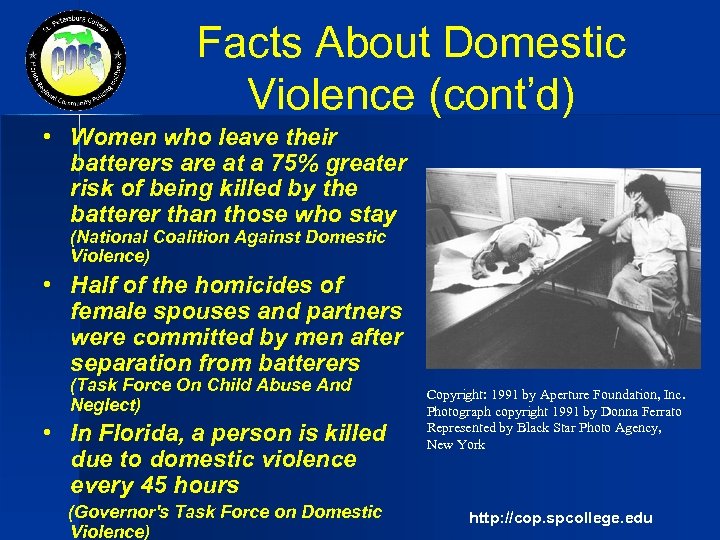
Facts About Domestic Violence (cont’d) • Women who leave their batterers are at a 75% greater risk of being killed by the batterer than those who stay (National Coalition Against Domestic Violence) • Half of the homicides of female spouses and partners were committed by men after separation from batterers (Task Force On Child Abuse And Neglect) • In Florida, a person is killed due to domestic violence every 45 hours (Governor's Task Force on Domestic Violence) Copyright: 1991 by Aperture Foundation, Inc. Photograph copyright 1991 by Donna Ferrato Represented by Black Star Photo Agency, New York http: //cop. spcollege. edu
Domestic Violence: Social or Behavioral Definition • A pattern of coercive behavior to gain power and control over another individual through any means necessary. http: //cop. spcollege. edu
Domestic Violence • Domestic violence is about power and control. • It is NOT about: – – Stress management Alcohol or drug abuse Anger management Poor coping skills http: //cop. spcollege. edu
Florida’s Domestic Violence Legal Definition • “Domestic Violence” means any assault, aggravated assault, battery, aggravated battery, sexual assault, sexual battery, stalking, aggravated stalking, kidnapping, false imprisonment, or any criminal offense resulting in physical injury or death of one family or household member by another family or household member. http: //cop. spcollege. edu
Florida’s Household Member Definition • “Family or household member” means spouses, former spouses, person related by blood or marriage, persons who are presently residing together as if a family or who have resided together in the past as if a family, and persons who are parents of a child in common regardless of whether they have been married. With the exception of persons who have a child in common, the family or household members must be currently residing or have in the past resided together in the same single dwelling unit. http: //cop. spcollege. edu
Types of Abuse • • • Physical Abuse Sexual Abuse Emotional Abuse Social Isolation Financial Abuse http: //cop. spcollege. edu
Minimizing Denial Blaming http: //cop. spcollege. edu
Power and Control Wheel http: //cop. spcollege. edu
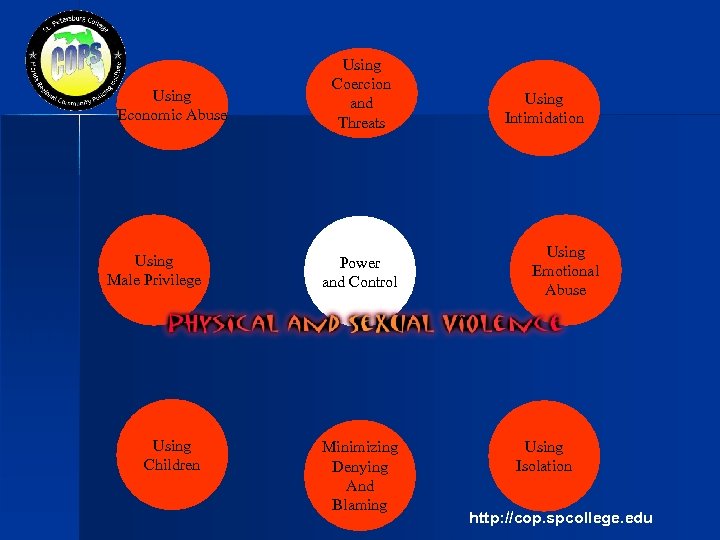
Using Economic Abuse Using Coercion and Threats Using Male Privilege Power and Control Using Children Minimizing Denying And Blaming Using Intimidation Using Emotional Abuse Using Isolation http: //cop. spcollege. edu
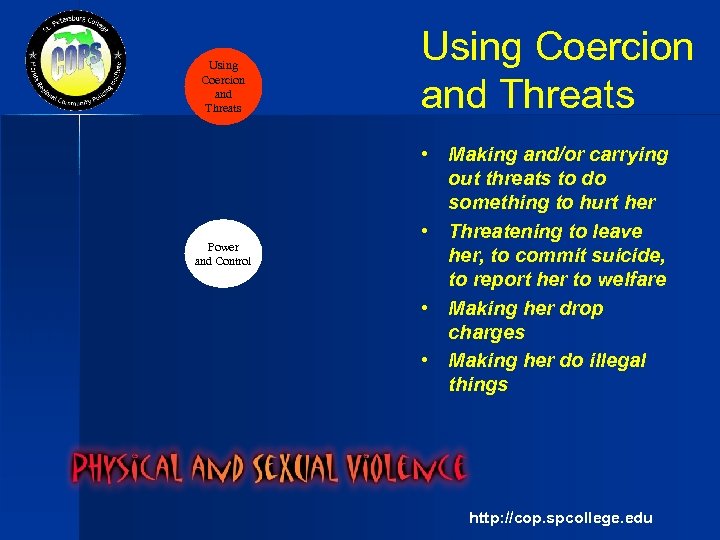
Using Coercion and Threats Power and Control Using Coercion and Threats • Making and/or carrying out threats to do something to hurt her • Threatening to leave her, to commit suicide, to report her to welfare • Making her drop charges • Making her do illegal things http: //cop. spcollege. edu
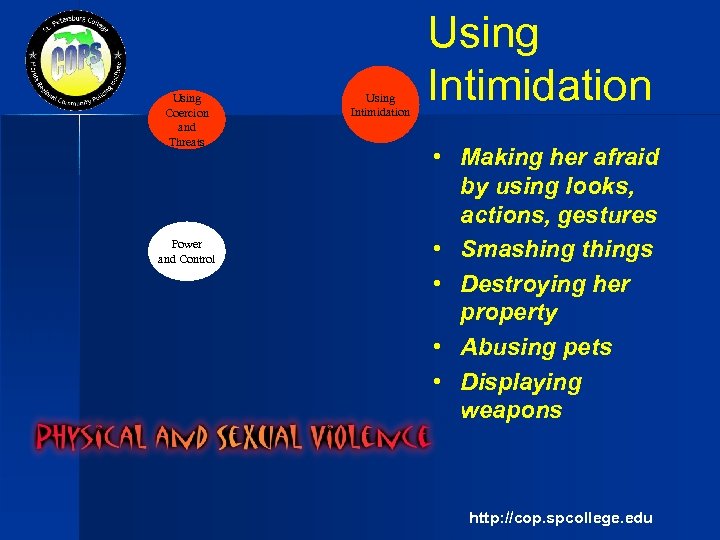
Using Coercion and Threats Power and Control Using Intimidation • Making her afraid by using looks, actions, gestures • Smashing things • Destroying her property • Abusing pets • Displaying weapons http: //cop. spcollege. edu
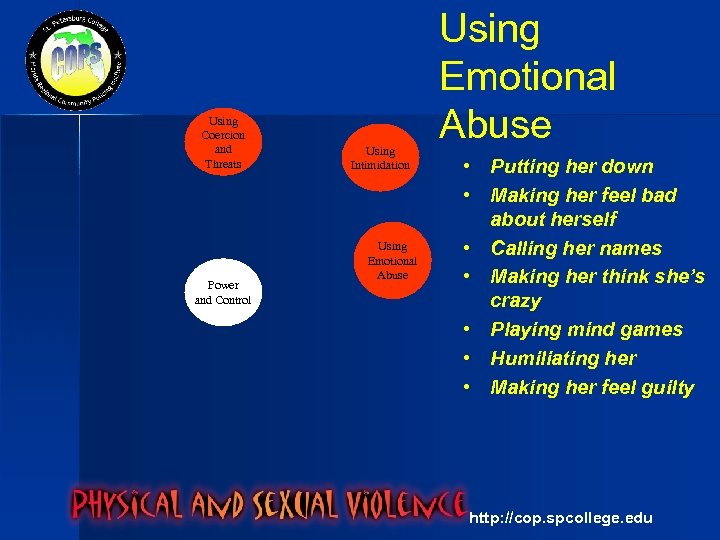
Using Coercion and Threats Power and Control Using Intimidation Using Emotional Abuse • Putting her down • Making her feel bad about herself • Calling her names • Making her think she’s crazy • Playing mind games • Humiliating her • Making her feel guilty http: //cop. spcollege. edu
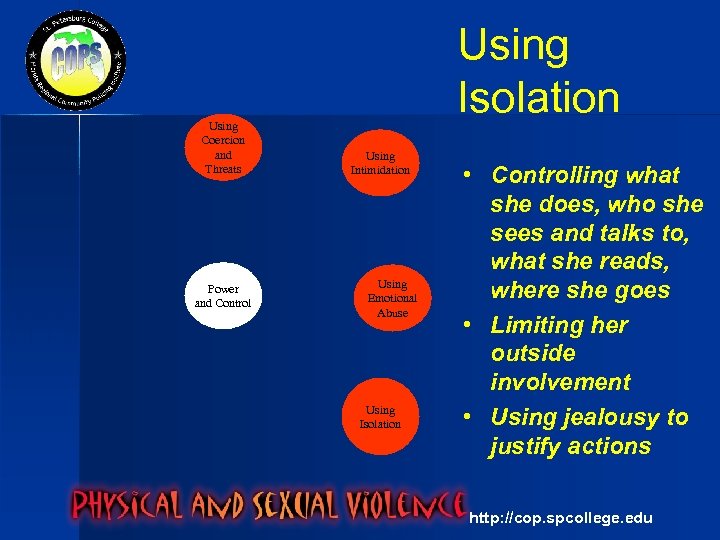
Using Coercion and Threats Power and Control Using Isolation Using Intimidation Using Emotional Abuse Using Isolation • Controlling what she does, who she sees and talks to, what she reads, where she goes • Limiting her outside involvement • Using jealousy to justify actions http: //cop. spcollege. edu
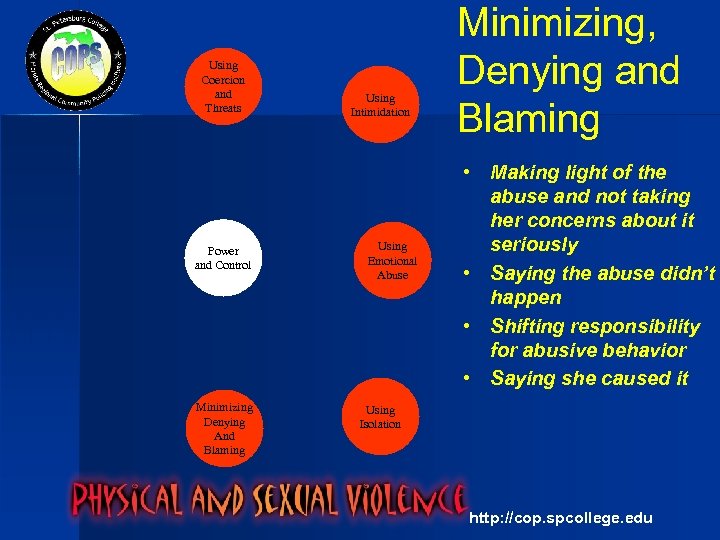
Using Coercion and Threats Power and Control Minimizing Denying And Blaming Using Intimidation Using Emotional Abuse Minimizing, Denying and Blaming • Making light of the abuse and not taking her concerns about it seriously • Saying the abuse didn’t happen • Shifting responsibility for abusive behavior • Saying she caused it Using Isolation http: //cop. spcollege. edu
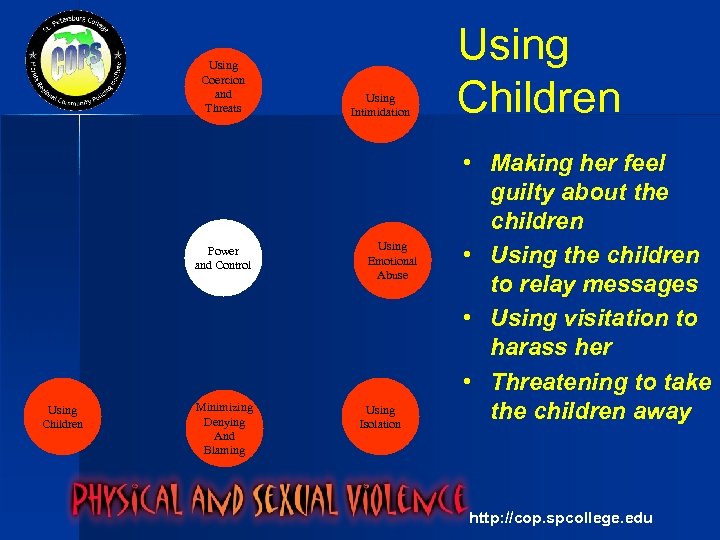
Using Coercion and Threats Power and Control Using Children Minimizing Denying And Blaming Using Intimidation Using Emotional Abuse Using Isolation Using Children • Making her feel guilty about the children • Using the children to relay messages • Using visitation to harass her • Threatening to take the children away http: //cop. spcollege. edu
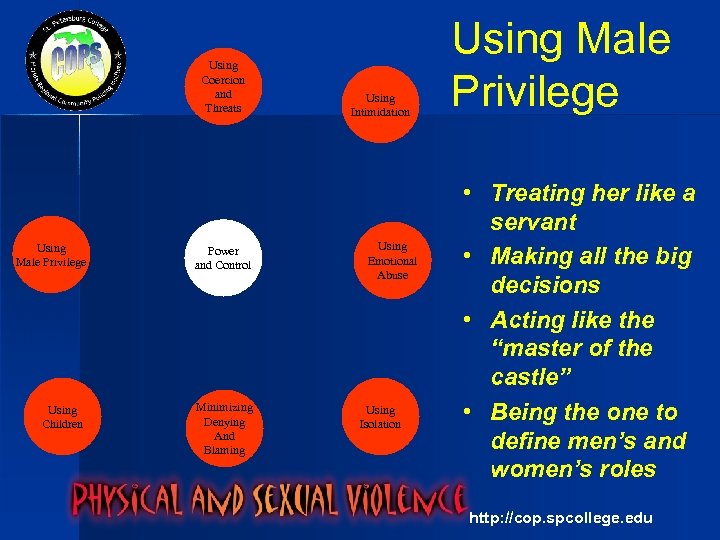
Using Coercion and Threats Using Male Privilege Power and Control Using Children Minimizing Denying And Blaming Using Intimidation Using Emotional Abuse Using Isolation Using Male Privilege • Treating her like a servant • Making all the big decisions • Acting like the “master of the castle” • Being the one to define men’s and women’s roles http: //cop. spcollege. edu
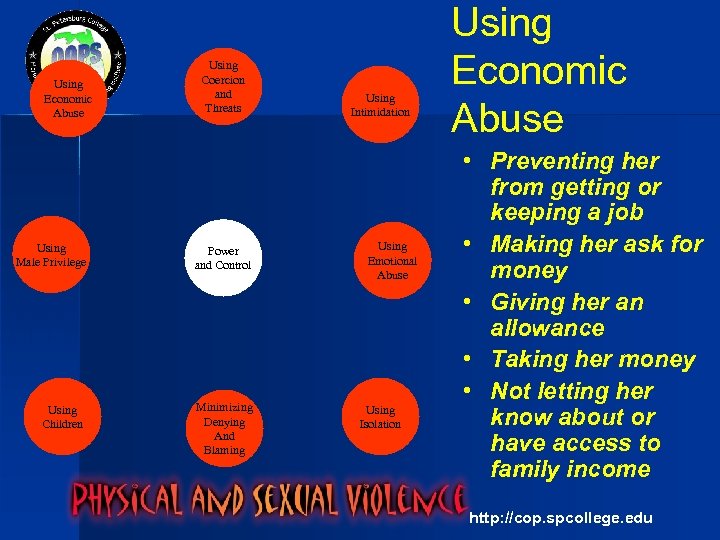
Using Economic Abuse Using Coercion and Threats Using Male Privilege Power and Control Using Children Minimizing Denying And Blaming Using Intimidation Using Emotional Abuse Using Isolation Using Economic Abuse • Preventing her from getting or keeping a job • Making her ask for money • Giving her an allowance • Taking her money • Not letting her know about or have access to family income http: //cop. spcollege. edu
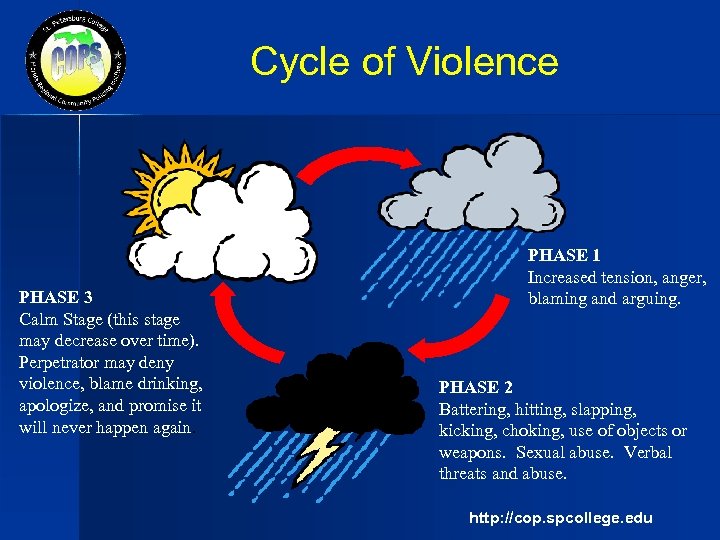
Cycle of Violence PHASE 3 Calm Stage (this stage may decrease over time). Perpetrator may deny violence, blame drinking, apologize, and promise it will never happen again. PHASE 1 Increased tension, anger, blaming and arguing. PHASE 2 Battering, hitting, slapping, kicking, choking, use of objects or weapons. Sexual abuse. Verbal threats and abuse. http: //cop. spcollege. edu
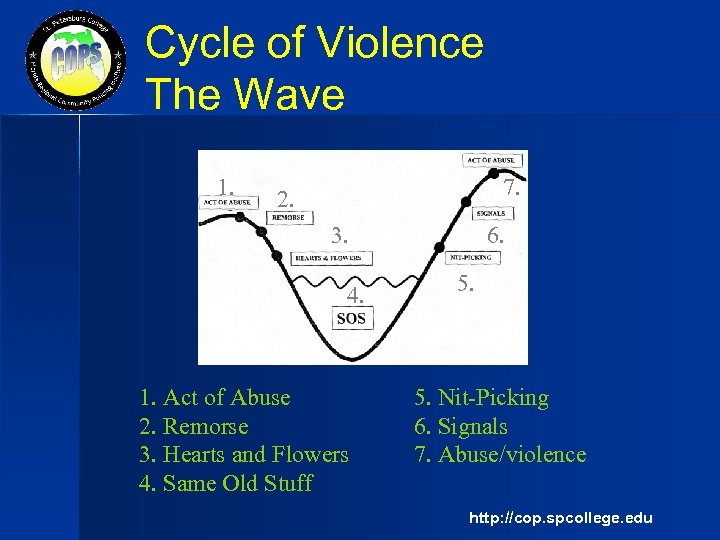
Cycle of Violence The Wave 1. 7. 2. 3. 4. 1. Act of Abuse 2. Remorse 3. Hearts and Flowers 4. Same Old Stuff 6. 5. Nit-Picking 6. Signals 7. Abuse/violence http: //cop. spcollege. edu
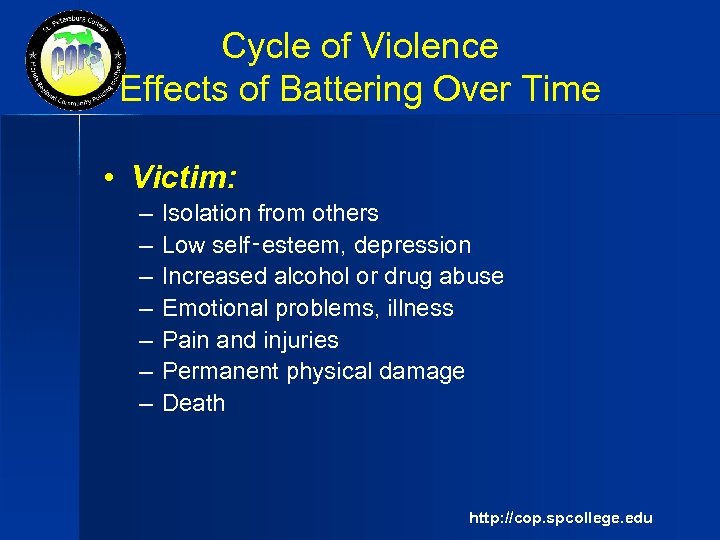
Cycle of Violence Effects of Battering Over Time • Victim: – – – – Isolation from others Low self‑esteem, depression Increased alcohol or drug abuse Emotional problems, illness Pain and injuries Permanent physical damage Death http: //cop. spcollege. edu
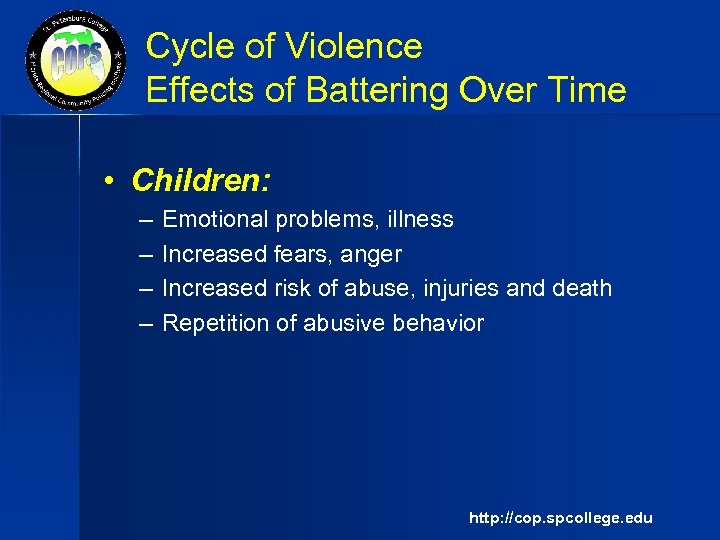
Cycle of Violence Effects of Battering Over Time • Children: – – Emotional problems, illness Increased fears, anger Increased risk of abuse, injuries and death Repetition of abusive behavior http: //cop. spcollege. edu
Cycle of Violence Effects of Battering Over Time • Batterer: – Increased belief that power and control are obtained through violence – Increase in violent behaviors – Increase in contact with Law Enforcement – Increased emotional problems – Decreased self‑esteem http: //cop. spcollege. edu
Cycle of Violence Effects of Battering Over Time • Society: – Increase in crime – Increase in legal, police, medical and counseling costs, cost of prison – Perpetuation of cycle of violence – Perpetuation of myths regarding men and women’s inequality – Decrease in quality of life http: //cop. spcollege. edu

“Hostages at Home” Video Presentation http: //cop. spcollege. edu
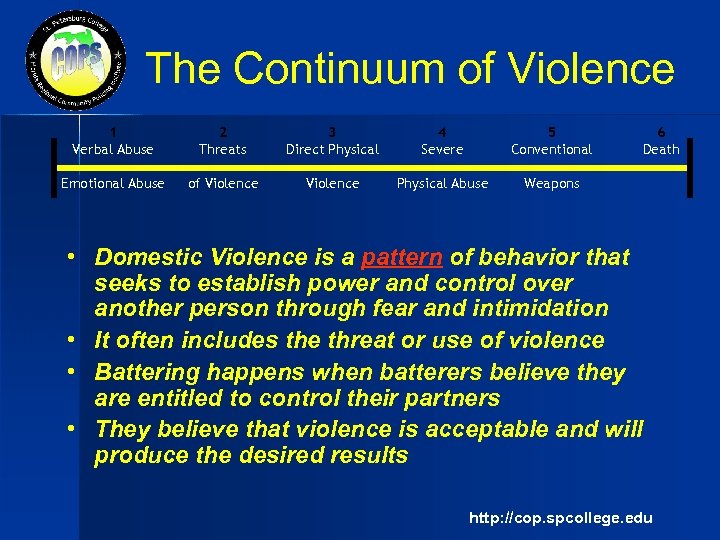
The Continuum of Violence 1 Verbal Abuse 2 Threats 3 Direct Physical 4 Severe 5 Conventional Emotional Abuse of Violence Physical Abuse 6 Death Weapons • Domestic Violence is a pattern of behavior that seeks to establish power and control over another person through fear and intimidation • It often includes the threat or use of violence • Battering happens when batterers believe they are entitled to control their partners • They believe that violence is acceptable and will produce the desired results http: //cop. spcollege. edu
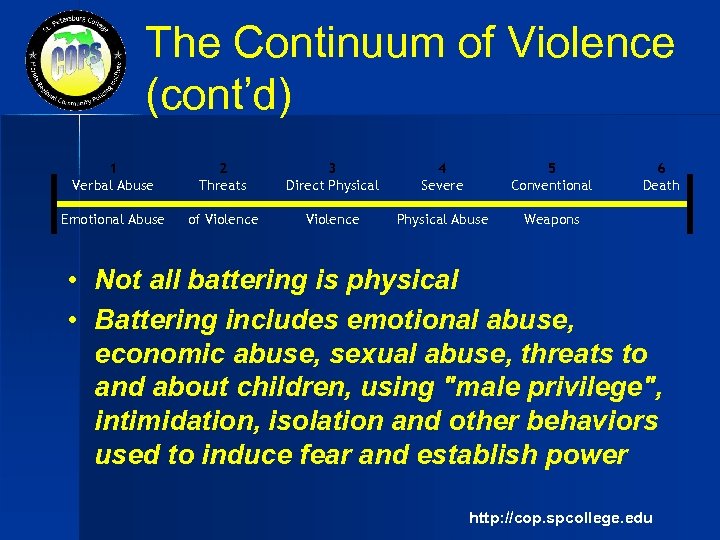
The Continuum of Violence (cont’d) 1 Verbal Abuse 2 Threats 3 Direct Physical 4 Severe 5 Conventional Emotional Abuse of Violence Physical Abuse 6 Death Weapons • Not all battering is physical • Battering includes emotional abuse, economic abuse, sexual abuse, threats to and about children, using "male privilege", intimidation, isolation and other behaviors used to induce fear and establish power http: //cop. spcollege. edu
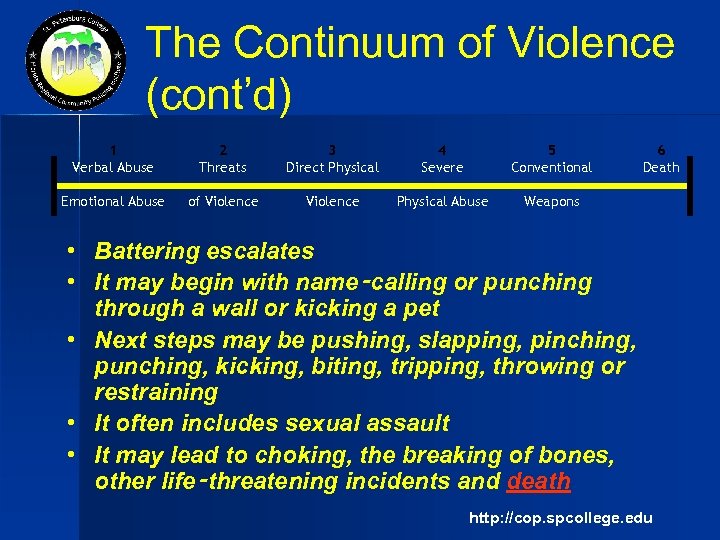
The Continuum of Violence (cont’d) 1 Verbal Abuse 2 Threats 3 Direct Physical 4 Severe 5 Conventional Emotional Abuse of Violence Physical Abuse 6 Death Weapons • Battering escalates • It may begin with name‑calling or punching through a wall or kicking a pet • Next steps may be pushing, slapping, pinching, punching, kicking, biting, tripping, throwing or restraining • It often includes sexual assault • It may lead to choking, the breaking of bones, other life‑threatening incidents and death http: //cop. spcollege. edu
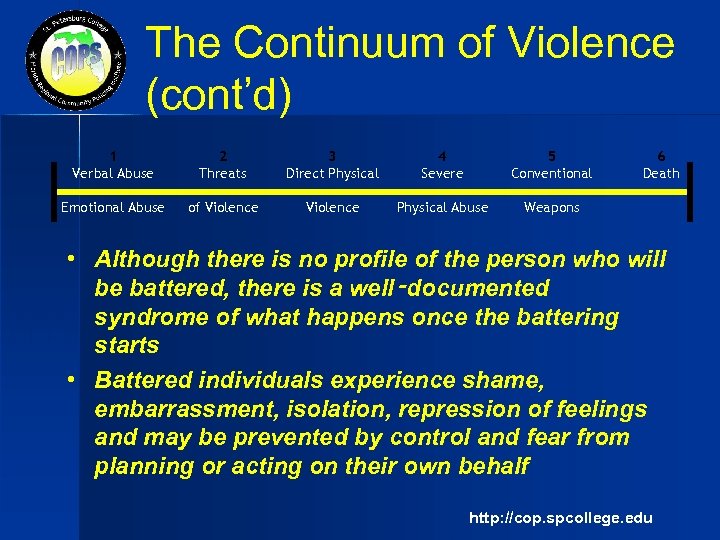
The Continuum of Violence (cont’d) 1 Verbal Abuse 2 Threats 3 Direct Physical 4 Severe 5 Conventional Emotional Abuse of Violence Physical Abuse 6 Death Weapons • Although there is no profile of the person who will be battered, there is a well‑documented syndrome of what happens once the battering starts • Battered individuals experience shame, embarrassment, isolation, repression of feelings and may be prevented by control and fear from planning or acting on their own behalf http: //cop. spcollege. edu
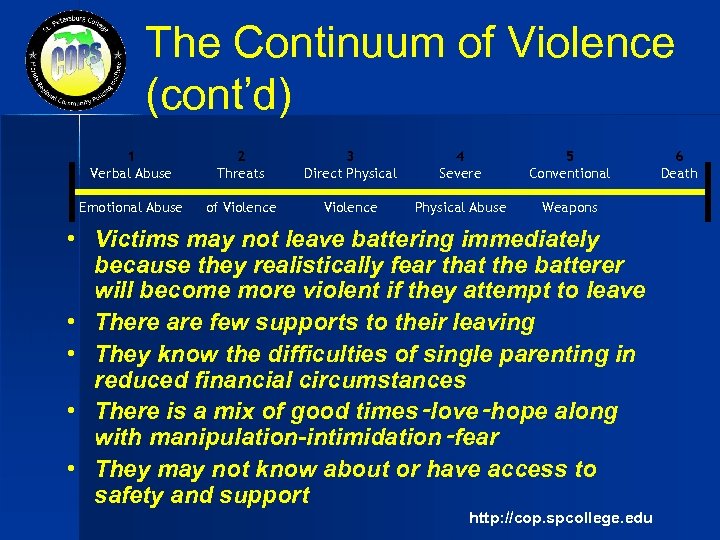
The Continuum of Violence (cont’d) 1 Verbal Abuse 2 Threats 3 Direct Physical 4 Severe 5 Conventional Emotional Abuse of Violence Physical Abuse Weapons • Victims may not leave battering immediately because they realistically fear that the batterer will become more violent if they attempt to leave • There are few supports to their leaving • They know the difficulties of single parenting in reduced financial circumstances • There is a mix of good times‑love‑hope along with manipulation-intimidation‑fear • They may not know about or have access to safety and support http: //cop. spcollege. edu 6 Death

“Profile of an Assailant” Video Presentation http: //cop. spcollege. edu
“Profile of an Assailant” Video Presentation • What tactics did Ty use with law enforcement in this video? http: //cop. spcollege. edu
“Profile of an Assailant” Video Presentation • What other tactics have you seen batterers use with law enforcement or other helpers? http: //cop. spcollege. edu
“Profile of an Assailant” Video Presentation • What did Ty say about arrest? http: //cop. spcollege. edu
“Profile of an Assailant” Video Presentation • What behaviors didn’t fit into the legal definition of domestic violence? http: //cop. spcollege. edu
Exercise • How might batterers’ tactics shift or change in certain populations? http: //cop. spcollege. edu
Effects of Non-Physical Abuse • Self perception attacked and influenced – – Loss of identity Self‑doubt Values and beliefs Here and now focus • Loss of personal control and personal focus – Habits of compliance – Costs of resistance • Excessive responsibility – Vital to batterer's survival – Guilt http: //cop. spcollege. edu
Effects of Non-Physical Abuse (cont’d) • Health problems – Eating – Head, back, neck – Gastrointestinal problems • Mixed emotions and struggles – – – Ambivalence Overwhelmed Anger Discouragement Loneliness http: //cop. spcollege. edu
Effects of Non-Physical Abuse (cont’d) • Psychological and emotional problems – – – Difficulty concentrating Depression Anxiety, fear, phobias Exhaustion Trust Lying • Development of coping skills – – Manipulation Hyper vigilance Avoidance Self isolation http: //cop. spcollege. edu
Effects of Non-Physical Abuse (cont’d) • Minimization and rationalization – Belief in blame – Belief in abuser's efforts – Excuses http: //cop. spcollege. edu
Reasons Victims Stay Exercise http: //cop. spcollege. edu
Barriers to Victims Leaving • • • Relentless behavior of batterer Fear of what batterer might do Fear for children Financial dependence Conflicts with religious beliefs Isolation/lack of support Access to batterer Culture Shame Self-esteem http: //cop. spcollege. edu Immigration issues
Top Three Reasons Why Victims Stay • Fear • Children • Financial http: //cop. spcollege. edu
Why Victims Leave • • • Children are endangered “Real” danger recognized Positive reinforcement removed New options recognized Recognition of cycle http: //cop. spcollege. edu
Barriers to Victims Leaving Exercise http: //cop. spcollege. edu
Why Might a Victim Return? http: //cop. spcollege. edu
Effects of Domestic Violence on Children http: //cop. spcollege. edu
Effects of Domestic Violence on Children • “Lisa 911” tape • Children’s Art http: //cop. spcollege. edu
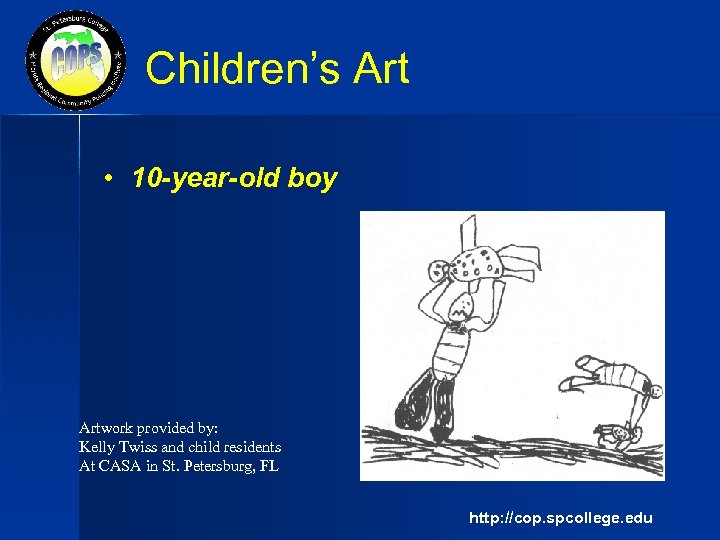
Children’s Art • 10 -year-old boy Artwork provided by: Kelly Twiss and child residents At CASA in St. Petersburg, FL http: //cop. spcollege. edu
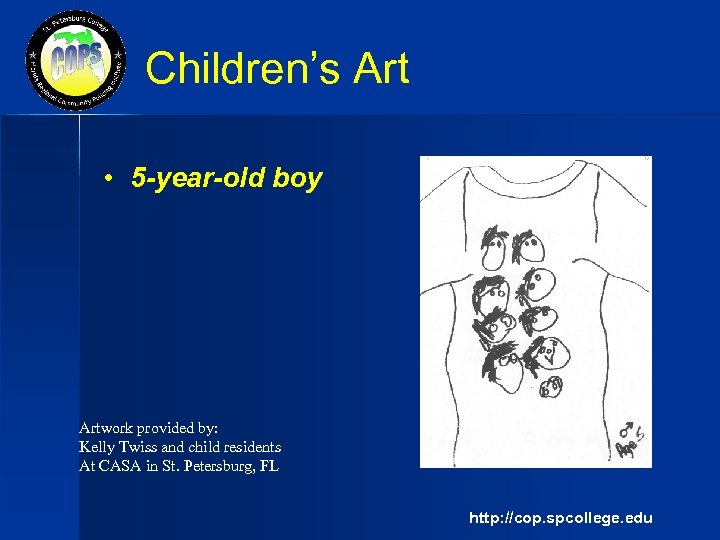
Children’s Art • 5 -year-old boy Artwork provided by: Kelly Twiss and child residents At CASA in St. Petersburg, FL http: //cop. spcollege. edu
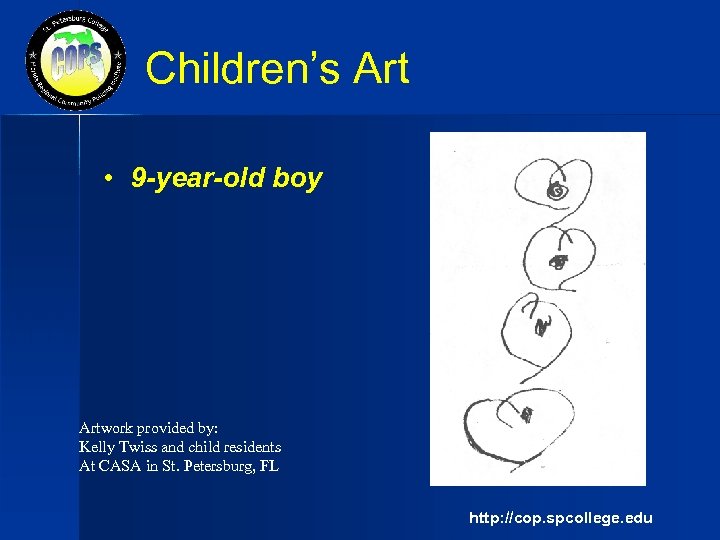
Children’s Art • 9 -year-old boy Artwork provided by: Kelly Twiss and child residents At CASA in St. Petersburg, FL http: //cop. spcollege. edu
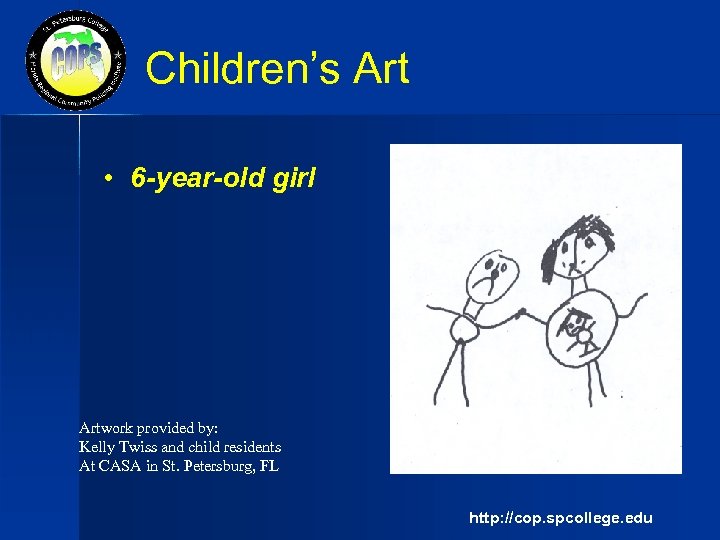
Children’s Art • 6 -year-old girl Artwork provided by: Kelly Twiss and child residents At CASA in St. Petersburg, FL http: //cop. spcollege. edu
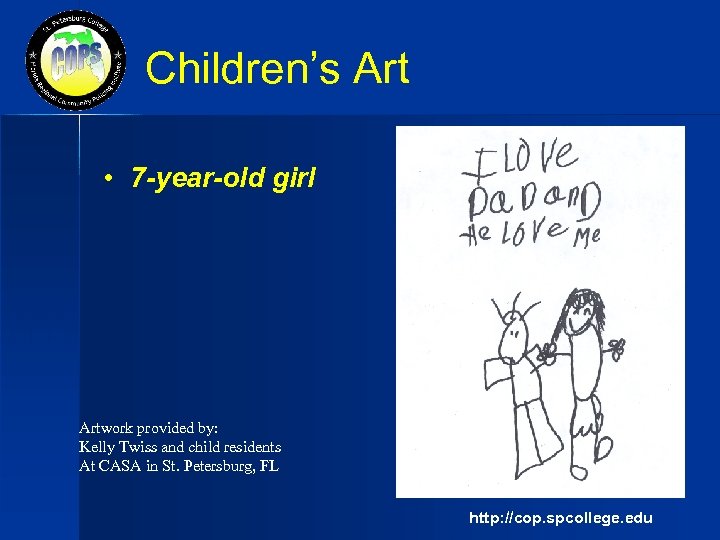
Children’s Art • 7 -year-old girl Artwork provided by: Kelly Twiss and child residents At CASA in St. Petersburg, FL http: //cop. spcollege. edu
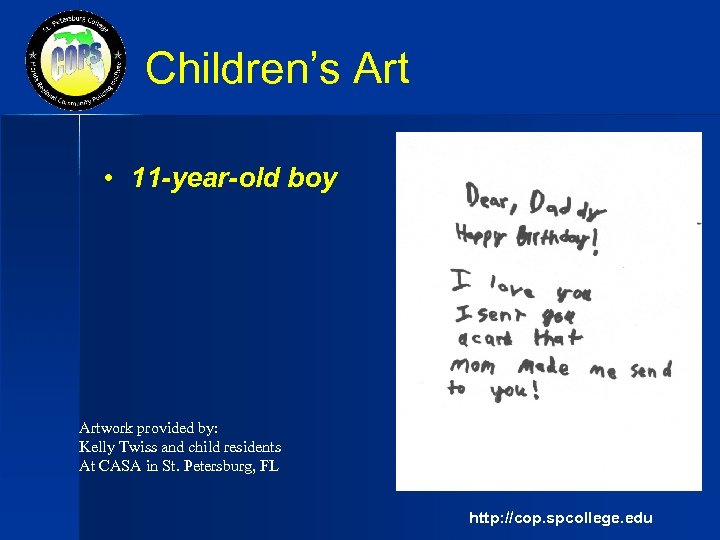
Children’s Art • 11 -year-old boy Artwork provided by: Kelly Twiss and child residents At CASA in St. Petersburg, FL http: //cop. spcollege. edu
Behaviors of Batterers that Effect Children http: //cop. spcollege. edu
Effects of Domestic Violence on Children - Age Group 0‑ 1 Year • Behaviors of domestic violence perpetrators that harm children – – – – Being violent in front of children Waking children up with the sound of violence Exposing child to assaults against mom or property Threats of or use of violence against child Sexual abuse of child Hitting or threatening child/mother while child is in mother's arms Taking child hostage to get mother to return to domestic violence perpetrator – Making mother choose between meeting needs of perpetrator or attending to child http: //cop. spcollege. edu
Effects of Domestic Violence on Children - Age Group 0‑ 1 Year • Effects of this abuse on children – – – – Physical injury or death Being born prematurely Fear and trauma which result in sleep and eating disturbances Child may become colicky or sick Child may become nervous, jumpy, cry a lot Child may be insecure, unable to bond Child may become listless, non responsive Failure to thrive http: //cop. spcollege. edu
Effects of Domestic Violence on Children - Age Group 2 -4 Years • Behaviors of domestic violence perpetrators that harm children – All of the behaviors listed for 0‑ 1 year – Hurting child when s/he intervenes to prevent mom from being injured – Using child as physical weapon against mother – Interrogating children about mother's activities – Forcing child to watch assaults against mother or to participate in abuse http: //cop. spcollege. edu
Effects of Domestic Violence on Children - Age Group 2 -4 Years • Effects of this abuse on children – – – All of the effects listed for 0‑ 1 year Acting out violently Withdrawal Problems relating to other children Delayed toilet training Insecurity and depression http: //cop. spcollege. edu
Effects of Domestic Violence on Children - Age Group 5 -12 Years • Behaviors of domestic violence perpetrators that harm children – Being violent physically and/or sexually towards mother in front of children – Hurting child when s/he intervenes to stop violence against mother – Using child as a spy against mother – Forcing child to participate in attack on mother – Physically or sexually abusing child – Interrogating child about mother's activities http: //cop. spcollege. edu
Effects of Domestic Violence on Children - Age Group 5 -12 Years • Effects of this abuse on children – – – – Physical injury or death Fear Insecurity, low self‑esteem Withdrawal Depression Running away Early interest in alcohol and drugs – School problems – – – Becoming an overachiever Bed‑wetting Sexual activity Becoming caretaker of adults Becoming violent Developing problems to divert parents from fighting – Becoming embarrassed by his/her family http: //cop. spcollege. edu
Effects of Domestic Violence on Children - Age Group Teen Years • Behaviors of domestic violence perpetrators that harm children – – Physically or sexually abusing child Coercing child to be abusive to mother Being violent physically and/or sexually to mother in front of child Hurting child when s/he tries to intervene to stop violence against mother – Using child as spy against mother – Forcing child to participate in attack on mother http: //cop. spcollege. edu
Effects of Domestic Violence on Children - Age Group Teen Years • Effects of this abuse on teens – – – – – School and social problems Shame and embarrassment about his/her family Sexual activity/promiscuity Tendency to get serious in relationships too early in order to escape home Truancy Becoming super‑achiever at school Depression, suicide, alcohol or drug abuse Confusion about gender roles Becoming abusive http: //cop. spcollege. edu
Effects of Domestic Violence on Children - Age Group Teen Years • Special effects on teenage girls – – – Physical injury or death Fearing that male violence is normal Learning that women do not deserve respect Accepting violence in their own relationships Embarrassed about being female Becoming pregnant http: //cop. spcollege. edu
Effects of Domestic Violence on Children - Age Group Teen Years • Special effects on teenage boys – – – Physical injury or death Fearing that males are violent Learning disrespect for women Using violence in their own relationships Confusion or insecurities about being a man Attacking mother, father, or siblings http: //cop. spcollege. edu
Effects of Domestic Violence on Children • How can we make a difference for children in domestic violence homes? http: //cop. spcollege. edu
Three Guiding Principles of Intervention 1. Increase Safety 2. Respect Autonomy 3. Hold batterer accountable http: //cop. spcollege. edu
Therapeutic Messages • • • No one deserves to be beaten You are not alone I care There are options You have the right to: – – Joy Peace Non-violence An opinion http: //cop. spcollege. edu
Helpful Tips Do/Don’t http: //cop. spcollege. edu
Impact of Law Enforcement • • Safety Criminal justice system entry Identifies as crime Information and referral http: //cop. spcollege. edu
Exercise • Hurricane crisis exercise http: //cop. spcollege. edu
Lethality/Risk Assessment • Evaluating the level of threat by looking at batterer’s behavioral patterns, cues and indicators. http: //cop. spcollege. edu
Lethality/Risk Assessment • Who uses lethality/risk assessment? – – Law Enforcement Advocates Probation Courts http: //cop. spcollege. edu
Lethality/Risk Assessment • Questions for a Lethality / Risk Assessment http: //cop. spcollege. edu
Lethality/Risk Assessment • Limitations of Lethality / Risk Assessment http: //cop. spcollege. edu
Lethality/Risk Assessment • 75 percent of people killed in domestic violence relationships are killed as they leave or once they’ve left. http: //cop. spcollege. edu
Safety Planning = positive power and control http: //cop. spcollege. edu
Safety Planning • Situations prompting safety planning: – – Living with batterer Leaving or escaping Living separated from batterer Stalking http: //cop. spcollege. edu
Safety Planning • Ten Common things to address: 1. 2. 3. 4. 5. How to get away How to get help Where to go How to be safe when you leave Keeping links http: //cop. spcollege. edu
Safety Planning (cont’d) • Ten Common things to address: 6. 7. 8. 9. 10. Keeping children and pets safe Protecting “stuff” Safety at work or play Anticipating batterer’s actions Transportation & route http: //cop. spcollege. edu
Factors to Consider • • Children Transportation Previous attempts Emergency bags http: //cop. spcollege. edu
Questions & Answers http: //cop. spcollege. edu
Скачать презентацию Dynamics of Domestic Violence Presented by The Florida
2e85135273a9769833adf31816d7ed78.ppt