


 Скачать презентацию Dynamic Service Generation Agent interactions for service exchange
509a179a60aeb606acebbfe3dcaa0acc.ppt
- Количество слайдов: 58
 Dynamic Service Generation: Agent interactions for service exchange on the Grid Clement Jonquet Ph. D defence Thursday November 16, 2006 Clement Jonquet - Ph. D defence
 Speech overview Introduction to Dynamic Service Generation (DSG) 2. Speech overview 1. GRID and Service Oriented Computing (SOC) key concepts 3. Multi-Agent Systems (MAS) and the STROBE model 4. Service based integration of GRID and MAS (AGIL) 5. Conclusion Clement Jonquet - Ph. D defence 2
 Speech overview 1. Introduction to Dynamic Service Generation (DSG) 1. Introduction to DSG 2. GRID and Service Oriented Computing (SOC) key concepts 3. Multi-Agent Systems (MAS) and the STROBE model 4. Service based integration of GRID and MAS (AGIL) 5. Conclusion Clement Jonquet - Ph. D defence 3
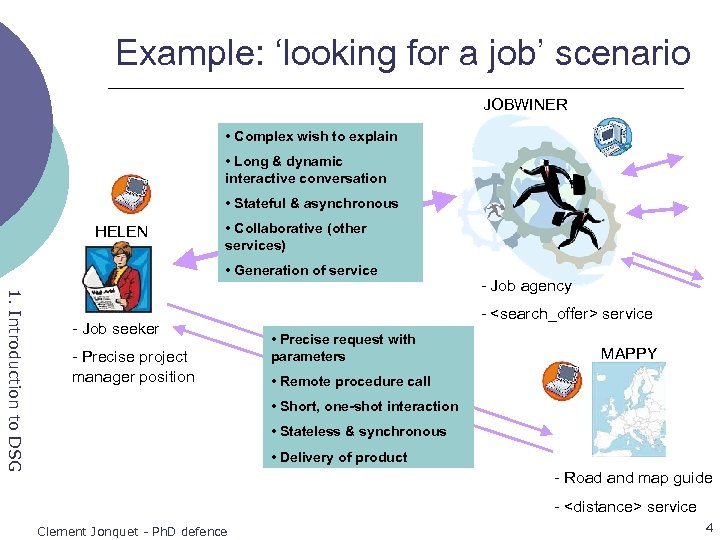 Example: ‘looking for a job’ scenario JOBWINER • Complex wish to explain • Long & dynamic interactive conversation • Stateful & asynchronous HELEN • Collaborative (other services) • Generation of service 1. Introduction to DSG - Job seeker - Precise project manager position - Job agency -
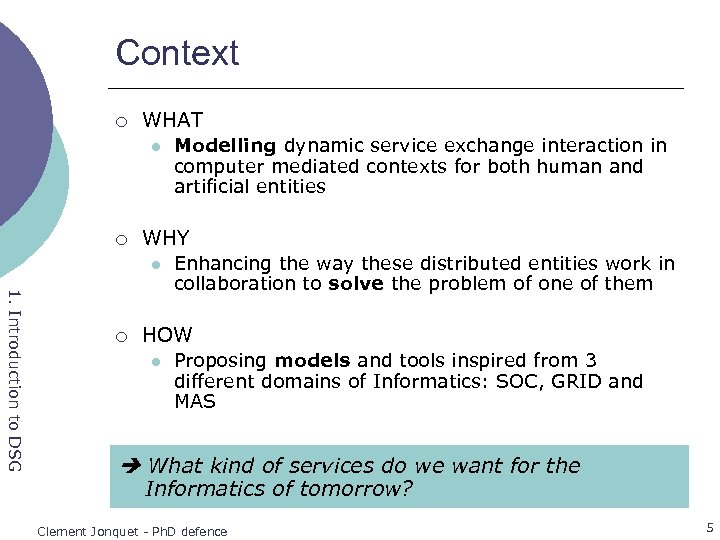 Context ¡ WHAT l ¡ WHY l 1. Introduction to DSG ¡ Modelling dynamic service exchange interaction in computer mediated contexts for both human and artificial entities Enhancing the way these distributed entities work in collaboration to solve the problem of one of them HOW l Proposing models and tools inspired from 3 different domains of Informatics: SOC, GRID and MAS What kind of services do we want for the Informatics of tomorrow? Clement Jonquet - Ph. D defence 5
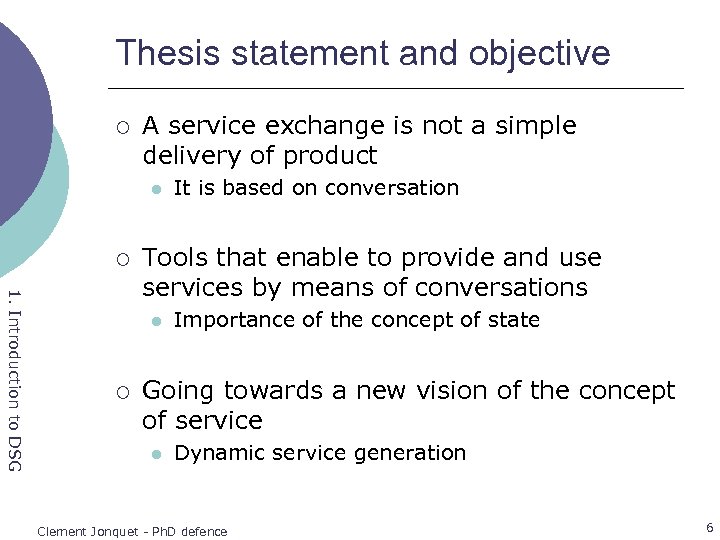 Thesis statement and objective ¡ A service exchange is not a simple delivery of product l ¡ 1. Introduction to DSG Tools that enable to provide and use services by means of conversations l ¡ It is based on conversation Importance of the concept of state Going towards a new vision of the concept of service l Dynamic service generation Clement Jonquet - Ph. D defence 6
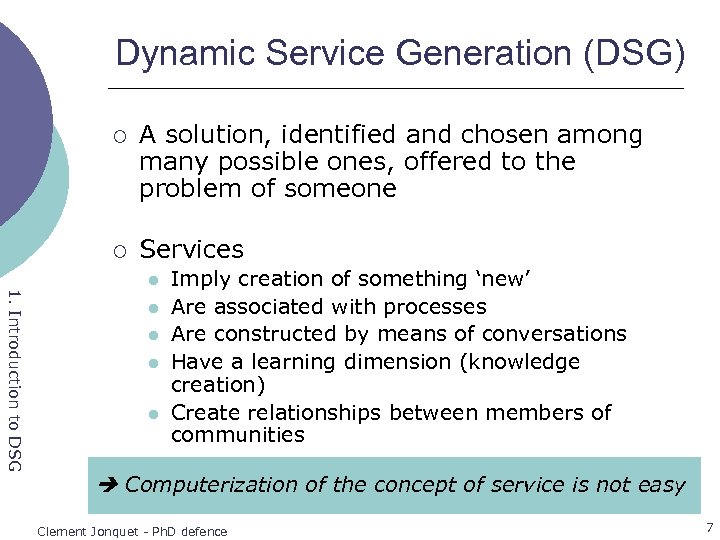 Dynamic Service Generation (DSG) ¡ A solution, identified and chosen among many possible ones, offered to the problem of someone ¡ Services 1. Introduction to DSG l l l Imply creation of something ‘new’ Are associated with processes Are constructed by means of conversations Have a learning dimension (knowledge creation) Create relationships between members of communities Computerization of the concept of service is not easy Clement Jonquet - Ph. D defence 7
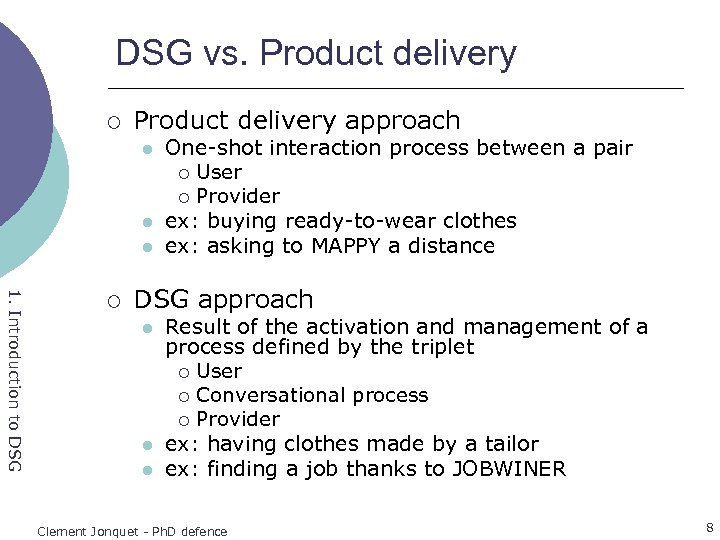 DSG vs. Product delivery ¡ Product delivery approach l l l 1. Introduction to DSG ¡ One-shot interaction process between a pair ¡ User ¡ Provider ex: buying ready-to-wear clothes ex: asking to MAPPY a distance DSG approach l l l Result of the activation and management of a process defined by the triplet ¡ User ¡ Conversational process ¡ Provider ex: having clothes made by a tailor ex: finding a job thanks to JOBWINER Clement Jonquet - Ph. D defence 8
 Method adopted ¡ Characterization process l ¡ Try to address some of these characteristics l 1. Introduction to DSG l l ¡ Concrete tools and models Experimentations on simple scenarios Re-usability of concrete principles Motivation l ¡ List of DSG characteristics To formalize the convergence of 3 important domains for DSG: SOC, GRID and MAS Integration approach Clement Jonquet - Ph. D defence 9
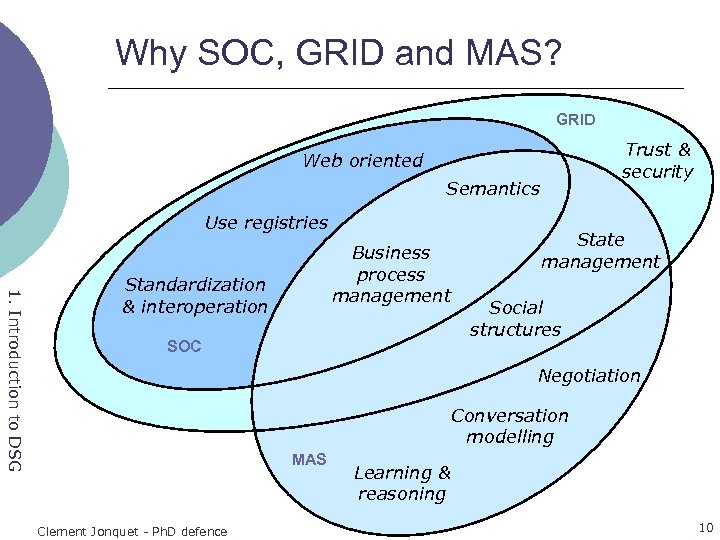 Why SOC, GRID and MAS? GRID Trust & security Web oriented Semantics Use registries State management 1. Introduction to DSG Business process management Standardization & interoperation Social structures SOC Negotiation Conversation modelling MAS Clement Jonquet - Ph. D defence Learning & reasoning 10
 Speech overview 1. 2. Introduction to Dynamic Service Generation (DSG) 2. GRID & SOC key concepts GRID and Service Oriented Computing (SOC) key concepts 3. Multi-Agent Systems (MAS) and the STROBE model 4. Service based integration of GRID and MAS (AGIL) 5. Conclusion Clement Jonquet - Ph. D defence 11
 What is GRID? ¡ Foundation l Flexible, secure, coordinated resource sharing among Virtual Organizations (VO) [Foster et al. , 1999, Blueprint] & [Foster et al. , 2001, Anatomy] ¡ Originally l 2. GRID & SOC key concepts ¡ Extended l ¡ Environment with a large number of networked computer systems where computing and storage resources could be shared as needed and on demand Virtualization of resources and assignment to stateful and dynamic services [Globus alliance, 2002, Physiology (OGSA)] Last standard l l l Web Service Resource Framework [Globus alliance, 2004, WSRF] GRID-SOC convergence Grid service = stateless service + stateful resource Clement Jonquet - Ph. D defence 12
![Grid service ¡ Compliant with Web service and SOA standards [W 3 C] l](https://present5.com/presentation/509a179a60aeb606acebbfe3dcaa0acc/image-13.jpg "Grid service ¡ Compliant with Web service and SOA standards [W 3 C] l") Grid service ¡ Compliant with Web service and SOA standards [W 3 C] l l l 2. GRID & SOC key concepts ¡ 2 major new aspects l l ¡ State management (stateful/stateless) Lifetime management (transient/persistent) Dynamic assignment of resources to a service l Clement Jonquet - Ph. D defence Describable, discoverable component Message based communication Perform some function Instantiation mechanism 13
Grid service ¡ Compliant with Web service and SOA standards [W 3 C] l l l 2. GRID & SOC key concepts ¡ 2 major new aspects l l ¡ State management (stateful/stateless) Lifetime management (transient/persistent) Dynamic assignment of resources to a service l Clement Jonquet - Ph. D defence Describable, discoverable component Message based communication Perform some function Instantiation mechanism 13
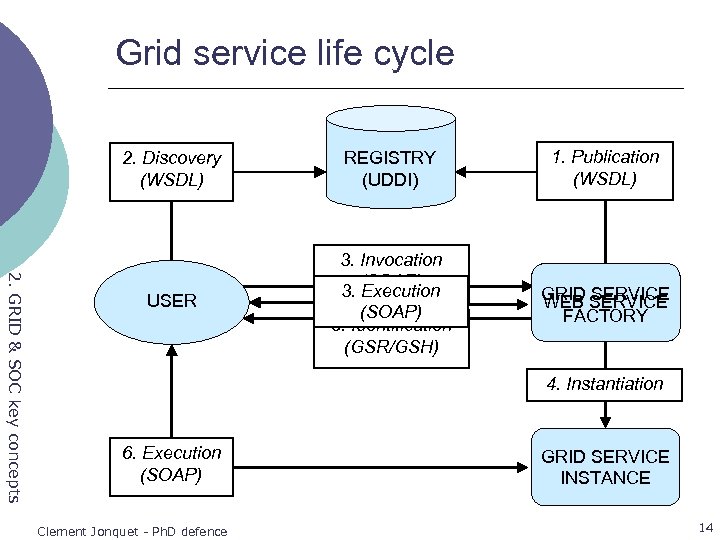 Grid service life cycle 2. GRID & SOC key concepts 2. Discovery (WSDL) REGISTRY (UDDI) 1. Publication (WSDL) USER 3. Invocation (SOAP) 3. Execution (SOAP) 5. Identification (GSR/GSH) GRID SERVICE WEB SERVICE FACTORY 4. Instantiation 6. Execution (SOAP) Clement Jonquet - Ph. D defence GRID SERVICE INSTANCE 14
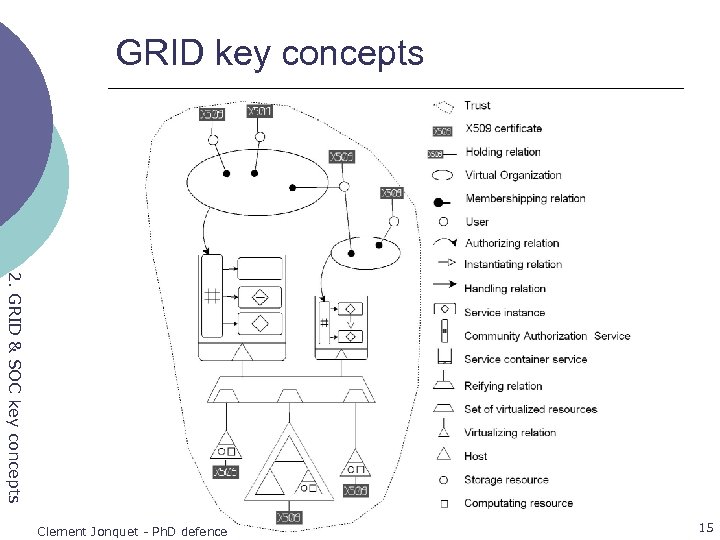 GRID key concepts 2. GRID & SOC key concepts Clement Jonquet - Ph. D defence 15
 Speech overview 1. Introduction to Dynamic Service Generation (DSG) 2. GRID and Service Oriented Computing (SOC) key concepts 3. MAS & the STROBE model 3. Multi-Agent Systems (MAS) and the STROBE model 4. Service based integration of GRID and MAS (AGIL) 5. Conclusion Clement Jonquet - Ph. D defence 16
![What are agents and MAS? ¡ Definition [Ferber, 1995] & [Jennings, 2001]: Physical or](https://present5.com/presentation/509a179a60aeb606acebbfe3dcaa0acc/image-17.jpg "What are agents and MAS? ¡ Definition [Ferber, 1995] & [Jennings, 2001]: Physical or") What are agents and MAS? ¡ Definition [Ferber, 1995] & [Jennings, 2001]: Physical or virtual autonomous entities: l l l 3. MAS & the STROBE model l l ¡ Situated in a particular environment Capable of perceiving and acting in that environment Designed to fulfil a specific role Communicate directly with other agents Possess their own state (and controls it) and skills Offer services Have a behaviour that tends to satisfy their objectives Service oriented characteristics l l l Reactive, proactive, and adaptive Know about themselves, and have a memory and a persistent state Interact and work in collaboration Able to learn and reason in order to evolve Deal with semantics associated to concepts by processing ontologies Clement Jonquet - Ph. D defence 17
What are agents and MAS? ¡ Definition [Ferber, 1995] & [Jennings, 2001]: Physical or virtual autonomous entities: l l l 3. MAS & the STROBE model l l ¡ Situated in a particular environment Capable of perceiving and acting in that environment Designed to fulfil a specific role Communicate directly with other agents Possess their own state (and controls it) and skills Offer services Have a behaviour that tends to satisfy their objectives Service oriented characteristics l l l Reactive, proactive, and adaptive Know about themselves, and have a memory and a persistent state Interact and work in collaboration Able to learn and reason in order to evolve Deal with semantics associated to concepts by processing ontologies Clement Jonquet - Ph. D defence 17
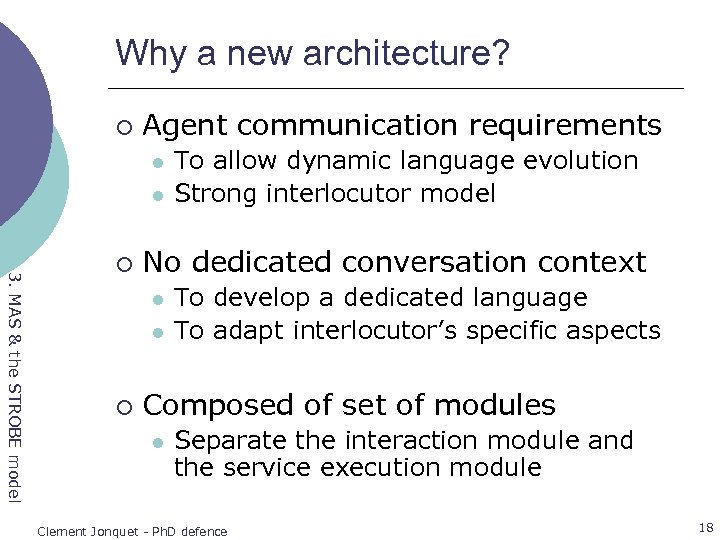 Why a new architecture? ¡ Agent communication requirements l l 3. MAS & the STROBE model ¡ No dedicated conversation context l l ¡ To allow dynamic language evolution Strong interlocutor model To develop a dedicated language To adapt interlocutor’s specific aspects Composed of set of modules l Separate the interaction module and the service execution module Clement Jonquet - Ph. D defence 18
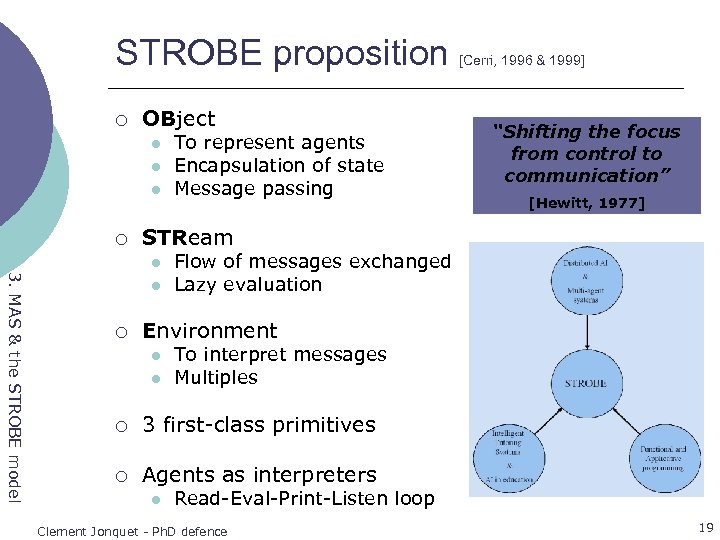 STROBE proposition ¡ OBject l l l ¡ “Shifting the focus from control to communication” [Hewitt, 1977] STReam l 3. MAS & the STROBE model l ¡ To represent agents Encapsulation of state Message passing [Cerri, 1996 & 1999] Flow of messages exchanged Lazy evaluation Environment l l To interpret messages Multiples ¡ 3 first-class primitives ¡ Agents as interpreters l Read-Eval-Print-Listen loop Clement Jonquet - Ph. D defence 19
![The STROBE model [Jonquet & Cerri, AAI journal, 2005] ¡ Agent representation and communication](https://present5.com/presentation/509a179a60aeb606acebbfe3dcaa0acc/image-20.jpg "The STROBE model [Jonquet & Cerri, AAI journal, 2005] ¡ Agent representation and communication") The STROBE model [Jonquet & Cerri, AAI journal, 2005] ¡ Agent representation and communication model ¡ Include an interpreter in each environment l ¡ 3. MAS & the STROBE model STROBE agents build their own dedicated languages while communicating l ¡ Language = environment + interpreter Language evolution done dynamically at: l l ¡ Dedicated to interlocutors The data and control level The interpreter level (using reflection and metaprogramming techniques) Formalized, implemented and experimented l Scheme & Java/Kawa in Mad. Kit Clement Jonquet - Ph. D defence 20
The STROBE model [Jonquet & Cerri, AAI journal, 2005] ¡ Agent representation and communication model ¡ Include an interpreter in each environment l ¡ 3. MAS & the STROBE model STROBE agents build their own dedicated languages while communicating l ¡ Language = environment + interpreter Language evolution done dynamically at: l l ¡ Dedicated to interlocutors The data and control level The interpreter level (using reflection and metaprogramming techniques) Formalized, implemented and experimented l Scheme & Java/Kawa in Mad. Kit Clement Jonquet - Ph. D defence 20
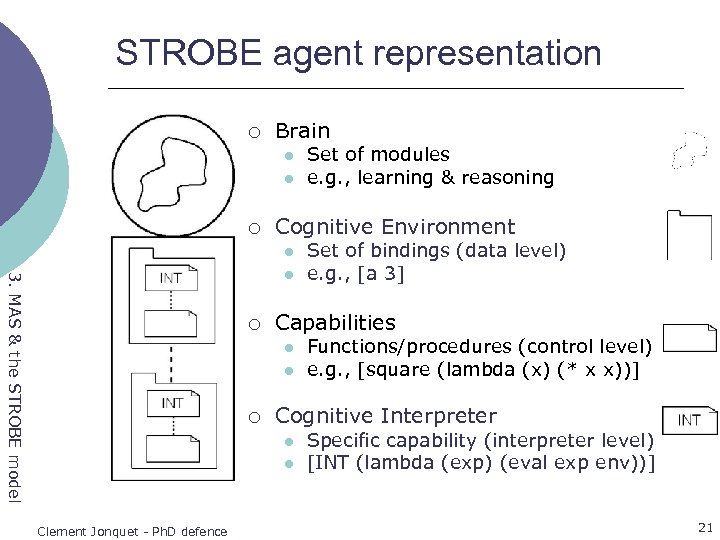 STROBE agent representation ¡ Brain l l ¡ Cognitive Environment l 3. MAS & the STROBE model l ¡ l Functions/procedures (control level) e. g. , [square (lambda (x) (* x x))] Cognitive Interpreter l l Clement Jonquet - Ph. D defence Set of bindings (data level) e. g. , [a 3] Capabilities l ¡ Set of modules e. g. , learning & reasoning Specific capability (interpreter level) [INT (lambda (exp) (eval exp env))] 21
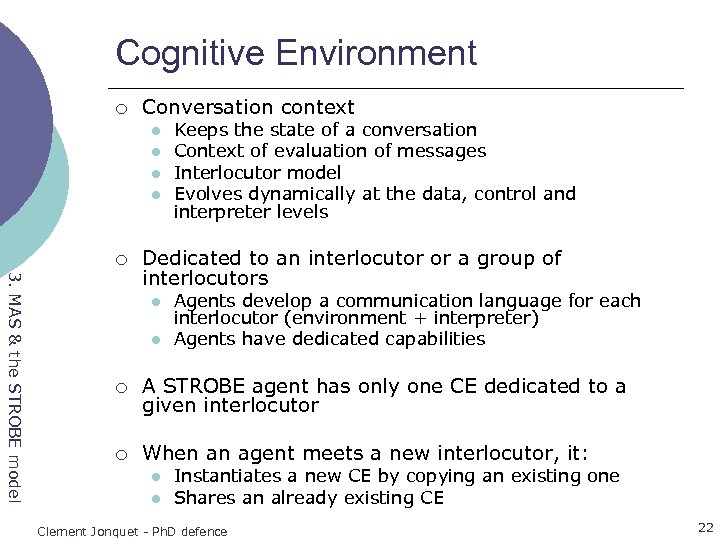 Cognitive Environment ¡ Conversation context l l ¡ Keeps the state of a conversation Context of evaluation of messages Interlocutor model Evolves dynamically at the data, control and interpreter levels 3. MAS & the STROBE model Dedicated to an interlocutor or a group of interlocutors l l Agents develop a communication language for each interlocutor (environment + interpreter) Agents have dedicated capabilities ¡ A STROBE agent has only one CE dedicated to a given interlocutor ¡ When an agent meets a new interlocutor, it: l l Instantiates a new CE by copying an existing one Shares an already existing CE Clement Jonquet - Ph. D defence 22
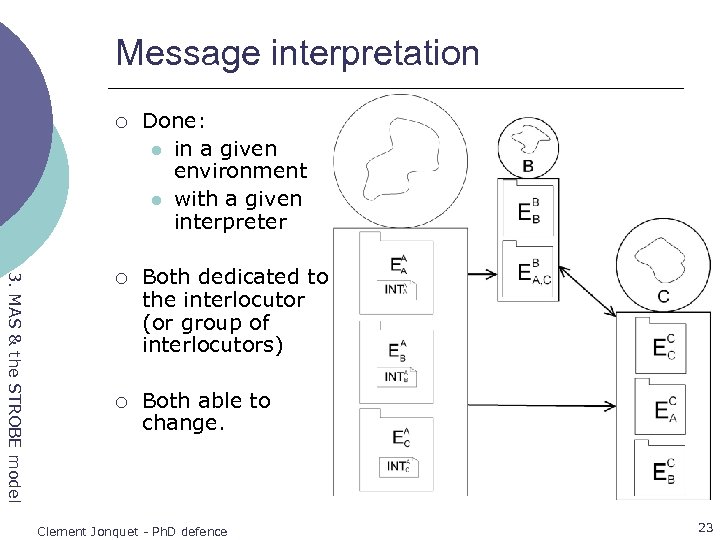 Message interpretation 3. MAS & the STROBE model ¡ Done: l in a given environment l with a given interpreter ¡ Both dedicated to the interlocutor (or group of interlocutors) ¡ Both able to change. Clement Jonquet - Ph. D defence 23
 Speech overview Introduction to Dynamic Service Generation (DSG) 2. 4. Service based integration 1. GRID and Service Oriented Computing (SOC) key concepts 3. Multi-Agent Systems (MAS) and the STROBE model 4. 5. Service based integration of GRID and MAS (AGIL) Conclusion Clement Jonquet - Ph. D defence 24
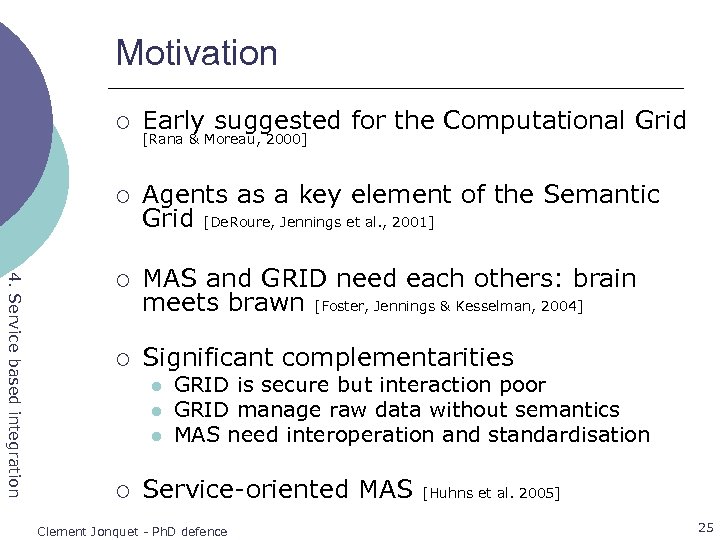 Motivation Early suggested for the Computational Grid ¡ 4. Service based integration ¡ Agents as a key element of the Semantic Grid [De. Roure, Jennings et al. , 2001] ¡ MAS and GRID need each others: brain meets brawn [Foster, Jennings & Kesselman, 2004] ¡ Significant complementarities [Rana & Moreau, 2000] l l l ¡ GRID is secure but interaction poor GRID manage raw data without semantics MAS need interoperation and standardisation Service-oriented MAS Clement Jonquet - Ph. D defence [Huhns et al. 2005] 25
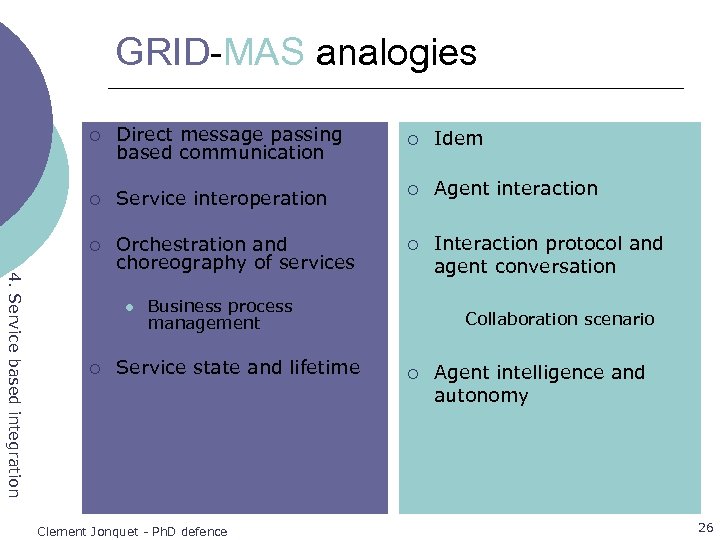 GRID-MAS analogies ¡ Direct message passing based communication ¡ ¡ 4. Service based integration ¡ Idem Service interoperation ¡ Agent interaction Orchestration and choreography of services ¡ Interaction protocol and agent conversation l ¡ Business process management Service state and lifetime Clement Jonquet - Ph. D defence l ¡ Collaboration scenario Agent intelligence and autonomy 26
![GRID-MAS analogies [Foster et al. OGSA, 2002] ¡ Grid user l l l [Ferber](https://present5.com/presentation/509a179a60aeb606acebbfe3dcaa0acc/image-27.jpg "GRID-MAS analogies [Foster et al. OGSA, 2002] ¡ Grid user l l l [Ferber") GRID-MAS analogies [Foster et al. OGSA, 2002] ¡ Grid user l l l [Ferber et al. 2003] ¡ Member of VOs Uses services Offers services Agent l l l Member of groups Holds roles Delegates tasks [Cerri et al. , OGSHA, 2004] 4. Service based integration ¡ VO l l l ¡ Context of service exchanges Exchanges inside Services publication Service l l l Functional position CAS Services are local to VO Clement Jonquet - Ph. D defence ¡ Group l l l ¡ Context of activities Communications inside Capabilities become roles Role l l l Functional position Role management Roles are local to groups 27
GRID-MAS analogies [Foster et al. OGSA, 2002] ¡ Grid user l l l [Ferber et al. 2003] ¡ Member of VOs Uses services Offers services Agent l l l Member of groups Holds roles Delegates tasks [Cerri et al. , OGSHA, 2004] 4. Service based integration ¡ VO l l l ¡ Context of service exchanges Exchanges inside Services publication Service l l l Functional position CAS Services are local to VO Clement Jonquet - Ph. D defence ¡ Group l l l ¡ Context of activities Communications inside Capabilities become roles Role l l l Functional position Role management Roles are local to groups 27
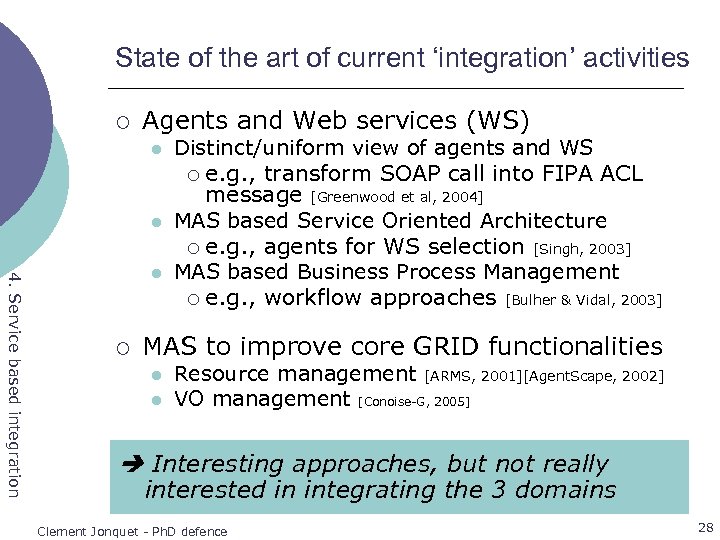 State of the art of current ‘integration’ activities ¡ Agents and Web services (WS) l l 4. Service based integration l ¡ Distinct/uniform view of agents and WS ¡ e. g. , transform SOAP call into FIPA ACL message [Greenwood et al, 2004] MAS based Service Oriented Architecture ¡ e. g. , agents for WS selection [Singh, 2003] MAS based Business Process Management ¡ e. g. , workflow approaches [Bulher & Vidal, 2003] MAS to improve core GRID functionalities l l Resource management [ARMS, 2001][Agent. Scape, 2002] VO management [Conoise-G, 2005] Interesting approaches, but not really interested in integrating the 3 domains Clement Jonquet - Ph. D defence 28
 Mapping of GRID and MAS concepts ¡ Agent l l ¡ VO (= Group = Community) l 4. Service based integration l ¡ Dynamic social group (virtual or not) Context of service exchanges Service-Capability relationship l l ¡ Unifies AA, HA, Grid user Active entities involved in service exchange Autonomous, intelligent and interactive Grid users as potential artificial entity Virtualization of an agent capability A service is an interface of a capability available for a VO Instantiation l l Process of creating a new servicecapability couple Instantiating a new service means to instantiate a new CE containing the new capability Clement Jonquet - Ph. D defence 29
![Agent-Grid Integration Language [Jonquet, Dugenie & Cerri, MAGS journal, 2007] ¡ 3 elements: l](https://present5.com/presentation/509a179a60aeb606acebbfe3dcaa0acc/image-30.jpg "Agent-Grid Integration Language [Jonquet, Dugenie & Cerri, MAGS journal, 2007] ¡ 3 elements: l") Agent-Grid Integration Language [Jonquet, Dugenie & Cerri, MAGS journal, 2007] ¡ 3 elements: l l l ¡ Graphical description language l 4. Service based integration ¡ Set concepts Set of relations between concepts Set of integration rules Kind of UML for GRID-MAS integrated systems Set-theory formalization l Example: holding relation Clement Jonquet - Ph. D defence 30
Agent-Grid Integration Language [Jonquet, Dugenie & Cerri, MAGS journal, 2007] ¡ 3 elements: l l l ¡ Graphical description language l 4. Service based integration ¡ Set concepts Set of relations between concepts Set of integration rules Kind of UML for GRID-MAS integrated systems Set-theory formalization l Example: holding relation Clement Jonquet - Ph. D defence 30
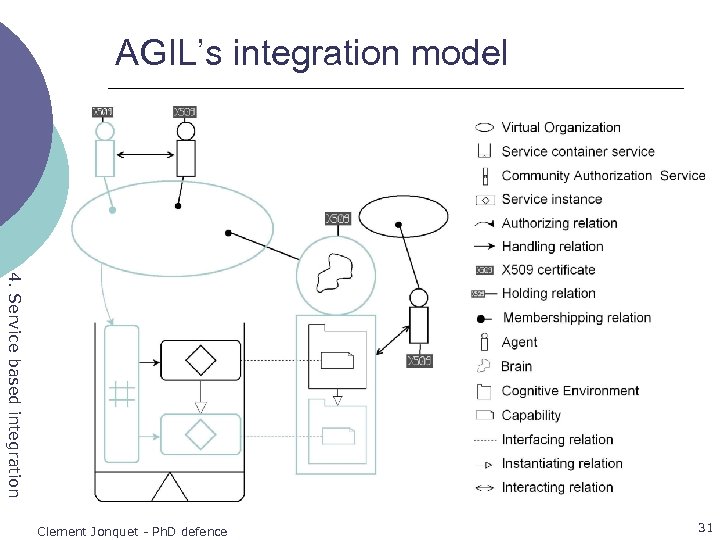 AGIL’s integration model 4. Service based integration Clement Jonquet - Ph. D defence 31
 AGIL discussion (1/2) ¡ Integrates both GRID and MAS properties l l 4. Service based integration ¡ Not restrictive neither for MAS nor GRID l ¡ Bottom-up vision of service in GRID Top-down vision of service in MAS Today, but tomorrow? Includes some of the MAS based GRID approaches l Meta GRID core mechanism are themselves Grid services Clement Jonquet - Ph. D defence 32
 AGIL discussion (2/2) ¡ Both a description language and a integration model l l 4. Service based integration ¡ STROBE is adequate for AGIL l l ¡ Allows to represent both the meta-model and its instances (i. e. , future integrated systems) Rigorously fix the concepts, relations and rules WSRF: stateful resource + stateless service evolution only at the resource level AGIL: CE + capability evolution of the CE and capability levels A service is an interface of a capability executed with Grid resources but managed by an intelligent, autonomous and interactive agent Clement Jonquet - Ph. D defence 33
 Speech overview Introduction to Dynamic Service Generation (DSG) 2. 5. Conclusion 1. GRID and Service Oriented Computing (SOC) key concepts 3. Multi-Agent Systems (MAS) and the STROBE model 4. Service based integration of GRID and MAS (AGIL) 5. Conclusion Clement Jonquet - Ph. D defence 34
 Conclusion (1/2) ¡ We tried to address the question of service exchange modelling in computing context ¡ Dynamic Service Generation l 5. Conclusion l ¡ A reflection about the concept of service that defends an integration of SOC, MAS and GRID Conversation based view of services 3 concretes contributions l l l STROBE i-dialogue (not presented today) AGIL Clement Jonquet - Ph. D defence 35
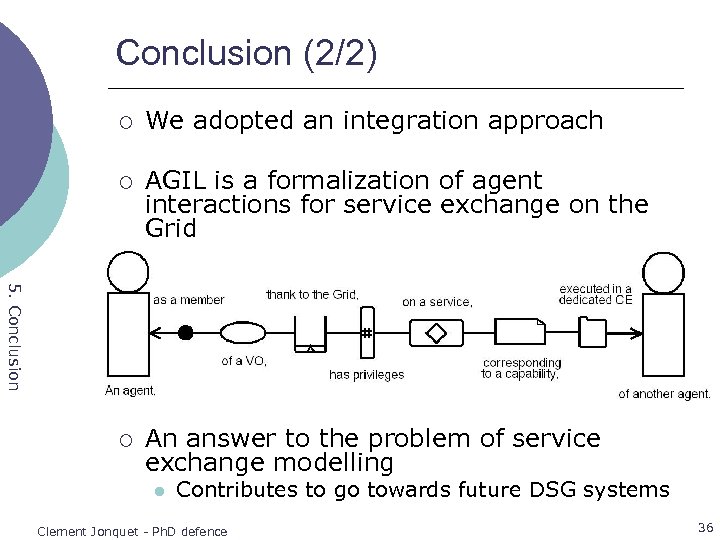 Conclusion (2/2) We adopted an integration approach ¡ AGIL is a formalization of agent interactions for service exchange on the Grid ¡ An answer to the problem of service exchange modelling 5. Conclusion ¡ l Contributes to go towards future DSG systems Clement Jonquet - Ph. D defence 36
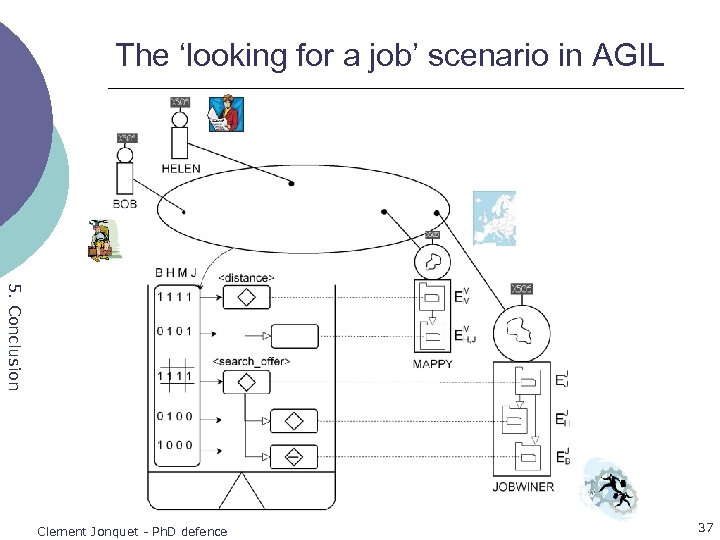 The ‘looking for a job’ scenario in AGIL 5. Conclusion Clement Jonquet - Ph. D defence 37
 Thank you! Clement Jonquet - Ph. D defence
 Perspectives ¡ Short term ones l l Learning rules on CEs in the STROBE model Integrate first-class continuations in CE Add to AGIL other concepts, relations and rules Implement AGIL as an ontology [Duvert & Jonquet et al. , Awe. SOMe workshop, 2006] ¡ Long term ones l l Integrate new aspects and characteristics of DSG (specially coming from SOC [Singh & Huhns, 2005]) Continue the DSG characterization process Validate the AGIL integration model on a large scale project Integration with Semantic Web Services approaches (service container as a semantic platform) [Domingue & Motta, IRS and WSMO, 2005] l Provenance of dynamically generated services 2005] Clement Jonquet - Ph. D defence [Moreau et al. , 39
 Publications www. lirmm. fr/~jonquet/Publications ¡ Journal l Clement Jonquet, Pascal Dugenie, Stefano A. Cerri, Agent-Grid Integration Language, Multiagent and Grid Systems, Accepted for publication - Expected middle of 2007. l Pascal Dugénie, Philippe Lemoisson, Clement Jonquet, Monica Crubézy, The Grid Shared Desktop: A Bootstrapping Environment for Collaboration, Advanced Technology for Learning, Special issue on Collaborative Learning, Accepted for publication - Expected end of 2006. l Clement Jonquet, Stefano A. Cerri, The STROBE model: Dynamic Service Generation on the Grid, Applied Artificial Intelligence, Special issue on Learning Grid Services, Vol. 19 (9 -10), p. 967 -1013, Nov. 2005. ¡ International conference l Clement Jonquet, Stefano A. Cerri, I-Dialogue: Modelling Agent Conversation by Streams and Lazy Evaluation, International Lisp Conference, ILC'05, Stanford University, CA, USA, Jun. 2005. ¡ Workshop l Frédéric Duvert, Clement Jonquet, Pascal Dugénie, Stefano A. Cerri, Agent-Grid Integration Ontology, R. Meersman, Z. Tari, P. Herrero(eds. ) International Workshop on Agents, Web Services and Ontologies Merging, AWe. SOMe'06 , Vol. 4277, LNCS, pp. 136 -146, Montpellier, France, Nov. 2006. l Clement Jonquet and Marc Eisenstadt and Stefano A. Cerri, Learning Agents and Enhanced Presence for Generation of Services on the Grid, Towards the Learning GRID: advances in Human Learning Services, Vol. 127, Frontiers in Artificial Intelligence and Applications, p. 203 -213, IOS Press, Nov. 2005. l Clement Jonquet, Stefano A. Cerri, Cognitive Agents Learning by Communicating, P. Aniorté (ed. ), 7ème Colloque Agents Logiciels, Coopération, Apprentissage & Activité humaine, ALCAA'03, Bayonne, France, Sep. 2003. ¡ National conference l Clement Jonquet, Pascal Dugenie, Stefano A. Cerri, Intégration orientée service des modèles Grid et multi-agents, 14èmes Journées Francophones sur les Systèmes Multi-Agents, p. 271 -274, Annecy, France, Oct. 2006. l Clement Jonquet, Stefano A. Cerri, Les Agents comme des interpréteurs Scheme : Spécification dynamique par la communication, 14ème Congrès Francophone de Reconnaissance des Formes et Intelligence Artificielle, Vol. 2, p. 779788, Toulouse, France, Jan. 2004. l Clement Jonquet, Stefano A. Cerri, Apprentissage issu de la communication pour des agents cognitifs, 11ème Journées Francophones sur les Systèmes Multi-Agents, p. 83 -87, Hammamet, Tunisie, Nov. 2003. Clement Jonquet - Ph. D defence 40
![I-dialogue [Jonquet & Cerri, International Lisp Conference, 2005] ¡ An computational abstraction to model](https://present5.com/presentation/509a179a60aeb606acebbfe3dcaa0acc/image-41.jpg "I-dialogue [Jonquet & Cerri, International Lisp Conference, 2005] ¡ An computational abstraction to model") I-dialogue [Jonquet & Cerri, International Lisp Conference, 2005] ¡ An computational abstraction to model agent multi-party conversations l l Inspired by the dialogue abstraction proposed by [O’Donnel, 1985] to model process interactions Uses first-class procedures, streams and lazy evaluation ¡ Enables to manage the entire conversation dynamically (not pre-determined) ¡ Adequate for intertwined dialogues l l l Executed simultaneously Inputs and outputs depend on each other Service composition Clement Jonquet - Ph. D defence 41
I-dialogue [Jonquet & Cerri, International Lisp Conference, 2005] ¡ An computational abstraction to model agent multi-party conversations l l Inspired by the dialogue abstraction proposed by [O’Donnel, 1985] to model process interactions Uses first-class procedures, streams and lazy evaluation ¡ Enables to manage the entire conversation dynamically (not pre-determined) ¡ Adequate for intertwined dialogues l l l Executed simultaneously Inputs and outputs depend on each other Service composition Clement Jonquet - Ph. D defence 41
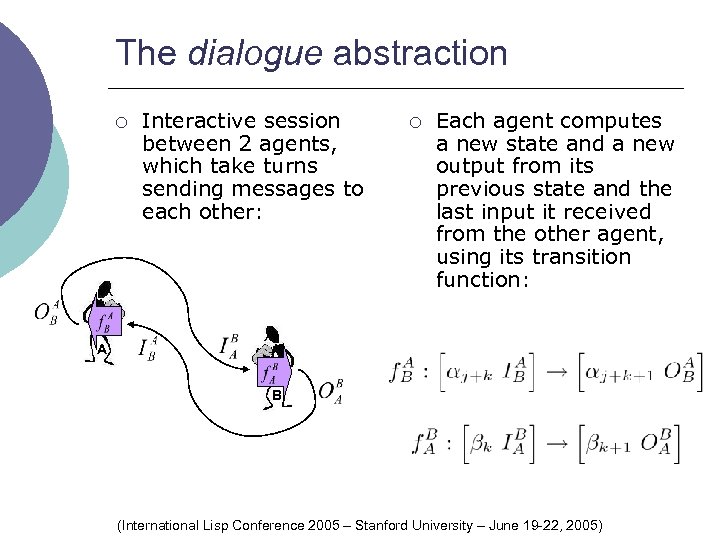 The dialogue abstraction ¡ Interactive session between 2 agents, which take turns sending messages to each other: ¡ Each agent computes a new state and a new output from its previous state and the last input it received from the other agent, using its transition function: A B (International Lisp Conference 2005 – Stanford University – June 19 -22, 2005)
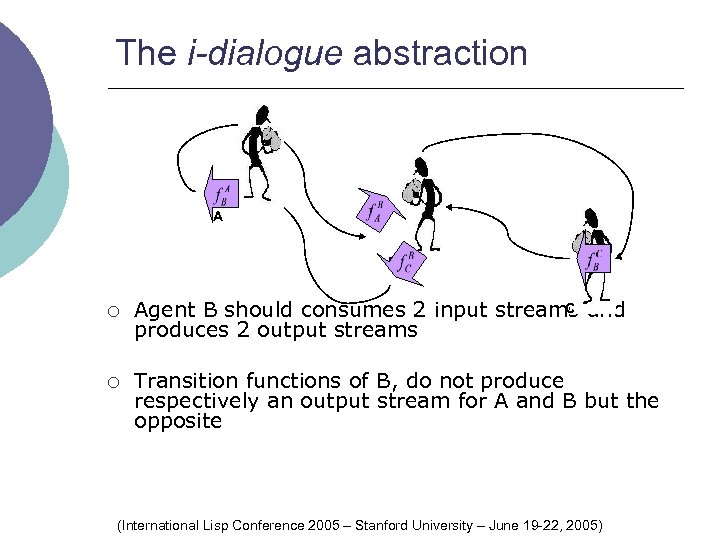 The i-dialogue abstraction A B ¡ ¡ C Agent B should consumes 2 input streams and produces 2 output streams Transition functions of B, do not produce respectively an output stream for A and B but the opposite (International Lisp Conference 2005 – Stanford University – June 19 -22, 2005)
 Evaluation & experimentations ¡ STROBE l l 2 implementations (Scheme & Java/Kawa in Mad. Kit) 2 main experimentations ¡ ¡ ¡ Dynamic specification of a problem (client – service provider dialogue to construct an train ticket reservation. Use of non-deterministic interpreters (constraints specification)) I-dialogue l l ¡ Meta-level learning by communicating (teacher – student dialogue for the learning of a new performative) Implemented in Scheme Integration with the STROBE implementation in progress AGIL l Implementation under the form of an ontology started Clement Jonquet - Ph. D defence 44
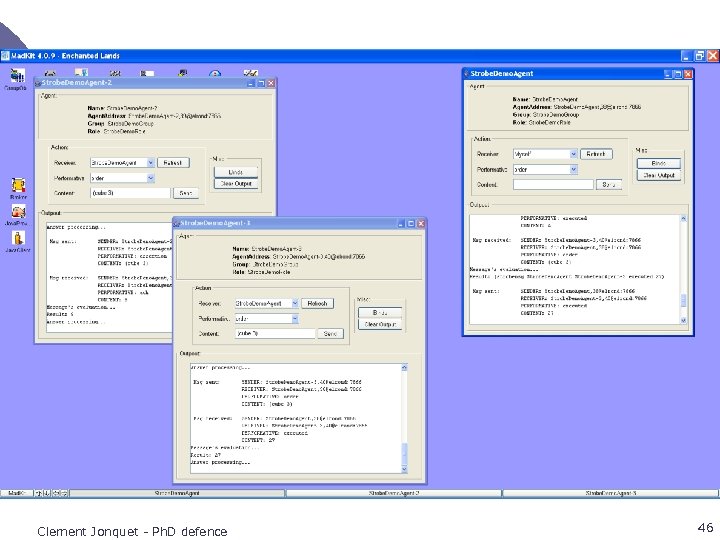
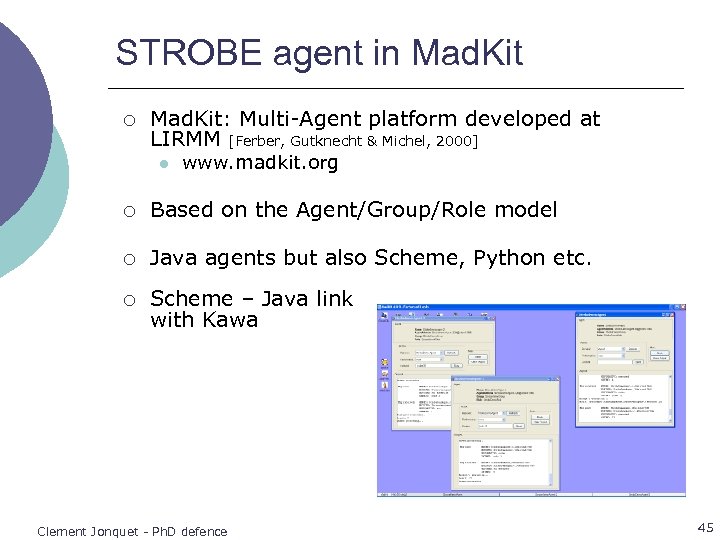 STROBE agent in Mad. Kit ¡ Mad. Kit: Multi-Agent platform developed at LIRMM [Ferber, Gutknecht & Michel, 2000] l www. madkit. org ¡ Based on the Agent/Group/Role model ¡ Java agents but also Scheme, Python etc. ¡ Scheme – Java link with Kawa Clement Jonquet - Ph. D defence 45
 Clement Jonquet - Ph. D defence 46
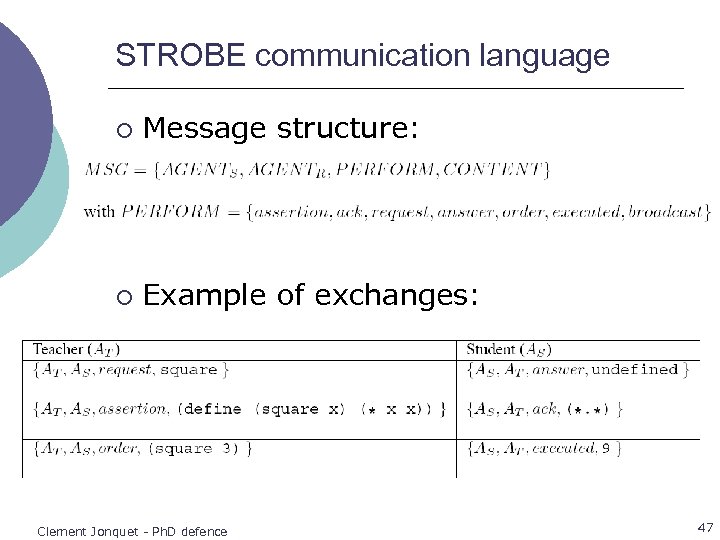 STROBE communication language ¡ Message structure: ¡ Example of exchanges: Clement Jonquet - Ph. D defence 47
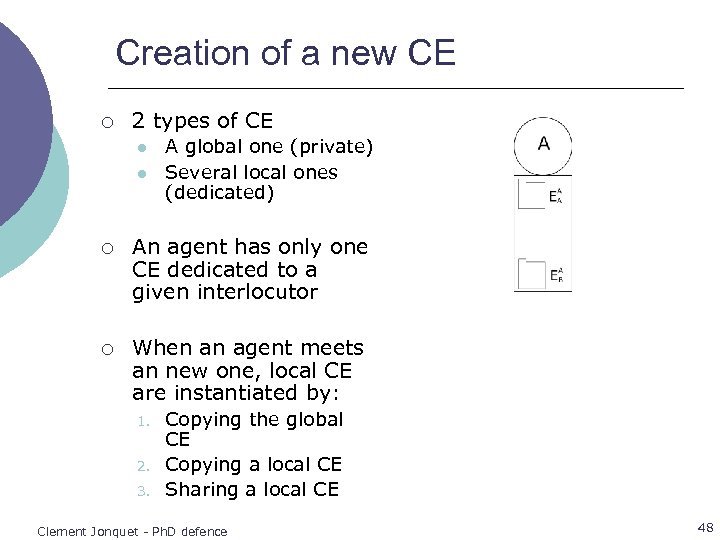 Creation of a new CE ¡ 2 types of CE l l A global one (private) Several local ones (dedicated) ¡ An agent has only one CE dedicated to a given interlocutor ¡ When an agent meets an new one, local CE are instantiated by: 1. 2. 3. Copying the global CE Copying a local CE Sharing a local CE Clement Jonquet - Ph. D defence 48
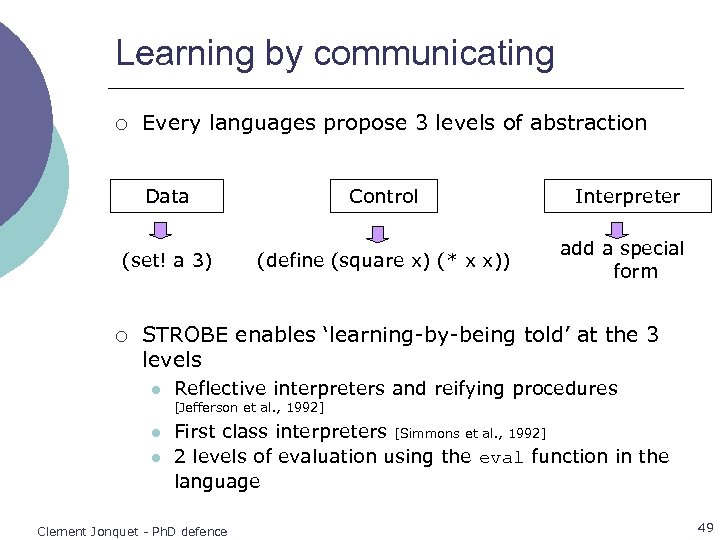 Learning by communicating ¡ Every languages propose 3 levels of abstraction Data Control (set! a 3) (define (square x) (* x x)) ¡ Interpreter add a special form STROBE enables ‘learning-by-being told’ at the 3 levels l Reflective interpreters and reifying procedures [Jefferson et al. , 1992] l l First class interpreters [Simmons et al. , 1992] 2 levels of evaluation using the eval function in the language Clement Jonquet - Ph. D defence 49
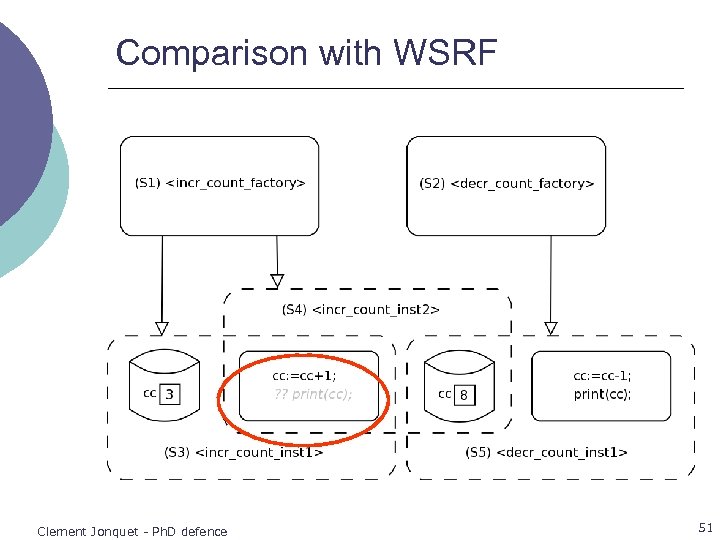
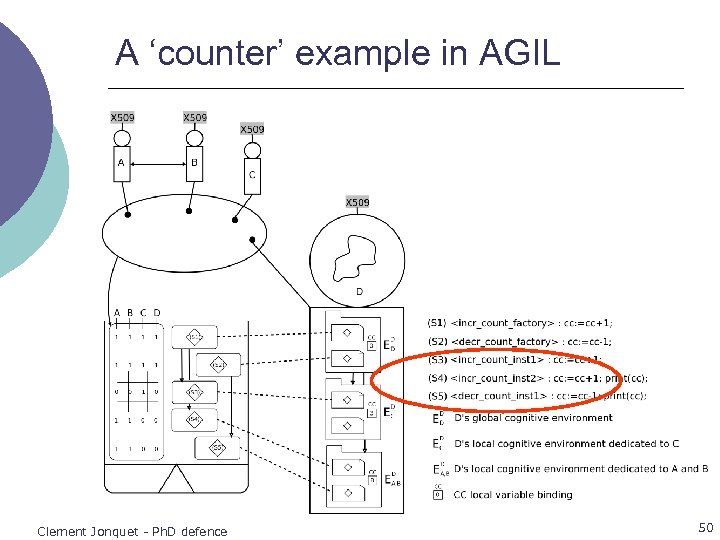 A ‘counter’ example in AGIL ¡ Clement Jonquet - Ph. D defence Incrementing / decrementing counter service 50
 Comparison with WSRF Clement Jonquet - Ph. D defence 51
 PD vs. DSG (1/2) ¡ User exactly knows: l l l ¡ what he wants (clearly defined problem) what the system can offer him (clearly defined product) how to express his request (adaptation to provider’s language) l l l ¡ Same type of deliveries ¡ ¡ No history ¡ ¡ Cannot realise DSG Pre-developed by the provider (clearly defined goal) ¡ Clement Jonquet - Ph. D defence User : ¡ ¡ has unclear wish (bootstrapping situation) elicits and understands progressively the provider’s capabilities the provider adapts to the user’s language Unique generated services (conversation is unique) Depend from previous DSG and history Can realise PD Offered within a service domain and constructed dynamically (user’s specific objectives) 52
 PD vs. DSG (2/2) Long lifetime Slow evolution No reasoning No knowledge creation Same satisfaction for each delivery No possible retraction No emotion or psychological impacts Easily valuable an billable Able to announce the result ¡ ¡ Inactive when not engaged in a delivery phase ¡ ¡ Passive ¡ ¡ ¡ ¡ ¡ Clement Jonquet - Ph. D defence ¡ ¡ ¡ ¡ ¡ Ephemeral life-cycle Dynamic and natural evolution Static and dynamic reasoning Pedagogical perspective Satisfaction increases with each generation Anytime mind changing Implies (+ or -) emotions Hardly valuable and billable Gain the user’s trust (not announce or guarantee a final result) Perpetually evolving, learning on their previous generation to improve the next ones Pro-active 53
 Service taxonomy Clement Jonquet - Ph. D defence 54
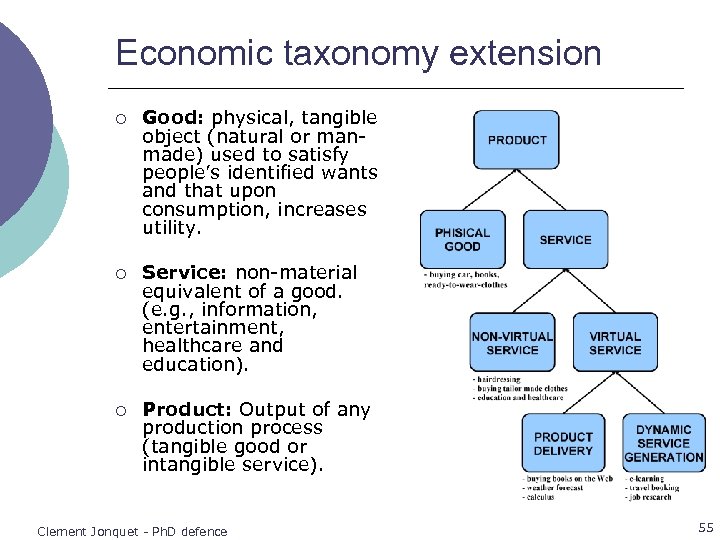 Economic taxonomy extension ¡ Good: physical, tangible object (natural or manmade) used to satisfy people’s identified wants and that upon consumption, increases utility. ¡ Service: non-material equivalent of a good. (e. g. , information, entertainment, healthcare and education). ¡ Product: Output of any production process (tangible good or intangible service). Clement Jonquet - Ph. D defence 55
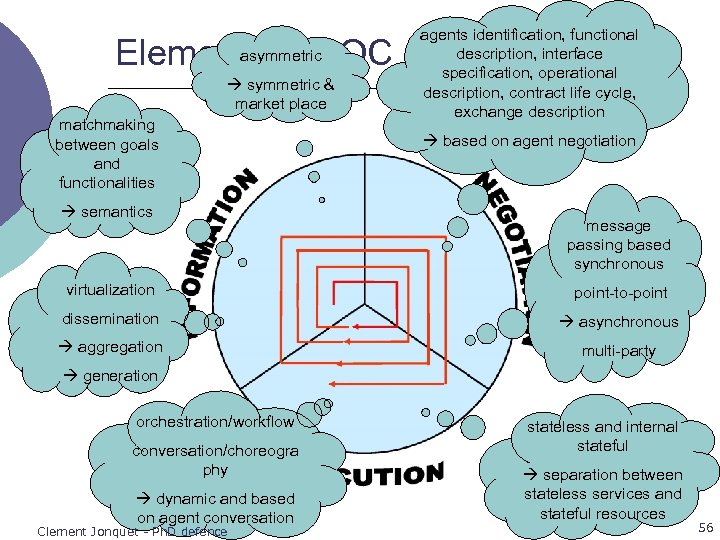 asymmetric Elements of SOC symmetric & market place matchmaking between goals and functionalities semantics agents identification, functional description, interface specification, operational description, contract life cycle, exchange description based on agent negotiation message passing based synchronous virtualization point-to-point dissemination asynchronous aggregation multi-party generation orchestration/workflow conversation/choreogra phy dynamic and based on agent conversation Clement Jonquet - Ph. D defence stateless and internal stateful separation between stateless services and stateful resources 56
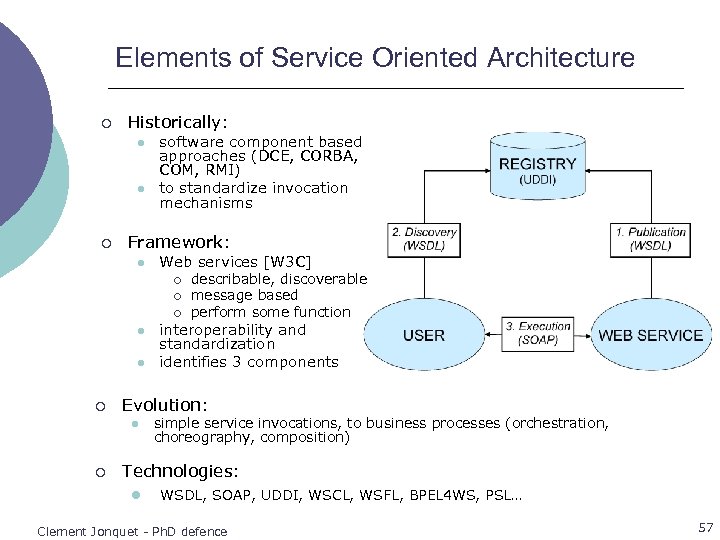 Elements of Service Oriented Architecture ¡ Historically: l l ¡ software component based approaches (DCE, CORBA, COM, RMI) to standardize invocation mechanisms Framework: l Web services [W 3 C] ¡ ¡ ¡ l l ¡ interoperability and standardization identifies 3 components Evolution: l ¡ describable, discoverable message based perform some function simple service invocations, to business processes (orchestration, choreography, composition) Technologies: l WSDL, SOAP, UDDI, WSCL, WSFL, BPEL 4 WS, PSL… Clement Jonquet - Ph. D defence 57
 Web services limits ¡ ¡ RPC like computing Object-oriented behaviour No user adaptation No memory (stateless) ¡ No conversation ¡ Synchronous communication ¡ No lifetime management ¡ Passive ¡ No semantics Web services are typical PDS A service is seen as a standardized and interoperable interface of a specific function (accessed remotely) Clement Jonquet - Ph. D defence 58