


 Скачать презентацию Dynamic Service Discovery through Meta-Interactions with Service Providers
ad4c8ab9a1d6a83b44e8c0c0eedc9000.ppt
- Количество слайдов: 16
 Dynamic Service Discovery through Meta-Interactions with Service Providers Tomas Vitvar, Maciej Zaremba, Mathew Moran Tomas Vitvar tomas. vitvar@deri. org Copyright 2007 Digital Enterprise Research Institute. All rights reserved. The 4 th European Semantic Web Conference (ESWC 2007) June 03 -07, 2007, Innsbruck, Austria www. deri. org
 Overview • B ackground and Objectives • Service Discovery and Data-Fetching • Implementation and Evaluatuion (SWS Challenge) • Future Work 2
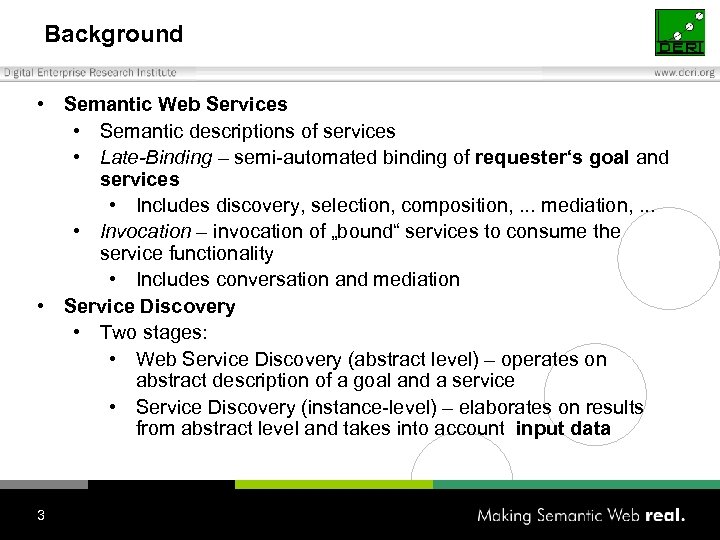 Background • Semantic Web Services • Semantic descriptions of services • Late-Binding – semi-automated binding of requester‘s goal and services • Includes discovery, selection, composition, . . . mediation, . . . • Invocation – invocation of „bound“ services to consume the service functionality • Includes conversation and mediation • Service Discovery • Two stages: • Web Service Discovery (abstract level) – operates on abstract description of a goal and a service • Service Discovery (instance-level) – elaborates on results from abstract level and takes into account input data 3
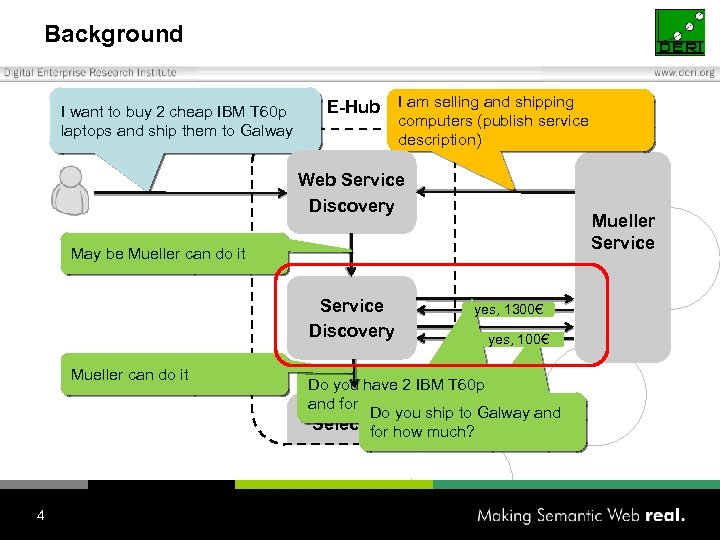 Background I want to buy 2 cheap IBM T 60 p laptops and ship them to Galway E-Hub I am selling and shipping computers (publish service description) Web Service Discovery Mueller Service May be Mueller can do it Service Discovery Mueller can do it 4 yes, 1300€ yes, 100€ Do you have 2 IBM T 60 p and for how much? Do you ship to Galway and Selection how much? for
 Objectives • Service Discovery • Data needed: user data and service data • User Data is either part of user goal request or can be supplied through user‘s interactions • Service Data: need to be supplied thorugh service dynamically • Questions (we only care about service data) (1) Which service data to supply for discovery (2) How to supply the service data for discovery 5
 Objectives • Which service data to supply for discovery? • modeling of service „data-fetching“ interface • How to supply the service data for discovery? • invocaction of the service „data-fetching“ interface as part of the discovery process 6
 Modeling of Service „data-fetching“ interface • Choreography (service view): all input messages are sent from the network and all output messages are sent to the network • State Machine • ontology conpcets as input/output messages • Data-fetching interface is part of service description created by the service provider • Service provider decides on which data can be fetched • Data-fetching interface defines meta-interactions with the service 7
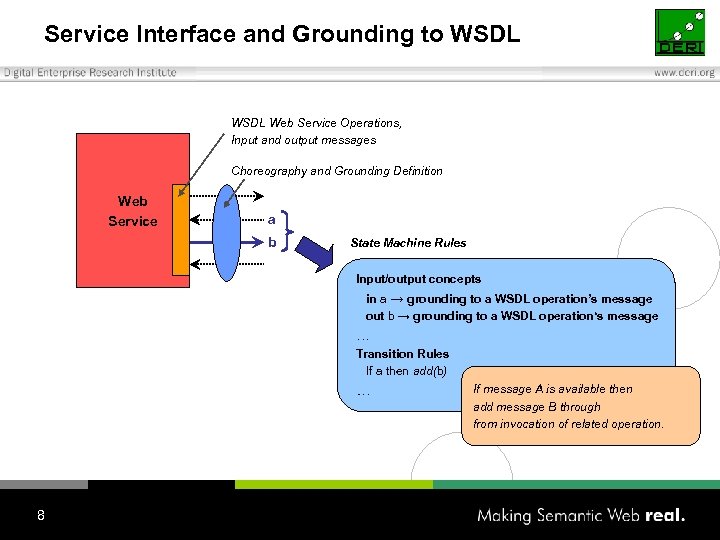 Service Interface and Grounding to WSDL Web Service Operations, Input and output messages Choreography and Grounding Definition Web Service a b State Machine Rules Input/output concepts in a → grounding to a WSDL operation’s message out b → grounding to a WSDL operation‘s message … Transition Rules If a then add(b) … 8 If message A is available then add message B through from invocation of related operation.
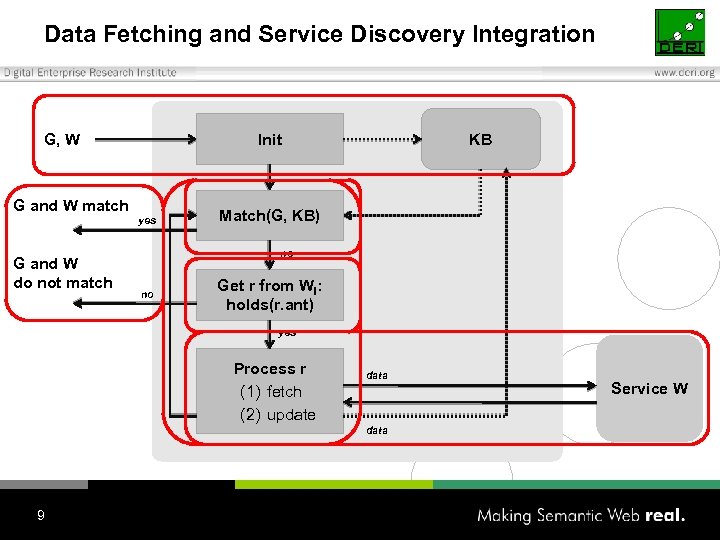 Data Fetching and Service Discovery Integration Init G, W G and W match yes G and W do not match KB Match(G, KB) no no Get r from WI: holds(r. ant) yes Process r (1) fetch (2) update data 9 Service W
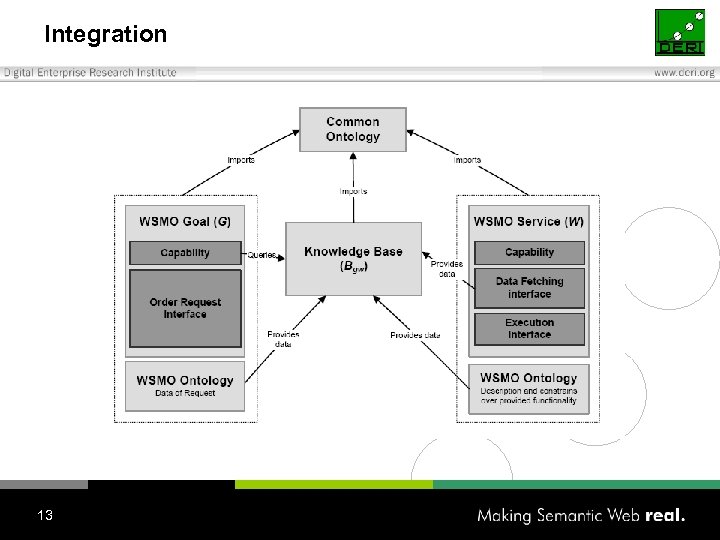
 Implementation • SWS Challenge Scenarion (Discovery) • WSMO Service Model • Modeling of Ontologies, Goals, and Services • WSML Ontology Language • Extending WSMO Service Choreography Interface => choreography interface for data-fetching (distinguished through non-functional property) • All service providers use WSMO • All service providers follow common ontology (no mediation) • WSMX Middleware • Implementation of Service Discovery Component • Whole scenario Implementation 10
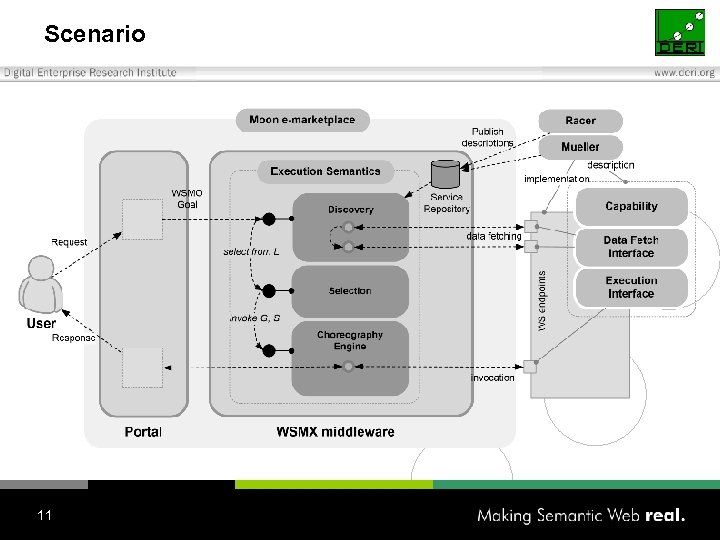 Scenario 11
 Modeling • WSMO Ontology • Common Ontology: Shared concepts • WSMO Services • Capability (Functional Description) • Choreography Interfaces • Data-Fetching and Invocation • WSMO Goals • User wants to buy some products and ship them to some location (postcondition of the goal – query) • Preference: price (non-functional property) 12
 Integration 13
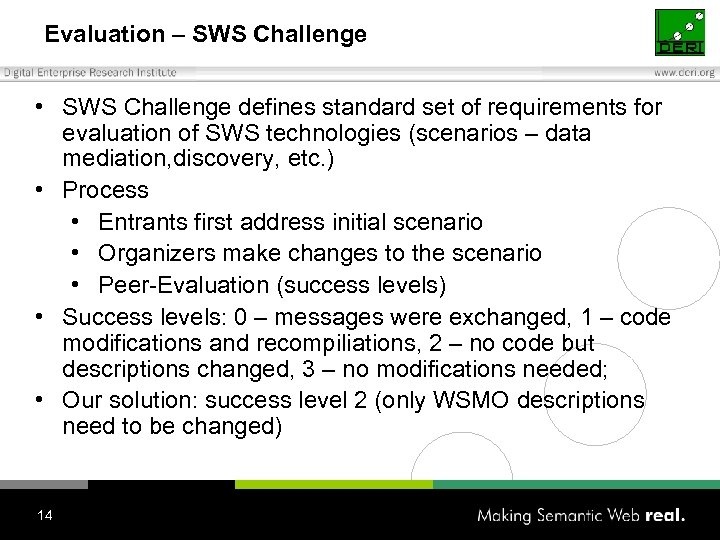 Evaluation – SWS Challenge • SWS Challenge defines standard set of requirements for evaluation of SWS technologies (scenarios – data mediation, discovery, etc. ) • Process • Entrants first address initial scenario • Organizers make changes to the scenario • Peer-Evaluation (success levels) • Success levels: 0 – messages were exchanged, 1 – code modifications and recompiliations, 2 – no code but descriptions changed, 3 – no modifications needed; • Our solution: success level 2 (only WSMO descriptions need to be changed) 14
 Future Work • Additional tasks build on the top – e. g. Contracting/negotation (definition of a concrete protocol on a data-fetch interface) • Scalability – the whole data-fetch interface needs to be procssed until the new data can be fetch or the match if found • Integration with data mediation 15
 Thanks! 16