 Скачать презентацию DYNAMIC PROGRAMMING Algorithmic Paradigms Greedy Build up
a3dfd0145ddf2a3b52817ad55709ef93.ppt
- Количество слайдов: 24



DYNAMIC PROGRAMMING

Algorithmic Paradigms Greedy. Build up a solution incrementally, myopically optimizing some local criterion. Divide-and-conquer. Break up a problem into two sub-problems, solve each sub-problem independently, and combine solution to sub-problems to form solution to original problem. Dynamic programming. Break up a problem into a series of overlapping sub-problems, and build up solutions to larger and larger sub-problems. 2
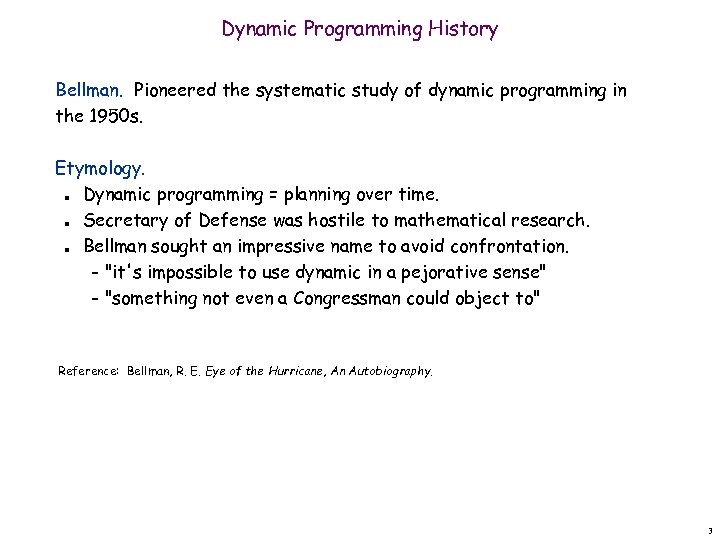
Dynamic Programming History Bellman. Pioneered the systematic study of dynamic programming in the 1950 s. Etymology. Dynamic programming = planning over time. Secretary of Defense was hostile to mathematical research. Bellman sought an impressive name to avoid confrontation. – "it's impossible to use dynamic in a pejorative sense" – "something not even a Congressman could object to" n n n Reference: Bellman, R. E. Eye of the Hurricane, An Autobiography. 3
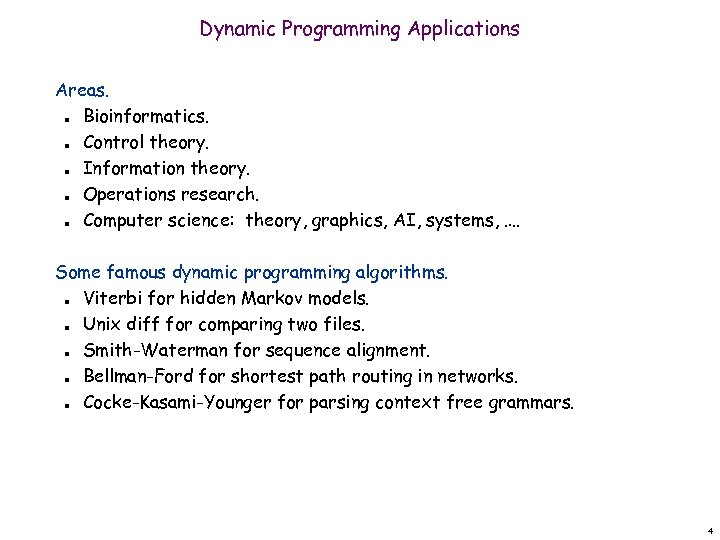
Dynamic Programming Applications Areas. Bioinformatics. Control theory. Information theory. Operations research. Computer science: theory, graphics, AI, systems, …. n n n Some famous dynamic programming algorithms. Viterbi for hidden Markov models. Unix diff for comparing two files. Smith-Waterman for sequence alignment. Bellman-Ford for shortest path routing in networks. Cocke-Kasami-Younger for parsing context free grammars. n n n 4
Sequence Alignment

String Similarity How similar are two strings? n ocurrance n occurrence o c u r r o c c u r a n c e - r e n c e 5 mismatches, 1 gap o c - u r o c c u r r a n c e r e n c e 1 mismatch, 1 gap o c - u r o c c u r r - r e a n c e - n c e 0 mismatches, 3 gaps 6
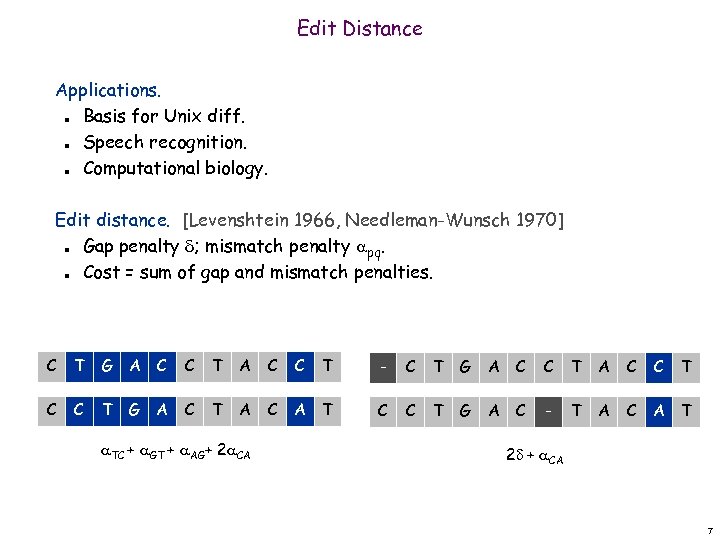
Edit Distance Applications. Basis for Unix diff. Speech recognition. Computational biology. n n n Edit distance. [Levenshtein 1966, Needleman-Wunsch 1970] Gap penalty ; mismatch penalty pq. Cost = sum of gap and mismatch penalties. n n C T G A C C T - C T G A C C T G A C T A C A T C C T G A C - T A C A T TC + GT + AG+ 2 CA 2 + CA 7
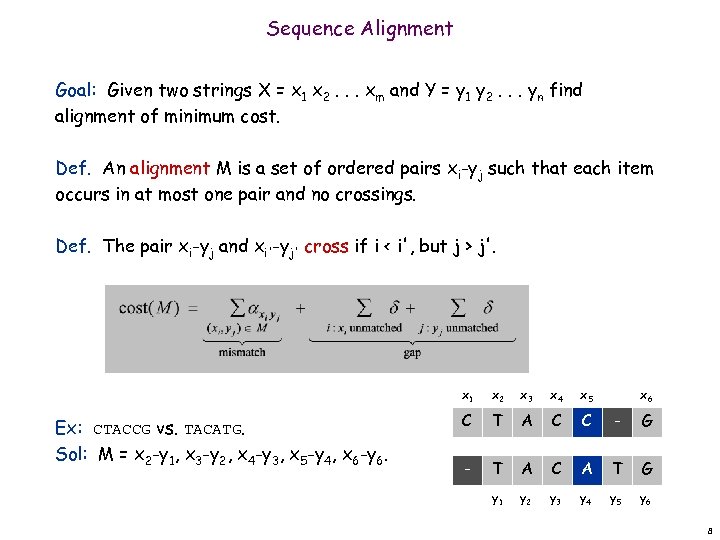
Sequence Alignment Goal: Given two strings X = x 1 x 2. . . xm and Y = y 1 y 2. . . yn find alignment of minimum cost. Def. An alignment M is a set of ordered pairs xi-yj such that each item occurs in at most one pair and no crossings. Def. The pair xi-yj and xi'-yj' cross if i < i', but j > j'. x 1 Ex: CTACCG vs. TACATG. Sol: M = x 2 -y 1, x 3 -y 2, x 4 -y 3, x 5 -y 4, x 6 -y 6. x 2 x 3 x 4 x 5 C T A C C - G - T A C A T G y 1 y 2 y 3 y 4 y 5 y 6 x 6 8
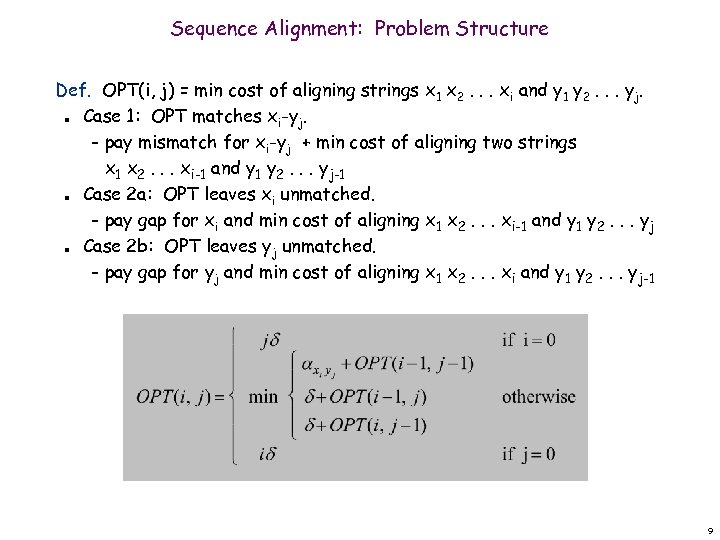
Sequence Alignment: Problem Structure Def. OPT(i, j) = min cost of aligning strings x 1 x 2. . . xi and y 1 y 2. . . yj. Case 1: OPT matches xi-yj. – pay mismatch for xi-yj + min cost of aligning two strings x 1 x 2. . . xi-1 and y 1 y 2. . . yj-1 Case 2 a: OPT leaves xi unmatched. – pay gap for xi and min cost of aligning x 1 x 2. . . xi-1 and y 1 y 2. . . yj Case 2 b: OPT leaves yj unmatched. – pay gap for yj and min cost of aligning x 1 x 2. . . xi and y 1 y 2. . . yj-1 n n n 9
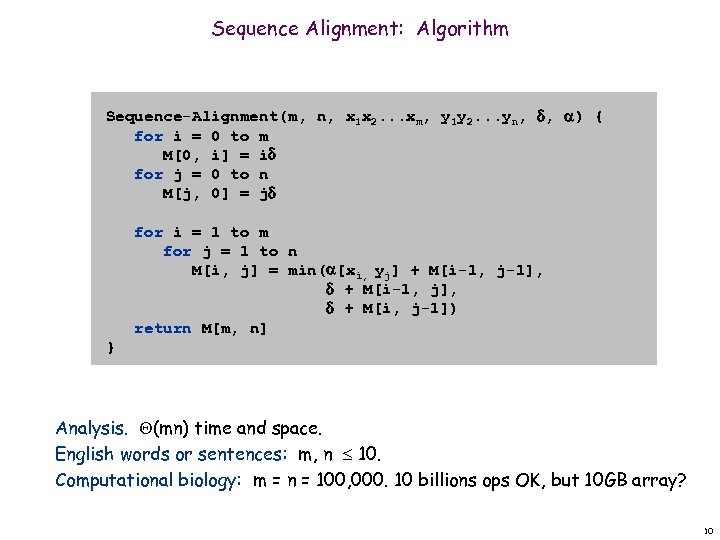
Sequence Alignment: Algorithm Sequence-Alignment(m, n, x 1 x 2. . . xm, y 1 y 2. . . yn, , ) { for i = 0 to m M[0, i] = i for j = 0 to n M[j, 0] = j for i = 1 to m for j = 1 to n M[i, j] = min( [xi, yj] + M[i-1, j-1], + M[i-1, j], + M[i, j-1]) return M[m, n] } Analysis. (mn) time and space. English words or sentences: m, n 10. Computational biology: m = n = 100, 000. 10 billions ops OK, but 10 GB array? 10

Shortest Paths
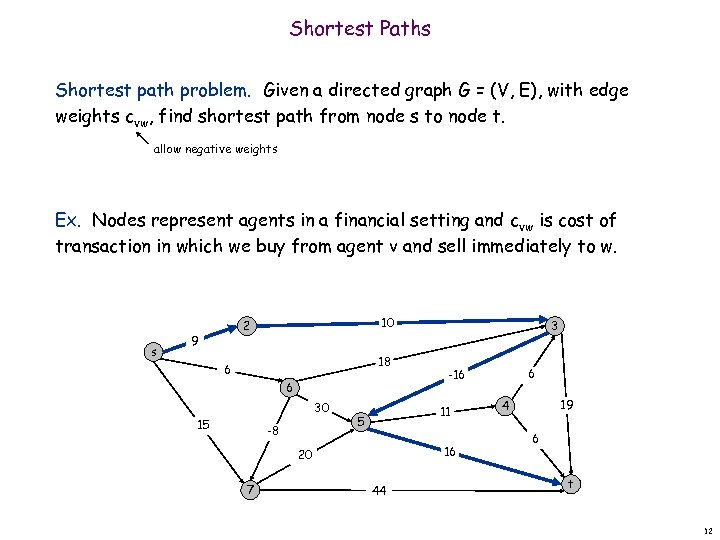
Shortest Paths Shortest path problem. Given a directed graph G = (V, E), with edge weights cvw, find shortest path from node s to node t. allow negative weights Ex. Nodes represent agents in a financial setting and cvw is cost of transaction in which we buy from agent v and sell immediately to w. s 10 2 9 18 6 6 30 15 -8 5 16 44 6 -16 11 20 7 3 19 4 6 t 12
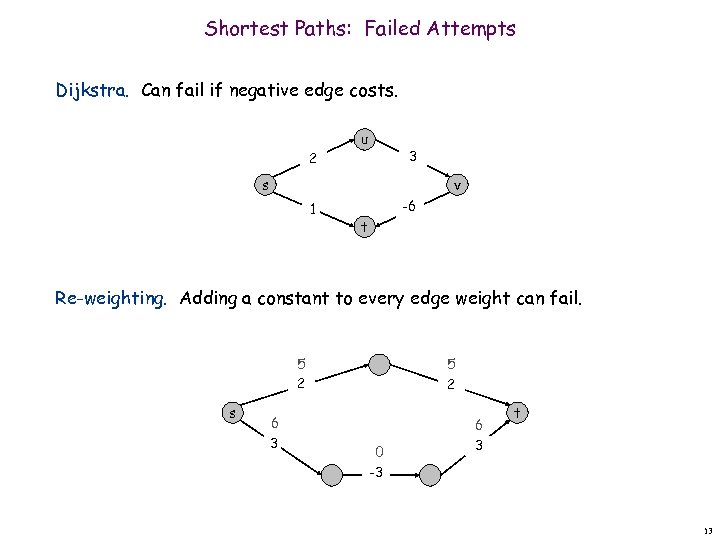
Shortest Paths: Failed Attempts Dijkstra. Can fail if negative edge costs. 2 u 3 s v 1 -6 t Re-weighting. Adding a constant to every edge weight can fail. 5 2 s 6 3 5 2 0 -3 6 3 t 13
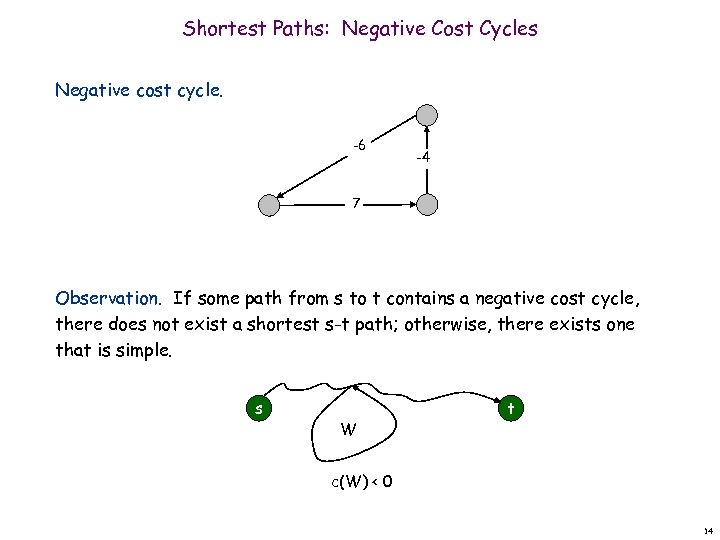
Shortest Paths: Negative Cost Cycles Negative cost cycle. -6 -4 7 Observation. If some path from s to t contains a negative cost cycle, there does not exist a shortest s-t path; otherwise, there exists one that is simple. s W t c(W) < 0 14

Shortest Paths: Dynamic Programming Def. OPT(i, v) = length of shortest v-t path P using at most i edges. n n Case 1: P uses at most i-1 edges. – OPT(i, v) = OPT(i-1, v) Case 2: P uses exactly i edges. – if (v, w) is first edge, then OPT uses (v, w), and then selects best w-t path using at most i-1 edges Remark. By previous observation, if no negative cycles, then OPT(n-1, v) = length of shortest v-t path. 15
![Shortest Paths: Implementation Shortest-Path(G, t) { foreach node v V M[0, v] M[0, t]](https://present5.com/presentation/a3dfd0145ddf2a3b52817ad55709ef93/image-16.jpg "Shortest Paths: Implementation Shortest-Path(G, t) { foreach node v V M[0, v] M[0, t]")
Shortest Paths: Implementation Shortest-Path(G, t) { foreach node v V M[0, v] M[0, t] 0 } for i = 1 to n-1 foreach node v V M[i, v] M[i-1, v] foreach edge (v, w) E M[i, v] min { M[i, v], M[i-1, w] + cvw } Analysis. (mn) time, (n 2) space. Finding the shortest paths. Maintain a "successor" for each table entry. 16
![Shortest Paths: Practical Improvements Practical improvements. Maintain only one array M[v] = shortest v-t](https://present5.com/presentation/a3dfd0145ddf2a3b52817ad55709ef93/image-17.jpg "Shortest Paths: Practical Improvements Practical improvements. Maintain only one array M[v] = shortest v-t")
Shortest Paths: Practical Improvements Practical improvements. Maintain only one array M[v] = shortest v-t path that we have found so far. No need to check edges of the form (v, w) unless M[w] changed in previous iteration. n n Theorem. Throughout the algorithm, M[v] is length of some v-t path, and after i rounds of updates, the value M[v] is no larger than the length of shortest v-t path using i edges. Overall impact. Memory: O(m + n). Running time: O(mn) worst case, but substantially faster in practice. n n 17
![Bellman-Ford: Efficient Implementation Push-Based-Shortest-Path(G, s, t) { foreach node v V { M[v] successor[v]](https://present5.com/presentation/a3dfd0145ddf2a3b52817ad55709ef93/image-18.jpg "Bellman-Ford: Efficient Implementation Push-Based-Shortest-Path(G, s, t) { foreach node v V { M[v] successor[v]")
Bellman-Ford: Efficient Implementation Push-Based-Shortest-Path(G, s, t) { foreach node v V { M[v] successor[v] } M[t] = 0 for i = 1 to n-1 { foreach node w V { if (M[w] has been updated in previous iteration) { foreach node v such that (v, w) E { if (M[v] > M[w] + cvw) { M[v] M[w] + cvw successor[v] w } } } If no M[w] value changed in iteration i, stop. } } 18

Segmented Least Squares
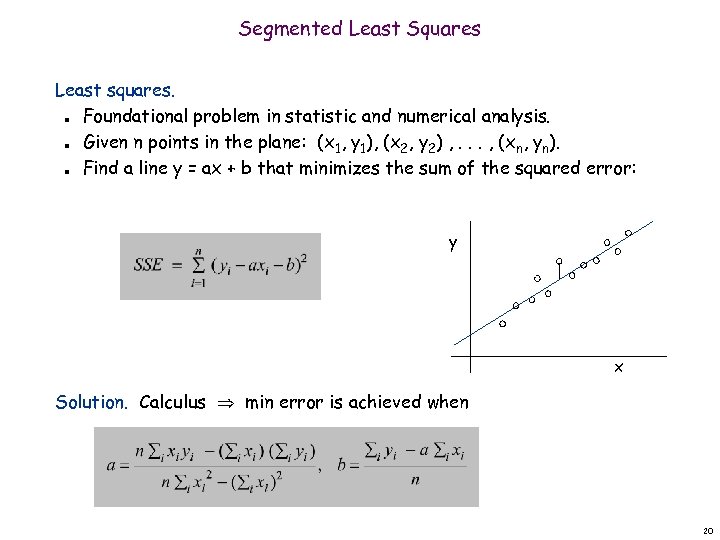
Segmented Least Squares Least squares. Foundational problem in statistic and numerical analysis. Given n points in the plane: (x 1, y 1), (x 2, y 2) , . . . , (xn, yn). Find a line y = ax + b that minimizes the sum of the squared error: n n n y x Solution. Calculus min error is achieved when 20
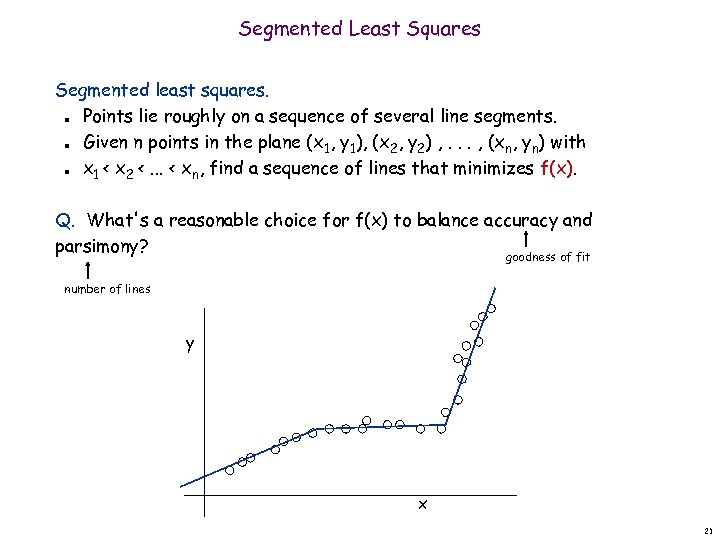
Segmented Least Squares Segmented least squares. Points lie roughly on a sequence of several line segments. Given n points in the plane (x 1, y 1), (x 2, y 2) , . . . , (xn, yn) with x 1 < x 2 <. . . < xn, find a sequence of lines that minimizes f(x). n n n Q. What's a reasonable choice for f(x) to balance accuracy and parsimony? goodness of fit number of lines y x 21

Segmented Least Squares Segmented least squares. Points lie roughly on a sequence of several line segments. Given n points in the plane (x 1, y 1), (x 2, y 2) , . . . , (xn, yn) with x 1 < x 2 <. . . < xn, find a sequence of lines that minimizes: – the sum of the sums of the squared errors E in each segment – the number of lines L Tradeoff function: E + c L, for some constant c > 0. n n y x 22
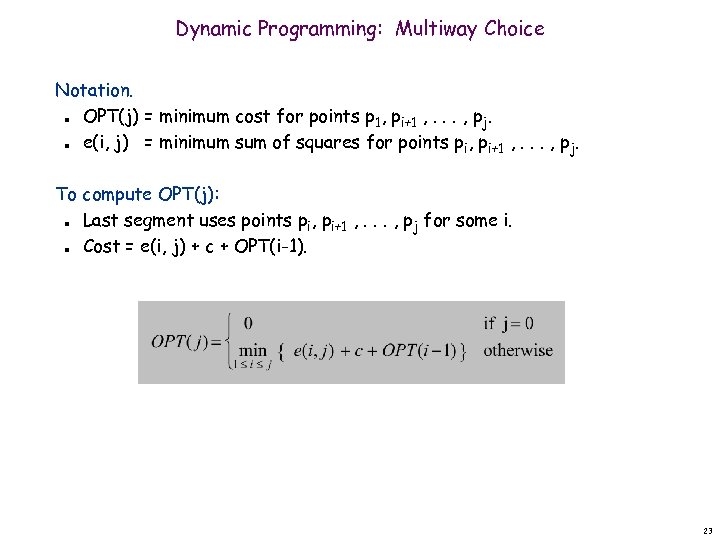
Dynamic Programming: Multiway Choice Notation. OPT(j) = minimum cost for points p 1, pi+1 , . . . , pj. e(i, j) = minimum sum of squares for points pi, pi+1 , . . . , pj. n n To compute OPT(j): Last segment uses points pi, pi+1 , . . . , pj for some i. Cost = e(i, j) + c + OPT(i-1). n n 23
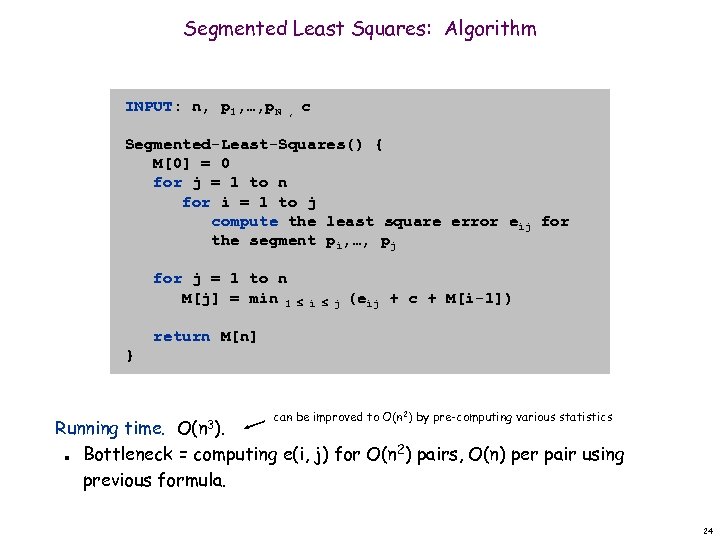
Segmented Least Squares: Algorithm INPUT: n, p 1, …, p. N , c Segmented-Least-Squares() { M[0] = 0 for j = 1 to n for i = 1 to j compute the least square error eij for the segment pi, …, pj for j = 1 to n M[j] = min 1 i j (eij + c + M[i-1]) return M[n] } O(n 3). can be improved to O(n 2) by pre-computing various statistics Running time. Bottleneck = computing e(i, j) for O(n 2) pairs, O(n) per pair using previous formula. n 24
Скачать презентацию DYNAMIC PROGRAMMING Algorithmic Paradigms Greedy Build up
a3dfd0145ddf2a3b52817ad55709ef93.ppt