


 Скачать презентацию Dynamic Planet 2005 August 22 -26 2005 Cairns
1d2adb8f64f9cc4538f75517c3eca0ae.ppt
- Количество слайдов: 1
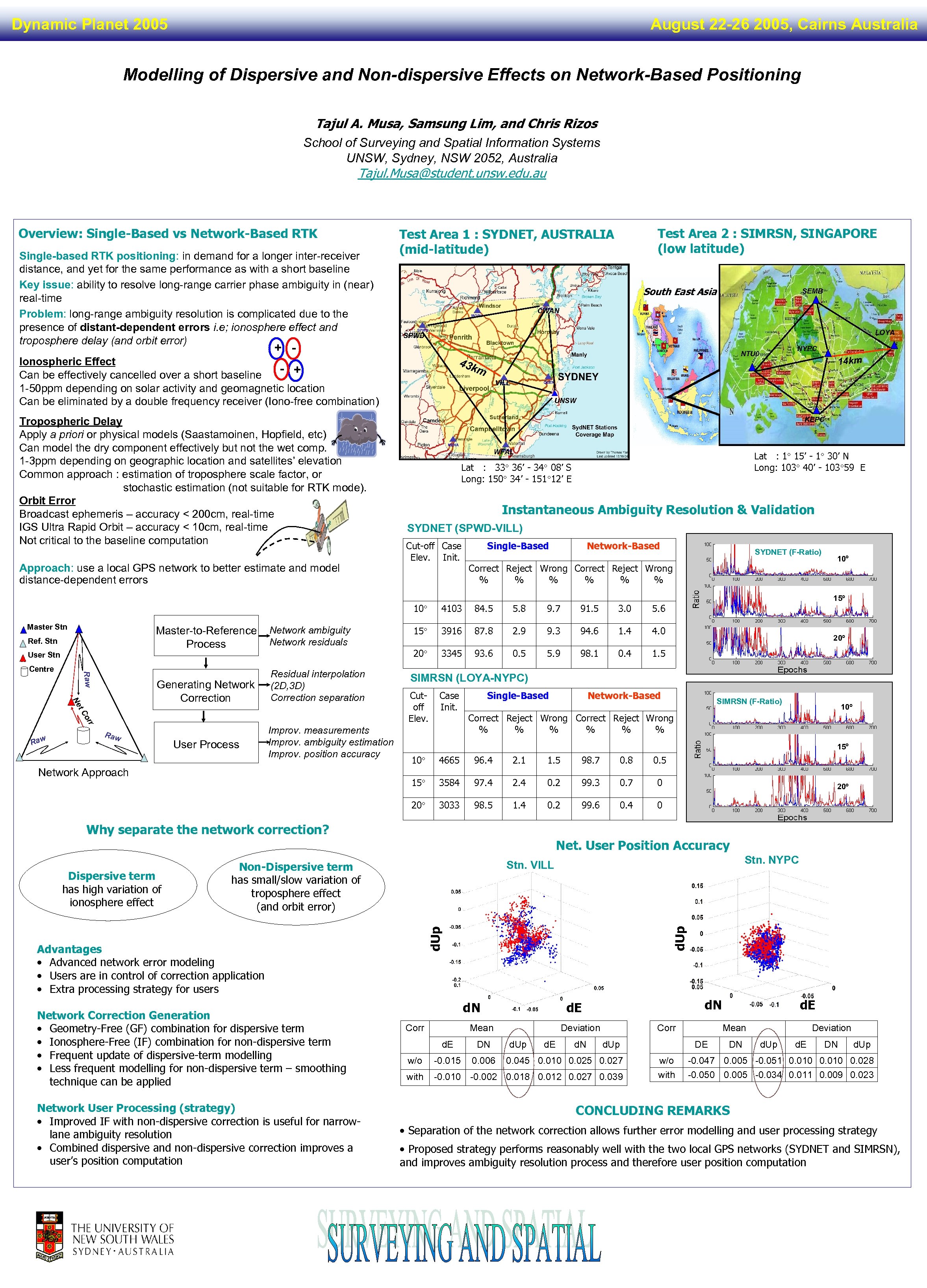 Dynamic Planet 2005 August 22 -26 2005, Cairns Australia Modelling of Dispersive and Non-dispersive Effects on Network-Based Positioning Tajul A. Musa, Samsung Lim, and Chris Rizos School of Surveying and Spatial Information Systems UNSW, Sydney, NSW 2052, Australia Tajul. Musa@student. unsw. edu. au Overview: Single-Based vs Network-Based RTK Single-based RTK positioning: in demand for a longer inter-receiver distance, and yet for the same performance as with a short baseline Key issue: ability to resolve long-range carrier phase ambiguity in (near) real-time Problem: long-range ambiguity resolution is complicated due to the presence of distant-dependent errors i. e; ionosphere effect and troposphere delay (and orbit error) Test Area 2 : SIMRSN, SINGAPORE (low latitude) Test Area 1 : SYDNET, AUSTRALIA (mid-latitude) South East Asia SEMB CWAN SINGAPORE LOYA SPWD + - Ionospheric Effect - + Can be effectively cancelled over a short baseline 1 -50 ppm depending on solar activity and geomagnetic location Can be eliminated by a double frequency receiver (Iono-free combination) Tropospheric Delay Apply a priori or physical models (Saastamoinen, Hopfield, etc) Can model the dry component effectively but not the wet comp. 1 -3 ppm depending on geographic location and satellites’ elevation Common approach : estimation of troposphere scale factor, or stochastic estimation (not suitable for RTK mode). Orbit Error Broadcast ephemeris – accuracy < 200 cm, real-time IGS Ultra Rapid Orbit – accuracy < 10 cm, real-time Not critical to the baseline computation Approach: use a local GPS network to better estimate and model distance-dependent errors NTU 0 43 k Master-to-Reference Process Generating Network Correction Ref. Stn Network ambiguity Network residuals Residual interpolation (2 D, 3 D) Correction separation User Stn Raw Centre t Ne r r Co Raw User Process Improv. measurements Improv. ambiguity estimation Improv. position accuracy VILL UNSW KEPC WFAL Lat : 1 15’ - 1 30’ N Long: 103 40’ - 103 59 E Lat : 33 36’ - 34 08’ S Long: 150 34’ - 151 12’ E Instantaneous Ambiguity Resolution & Validation SYDNET (SPWD-VILL) Cut-off Case Elev. Init. Single-Based Network-Based SYDNET (F-Ratio) Correct Reject Wrong % % % 4103 84. 5 5. 8 9. 7 91. 5 3. 0 15 3916 87. 8 2. 9 9. 3 94. 6 1. 4 4. 0 20 3345 93. 6 0. 5 5. 9 98. 1 0. 4 10 15 5. 6 1. 5 20 SIMRSN (LOYA-NYPC) Cutoff Elev. Case Init. Single-Based Network-Based SIMRSN (F-Ratio) 10 Correct Reject Wrong % % % 15 10 4665 96. 4 2. 1 1. 5 98. 7 0. 8 0. 5 15 3584 97. 4 2. 4 0. 2 99. 3 0. 7 0 20 Network Approach 14 km m 10 Master Stn NYPC 3033 98. 5 1. 4 0. 2 99. 6 0. 4 0 20 Why separate the network correction? Net. User Position Accuracy Stn. VILL Advantages • Advanced network error modeling • Users are in control of correction application • Extra processing strategy for users Network Correction Generation • Geometry-Free (GF) combination for dispersive term • Ionosphere-Free (IF) combination for non-dispersive term • Frequent update of dispersive-term modelling • Less frequent modelling for non-dispersive term – smoothing technique can be applied Network User Processing (strategy) • Improved IF with non-dispersive correction is useful for narrowlane ambiguity resolution • Combined dispersive and non-dispersive correction improves a user’s position computation d. Up Non-Dispersive term has small/slow variation of troposphere effect (and orbit error) d. Up Dispersive term has high variation of ionosphere effect Stn. NYPC d. N Corr d. N d. E Mean Deviation d. Up d. E d. N Corr d. E DN d. Up w/o -0. 015 0. 006 with -0. 010 -0. 002 0. 018 0. 012 0. 027 0. 039 0. 045 0. 010 0. 025 0. 027 Mean DE w/o with d. E DN Deviation d. Up d. E DN d. Up -0. 047 0. 005 -0. 051 0. 010 0. 028 -0. 050 0. 005 -0. 034 0. 011 0. 009 0. 023 CONCLUDING REMARKS • Separation of the network correction allows further error modelling and user processing strategy • Proposed strategy performs reasonably well with the two local GPS networks (SYDNET and SIMRSN), and improves ambiguity resolution process and therefore user position computation