 Скачать презентацию Dynamic Networks Presented to IDLS 2003 30 September
44da80e4ab576fc4aa35529ab9d0da6d.ppt
- Количество слайдов: 31



Dynamic Networks Presented to IDLS 2003 30 September 2003 Kelly Sobon SSC-SD 24502 kelly. sobon@navy. mil (619) 524 -7741
Agenda • Why Dynamic Network Management • Link 16 Dynamic Network Management Program – Network Controller Technology • Joint Interface Control Officer (JICO) Support System (JSS) – Time Slot Reallocation – Stochastic Unified Multiple Access (SHUMA) Protocol • Future Initiatives – Dynamic Network Controller – Dynamic Multi-netting • Summary 2
Why Dynamic Network Management
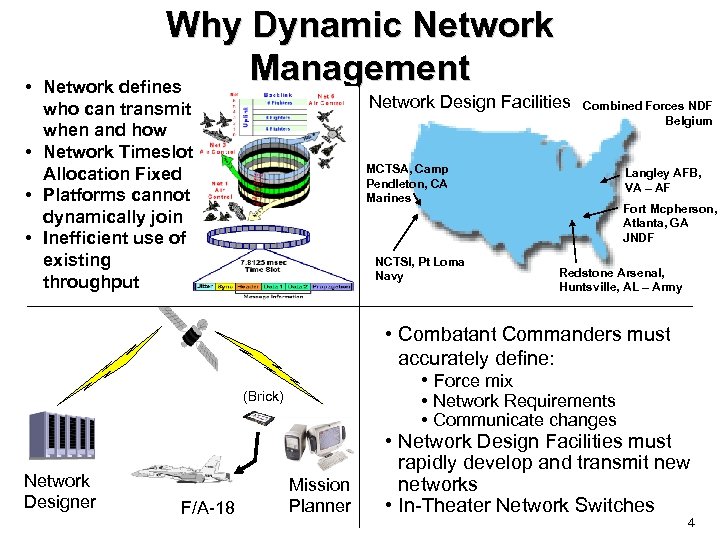
• Why Dynamic Network Management Network defines Network Design Facilities who can transmit when and how • Network Timeslot Allocation Fixed • Platforms cannot dynamically join • Inefficient use of existing throughput MCTSA, Camp Pendleton, CA Marines NCTSI, Pt Loma Navy F/A-18 Langley AFB, VA – AF Fort Mcpherson, Atlanta, GA JNDF Redstone Arsenal, Huntsville, AL – Army • Combatant Commanders must accurately define: • Force mix (Brick) Network Designer Combined Forces NDF Belgium • Network Requirements • Communicate changes Mission Planner • Network Design Facilities must rapidly develop and transmit new networks • In-Theater Network Switches 4
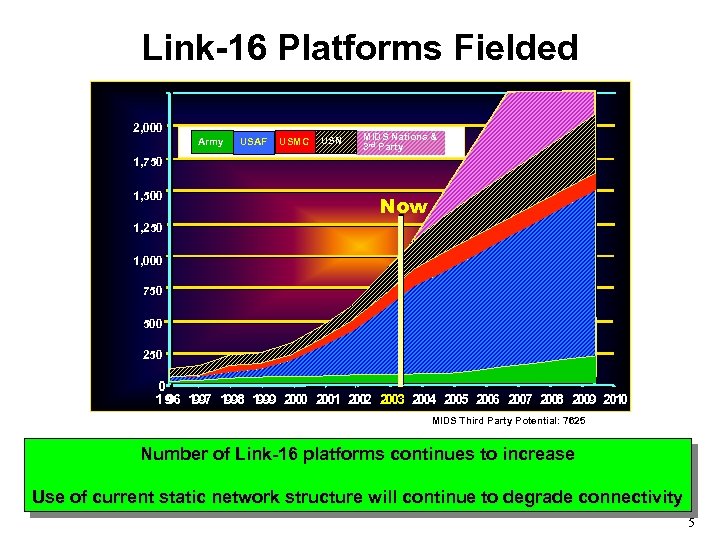
Link-16 Platforms Fielded 2, 000 Army USAF USMC USN MIDS Nations & 3 rd Party 1, 750 1, 500 Now 1, 250 1, 000 750 500 250 0 1 9 1997 1998 1999 2000 2001 2002 2003 2004 2005 2006 2007 2008 2009 2010 96 MIDS Third Party Potential: 7625 Number of Link-16 platforms continues to increase Use of current static network structure will continue to degrade connectivity 5
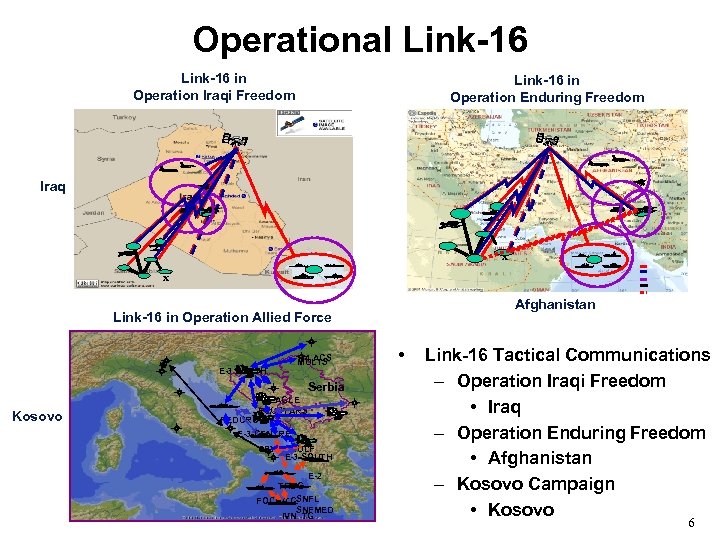
Operational Link-16 in Operation Iraqi Freedom Link-16 in Operation Enduring Freedom Iraq X X Afghanistan Link-16 in Operation Allied Force 74 ACS MULTS E-3 NORTH Serbia Kosovo TF EAGLE RJ/JSTARS REDCROWN E-3 CENTRE LEYTE GULF E-3 SOUTH TRBG E-2 FOCH TGSNFL SNFMED IVN TG • Link-16 Tactical Communications – Operation Iraqi Freedom • Iraq – Operation Enduring Freedom • Afghanistan – Kosovo Campaign • Kosovo 6
Link 16 Dynamic Network Management Program
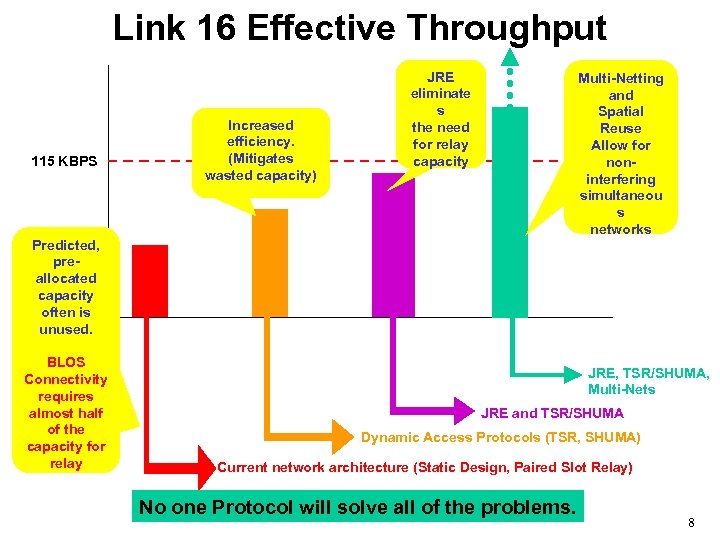
Link 16 Effective Throughput 115 KBPS Increased efficiency. (Mitigates wasted capacity) JRE eliminate s the need for relay capacity Multi-Netting and Spatial Reuse Allow for noninterfering simultaneou s networks Predicted, preallocated capacity often is unused. BLOS Connectivity requires almost half of the capacity for relay JRE, TSR/SHUMA, Multi-Nets JRE and TSR/SHUMA Dynamic Access Protocols (TSR, SHUMA) Current network architecture (Static Design, Paired Slot Relay) No one Protocol will solve all of the problems. 8
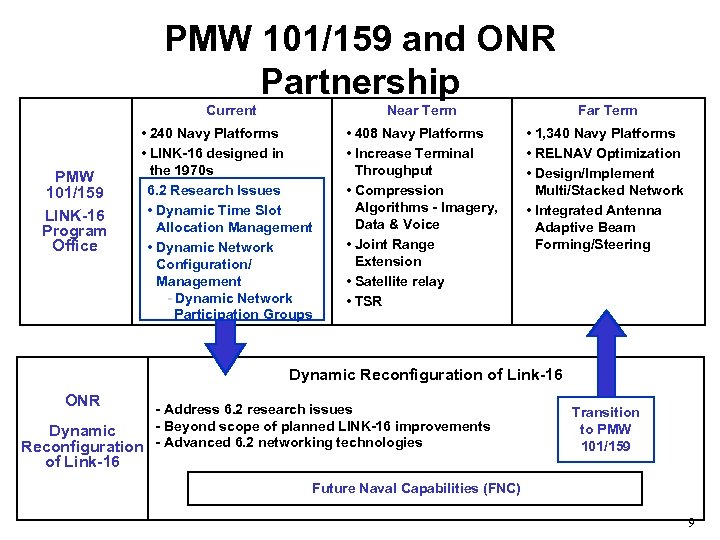
PMW 101/159 and ONR Partnership Current PMW 101/159 LINK-16 Program Office Near Term • 240 Navy Platforms • LINK-16 designed in the 1970 s 6. 2 Research Issues • Dynamic Time Slot Allocation Management • Dynamic Network Configuration/ Management - Dynamic Network Participation Groups Far Term • 408 Navy Platforms • Increase Terminal Throughput • Compression Algorithms - Imagery, Data & Voice • Joint Range Extension • Satellite relay • TSR • 1, 340 Navy Platforms • RELNAV Optimization • Design/Implement Multi/Stacked Network • Integrated Antenna Adaptive Beam Forming/Steering Dynamic Reconfiguration of Link-16 ONR - Address 6. 2 research issues - Beyond scope of planned LINK-16 improvements Dynamic Reconfiguration - Advanced 6. 2 networking technologies of Link-16 Transition to PMW 101/159 Future Naval Capabilities (FNC) 9
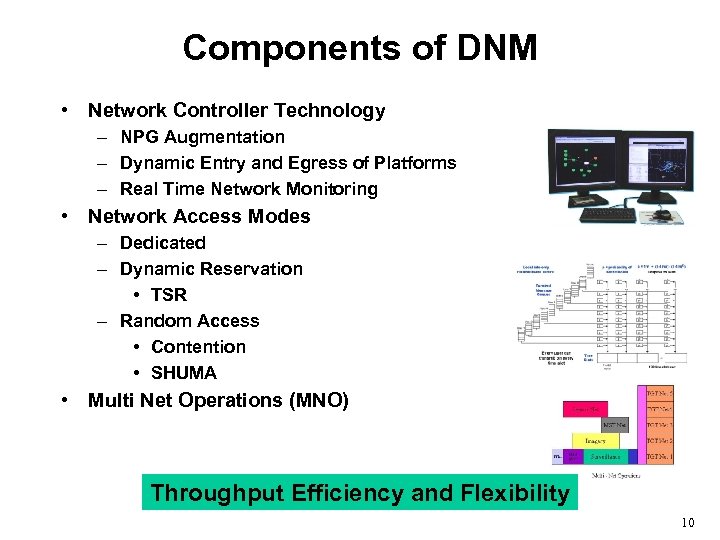
Components of DNM • Network Controller Technology – NPG Augmentation – Dynamic Entry and Egress of Platforms – Real Time Network Monitoring • Network Access Modes – Dedicated – Dynamic Reservation • TSR – Random Access • Contention • SHUMA • Multi Net Operations (MNO) Throughput Efficiency and Flexibility 10
Link 16 Dynamic Network Management Network Controller Technology
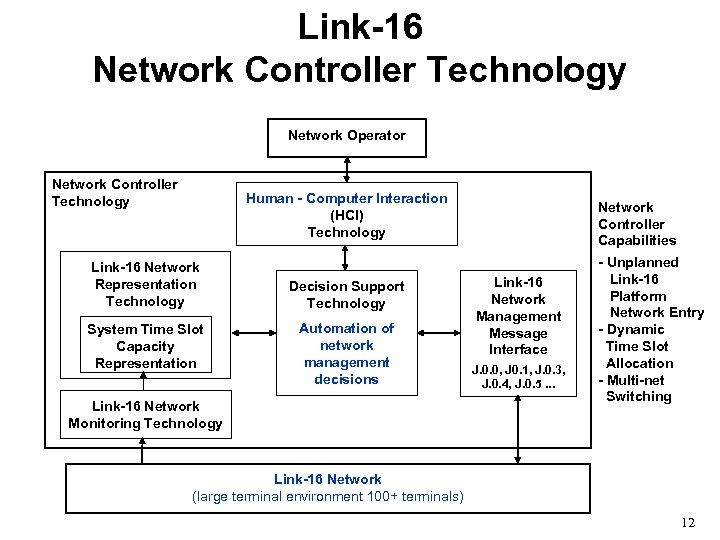
Link-16 Network Controller Technology Network Operator Network Controller Technology Human - Computer Interaction (HCI) Technology Link-16 Network Representation Technology System Time Slot Capacity Representation Decision Support Technology Automation of network management decisions Link-16 Network Monitoring Technology Network Controller Capabilities Link-16 Network Management Message Interface J. 0. 0, J 0. 1, J. 0. 3, J. 0. 4, J. 0. 5. . . - Unplanned Link-16 Platform Network Entry - Dynamic Time Slot Allocation - Multi-net Switching Link-16 Network (large terminal environment 100+ terminals) 12
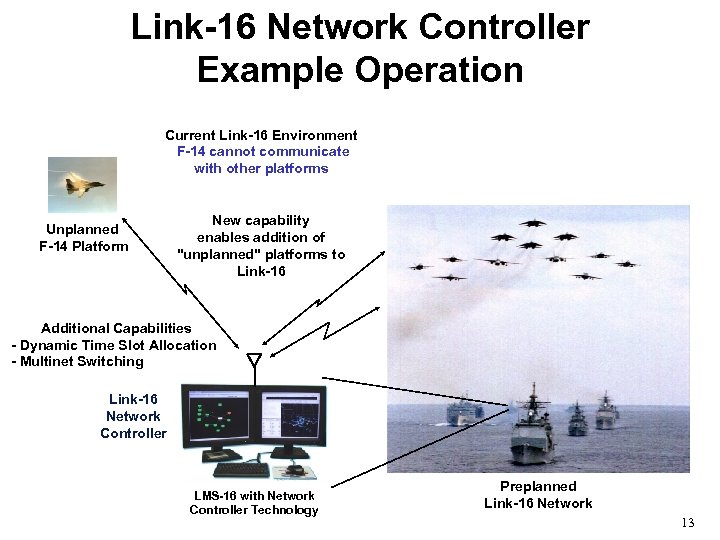
Link-16 Network Controller Example Operation Current Link-16 Environment F-14 cannot communicate with other platforms Unplanned F-14 Platform New capability enables addition of "unplanned" platforms to Link-16 Additional Capabilities - Dynamic Time Slot Allocation - Multinet Switching Link-16 Network Controller LMS-16 with Network Controller Technology Preplanned Link-16 Network 13
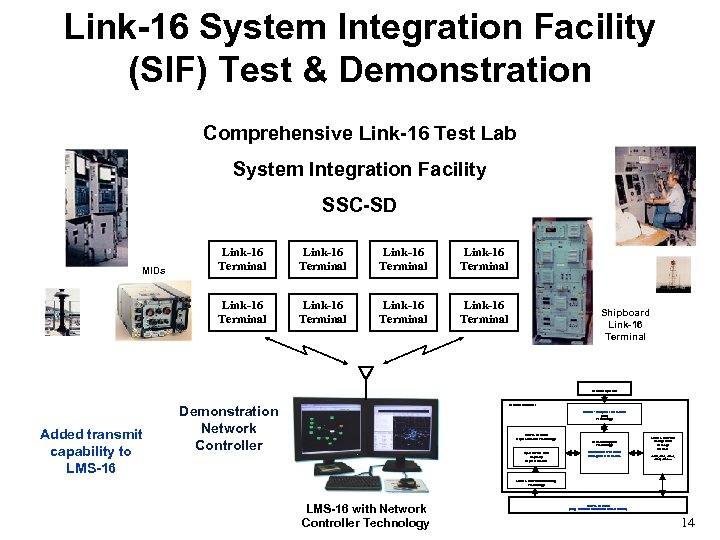
Link-16 System Integration Facility (SIF) Test & Demonstration Comprehensive Link-16 Test Lab System Integration Facility SSC-SD Link-16 Terminal MIDs Link-16 Terminal Shipboard Link-16 Terminal Network Operator Added transmit capability to LMS-16 Network Controller Demonstration Network Controller Human - Computer Interaction (HCI) Technology Link-16 Network Representation Technology System Time Slot Capacity Representation Decision Support Technology Automation of network management decisions Link-16 Network Management Message Interface J. 0. 0, J 0. 1, J. 0. 3, J. 0. 4, J. 0. 5. . . Link-16 Network Monitoring Technology LMS-16 with Network Controller Technology Link-16 Network (large terminal environment 100+ terminals) 14
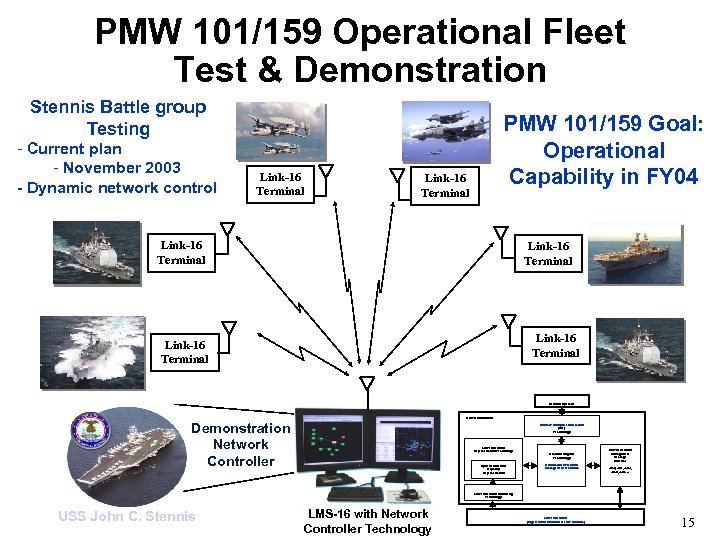
PMW 101/159 Operational Fleet Test & Demonstration Stennis Battle group Testing - Current plan - November 2003 - Dynamic network control Link-16 Terminal PMW 101/159 Goal: Operational Capability in FY 04 Link-16 Terminal Link-16 Terminal Network Operator Network Controller Demonstration Network Controller Human - Computer Interaction (HCI) Technology Link-16 Network Representation Technology System Time Slot Capacity Representation Decision Support Technology Automation of network management decisions Link-16 Network Management Message Interface J. 0. 0, J 0. 1, J. 0. 3, J. 0. 4, J. 0. 5. . . Link-16 Network Monitoring Technology USS John C. Stennis LMS-16 with Network Controller Technology Link-16 Network (large terminal environment 100+ terminals) 15
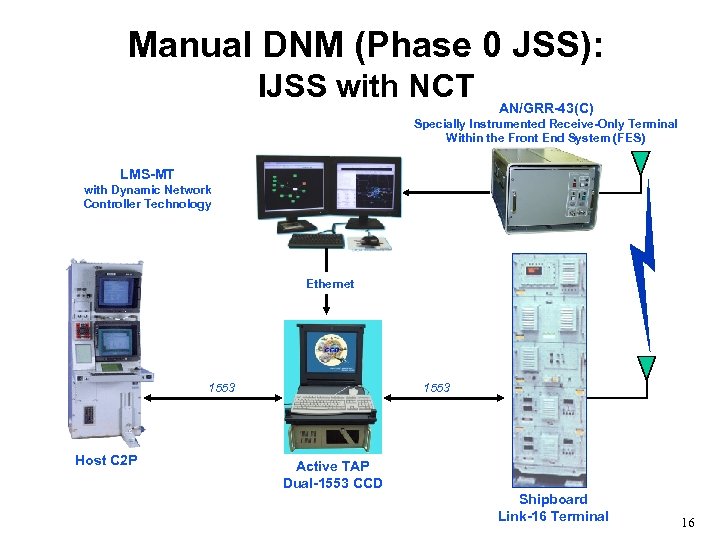
Manual DNM (Phase 0 JSS): IJSS with NCT AN/GRR-43(C) Specially Instrumented Receive-Only Terminal Within the Front End System (FES) LMS-MT with Dynamic Network Controller Technology Ethernet 1553 Host C 2 P 1553 Active TAP Dual-1553 CCD Shipboard Link-16 Terminal 16
Link 16 Dynamic Network Management Time Slot Reallocation
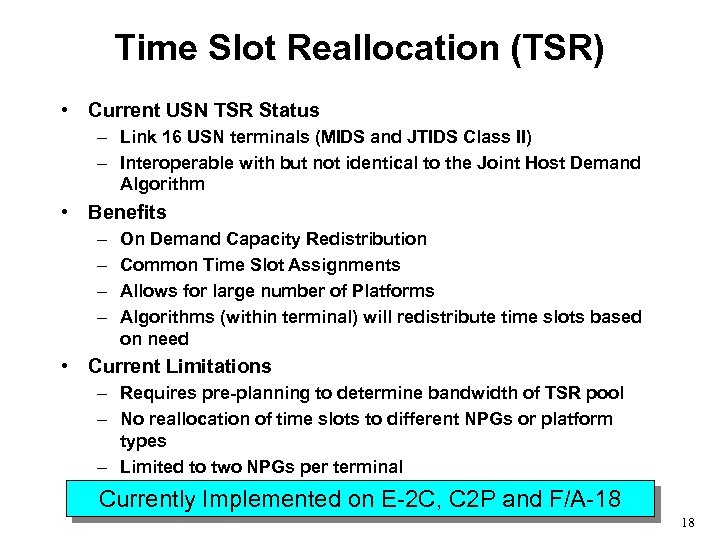
Time Slot Reallocation (TSR) • Current USN TSR Status – Link 16 USN terminals (MIDS and JTIDS Class II) – Interoperable with but not identical to the Joint Host Demand Algorithm • Benefits – – On Demand Capacity Redistribution Common Time Slot Assignments Allows for large number of Platforms Algorithms (within terminal) will redistribute time slots based on need • Current Limitations – Requires pre-planning to determine bandwidth of TSR pool – No reallocation of time slots to different NPGs or platform types – Limited to two NPGs per terminal Currently Implemented on E-2 C, C 2 P and F/A-18 18
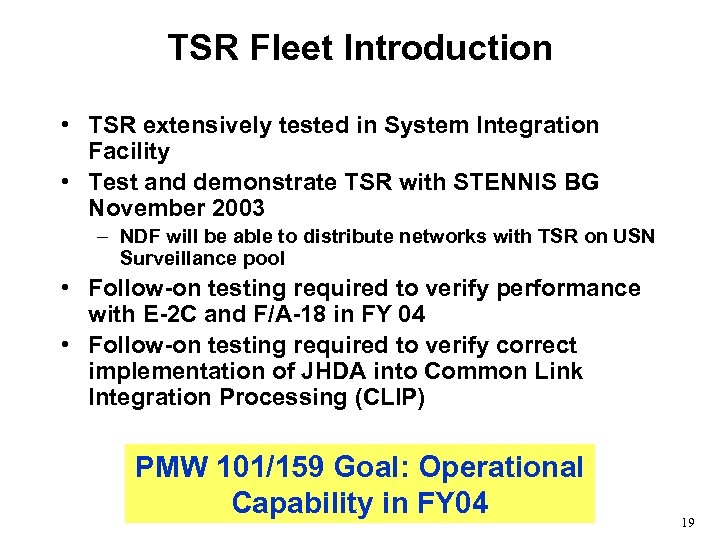
TSR Fleet Introduction • TSR extensively tested in System Integration Facility • Test and demonstrate TSR with STENNIS BG November 2003 – NDF will be able to distribute networks with TSR on USN Surveillance pool • Follow-on testing required to verify performance with E-2 C and F/A-18 in FY 04 • Follow-on testing required to verify correct implementation of JHDA into Common Link Integration Processing (CLIP) PMW 101/159 Goal: Operational Capability in FY 04 19
Link 16 Dynamic Network Management Stochastic Unified Multiple Access (SHUMA) Protocol
Stochastic Unified Multiple Access (SHUMA) • New Network Protocol Algorithm • ONR Funded through FY 04 • Expected to provide benefits across various NPGs – Effort underway to identify targeted applications – Compare to Dedicated, Contention Access, and TSR • Primarily Lab effort through FY 04 • Host impact study to determine scope of any changes required 21
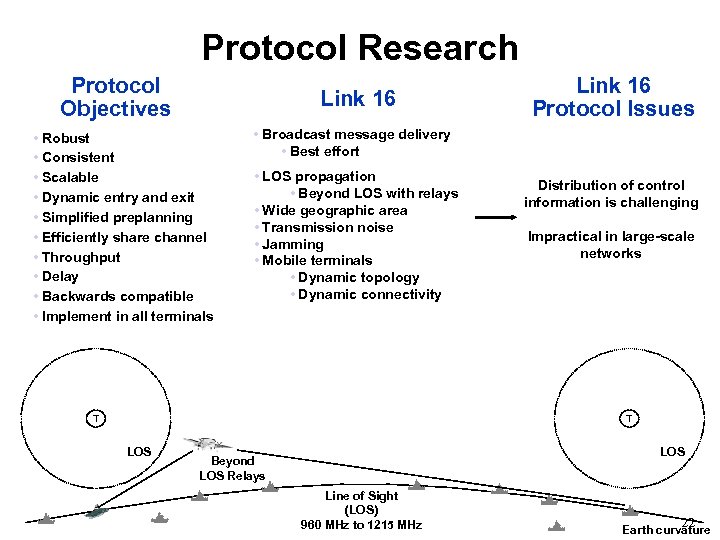
Protocol Research Protocol Objectives Link 16 • Robust • Consistent • Scalable • Dynamic entry and exit • Simplified preplanning • Efficiently share channel • Throughput • Delay • Backwards compatible • Implement in all terminals Link 16 Protocol Issues • Broadcast message delivery • Best effort • LOS propagation • Beyond LOS with relays • Wide geographic area • Transmission noise • Jamming • Mobile terminals • Dynamic topology • Dynamic connectivity T Distribution of control information is challenging Impractical in large-scale networks T LOS Beyond LOS Relays Line of Sight (LOS) 960 MHz to 1215 MHz 22 Earth curvature
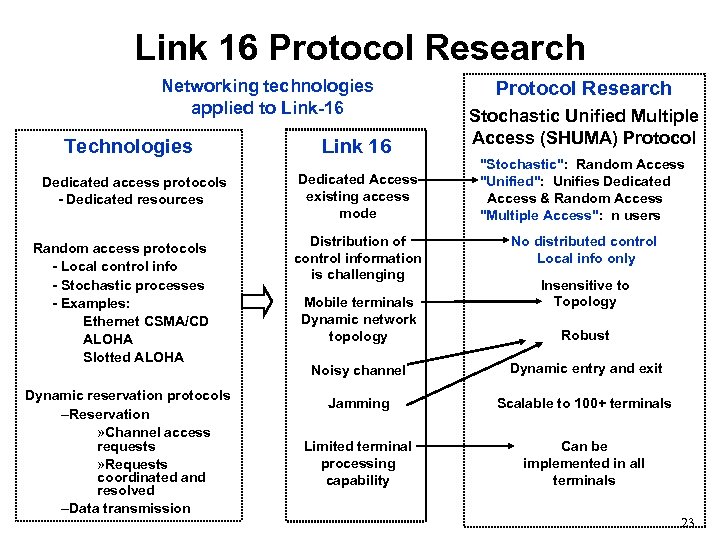
Link 16 Protocol Research Networking technologies applied to Link-16 Technologies Dedicated access protocols - Dedicated resources Random access protocols - Local control info - Stochastic processes - Examples: Ethernet CSMA/CD ALOHA Slotted ALOHA Dynamic reservation protocols –Reservation » Channel access requests » Requests coordinated and resolved –Data transmission Link 16 Dedicated Access existing access mode Distribution of control information is challenging Mobile terminals Dynamic network topology Protocol Research Stochastic Unified Multiple Access (SHUMA) Protocol "Stochastic": Random Access "Unified": Unifies Dedicated Access & Random Access "Multiple Access": n users No distributed control Local info only Insensitive to Topology Robust Noisy channel Dynamic entry and exit Jamming Scalable to 100+ terminals Limited terminal processing capability Can be implemented in all terminals 23
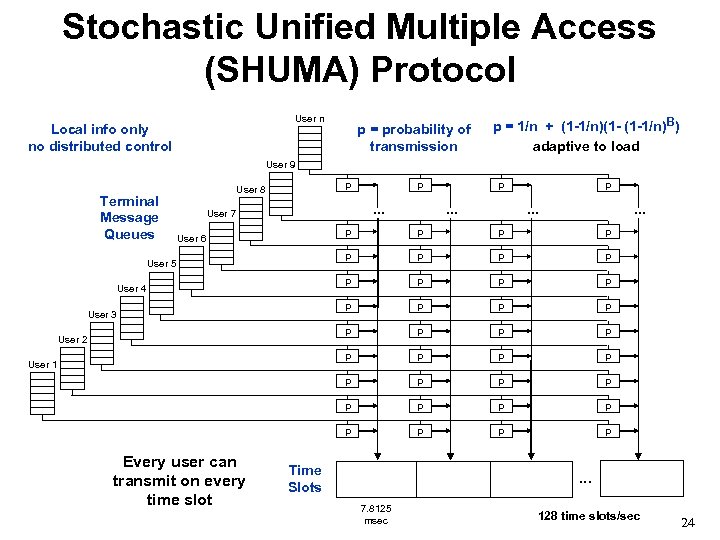
Stochastic Unified Multiple Access (SHUMA) Protocol User n Local info only no distributed control p = probability of transmission p = 1/n + (1 -1/n)(1 - (1 -1/n)B) adaptive to load User 9 Terminal Message Queues p User 8 p . . . User 7 p . . . p p p p p p Every user can transmit on every time slot p p User 1 p p User 2 p p User 3 p p User 4 p p User 5 p p User 6 p p p Time Slots . . . 7. 8125 msec 128 time slots/sec 24
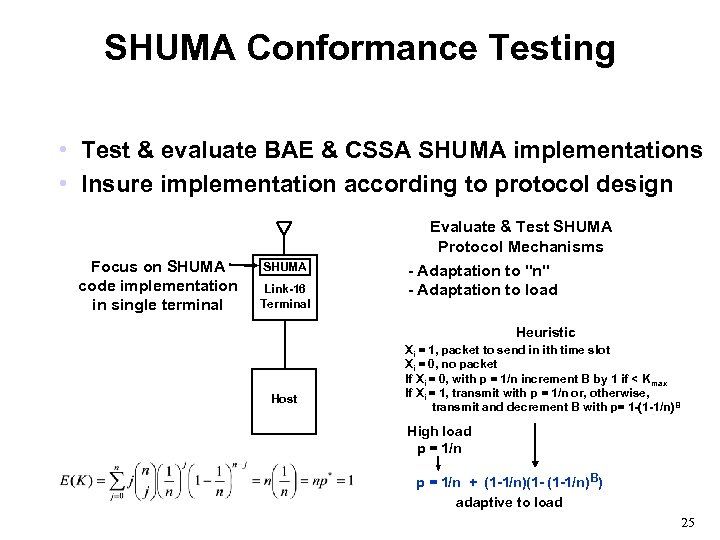
SHUMA Conformance Testing • Test & evaluate BAE & CSSA SHUMA implementations • Insure implementation according to protocol design Focus on SHUMA code implementation in single terminal SHUMA Link-16 Terminal Evaluate & Test SHUMA Protocol Mechanisms - Adaptation to "n" - Adaptation to load Heuristic Host Xi = 1, packet to send in ith time slot Xi = 0, no packet If Xi = 0, with p = 1/n increment B by 1 if < K max If Xi = 1, transmit with p = 1/n or, otherwise, transmit and decrement B with p= 1 -(1 -1/n) B High load p = 1/n + (1 -1/n)(1 - (1 -1/n)B) adaptive to load 25
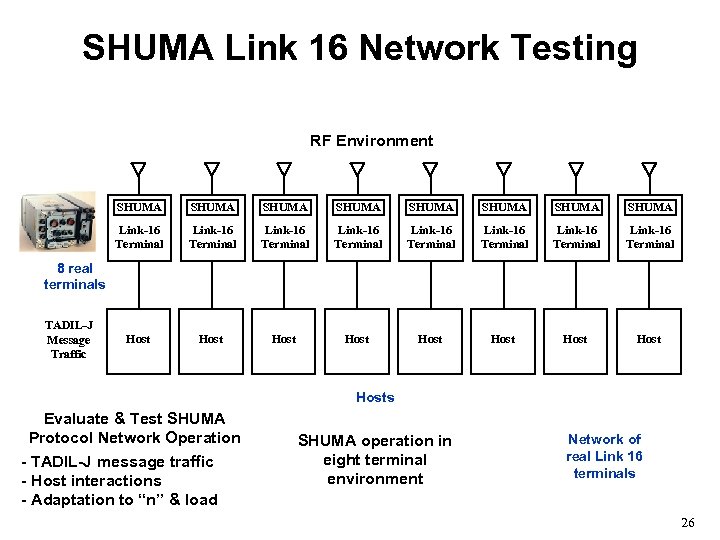
SHUMA Link 16 Network Testing RF Environment SHUMA SHUMA Link-16 Terminal Link-16 Terminal Host Host 8 real terminals TADIL-J Message Traffic Hosts Evaluate & Test SHUMA Protocol Network Operation - TADIL-J message traffic - Host interactions - Adaptation to “n” & load SHUMA operation in eight terminal environment Network of real Link 16 terminals 26
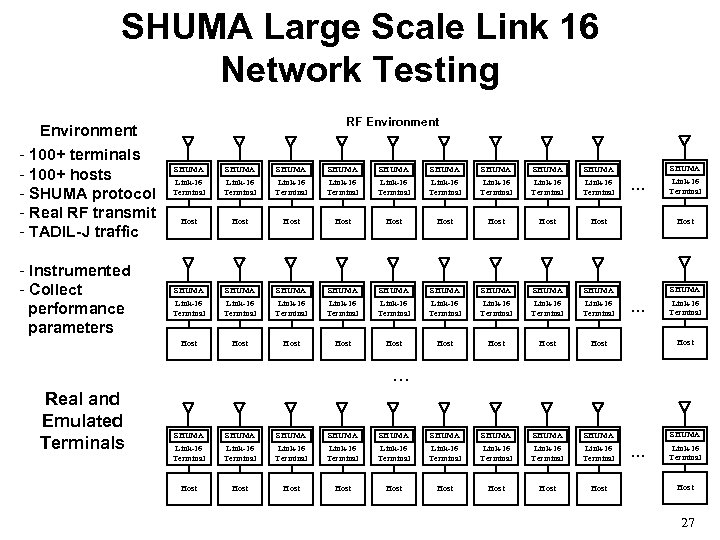
SHUMA Large Scale Link 16 Network Testing RF Environment - 100+ terminals - 100+ hosts - SHUMA protocol - Real RF transmit - TADIL-J traffic SHUMA SHUMA SHUMA Link-16 Terminal Link-16 Terminal Link-16 Terminal Host Host Host SHUMA SHUMA SHUMA Link-16 Terminal Link-16 Terminal Link-16 Terminal Host - Instrumented - Collect performance parameters SHUMA Host Host Host SHUMA … … Link-16 Terminal … Real and Emulated Terminals SHUMA SHUMA SHUMA Link-16 Terminal Link-16 Terminal Link-16 Terminal Host Host Host … Link-16 Terminal Host 27
Link 16 Dynamic Network Management Future Initiatives
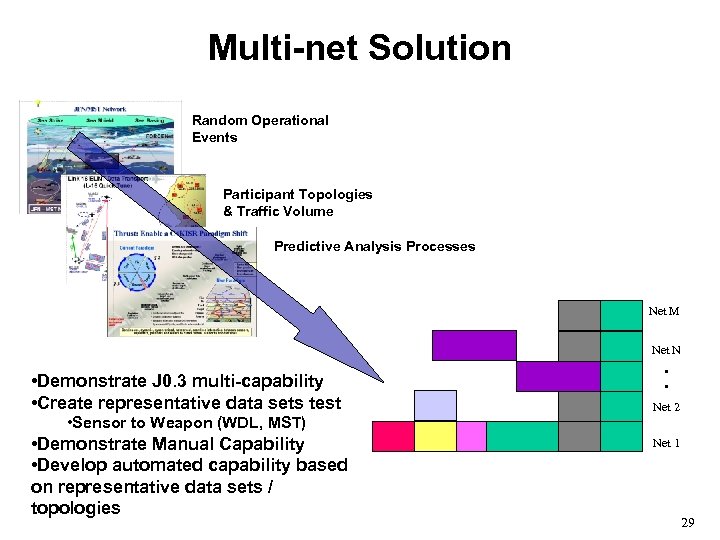
Multi-net Solution Random Operational Events Participant Topologies & Traffic Volume Predictive Analysis Processes Net M Net N • Demonstrate J 0. 3 multi-capability • Create representative data sets test • Sensor to Weapon (WDL, MST) • Demonstrate Manual Capability • Develop automated capability based on representative data sets / topologies • • Net 2 Net 1 29
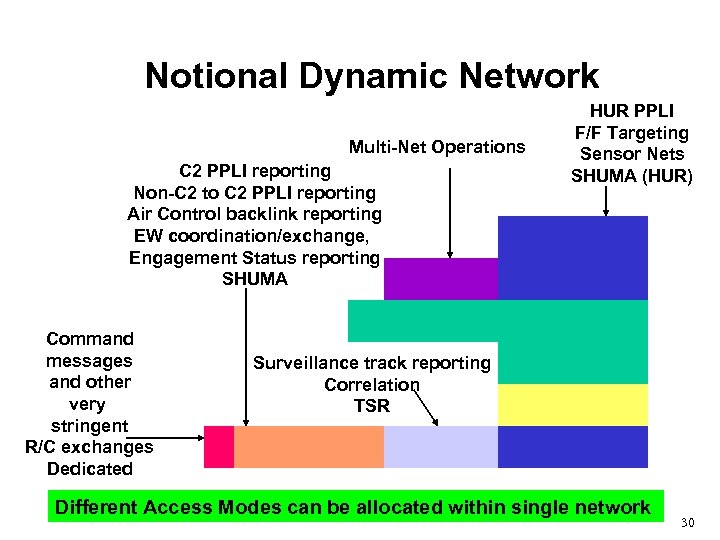
Notional Dynamic Network Multi-Net Operations C 2 PPLI reporting Non-C 2 to C 2 PPLI reporting Air Control backlink reporting EW coordination/exchange, Engagement Status reporting SHUMA Command messages and other very stringent R/C exchanges Dedicated HUR PPLI F/F Targeting Sensor Nets SHUMA (HUR) Surveillance track reporting Correlation TSR Different Access Modes can be allocated within single network 30
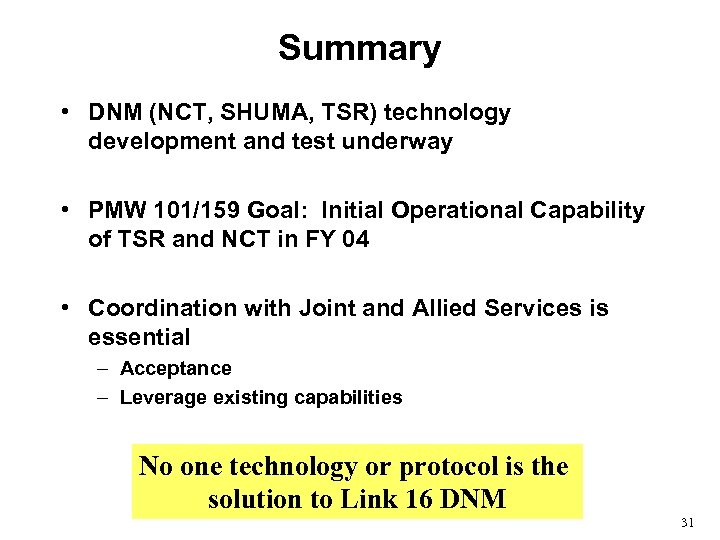
Summary • DNM (NCT, SHUMA, TSR) technology development and test underway • PMW 101/159 Goal: Initial Operational Capability of TSR and NCT in FY 04 • Coordination with Joint and Allied Services is essential – Acceptance – Leverage existing capabilities No one technology or protocol is the solution to Link 16 DNM 31
Скачать презентацию Dynamic Networks Presented to IDLS 2003 30 September
44da80e4ab576fc4aa35529ab9d0da6d.ppt