 Скачать презентацию Dwarf Galaxies Building Blocks of the Universe
560369d4f1d57e54b9e2b338ca195e2a.ppt
- Количество слайдов: 32



Dwarf Galaxies: Building Blocks of the Universe • “Definition” • Importance • Evolution and winds • Gas mass and distribution • Magnetic fields • Kinematics and Dark Matter • 3 -D structure • Winds: case studies • Future studies IMPRS, April 8 themes of an expiring graduate school. . . 1
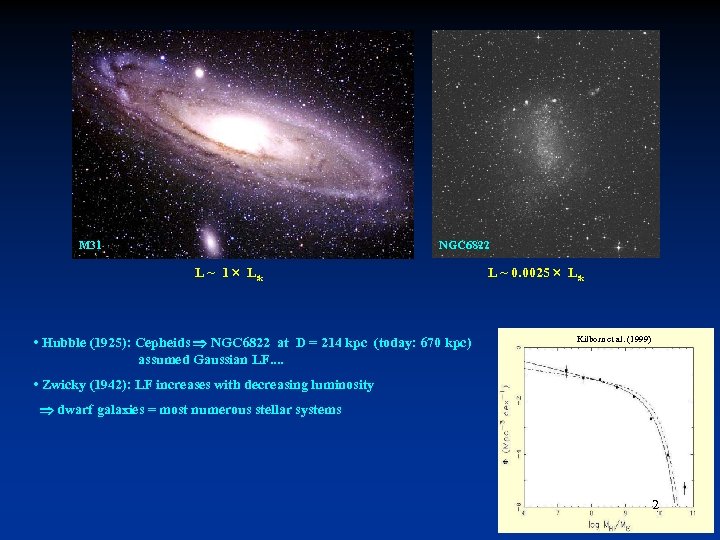
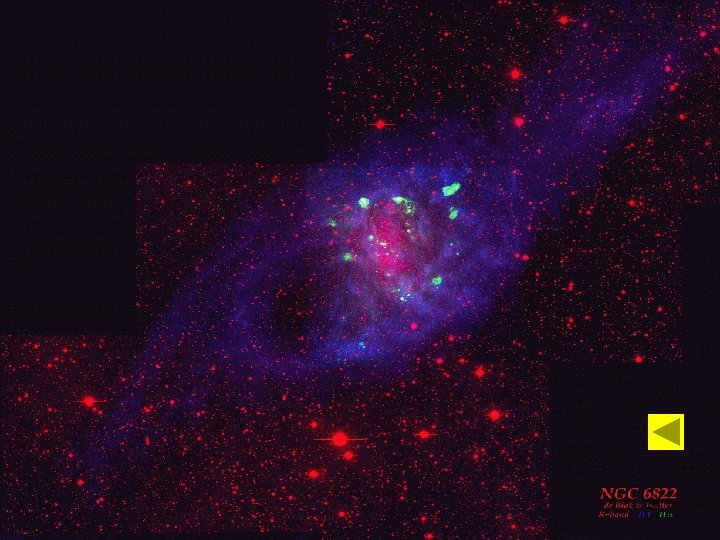
The first stellar system deemed extragalactic wasn‘t. . M 31 but rather. . NGC 6822 L~ 1 L * • Hubble (1925): Cepheids NGC 6822 at D = 214 kpc (today: 670 kpc) assumed Gaussian LF. . L ~ 0. 0025 L * Kilborn et al. (1999) • Zwicky (1942): LF increases with decreasing luminosity dwarf galaxies = most numerous stellar systems 2
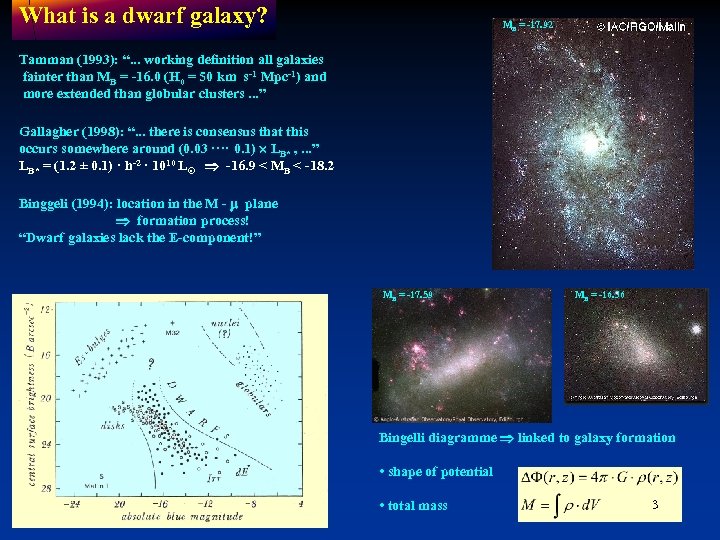
What is a dwarf galaxy? MB = -17. 92 Tamman (1993): “. . . working definition all galaxies fainter than MB = -16. 0 (H 0 = 50 km s-1 Mpc-1) and more extended than globular clusters. . . ” Gallagher (1998): “. . . there is consensus that this occurs somewhere around (0. 03 ···· 0. 1) LB* , . . . ” LB* = (1. 2 ± 0. 1) · h-2 · 1010 L -16. 9 < MB < -18. 2 Binggeli (1994): location in the M - plane formation process! “Dwarf galaxies lack the E-component!” MB = -17. 59 MB = -16. 36 Bingelli diagramme linked to galaxy formation • shape of potential • total mass 3
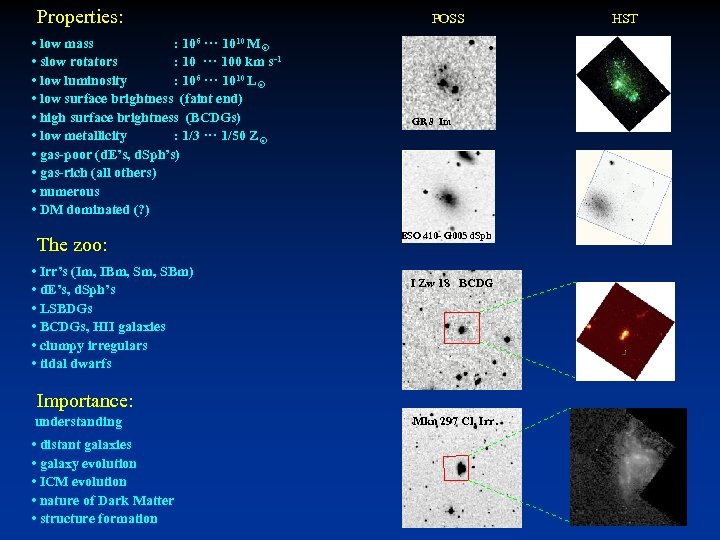
Properties: • low mass : 106 ··· 1010 M • slow rotators : 10 ··· 100 km s-1 • low luminosity : 106 ··· 1010 L • low surface brightness (faint end) • high surface brightness (BCDGs) • low metallicity : 1/3 ··· 1/50 Z • gas-poor (d. E’s, d. Sph’s) • gas-rich (all others) • numerous • DM dominated (? ) The zoo: • Irr’s (Im, IBm, SBm) • d. E’s, d. Sph’s • LSBDGs • BCDGs, HII galaxies • clumpy irregulars • tidal dwarfs POSS HST GR 8 Im ESO 410 - G 005 d. Sph I Zw 18 BCDG Importance: understanding • distant galaxies • galaxy evolution • ICM evolution • nature of Dark Matter • structure formation Mkn 297 Cl. Irr. 4
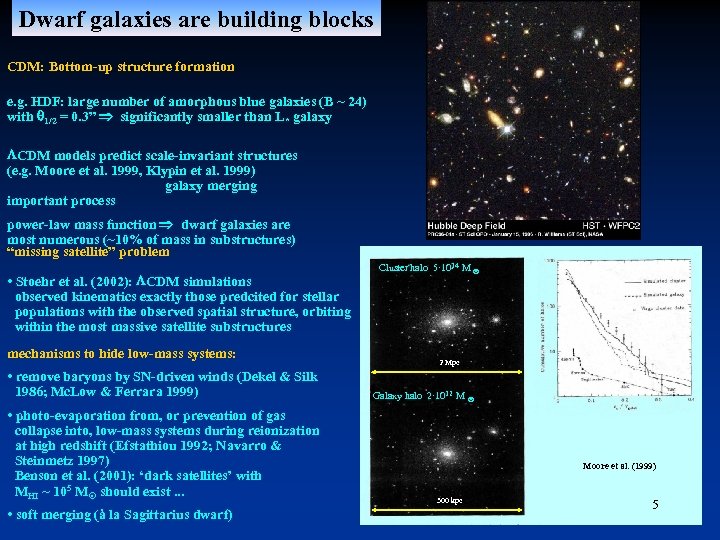
Dwarf galaxies are building blocks CDM: Bottom-up structure formation e. g. HDF: large number of amorphous blue galaxies (B ~ 24) with 1/2 = 0. 3” significantly smaller than L* galaxy CDM models predict scale-invariant structures (e. g. Moore et al. 1999, Klypin et al. 1999) galaxy merging important process power-law mass function dwarf galaxies are most numerous (~10% of mass in substructures) “missing satellite” problem • Stoehr et al. (2002): CDM simulations observed kinematics exactly those predcited for stellar populations with the observed spatial structure, orbiting within the most massive satellite substructures mechanisms to hide low-mass systems: • remove baryons by SN-driven winds (Dekel & Silk 1986; Mc. Low & Ferrara 1999) • photo-evaporation from, or prevention of gas collapse into, low-mass systems during reionization at high redshift (Efstathiou 1992; Navarro & Steinmetz 1997) Benson et al. (2001): ‘dark satellites’ with MHI ~ 105 M should exist. . . • soft merging (à la Sagittarius dwarf) Cluster halo 5· 1014 M 2 Mpc Galaxy halo 2· 1012 M Moore et al. (1999) 300 kpc 5
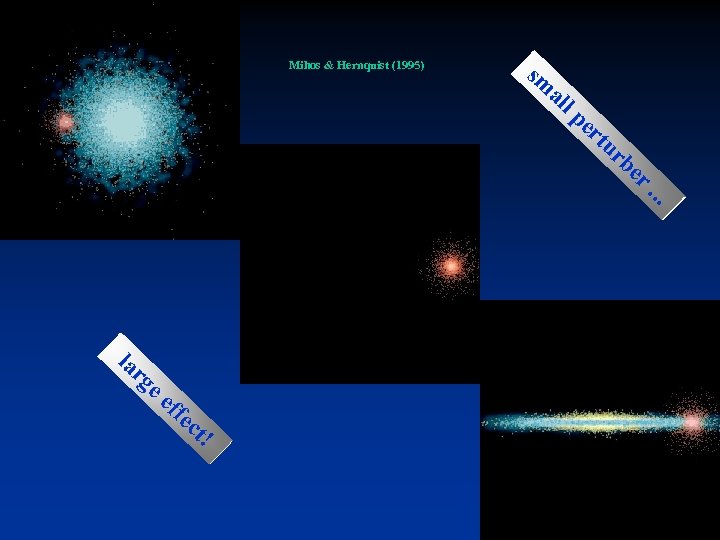
Mihos & Hernquist (1995) sm al lp er tu rb er . . . la r ge ef fe ct ! 6
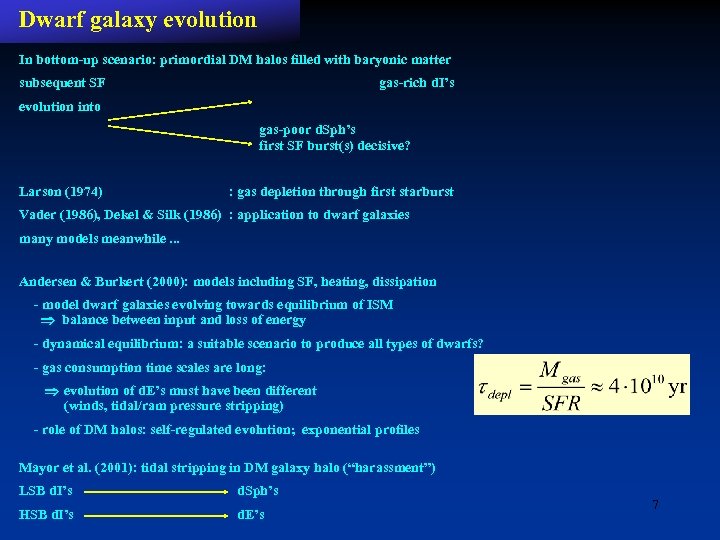
Dwarf galaxy evolution In bottom-up scenario: primordial DM halos filled with baryonic matter subsequent SF gas-rich d. I’s evolution into gas-poor d. Sph’s first SF burst(s) decisive? Larson (1974) : gas depletion through first starburst Vader (1986), Dekel & Silk (1986) : application to dwarf galaxies many models meanwhile. . . Andersen & Burkert (2000): models including SF, heating, dissipation - model dwarf galaxies evolving towards equilibrium of ISM balance between input and loss of energy - dynamical equilibrium: a suitable scenario to produce all types of dwarfs? - gas consumption time scales are long: evolution of d. E’s must have been different (winds, tidal/ram pressure stripping) - role of DM halos: self-regulated evolution; exponential profiles Mayor et al. (2001): tidal stripping in DM galaxy halo (“harassment”) LSB d. I’s d. Sph’s HSB d. I’s d. E’s 7
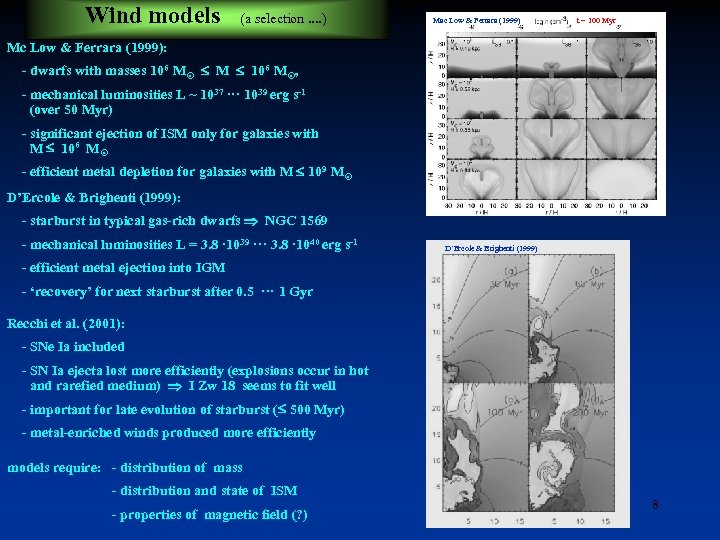
Wind models (a selection. . ) Mac Low & Ferrara (1999) t = 100 Myr Mc Low & Ferrara (1999): - dwarfs with masses 106 M M 106 M , - mechanical luminosities L ~ 1037 ··· 1039 erg s-1 (over 50 Myr) - significant ejection of ISM only for galaxies with M 106 M - efficient metal depletion for galaxies with M 109 M D’Ercole & Brighenti (1999): - starburst in typical gas-rich dwarfs NGC 1569 - mechanical luminosities L = 3. 8 · 1039 ··· 3. 8 · 1040 erg s-1 D’Ercole & Brighenti (1999) - efficient metal ejection into IGM - ‘recovery’ for next starburst after 0. 5 ··· 1 Gyr Recchi et al. (2001): - SNe Ia included - SN Ia ejecta lost more efficiently (explosions occur in hot and rarefied medium) I Zw 18 seems to fit well - important for late evolution of starburst ( 500 Myr) - metal-enriched winds produced more efficiently models require: - distribution of mass - distribution and state of ISM - properties of magnetic field (? ) 8
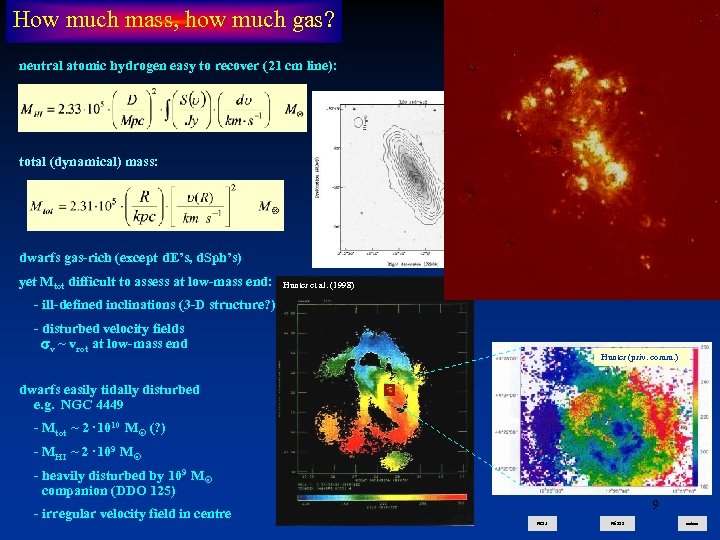
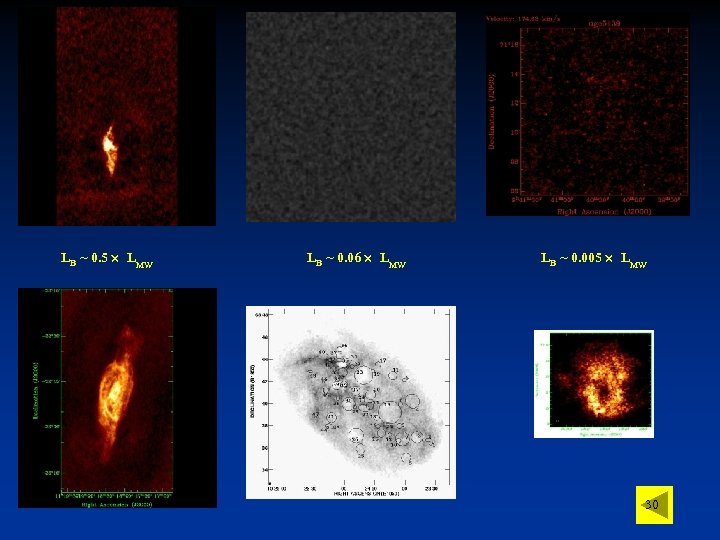
How much mass, how much gas? Bomans et al. (1997) IZw 18 HI neutral atomic hydrogen easy to recover (21 cm line): Gentile (in prep. ) total (dynamical) mass: dwarfs gas-rich (except d. E’s, d. Sph’s) yet Mtot difficult to assess at low-mass end: van Zee et al. (1998) Hunter et al. (1998) - ill-defined inclinations (3 -D structure? ) - disturbed velocity fields v ~ vrot at low-mass end Hunter (priv. comm. ) dwarfs easily tidally disturbed e. g. NGC 4449 - Mtot ~ 2 · 1010 M (? ) - MHI ~ 2 · 109 M - heavily disturbed by 109 M companion (DDO 125) - irregular velocity field in centre 9 M 31 N 6822 cubes
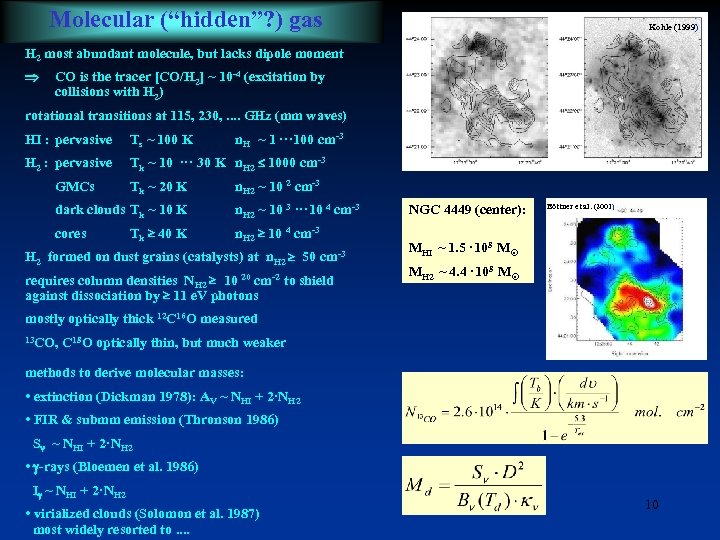
Molecular (“hidden”? ) gas Kohle (1999) H 2 most abundant molecule, but lacks dipole moment CO is the tracer [CO/H 2] ~ 10 -4 (excitation by collisions with H 2) rotational transitions at 115, 230, . . GHz (mm waves) HI : pervasive Ts ~ 100 K H 2 : pervasive Tk ~ 10 ··· 30 K n. H 2 1000 cm-3 GMCs Tk ~ 20 K n. H ~ 1 ··· 100 cm-3 n. H 2 ~ 10 2 cm-3 dark clouds Tk ~ 10 K n. H 2 ~ 10 3 ··· 10 4 cm-3 cores n. H 2 10 4 cm-3 Tk 40 K H 2 formed on dust grains (catalysts) at n. H 2 50 cm-3 requires column densities NH 2 10 against dissociation by 11 e. V photons 20 cm-2 to shield NGC 4449 (center): Böttner et al. (2001) MHI ~ 1. 5 · 108 M MH 2 ~ 4. 4 · 108 M mostly optically thick 12 C 16 O measured 13 CO, C 18 O optically thin, but much weaker methods to derive molecular masses: • extinction (Dickman 1978): AV ~ NHI + 2·NH 2 • FIR & submm emission (Thronson 1986) S ~ NHI + 2·NH 2 • -rays (Bloemen et al. 1986) I ~ NHI + 2·NH 2 • virialized clouds (Solomon et al. 1987) most widely resorted to. . 10
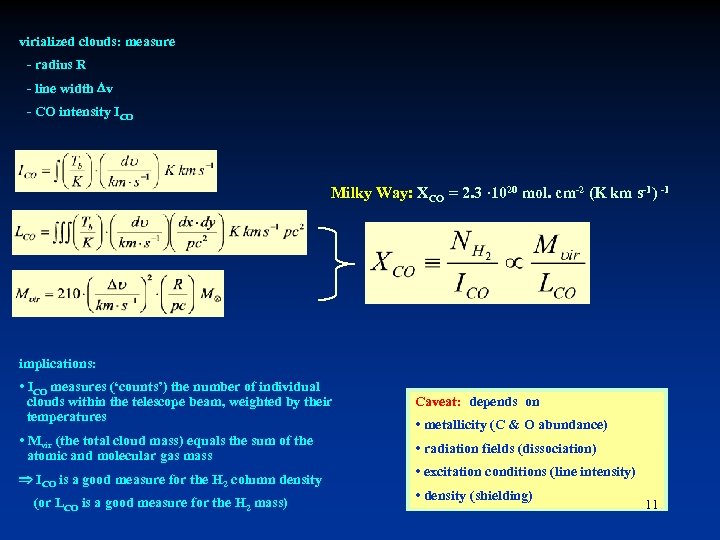
virialized clouds: measure - radius R - line width v - CO intensity ICO Milky Way: XCO = 2. 3 · 1020 mol. cm-2 (K km s-1) -1 implications: • ICO measures (‘counts’) the number of individual clouds within the telescope beam, weighted by their temperatures Caveat: depends on • Mvir (the total cloud mass) equals the sum of the atomic and molecular gas mass • radiation fields (dissociation) ICO is a good measure for the H 2 column density (or LCO is a good measure for the H 2 mass) • metallicity (C & O abundance) • excitation conditions (line intensity) • density (shielding) 11
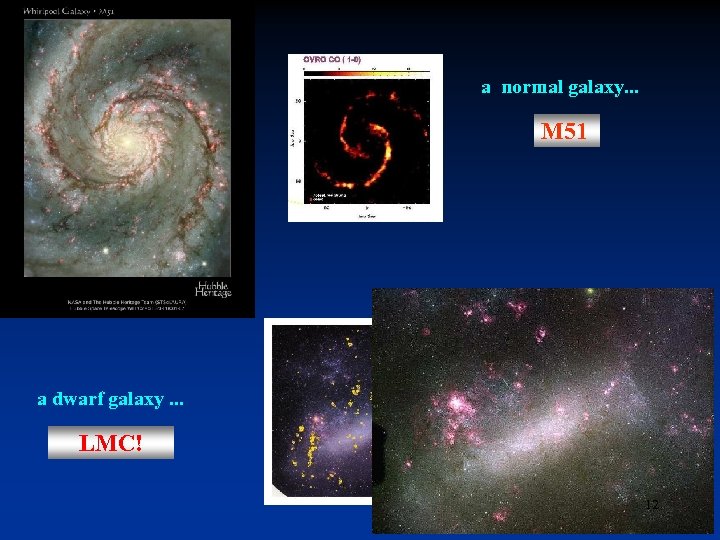
a normal galaxy. . . M 51 a dwarf galaxy. . . LMC! 12
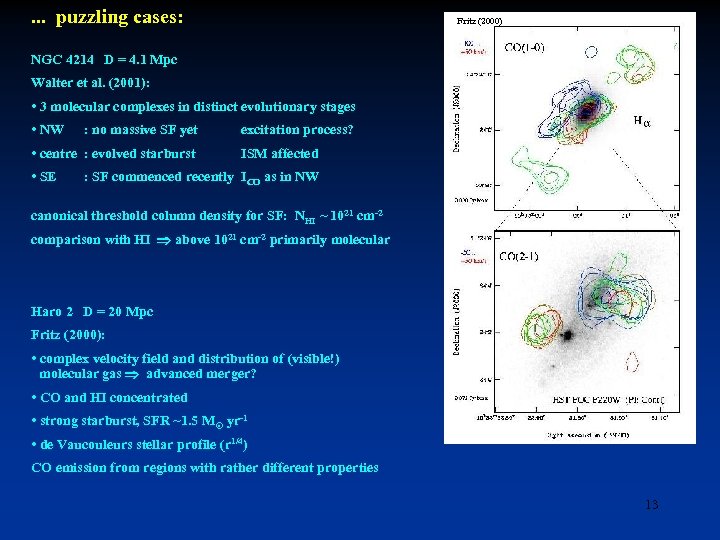
. . . puzzling cases: Fritz (2000) NGC 4214 D = 4. 1 Mpc Walter et al. (2001): • 3 molecular complexes in distinct evolutionary stages • NW : no massive SF yet • centre : evolved starburst • SE excitation process? ISM affected : SF commenced recently ICO as in NW canonical threshold column density for SF: NHI ~ 1021 cm-2 comparison with HI above 1021 cm-2 primarily molecular Haro 2 D = 20 Mpc Fritz (2000): • complex velocity field and distribution of (visible!) molecular gas advanced merger? • CO and HI concentrated • strong starburst, SFR ~1. 5 M yr-1 • de Vaucouleurs stellar profile (r 1/4) CO emission from regions with rather different properties 13
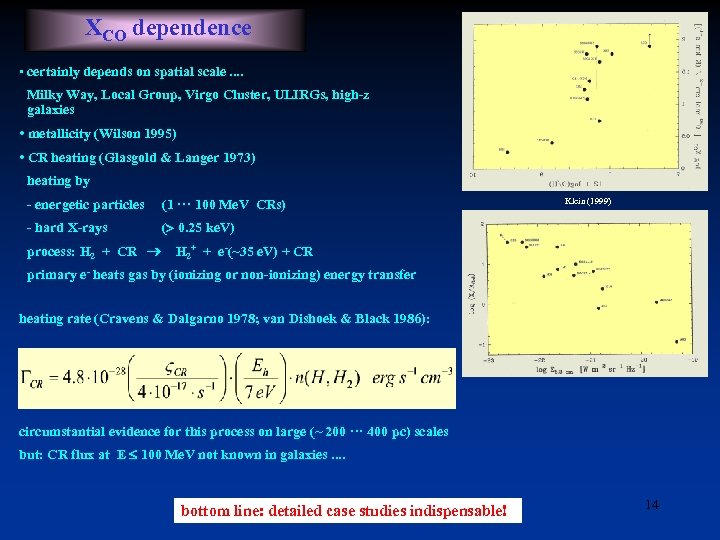
XCO dependence • certainly depends on spatial scale. . Milky Way, Local Group, Virgo Cluster, ULIRGs, high-z galaxies • metallicity (Wilson 1995) • CR heating (Glasgold & Langer 1973) heating by - energetic particles (1 ··· 100 Me. V CRs) - hard X-rays ( 0. 25 ke. V) process: H 2 + CR Klein (1999) H 2+ + e-(~35 e. V) + CR primary e- heats gas by (ionizing or non-ionizing) energy transfer heating rate (Cravens & Dalgarno 1978; van Dishoek & Black 1986): circumstantial evidence for this process on large (~ 200 ··· 400 pc) scales but: CR flux at E 100 Me. V not known in galaxies. . bottom line: detailed case studies indispensable! 14
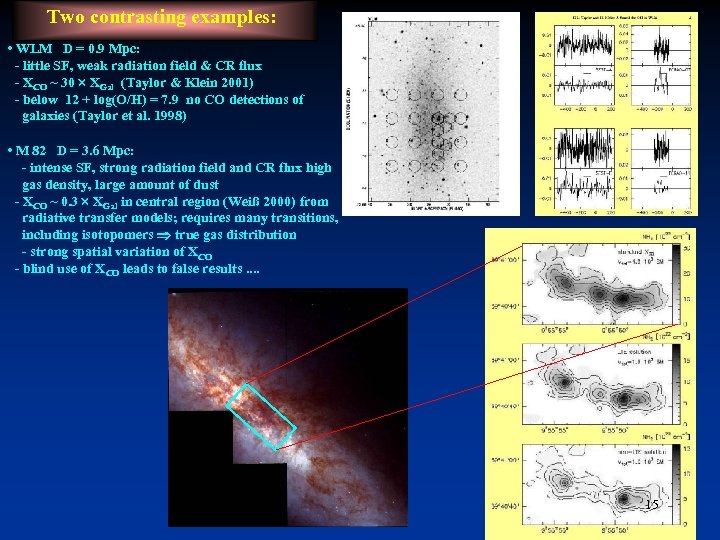
Two contrasting examples: • WLM D = 0. 9 Mpc: - little SF, weak radiation field & CR flux - XCO ~ 30 XGal (Taylor & Klein 2001) - below 12 + log(O/H) = 7. 9 no CO detections of galaxies (Taylor et al. 1998) • M 82 D = 3. 6 Mpc: - intense SF, strong radiation field and CR flux high gas density, large amount of dust - XCO ~ 0. 3 XGal in central region (Weiß 2000) from radiative transfer models; requires many transitions, including isotopomers true gas distribution - strong spatial variation of XCO - blind use of XCO leads to false results. . 15
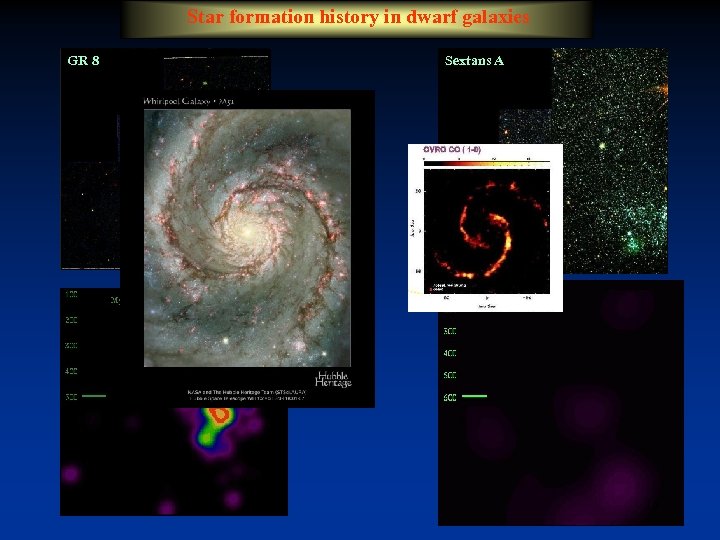
Star formation history in dwarf galaxies GR 8 Sextans A 16
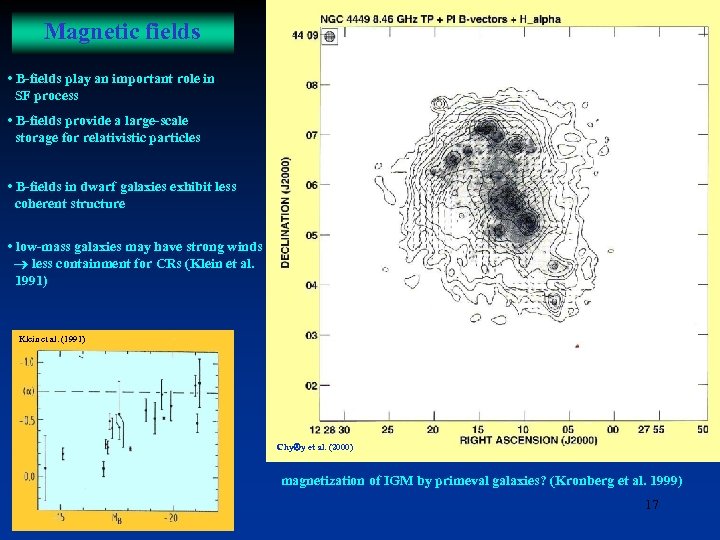
Magnetic fields Dumke et al. (1995) • B-fields play an important role in SF process • B-fields provide a large-scale storage for relativistic particles NGC 4631 • B-fields in dwarf galaxies exhibit less coherent structure NGC 4565 • low-mass galaxies may have strong winds less containment for CRs (Klein et al. 1991) Klein et al. (1996) Chy y et al. (2000) magnetization of IGM by primeval galaxies? (Kronberg et al. 1999) 17
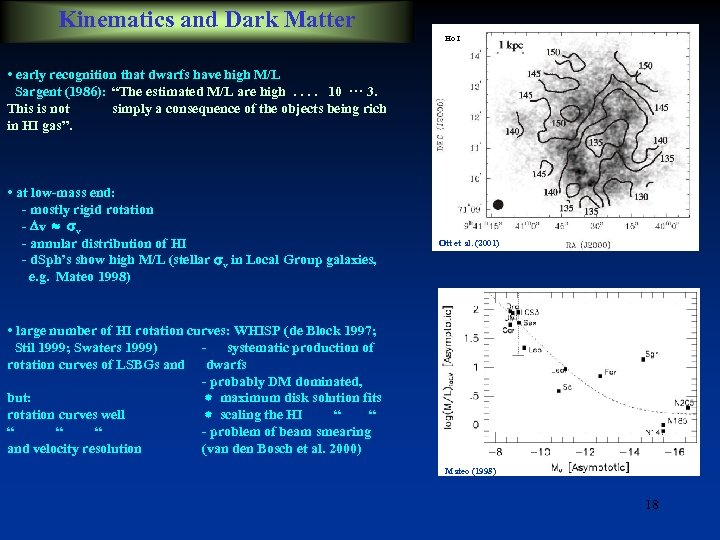
Kinematics and Dark Matter Ho I • early recognition that dwarfs have high M/L Sargent (1986): “The estimated M/L are high. . 10 ··· 3. This is not simply a consequence of the objects being rich in HI gas”. • at low-mass end: - mostly rigid rotation - v v - annular distribution of HI - d. Sph’s show high M/L (stellar v in Local Group galaxies, e. g. Mateo 1998) Ott et al. (2001) • large number of HI rotation curves: WHISP (de Block 1997; Stil 1999; Swaters 1999) - systematic production of rotation curves of LSBGs and dwarfs - probably DM dominated, but: maximum disk solution fits rotation curves well scaling the HI “ “ “ - problem of beam smearing and velocity resolution (van den Bosch et al. 2000) Mateo (1998) 18
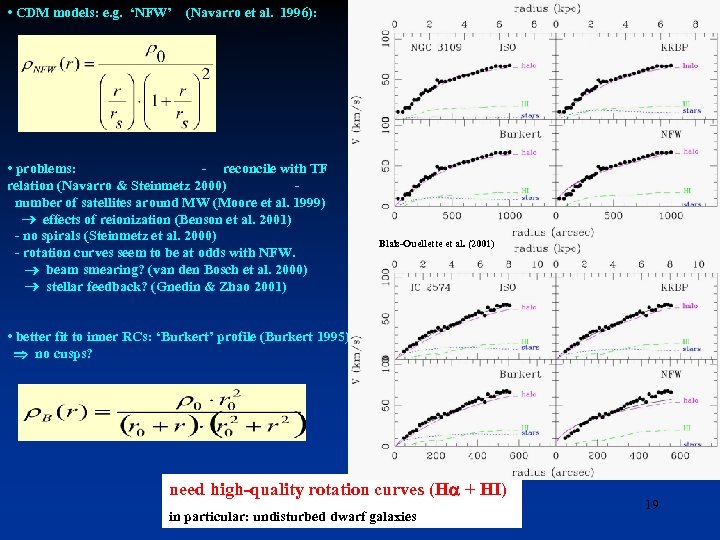
• CDM models: e. g. ‘NFW’ (Navarro et al. 1996): • problems: - reconcile with TF relation (Navarro & Steinmetz 2000) number of satellites around MW (Moore et al. 1999) effects of reionization (Benson et al. 2001) - no spirals (Steinmetz et al. 2000) - rotation curves seem to be at odds with NFW. beam smearing? (van den Bosch et al. 2000) stellar feedback? (Gnedin & Zhao 2001) Blais-Ouellette et al. (2001) • better fit to inner RCs: ‘Burkert’ profile (Burkert 1995) no cusps? Swaters (1999) need high-quality rotation curves (H + HI) in particular: undisturbed dwarf galaxies 19
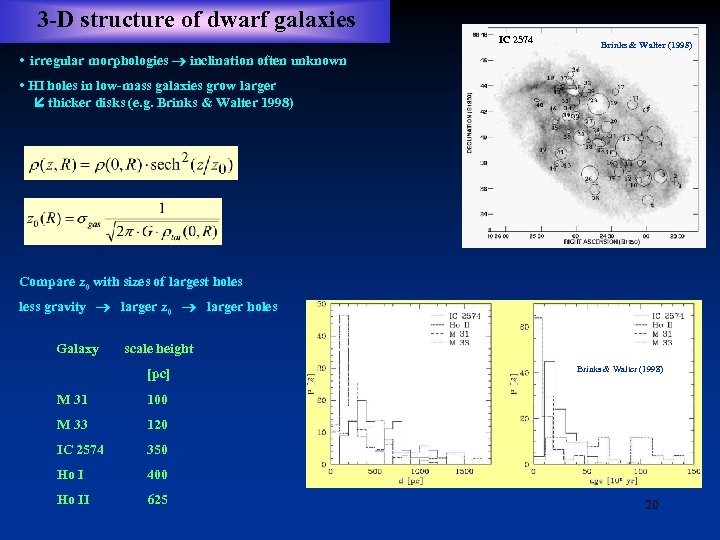
3 -D structure of dwarf galaxies IC 2574 Brinks & Walter (1998) • irregular morphologies inclination often unknown • HI holes in low-mass galaxies grow larger thicker disks (e. g. Brinks & Walter 1998) Compare z 0 with sizes of largest holes less gravity larger z 0 larger holes Galaxy scale height [pc] M 31 100 M 33 120 IC 2574 350 Ho I 400 Ho II 625 Brinks & Walter (1998) 20
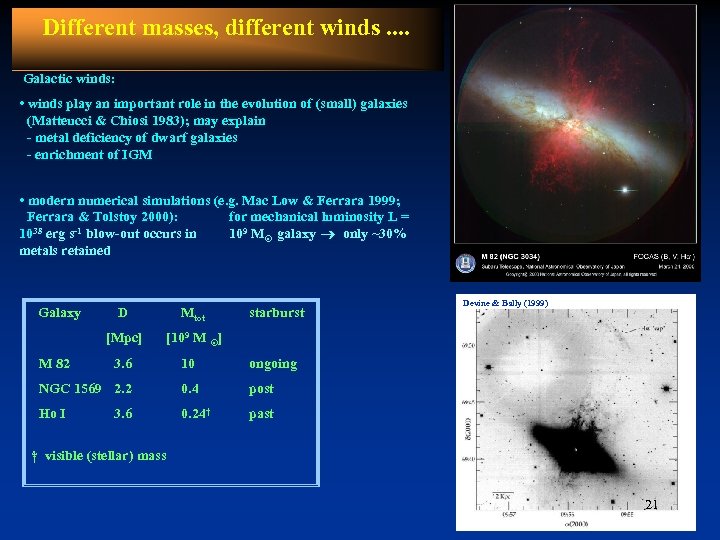
Different masses, different winds. . Galactic winds: • winds play an important role in the evolution of (small) galaxies (Matteucci & Chiosi 1983); may explain - metal deficiency of dwarf galaxies - enrichment of IGM • modern numerical simulations (e. g. Mac Low & Ferrara 1999; Ferrara & Tolstoy 2000): for mechanical luminosity L = 38 erg s-1 blow-out occurs in 10 109 M galaxy only ~30% metals retained Galaxy Mtot [Mpc] M 82 D starburst Devine & Bally (1999) [109 M ] 3. 6 10 ongoing NGC 1569 2. 2 0. 4 post Ho I 0. 24† past 3. 6 † visible (stellar) mass 21
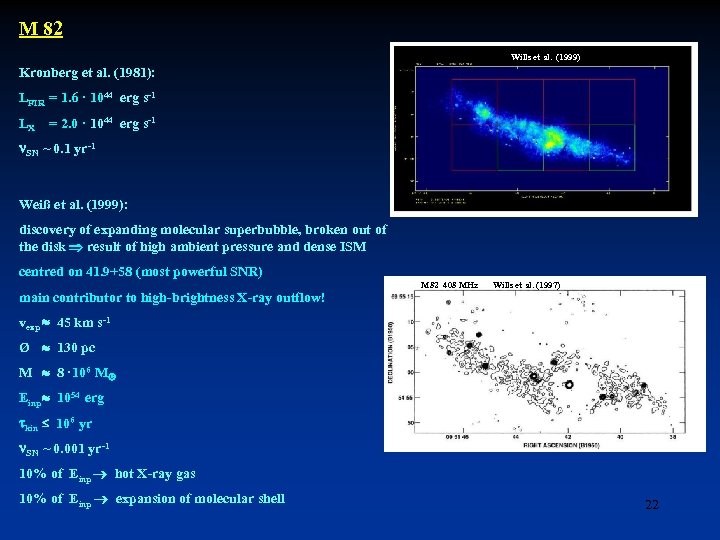
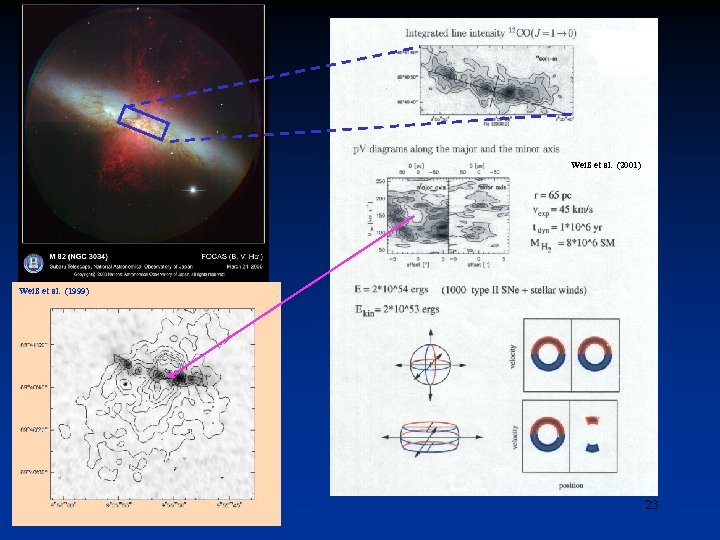
M 82 Wills et al. (1999) Kronberg et al. (1981): LFIR = 1. 6 · 1044 erg s-1 LX = 2. 0 · 1044 erg s-1 SN ~ 0. 1 yr-1 Weiß et al. (1999): discovery of expanding molecular superbubble, broken out of the disk result of high ambient pressure and dense ISM centred on 41. 9+58 (most powerful SNR) main contributor to high-brightness X-ray outflow! M 82 408 MHz Wills et al. (1997) vexp 45 km s-1 Ø 130 pc M 8 · 106 M Einp 1054 erg kin 106 yr SN ~ 0. 001 yr-1 10% of Einp hot X-ray gas 10% of Einp expansion of molecular shell 22
Weiß et al. (2001) Weiß et al. (1999) 23
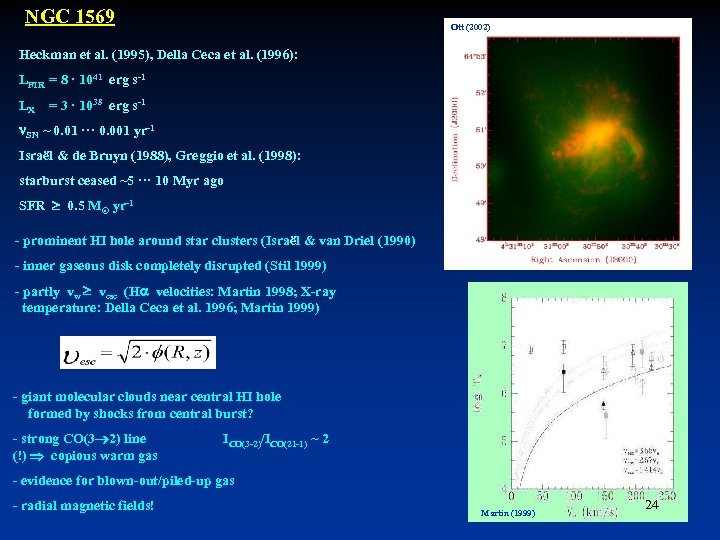
NGC 1569 Ott (2002) Heckman et al. (1995), Della Ceca et al. (1996): LFIR = 8 · 1041 erg s-1 LX = 3 · 1038 erg s-1 SN ~ 0. 01 ··· 0. 001 yr-1 Israël & de Bruyn (1988), Greggio et al. (1998): starburst ceased ~5 ··· 10 Myr ago SFR 0. 5 M yr-1 - prominent HI hole around star clusters (Israël & van Driel (1990) - inner gaseous disk completely disrupted (Stil 1999) - partly vw vesc (H velocities: Martin 1998; X-ray temperature: Della Ceca et al. 1996; Martin 1999) - giant molecular clouds near central HI hole formed by shocks from central burst? - strong CO(3 2) line (!) copious warm gas ICO(3 -2)/ICO(21 -1) ~ 2 - evidence for blown-out/piled-up gas - radial magnetic fields! Martin (1999) 24
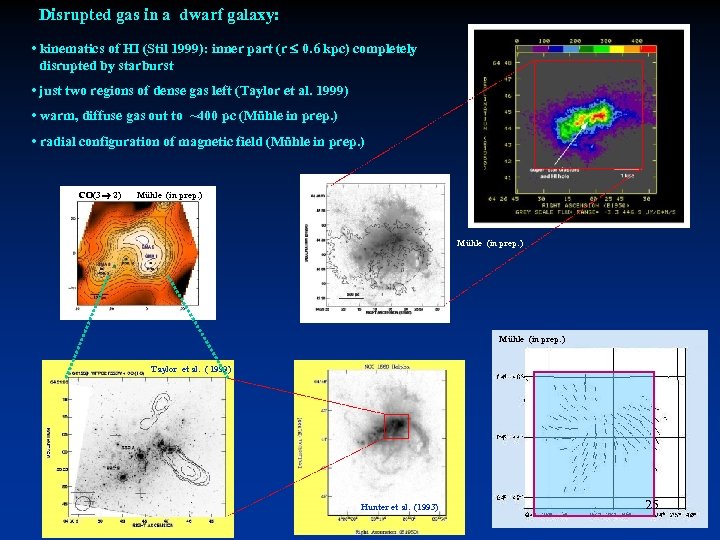
Disrupted gas in a dwarf galaxy: • kinematics of HI (Stil 1999): inner part (r 0. 6 kpc) completely disrupted by starburst • just two regions of dense gas left (Taylor et al. 1999) • warm, diffuse gas out to ~400 pc (Mühle in prep. ) • radial configuration of magnetic field (Mühle in prep. ) CO(3 2) Mühle (in prep. ) Taylor et al. ( 1999) Hunter et al. (1993) 25
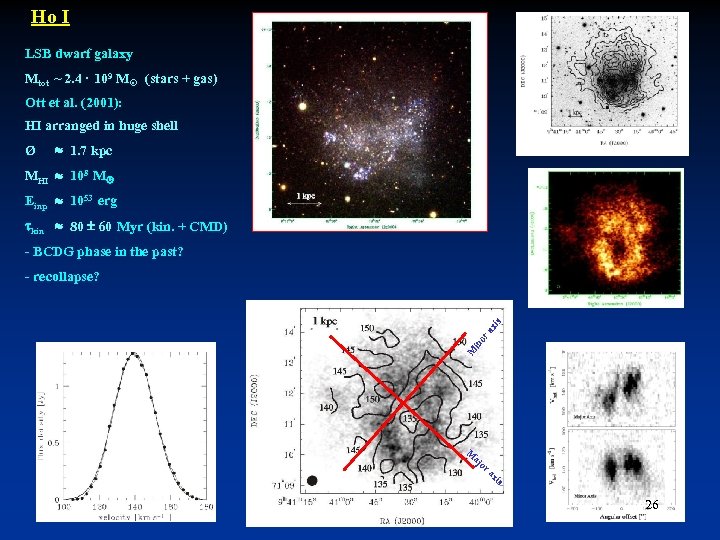
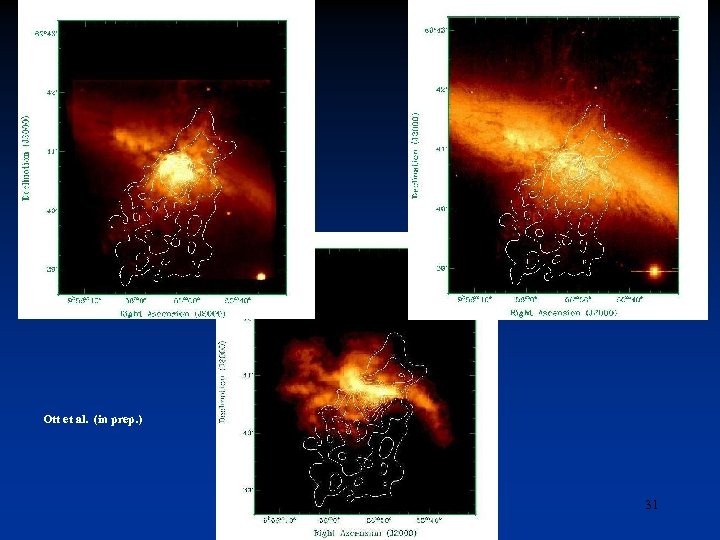
Ho I LSB dwarf galaxy Mtot ~ 2. 4 · 109 M (stars + gas) Ott et al. (2001): HI arranged in huge shell Ø 1. 7 kpc MHI 108 M Einp 1053 erg kin 80 60 Myr (kin. + CMD) - BCDG phase in the past? M in or ax is - recollapse? M aj or ax is 26
Outlook • study of low-mass galaxies important for our understanding of galaxies in the early universe • detailed case studies indispensable (dwarf galaxies are individuals!) - different environments (field, group, cluster) - different masses and SFR’s - recover full gas content - derive gravitational potentials (DM) - study interplay between SF and ISM (disk - halo) • numerical simulations must incorporate realistic conditions - gas distribution - mass distribution - attempt to ‘reproduce’ observed galaxies • interpreting distant galaxies requires scrutiny of nearby ones, in particular at low-mass end • relevant observations of (more) distant galaxies - SKA - ALMA - NGST - X-ray satellites 27
28
29
LB ~ 0. 5 LMW LB ~ 0. 06 LMW LB ~ 0. 005 LMW 30
Ott et al. (in prep. ) 31
32
Скачать презентацию Dwarf Galaxies Building Blocks of the Universe
560369d4f1d57e54b9e2b338ca195e2a.ppt