 Скачать презентацию DVB-H digital video broadcasting for handheld devices Björn
8c4bdfa862280f7c0943ad6121d02a43.ppt
- Количество слайдов: 20



DVB-H digital video broadcasting for handheld devices Björn Forss Magnus Melin
Introduction • Convergence of digital media and communication give users possibility to consume most digital content also in mobile environment • The emerging DVB-H standard aims to provide digital TV reception in mobile devices – Earlier known as DVB-X • DVB-H is being standardized by and ad hoc group of the DVB organization – Expected to be standardized in the first quarter of 2004 • DVB-H combines traditional television broadcast standards with elements specific to handheld devices; mobility, smaller screens and antennas, indoor coverage and reliance on battery power
Motivation for creating DVB-H • Why not use UMTS? – Not scalable for mass content delivery – For delivery of mass media content, broadcast networks should be preferred over point-to-point cellular networks • Why not use DVB-T? – Was designed for rooftop reception – Need for an efficient power saving mechanism – Inadequate impulse noise protection • Why not use DAB? – Designed for devices with similar power constraints but too narrow spectrum is assigned for data transmission DAB = Digital Audio Broadcasting
DVB-T • Terrestrial Digital Television Standard – Used in 36 countries world wide • One-to-many broadband wireless data transport – Video, audio, data and – importantly – IP packets – Scalable: cell size up to 100 km (DVB-H cell size is smaller) – Huge capacity: 54 channels each 5 -32 Mbit/s • Shut down of analog TV will free up huge frequency capacity for DVB-T usage DVB-T = Digital Video Broadcasting - Terrestrial
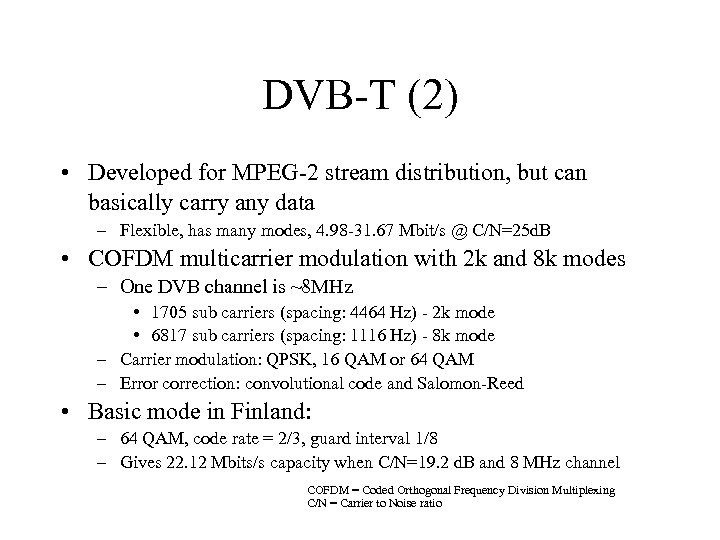
DVB-T (2) • Developed for MPEG-2 stream distribution, but can basically carry any data – Flexible, has many modes, 4. 98 -31. 67 Mbit/s @ C/N=25 d. B • COFDM multicarrier modulation with 2 k and 8 k modes – One DVB channel is ~8 MHz • 1705 sub carriers (spacing: 4464 Hz) - 2 k mode • 6817 sub carriers (spacing: 1116 Hz) - 8 k mode – Carrier modulation: QPSK, 16 QAM or 64 QAM – Error correction: convolutional code and Salomon-Reed • Basic mode in Finland: – 64 QAM, code rate = 2/3, guard interval 1/8 – Gives 22. 12 Mbits/s capacity when C/N=19. 2 d. B and 8 MHz channel COFDM = Coded Orthogonal Frequency Division Multiplexing C/N = Carrier to Noise ratio
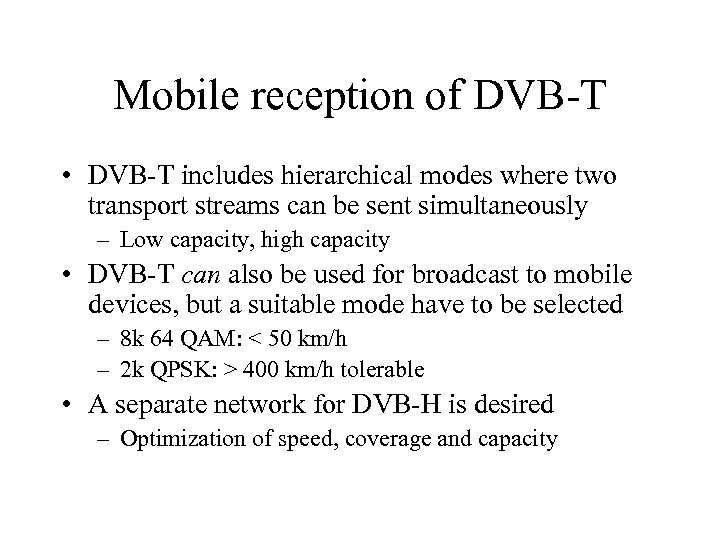
Mobile reception of DVB-T • DVB-T includes hierarchical modes where two transport streams can be sent simultaneously – Low capacity, high capacity • DVB-T can also be used for broadcast to mobile devices, but a suitable mode have to be selected – 8 k 64 QAM: < 50 km/h – 2 k QPSK: > 400 km/h tolerable • A separate network for DVB-H is desired – Optimization of speed, coverage and capacity
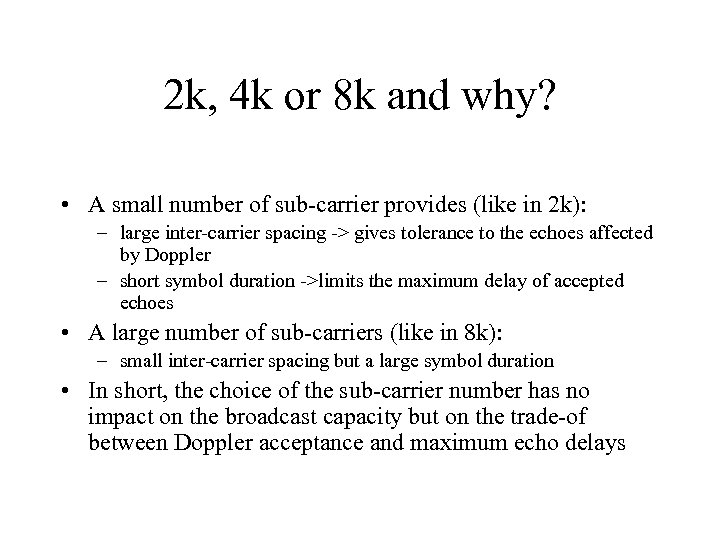
2 k, 4 k or 8 k and why? • A small number of sub-carrier provides (like in 2 k): – large inter-carrier spacing -> gives tolerance to the echoes affected by Doppler – short symbol duration ->limits the maximum delay of accepted echoes • A large number of sub-carriers (like in 8 k): – small inter-carrier spacing but a large symbol duration • In short, the choice of the sub-carrier number has no impact on the broadcast capacity but on the trade-of between Doppler acceptance and maximum echo delays
DVB-H mission • Make it “… possible to transmit in one DVB transport stream both DVB-H and DVB-T components in such a way that existing DVB-T receivers which cannot decode the DVB-H portion are not disturbed by this DVB-H portion. ”
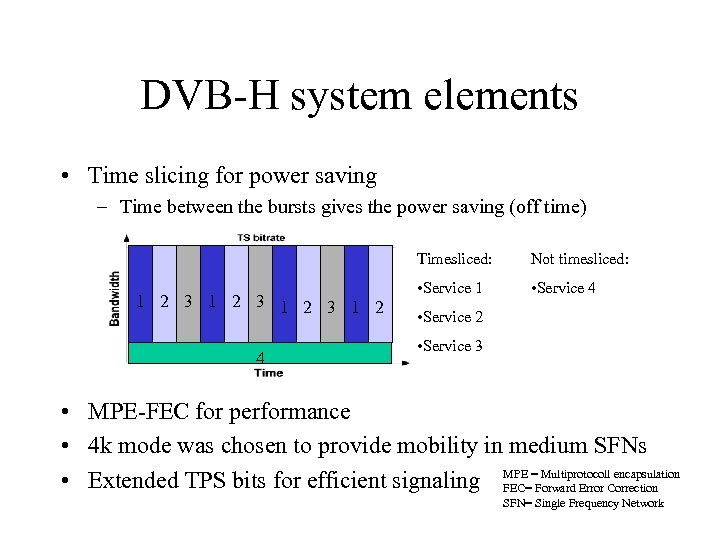
DVB-H system elements • Time slicing for power saving – Time between the bursts gives the power saving (off time) Timesliced: 1 2 3 1 2 4 Not timesliced: • Service 1 • Service 4 • Service 2 • Service 3 • MPE-FEC for performance • 4 k mode was chosen to provide mobility in medium SFNs • Extended TPS bits for efficient signaling MPE = Multiprotocoll encapsulation FEC= Forward Error Correction SFN= Single Frequency Network
IP Datacast (IPDC) • “IP datacasting is a service where digital content formats, software applications, programming interfaces and multimedia services are combined through IP (Internet Protocol) with digital broadcasting. ” <http: //www. ipdc-forum. com/about/> – All content delivered as IP packets – Connectivity layer convergence • DVB-H combined with IP datacasting enables distribution of many kinds of digital content – TV broadcast, music, games etc.
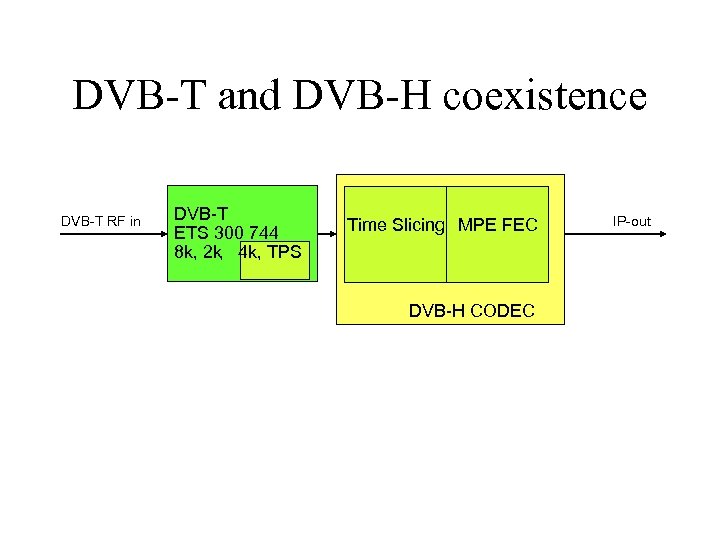
DVB-T and DVB-H coexistence DVB-T RF in DVB-T ETS 300 744 , 8 k, 2 k 4 k, TPS Time Slicing MPE FEC DVB-H CODEC IP-out
IPDC over DVB-H business • New forms of multimedia enjoyment for consumers • New market opportunities for telecommunication and broadcasting industries • High bandwidth and high transmission speeds but insensitive to number of recipients attractive from a business perspective IPDC = IP Datacast
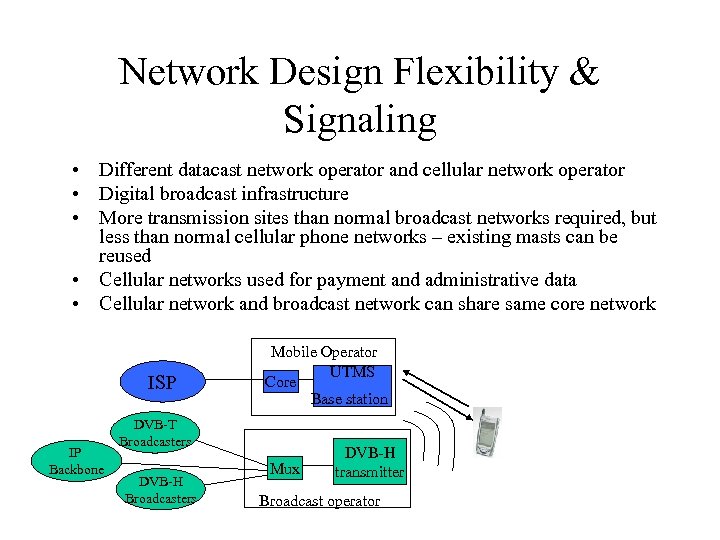
Network Design Flexibility & Signaling • Different datacast network operator and cellular network operator • Digital broadcast infrastructure • More transmission sites than normal broadcast networks required, but less than normal cellular phone networks – existing masts can be reused • Cellular networks used for payment and administrative data • Cellular network and broadcast network can share same core network ISP IP Backbone Mobile Operator UTMS Core Base station DVB-T Broadcasters DVB-H Broadcasters Mux DVB-H transmitter Broadcast operator
DVB-H features/pros • • • Cost efficient delivery of broadcast content to a large audience Low time to market Low complexity Not heavily affected of peak usage (during special events etc. ) Flexible transport stream sharing between DVB-T and DVB-H possible Based on DVB-T with minimal changes Fulfils most commercial requirements Allows seamless handover No adverse effect on DVB-T IP allows encryption
DVB-H features/cons • Only IP based services possible • Reduced power saving when total bit rate for DVB-H services is very low (no big “bursts” possible)
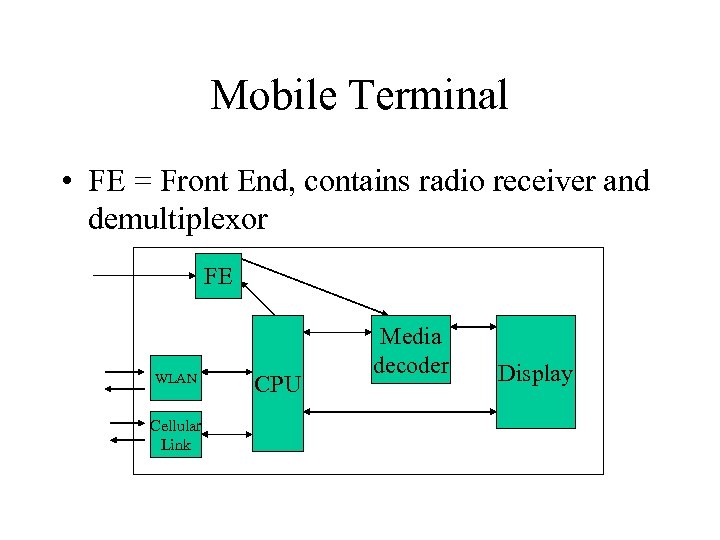
Mobile Terminal • FE = Front End, contains radio receiver and demultiplexor FE WLAN Cellular Link CPU Media decoder Display
Power consumption and handover • IP encapsulation allows sending the data in bursts to the mobile station and this saves energy (battery power) • Power consumption and handover – 2 Mbit buffer – Handover possible during off time (services can be used even if the terminal has moved during off time)
C/N Performance • • RS decoder utilizing the Time Slice buffer Virtual time interleaver 10% TS PER tolerated Doppler and CN improved in mobile and portable • Impulse interference tolerance improved • Possibility to vary the level of robustness
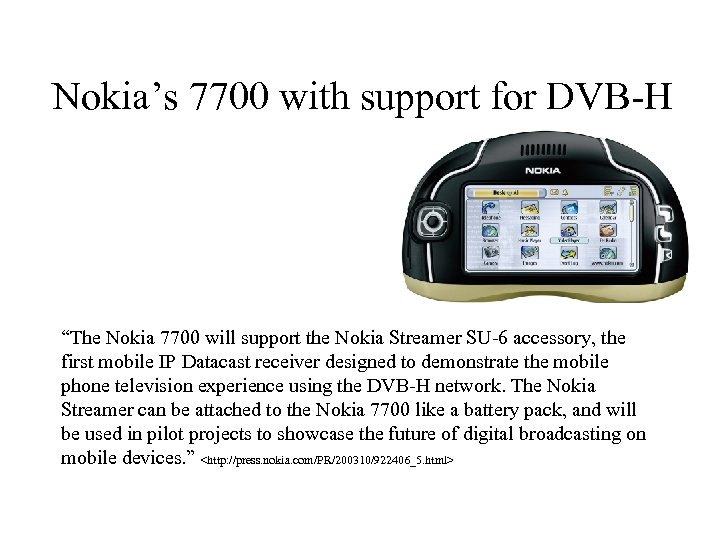
Nokia’s 7700 with support for DVB-H “The Nokia 7700 will support the Nokia Streamer SU-6 accessory, the first mobile IP Datacast receiver designed to demonstrate the mobile phone television experience using the DVB-H network. The Nokia Streamer can be attached to the Nokia 7700 like a battery pack, and will be used in pilot projects to showcase the future of digital broadcasting on mobile devices. ” <http: //press. nokia. com/PR/200310/922406_5. html>
References • • • DVB-H – digital TV for handhelds? Jukka Henriksson, Nokia Content Distribution Using Wireless Broadcast and Multicast Communication Networks. Janne Aaltonen, Thesis for Degree of Doctor, Tampere University of Technology IP Datacasting Technology - Bringing TV to the Mobile Phone, White Paper <http: //www. nokia. com/Base. Project/Sites/NOKIA_MAIN_18022/CDA/Categories/Abou t. Nokia/Press/White. Papers/_Content/_Static_Files/ipdatacastingtechnology. pdf> DVB <http: //www. dvb. org/index. php? id=20> Cable & Satellite International <http: //www. cable-satellite. com/main_news. htm> Sonera medialab <http: //www. medialab. sonera. fi/projects/ipdcmhp/ > EE-Times Junko Yoshida, <http: //www. eetimes. com/sys/news/OEG 20030310 S 0049> Performance analysis and low power VLSI implementation of DVB-T receiver <http: //www. signal. uu. se/Courses/Semabstracts/ofdm 2. pdf> DVB-T: New Operative Modes For Digital Terrestrial TV, Gerard Faria, <http: //www. broadcastpapers. com/tvtran/Harris. DVBTNew. Op. Modes. doc>
Скачать презентацию DVB-H digital video broadcasting for handheld devices Björn
8c4bdfa862280f7c0943ad6121d02a43.ppt