 Скачать презентацию Dunes and Slacks Dune Mound of wind blown
5e5ecebfae19058d6887ddac8e584a3d.ppt
- Количество слайдов: 44



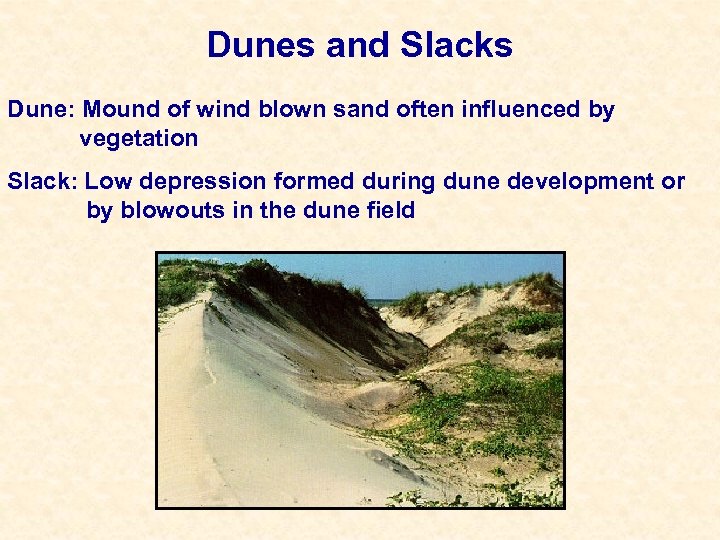
Dunes and Slacks Dune: Mound of wind blown sand often influenced by vegetation Slack: Low depression formed during dune development or by blowouts in the dune field
Barrier Island Dunes and Slacks Vegetation Zones: Strandline Foredune Dunefield Reardune Mesic slack Xeric slack
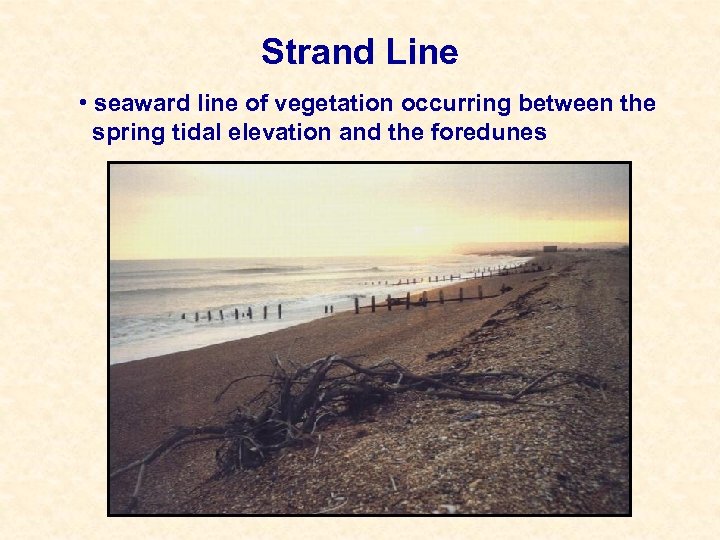
Strand Line • seaward line of vegetation occurring between the spring tidal elevation and the foredunes
Strand Line • transient zone- eroded by wave action or may develop into foredunes on accreting shorelines • seedbed for plants on foredunes • wrack material enhances germination and growth • salt aerosol levels are high • sea rocket, euphorbia, sea elder, croton, and sea oats
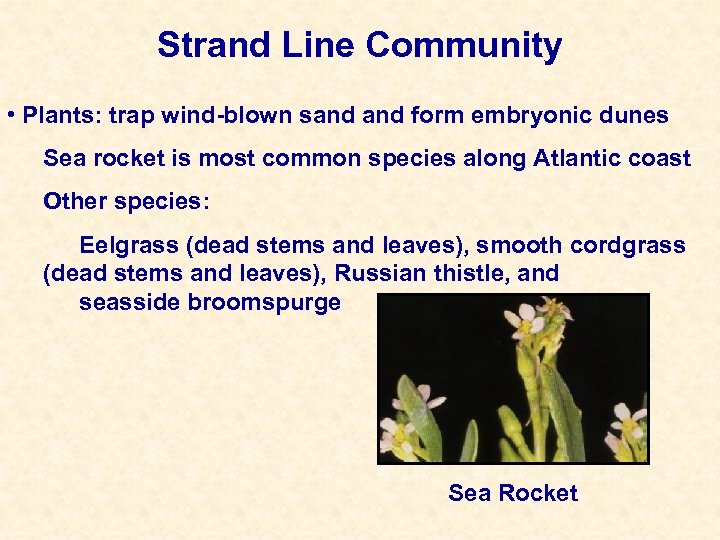
Strand Line Community • Plants: trap wind-blown sand form embryonic dunes Sea rocket is most common species along Atlantic coast Other species: Eelgrass (dead stems and leaves), smooth cordgrass (dead stems and leaves), Russian thistle, and seasside broomspurge Sea Rocket
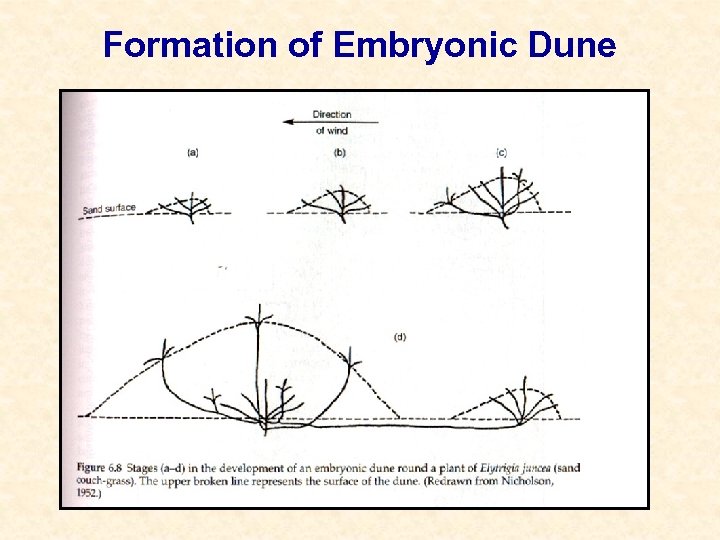
Formation of Embryonic Dune
Strand Line Community • Over time: Nutrient source becomes limited Environmental conditions change Vegetation cover begins to change: Strand Line species replaced by Dune Pioneers Russian Thistle Sea Elder Evening Primrose Sea Oats Sea Rocket Am. Beachgrass
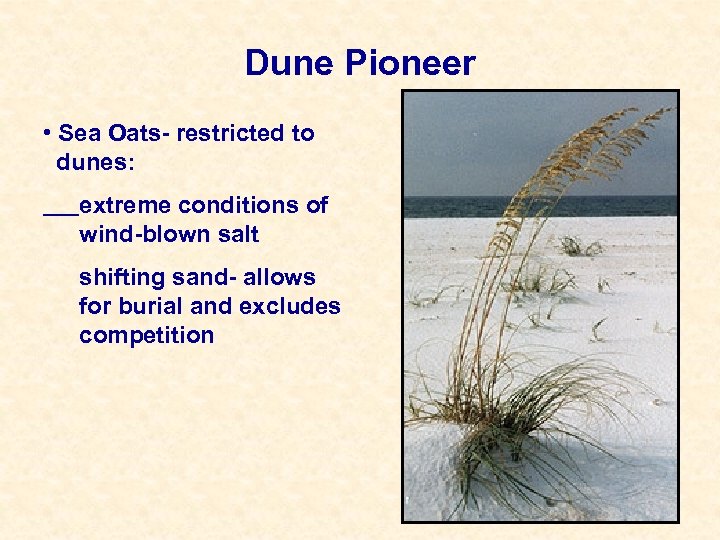
Dune Pioneer • Sea Oats- restricted to dunes: extreme conditions of wind-blown salt shifting sand- allows for burial and excludes competition
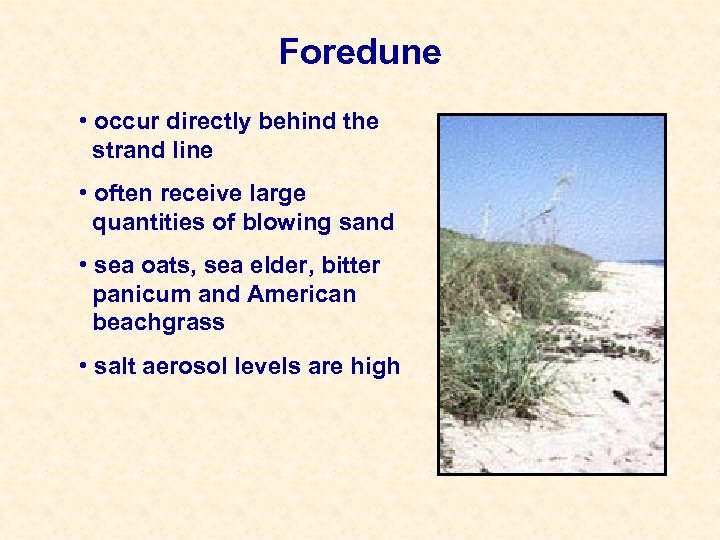
Foredune • occur directly behind the strand line • often receive large quantities of blowing sand • sea oats, sea elder, bitter panicum and American beachgrass • salt aerosol levels are high
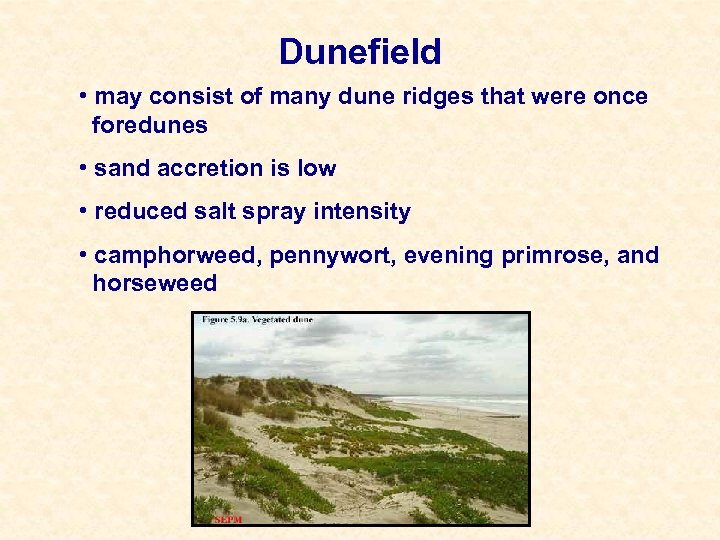
Dunefield • may consist of many dune ridges that were once foredunes • sand accretion is low • reduced salt spray intensity • camphorweed, pennywort, evening primrose, and horseweed
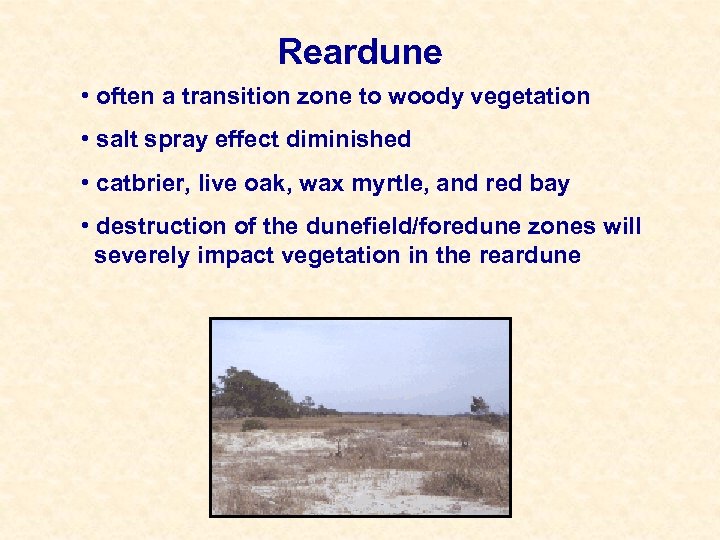
Reardune • often a transition zone to woody vegetation • salt spray effect diminished • catbrier, live oak, wax myrtle, and red bay • destruction of the dunefield/foredune zones will severely impact vegetation in the reardune
Slacks • low depressions formed during dune ridge development or by blowouts in the dune field • salt spray intensity is low • greater diversity of species • increased plant cover density • may be destroyed by migrating sand dunes
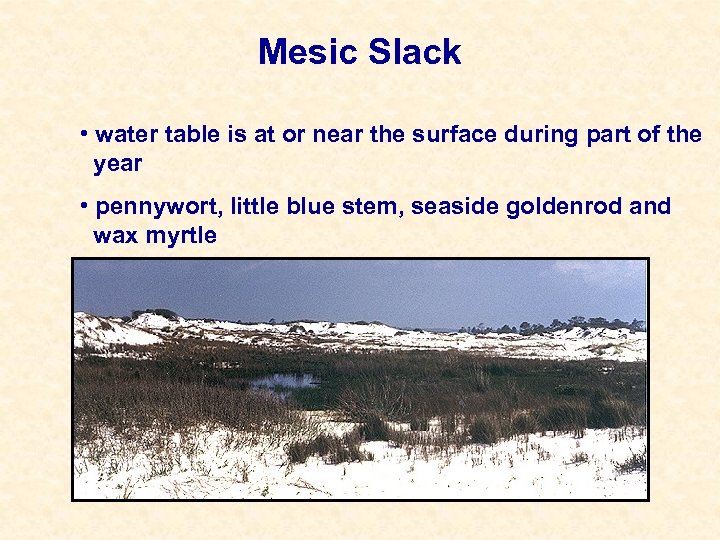
Mesic Slack • water table is at or near the surface during part of the year • pennywort, little blue stem, seaside goldenrod and wax myrtle
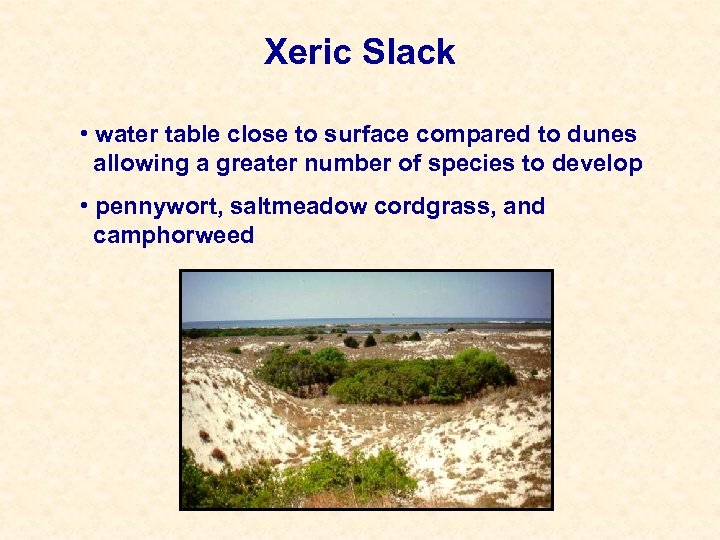
Xeric Slack • water table close to surface compared to dunes allowing a greater number of species to develop • pennywort, saltmeadow cordgrass, and camphorweed
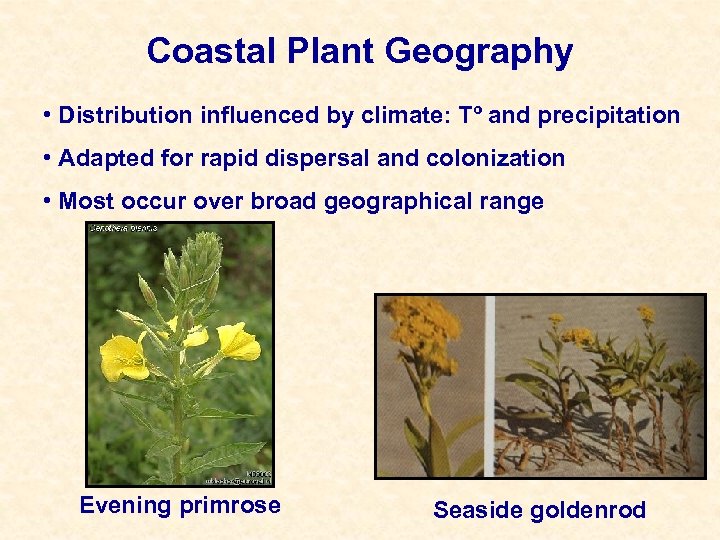
Coastal Plant Geography • Distribution influenced by climate: Tº and precipitation • Adapted for rapid dispersal and colonization • Most occur over broad geographical range Evening primrose Seaside goldenrod
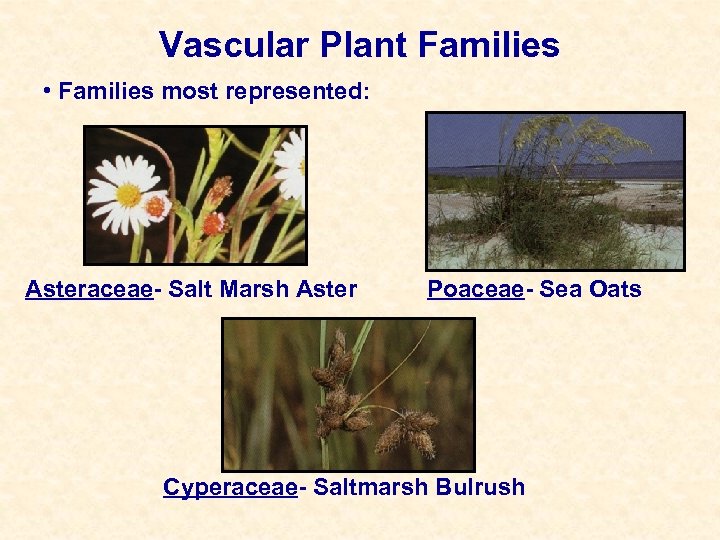
Vascular Plant Families • Families most represented: Asteraceae- Salt Marsh Aster Poaceae- Sea Oats Cyperaceae- Saltmarsh Bulrush
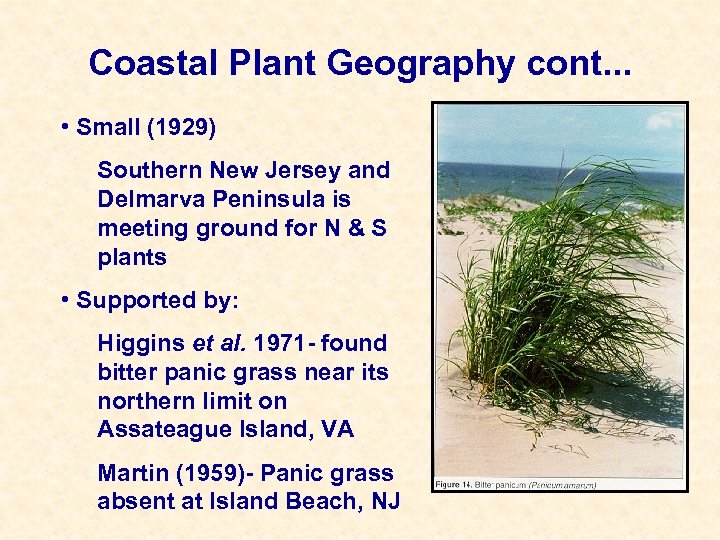
Coastal Plant Geography cont. . . • Small (1929) Southern New Jersey and Delmarva Peninsula is meeting ground for N & S plants • Supported by: Higgins et al. 1971 - found bitter panic grass near its northern limit on Assateague Island, VA Martin (1959)- Panic grass absent at Island Beach, NJ
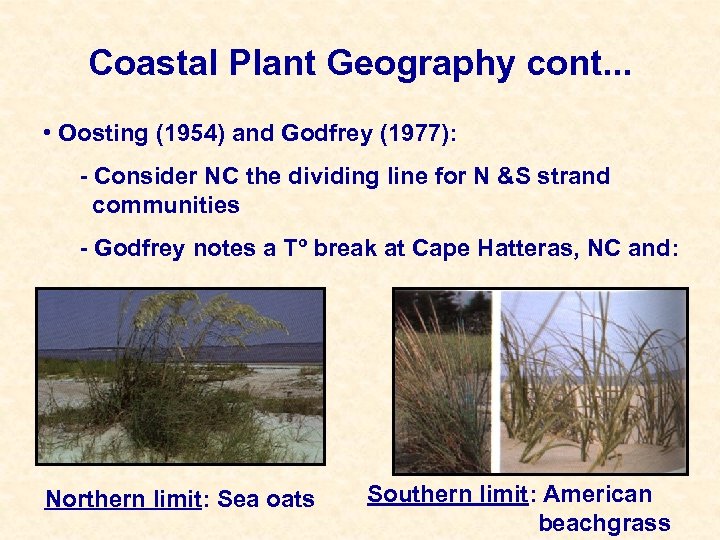
Coastal Plant Geography cont. . . • Oosting (1954) and Godfrey (1977): - Consider NC the dividing line for N &S strand communities - Godfrey notes a Tº break at Cape Hatteras, NC and: Northern limit: Sea oats Southern limit: American beachgrass
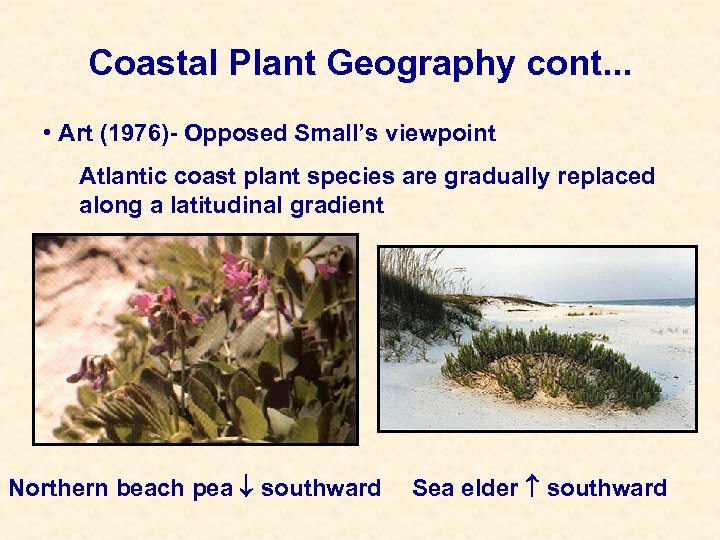
Coastal Plant Geography cont. . . • Art (1976)- Opposed Small’s viewpoint Atlantic coast plant species are gradually replaced along a latitudinal gradient Northern beach pea southward Sea elder southward
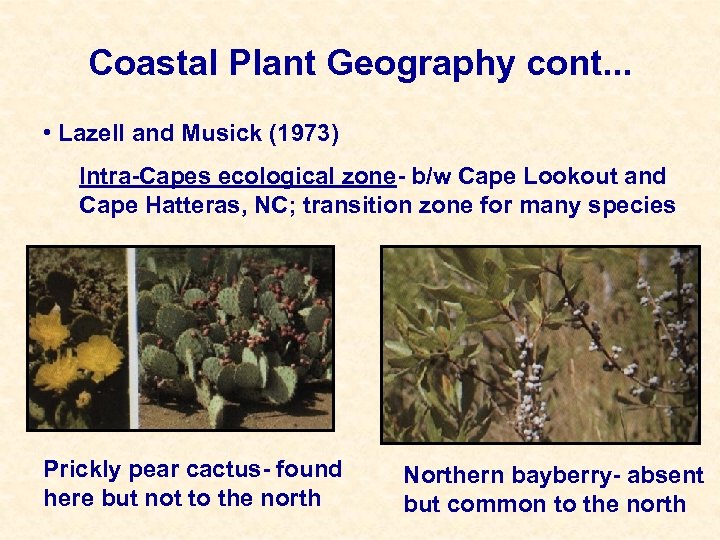
Coastal Plant Geography cont. . . • Lazell and Musick (1973) Intra-Capes ecological zone- b/w Cape Lookout and Cape Hatteras, NC; transition zone for many species Prickly pear cactus- found here but not to the north Northern bayberry- absent but common to the north
Rare and Endangered Plants • New Jersey: Seaside broomspurge- rare in NJ, yet abundant in southeast Seabeach sandwort- endangered in NJ, more common to the north
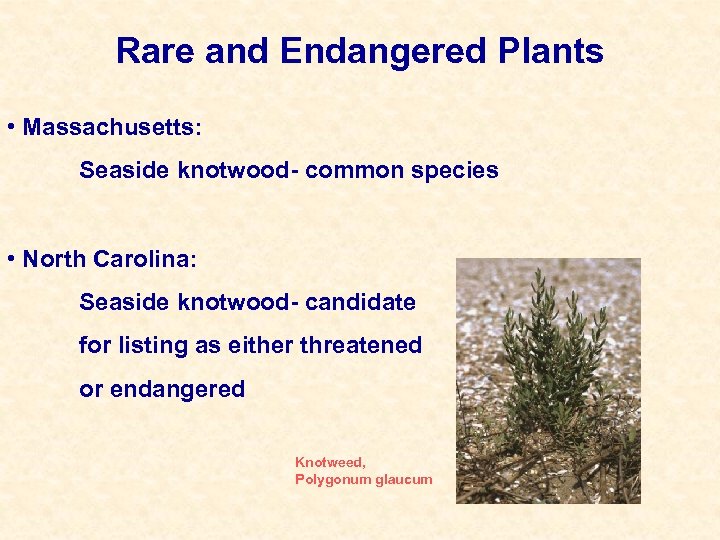
Rare and Endangered Plants • Massachusetts: Seaside knotwood- common species • North Carolina: Seaside knotwood- candidate for listing as either threatened or endangered Knotweed, Polygonum glaucum
Non-vascular Plants • More important in slacks • Microorganisms have an important role in soil formation • Aggregates found in dune and slack soils: Fungi, bacteria, actinomycetes, and algae • These plants bind soil particles and increase soil fertility • Little is known of these plants- future research warranted
Non-vascular Plants • Microbial aggregations Increase in number and complexity as dunes mature Bacteria binds sand particles to water-holding capacity 2 types: Root microbial aggregates- Sand grains trap in root surface and hairs Debris microbial aggregates- Sand grains adhere to decaying organic matter to form these
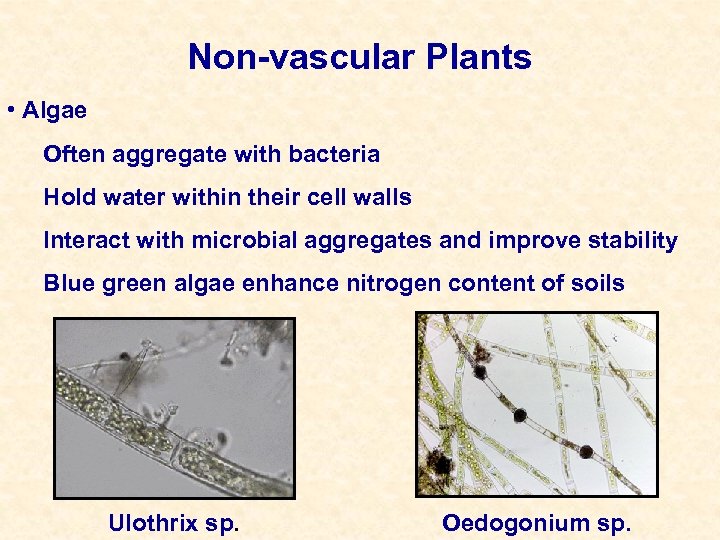
Non-vascular Plants • Algae Often aggregate with bacteria Hold water within their cell walls Interact with microbial aggregates and improve stability Blue green algae enhance nitrogen content of soils Ulothrix sp. Oedogonium sp.
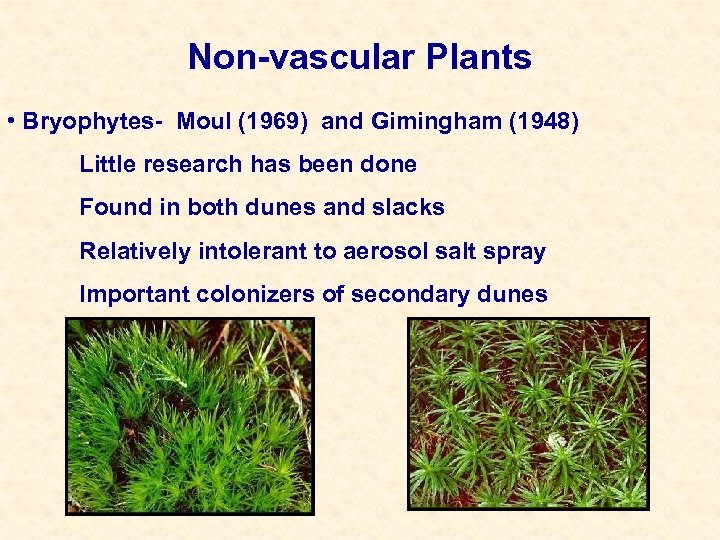
Non-vascular Plants • Bryophytes- Moul (1969) and Gimingham (1948) Little research has been done Found in both dunes and slacks Relatively intolerant to aerosol salt spray Important colonizers of secondary dunes
Non-vascular Plants • Fungi- Nicholson and Johnston (1979) Little research has been done Increase in incidence as dunes mature Some play a role in nutrition of higher plants Some plants are susceptible to fungal attacks
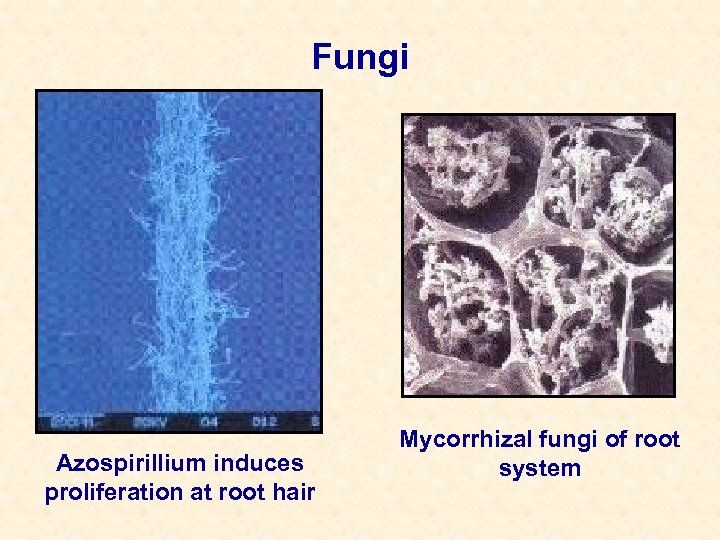
Fungi Azospirillium induces proliferation at root hair Mycorrhizal fungi of root system
Exotic Species • Plants: may establish breeding populations • Accidentally introduced by tourists • Few survive and thrive in dunes and slacks Japanese sedge French tamarisk
Animals • Invertebrates • Amphibians • Reptiles • Birds • Mammals • Rare and endangered species • Exotics
Invertebrates Nematodes: Suppress growth and cause root damage to plants Cause die offs of American Beachgrass Arthropods: Mc. Lachlan et al. (1987) found 7 orders of insects in study along African coast Insects most common in mature dunes Mostly found in open sand habitat
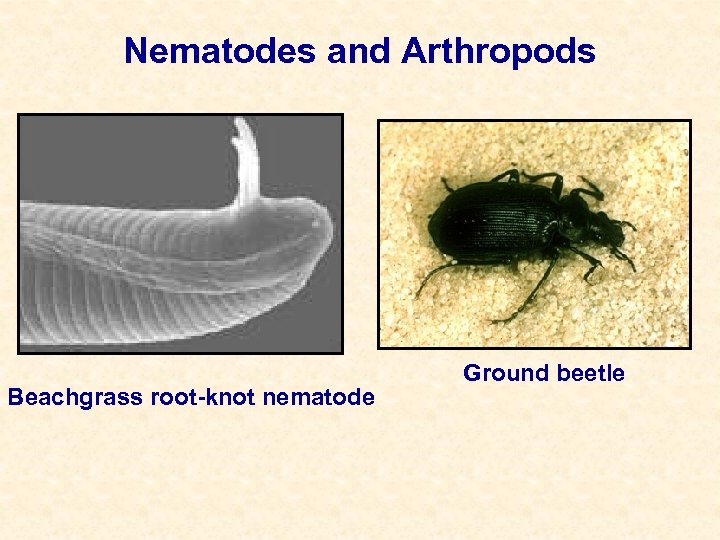
Nematodes and Arthropods Beachgrass root-knot nematode Ground beetle
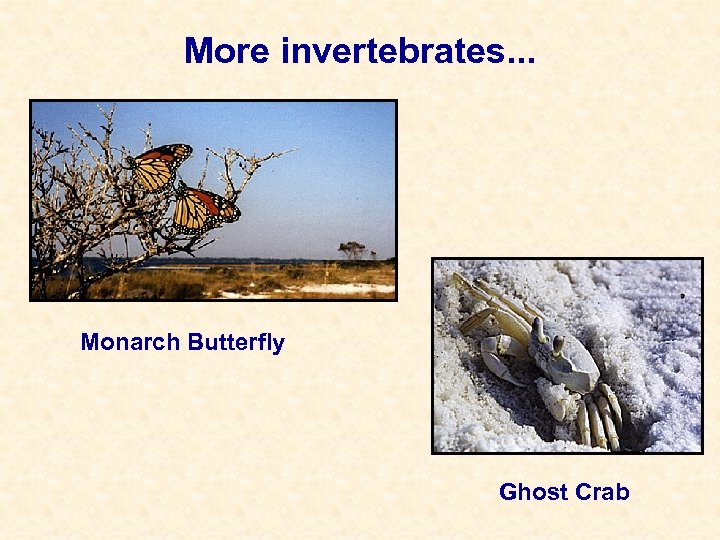
More invertebrates. . . Monarch Butterfly Ghost Crab
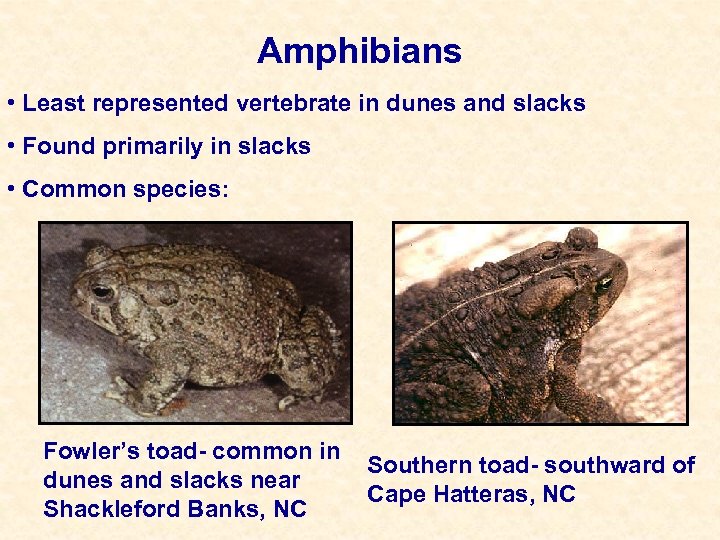
Amphibians • Least represented vertebrate in dunes and slacks • Found primarily in slacks • Common species: Fowler’s toad- common in dunes and slacks near Shackleford Banks, NC Southern toad- southward of Cape Hatteras, NC
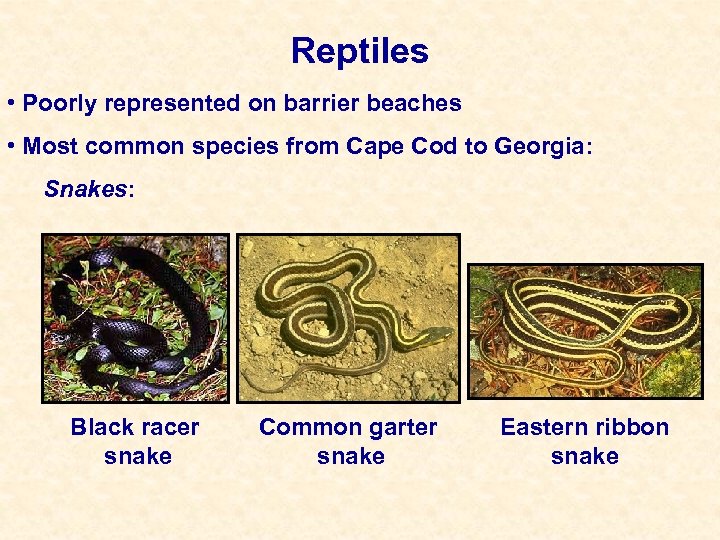
Reptiles • Poorly represented on barrier beaches • Most common species from Cape Cod to Georgia: Snakes: Black racer snake Common garter snake Eastern ribbon snake
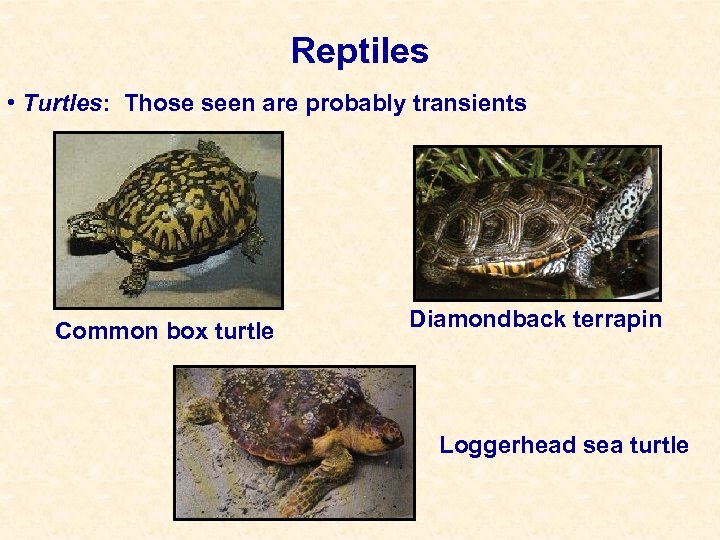
Reptiles • Turtles: Those seen are probably transients Common box turtle Diamondback terrapin Loggerhead sea turtle
Birds • Many species use dune and slack resources • Few live entire lifespan in this area • Mostly use dunes and slacks for nesting or feeding sites Terns and gulls use strand line and sand flats Willit- nest in clumps of dune grasses Piping Plover- federally threatened forages along beach for small inverts
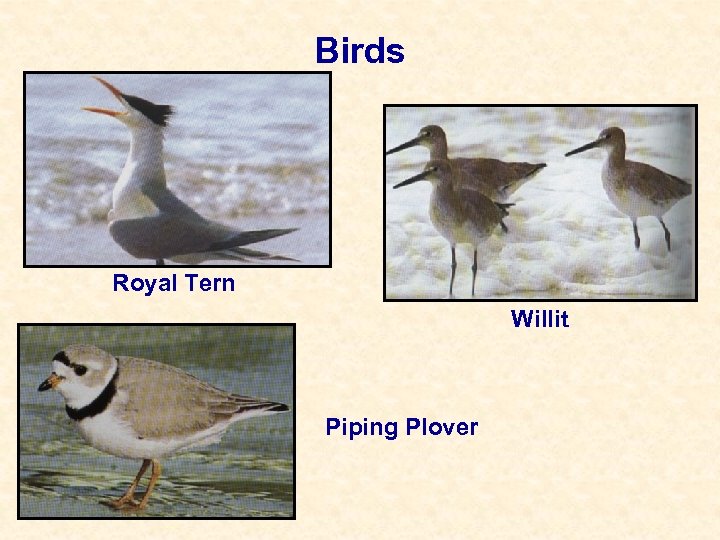
Birds Royal Tern Willit Piping Plover
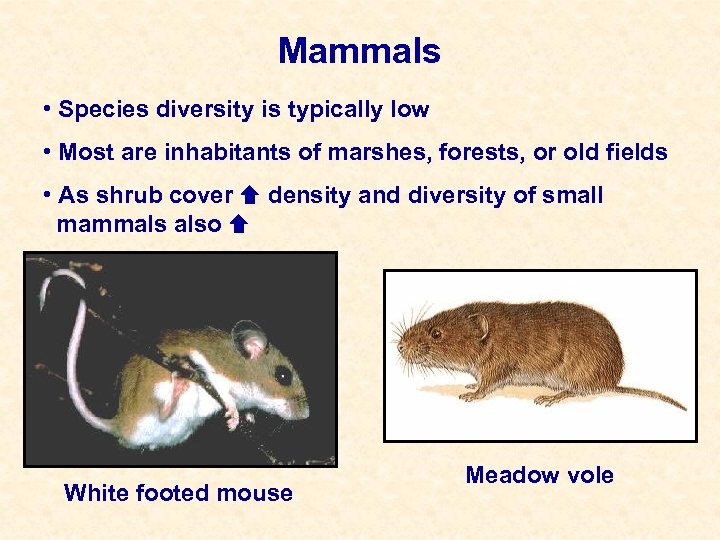
Mammals • Species diversity is typically low • Most are inhabitants of marshes, forests, or old fields • As shrub cover density and diversity of small mammals also White footed mouse Meadow vole
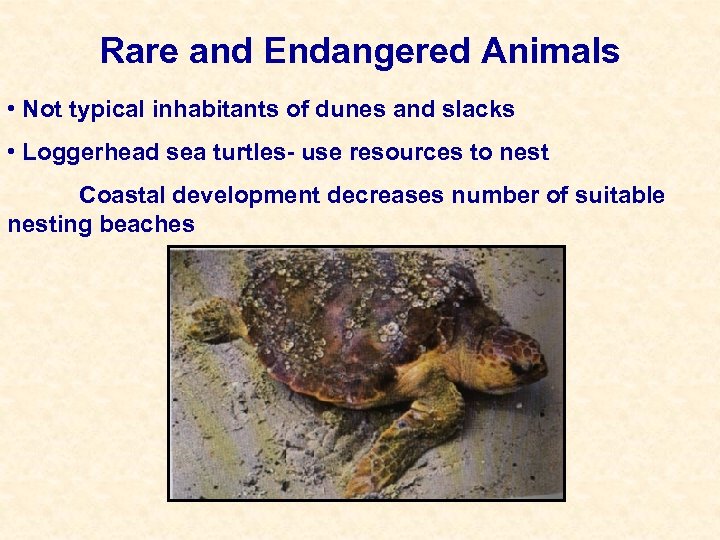
Rare and Endangered Animals • Not typical inhabitants of dunes and slacks • Loggerhead sea turtles- use resources to nest Coastal development decreases number of suitable nesting beaches
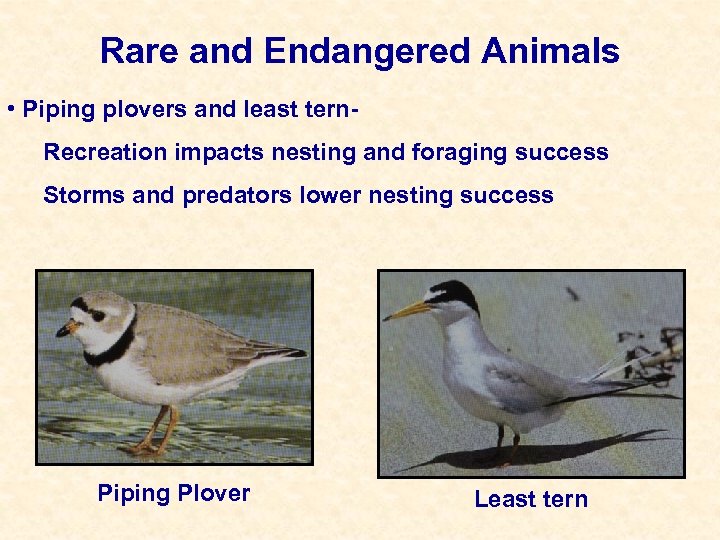
Rare and Endangered Animals • Piping plovers and least tern. Recreation impacts nesting and foraging success Storms and predators lower nesting success Piping Plover Least tern
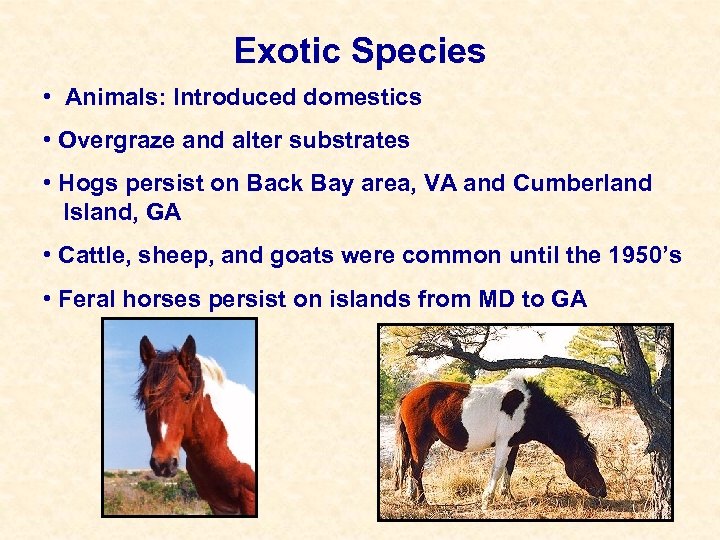
Exotic Species • Animals: Introduced domestics • Overgraze and alter substrates • Hogs persist on Back Bay area, VA and Cumberland Island, GA • Cattle, sheep, and goats were common until the 1950’s • Feral horses persist on islands from MD to GA
References Amos, W. H. and S. H. Amos. 1985. National Audobon Society Nature Guides: Atlantic and Gulf coasts. Random House: New York, NY: 670 p. Graetz, K. E. , 1973. Seacoast Plants of the Carolinas. U. S. Department of Agriculture Soil Conservation Service, Raleigh, North Carolina, 206 pp. Environmental Inventory of Kiawah Island, 1975. Environmental Research Center, Inc. , Columbia, South Carolina. Kraus, E. Jean Wilson, 1988. A Guide to Ocean Dune Plants Common to North Carolina. The University of North Carolina Press, Chapel Hill, North Carolina, 72 pp. Packham, J. R. , and A. J. Willis. 1997. Ecology of dunes, saltmarsh and shingle. Chapman and Hall: Cambridge: 335 pp. Shumway, Scott W. , 2000. Facilitative effects of a sand dune shrub on species growing beneath the shrub canopy. Oecologia (2000) 124: 138148. Will, M. E. , D. M. Sylvia, 1990. Interaction of Rhizosphere Bacteria, Fertilizer, and Vesicular-Arbuscular Mycorrhizal Fungi with Sea Oats. Appl. Environ. Microbiol. , July 1990, p. 2073 -2079.
References cont. . . http: //birch. incolsa. net/~drigg/snakes. htm http: //bonita. mbnms. noaa. gov/sitechar/sandy. html http: //cedar. evansville. edu/~ck 6/bstud/mouse. html http: //entweb. clemson. edu/cuentres/cesheets/benefici/ce 172. htm http: //mbgnet. mobot. org/pfg/diverse/biomes/grasslnd/animals/vole. htm http: //www. chias. org/www/diorama/w 1. html http: //www. csc. noaa. gov/otter/htmls/mainmenu. htm http: //www. csdl. tamu. edu/FLORA/gallery. htm http: //www. environment. gov. au/ http: //www. epa. gov/owow/oceans/lagoon/foredune. html http: //www. gcw. nl/nieuws/art/a 99_1_1. htm http: //www. helsinki. fi/kmus/botpics. html http: //www. marshall. edu/herp/anurans. htm http: //www. nceet. snre. umich. edu/End. Spp/oldfilerequested. html http: //www. ohiokids. org/ohc/nature/animals/reptile/bracer. html http: //www. seafriends. org. nz/oceano/beach. htm#beach http: //www/uncwil. edu/people/hosier/BIE/bieclschd/present/adapthuman. htm http: //www. yates. clara. net/photos. html
Скачать презентацию Dunes and Slacks Dune Mound of wind blown
5e5ecebfae19058d6887ddac8e584a3d.ppt