Скачать презентацию DSSC and TF Poly-Si Solar Cells Dye-sensitized Ti
5aab134234af42c36ca8fff0be2c7aef.ppt
- Количество слайдов: 67
 DSSC and TF Poly-Si Solar Cells Dye-sensitized Ti. O 2 and thin film polysilicon solar cells: fabrication and measurements of photon-to-electron conversion efficiencies using Lab. View
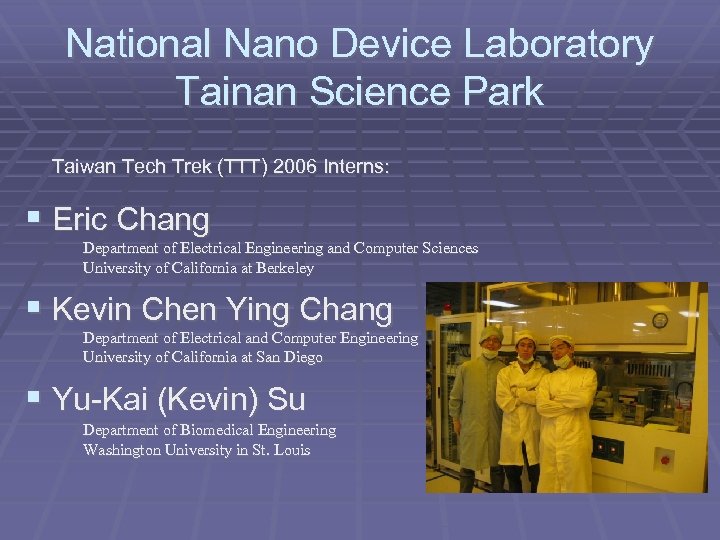 National Nano Device Laboratory Tainan Science Park Taiwan Tech Trek (TTT) 2006 Interns: Eric Chang Department of Electrical Engineering and Computer Sciences University of California at Berkeley Kevin Chen Ying Chang Department of Electrical and Computer Engineering University of California at San Diego Yu-Kai (Kevin) Su Department of Biomedical Engineering Washington University in St. Louis
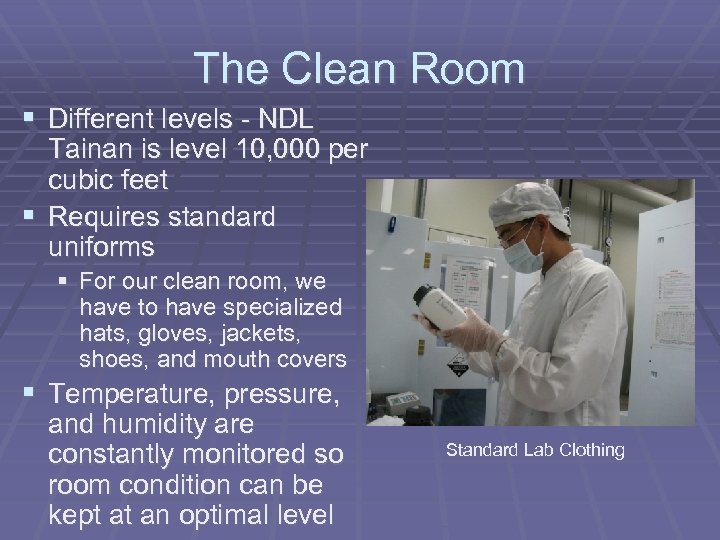 The Clean Room Different levels - NDL Tainan is level 10, 000 per cubic feet Requires standard uniforms For our clean room, we have to have specialized hats, gloves, jackets, shoes, and mouth covers Temperature, pressure, and humidity are constantly monitored so room condition can be kept at an optimal level Standard Lab Clothing
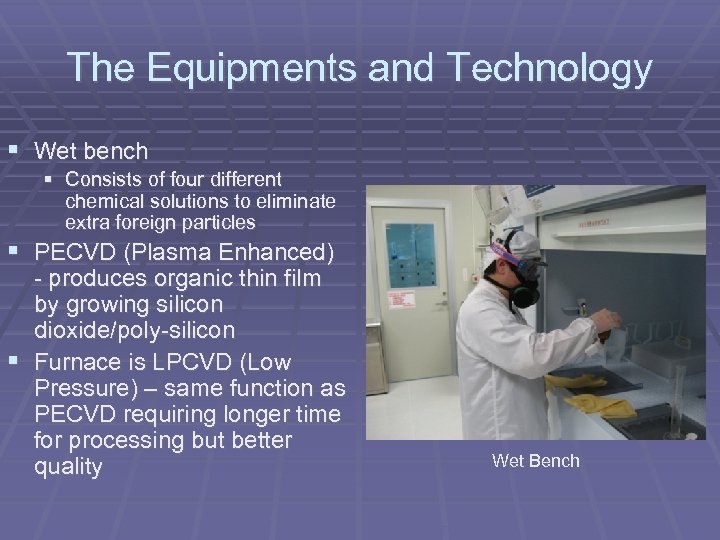 The Equipments and Technology Wet bench Consists of four different chemical solutions to eliminate extra foreign particles PECVD (Plasma Enhanced) - produces organic thin film by growing silicon dioxide/poly-silicon Furnace is LPCVD (Low Pressure) – same function as PECVD requiring longer time for processing but better quality Wet Bench
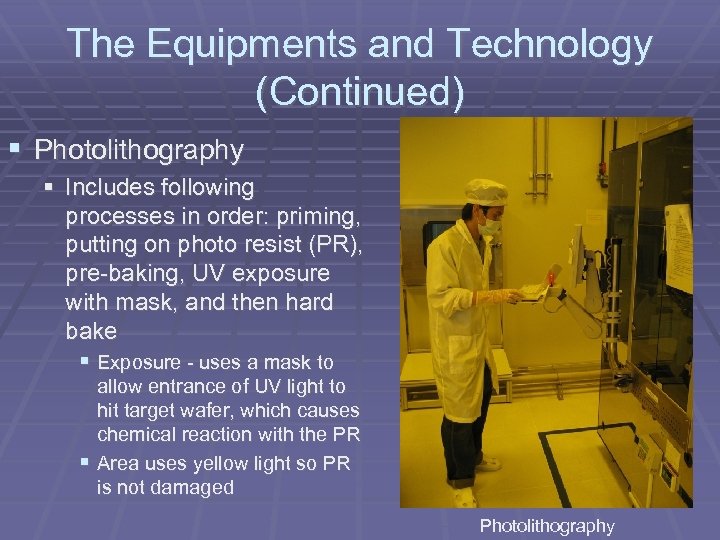 The Equipments and Technology (Continued) Photolithography Includes following processes in order: priming, putting on photo resist (PR), pre-baking, UV exposure with mask, and then hard bake Exposure - uses a mask to allow entrance of UV light to hit target wafer, which causes chemical reaction with the PR Area uses yellow light so PR is not damaged Photolithography
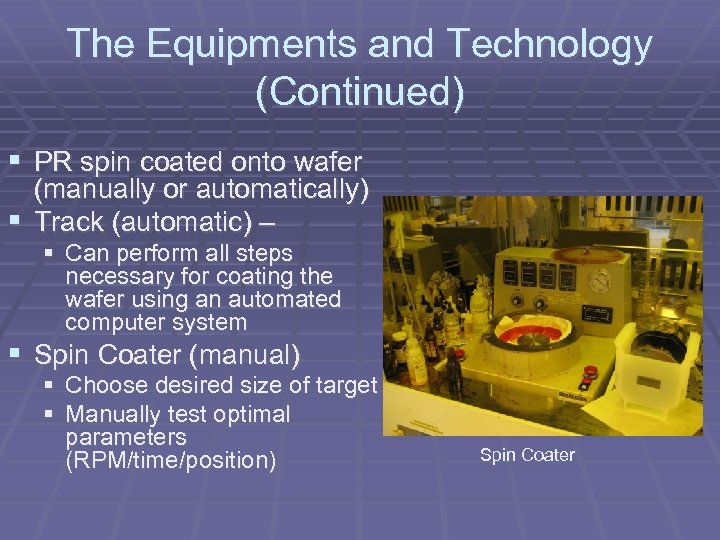 The Equipments and Technology (Continued) PR spin coated onto wafer (manually or automatically) Track (automatic) – Can perform all steps necessary for coating the wafer using an automated computer system Spin Coater (manual) Choose desired size of target Manually test optimal parameters (RPM/time/position) Spin Coater
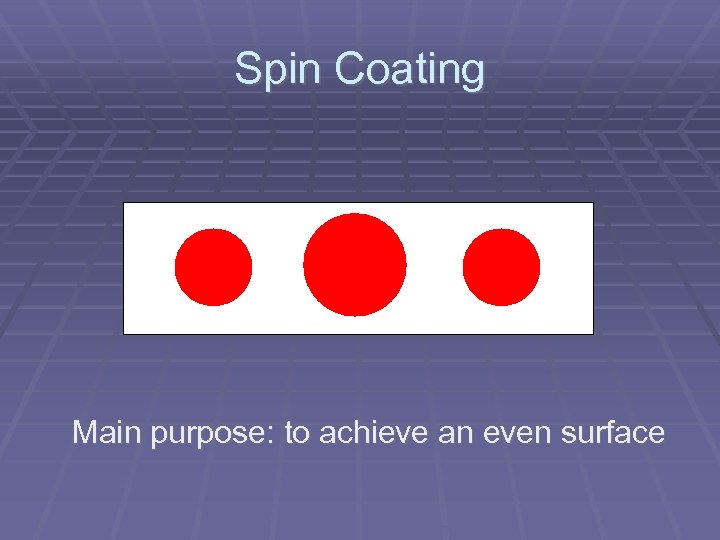 Spin Coating Main purpose: to achieve an even surface
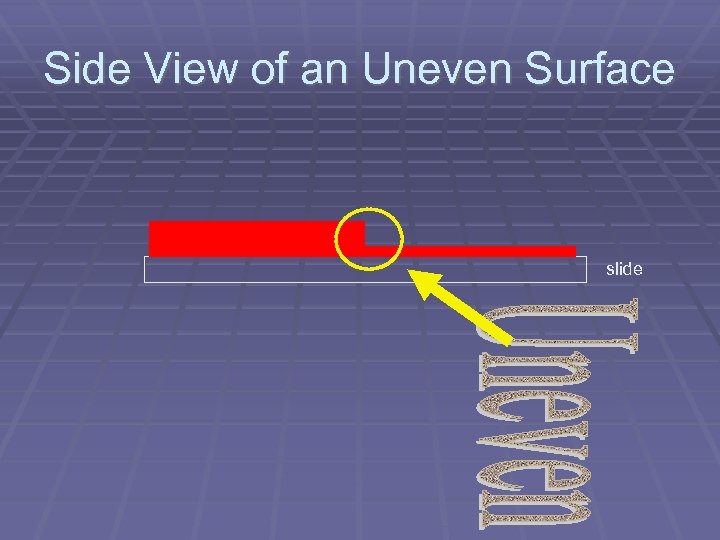 Side View of an Uneven Surface slide
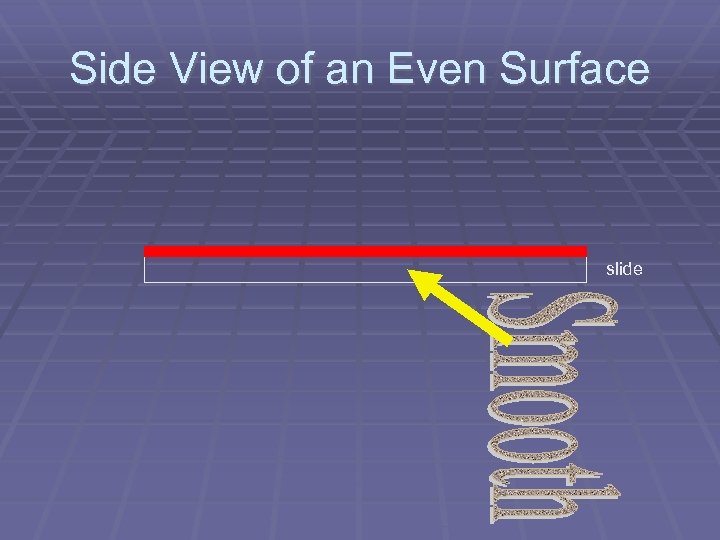 Side View of an Even Surface slide
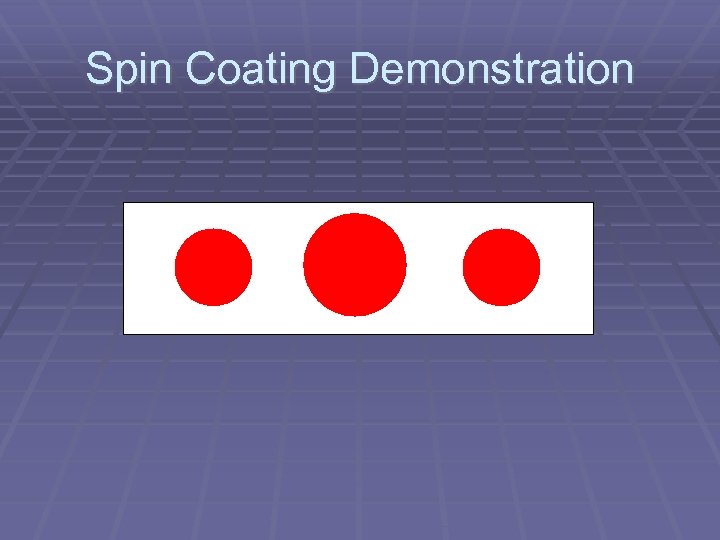 Spin Coating Demonstration



















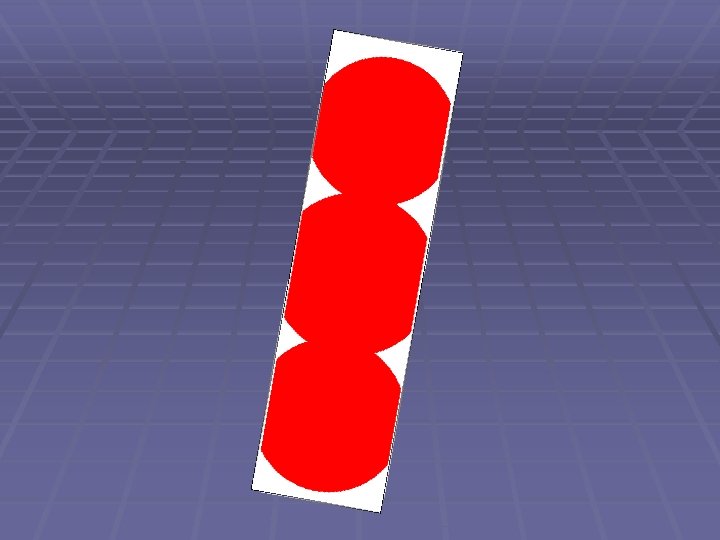

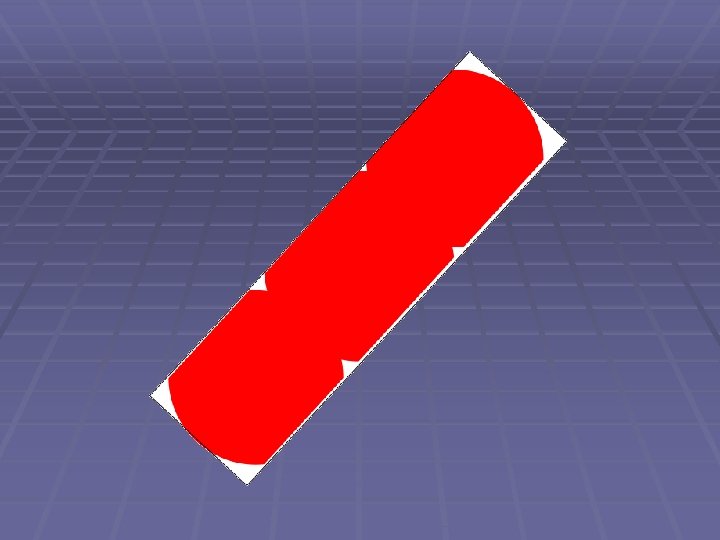


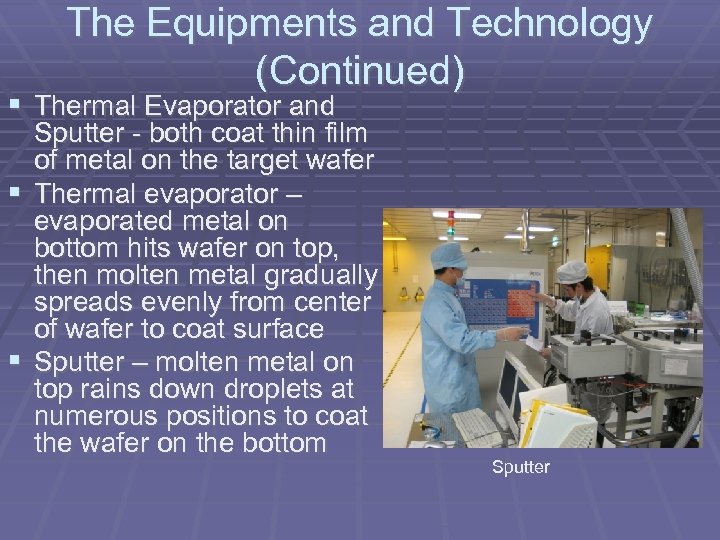 The Equipments and Technology (Continued) Thermal Evaporator and Sputter - both coat thin film of metal on the target wafer Thermal evaporator – evaporated metal on bottom hits wafer on top, then molten metal gradually spreads evenly from center of wafer to coat surface Sputter – molten metal on top rains down droplets at numerous positions to coat the wafer on the bottom Sputter
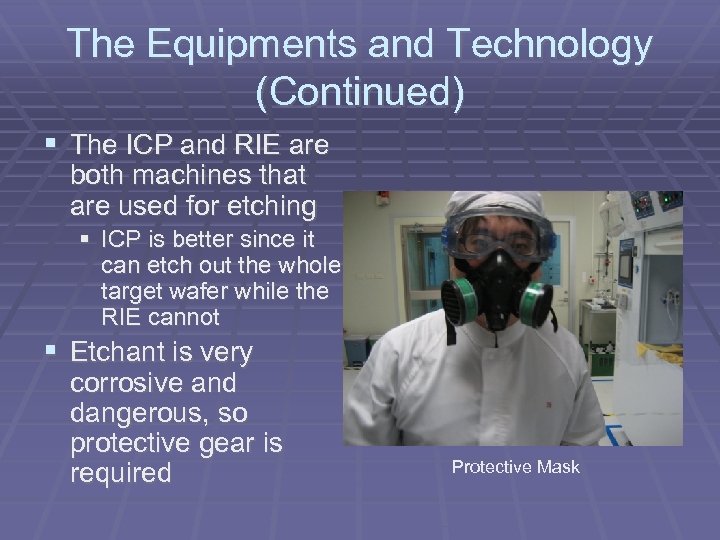 The Equipments and Technology (Continued) The ICP and RIE are both machines that are used for etching ICP is better since it can etch out the whole target wafer while the RIE cannot Etchant is very corrosive and dangerous, so protective gear is required Protective Mask
 The Equipments and Technology (Continued) AFM – scans out 3 D image of target’s surface Nano-scale probe vibrates with a certain frequency at a synchronized distance away from the target Vibration changes can be detected by a light that is reflected upon it, which gives data for image Probe station Uses microscope and nano-scale probe to make contact with different shapes of arrays on target Probe station is utilized for contact with conductive materials, while AFM targets regular surfaces
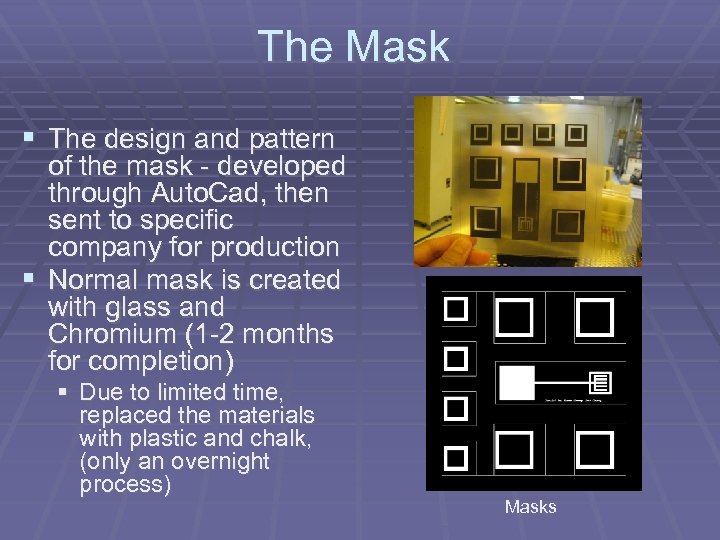 The Mask The design and pattern of the mask - developed through Auto. Cad, then sent to specific company for production Normal mask is created with glass and Chromium (1 -2 months for completion) Due to limited time, replaced the materials with plastic and chalk, (only an overnight process) Masks
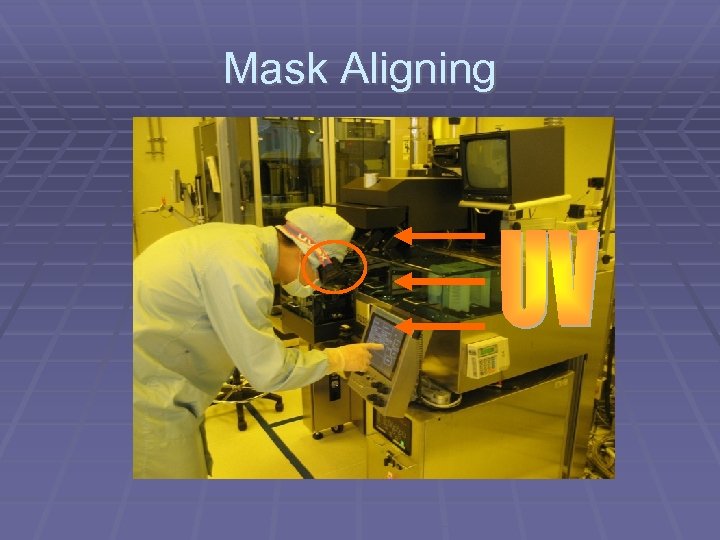 Mask Aligning
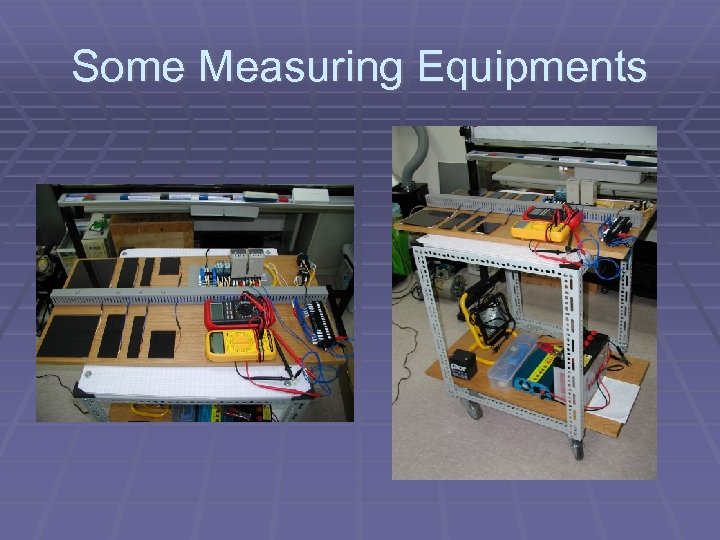 Some Measuring Equipments
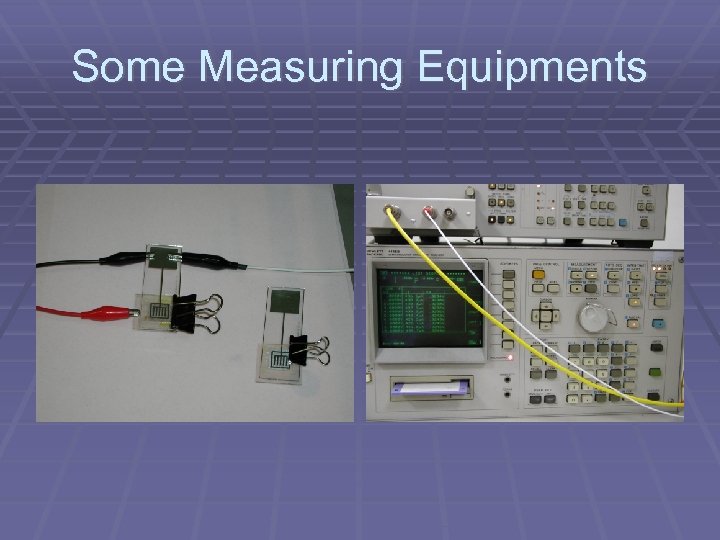 Some Measuring Equipments
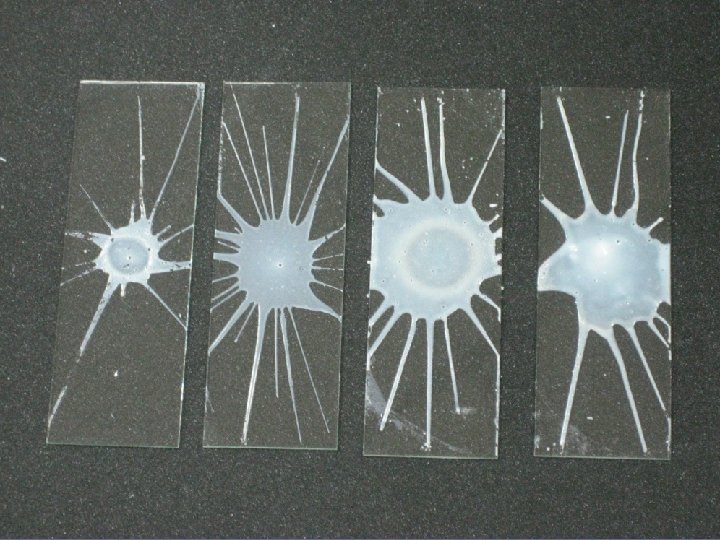 Finding the Optimal RPM and Time 0. 2 m. L HAc (hydrogen acetate) in 100 m. L DI water Ti. O 2: 1. 35± 0. 05 g with 40 drops of acetic acid 1 RPM 2 3 4 500 1300 1200 1100 30 30 30 Time (second) 20
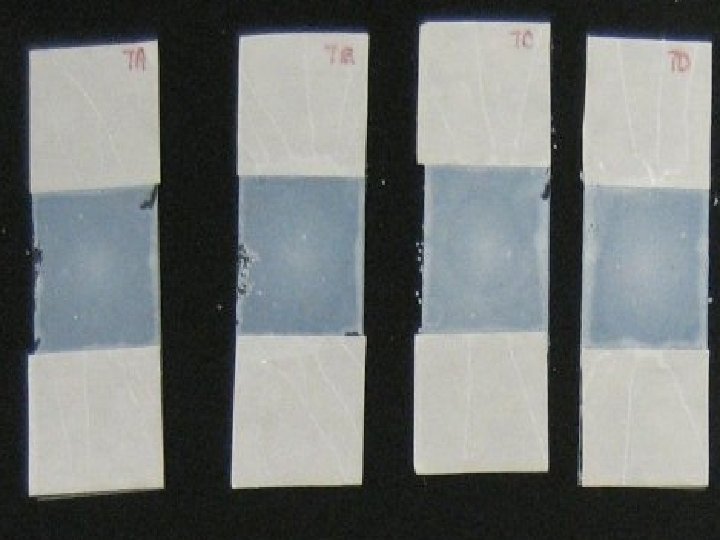 Table 1: 70 Drops of Acetic Acid RPM Time (second) Comment 7 A 1100 30 7 B 1100 30 7 C 1000 30 7 D 900 30 not drops, painted on (corners) 7 E 900 30 Less Ti. O 2 at the corners compared to D 7 F 1100 30 Less drops, not as evenly distributed 7 G 1100 30 7 H 1100 30 More drops at corners
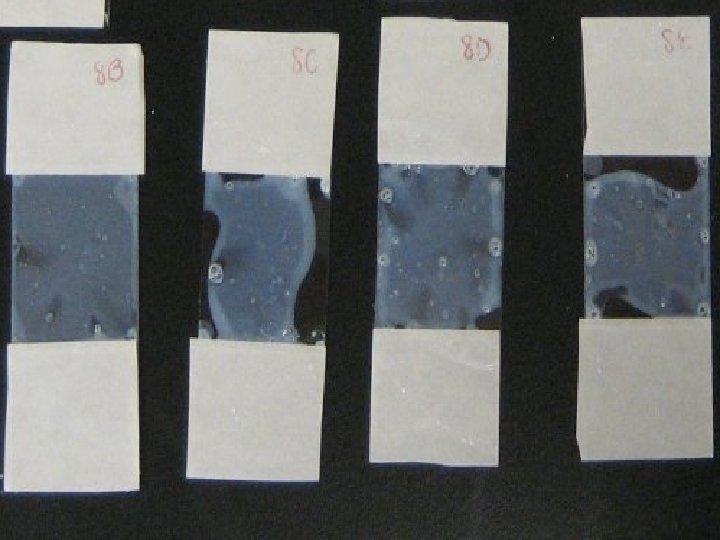 Table 2: 80 Drops of Acetic Acid RPM Time (second) 8 A 1000 30 8 B 900 30 8 C 700 20 8 D 800 10 8 E 700 40 Comment Not evenly spread
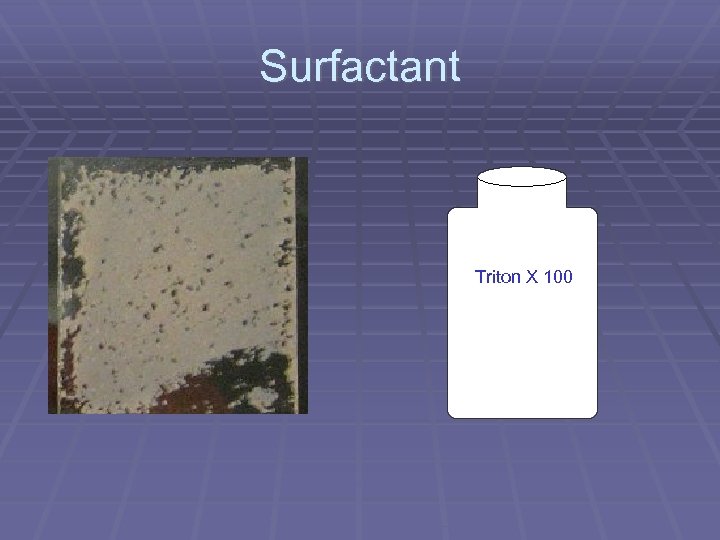 Surfactant Triton X 100
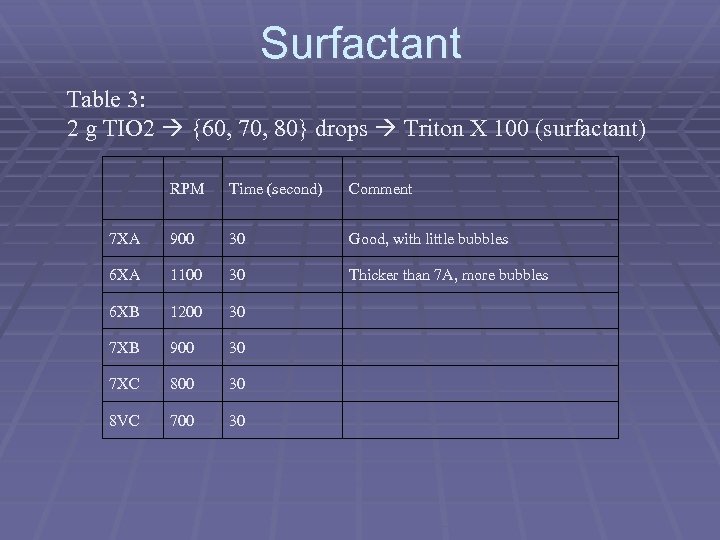 Surfactant Table 3: 2 g TIO 2 {60, 70, 80} drops Triton X 100 (surfactant) RPM Time (second) Comment 7 XA 900 30 Good, with little bubbles 6 XA 1100 30 Thicker than 7 A, more bubbles 6 XB 1200 30 7 XB 900 30 7 XC 800 30 8 VC 700 30
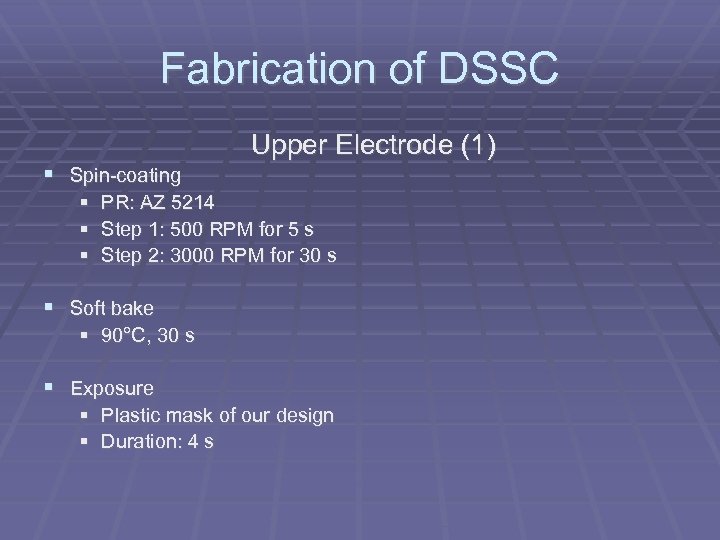 Fabrication of DSSC Upper Electrode (1) Spin-coating PR: AZ 5214 Step 1: 500 RPM for 5 s Step 2: 3000 RPM for 30 s Soft bake 90°C, 30 s Exposure Plastic mask of our design Duration: 4 s
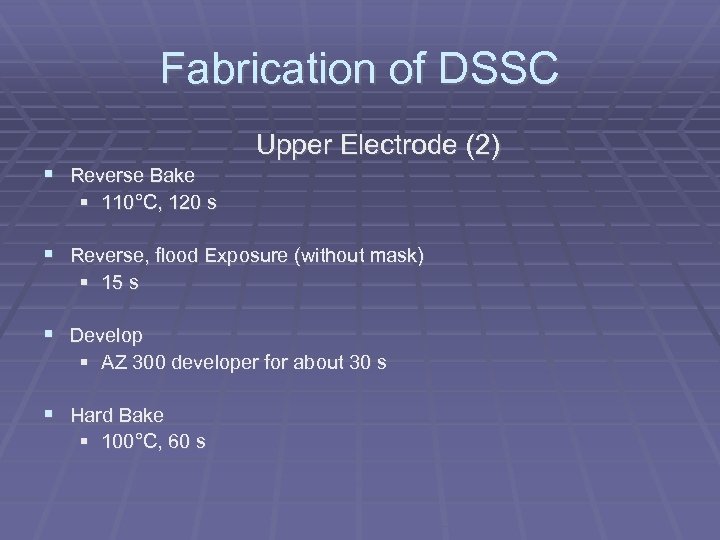 Fabrication of DSSC Upper Electrode (2) Reverse Bake 110°C, 120 s Reverse, flood Exposure (without mask) 15 s Develop AZ 300 developer for about 30 s Hard Bake 100°C, 60 s
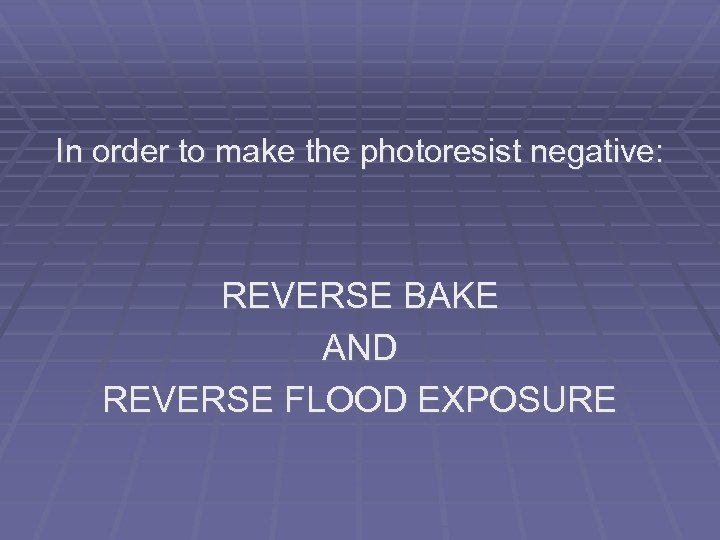 In order to make the photoresist negative: REVERSE BAKE AND REVERSE FLOOD EXPOSURE
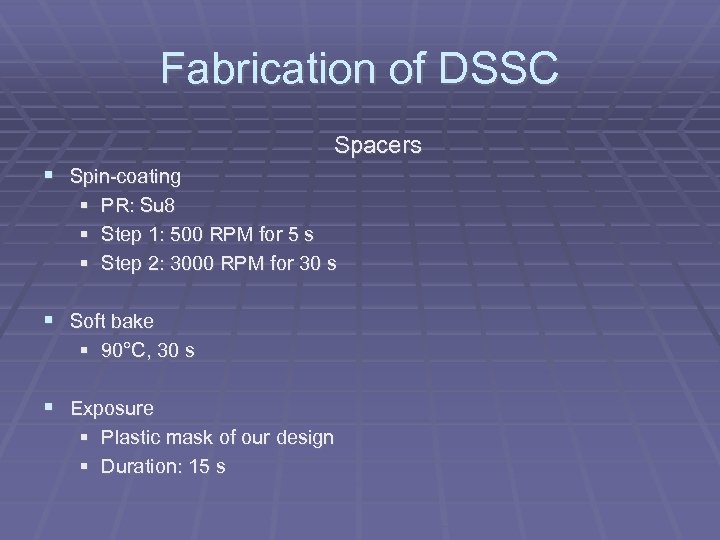 Fabrication of DSSC Spacers Spin-coating PR: Su 8 Step 1: 500 RPM for 5 s Step 2: 3000 RPM for 30 s Soft bake 90°C, 30 s Exposure Plastic mask of our design Duration: 15 s
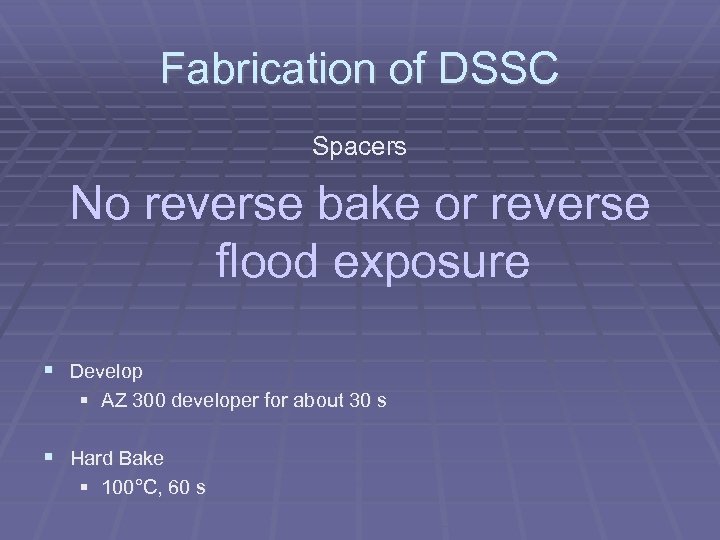 Fabrication of DSSC Spacers No reverse bake or reverse flood exposure Develop AZ 300 developer for about 30 s Hard Bake 100°C, 60 s
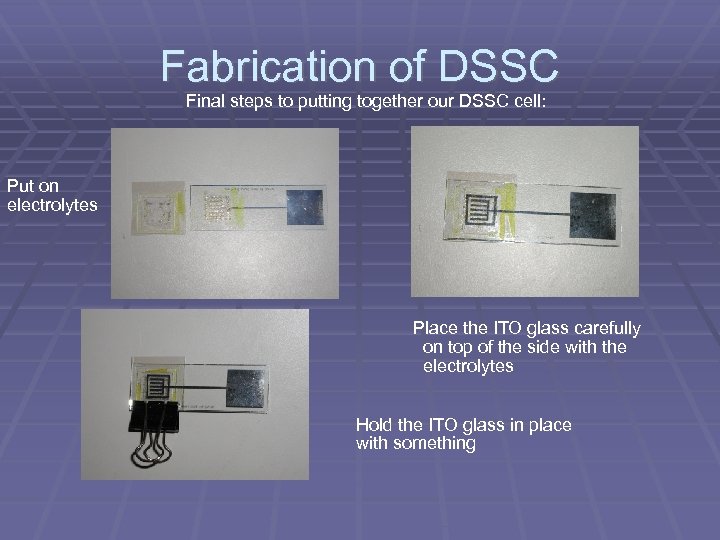 Fabrication of DSSC Final steps to putting together our DSSC cell: Put on electrolytes Place the ITO glass carefully on top of the side with the electrolytes Hold the ITO glass in place with something
 DSSC How It Works and How to Test It
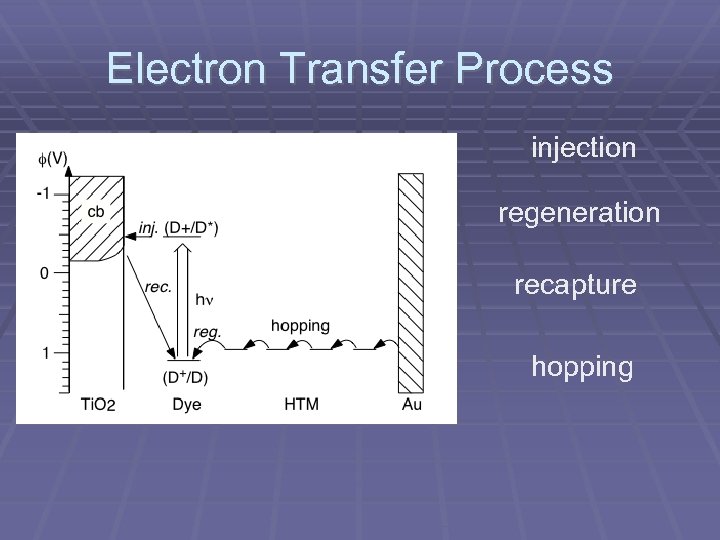 Electron Transfer Process injection regeneration recapture hopping
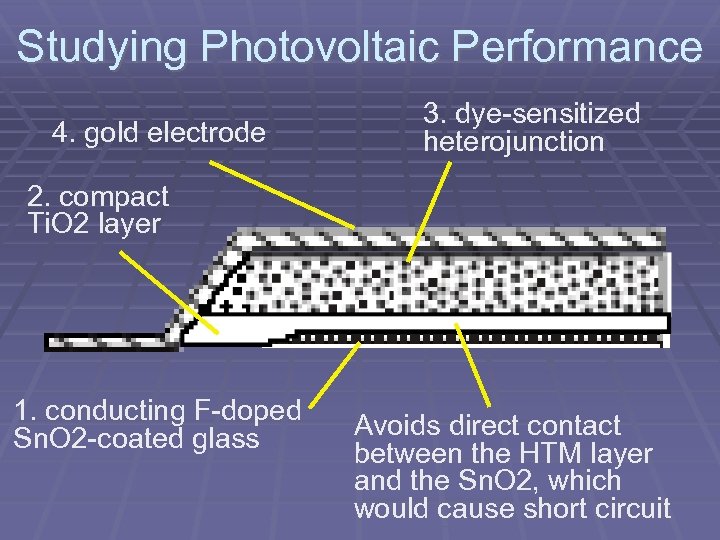 Studying Photovoltaic Performance 4. gold electrode 3. dye-sensitized heterojunction 2. compact Ti. O 2 layer 1. conducting F-doped Sn. O 2 -coated glass Avoids direct contact between the HTM layer and the Sn. O 2, which would cause short circuit
 Thin-Film Poly-Silicon 0 Anneal at 5000 C for Induce crystal: layer 1 hr Remove Al 500 Amorphous Si by wet etching a-Si 4750 nm poly-Si 5000 nm Amorphous Si Induced metal layer Bottom electrode Al a-Si 250 nm poly-Si 250 nm Al 250 nm ITO 300 nm Glass
 Closeup A Detailed Look at Our Experiments
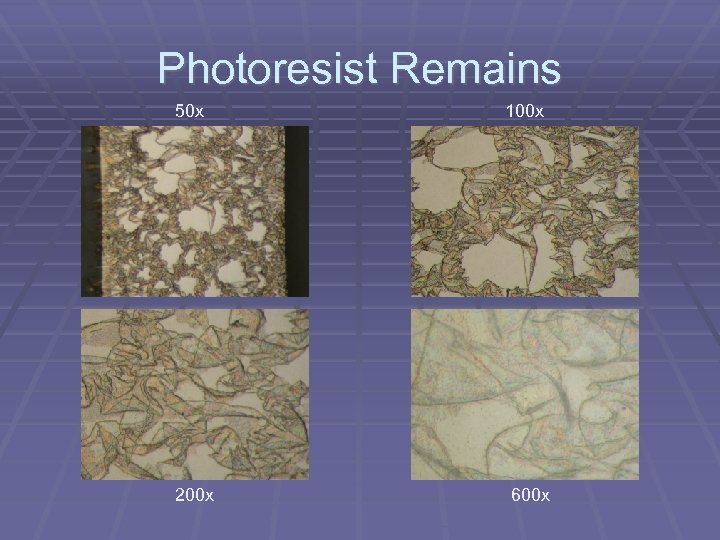 Photoresist Remains 50 x 200 x 100 x 600 x
![50 x Ti. O 2 100 x good contact TIO 2 ] electrode 200](https://present5.com/presentation/5aab134234af42c36ca8fff0be2c7aef/image-60.jpg "50 x Ti. O 2 100 x good contact TIO 2 ] electrode 200") 50 x Ti. O 2 100 x good contact TIO 2 ] electrode 200 x
50 x Ti. O 2 100 x good contact TIO 2 ] electrode 200 x
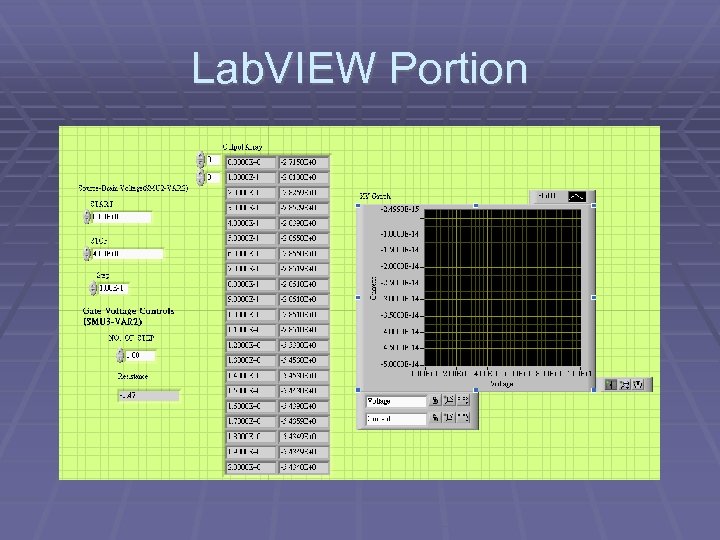
 Lab. VIEW Portion Measurements & Results
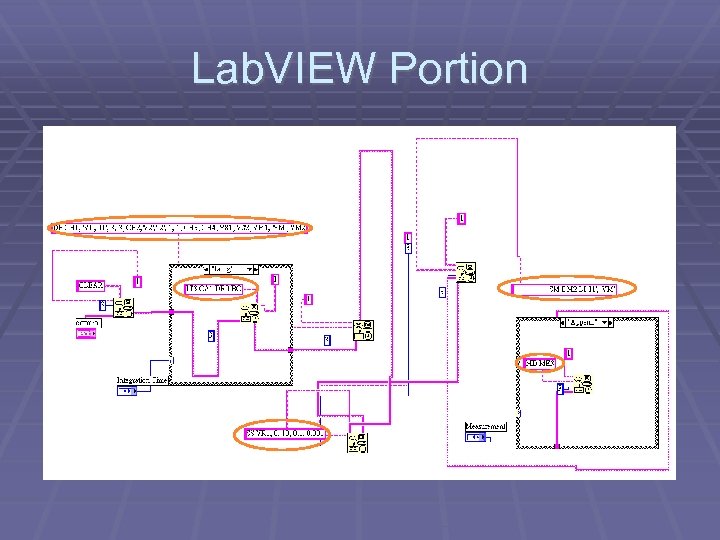 Lab. VIEW Portion
 Lab. VIEW Portion
 Lab. VIEW Portion
 Lab. VIEW Portion
 The END