 Скачать презентацию DSP BIOS System Integration Workshop 1 2 3 4
13160472266847172b6699fd16467b53.ppt
- Количество слайдов: 21



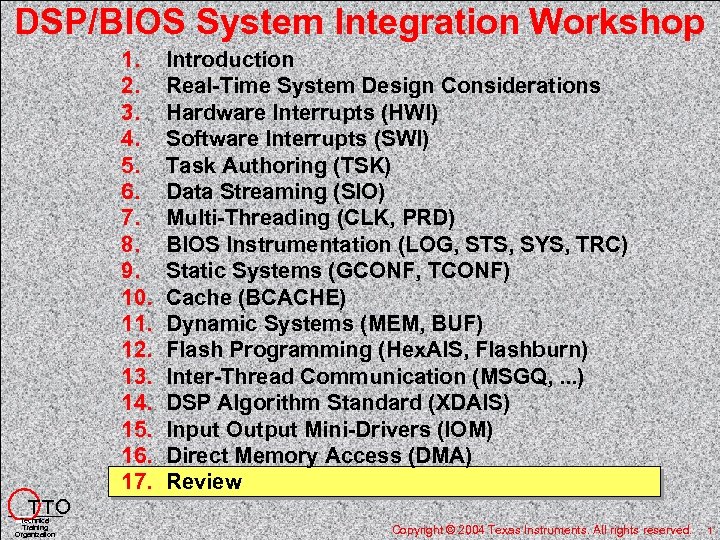
DSP/BIOS System Integration Workshop 1. 2. 3. 4. 5. 6. 7. 8. 9. 10. 11. 12. 13. 14. 15. 16. 17. Introduction Real-Time System Design Considerations Hardware Interrupts (HWI) Software Interrupts (SWI) Task Authoring (TSK) Data Streaming (SIO) Multi-Threading (CLK, PRD) BIOS Instrumentation (LOG, STS, SYS, TRC) Static Systems (GCONF, TCONF) Cache (BCACHE) Dynamic Systems (MEM, BUF) Flash Programming (Hex. AIS, Flashburn) Inter-Thread Communication (MSGQ, . . . ) DSP Algorithm Standard (XDAIS) Input Output Mini-Drivers (IOM) Direct Memory Access (DMA) Review T TO Technical Training Organization Copyright © 2004 Texas Instruments. All rights reserved. 1
Conclusions DSP/BIOS Review Development Tools For More Information T TO Technical Training Organization 2
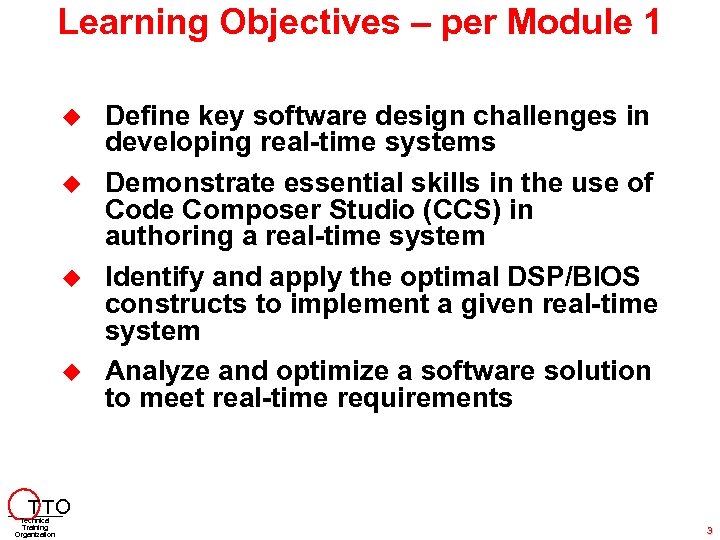
Learning Objectives – per Module 1 Define key software design challenges in developing real-time systems Demonstrate essential skills in the use of Code Composer Studio (CCS) in authoring a real-time system Identify and apply the optimal DSP/BIOS constructs to implement a given real-time system Analyze and optimize a software solution to meet real-time requirements T TO Technical Training Organization 3
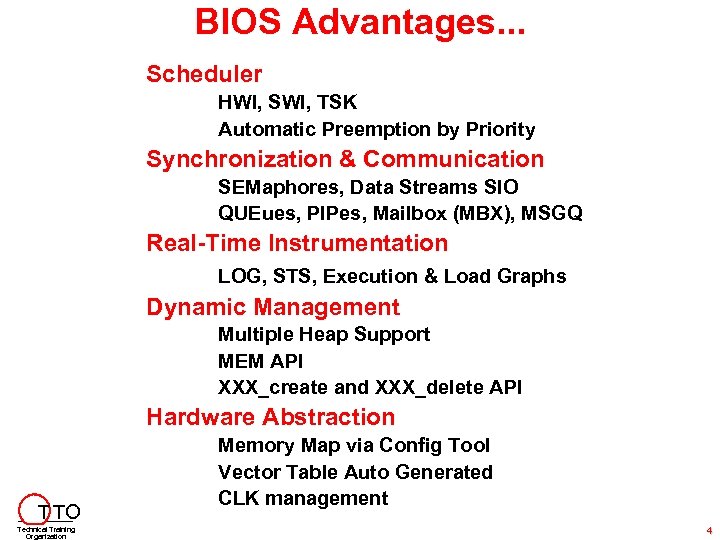
BIOS Advantages. . . Scheduler HWI, SWI, TSK Automatic Preemption by Priority Synchronization & Communication SEMaphores, Data Streams SIO QUEues, PIPes, Mailbox (MBX), MSGQ Real-Time Instrumentation LOG, STS, Execution & Load Graphs Dynamic Management Multiple Heap Support MEM API XXX_create and XXX_delete API Hardware Abstraction T TO Technical Training Organization Memory Map via Config Tool Vector Table Auto Generated CLK management 4
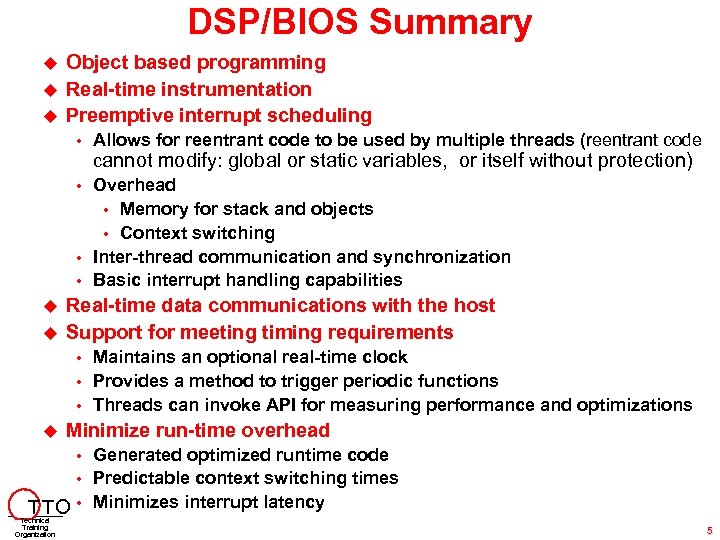
DSP/BIOS Summary Object based programming Real-time instrumentation Preemptive interrupt scheduling Real-time data communications with the host Support for meeting timing requirements Maintains an optional real-time clock Provides a method to trigger periodic functions Threads can invoke API for measuring performance and optimizations Minimize run-time overhead T TO Technical Training Organization Allows for reentrant code to be used by multiple threads (reentrant code cannot modify: global or static variables, or itself without protection) Overhead Memory for stack and objects Context switching Inter-thread communication and synchronization Basic interrupt handling capabilities Generated optimized runtime code Predictable context switching times Minimizes interrupt latency 5
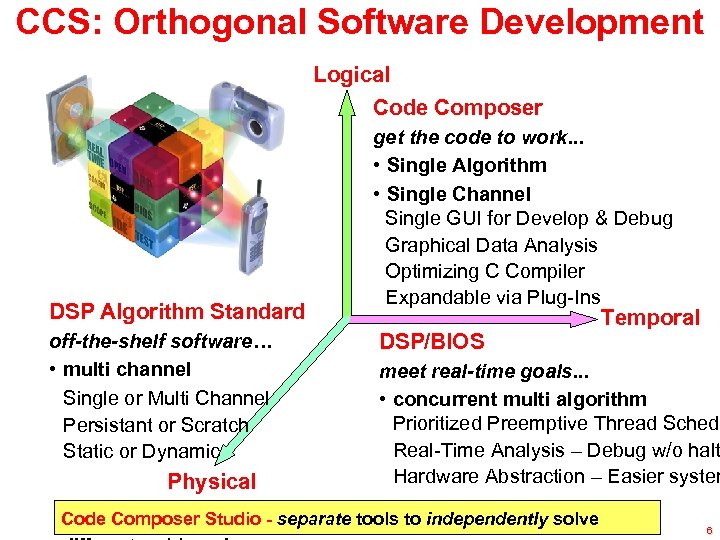
CCS: Orthogonal Software Development Logical Code Composer DSP Algorithm Standard off-the-shelf software… • multi channel Single or Multi Channel Persistant or Scratch Static or Dynamic Physical get the code to work. . . • Single Algorithm • Single Channel Single GUI for Develop & Debug Graphical Data Analysis Optimizing C Compiler Expandable via Plug-Ins DSP/BIOS Temporal meet real-time goals. . . • concurrent multi algorithm Prioritized Preemptive Thread Schedu Real-Time Analysis – Debug w/o halt Hardware Abstraction – Easier system Code Composer Studio - separate tools to independently solve 6
Conclusions DSP/BIOS Review Development Tools For More Information T TO Technical Training Organization 7
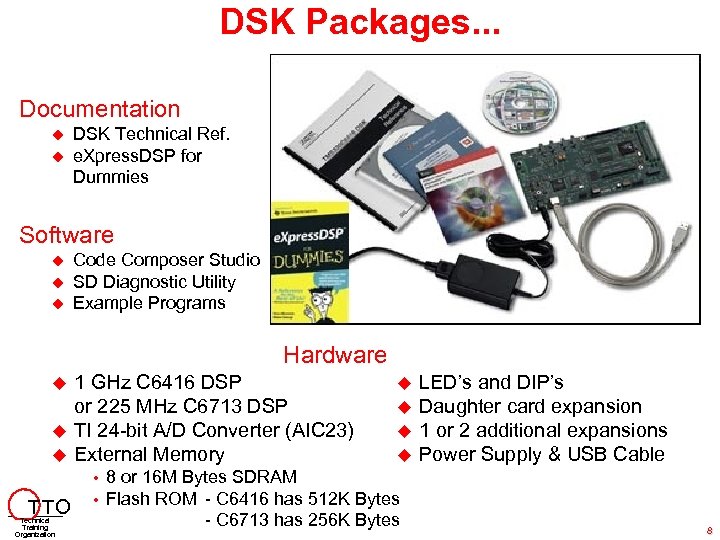
DSK Packages. . . Documentation DSK Technical Ref. e. Xpress. DSP for Dummies Software Code Composer Studio SD Diagnostic Utility Example Programs Hardware 1 GHz C 6416 DSP or 225 MHz C 6713 DSP TI 24 -bit A/D Converter (AIC 23) External Memory T TO Technical Training Organization 8 or 16 M Bytes SDRAM Flash ROM - C 6416 has 512 K Bytes - C 6713 has 256 K Bytes LED’s and DIP’s Daughter card expansion 1 or 2 additional expansions Power Supply & USB Cable 8
Conclusions DSP/BIOS Review Development Tools For More Information T TO Technical Training Organization 10
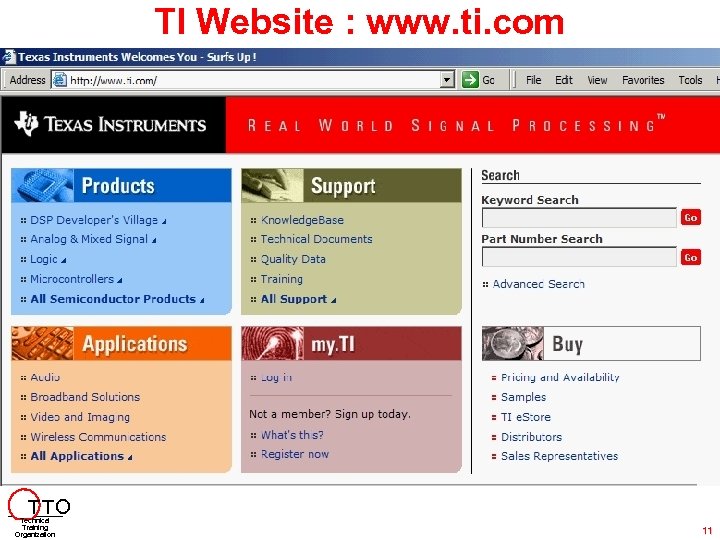
TI Website : www. ti. com T TO Technical Training Organization 11
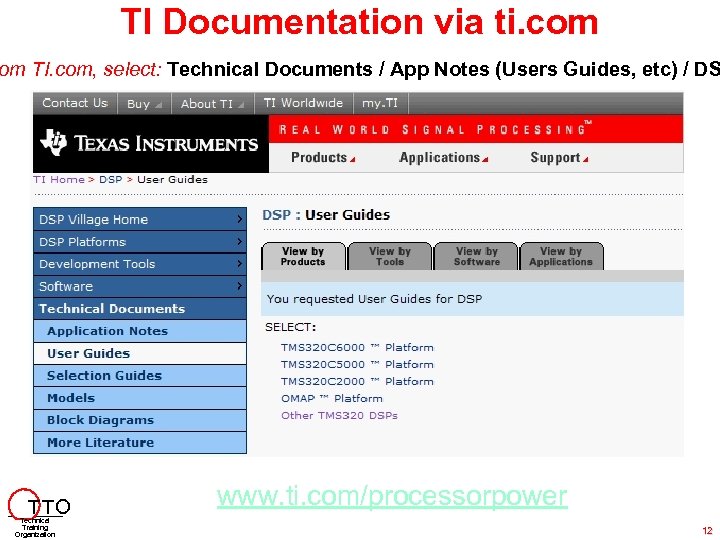
TI Documentation via ti. com om TI. com, select: Technical Documents / App Notes (Users Guides, etc) / DS T TO Technical Training Organization www. ti. com/processorpower 12
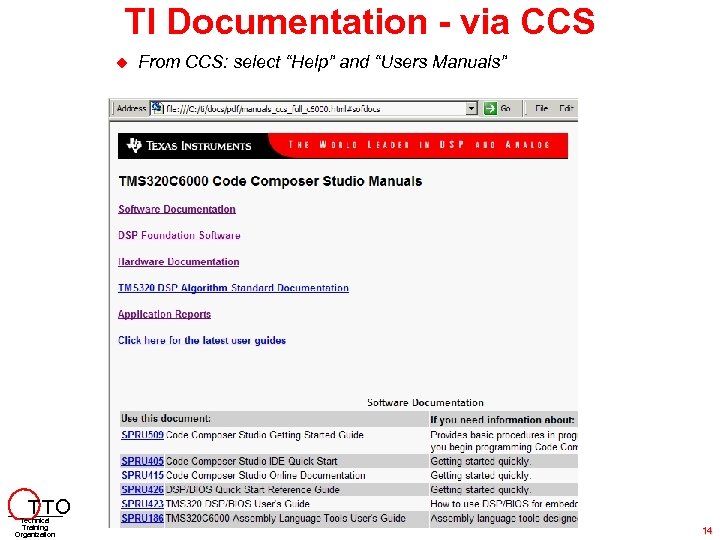
TI Documentation - via CCS From CCS: select “Help” and “Users Manuals” T TO Technical Training Organization 14
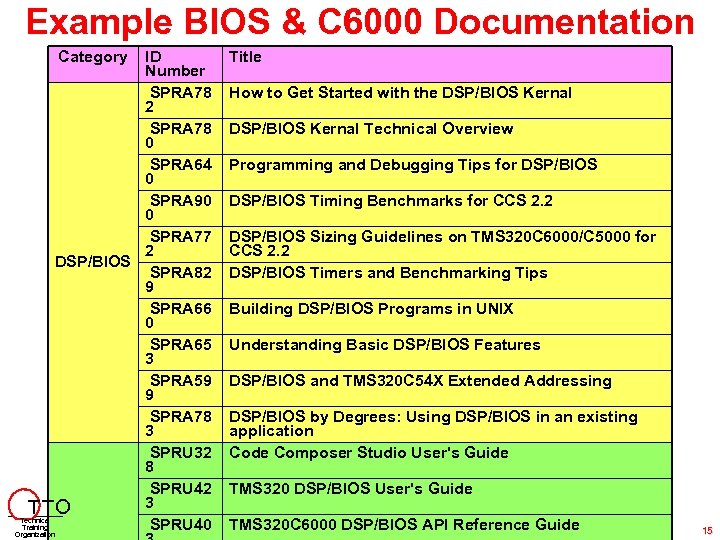
Example BIOS & C 6000 Documentation Category ID Number SPRA 78 2 SPRA 78 0 SPRA 64 0 SPRA 90 0 SPRA 77 2 DSP/BIOS SPRA 82 9 SPRA 66 0 SPRA 65 3 SPRA 59 9 SPRA 78 3 SPRU 32 8 SPRU 42 3 T TO Technical SPRU 40 Training Organization Title How to Get Started with the DSP/BIOS Kernal Technical Overview Programming and Debugging Tips for DSP/BIOS Timing Benchmarks for CCS 2. 2 DSP/BIOS Sizing Guidelines on TMS 320 C 6000/C 5000 for CCS 2. 2 DSP/BIOS Timers and Benchmarking Tips Building DSP/BIOS Programs in UNIX Understanding Basic DSP/BIOS Features DSP/BIOS and TMS 320 C 54 X Extended Addressing DSP/BIOS by Degrees: Using DSP/BIOS in an existing application Code Composer Studio User's Guide TMS 320 DSP/BIOS User's Guide TMS 320 C 6000 DSP/BIOS API Reference Guide 15
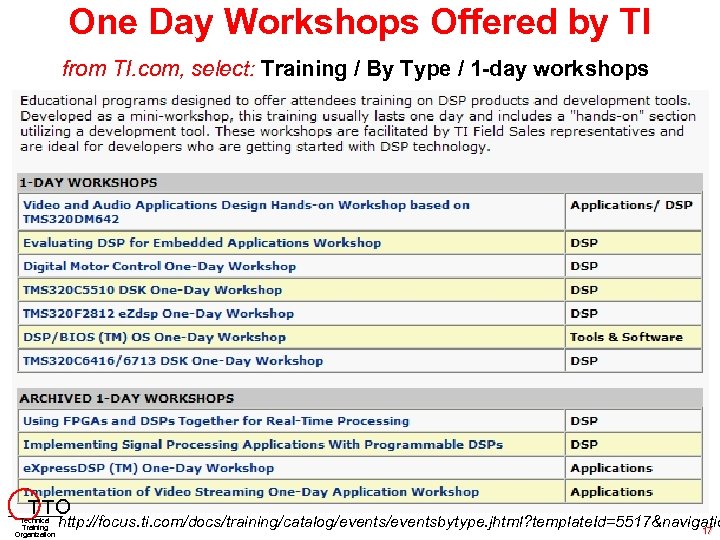
One Day Workshops Offered by TI from TI. com, select: Training / By Type / 1 -day workshops T TO Technical Training Organization http: //focus. ti. com/docs/training/catalog/eventsbytype. jhtml? template. Id=5517&navigatio 17
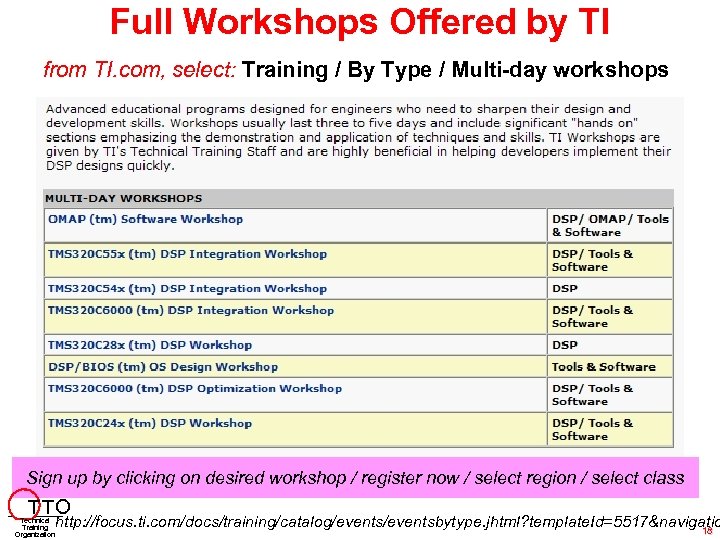
Full Workshops Offered by TI from TI. com, select: Training / By Type / Multi-day workshops Sign up by clicking on desired workshop / register now / select region / select class T TO Technical Training Organization http: //focus. ti. com/docs/training/catalog/eventsbytype. jhtml? template. Id=5517&navigatio 18
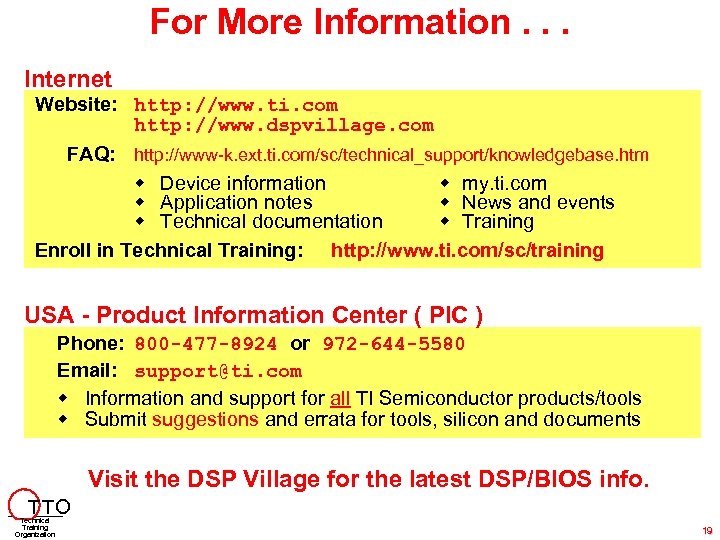
For More Information. . . Internet Website: http: //www. ti. com http: //www. dspvillage. com FAQ: http: //www-k. ext. ti. com/sc/technical_support/knowledgebase. htm Device information my. ti. com Application notes News and events Technical documentation Training Enroll in Technical Training: http: //www. ti. com/sc/training USA - Product Information Center ( PIC ) Phone: 800 -477 -8924 or 972 -644 -5580 Email: support@ti. com Information and support for all TI Semiconductor products/tools Submit suggestions and errata for tools, silicon and documents Visit the DSP Village for the latest DSP/BIOS info. T TO Technical Training Organization 19
Conclusions DSP/BIOS Review Development Tools For More Information T TO Technical Training Organization 21
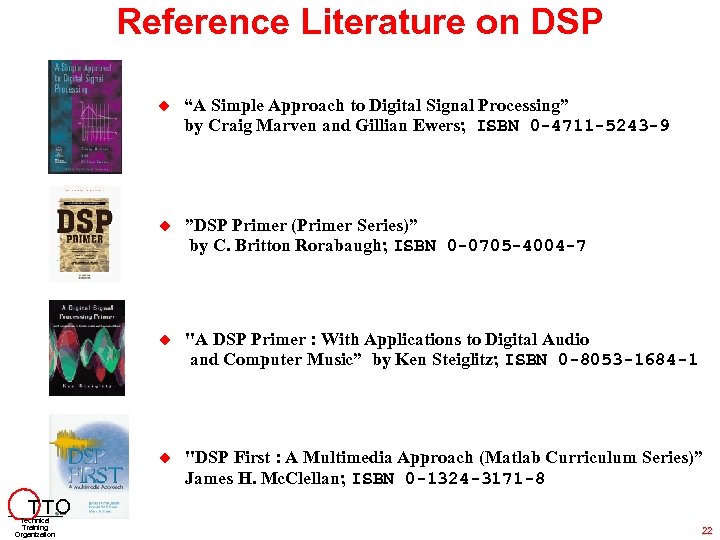
Reference Literature on DSP “A Simple Approach to Digital Signal Processing” by Craig Marven and Gillian Ewers; ISBN 0 -4711 -5243 -9 ”DSP Primer (Primer Series)” by C. Britton Rorabaugh; ISBN 0 -0705 -4004 -7 "A DSP Primer : With Applications to Digital Audio and Computer Music” by Ken Steiglitz; ISBN 0 -8053 -1684 -1 "DSP First : A Multimedia Approach (Matlab Curriculum Series)” James H. Mc. Clellan; ISBN 0 -1324 -3171 -8 T TO Technical Training Organization 22
Conclusions DSP/BIOS Review Development Tools For More Information T TO Technical Training Organization 23
Final Steps. . . Please fill out the course evaluation form at www. tiworkshops. com. Your comments are important to us; please note: What you liked most Suggestions for improvement If desired, make a copy of lab files to take with you Don’t forget your personal belongings T TO Technical Training Organization 24
Thank You For Attending ! Technical Training Organization ti 25
Скачать презентацию DSP BIOS System Integration Workshop 1 2 3 4
13160472266847172b6699fd16467b53.ppt