 Скачать презентацию Dry Goods Dairy Vegetables and Fruit Organise and
c71e5374c7cf9d059a50d5b8fa9af71d.ppt
- Количество слайдов: 28



Dry Goods, Dairy, Vegetables and Fruit Organise and Prepare Food
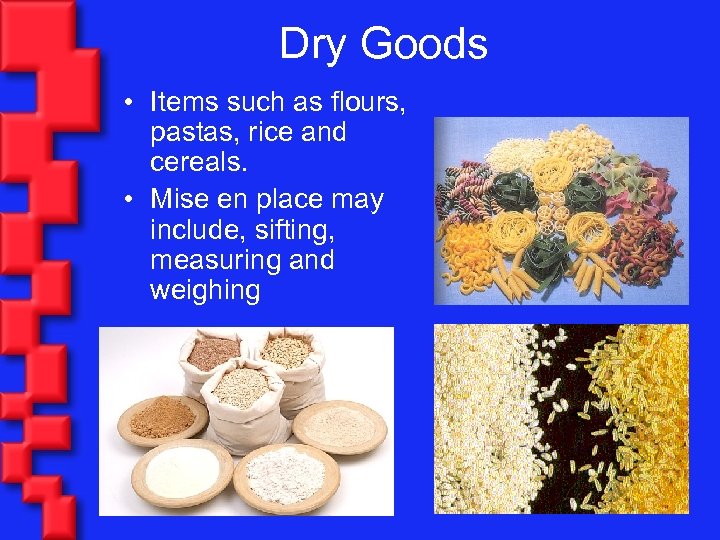
Dry Goods • Items such as flours, pastas, rice and cereals. • Mise en place may include, sifting, measuring and weighing
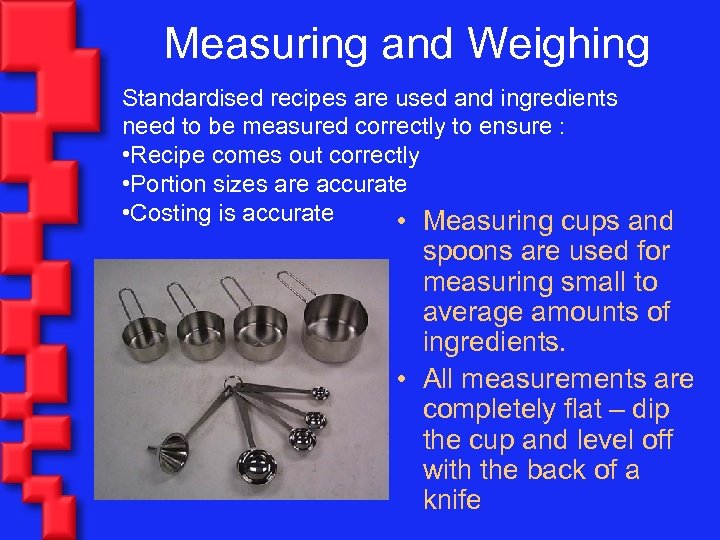
Measuring and Weighing Standardised recipes are used and ingredients need to be measured correctly to ensure : • Recipe comes out correctly • Portion sizes are accurate • Costing is accurate • Measuring cups and spoons are used for measuring small to average amounts of ingredients. • All measurements are completely flat – dip the cup and level off with the back of a knife
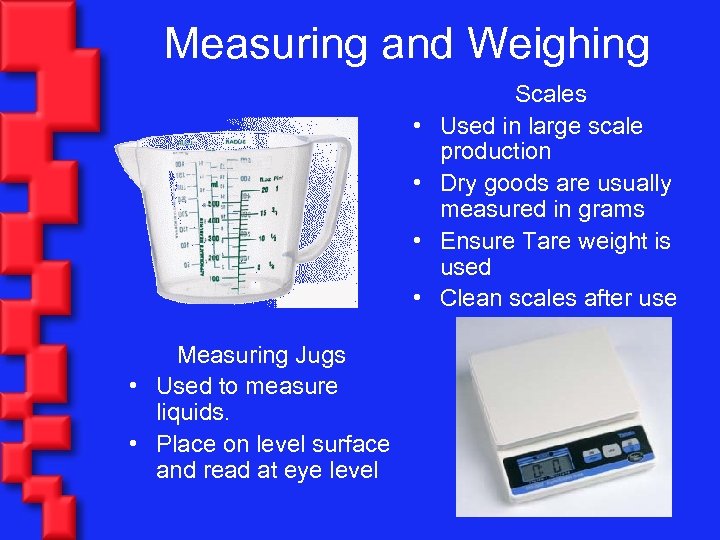
Measuring and Weighing • • Measuring Jugs • Used to measure liquids. • Place on level surface and read at eye level Scales Used in large scale production Dry goods are usually measured in grams Ensure Tare weight is used Clean scales after use
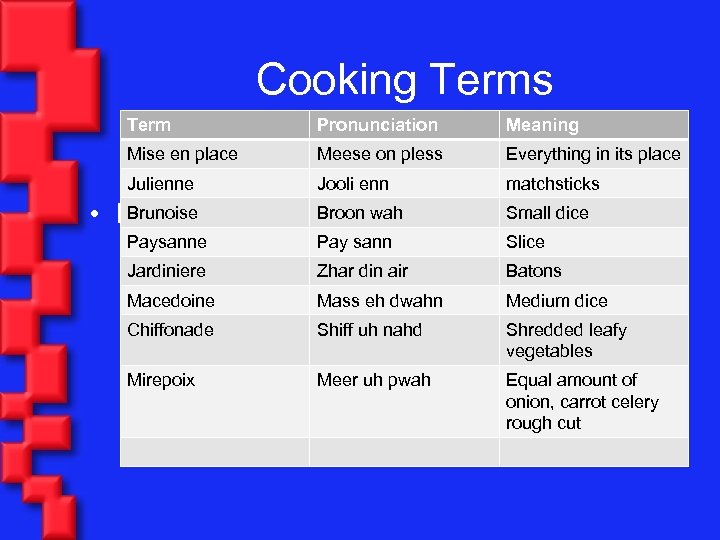
Cooking Terms Term Pronunciation Meaning Mise en place Meese on pless Everything in its place Julienne Jooli enn matchsticks Brunoise Broon wah Small dice • Mise en Place – (meese on pless) Paysanne Pay sann Slice Jardiniere Zhar din air Batons Macedoine Mass eh dwahn Medium dice Chiffonade Shiff uh nahd Shredded leafy vegetables Mirepoix Meer uh pwah Equal amount of onion, carrot celery rough cut
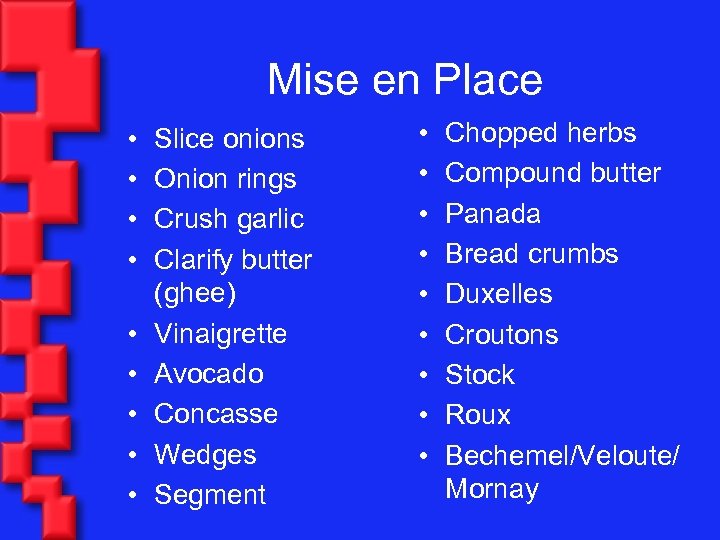
Mise en Place • • • Slice onions Onion rings Crush garlic Clarify butter (ghee) Vinaigrette Avocado Concasse Wedges Segment • • • Chopped herbs Compound butter Panada Bread crumbs Duxelles Croutons Stock Roux Bechemel/Veloute/ Mornay
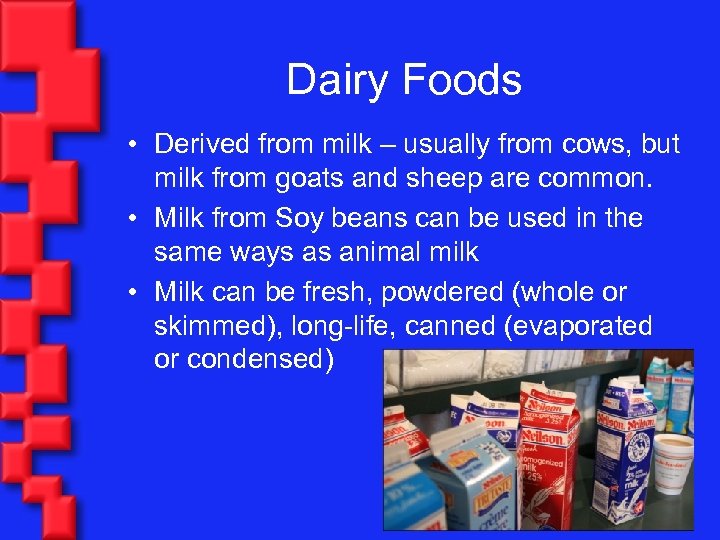
Dairy Foods • Derived from milk – usually from cows, but milk from goats and sheep are common. • Milk from Soy beans can be used in the same ways as animal milk • Milk can be fresh, powdered (whole or skimmed), long-life, canned (evaporated or condensed)
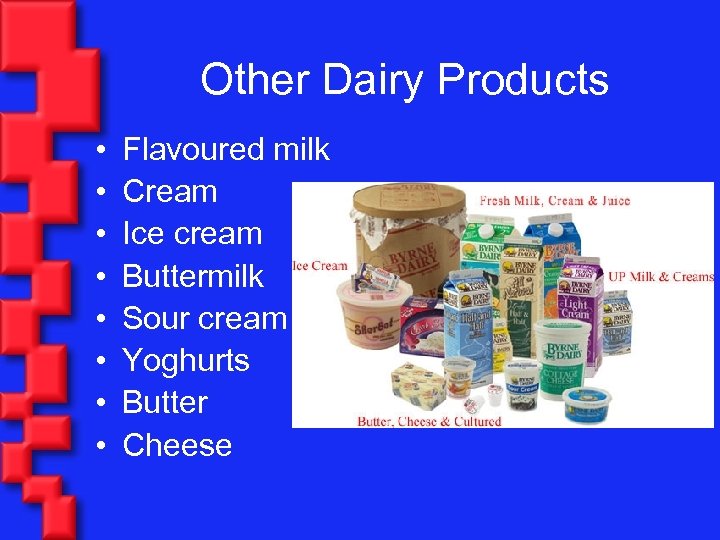
Other Dairy Products • • Flavoured milk Cream Ice cream Buttermilk Sour cream Yoghurts Butter Cheese
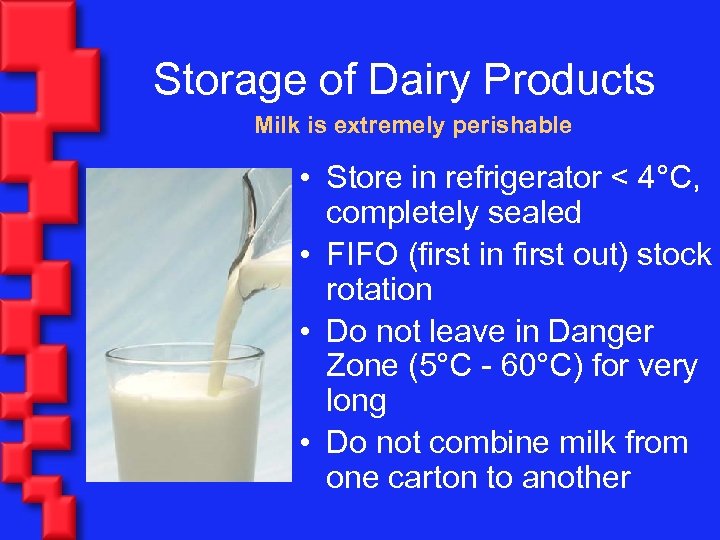
Storage of Dairy Products Milk is extremely perishable • Store in refrigerator < 4°C, completely sealed • FIFO (first in first out) stock rotation • Do not leave in Danger Zone (5°C - 60°C) for very long • Do not combine milk from one carton to another
Cooking with Dairy Products • Dairy products may be used as they are (fresh milk, cheese, ice cream) • Dairy products must not be heated past the boiling point 100°C or the product may separate causing curdling. • Dairy products may be used in: – – – – Desserts (puddings, custards, cheesecakes) Sauces (bechemel, cream sauce) Soups (cream soups) Egg dishes ( quiche, frittata) Main meals (added to pasta and vegetables) Cold drinks (smoothies, milk shakes) Hot drinks (tea, coffee, hot chocolate)
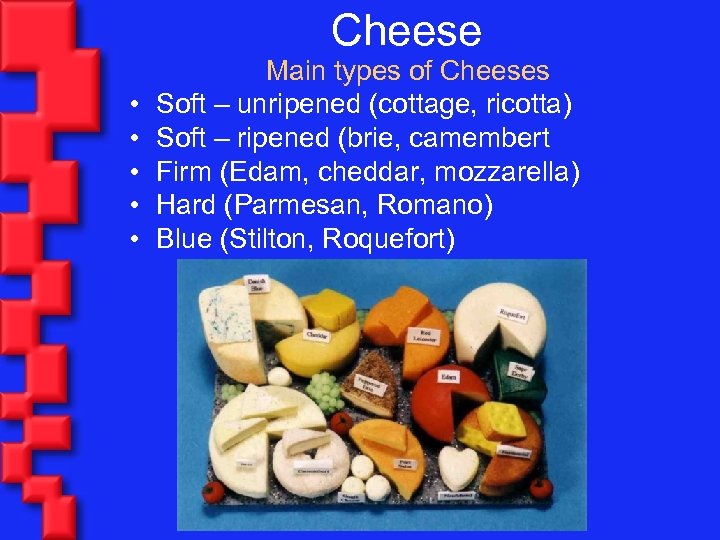
Cheese • • • Main types of Cheeses Soft – unripened (cottage, ricotta) Soft – ripened (brie, camembert Firm (Edam, cheddar, mozzarella) Hard (Parmesan, Romano) Blue (Stilton, Roquefort)
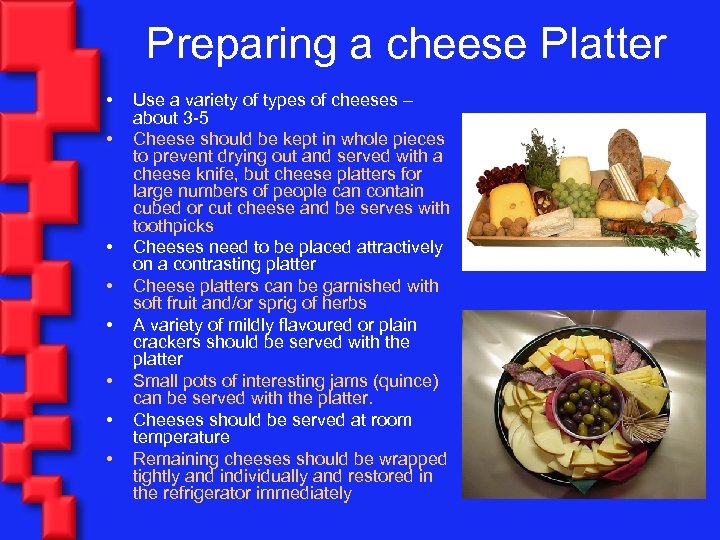
Preparing a cheese Platter • • Use a variety of types of cheeses – about 3 -5 Cheese should be kept in whole pieces to prevent drying out and served with a cheese knife, but cheese platters for large numbers of people can contain cubed or cut cheese and be serves with toothpicks Cheeses need to be placed attractively on a contrasting platter Cheese platters can be garnished with soft fruit and/or sprig of herbs A variety of mildly flavoured or plain crackers should be served with the platter Small pots of interesting jams (quince) can be served with the platter. Cheeses should be served at room temperature Remaining cheeses should be wrapped tightly and individually and restored in the refrigerator immediately
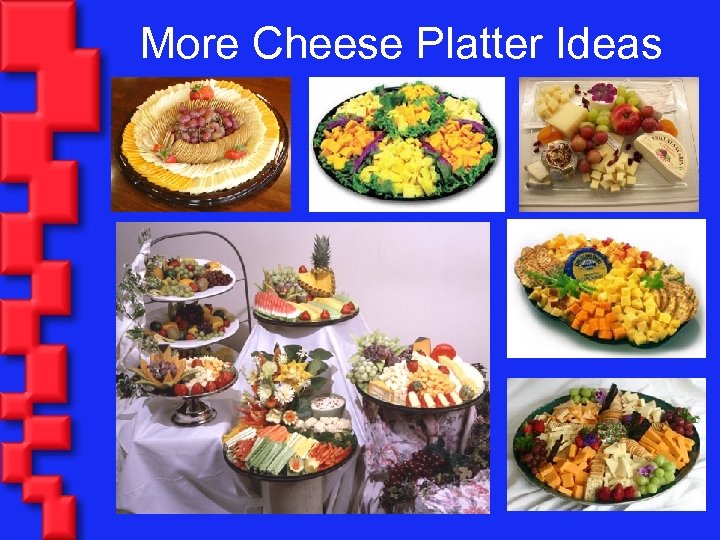
More Cheese Platter Ideas
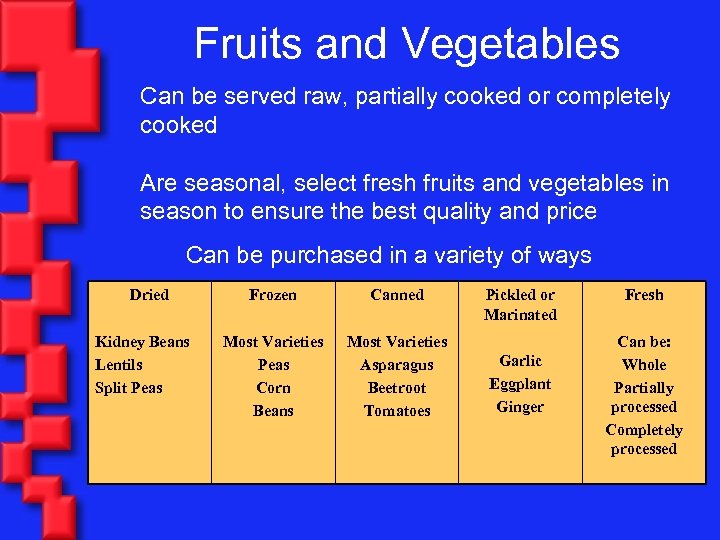
Fruits and Vegetables Can be served raw, partially cooked or completely cooked Are seasonal, select fresh fruits and vegetables in season to ensure the best quality and price Can be purchased in a variety of ways Dried Kidney Beans Lentils Split Peas Frozen Canned Most Varieties Peas Corn Beans Most Varieties Asparagus Beetroot Tomatoes Pickled or Marinated Garlic Eggplant Ginger Fresh Can be: Whole Partially processed Completely processed
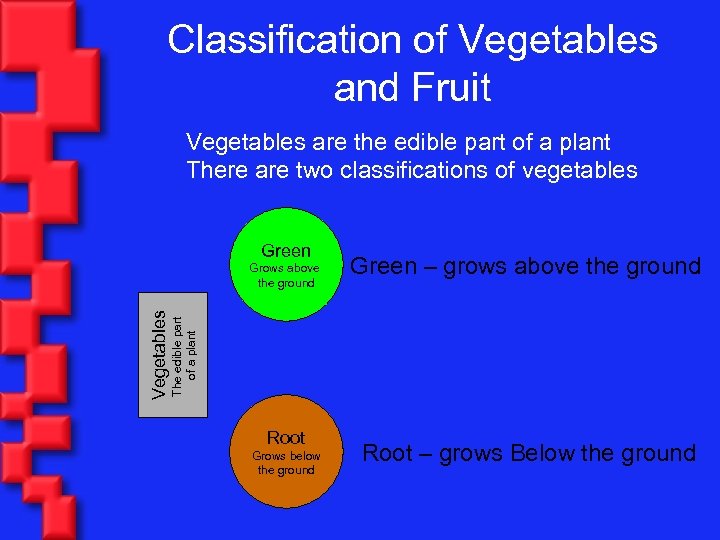
Classification of Vegetables and Fruit Vegetables are the edible part of a plant There are two classifications of vegetables Green – grows above the ground The edible part of a plant Vegetables Grows above the ground Root Grows below the ground Root – grows Below the ground
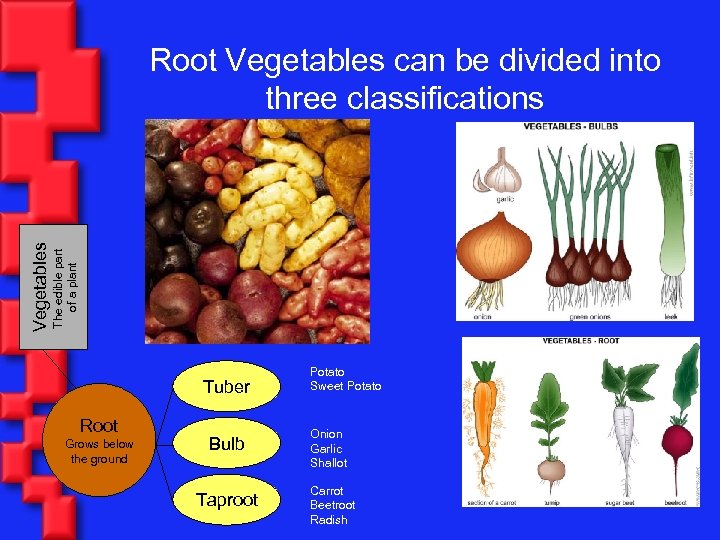
The edible part of a plant Vegetables Root Vegetables can be divided into three classifications Tuber Root Grows below the ground Bulb Taproot Potato Sweet Potato Onion Garlic Shallot Carrot Beetroot Radish
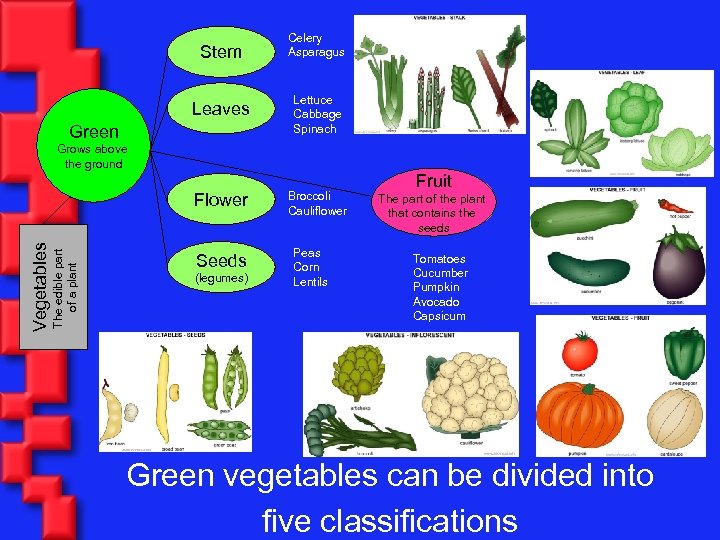
Stem Leaves Green Celery Asparagus Lettuce Cabbage Spinach Grows above the ground The edible part of a plant Vegetables Flower Seeds (legumes) Broccoli Cauliflower Peas Corn Lentils Fruit The part of the plant that contains the seeds Tomatoes Cucumber Pumpkin Avocado Capsicum Green vegetables can be divided into five classifications
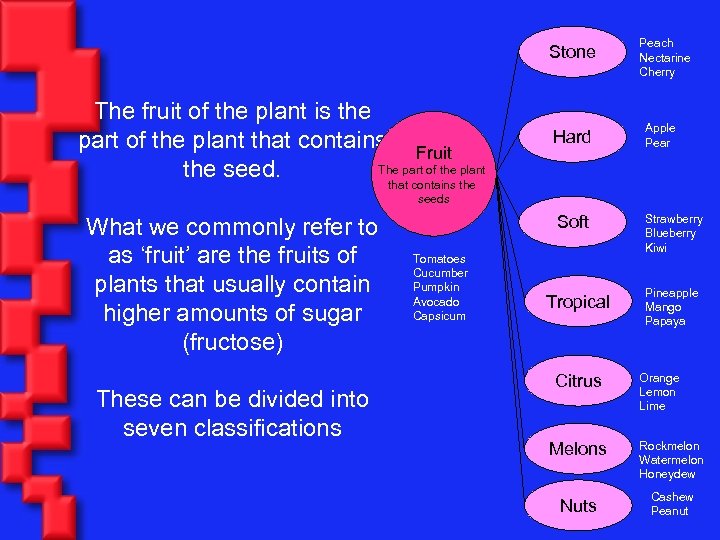
Stone The fruit of the plant is the part of the plant that contains Fruit The part of the plant the seed. that contains the Peach Nectarine Cherry Hard Apple Pear Soft Strawberry Blueberry Kiwi seeds What we commonly refer to as ‘fruit’ are the fruits of plants that usually contain higher amounts of sugar (fructose) These can be divided into seven classifications Tomatoes Cucumber Pumpkin Avocado Capsicum Tropical Citrus Pineapple Mango Papaya Orange Lemon Lime Melons Rockmelon Watermelon Honeydew Nuts Cashew Peanut
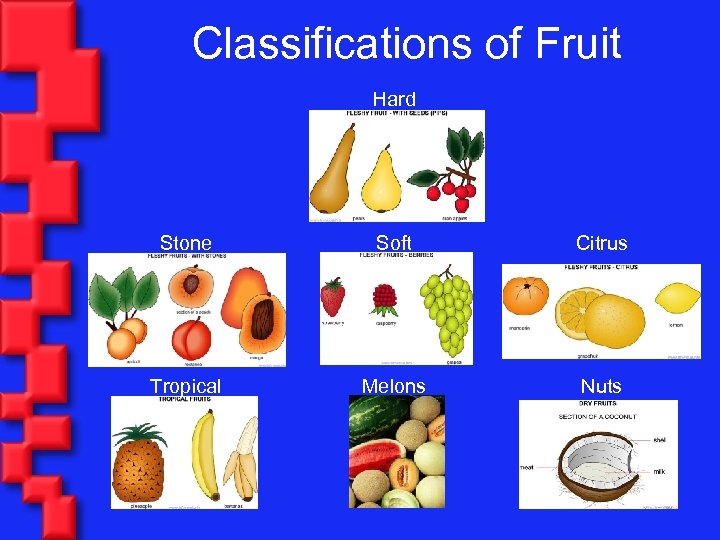
Classifications of Fruit Hard Stone Soft Citrus Tropical Melons Nuts
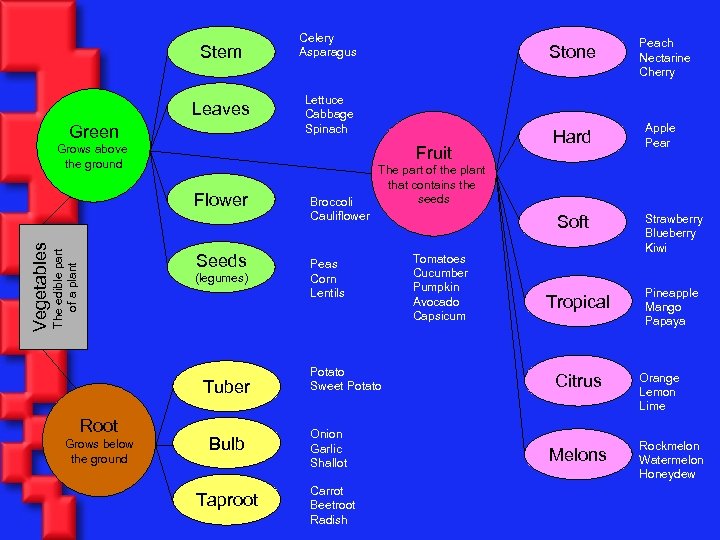
Stem Leaves Green Celery Asparagus Lettuce Cabbage Spinach The edible part of a plant Vegetables Flower Seeds (legumes) Tuber Grows below the ground Bulb Taproot Broccoli Cauliflower Potato Sweet Potato Carrot Beetroot Radish Hard Apple Pear Strawberry Blueberry Kiwi The part of the plant that contains the seeds Peas Corn Lentils Onion Garlic Shallot Peach Nectarine Cherry Soft Fruit Grows above the ground Root Stone Tomatoes Cucumber Pumpkin Avocado Capsicum Tropical Citrus Melons Pineapple Mango Papaya Orange Lemon Lime Rockmelon Watermelon Honeydew
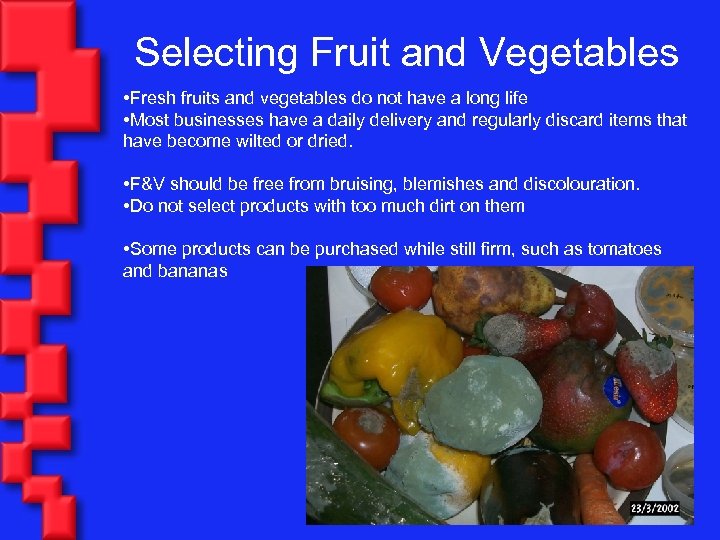
Selecting Fruit and Vegetables • Fresh fruits and vegetables do not have a long life • Most businesses have a daily delivery and regularly discard items that have become wilted or dried. • F&V should be free from bruising, blemishes and discolouration. • Do not select products with too much dirt on them • Some products can be purchased while still firm, such as tomatoes and bananas
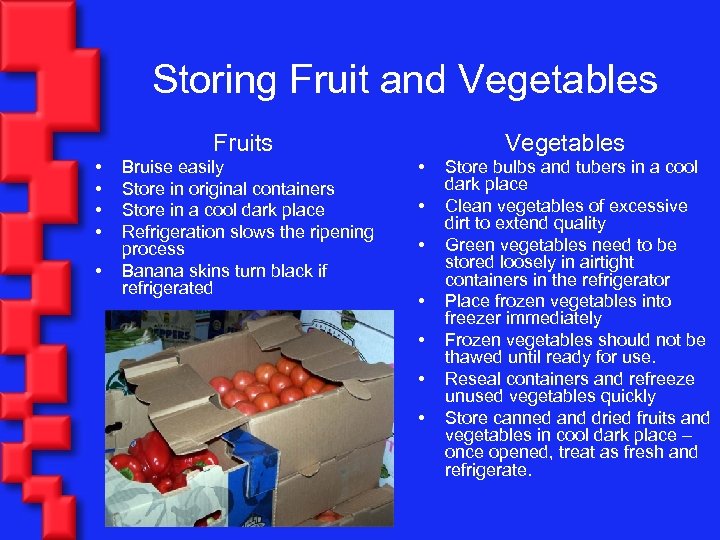
Storing Fruit and Vegetables Fruits • • • Bruise easily Store in original containers Store in a cool dark place Refrigeration slows the ripening process Banana skins turn black if refrigerated Vegetables • • Store bulbs and tubers in a cool dark place Clean vegetables of excessive dirt to extend quality Green vegetables need to be stored loosely in airtight containers in the refrigerator Place frozen vegetables into freezer immediately Frozen vegetables should not be thawed until ready for use. Reseal containers and refreeze unused vegetables quickly Store canned and dried fruits and vegetables in cool dark place – once opened, treat as fresh and refrigerate.
Preparing Fruits and Vegetables • Prepare as far as possible in advance, but not too far. • Wash fruits and vegetables well – Root vegetables may have dirt – Green vegetables may have pesticide – Leafy vegetables need to be washed two or three times but not left in water – Flower vegetables may be soaked in salty water for up to ½ hour, then rinsed – Potatoes should be kept in cold water after peeling to prevent oxidisation, but not left to soak for too long • Trim and peel vegetables as required but only lightly – re-wash after peeling • Some vegetable off-cuts can be placed in a stockpot (carrots, onions, leeks)
Preparing a Fruit Platter Choosing a Platter • Choose a simple platter with little or no design. Crisp clean colors such as white or black highlight the fruit best. Choosing Fruit • Pick firm ripe fruit with a rich aroma. • • Wash and dry all the fruit. • • Crisp apples, such as a Granny Smith, melons, berries, grapes, pineapple, kiwi and apricots or plums are good choices. • • Stay away from soft apples, such as a Fuji, bananas, pears and peaches. All these fruits discolor quickly and do not make for a good choice for a fruit platter. • • Buy berries a day ahead of time, they ripen quickly and can spoil before use if they sit in the refrigerator for too many days. • • Pineapple and melon should be purchased three days ahead of time. This allows them to ripen to there peak flavor before serving. • Preparing the Fruit • Cut apricots and plums into halves or quarters. Being sure to remove the pit. • Kiwi should be sliced into rounds and peeled. • All berries should be left whole. Strawberries should retain the green leaves atop each berry. • Apples should be cored and cut into wedges. To help prevent the apples from browning dip each apple wedge into a mixture of 4 cups water to 3 tablespoons lemon juice. • Cluster grapes in groups of 7 to 8 grapes on each stem. This allows guests to pick up a cluster and easily transfer it to a plate.
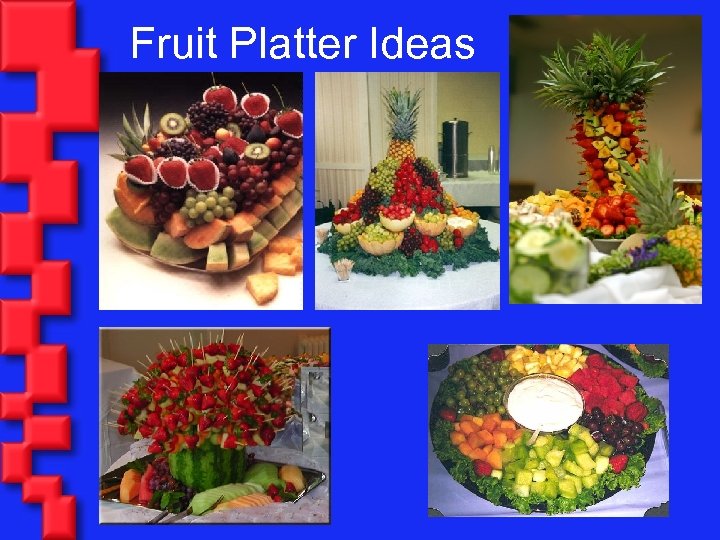
Fruit Platter Ideas
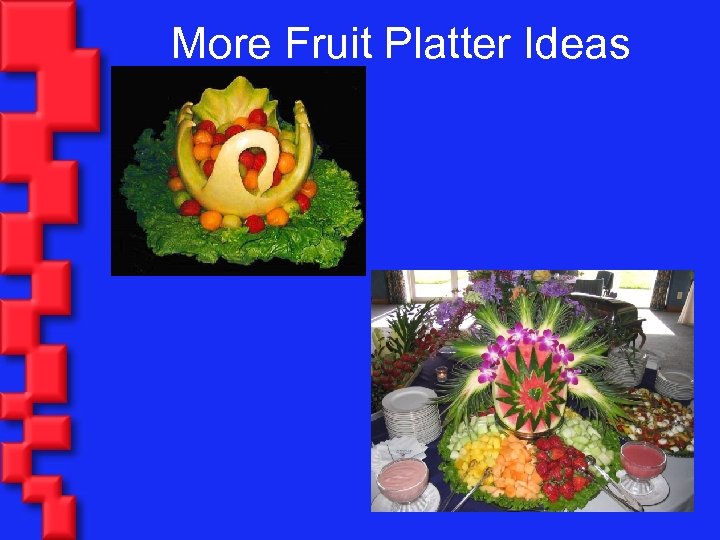
More Fruit Platter Ideas
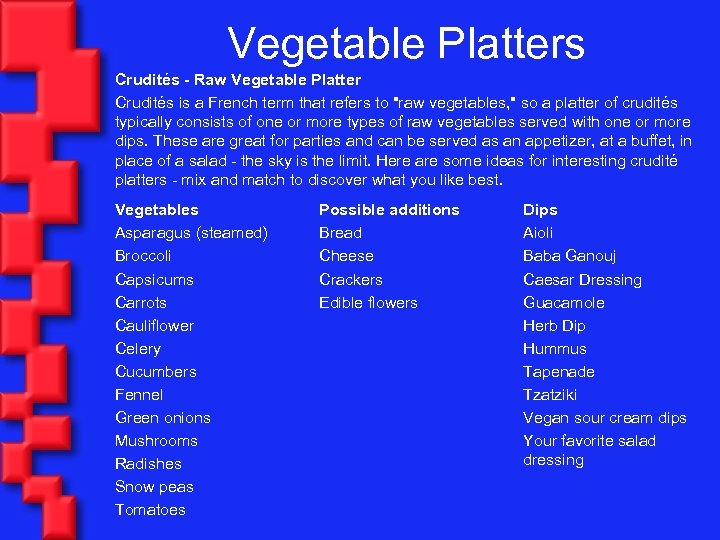
Vegetable Platters Crudités - Raw Vegetable Platter Crudités is a French term that refers to "raw vegetables, " so a platter of crudités typically consists of one or more types of raw vegetables served with one or more dips. These are great for parties and can be served as an appetizer, at a buffet, in place of a salad - the sky is the limit. Here are some ideas for interesting crudité platters - mix and match to discover what you like best. Vegetables Asparagus (steamed) Broccoli Capsicums Carrots Cauliflower Celery Cucumbers Fennel Green onions Mushrooms Radishes Snow peas Tomatoes Possible additions Bread Cheese Crackers Edible flowers Dips Aioli Baba Ganouj Caesar Dressing Guacamole Herb Dip Hummus Tapenade Tzatziki Vegan sour cream dips Your favorite salad dressing
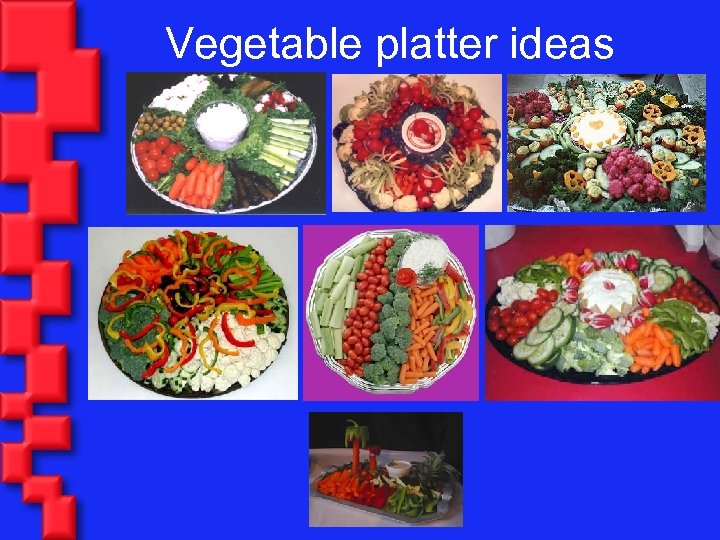
Vegetable platter ideas
Скачать презентацию Dry Goods Dairy Vegetables and Fruit Organise and
c71e5374c7cf9d059a50d5b8fa9af71d.ppt