 Скачать презентацию Drugs and Substance Abuse on the DSM 1
faab99b079f8e94a067243c8ffbc9cce.ppt
- Количество слайдов: 86



Drugs and Substance Abuse on the DSM 1
Drug and Substance Abuse on the DSM Diagnosis: 1. Substance-induced disorder (effect) disorder 2. Substance-related disorder (cause) disorder. . . dependence and abuse 2
Drug and Substance Abuse on the DSM Why drugs? “Life as we find it, is too hard for us; it brings too many pains, disappointments and impossible tasks. In order to bear it, we cannot dispense with palliative measures: powerful deflection, which causes to make light our misery; substantive satisfaction, which diminish it; and Intoxication, which makes us insensitive to it. ” - Freud 3
Drug and Substance Abuse on the DSM Stress: Task-oriented, problem solving vs. Defense oriented, emotion-focused response 4
Drug and Substance Abuse on the DSM 1. Powerful deflection, which causes to make light our misery; deflection 2. Substantive satisfaction, which diminish it; satisfaction 3. Intoxication, which makes us insensitive to it 5
Drug and Substance Abuse on the DSM Forms of intoxication: 1. Sedation: alcohol, barbituates, benzodiazepines. . . Sedation 2. Stimulation: caffeine, nicotine, amphetamine. . . Stimulation 3. Fantasy: psychedelics, hallucinogenics, cannabis. . . Fantasy 4. Narcotics: opium, morphine, heroin. . . Narcotics 6
Drug and Substance Abuse on the DSM Alcohol: BR: 6 8 10%+ LTR: 12 18 20%+ Genetics: concordance and adoption studies (“modelling is a factor”) 7
Drug and Substance Abuse on the DSM Alcohol, biologically: 1. Increase in some neural activity Increase (e. g. monoamine and endorphin) 2. Decrease in other neural activity Decrease (e. g. GABA and glutamate) 8
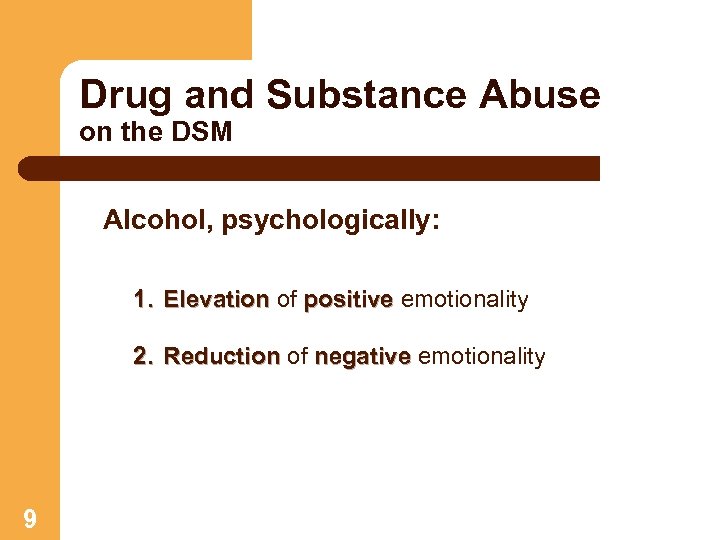
Drug and Substance Abuse on the DSM Alcohol, psychologically: 1. Elevation of positive emotionality Elevation 2. Reduction of negative emotionality Reduction negative 9
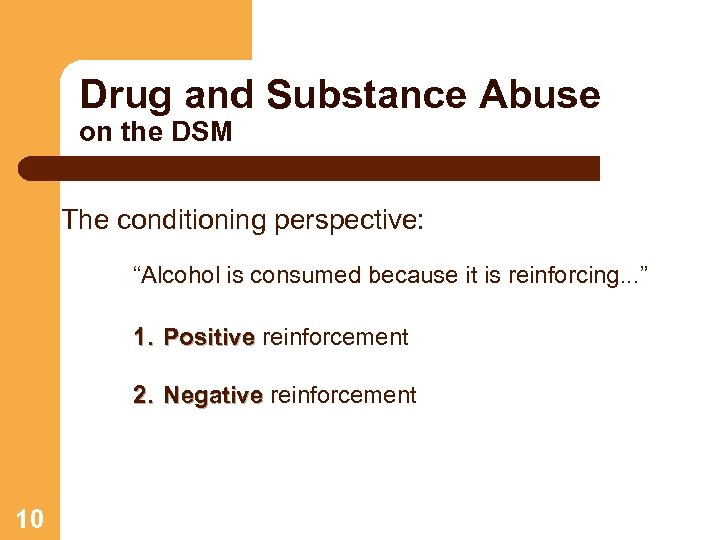
Drug and Substance Abuse on the DSM The conditioning perspective: “Alcohol is consumed because it is reinforcing. . . ” 1. Positive reinforcement 2. Negative reinforcement Negative 10
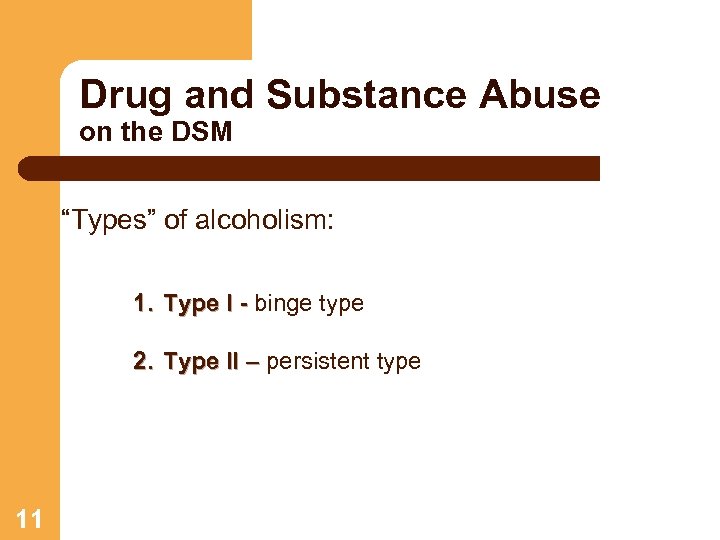
Drug and Substance Abuse on the DSM “Types” of alcoholism: 1. Type I - binge type 2. Type II – persistent type – 11
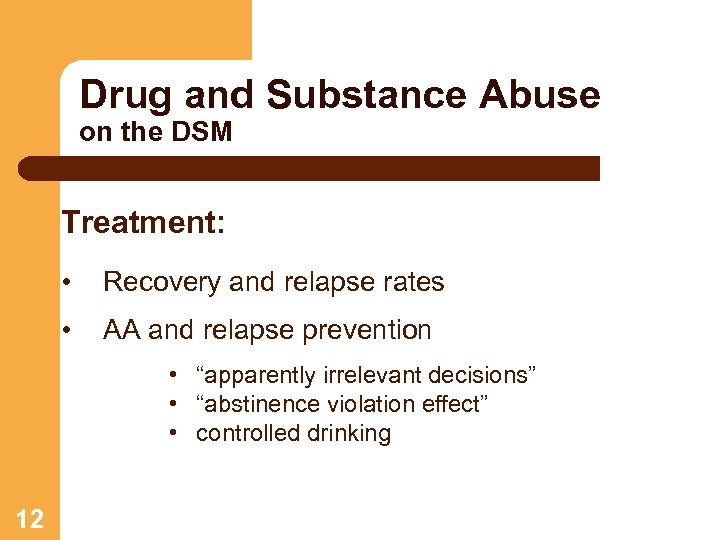
Drug and Substance Abuse on the DSM Treatment: • Recovery and relapse rates • AA and relapse prevention • “apparently irrelevant decisions” • “abstinence violation effect” • controlled drinking 12
Drug and Substance Abuse on the DSM Comorbidity: 1. Drug as primary (“primary alcoholism”) 2. Drug as secondary (“dual diagnosis”) 13
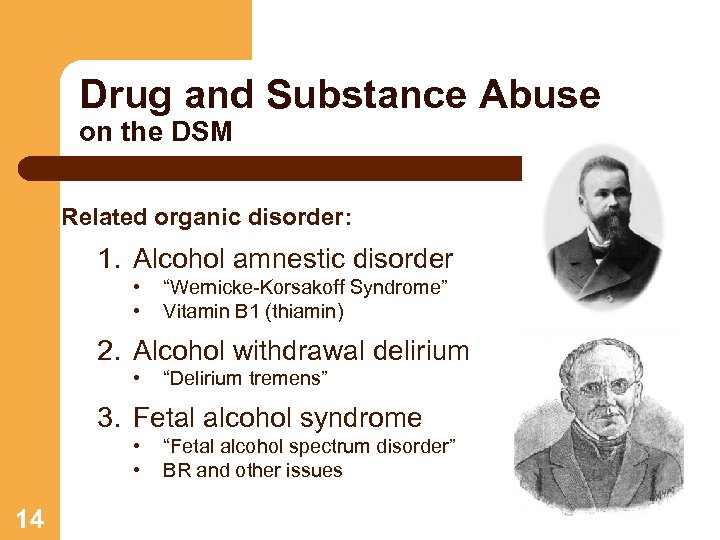
Drug and Substance Abuse on the DSM Related organic disorder: 1. Alcohol amnestic disorder • • “Wernicke-Korsakoff Syndrome” Vitamin B 1 (thiamin) 2. Alcohol withdrawal delirium • “Delirium tremens” 3. Fetal alcohol syndrome • • 14 “Fetal alcohol spectrum disorder” BR and other issues
Sex on the DSM IV 15
Sex and the DSM IV I. Sexual dysfunctions: l l II. Variants and deviations: deviations l l 16 desire arousal orgasm pain paraphilias, gender identity disorders (and sexual orientation)
Sex and the DSM IV History: l l Kinsey, Masters & Johnson, Money and NORC l 17 Reverend Sylvester Graham and Dr. John Harvey Kellogg The old “Barbie Doll” approach and the newer evolutionary one: mental and physical aspects
Sex and the DSM IV Understanding our sexuality: Back to basics : Why sex? Ø Ø 18 What is different about sexual motivation, in evolutionary history? The adaptive functions of sex: reproduction and beyond
Sex and the DSM IV Understanding our sexuality: The design of sexual systems: Ø Ø 19 “Releasers” (cues and rituals) “Boundary conditions” (internal and external)
Sex and the DSM IV Understanding our sexuality: The process: a. b. c. d. partner location elicit desire pretactile sexual interaction maintain arousal tactile sexual interaction “acception” intercourse “conception” The problem: The invocation and maintenance of motivation (“proception”) 20
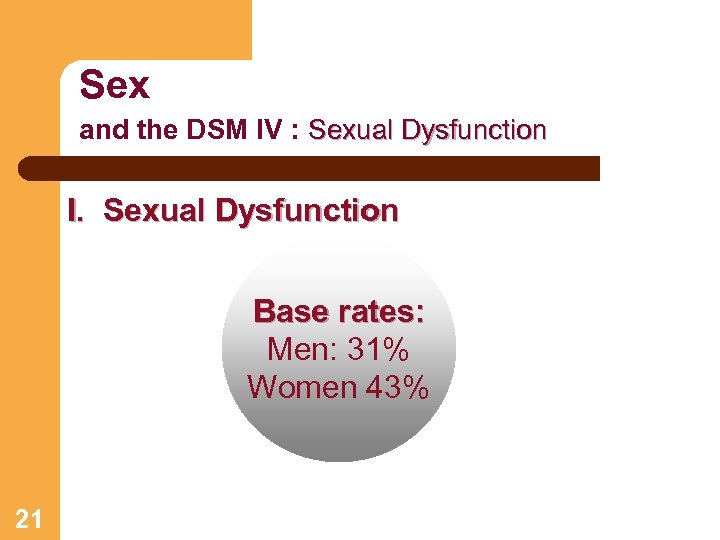
Sex and the DSM IV : Sexual Dysfunction I. Sexual Dysfunction Base rates: Men: 31% Women 43% 21
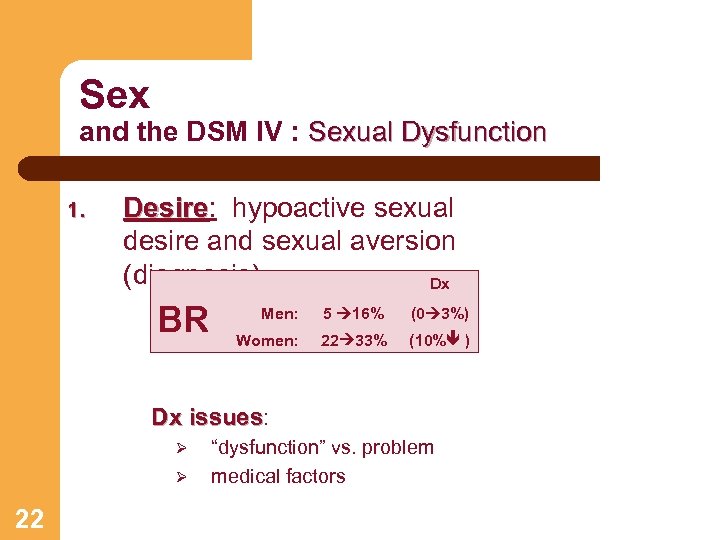
Sex and the DSM IV : Sexual Dysfunction 1. Desire: hypoactive sexual Desire desire and sexual aversion (diagnosis) Dx BR Men: 5 16% (0 3%) Women: 22 33% (10% ) Dx issues: issues Ø Ø 22 “dysfunction” vs. problem medical factors
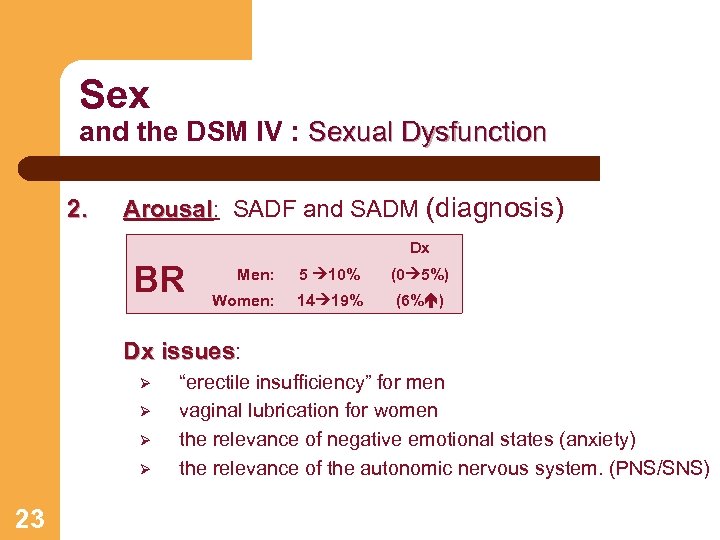
Sex and the DSM IV : Sexual Dysfunction 2. Arousal: SADF and SADM (diagnosis) Arousal Dx BR Men: 5 10% (0 5%) Women: 14 19% (6% ) Dx issues: issues Ø Ø 23 “erectile insufficiency” for men vaginal lubrication for women the relevance of negative emotional states (anxiety) the relevance of the autonomic nervous system. (PNS/SNS)
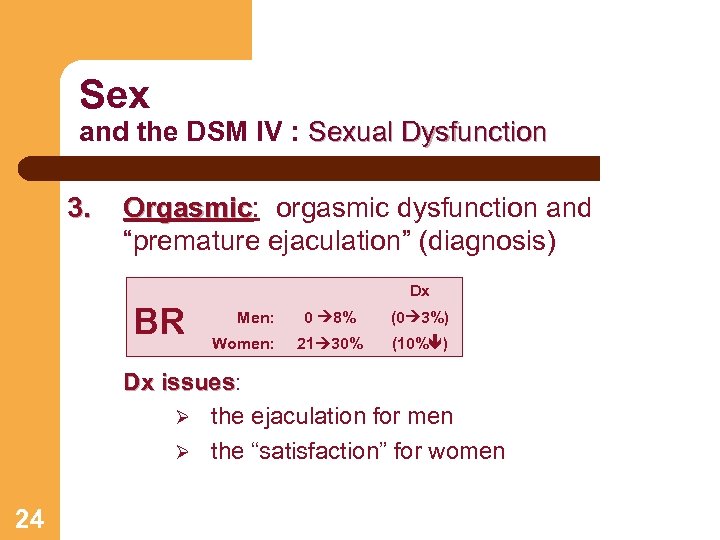
Sex and the DSM IV : Sexual Dysfunction 3. Orgasmic: orgasmic dysfunction and Orgasmic “premature ejaculation” (diagnosis) Dx BR Men: Women: 0 8% (0 3%) 21 30% (10% ) Dx issues: issues Ø the ejaculation for men Ø the “satisfaction” for women 24
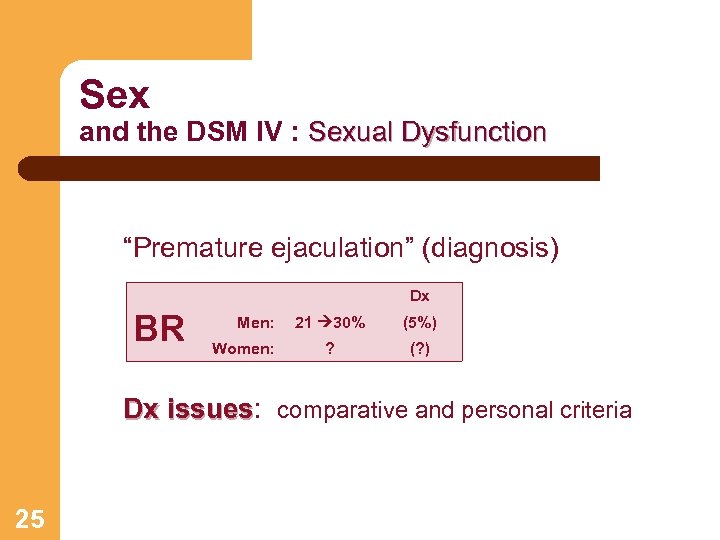
Sex and the DSM IV : Sexual Dysfunction “Premature ejaculation” (diagnosis) Dx BR Men: Women: 21 30% (5%) ? (? ) Dx issues: comparative and personal criteria issues 25
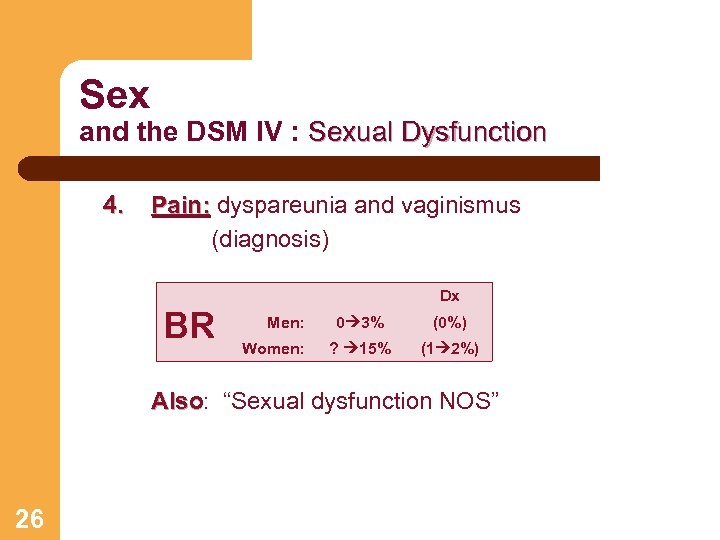
Sex and the DSM IV : Sexual Dysfunction 4. Pain: dyspareunia and vaginismus Pain: (diagnosis) Dx BR Men: Women: 0 3% (0%) ? 15% (1 2%) Also: “Sexual dysfunction NOS” Also 26
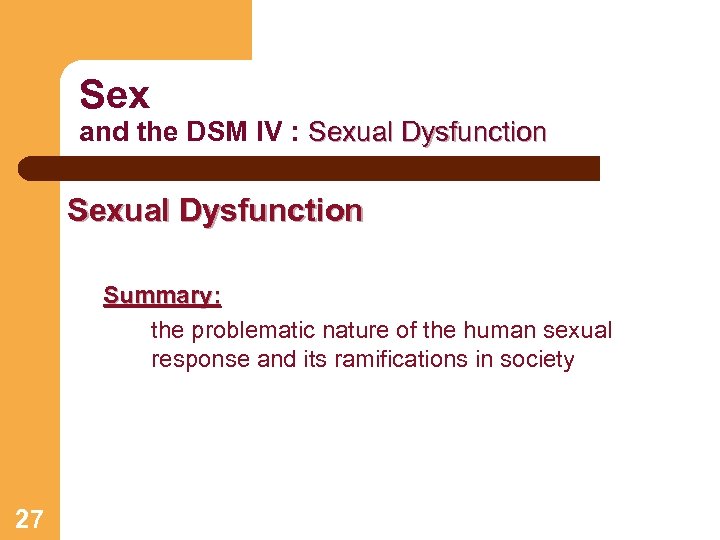
Sex and the DSM IV : Sexual Dysfunction Summary: the problematic nature of the human sexual response and its ramifications in society 27
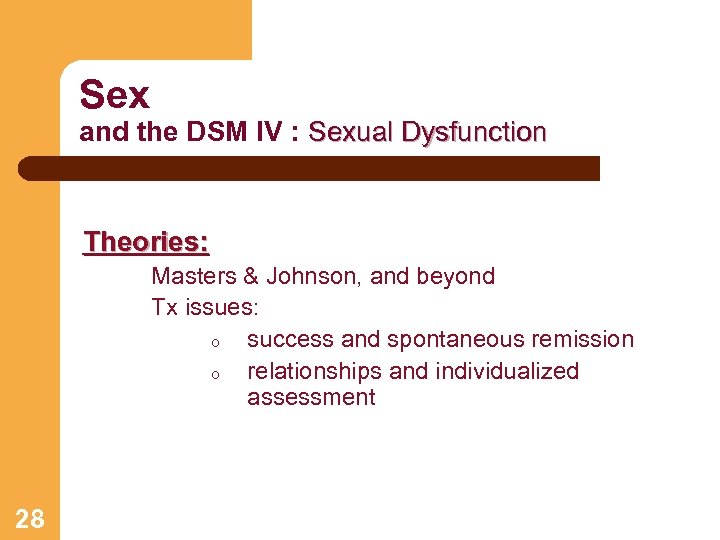
Sex and the DSM IV : Sexual Dysfunction Theories: Masters & Johnson, and beyond Tx issues: o success and spontaneous remission o relationships and individualized assessment 28
Sex and the DSM IV II. Variants and Deviations A. Paraphilias and their relation to “sexual” offenses B. Gender identity and its disorders C. Sexual orientation and the controversy over diagnosis The concept of the “lovemap” 29
Sex and the DSM IV : Variants and Deviations A. Paraphilia: Definition: “. . . reiteratively responsive to and dependent on atypical or forbidden stimulus imagery, in fantasy or practice, for the initiation and maintenance of erotosexual arousal and achievement or facilitation of orgasm. ” Note: paraphilias and phobias, as opposed to “fetishes” and “irrational fears” 30
Sex and the DSM IV : Paraphilias Examples: Ø Ø Ø Ø Ø 31 voyeurism exhibitionism fetishes fetishistic transvestism pedophilia zoophilia frotterism sexual sadism and masochism and others. . .
Sex and the DSM IV : Paraphilias Theories: (and what is wrong with them) 1. 2. 32 Psychodynamic Theory management of impulses Learning Theory A. Classical conditioning: stimulus associations problems: extinction and real life? B. Operant conditioning: reinforcements problems: extinction and real life? Cognition: Ø “arousal transference/misattribution” Ø problems: self-correction and real life?
Sex and the DSM IV : Paraphilias What is wrong with learning theories for paraphilias? e. g. Ø Ø retrospective observations of paraphilias prospective observations of the rest of us Asking the right question: “the vandalized lovemap” 33
Sex and the DSM IV : Paraphilias Ø Ø Ø 34 The limitations of behavior therapies Modern approaches to treatment Notes: preadaptation and multiplicity Factors that “scramble lovemaps” Summary and review Antiandrogens and the problem of relapse
Sex and the DSM IV Beyond the paraphilias: sexual offences in society 1. Rape: Ø Ø 35 reported rape. . . and all the rest convicted cases. . . and all the rest power, anger, pain. . . and “narcissistic reactance” the social problem, here, today
Sex and the DSM IV : Beyond the paraphilias 2. Child molestation and incest: Ø Ø Ø 36 Reported rates Why child molestation? § convicted cases and the context § the case of incest Notes: § issue of child testimony and “recovered memories” § how harmful is childhood sexual abuse?
Sex and the DSM IV : Beyond the paraphilias 3. Sexual sadism and masochism: Ø Ø 37 “sex is seldom just about sex” modern diagnostic practice
Sex and the DSM IV : Variants and Deviations B. Gender Identity Disorder (GID) Your sex and your gender Development of the “gendermap”: gendermap “the relay race” 1. genes 2. prenatal hormones 3. physical aggression 4. learning 38
Sex and the DSM IV : Gender Identity Ø Unusual results: “intersexual syndromes” A. Androgenital syndrome (XX) B. Androgen insensitivity syndrome (XY) Ø Ø Ø 39 Prenatal hormonal variations and “biasing the brain” Cross-species comparisions Culture and the “transgendered” population
Sex and the DSM IV : Gender Identity Disorders Child GID Diagnosis: discordance, distress and the desire to change Prognosis: e. g. “the sissy boy syndrome” 40
Sex and the DSM IV : Gender Identity Disorders Adult GID Diagnosis: discordance, distress and the desire for change A. Women Ø Ø FMT, masculinity and gynephilia “Gender atypicality” among women B. Men Ø MFT, femininity androphilia § Ø Ø “Gender atypicality” among men Note: MTF and “autogynephilia” § 41 i. e “Classic / Homosexual TS” i. e “non-classic / Heterosexual TS”
Sex and the DSM IV : Gender Identity Disorders Therapy: . . . three possibilities 1. Body mind. . . the transsexual solution. . . and the debate 2. Mind body. . . modifying gender identity. . . and the debate 3. The alternative. . . reduce the distress. . . and the debate 42
Sex and the DSM IV : Sexual Orientation C. Sexual Orientation and the DSM What is “sexual orientation”? “Erotosexual attractions only to someone who has the same external body morphology as your own” - John Money 43
Sex and the DSM IV : Sexual Orientation Sexual Behavior, desire and romantic attraction Ø Ø Ø 44 e. g. the Sambians and the rest of us cross-cultural comparisons cross-species considerations
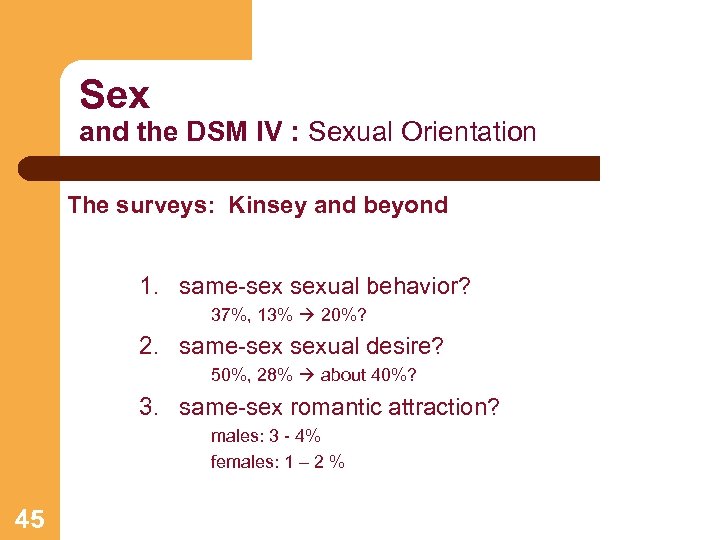
Sex and the DSM IV : Sexual Orientation The surveys: Kinsey and beyond 1. same-sex sexual behavior? 37%, 13% 20%? 2. same-sex sexual desire? 50%, 28% about 40%? 3. same-sex romantic attraction? males: 3 - 4% females: 1 – 2 % 45
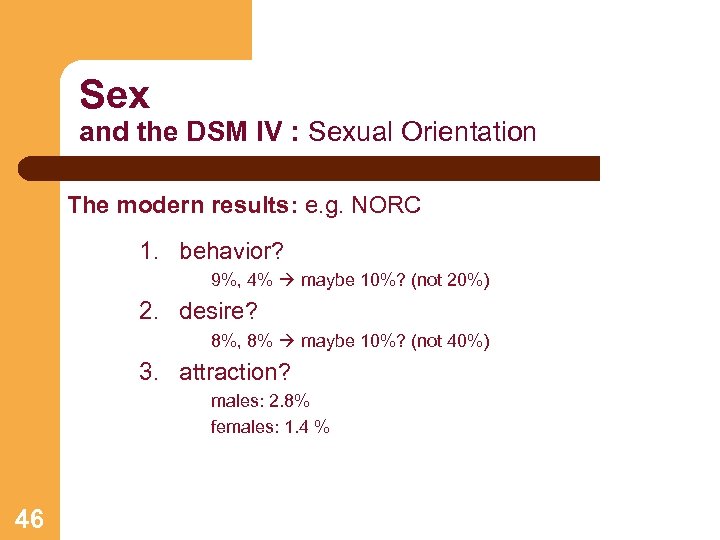
Sex and the DSM IV : Sexual Orientation The modern results: e. g. NORC 1. behavior? 9%, 4% maybe 10%? (not 20%) 2. desire? 8%, 8% maybe 10%? (not 40%) 3. attraction? males: 2. 8% females: 1. 4 % 46
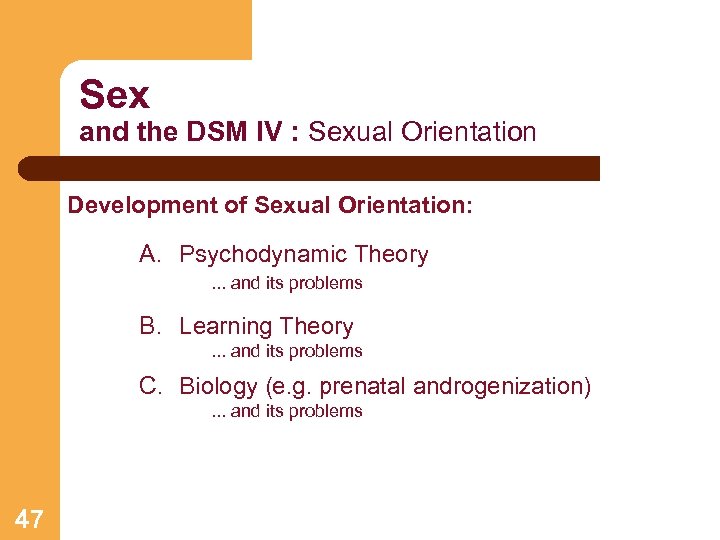
Sex and the DSM IV : Sexual Orientation Development of Sexual Orientation: A. Psychodynamic Theory. . . and its problems B. Learning Theory. . . and its problems C. Biology (e. g. prenatal androgenization). . . and its problems 47
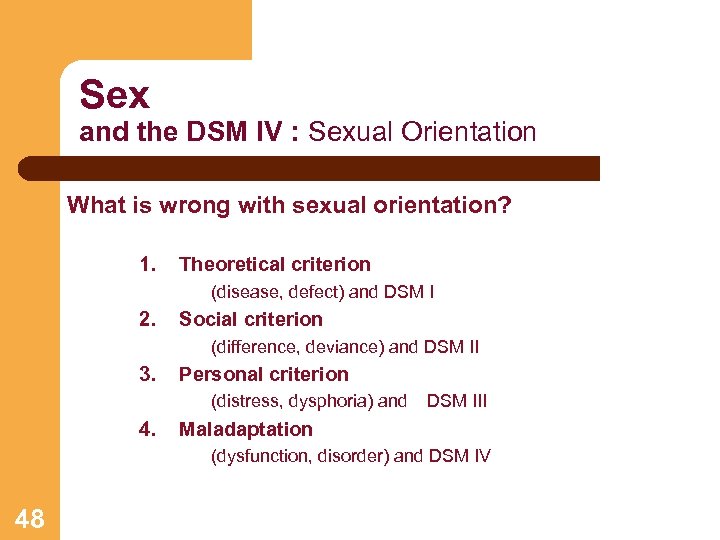
Sex and the DSM IV : Sexual Orientation What is wrong with sexual orientation? 1. Theoretical criterion (disease, defect) and DSM I 2. Social criterion (difference, deviance) and DSM II 3. Personal criterion (distress, dysphoria) and 4. DSM III Maladaptation (dysfunction, disorder) and DSM IV 48
Sex and the DSM IV : Sexual Orientation The Diagnosis: “Sexual disorder NOS” Ø Ø Ø 49 discordance, distress and the desire for change
Sex and the DSM IV : Sexual Orientation Therapy: three possibilities 1. Sex life sexual orientation 2. “Conversion” and “reparative” therapy 3. The alternative. . . reducing the distress. . . and the debate 50
Sleep disorders and the DSM IV Dyssomnias: Ø Ø Ø 51 insomnia hypersomnia, narcolepsy breathing (e. g. apnea) circadian
Sleep disorders and the DSM IV Parasomnias: nightmares Ø sleep terrors Ø sleepwalking Ø 52
Schizophrenia 53
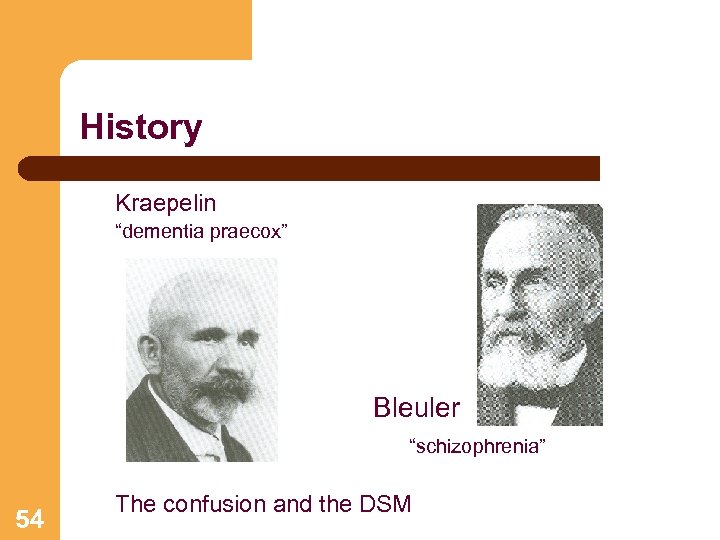
History Kraepelin “dementia praecox” Bleuler “schizophrenia” 54 The confusion and the DSM
Descriptive features and differential diagnosis Psychotic disorder due to general medical condition Substance-induced psychotic disorder Delusional psychoses Also: schizophreniform disorder brief psychotic disorder 55
Descriptive features and differential diagnosis Positive symptoms: delusions, hallucinations Negative symptoms: cognitive, emotional, volitional, behavioral Type I (“positive”) and Type II (“deficit”) Prevalence and incidence rates Treatment and remission rates 56
Research A. Biology 1. Concordance, then and now (“pair-wise” and probandwise figures) Discordant twins: what’s different and what’s not 57
Research A. Biology 2. Adoption, then and now Prospective research: Heston and beyond Retrospective research: Kety and beyond Longitudinal research: Mednick “high risk” study Israel “kibbutz” study Finland “adoption” study “Cross-fostering” results The Genains: Nora, Iris, Myra, Hester 58
Theory The Dopamine Hypotheses Drugs and early antidepressants & antipsychotics Factors: genes, age and congenital possibilities Theory, revised: 1. “High mesolimbic activity”: dopamine hypersensitivity 2. “Hypofrontality” and “denervation supersensitivity” 59
Theory, revised, part two: “Fewer inhibitory interneurons”: glutamate Result: “a neurodevelopmental disorder” Some neurophysiological findings Ø Ø 60 SPEM eye flutter habituation pain
Treatment Antipsychotics: First generation: e. g. phenothiazines “Side” effects: pseudo. Parkinsonism Ø extrapyramidal effects Ø tardive dyskinesia Ø “neuroleptic malignancy syndrome” Ø 61
Treatment Antipsychotics: Second generation: e. g. atypical antipsychotics Ø Ø 62 Clozapine Risperidol Zyprexa, Abilify, et al Recent developments
Schizophrenia B. Psychological and Sociocultural factors Cause, course and content Theory: then and now 63
Treatment: 3 observations on the course of schizophrenia 1. Hospital wards: Ø Ø 64 psychoanalysis and milieu therapy token economy units
Treatment: 3 observations on the course of schizophrenia 2. The world: Ø Ø 65 prevalence and incidence relapse and remission
Treatment: 3 observations on the course of schizophrenia 3. The family: Ø Ø 66 expressed emotionality family therapy
Schizophrenia Comprehensive Health Care: compliance and “sociotherapy” “We’ve been slow to realize the limitations of an exclusively pharmacological approach” -text 67
Schizophrenia Long-term Community Care: costs and benefits “A hospital bed in a parked taxi with the meter running -Groucho Marx 68
Schizophrenia Types: Ø Ø Ø 69 paranoid (e. g. Type I) disorganized (“hebephrenic”) catatonic (“waxy flexibility”) undifferentiated residual (not remission)
Schizophrenia Summary: The biology and psychology of schizophrenia: Perceptual overload and “aberrant salience” 70
The Delusional Psychoses 71
The Delusional Psychoses Delusions Why chaos and confusion? Ø Ø 72 it’s physical it’s mental
The Delusional Psychoses Theory Conflict, interpersonal and otherwise Risk factors Isolation, real and imagined 73
The Delusional Psychoses Types: Ø Ø Ø 74 persecutory erotomania grandiose jealous somatic, etc.
The Delusional Psychoses Treatment: Ø Ø Ø 75 “crashing through” “end around” minimizing risk
Contemporary Issues 76
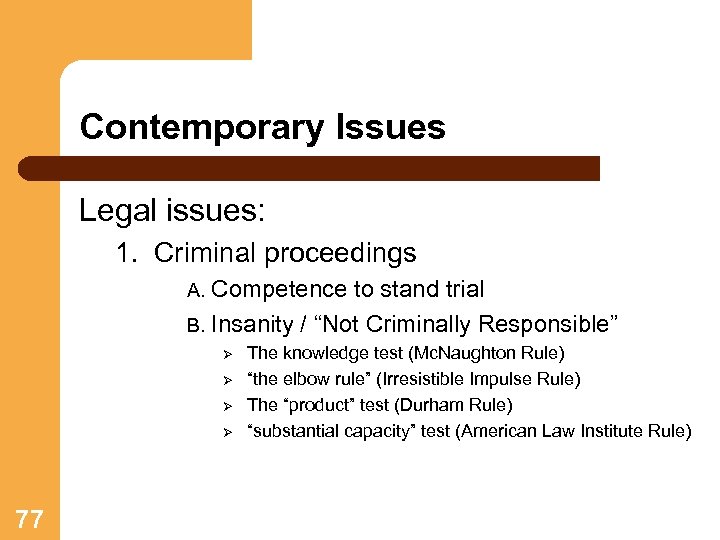
Contemporary Issues Legal issues: 1. Criminal proceedings A. Competence to stand trial B. Insanity / “Not Criminally Responsible” Ø Ø 77 The knowledge test (Mc. Naughton Rule) “the elbow rule” (Irresistible Impulse Rule) The “product” test (Durham Rule) “substantial capacity” test (American Law Institute Rule)
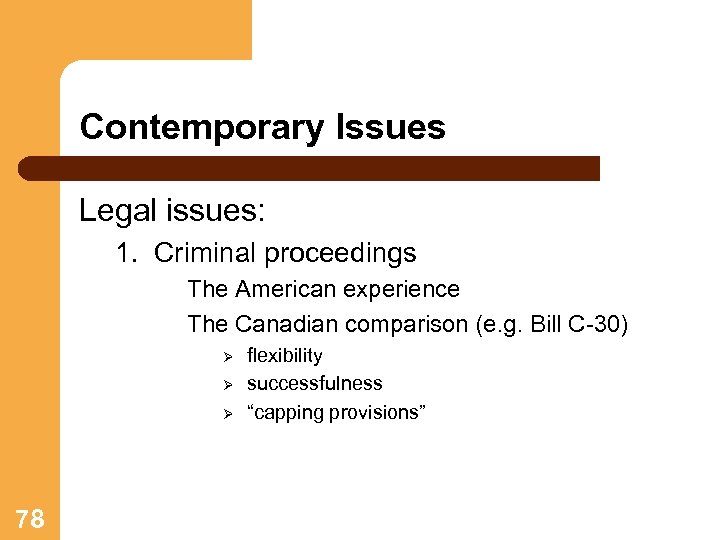
Contemporary Issues Legal issues: 1. Criminal proceedings The American experience The Canadian comparison (e. g. Bill C-30) Ø Ø Ø 78 flexibility successfulness “capping provisions”
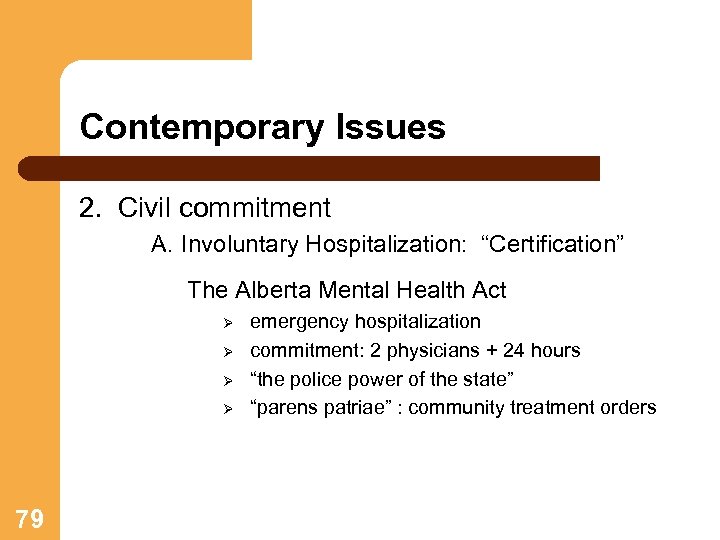
Contemporary Issues 2. Civil commitment A. Involuntary Hospitalization: “Certification” The Alberta Mental Health Act Ø Ø 79 emergency hospitalization commitment: 2 physicians + 24 hours “the police power of the state” “parens patriae” : community treatment orders
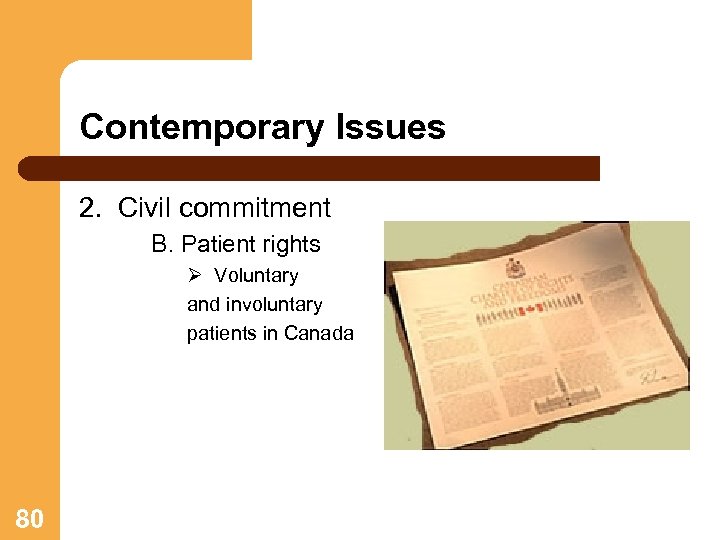
Contemporary Issues 2. Civil commitment B. Patient rights Ø Voluntary and involuntary patients in Canada 80
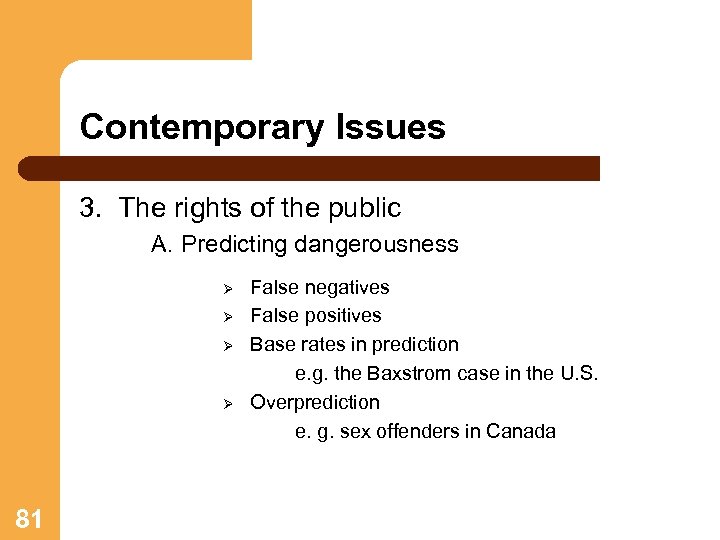
Contemporary Issues 3. The rights of the public A. Predicting dangerousness False negatives Ø False positives Ø Base rates in prediction e. g. the Baxstrom case in the U. S. Ø Overprediction e. g. sex offenders in Canada Ø 81
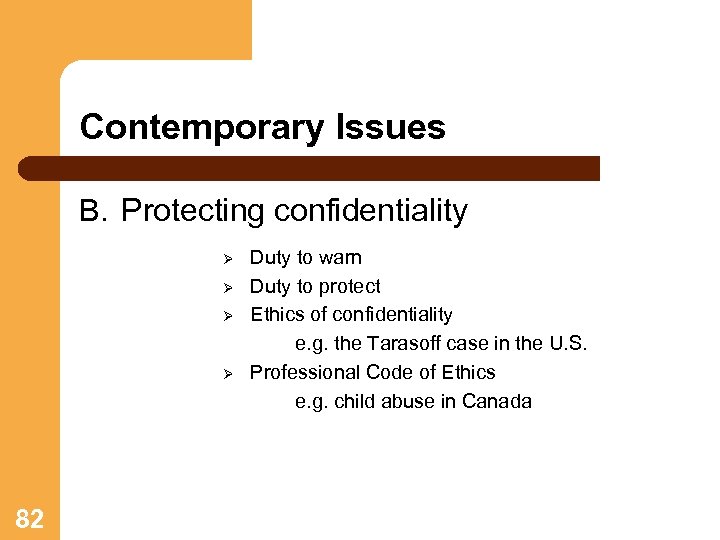
Contemporary Issues B. Protecting confidentiality Ø Ø 82 Duty to warn Duty to protect Ethics of confidentiality e. g. the Tarasoff case in the U. S. Professional Code of Ethics e. g. child abuse in Canada
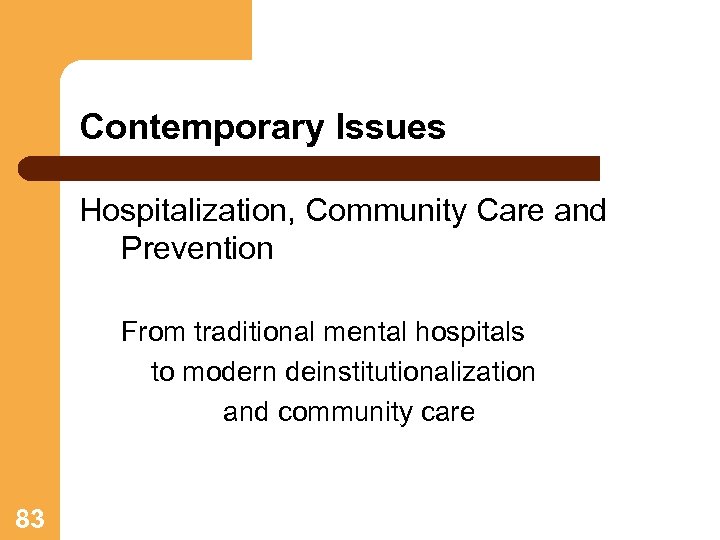
Contemporary Issues Hospitalization, Community Care and Prevention From traditional mental hospitals to modern deinstitutionalization and community care 83
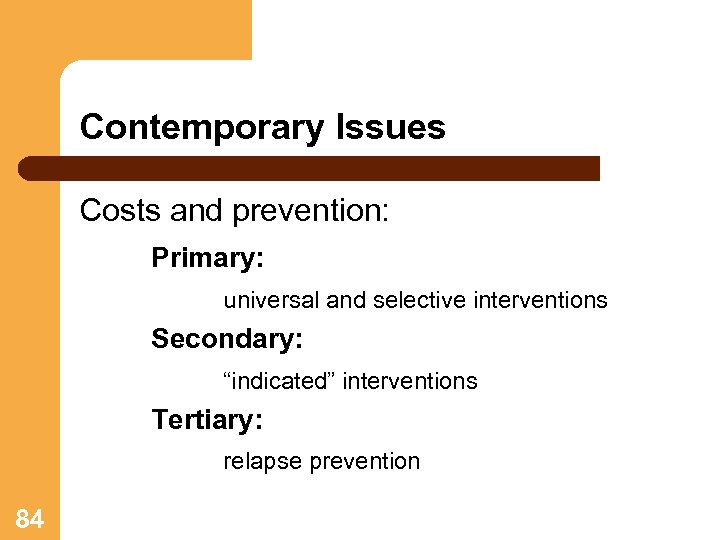
Contemporary Issues Costs and prevention: Primary: universal and selective interventions Secondary: “indicated” interventions Tertiary: relapse prevention 84
Contemporary Issues Organized efforts for mental health Public awareness and mutual concern 85
The End! Essays Final Exam 86
Скачать презентацию Drugs and Substance Abuse on the DSM 1
faab99b079f8e94a067243c8ffbc9cce.ppt