


 Скачать презентацию Drug Therapy in the Pregnant Dental Patient Doreen
7177de246158c3748736216f6bb5ebf9.ppt
- Количество слайдов: 59
 Drug Therapy in the Pregnant Dental Patient Doreen Matsui MD, FRCPC Associate Professor, Department of Paediatrics Children’s Hospital of Western Ontario
 Objectives • To review general principles regarding drugs in pregnancy • To describe effects of drugs commonly used in dentistry • To briefly overview use of drugs during breastfeeding
 Drug Use in Pregnancy (Larimore WL et al. Prim Care 2000; 27: 35 -53) • 1991 WHO International Survey of Drug Utilization in Pregnancy • 86% of women took medication during pregnancy • Average of 2. 9 prescriptions • Despite this high rate of medication intake, most drugs are not labeled for use during pregnancy
 Inadvertent Exposure • 1/2 of pregnancies unplanned • Teratogenic potential should be considered and explained to women of childbearing age at time drug is prescribed – <50% of women know they are pregnant by 4 th week and ~20% still don’t know by 8 th week
 Drug Use in Pregnancy (Van Trigt AM et al. Pharm World Sci 1994; 16: 254 -9) • Women interviewed within 2 weeks after delivery • 40% had one or more questions about drugs during their pregnancy • Similar proportion said that during pregnancy important to consult a health professional before using any medication • Safety was issue that raised the most questions
 Compliance • Pregnant women tend to comply less than optimally with drug therapy • Misinformation • 39% of women reported noncompliance predominantly due to hesitation to use drugs during pregnancy (Van Trigt AM et al. Pharm World Sci 1994; 16: 254 -9)
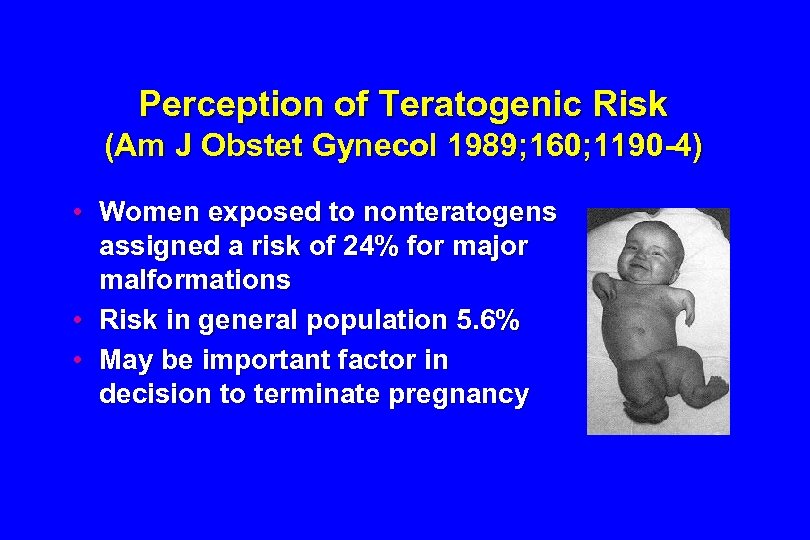 Perception of Teratogenic Risk (Am J Obstet Gynecol 1989; 160; 1190 -4) • Women exposed to nonteratogens assigned a risk of 24% for major malformations • Risk in general population 5. 6% • May be important factor in decision to terminate pregnancy
 Perception of Teratogenic Risk (Sanz E et al. Eur J Obstet Gynecol Reprod Biol 2001; 95: 127 -31) • Perception of risk related to medication used in pregnancy higher than the recognized risk in a group of 15 GPs, 10 gynaecologists, 106 preclinical medical students, 150 medical students in clinical training, 81 pregnant women and 63 non-pregnant women
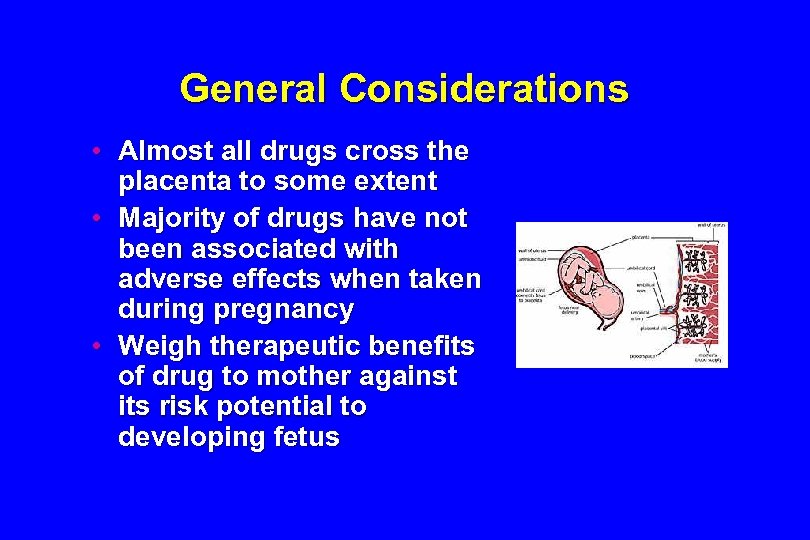 General Considerations • Almost all drugs cross the placenta to some extent • Majority of drugs have not been associated with adverse effects when taken during pregnancy • Weigh therapeutic benefits of drug to mother against its risk potential to developing fetus
 Adverse Effects • • • Spontaneous abortion Fetal growth retardation Teratogenicity Direct drug toxicity Neonatal drug withdrawal Long term effects on neurobehavioral development • Carcinogenesis
 Teratogenic Risk (Lo et al. Obstet Gynecol 2002; 100: 465 -73) • • • Standard clinical teratology databases 485 drugs approved by FDA 1980 - 2000 Treatment with only small fraction (2. 4%) has been associated with substantial teratogenic risk • Took on average 6. 0 ± 4. 1 years after approval to determine risk
 Known Teratogens • Alcohol (Ethanol) • Carbamazepine • Cytotoxic chemotherapy • DES • Isotretinoin and Etretinate • Lithium • • Methimazole Misoprostol Phenytoin Thalidomide Trimethoprim Valproic Acid Warfarin
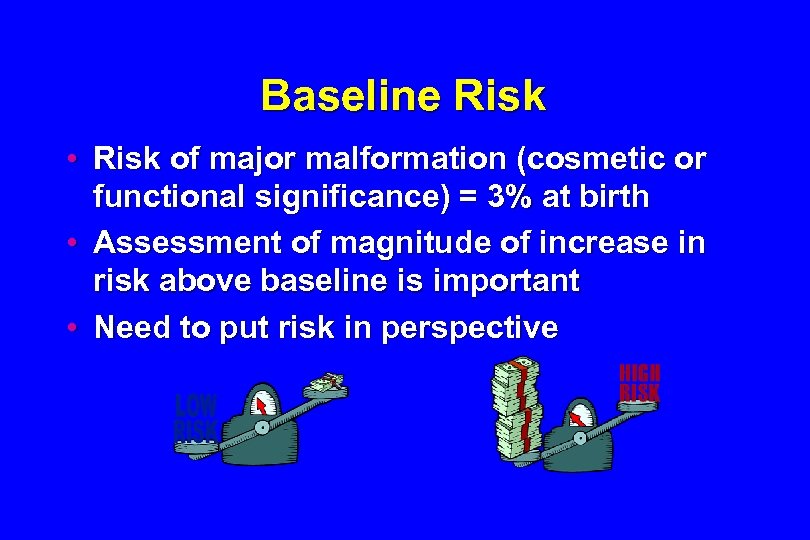 Baseline Risk • Risk of major malformation (cosmetic or functional significance) = 3% at birth • Assessment of magnitude of increase in risk above baseline is important • Need to put risk in perspective
 Important Factors • Timing of exposure (sensitive period) – “All-or-none” period – *Organogenesis* • “Avoid drug administration, if at all possible during 1 st trimester” – Brain development • Dose of drug (threshold, doseresponse) • Genetic susceptibility
 Associated Factors • Role of underlying maternal disease • Other exposures such as alcohol and cigarette smoking
 General Recommendations • Minimize use of medications to those which are necessary and for shortest duration possible • Effective drugs that have been in use for long periods preferable to newer alternatives
 Evaluating Risk - Drug Studies • Manufacturer almost never tests product in pregnant women prior to marketing • Evidence from large clinical trials does not exist • Reproductive toxicology studies in animals - extrapolation?
 Animals vs Humans • 40 -50 chemical and physical agents probably human developmental toxicants • >1200 produce developmental defects in experimental animals • >80% of agents known to produce defects in humans also cause defects in at least one test animal
 “CPS” • Majority of drugs not labeled for use during pregnancy • “Safety of Drug X in pregnancy has not been established. Drug X should not be used during pregnancy unless the potential benefit to the patient outweighs the possible risk to the fetus. ”
 FDA Classification • X, D, C, B, A • Little correlation with risk
 Sources of Information • Reference Textbooks – Drugs in Pregnancy and Lactation (Briggs) – Maternal-Fetal Toxicology (Koren) • Computer Databases – Reprotox – TERIS • Teratogen Information Services – Motherisk Program – FRAME Program
 The Pregnant Dental Patient • • Elective vs urgent 2 nd trimester Eliminate source of infection or pain Usually short-term drug therapy
 Penicillins • Collaborative Perinatal Project • Frequency of congenital anomalies no greater than expected among children of 4, 356 women treated with penicillin (or one of its derivatives) during 1 st 4 lunar months of pregnancy
 Penicillins and Cephalosporins • Amoxicillin and cephalosporins also considered safe to use during pregnancy • No increased risk of malformations with amoxicillin/clavulanic acid (Clavulin) in 2 studies (Br J Clin Pharmacol 2004; 58: 298302 and Eur J Obstet Gynecol Reprod Biol 2001; 97: 188 -92)
 Erythromycin • Surveillance study of Michigan Medicaid recipients (1985 -1992) • No association between drug and congenital malformations in 6, 972 newborns exposed during 1 st trimester • Avoid estolate form (cholestatic hepatitis) • Less but reassuring data with clarithromycin and azithromycin
 Clindamycin (Scand J Infect Dis 2000; 32: 579 -80) • Hungarian Case-Control Surveillance of Congenital Abnormalities (19801996) • OR (95% CI) for clindamycin 1. 2 (0. 43. 8) and for lincomycin 1. 3 (0. 3 -5. 1) • Limited numbers
 Metronidazole • Mutagenic in bacteria and carcinogenic in animals • Small number of reports raised suspicion of teratogenic effect
 Metronidazole (Am J Obstet Gynecol 1995; 172: 525 -9) • Outcome of interest = occurrence of birth defects in live-born infants • Overall weighted OR during the 1 st trimester calculated by meta-analysis of 7 studies was 0. 93 (95% CI 0. 731. 18)
 Fluoroquinolones (Antimicrob Agents Chemother 1998; 42: 1336 -9) • Arthropathy in weight-bearing joints of animals • 200 women exposed to fluoroquinolones during pregnancy • Rates of major malformations did not differ between groups exposed to quinolones during 1 st trimester (2. 2%) and control group (2. 6%) • Gross motor milestones did not differ between children in 2 groups
 Tetracycline • Main risk is yellow-brown discoloration of teeth • Risk only later than 4 -5 months gestation when deciduous teeth begin to calcify • No staining from doxycycline documented • Effects on bone minimal
 Local Anesthetics - Lidocaine • Considered relatively safe for use during pregnancy
 Epinephrine • Potential to compromise uterine blood flow • Studies have failed to demonstrate adverse fetal effects • Low doses used in dentistry • Avoid inadvertent intravascular injection
 Acetaminophen • “Analgesic of choice” • Occasional use at therapeutic doses • Chronic use or overdose
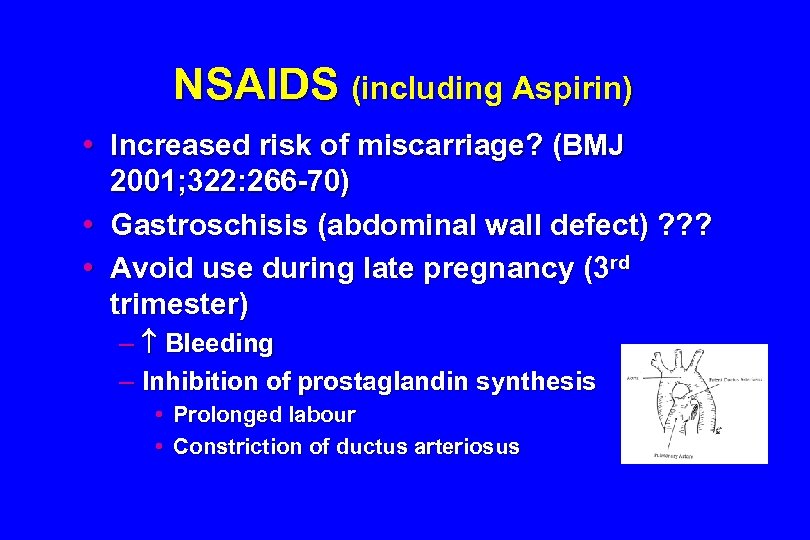 NSAIDS (including Aspirin) • Increased risk of miscarriage? (BMJ 2001; 322: 266 -70) • Gastroschisis (abdominal wall defect) ? ? ? • Avoid use during late pregnancy (3 rd trimester) – Bleeding – Inhibition of prostaglandin synthesis • Prolonged labour • Constriction of ductus arteriosus
 New COX-2 Inhibitors (Am J Physiol Regul Integr Comp Physiol 2000; 278: R 1496 -505) • Studies in fetal lambs demonstrated – Celecoxib constricted isolated ductus in vitro – Celecoxib produced both an increase in pressure gradient and resistance across the ductus in vivo
 Narcotics (Codeine, Oxycodone, etc. ) • Don’t appear to risk of birth defects • Low dose short-term regimens acceptable • Respiratory depression • Neonatal withdrawal
 Codeine • Unlikely to pose substantial teratogenic risk but data insufficient to state no risk (TERIS, 2002) • Associations between 1 st trimester use and congenital anomalies in case-control studies although others have not confirmed • Absence of consistent pattern and criticisms of possible bias in data make it unjustified to consider codeine as causative of these malformations
 Nitrous Oxide (N 2 O) with O 2 • Use during pregnancy somewhat controversial • Inhibits methionine synthetase which can affect DNA synthesis • Teratogenic in animals • Single brief maternal exposure during pregnancy unlikely to pose a substantial teratogenic risk • Minimize prolonged use (< 30 minutes, at least 50% O 2)
 Occupational Exposure to N 2 O • risk of spontaneous abortion? • Importance of scavenging equipment
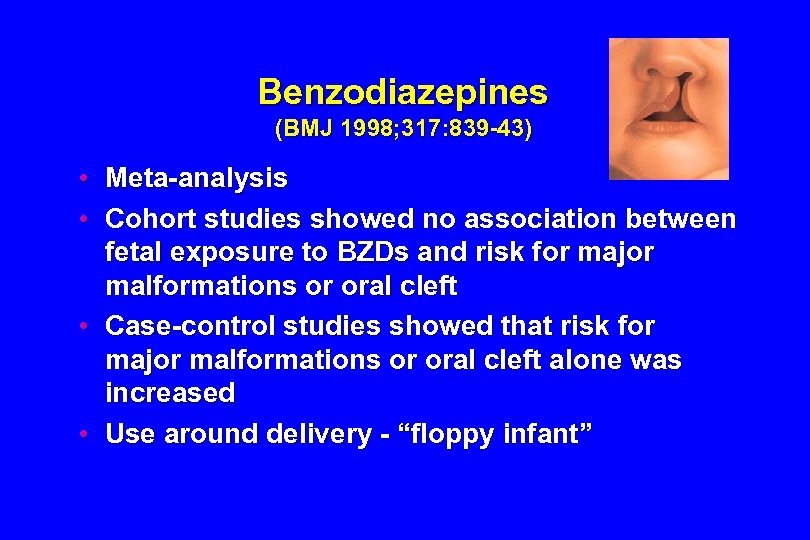 Benzodiazepines (BMJ 1998; 317: 839 -43) • • Meta-analysis Cohort studies showed no association between fetal exposure to BZDs and risk for major malformations or oral cleft • Case-control studies showed that risk for major malformations or oral cleft alone was increased • Use around delivery - “floppy infant”
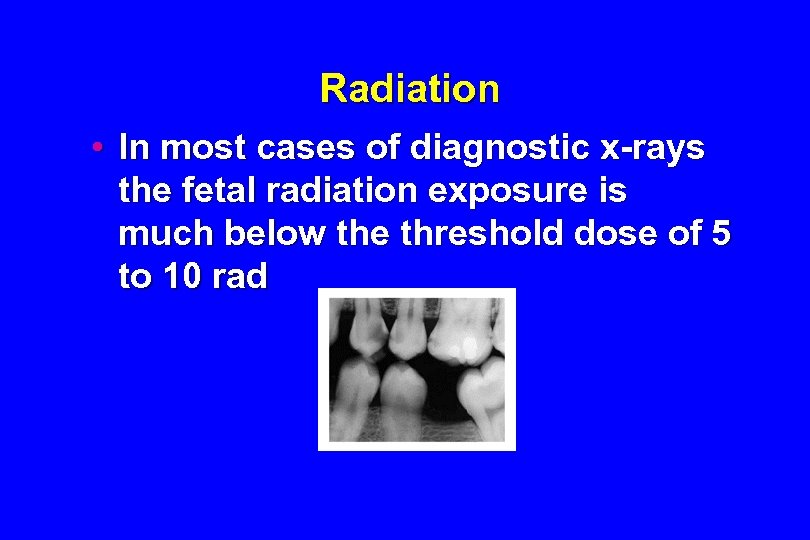 Radiation • In most cases of diagnostic x-rays the fetal radiation exposure is much below the threshold dose of 5 to 10 rad
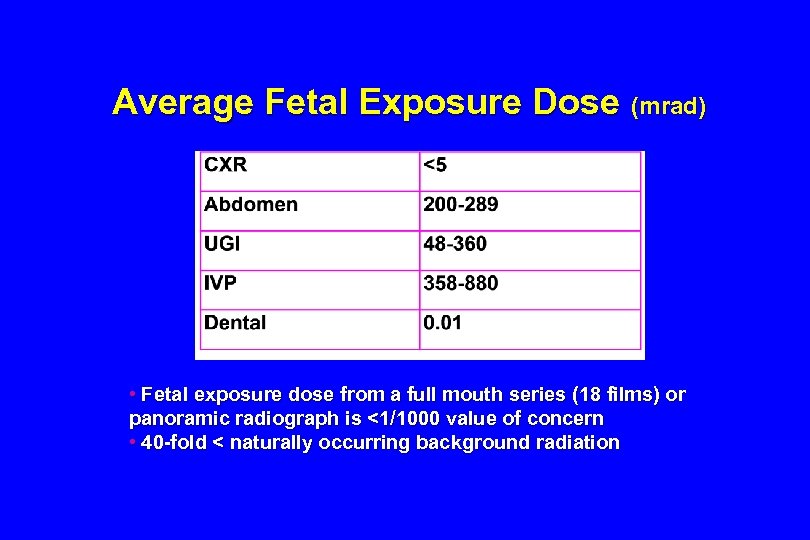 Average Fetal Exposure Dose (mrad) • Fetal exposure dose from a full mouth series (18 films) or panoramic radiograph is <1/1000 value of concern • 40 -fold < naturally occurring background radiation
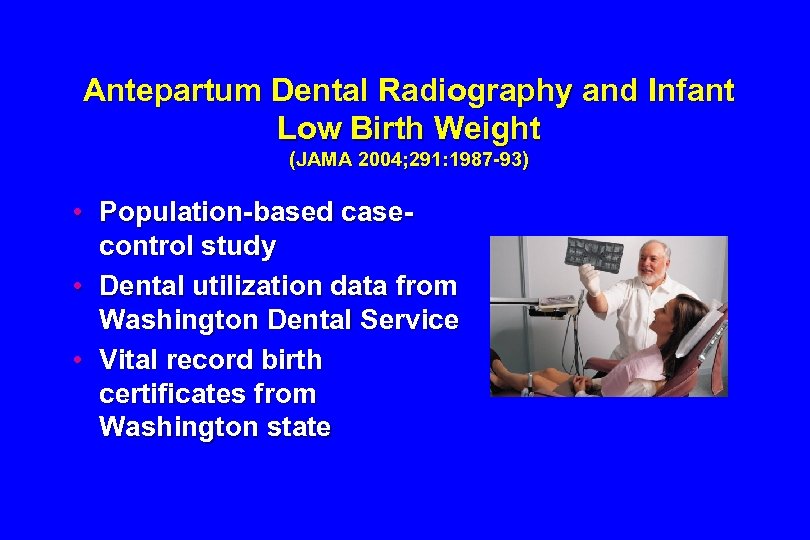 Antepartum Dental Radiography and Infant Low Birth Weight (JAMA 2004; 291: 1987 -93) • Population-based casecontrol study • Dental utilization data from Washington Dental Service • Vital record birth certificates from Washington state
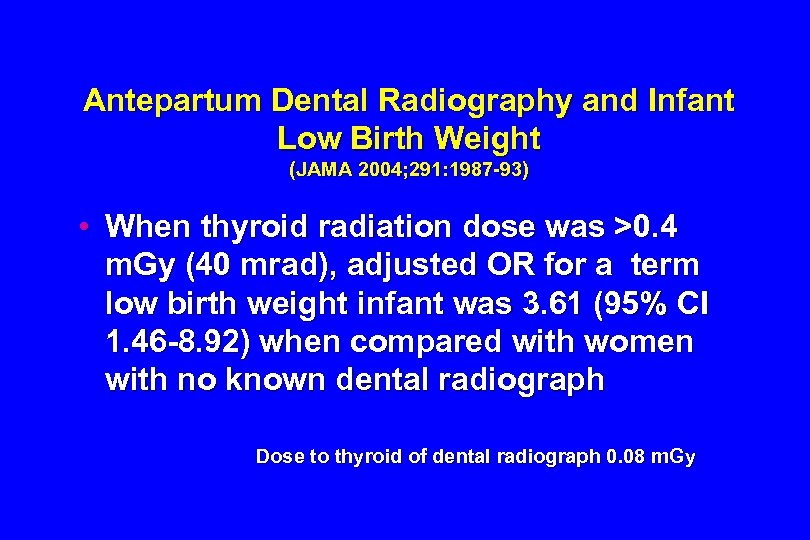 Antepartum Dental Radiography and Infant Low Birth Weight (JAMA 2004; 291: 1987 -93) • When thyroid radiation dose was >0. 4 m. Gy (40 mrad), adjusted OR for a term low birth weight infant was 3. 61 (95% CI 1. 46 -8. 92) when compared with women with no known dental radiograph Dose to thyroid of dental radiograph 0. 08 m. Gy
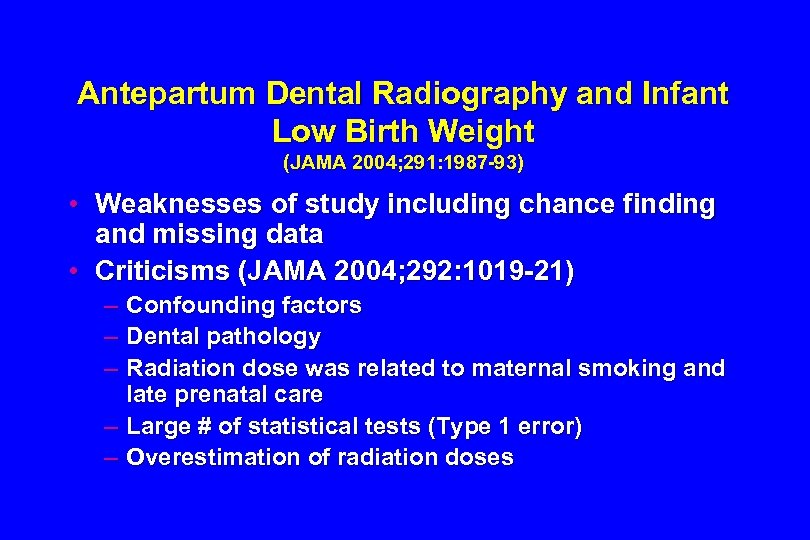 Antepartum Dental Radiography and Infant Low Birth Weight (JAMA 2004; 291: 1987 -93) • Weaknesses of study including chance finding and missing data • Criticisms (JAMA 2004; 292: 1019 -21) – Confounding factors – Dental pathology – Radiation dose was related to maternal smoking and late prenatal care – Large # of statistical tests (Type 1 error) – Overestimation of radiation doses
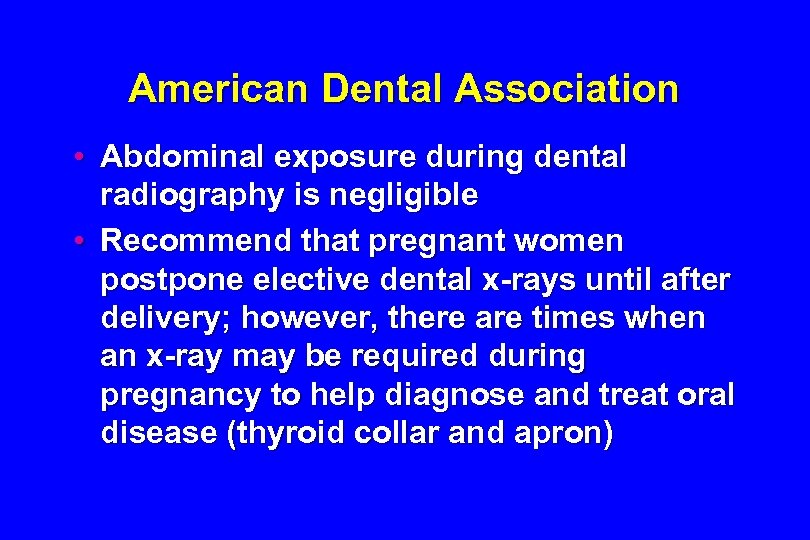 American Dental Association • Abdominal exposure during dental radiography is negligible • Recommend that pregnant women postpone elective dental x-rays until after delivery; however, there are times when an x-ray may be required during pregnancy to help diagnose and treat oral disease (thyroid collar and apron)
 Drugs and Pregnancy - Summary • List of drugs which have been associated with adverse effects when taken during pregnancy is relatively short • Teratogenic potential should be explained to women of childbearing age at time drug is prescribed • Lack of information but important to avoid misinformation • Importance of baseline risk
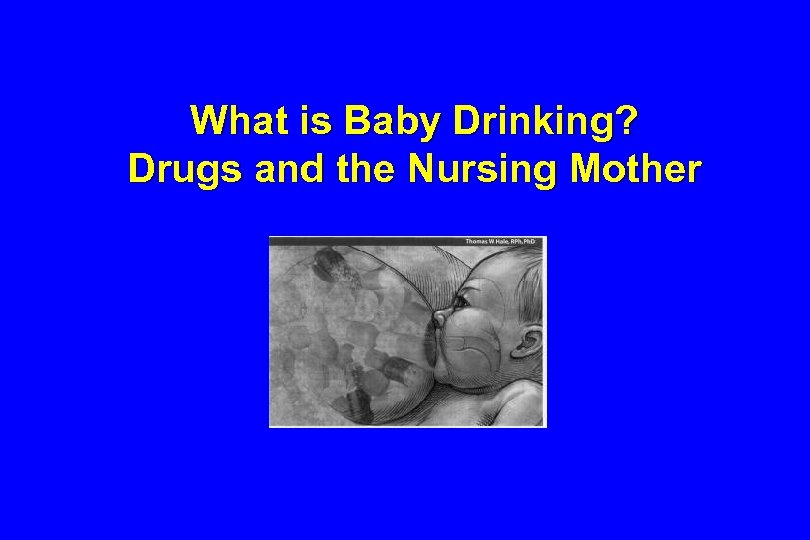 What is Baby Drinking? Drugs and the Nursing Mother
 Risk-Benefit Ratio • Benefits of continuing breastfeeding substantial • Convincing reason to justify cessation of breastfeeding required
 Clinical Implications • Majority of drugs cross from maternal plasma into breast milk • Most medications found in very small amounts in breast milk (<1% of maternal dose) • Risk of adverse effects in nursing infants is negligible for most drugs
 Clinical Implications • Reluctance to encourage continuation of breastfeeding – Pharmacological action of drug suggests that a toxic effect may occur – Adverse effects have previously been noted in nursing infants
 Clinical Implications • Experience with direct use of drug in infants for therapy may provide reassurance • Infant’s age (< 6 months), clinical status and frequency of feeding may be important
 Clinical Implications - Risk Assessment • Arbitrarily define as safe a value of <10% of therapeutic dose for infants (or the adult dose standardized by weight)
 Sources of Information • • • Peer-reviewed literature Textbooks Committee on Drugs (AAP) Computer Databases Teratogen Information Services – FRAME Program (London) – Motherisk Program (Toronto)
 Metronidazole • Use during lactation controversial • Excreted into breast milk in relatively large amounts • Concern expressed with respect to possible mutagenic effects • No reports of adverse effects in nursing infants • In conventional doses compatible with breastfeeding • If taken in single large dose breastfeeding may be temporarily withheld for 12 to 24 hours
 Codeine (Lancet 2006; 368: 704) • Full term healthy male infant • Intermittent difficulty breastfeeding and lethargy starting Day 7 and died Day 13 • Blood morphine concentration very high
 Codeine (Lancet 2006; 368: 704) • Mother – – Taking acetaminophen/codeine preparation dose due to somnolence and constipation Morphine [ ] of stored milk was very high Ultra-rapid metabolizer • Picture consistent with opioid toxicity • Careful follow-up of breastfeeding mothers using codeine and their infants (somnolence, poor feeding, etc. )
 Benzodiazepines • Milk levels of benzodiazepines not excessive but rarely sedation has been reported in breastfed infants • If sedative required, shorter half-life drugs such as lorazepam and midazolam preferred • Long term exposure not recommended
 Drugs and Breastfeeding Summary • Most medications found in very small amounts in breast milk • Risk of adverse effects in nursing infants is negligible for most drugs • Consequences of misinformation (medication noncompliance, breastfeeding cessation) NB to consult appropriate available sources