


 Скачать презентацию Drug Importation in the US Lose-Lose for US
5cf4e3ac1d89b16c95cf2535ab8007a3.ppt
- Количество слайдов: 18
 Drug Importation in the US: Lose-Lose for US and Foreign Consumers Patricia M. Danzon Ph. D The Wharton School University of Pennsylvania http: //hc. wharton. upenn. edu/danzon/index. htm
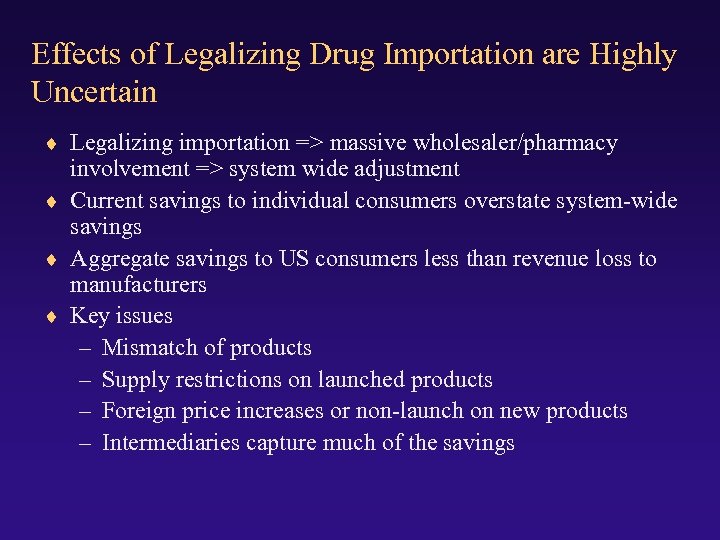 Effects of Legalizing Drug Importation are Highly Uncertain ¨ Legalizing importation => massive wholesaler/pharmacy involvement => system wide adjustment ¨ Current savings to individual consumers overstate system-wide savings ¨ Aggregate savings to US consumers less than revenue loss to manufacturers ¨ Key issues – Mismatch of products – Supply restrictions on launched products – Foreign price increases or non-launch on new products – Intermediaries capture much of the savings
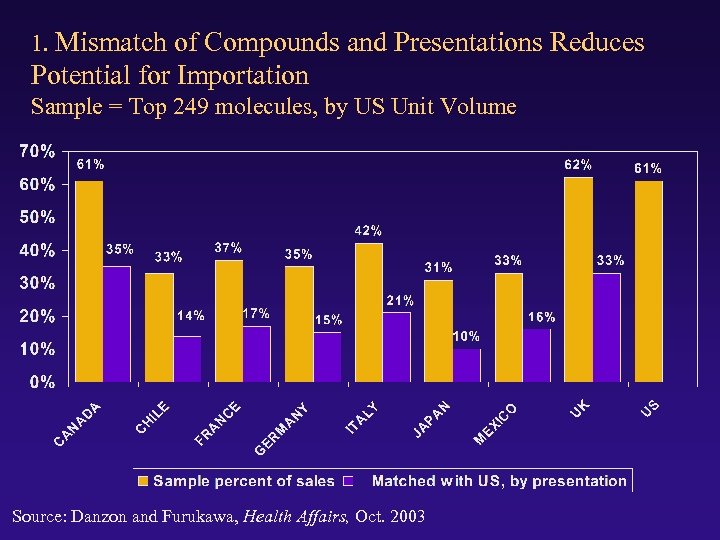 1. Mismatch of Compounds and Presentations Reduces Potential for Importation Sample = Top 249 molecules, by US Unit Volume Source: Danzon and Furukawa, Health Affairs, Oct. 2003
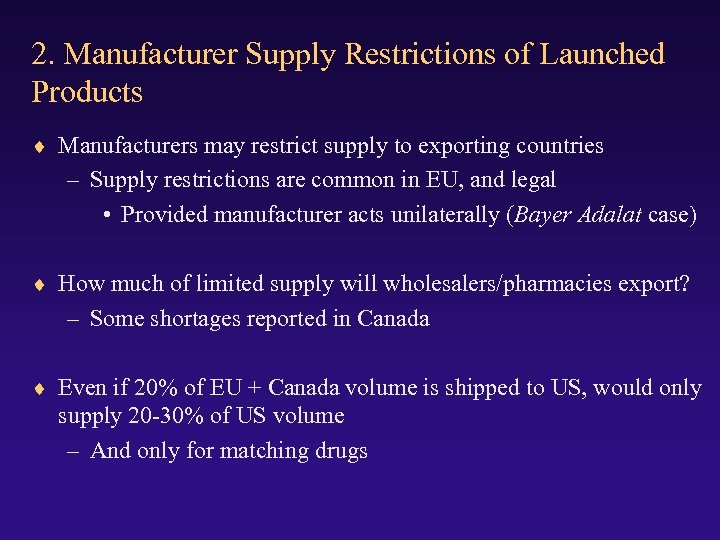 2. Manufacturer Supply Restrictions of Launched Products ¨ Manufacturers may restrict supply to exporting countries – Supply restrictions are common in EU, and legal • Provided manufacturer acts unilaterally (Bayer Adalat case) ¨ How much of limited supply will wholesalers/pharmacies export? – Some shortages reported in Canada ¨ Even if 20% of EU + Canada volume is shipped to US, would only supply 20 -30% of US volume – And only for matching drugs
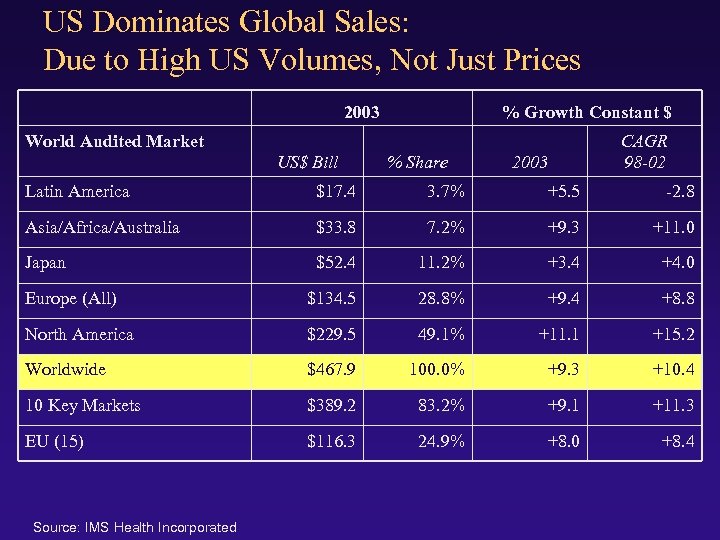 US Dominates Global Sales: Due to High US Volumes, Not Just Prices 2003 % Growth Constant $ World Audited Market US$ Bill % Share 2003 CAGR 98 -02 Latin America $17. 4 3. 7% +5. 5 -2. 8 Asia/Africa/Australia $33. 8 7. 2% +9. 3 +11. 0 Japan $52. 4 11. 2% +3. 4 +4. 0 Europe (All) $134. 5 28. 8% +9. 4 +8. 8 North America $229. 5 49. 1% +11. 1 +15. 2 Worldwide $467. 9 100. 0% +9. 3 +10. 4 10 Key Markets $389. 2 83. 2% +9. 1 +11. 3 EU (15) $116. 3 24. 9% +8. 0 +8. 4 Source: IMS Health Incorporated
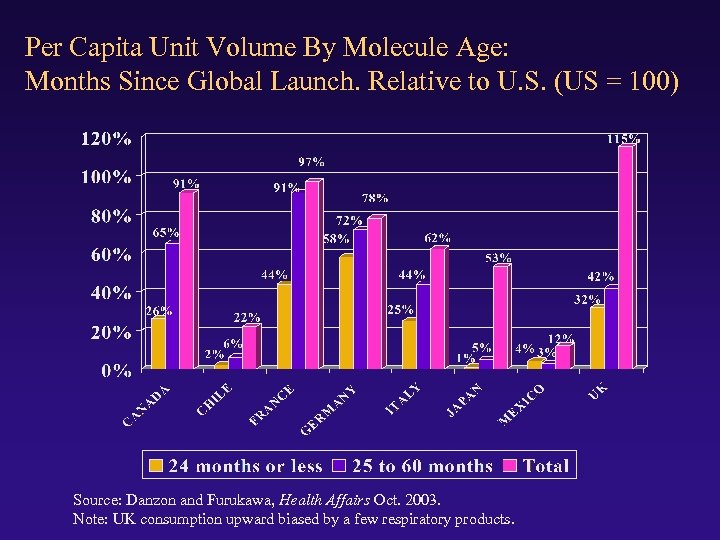 Per Capita Unit Volume By Molecule Age: Months Since Global Launch. Relative to U. S. (US = 100) Source: Danzon and Furukawa, Health Affairs Oct. 2003. Note: UK consumption upward biased by a few respiratory products.
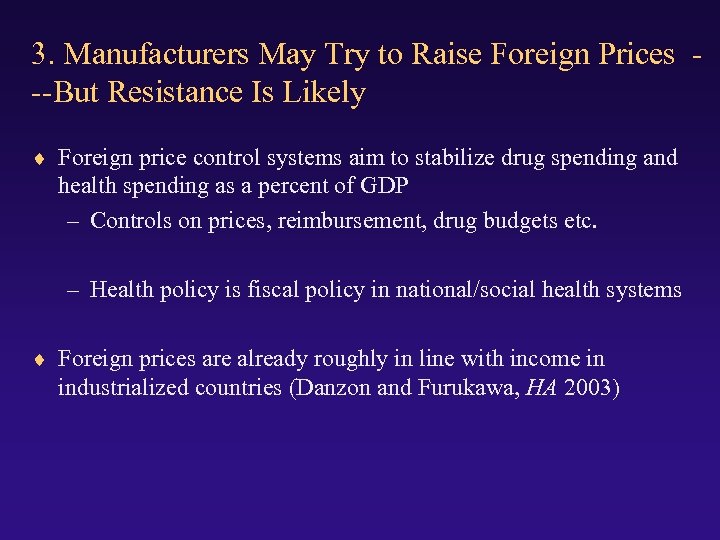 3. Manufacturers May Try to Raise Foreign Prices --But Resistance Is Likely ¨ Foreign price control systems aim to stabilize drug spending and health spending as a percent of GDP – Controls on prices, reimbursement, drug budgets etc. – Health policy is fiscal policy in national/social health systems ¨ Foreign prices are already roughly in line with income in industrialized countries (Danzon and Furukawa, HA 2003)
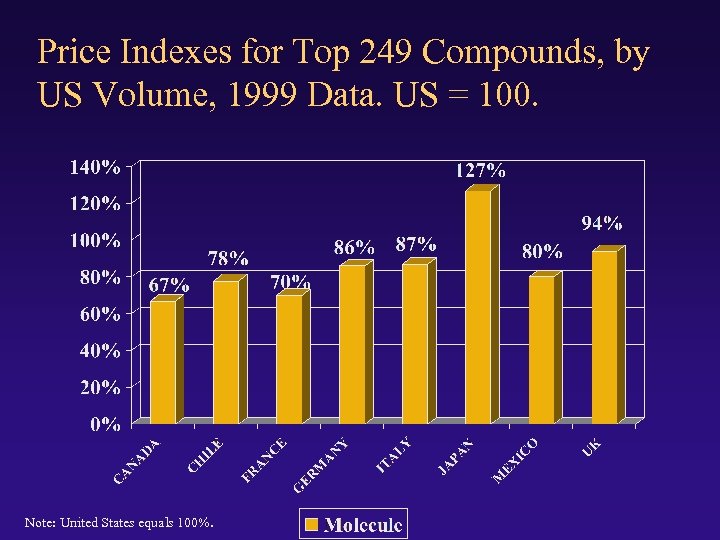 Price Indexes for Top 249 Compounds, by US Volume, 1999 Data. US = 100. Note: United States equals 100%.
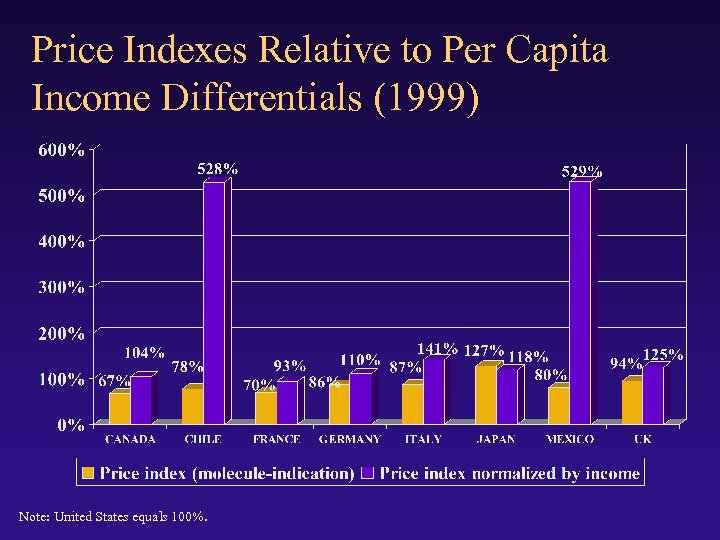 Price Indexes Relative to Per Capita Income Differentials (1999) Note: United States equals 100%.
 (b) Delay and Non-launch of New Drugs ex-US if Low Prices ¨ Countries that are unwilling/unable to pay higher prices may see fewer/delayed product launches ¨ If importation threat is large, manufacturers would rationally be less willing to launch ex-US at low prices – US market vs. loss of foreign sales – Feasible pricing range varies by product, importer costs etc.
 Countries with Lower Prices have Fewer Launches, Longer Launch Lags (Danzon, Wang and Wang 2003) ¨ We estimate the effects of price on launch delay, controlling for market size , per capita income, etc. ¨ Sample: launch of 85 NCEs launched in 1994 -1999 ¨ 14 EU countries, plus Australia, Canada, Czech, Japan, Mexico, New Zealand, Norway, Poland, S. Africa, Switzerland, and USA ¨ IMS data on prices and volumes
 Findings ¨ Countries with lower prices have longer launch lags and fewer launches ¨ EU countries that are major PI exporters have longer delays, controlling for expected price and volume
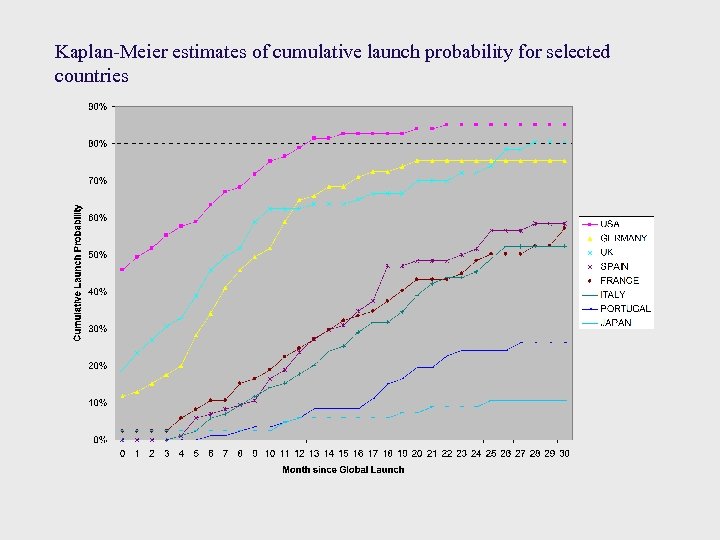 Kaplan-Meier estimates of cumulative launch probability for selected countries
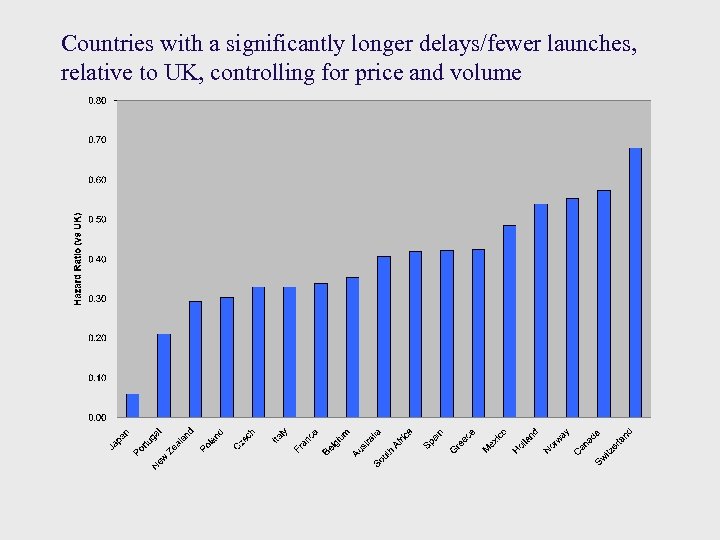 Countries with a significantly longer delays/fewer launches, relative to UK, controlling for price and volume
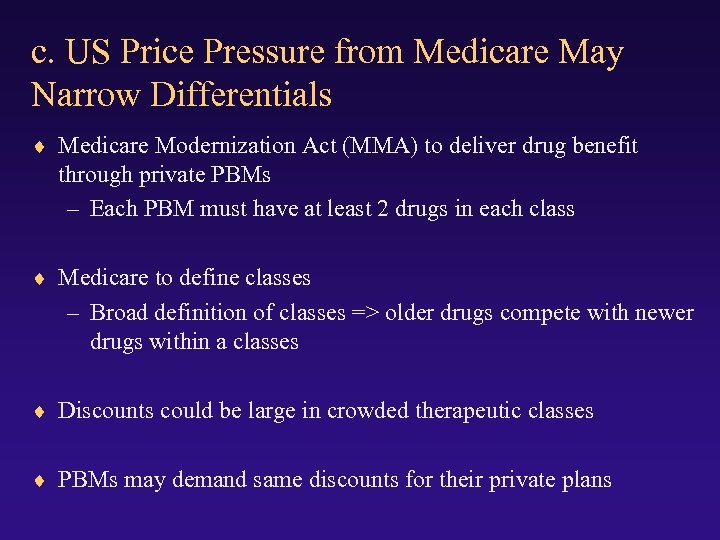 c. US Price Pressure from Medicare May Narrow Differentials ¨ Medicare Modernization Act (MMA) to deliver drug benefit through private PBMs – Each PBM must have at least 2 drugs in each class ¨ Medicare to define classes – Broad definition of classes => older drugs compete with newer drugs within a classes ¨ Discounts could be large in crowded therapeutic classes ¨ PBMs may demand same discounts for their private plans
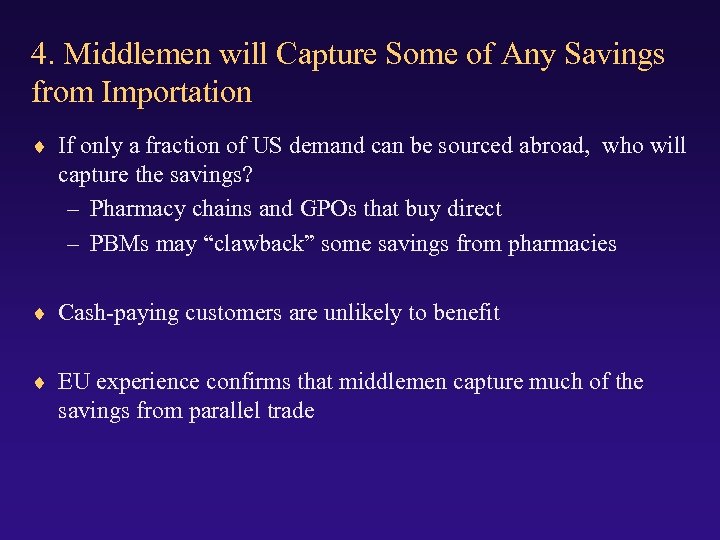 4. Middlemen will Capture Some of Any Savings from Importation ¨ If only a fraction of US demand can be sourced abroad, who will capture the savings? – Pharmacy chains and GPOs that buy direct – PBMs may “clawback” some savings from pharmacies ¨ Cash-paying customers are unlikely to benefit ¨ EU experience confirms that middlemen capture much of the savings from parallel trade
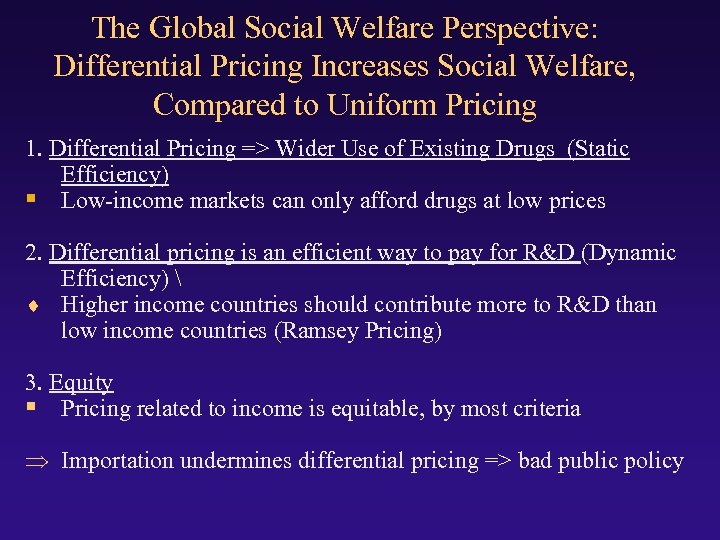 The Global Social Welfare Perspective: Differential Pricing Increases Social Welfare, Compared to Uniform Pricing 1. Differential Pricing => Wider Use of Existing Drugs (Static Efficiency) § Low-income markets can only afford drugs at low prices 2. Differential pricing is an efficient way to pay for R&D (Dynamic Efficiency) ¨ Higher income countries should contribute more to R&D than low income countries (Ramsey Pricing) 3. Equity § Pricing related to income is equitable, by most criteria Þ Importation undermines differential pricing => bad public policy
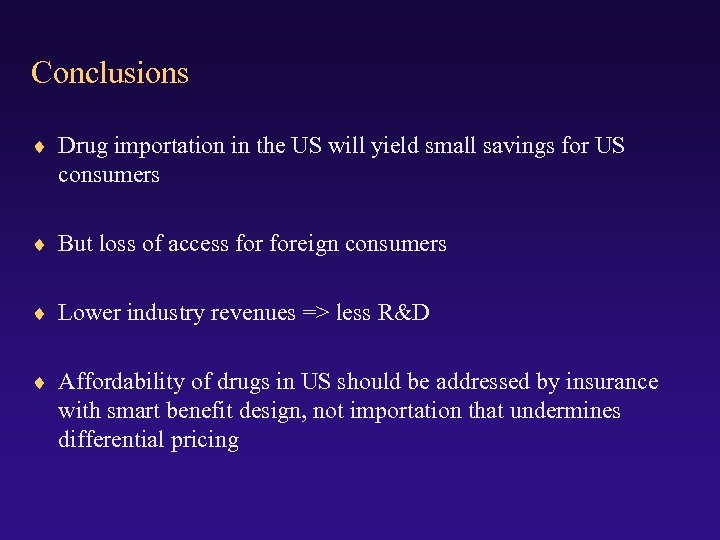 Conclusions ¨ Drug importation in the US will yield small savings for US consumers ¨ But loss of access foreign consumers ¨ Lower industry revenues => less R&D ¨ Affordability of drugs in US should be addressed by insurance with smart benefit design, not importation that undermines differential pricing