


 Скачать презентацию Drug Consumption rooms in The Netherlands History Efficacy
0a6567da39943109dd0378ee46a2fd7d.ppt
- Количество слайдов: 20
 Drug Consumption rooms in The Netherlands History, Efficacy and Results Victor Everhardt, Trimbos-instituut © * 1
 The Dutch definition of DCR • A facility under the administration of an official organisation where drug users can administer their pre obtained drugs in relative peace and quiet under supervision of (trained) staff. 2
 Target group • • long term addicts multiple problems street drug use poor physical state *Bransen, van t‘ Land Wolf, 2004 3
![At a certain moment there were [in Maastricht] 3000 drug tourists a day. […]Dealers](https://present5.com/presentation/0a6567da39943109dd0378ee46a2fd7d/image-4.jpg "At a certain moment there were [in Maastricht] 3000 drug tourists a day. […]Dealers") At a certain moment there were [in Maastricht] 3000 drug tourists a day. […]Dealers from Rotterdam and other cities moved in, because they were much more used to working on this scale than the local drug dealers. The place was littered with syringes. There was no health care facility in the area, nothing. It wasn’t easy to find a suitable location for this. The first place designated by the local council, was set fire to by the local community. When the local authorities didn’t succeed in finding a suitable location, they opened up the City Hall for the hard drug users. This was in the basement of the City Hall. (Consumption room worker Maastricht) 4
At a certain moment there were [in Maastricht] 3000 drug tourists a day. […]Dealers from Rotterdam and other cities moved in, because they were much more used to working on this scale than the local drug dealers. The place was littered with syringes. There was no health care facility in the area, nothing. It wasn’t easy to find a suitable location for this. The first place designated by the local council, was set fire to by the local community. When the local authorities didn’t succeed in finding a suitable location, they opened up the City Hall for the hard drug users. This was in the basement of the City Hall. (Consumption room worker Maastricht) 4
 Policy document Ministry of Health (2002) Two reasons • Benefits for public health (reduced risk of infectious diseases and overdose) • Decrease of public nuisance If formal DCR’s are not allowed the use of illegal ‘shooting galleries’ will increase and this is a threat for public health. 5
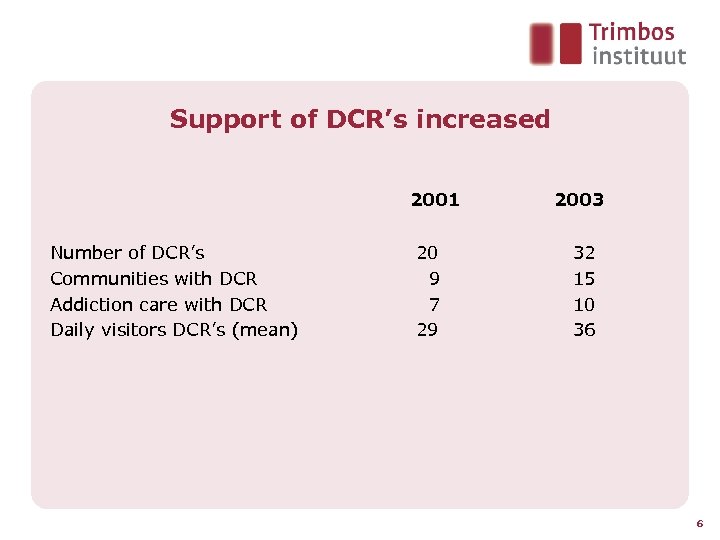 Support of DCR’s increased 2001 Number of DCR’s Communities with DCR Addiction care with DCR Daily visitors DCR’s (mean) 20 9 7 29 2003 32 15 10 36 6
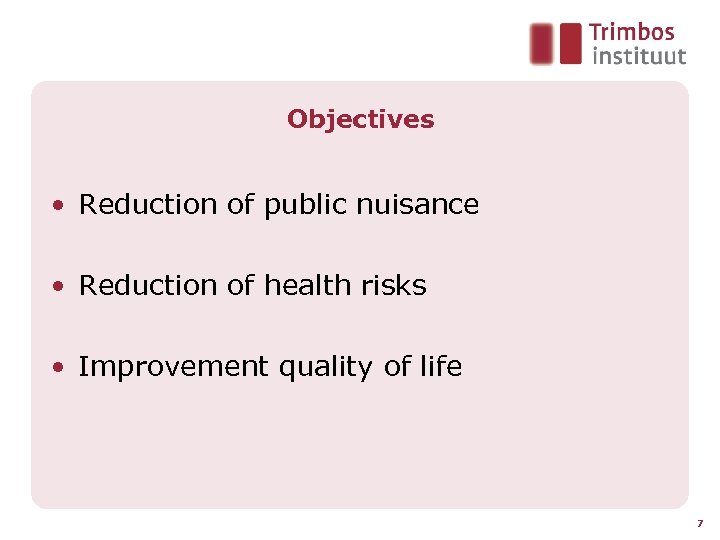 Objectives • Reduction of public nuisance • Reduction of health risks • Improvement quality of life 7
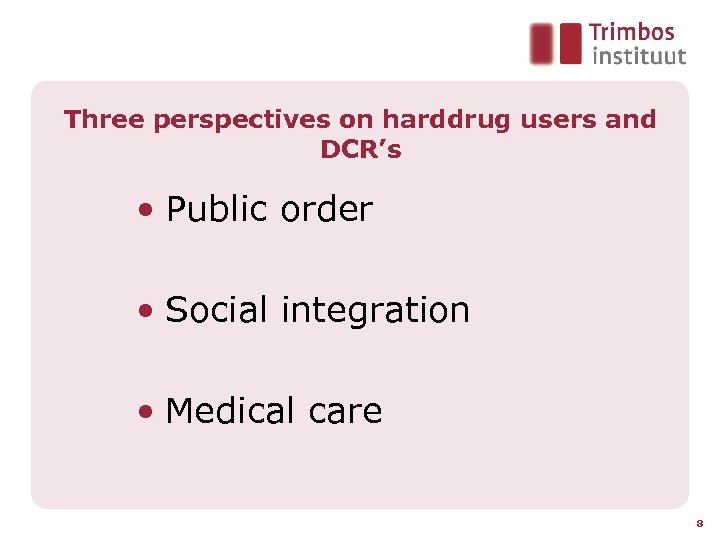 Three perspectives on harddrug users and DCR’s • Public order • Social integration • Medical care 8
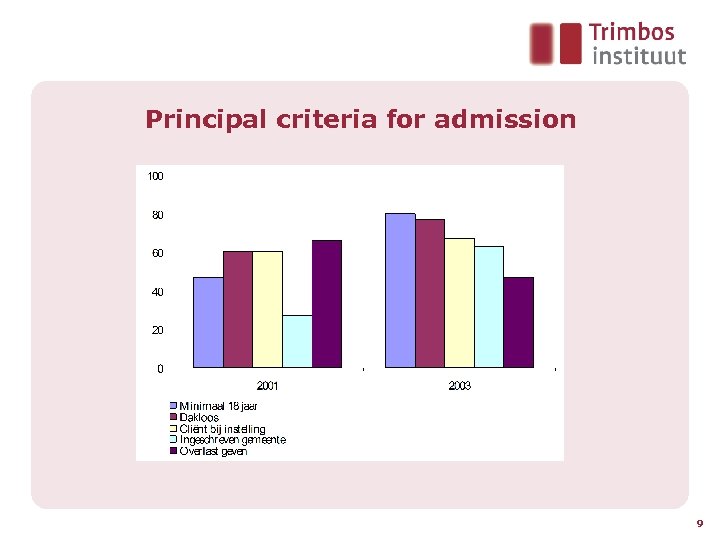 Principal criteria for admission 9
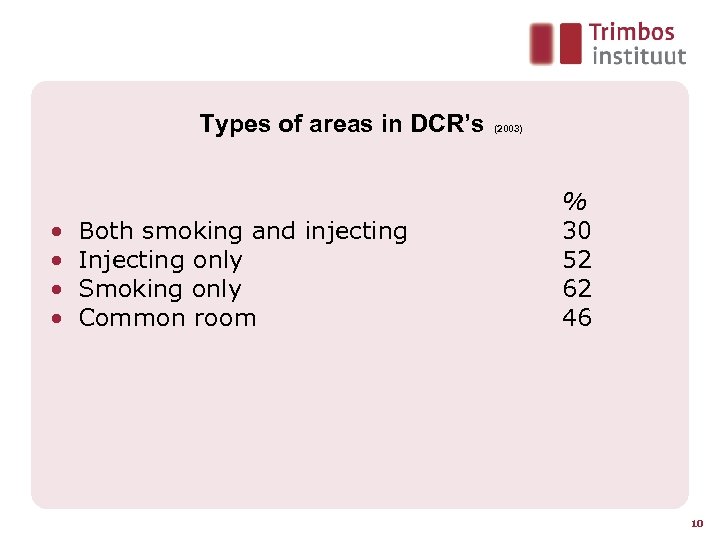 Types of areas in DCR’s • • Both smoking and injecting Injecting only Smoking only Common room (2003) % 30 52 62 46 10
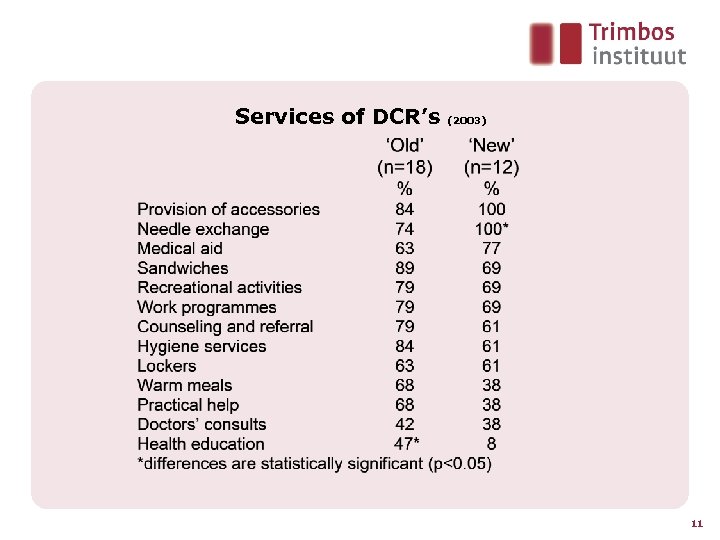 Services of DCR’s (2003) 11
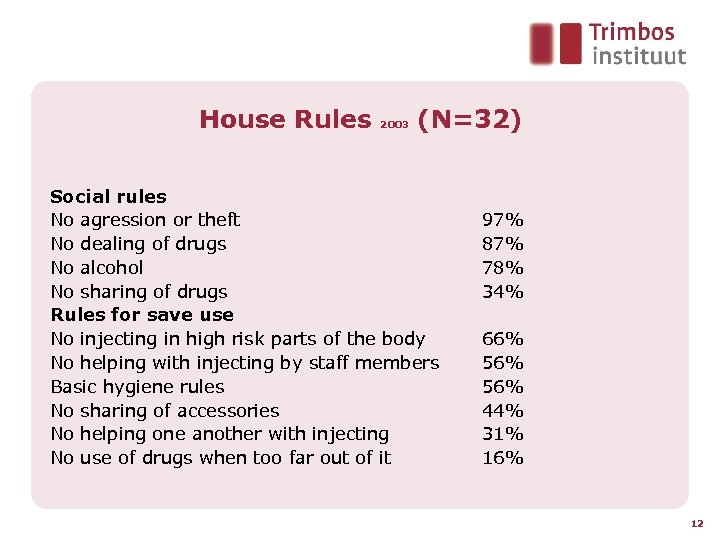 House Rules 2003 (N=32) Social rules No agression or theft No dealing of drugs No alcohol No sharing of drugs Rules for save use No injecting in high risk parts of the body No helping with injecting by staff members Basic hygiene rules No sharing of accessories No helping one another with injecting No use of drugs when too far out of it 97% 87% 78% 34% 66% 56% 44% 31% 16% 12
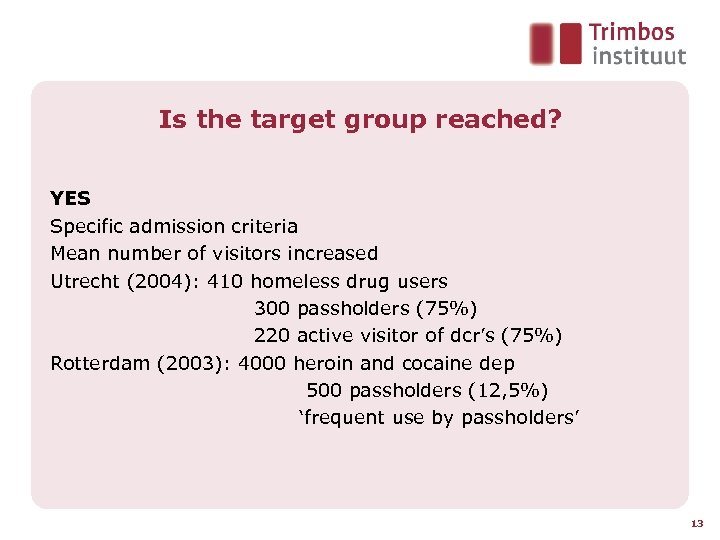 Is the target group reached? YES Specific admission criteria Mean number of visitors increased Utrecht (2004): 410 homeless drug users 300 passholders (75%) 220 active visitor of dcr’s (75%) Rotterdam (2003): 4000 heroin and cocaine dep 500 passholders (12, 5%) ‘frequent use by passholders’ 13
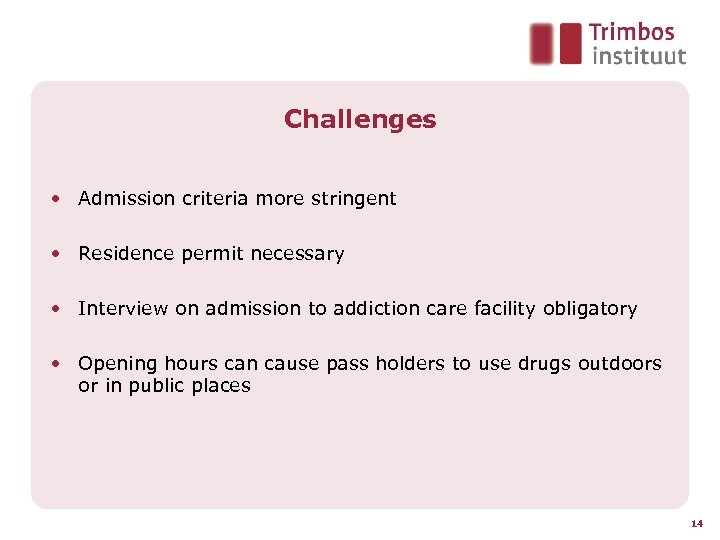 Challenges • Admission criteria more stringent • Residence permit necessary • Interview on admission to addiction care facility obligatory • Opening hours can cause pass holders to use drugs outdoors or in public places 14
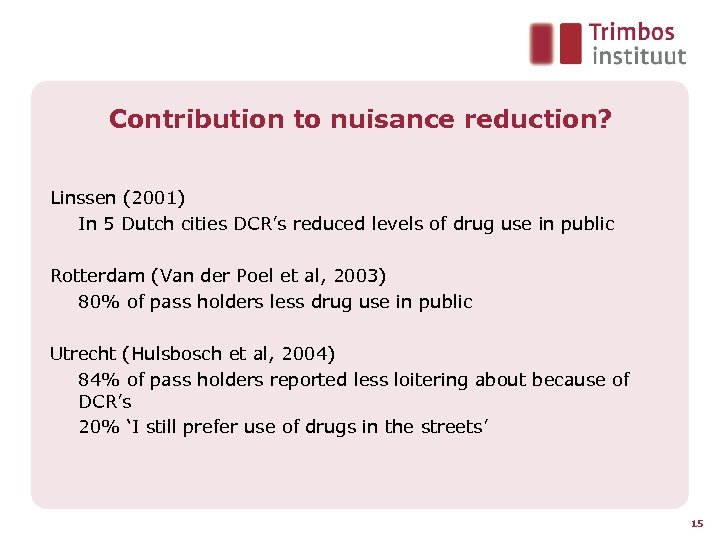 Contribution to nuisance reduction? Linssen (2001) In 5 Dutch cities DCR’s reduced levels of drug use in public Rotterdam (Van der Poel et al, 2003) 80% of pass holders less drug use in public Utrecht (Hulsbosch et al, 2004) 84% of pass holders reported less loitering about because of DCR’s 20% ‘I still prefer use of drugs in the streets’ 15
 Challenges • Admission criteria • Opening hours • Distance between drug market and DCR 16
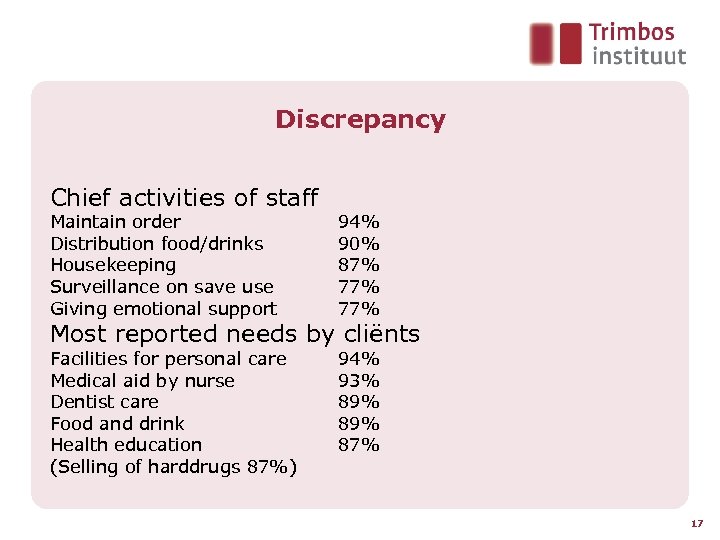 Discrepancy Chief activities of staff Maintain order Distribution food/drinks Housekeeping Surveillance on save use Giving emotional support 94% 90% 87% 77% Facilities for personal care Medical aid by nurse Dentist care Food and drink Health education (Selling of harddrugs 87%) 94% 93% 89% 87% Most reported needs by cliënts 17
 Conditions for succes • Successful contact with target group • Consensus about objectives, function & target group • DCR is embedded in local policy with regard to long-term addicts and harm reduction • Agreement with police and public prosecutor • Availability and accessibility of health care and welfare facilities for long-term addicts • Availability of trained staff • Cooperation with interest groups/target group 18
 Legal conditions I Principle of discretionary powers The Public Prosecutions Department (OM) may waive prosecution of offences if this serves the general public interest. The guidelines for investigation and prosecution of violations of the Opium Act state the following priorities 19
 Legal conditions II UN Conventions (1961, 1971 & 1988) • Harm reduction is part of Demand reduction (terminolgy of the UN conventions) • Use of drugs is not covered by UN Conventions • Possession for Personal Use is not covered by UN Conventions • A d. c. Room is a sound medical practice • D. C. Rooms are not contrary to UN Conventions Germany, Norway, Switzerland, Portugal, Spain and The Netherlands 20