


 Скачать презентацию Driving Efficiency with Unified Communications Summary Report www
8527a5c1c5ad735f23cf0993d83c3765.ppt
- Количество слайдов: 18
 Driving Efficiency with Unified Communications: Summary Report www. infotech. com Impact Research 1
 Introduction to the Summary Document This summary document contains sample slides from the full presentation “Driving Efficiency with Unified Communications. ” The actual presentation is 75 slides and goes in-depth into the aspects of Unified Communications illustrated in the table of contents below. Table of Contents for the full report: 1. Executive Summary 2. Research Method 3. What is Unified Communications? 4. UC Adoption Drivers 5. Who is Using UC? 6. UC Benefits 7. UC Challenges 8. UC Project Results 9. The UC Market and Vendors 10. Planning and Implementation 11. Key Conclusions 12. The Future of Unified Communications 13. Case Studies www. infotech. com Impact Research 2
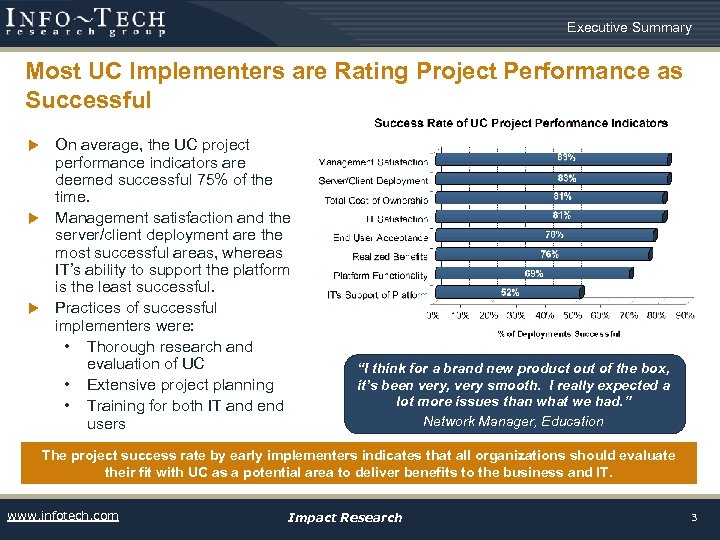 Executive Summary Most UC Implementers are Rating Project Performance as Successful On average, the UC project performance indicators are deemed successful 75% of the time. u Management satisfaction and the server/client deployment are the most successful areas, whereas IT’s ability to support the platform is the least successful. u Practices of successful implementers were: • Thorough research and evaluation of UC • Extensive project planning • Training for both IT and end users u “I think for a brand new product out of the box, it’s been very, very smooth. I really expected a lot more issues than what we had. ” Network Manager, Education The project success rate by early implementers indicates that all organizations should evaluate their fit with UC as a potential area to deliver benefits to the business and IT. www. infotech. com Impact Research 3
 Research Method www. infotech. com Impact Research 4
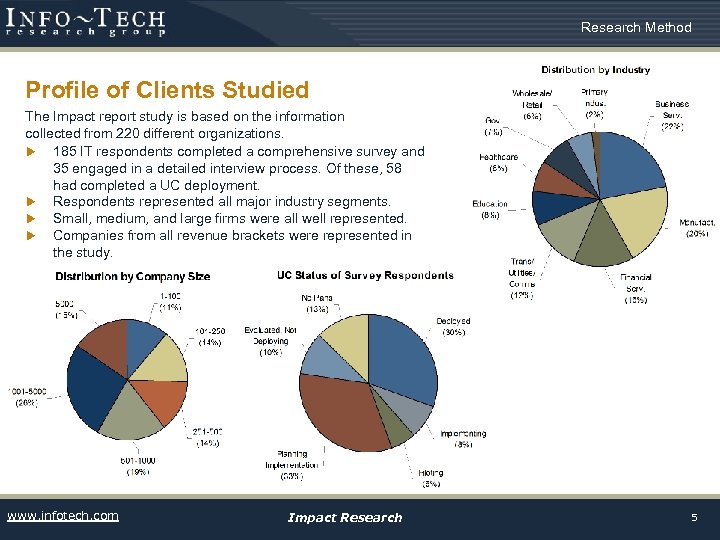 Research Method Profile of Clients Studied The Impact report study is based on the information collected from 220 different organizations. u 185 IT respondents completed a comprehensive survey and 35 engaged in a detailed interview process. Of these, 58 had completed a UC deployment. u Respondents represented all major industry segments. u Small, medium, and large firms were all well represented. u Companies from all revenue brackets were represented in the study. www. infotech. com Impact Research 5
 What is Unified Communications? www. infotech. com Impact Research 6
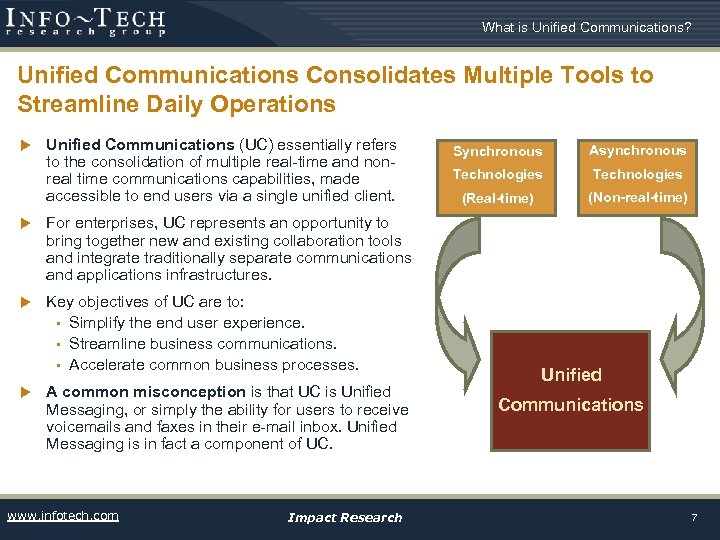 What is Unified Communications? Unified Communications Consolidates Multiple Tools to Streamline Daily Operations u Unified Communications (UC) essentially refers to the consolidation of multiple real-time and nonreal time communications capabilities, made accessible to end users via a single unified client. u Key objectives of UC are to: • Simplify the end user experience. • Streamline business communications. • Accelerate common business processes. Asynchronous Technologies (Real-time) (Non-real-time) For enterprises, UC represents an opportunity to bring together new and existing collaboration tools and integrate traditionally separate communications and applications infrastructures. u Synchronous u A common misconception is that UC is Unified Messaging, or simply the ability for users to receive voicemails and faxes in their e-mail inbox. Unified Messaging is in fact a component of UC. www. infotech. com Impact Research Unified Communications 7
 Who is Using UC? www. infotech. com Impact Research 8
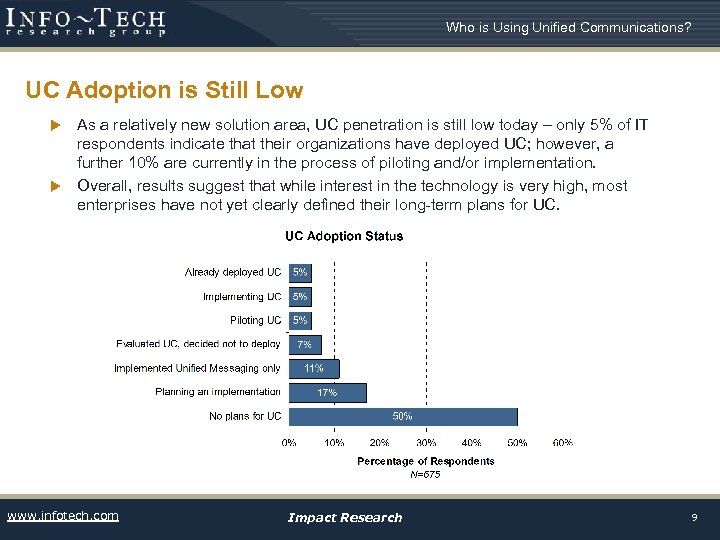 Who is Using Unified Communications? UC Adoption is Still Low As a relatively new solution area, UC penetration is still low today – only 5% of IT respondents indicate that their organizations have deployed UC; however, a further 10% are currently in the process of piloting and/or implementation. u Overall, results suggest that while interest in the technology is very high, most enterprises have not yet clearly defined their long-term plans for UC. u www. infotech. com Impact Research 9
 UC Benefits and Challenges www. infotech. com Impact Research 10
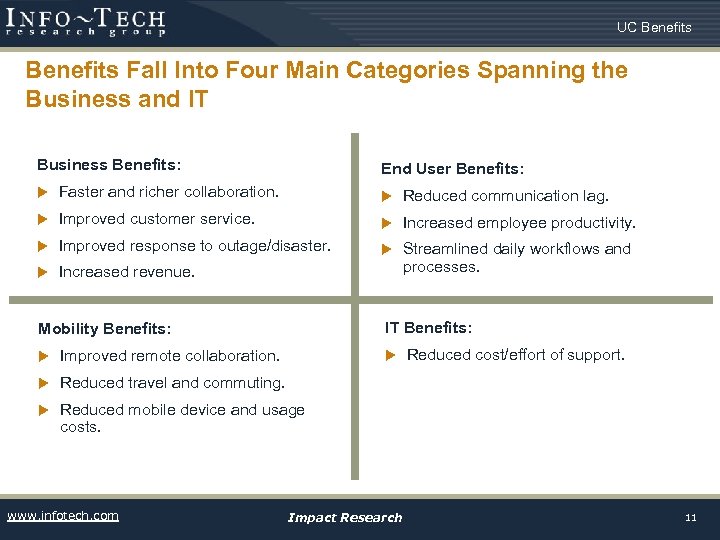 UC Benefits Fall Into Four Main Categories Spanning the Business and IT Business Benefits: End User Benefits: u Faster and richer collaboration. u Reduced communication lag. u Improved customer service. u Increased employee productivity. u Improved response to outage/disaster. u u Increased revenue. Streamlined daily workflows and processes. IT Benefits: Mobility Benefits: u Improved remote collaboration. u u Reduced cost/effort of support. Reduced travel and commuting. Reduced mobile device and usage costs. www. infotech. com u Impact Research 11
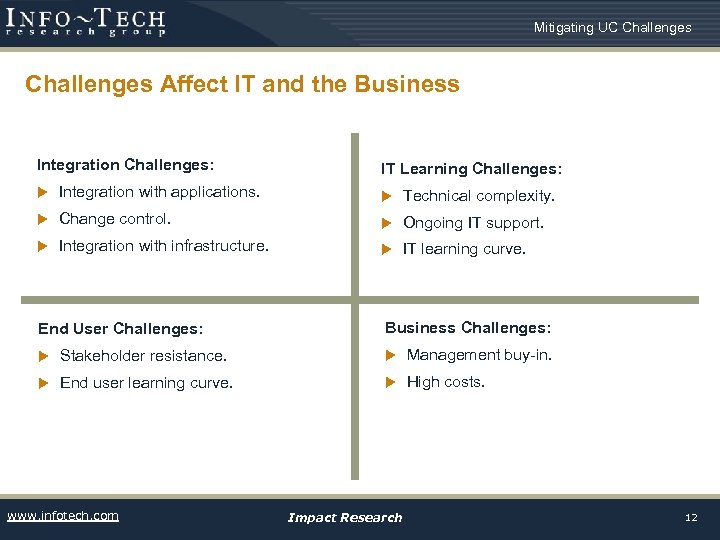 Mitigating UC Challenges Affect IT and the Business Integration Challenges: IT Learning Challenges: u Integration with applications. u Technical complexity. u Change control. u Ongoing IT support. u Integration with infrastructure. u IT learning curve. End User Challenges: Business Challenges: u Stakeholder resistance. u Management buy-in. u End user learning curve. u High costs. www. infotech. com Impact Research 12
 UC Project Results www. infotech. com Impact Research 13
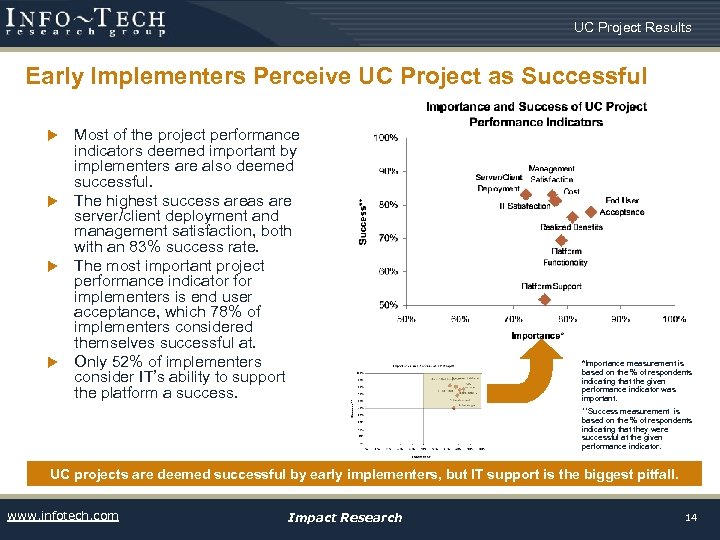 UC Project Results Early Implementers Perceive UC Project as Successful Most of the project performance indicators deemed important by implementers are also deemed successful. u The highest success areas are server/client deployment and management satisfaction, both with an 83% success rate. u The most important project performance indicator for implementers is end user acceptance, which 78% of implementers considered themselves successful at. u Only 52% of implementers consider IT’s ability to support the platform a success. u *Importance measurement is based on the % of respondents indicating that the given performance indicator was important. **Success measurement is based on the % of respondents indicating that they were successful at the given performance indicator. UC projects are deemed successful by early implementers, but IT support is the biggest pitfall. www. infotech. com Impact Research 14
 The UC Market and Vendors www. infotech. com Impact Research 15
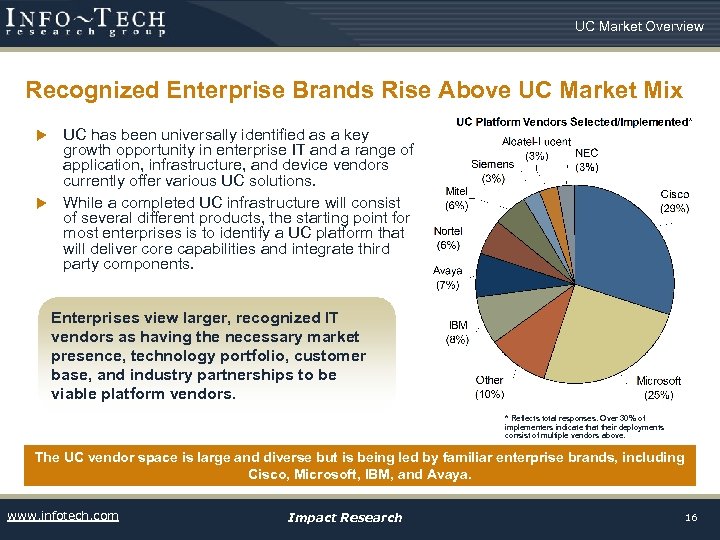 UC Market Overview Recognized Enterprise Brands Rise Above UC Market Mix UC has been universally identified as a key growth opportunity in enterprise IT and a range of application, infrastructure, and device vendors currently offer various UC solutions. u While a completed UC infrastructure will consist of several different products, the starting point for most enterprises is to identify a UC platform that will deliver core capabilities and integrate third party components. u Enterprises view larger, recognized IT vendors as having the necessary market presence, technology portfolio, customer base, and industry partnerships to be viable platform vendors. * Reflects total responses. Over 30% of implementers indicate that their deployments consist of multiple vendors above. The UC vendor space is large and diverse but is being led by familiar enterprise brands, including Cisco, Microsoft, IBM, and Avaya. www. infotech. com Impact Research 16
 Planning and Implementation www. infotech. com Impact Research 17
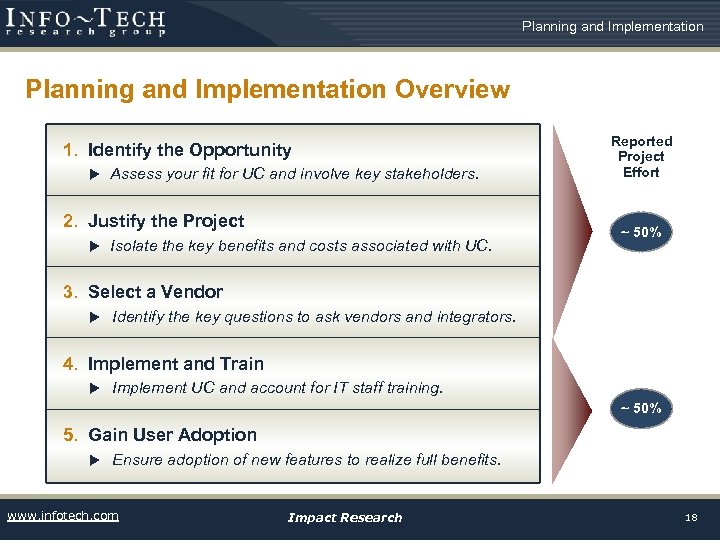 Planning and Implementation Overview 1. Identify the Opportunity u Assess your fit for UC and involve key stakeholders. 2. Justify the Project u Isolate the key benefits and costs associated with UC. Reported Project Effort ~ 50% 3. Select a Vendor u Identify the key questions to ask vendors and integrators. 4. Implement and Train u Implement UC and account for IT staff training. ~ 50% 5. Gain User Adoption u Ensure adoption of new features to realize full benefits. www. infotech. com Impact Research 18