 Скачать презентацию Drivers of Industry Financial Structure Dr C Bulent
618969998f0946d1d81fc2179d480cde.ppt
- Количество слайдов: 14




Drivers of Industry Financial Structure Dr. C. Bulent Aybar Professor of International Finance
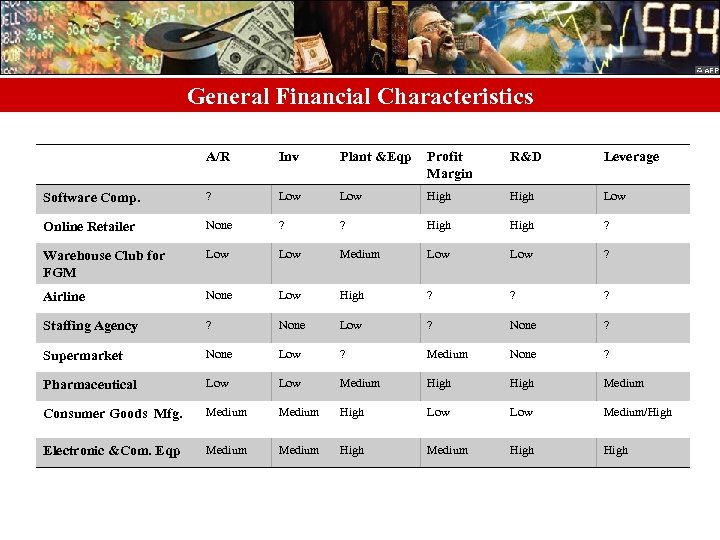
General Financial Characteristics A/R Inv Plant &Eqp Profit Margin R&D Leverage Software Comp. ? Low High Low Online Retailer None ? ? High ? Warehouse Club for FGM Low Medium Low ? Airline None Low High ? ? ? Staffing Agency ? None Low ? None ? Supermarket None Low ? Medium None ? Pharmaceutical Low Medium High Medium Consumer Goods Mfg. Medium High Low Medium/High Electronic &Com. Eqp Medium High
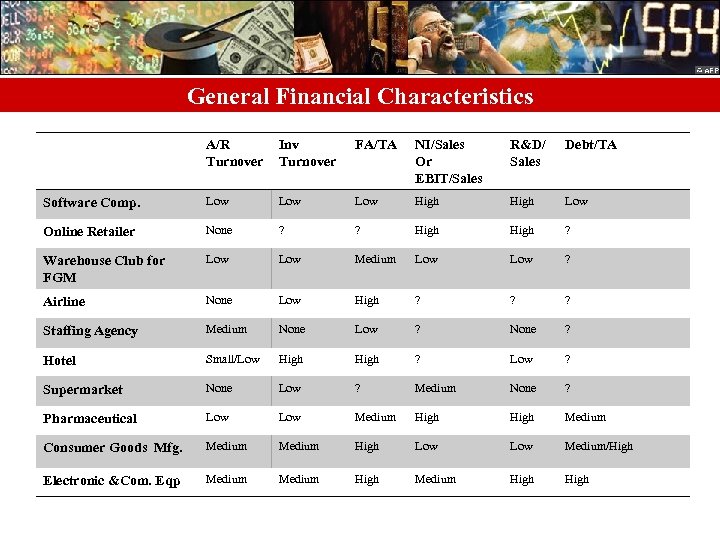
General Financial Characteristics A/R Turnover Inv Turnover FA/TA NI/Sales Or EBIT/Sales R&D/ Sales Debt/TA Software Comp. Low Low High Low Online Retailer None ? ? High ? Warehouse Club for FGM Low Medium Low ? Airline None Low High ? ? ? Staffing Agency Medium None Low ? None ? Hotel Small/Low High ? Low ? Supermarket None Low ? Medium None ? Pharmaceutical Low Medium High Medium Consumer Goods Mfg. Medium High Low Medium/High Electronic &Com. Eqp Medium High
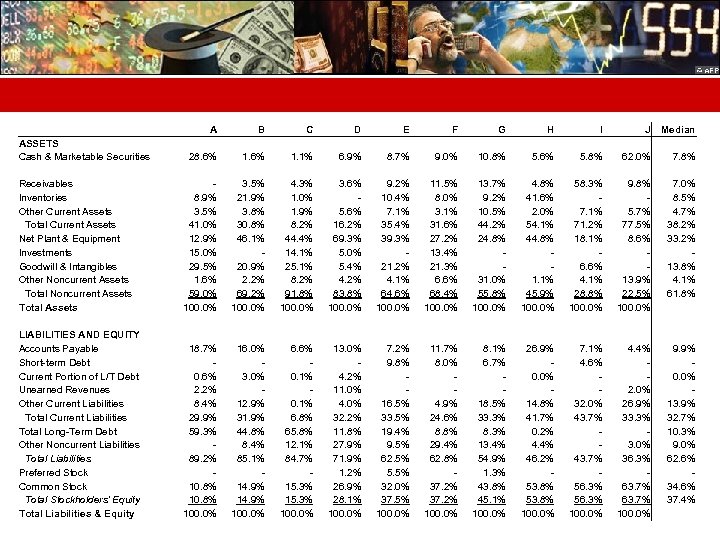
ASSETS Cash & Marketable Securities A Β C D Ε F G H I 28. 6% 1. 1% 6. 9% 8. 7% 9. 0% 10. 8% 5. 6% 5. 8% Receivables Inventories Other Current Assets Total Current Assets Net Plant & Equipment Investments Goodwill & Intangibles Other Noncurrent Assets Total Assets 8. 9% 3. 5% 41. 0% 12. 9% 15. 0% 29. 5% 1. 6% 59. 0% 100. 0% 3. 5% 21. 9% 3. 8% 30. 8% 46. 1% 20. 9% 2. 2% 69. 2% 100. 0% 4. 3% 1. 0% 1. 9% 8. 2% 44. 4% 14. 1% 25. 1% 8. 2% 91. 8% 100. 0% 3. 6% 5. 6% 16. 2% 69. 3% 5. 0% 5. 4% 4. 2% 83. 8% 100. 0% 9. 2% 10. 4% 7. 1% 35. 4% 39. 3% 21. 2% 4. 1% 64. 6% 100. 0% 11. 5% 8. 0% 3. 1% 31. 6% 27. 2% 13. 4% 21. 3% 6. 6% 68. 4% 100. 0% 13. 7% 9. 2% 10. 5% 44. 2% 24. 8% 31. 0% 55. 8% 100. 0% 4. 8% 41. 6% 2. 0% 54. 1% 44. 8% 1. 1% 45. 9% 100. 0% 58. 3% 7. 1% 71. 2% 18. 1% 6. 6% 4. 1% 28. 8% 100. 0% LIABILITIES AND EQUITY Accounts Payable Short-term Debt Current Portion of L/T Debt Unearned Revenues Other Current Liabilities Total Long-Term Debt Other Noncurrent Liabilities Total Liabilities Preferred Stock Common Stock Total Stockholders' Equity Total Liabilities & Equity 18. 7% 0. 6% 2. 2% 8. 4% 29. 9% 59. 3% 89. 2% 10. 8% 100. 0% 16. 0% 3. 0% 12. 9% 31. 9% 44. 8% 8. 4% 85. 1% 14. 9% 100. 0% 6. 6% 0. 1% 6. 8% 65. 8% 12. 1% 84. 7% 15. 3% 100. 0% 13. 0% 4. 2% 11. 0% 4. 0% 32. 2% 11. 8% 27. 9% 71. 9% 1. 2% 26. 9% 28. 1% 100. 0% 7. 2% 9. 8% 16. 5% 33. 5% 19. 4% 9. 5% 62. 5% 5. 5% 32. 0% 37. 5% 100. 0% 11. 7% 8. 0% 4. 9% 24. 6% 8. 8% 29. 4% 62. 8% 37. 2% 100. 0% 8. 1% 6. 7% 18. 5% 33. 3% 8. 3% 13. 4% 54. 9% 1. 3% 43. 8% 45. 1% 100. 0% 26. 9% 0. 0% 14. 8% 41. 7% 0. 2% 4. 4% 46. 2% 53. 8% 100. 0% 7. 1% 4. 6% 32. 0% 43. 7% 56. 3% 100. 0% J 62. 0% Median 9. 8% 5. 7% 77. 5% 8. 6% 13. 9% 22. 5% 100. 0% 4. 4% 2. 0% 26. 9% 33. 3% 3. 0% 36. 3% 63. 7% 100. 0% 7. 0% 8. 5% 4. 7% 38. 2% 33. 2% 13. 8% 4. 1% 61. 8% 7. 8% 9. 9% 0. 0% 13. 9% 32. 7% 10. 3% 9. 0% 62. 6% 34. 6% 37. 4%
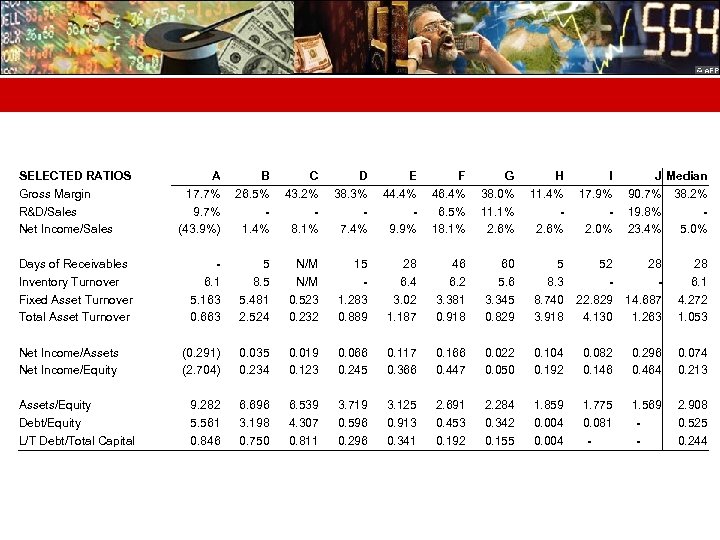
SELECTED RATIOS Gross Margin R&D/Sales Net Income/Sales A 17. 7% 9. 7% (43. 9%) Β 26. 5% 1. 4% C 43. 2% 8. 1% D 38. 3% 7. 4% Ε 44. 4% 9. 9% F 46. 4% 6. 5% 18. 1% G 38. 0% 11. 1% 2. 6% H 11. 4% 2. 6% I 17. 9% 2. 0% Days of Receivables Inventory Turnover Fixed Asset Turnover Total Asset Turnover 6. 1 5. 163 0. 663 5 8. 5 5. 481 2. 524 N/M 0. 523 0. 232 15 1. 283 0. 889 28 6. 4 3. 02 1. 187 46 6. 2 3. 381 0. 918 60 5. 6 3. 345 0. 829 5 8. 3 8. 740 3. 918 52 22. 829 4. 130 (0. 291) (2. 704) 0. 035 0. 234 0. 019 0. 123 0. 066 0. 245 0. 117 0. 366 0. 166 0. 447 0. 022 0. 050 0. 104 0. 192 0. 082 0. 146 9. 282 5. 561 0. 846 6. 696 3. 198 0. 750 6. 539 4. 307 0. 811 3. 719 0. 596 0. 296 3. 125 0. 913 0. 341 2. 691 0. 453 0. 192 2. 284 0. 342 0. 155 1. 859 0. 004 1. 775 0. 081 - Net Income/Assets Net Income/Equity Assets/Equity Debt/Equity L/T Debt/Total Capital J Median 90. 7% 38. 2% 19. 8% 23. 4% 5. 0% 28 28 6. 1 14. 687 4. 272 1. 263 1. 053 0. 296 0. 074 0. 464 0. 213 1. 569 2. 908 0. 525 0. 244
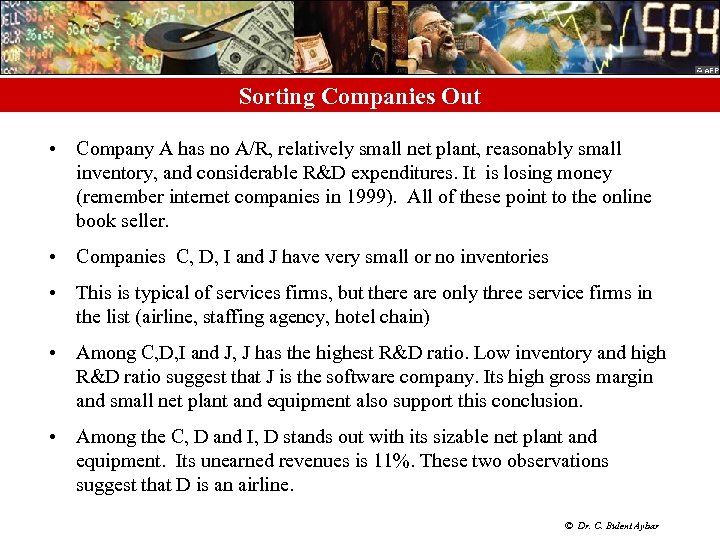
Sorting Companies Out • Company A has no A/R, relatively small net plant, reasonably small inventory, and considerable R&D expenditures. It is losing money (remember internet companies in 1999). All of these point to the online book seller. • Companies C, D, I and J have very small or no inventories • This is typical of services firms, but there are only three service firms in the list (airline, staffing agency, hotel chain) • Among C, D, I and J, J has the highest R&D ratio. Low inventory and high R&D ratio suggest that J is the software company. Its high gross margin and small net plant and equipment also support this conclusion. • Among the C, D and I, D stands out with its sizable net plant and equipment. Its unearned revenues is 11%. These two observations suggest that D is an airline. © Dr. C. Bulent Aybar
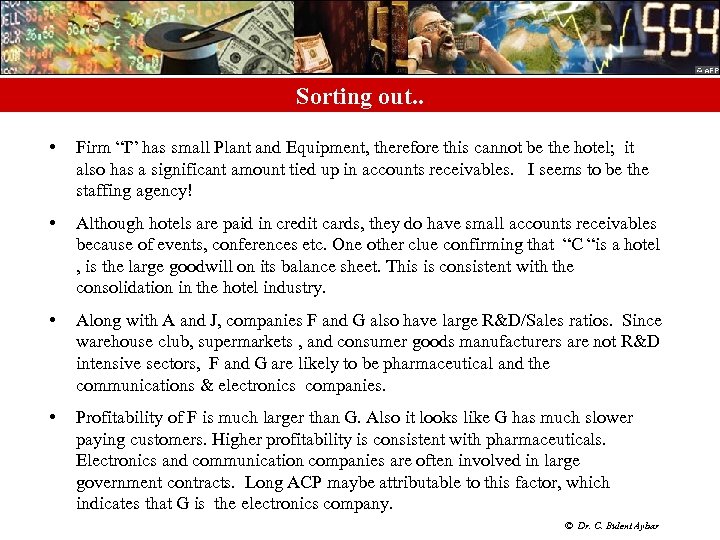
Sorting out. . • Firm “I” has small Plant and Equipment, therefore this cannot be the hotel; it also has a significant amount tied up in accounts receivables. I seems to be the staffing agency! • Although hotels are paid in credit cards, they do have small accounts receivables because of events, conferences etc. One other clue confirming that “C “is a hotel , is the large goodwill on its balance sheet. This is consistent with the consolidation in the hotel industry. • Along with A and J, companies F and G also have large R&D/Sales ratios. Since warehouse club, supermarkets , and consumer goods manufacturers are not R&D intensive sectors, F and G are likely to be pharmaceutical and the communications & electronics companies. • Profitability of F is much larger than G. Also it looks like G has much slower paying customers. Higher profitability is consistent with pharmaceuticals. Electronics and communication companies are often involved in large government contracts. Long ACP maybe attributable to this factor, which indicates that G is the electronics company. © Dr. C. Bulent Aybar
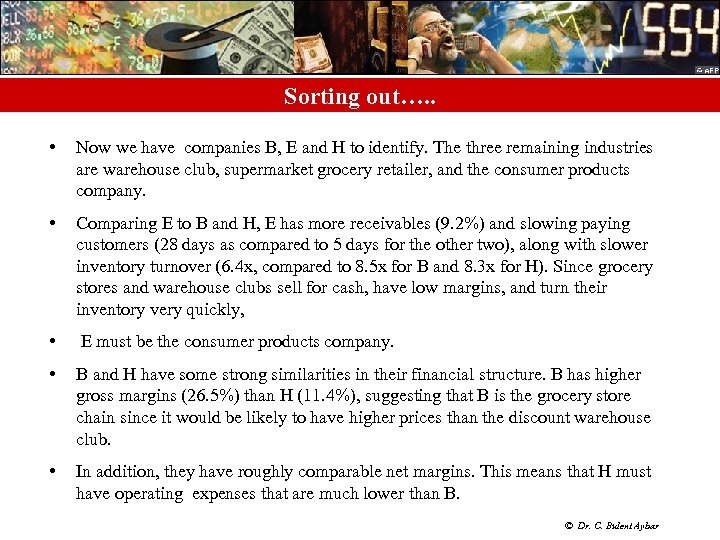
Sorting out…. . • Now we have companies B, E and H to identify. The three remaining industries are warehouse club, supermarket grocery retailer, and the consumer products company. • Comparing E to B and H, E has more receivables (9. 2%) and slowing paying customers (28 days as compared to 5 days for the other two), along with slower inventory turnover (6. 4 x, compared to 8. 5 x for B and 8. 3 x for H). Since grocery stores and warehouse clubs sell for cash, have low margins, and turn their inventory very quickly, • E must be the consumer products company. • B and H have some strong similarities in their financial structure. B has higher gross margins (26. 5%) than H (11. 4%), suggesting that B is the grocery store chain since it would be likely to have higher prices than the discount warehouse club. • In addition, they have roughly comparable net margins. This means that H must have operating expenses that are much lower than B. © Dr. C. Bulent Aybar
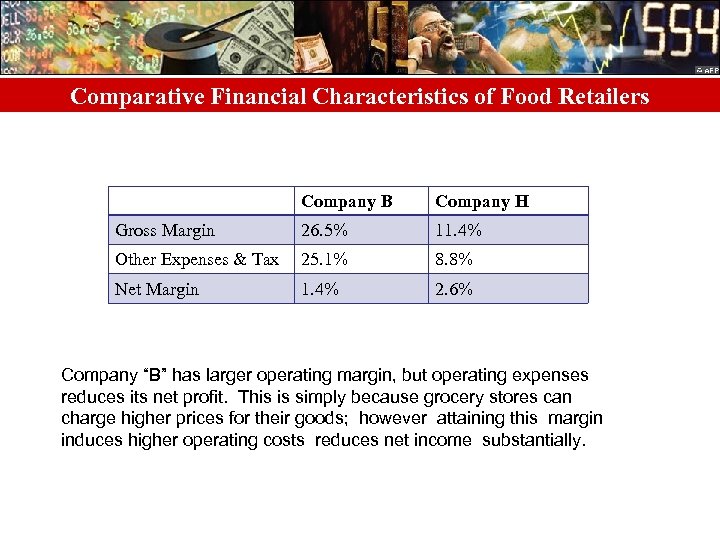
Comparative Financial Characteristics of Food Retailers Company B Company H Gross Margin 26. 5% 11. 4% Other Expenses & Tax 25. 1% 8. 8% Net Margin 1. 4% 2. 6% Company “B” has larger operating margin, but operating expenses reduces its net profit. This is simply because grocery stores can charge higher prices for their goods; however attaining this margin induces higher operating costs reduces net income substantially.
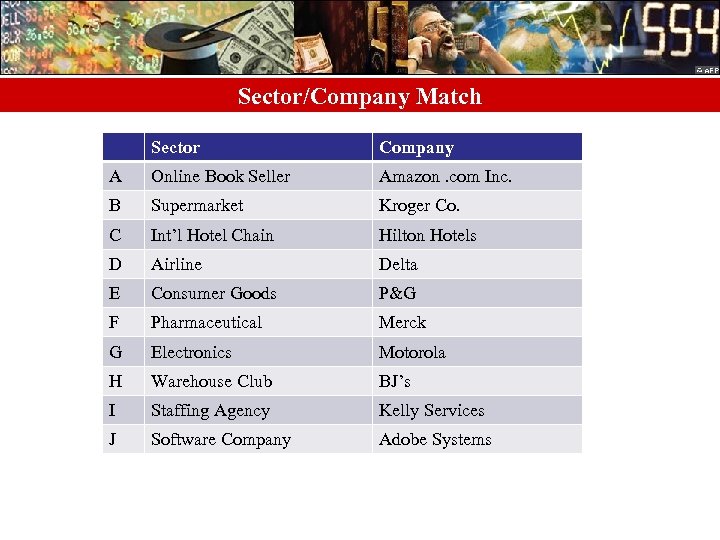
Sector/Company Match Sector Company A Online Book Seller Amazon. com Inc. B Supermarket Kroger Co. C Int’l Hotel Chain Hilton Hotels D Airline Delta E Consumer Goods P&G F Pharmaceutical Merck G Electronics Motorola H Warehouse Club BJ’s I Staffing Agency Kelly Services J Software Company Adobe Systems
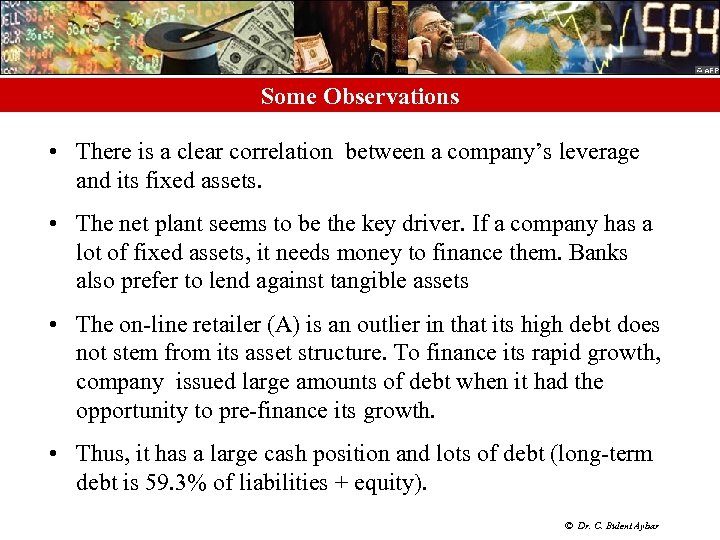
Some Observations • There is a clear correlation between a company’s leverage and its fixed assets. • The net plant seems to be the key driver. If a company has a lot of fixed assets, it needs money to finance them. Banks also prefer to lend against tangible assets • The on-line retailer (A) is an outlier in that its high debt does not stem from its asset structure. To finance its rapid growth, company issued large amounts of debt when it had the opportunity to pre-finance its growth. • Thus, it has a large cash position and lots of debt (long-term debt is 59. 3% of liabilities + equity). © Dr. C. Bulent Aybar
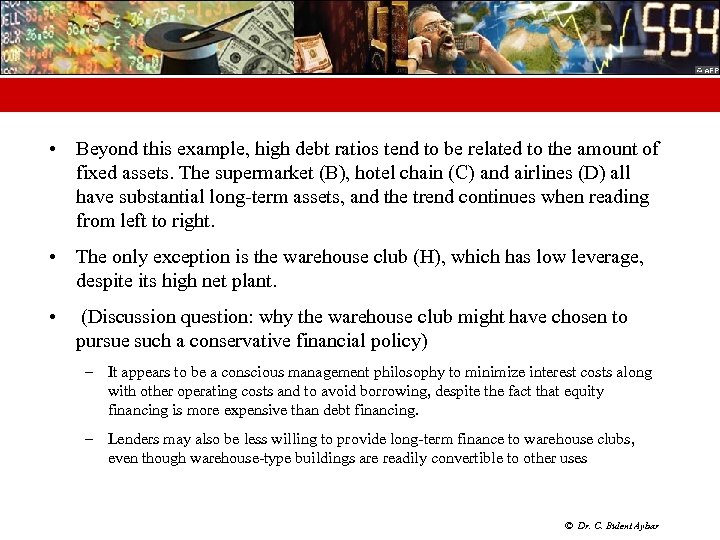
• Beyond this example, high debt ratios tend to be related to the amount of fixed assets. The supermarket (B), hotel chain (C) and airlines (D) all have substantial long-term assets, and the trend continues when reading from left to right. • The only exception is the warehouse club (H), which has low leverage, despite its high net plant. • (Discussion question: why the warehouse club might have chosen to pursue such a conservative financial policy) – It appears to be a conscious management philosophy to minimize interest costs along with other operating costs and to avoid borrowing, despite the fact that equity financing is more expensive than debt financing. – Lenders may also be less willing to provide long-term finance to warehouse clubs, even though warehouse-type buildings are readily convertible to other uses © Dr. C. Bulent Aybar
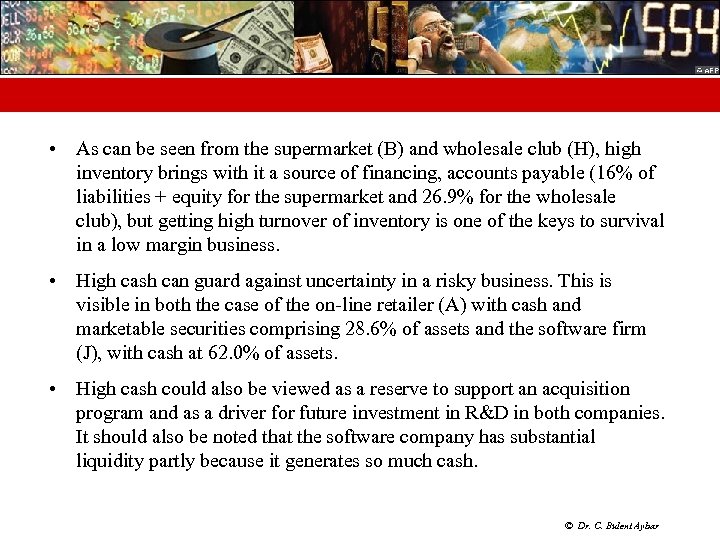
• As can be seen from the supermarket (B) and wholesale club (H), high inventory brings with it a source of financing, accounts payable (16% of liabilities + equity for the supermarket and 26. 9% for the wholesale club), but getting high turnover of inventory is one of the keys to survival in a low margin business. • High cash can guard against uncertainty in a risky business. This is visible in both the case of the on-line retailer (A) with cash and marketable securities comprising 28. 6% of assets and the software firm (J), with cash at 62. 0% of assets. • High cash could also be viewed as a reserve to support an acquisition program and as a driver for future investment in R&D in both companies. It should also be noted that the software company has substantial liquidity partly because it generates so much cash. © Dr. C. Bulent Aybar
Concluding Remarks on Financial Ratios • Liquidity and leverage ratios are most commonly used by banks in determining whether to lend to a company. • Activity measures are tracked by management to make sure that the company is in control. • Finally, operating performance measures such as the cost structure and return on equity are probably the measures most watched by managers. • We can use financial ratios to monitor and improve the operational effectiveness of the firm. © Dr. C. Bulent Aybar
Скачать презентацию Drivers of Industry Financial Structure Dr C Bulent
618969998f0946d1d81fc2179d480cde.ppt