 Скачать презентацию DRAFT — The Ba al Theory of Christianity —
d7c3d50ebe364d8f6644ea0e388630eb.ppt
- Количество слайдов: 44



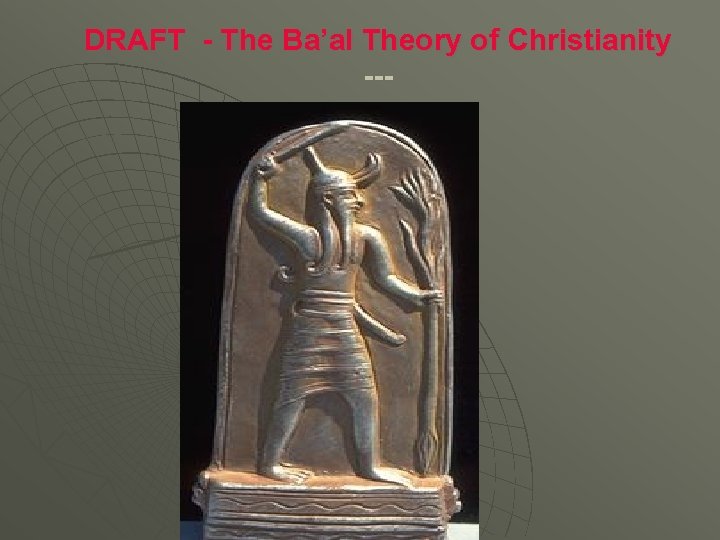
DRAFT - The Ba’al Theory of Christianity ---
A Blending of Political and Cultural History with Religious History u How The Rivalry Between The Cult Of Yahweh And The Worshipers Of Ba’al Helped To Create Christianity And Religious Intolerance In The Western World.
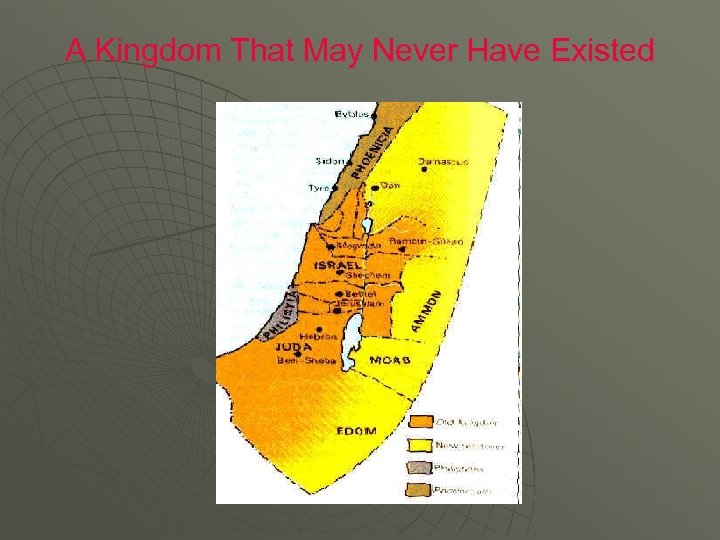
A Kingdom That May Never Have Existed
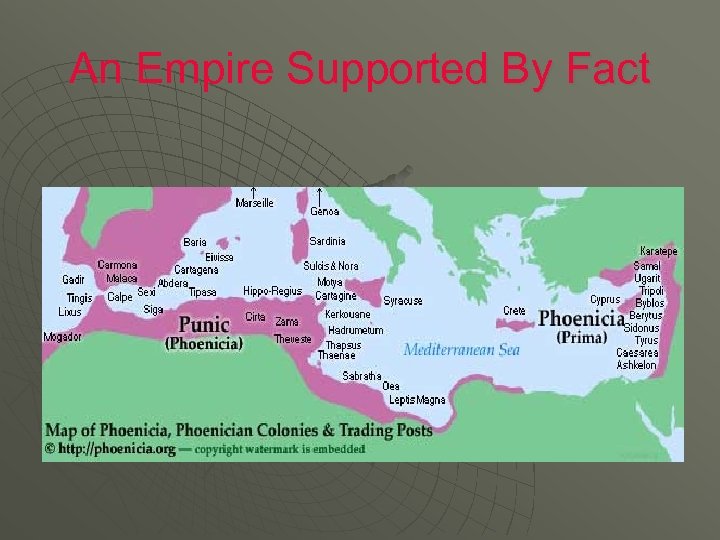
An Empire Supported By Fact
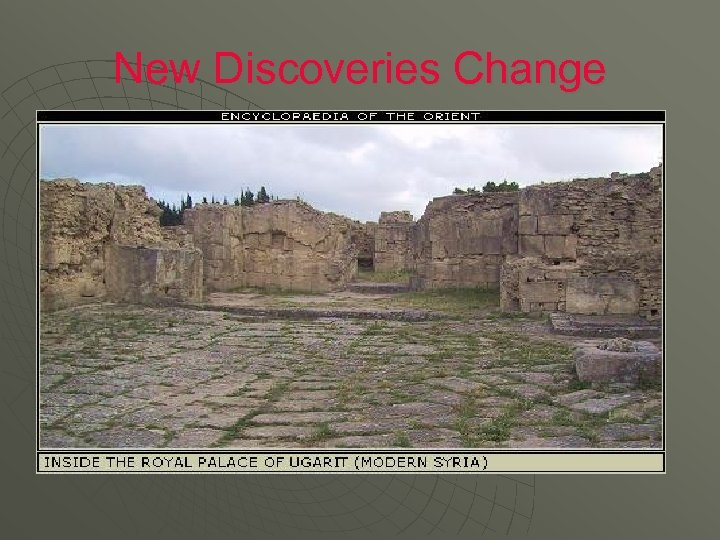
New Discoveries Change
Contributions – Foundation of Writing u u The people of Ugarit were the Canaanites, precursors to the Phoenicians. They were perhaps the first to recognize that human speech consists of only a finite number of atomic sounds and all that was really needed was a symbol for each. They devised 30 symbols from which the alphabets of all phonetic languages are derived (yes all: Hebrew, Latin, Sanskrit, Aramaic, Arabic, Greek, etc. ). The Greeks got their alphabet from the Phoenicians. The names of most letters in the Greek/Phoenician alphabets are clearly related – alpha/aleph (ox), beta/bet (house), gamma/gimel (camel), delta/dalet (door), etc. Notably, the Ugaritic alphabet only had consonants – the pre-Homeric Greeks added the vowels.
A Very Important People u u u Ugarit was an independent kingdom from the 18 th century BCE. The Canaanites had a golden age from about 1450 to 1200 BCE; They became the greatest naval power of the age and knew many key principles of navigation. They traded with the cities of the Mediterranean, Mesopotamia, Aegean Sea, Egypt and Asia Minor. http: //www. shunya. net/Pictures/Syria/ugarit/Ugarit. htm
Literature of the Age u A source of writing other then the Bible • Many psalms of the Bible found in writing at Ugarit • Festivals similar to Passover found • The Ba’al cycle found almost complete u u Religion of the Canaanites better understood What we see is the Canaanites as urban elites and Hebrews as “Pagans” - rural peoples
Roots of our Culture u Upon the Tsurian sea the people live Who style themselves Phoenicians. . . These were the first great founders of the world -Founders of cities and of mighty states -Who showed a path through seas before unknown. . • Dyonysius of Susiana, 3 AD
Roots of our Culture u u u The Phoenicians are usually described to us today as being only the areas of present day Lebanon. In fact, all of what is considered Canaan, from the time of Abraham to David, and its famed cities of Jericho, and Sodom and Gomorrah were in fact “Phoenician” in language, culture and religion. In the part of the writings we have recovered (the Amarna tablets from the 14 th Century BC, ) the people we call the Phoenicians called themselves Kenaani or Kinaani (Canaanites). http: //en. wikipedia. org/wiki/Phoenicia
– Cultural Development Timeline Of Politics and Religion u 10, 000 – 1500 BC … Organized religions is based in worship of the great Earth Mother, with very little evidence, in many locations, of the concept of a Sky God, or in fact any male deity. • The timeline for the Earth Mother religion denotes its dominance in some area for this whole period. However, the dominance of the Mother Goddess began to erode starting as early as 6, 000 in some place, and only lasted to 1500 in some limited areas.
– Cultural Development Timeline Of Politics and Religion u 6000 BC to 2500 BC … Phoenician religion evolves out of the Mother Goddess religion to incorporate the general religious views of Mesopotamia and Egypt, and becomes greatly influenced by the Sky God concepts of the Indo Europeans. • The Male dominated pantheon of gods is developed, with the great mother still worshiped by in a secondary role. The key deities are the Sun and the weather (storm gods). Much of the religious stories are based on astrological observations. u 3000 BC -250 BC … the religion of Phoenicia is a major influence in the Southern Mediterranean Basin, dominating North Africa, the major islands of the Western Mediterranean, and half of what is now Spain. The influence spreads to mainland Europe and to what is now England, and even possibly the Americas.
– Expansion and Invasion Timeline Of Politics and Religion u u u 3000 BC -250 BC … the religion of Phoenicia is a major influence in the Southern Mediterranean Basin, dominating North Africa, the major islands of the Western Mediterranean, and half of what is now Spain. The influence spreads to what is now England, and even possibly the Americas. 3, 000 -1200 BC Phoenicia periodically under control or major influence of Egypt, but is more often a relatively free trading partner 1600 -1200 BC The invasion of the “Hykksos and “Sea People” and other nomadic peoples greatly destabilizes the Eastern Mediterranean areas,
Timeline Of Politics and Religion Creation of the Hebrew States u u Phoenicia survives and becomes more independent and more dominant in the Eastern Mediterranean area. They become dominate in all Mediterranean trade. 1300 -1000 BC, in the highlands of what is now the “Holy Lands”, a small and unimportant area of Phoenician influence, the cult of Yahweh, modeled greatly on Phoenician religion, develops.
Timeline Of Politics and Religion Creation of the Hebrew States u Between 1000 BC and 650 BC, internal struggles between the Yahweh cultist leads to disunity and great internal struggles in what was the southern areas dominated by the Phoenicians (or Canaan). • Religious struggles concern mainly the role of Yahweh as sole god, chief god, or just a god, and the proper ways to offer prays and sacrifice to him and other gods. Mostly the proponents of Yahweh are in an inferior political position throughout this period
Timeline Of Politics and Religion The First Crisis • 900 – 650 BC – Assyrian and Neo- Babylonian domination of Eastern Mediterranean. Phoenicia is attacked often, with major defeats, but manages to stave off completed domination of new powers. • Phoenicia creates more support for it’s Western Mediterranean colonies as a means for escaping, if needed, from the new powers • Minor and relatively unimportant semi-Yahwehist kingdoms (Israel and Judah) are both destroyed with minimal effort of the super powers, and peoples exiled. • 600 -550 BC Yahwehist in exile in Babylon creates a new religion with Yahweh as sole god, and states that all defeats were Yahweh’s doing for punishment for failure to comply with Yahweh’s laws and mandates. (People now called Jews). Holy books rewritten and codified.
Timeline Of Politics and Religion Return and Second Crisis • 550 – 325 BC Persia dominate Eastern Mediterranean, with Phoenicia as a major ally, and plays major role in the wars with Greeks. u u Persian religions influences whole area (with new concepts of dualism, of heaven and hell (existence of the Devil), of resurrection of the dead, and many other new ideas which influence all the religions of the area, including the Jews. Yahwehist cult allowed to return to “Judea” to rebuild their temple and to establish a colony of believers. • Less then 10% of Jews” return to Judea. • (Four major division of “Jews” at this time … Returnees, those in Babylon, those who had fled to Egypt at the time of conquest, and those who had remained in Judea at the time of conquest.
Timeline Of Politics and Religion Ultimate Crisis • 325 – 150 BC Hellenistic (Greek) conquests Eastern Mediterranean and cultural domination of area. Phoenicia suffers great defeats and loses trading control to Greeks; Phoenician remnants (including Carthage) put far greater efforts in Western Mediterranean, including Spain. u “Classical world view” (Hellenism) mostly replaces “Ancient world” • Phoenicia loses in wars with Alexander and also in the Punic Wars with Rome, Carthage destroyed, Phoenicia “Hellenized, ” Spain and other areas of Phoenician influence occupied by Rome.
Timeline Of Politics and Religion Ultimate Crisis • 325 – 150 BC Hellenistic (Greek) conquests Eastern • 140 BC – 140 AD Jewish war of resistance against Classical domination (Greek then Roman) u 135 – 65 BC Judea rebels against Greeks successor (to Alexander) kings, unifies around religious issues, creates brief independent state u (Second Jewish Commonwealth) under strong “orthodox religious” efforts … force converts peoples of the area (including Galilee and Southern Phoenicia to “orthodox Judaism” u Offers alternative world view to both Ancients and Hellenization
Timeline Of Politics and Religion The Ultimate Crisis 66 AD – 135 AD Rome crushes a series of three major and a number of minor Jewish revolts and destroys Judea, the Second Temple, ) and nearly exterminates the Jews in much of the Eastern Mediterranean world, Loss in revolts eliminates the Jewish alternative as a “player” in the struggle between Ancients and Classical world views. 70 AD – 650 AD Christianity develops as a merging (morphing) of the Ancient, Classical, Persian and Jewish world views. Elements of all four are combined into a new “unified religion” for the Roman world.
Timeline Of Politics and Religion Christian World Replaces “Ancient” and Classical World u Extensive competition within the Christian communities, as well as strong competition from other (mainly Ba’alist and Persian based religions) leads to a new combined religions supported by the Emperors under the “One Emperor, One God, ” paradigm. • New religion puts far more emphasis on afterlife, and fate of souls then any other previous religion, and has a major role for the “Devil. ” (all Persian influenced) u One power is obtained, Christians strongly repress “Classicalist” with extensive killings, “burning of books” and other overt acts to repress the concepts of the Classical world.
Timeline Of Politics and Religion Christian World Replaces “Ancient” and Classical World u Extensive fighting internally among Christians continued concerning the rites and rituals of the new religion, leading to extensive division and regional conflicts over point of the religion and extensive killing. • 650 AD and on … Muslim invasions attempt to eliminate the Classical and Ancient world views and mainly supports the world view of the Yahwehist. u 650 – 1492 Reduced Christian world is mostly devoid of importance and knowledge for hundreds of years, attempting to fend of Muslims, Vikings, Mongols and a host of other peoples, and also “God’s wrath”, through use of forced conformity and not allowing for any thought not represented as good in the Bible.
Religious Conflicts During Time Frame u u Ancient View – Multiple Gods – The Gods are responsible for all acts (Gods looked like animals) Sacrifices needed for many occasions • To gain support of Gods (for war or new ventures • To placate an angry or disinterested God – (bring back the rains, stop our enemies) • To seal a deal between the state and the god or between individuals. (A covenant) u All forms accepted, including human sacrifice • First born sacrifice seems standard • Other human sacrifice used in time of crisis or major contracts
Religious Conflicts During Time Frame u u Classical View – Multiple Gods – While believing in predestination, the Classical view was humans had more role in controlling events (Gods look like humans) Sacrifices needed for many occasions – for same issues But the “state” (taxes”) as seen as major player in events. Human sacrifice fades out (but still used on occasion in time of great crisis • Romans allow for it when Hannibal “is at the gates” (Kind of like “when fighting the Carthaginians do as the Carthaginians”)
Religious Conflicts During Time Frame u u “Hebrew View – One God – (When that belief developed is still unclear) Sacrifices needed for many occasions – for same issues – as Ancients Human Sacrifice denounced by “prophets” (passing through fire) – But kings and people continue its practice throughout “Hebrew States” (Israel and Judea)
Religious Conflicts During Time Frame u Pre-Exile Jewish View • Jewish view on human sacrifice unclear. u u All the first opens the Matrix is mine Hero sacrifices daughter Whole cities are slaughter to please God David hangs seven men (to God) to end drought • Isaac story classic foundation myth with the human sacrifice to solidify contract between man and god. u Was Isaac sacrifice? • Reforms of Josiah – In kingdom of Judah – Do not hold u When was the book of Deuteronomy written?
Religious Conflicts During Time Frame u “Jewish View – Post Babylonian Exile One God – All rulers of the world operate as his agent • Sacrifices needed for many occasions – for same issues – as Ancients • Human Sacrifice seen as cause for God’s wrath – and destruction of previous states u u Role of everyone to enforce all of the rules of God – not just priest, or kings, but all people – Allowing for non-conformity of anyone threatens the return of God’s wrath and the destruction of all.
Religious Conflicts During Time Frame u u “Persian View” – A world of constant conflict between good and evil – Two separate deities (dualism) Sacrifices as far less important – Good deeds and right living are far more valued The rule of evil prevails now – but soon good will come to rule. There will be a time of final judgment and the dead will be resurrected and judged, this world of evil will end.
Response to Political and Religious Crises 1) Accepters – those who went “Greek” u 2) Resisters (active and passive) – Maccabees, the Essenes u 3) Mergers, Philo of Alexandria u 4) Morphers – those who attempted to maintain the old ways, by masking them with “the new terms. ” u
Response to Political and Religious Crises What happened to each of the groups u 1) Accepters – Merged into new world order u 2) Resisters – destroyed in series of wars (mainly ending in the Bar Kochba revolt – 2/3 of Judea killed? ) u 3) Mergers, -mainly rejected by both sides u 4) Morphers – That is the question … was Christianity the “morphed” version of the Ancients world view
Influences on Early Christianity u u Persian – dual conflicts between good and evil – the existence of the devil, coming resolution … resurrection of the dead. (All element of Zoroastrianism, especial the sect called Zurvanism) Mystery Cults of Egypt and Greece – much of the elements of the “mass” are found in the practices of the cults
Influences on Early Christianity u Ancients and Classical “Death and Rising Gods” • Most often associated with the cycle of the crops – God dies in winter, revived in spring – etc. Multiple examples, including the Ba’al cycle found in ancient Phoenician text. u Jewish concepts of “monotheism” and ten commandments, etc.
Influences on Early Christianity Missing influence – Phoenician – Key Factor – u In time of Crisis, God Sacrificed his only Begotten Son” … u u u Contrary to Jewish concepts (post exile) – cause of God’s Wrath Not found in death and dying cults (gods were not sacrificed) Not found in Persian Only seen in Phoenician cultural beliefs
Phoenician Story Euseb. Præp. Evan. lib. I. c. 10. —lib. IV. o For Cronus, whom the Phœnicians call Il, and who after his death was deified and instated in the planet which bears his name, when king, had by a nymph of the country called Anobret an only son, who on that account is styled Ieoud, for so the Phœnicians still call an only son: and when great dangers from war beset the land he adorned the altar, and invested this son with the emblems of royalty, and sacrificed him.
Phoenician Story Or in other words – o God – (For Cronus, whom the Phœnicians call Il, and who after his death was deified_ o Impregnated a young girl -, had by a nymph of the country called Anobret o Had one son - (who on that account is styled Ieoud, for so the Phœnicians still call an only son: o And in in time of danger, declared the son the king, (and when great dangers from war beset the land he adorned the altar, and invested this son with the emblems of royalty) o And then he was killed - and sacrificed him.
Phoenician Story We can trace this story back to at least 1200 BC, but, according to the source, the story is placed around 6, 000 BC (with the first rise of the “Sky Gods” in the area. u Therefore, with the Phoenicians, and all influenced by the Phoenician culture, what is stated in John 3: 1618 …
The Christian Version u u John 3: 16 -18 For God so loved the world, that he gave his only Son (ton huion ton monogenee), that whoever believes in him should not perish but have eternal life. For God did not send his Son into the world to condemn the world, but in order that the world might be saved through him. Whoever believes in him is not condemned, but whoever does not believe is condemned already, because he has not believed in the name of the only Son of God (tou monogenous tou huio tou theou). ”
The Christian Version Knew this concept, and understood the concept of God’s sacrificing his only son in time of Crisis and saw this concept to be one the most ancient of their stories - going back to the very foundation stories of their (Phoenician) culture – But this concept was completely opposite of the Jewish world view of the time.
The Christian Version The concept of the sacrifice of God, or the son of God, is core to Christianity, but was in fact, anathema to Judaism (or at least the Judaism of the dominate Returnee Jews. ) To the Jews of the time, the idea of human sacrifice, was the root cause of God’s anger at the Jewish people (and the destruction of their Kingdoms and their exile to Babylon.
Conflict Within Christianity Despite some strong objections on part of some “fathers, “ the Church eventually incorporated the “Old Testament” as part of the Christian Religion But – There are extensive denouncing in the Old Testament of the use of Human Sacrifice – and worship of Ba’al (the Lord).
Answering Conflicts Despite multiple references in the New Testament to Christ being a sacrifice (and completing the non-sacrifice of Isaac, the early Church solved this apparent problem by saying • Christ could not be a human sacrifice because … He was not human. Despite the similarities to Ba’al worship, and to other religions of the time, the early Church solved the apparent problem of these similarities by saying • All similarities were based on the trick of the Devil. The Devil had planted these religions among men from earliest time to trick people from accepting Jesus when he did come.
Answering Conflicts Church attacks challenger by calling all who do not accept teachings as “heretics” u Eventual the religion becomes the “cult religion of the Emperors (fourth effort at One Emperor, One God and leads to state demands for conformity u • Non-Belief becomes a capital crime
Outcomes Jews become “the untouchables” u All thought that is not in the Bible is condemned as being heretical u Ba’al evolves into the model for the Devil, u And all reference to the Phoenician contribution to the world is suppressed u
Outcomes u u Church adopts Jewish fears from the Old Testament concerning wrath of God Institute wide ranging efforts to fend off wrath of God, justified by Old Testament prophets • Forced conversion • Religious terror (Inquisition) • Wholesale killings of “non-believers” u The techniques to enforce religious conformity eventually adopted by “States” of 20 th Century
Скачать презентацию DRAFT — The Ba al Theory of Christianity —
d7c3d50ebe364d8f6644ea0e388630eb.ppt