


 Скачать презентацию DRAFT ONLY Recommendations for the Retention and Attraction
3276ee5b2b6c784e198b91eb4848dd36.ppt
- Количество слайдов: 31
 DRAFT ONLY Recommendations for the Retention and Attraction of African Americans in San Francisco **** African American Out-migration Task Force and Advisory Committee 1
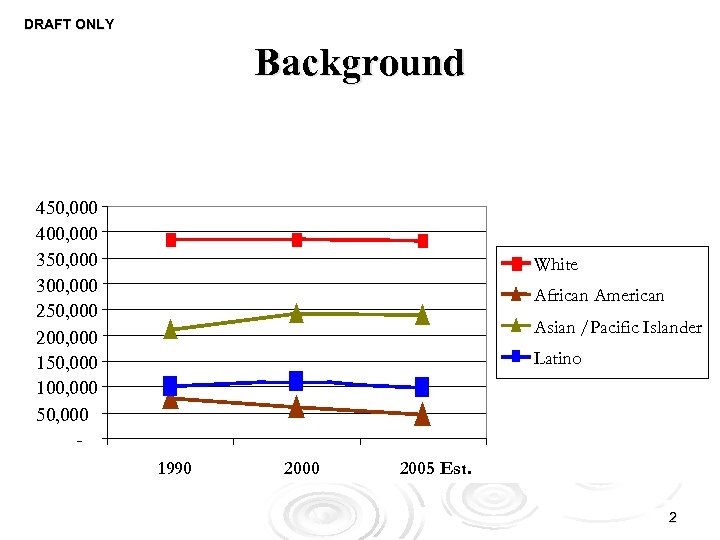 DRAFT ONLY Background San Francisco Population By Race 1990, 2000, Estimated 2005 450, 000 400, 000 350, 000 300, 000 250, 000 200, 000 150, 000 100, 000 50, 000 - White African American Asian /Pacific Islander Latino 1990 2005 Est. 2
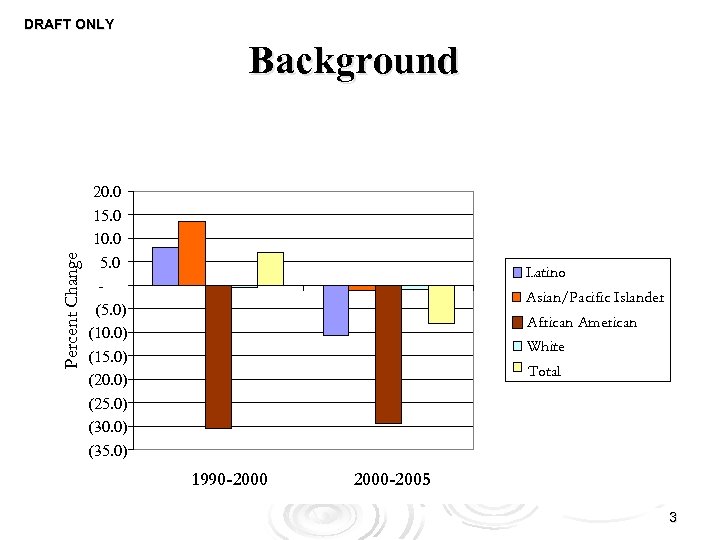 DRAFT ONLY Background Percent Change in San Francisco Population By Race 20. 0 15. 0 10. 0 5. 0 (5. 0) (10. 0) (15. 0) (20. 0) (25. 0) (30. 0) (35. 0) Latino Asian/Pacific Islander African American White Total 1990 -2000 -2005 3
 DRAFT ONLY Project Scope Ø Collect and analyze census and California State Department of Finance data to better understand the demographics of the decline. Ø Inventory existing city efforts aimed at or with potential to address the issue. Ø Survey existing and former residents to clarify factors contributing to flight. Ø Consult with cities that are considered attractive to African Americans. Ø Assess weaknesses and gaps in the existing set of activities. Ø Develop recommendations aimed at addressing weaknesses and filling gaps. 4
 DRAFT ONLY Key Findings Ø African American families declined at a disproportionately greater rate than non-family African American households. Ø With decreasing numbers of moderate and above moderate income households since 1990, the percentage share of very low income households increased from over one-half of African American households in 1990 to over two-thirds in 2005. Ø In 2000, one quarter of African Americans lived in poverty, more than twice the proportion of non-African Americans. Ø The unemployment rate among Blacks in the labor force from 1990 to 2005 was consistently over twice that of non-Blacks. 5
 DRAFT ONLY Key Findings Cont’d Ø From 1997 to 2002, Black-owned businesses declined by nearly one quarter and Black business receipts fell by 60. 7 percent, although the number of persons employed by Black businesses increased. Ø The proportion of homeowners among African Americans increased slightly since 1990, perhaps due to a greater rate of out-migration among renters than among homeowners. This would be consistent with other findings of housing as a primary reason for moving among African Americans in California. 6
 DRAFT ONLY Housing Context Ø Only 35% of African Americans in San Francisco are homeowners, the lowest rate across the city. Ø Nearly a quarter (24%) of African Americans are living in homes with the need for severe or moderate repairs, which is more than double that of Asians (9%) and Whites (10%). Ø At 4, 743, African Americans compose nearly half of the residents living in public housing. One third of the 9, 799 Section 8 household voucher residents in San Francisco are African Americans. 7
 DRAFT ONLY Housing Recommendations Ø Expand Homeownership Opportunities for Existing and Potential African American Residents l l Partner with Freddie Mac’s “Lease-to-Own” program to assist current residents to achieve homeownership. Create and promote legislation requiring the following: v consistency between both SFRA and MOH programs by eliminating or lowering down payment requirement. v underwriting guidelines for San Francisco Redevelopment Agency's Below Market Rate program to be consistent with Fannie Mae & Freddie Mac (100% financing on a fully documented loan with a 45% debt-to-income ratio), similar to MOH existing program. v a down-payment assistance fund to purchase both MOH’s and SFRA’s BMR units. v a S. F. Rescue Loan Program to assist distressed homeowners impacted by predatory loans. 8
 DRAFT ONLY Housing Recommendations l Ø Cont’d Work with African American realtors to market housing opportunities and sell property. Stabilize and Improve Conditions in San Francisco’s Public Housing l l l Provide existing public housing residents with Section 8 voucher that can be used to support future home purchase. Institutionalize Eviction Prevention strategies for the SF Housing Authority, and ongoing support for Season of Sharing's model. Fully support the HOPE SF Housing Bond appoint an oversight body to insure effective implementation without displacement. 9
 DRAFT ONLY Housing Recommendations l Cont’d Promote Public Policies that Support Retention and Attraction Strategies • Improve Certificate of Preference Program: v Implement legislation that extends the certificate of preference benefits to additional generations of family members. v Implement legislation that extends the expiration date for certificate of preference. For example, Fillmore and BVHP certificates are set to expire in 2009. v Allocate funds for a down-payment assistance program specifically for families using the Certificate of Preference Program. l Create legislation providing BMR buyers a minimum 3% appreciation per year as a wealth-building strategy. (A successful example exists in Santa Ana, CA). 10
 DRAFT ONLY Housing Recommendations Cont’d l l l Ø Create legislation requiring additional funding to build and sustain the capacity to provide financial fitness and homeownership education. Provide financial and political support for an explicitly African American community based organization which will focus on issues of housing and homeownership education in the African American community. Allocate additional resources to increase the capacity of existing IDA (Individual Development Accounts) programs tied to homeownership. Preserve and Improve Existing Housing Stock and Produce New Affordable Housing l l Through legislation, assist with capital improvements for existing co-op owners at King/Garvey, St. Francis, Unity, and North Ridge. Provide funding for technical assistance to Co-op governing boards. Produce family-oriented affordable housing. 11
 DRAFT ONLY Education Context Ø In San Francisco, only 26. 3% of African American high school graduates have taken the classes required for University of California or California State University entrance, compared to 58. 3% of whites. Ø High school graduation is also unacceptably low, as only 25% of African Americans in San Francisco over the age of 25 have graduated from high school. Ø Across a range of educational indicators, which include test scores, graduation rates, university attendance, and graduate studies, African Americans remain at the bottom of demographic comparisons. 12
 DRAFT ONLY Education Recommendations Ø Strengthen Infrastructure to Improve K through 12 Achievement l l l Establish and promote schools and educational approaches with a proven track record of high achievement among African American students. Support placing of Wi-fi opportunities throughout low-income communities and public housing sites especially and provide lowincome families with greater access to computers and laptops as a strategy to bridge the digital divide. Support to full implementation of the Partnership for Achievement and encourage the Mayor's Office and other branches of City government to work closely with the new SFUSD Superintendent, school principals, and parents to track, monitor, and improve the performance of African American youth enrolled in District schools. 13
 DRAFT ONLY Education Recommendations l Ø Cont’d Increase the number of qualified African American public school educators through an aggressive recruitment campaign working with the Association of Black School Educators and the California Coalition of Black School Board Members. Establish Direct and Effective Linkages to Community Colleges & Universities. l l l Link between the African American community and the Southeast campus of City College should have an aggressive biotech training program. Strengthen partnerships between the SFUSD and SF State, USF, UCSF, and CCSF to provide educational opportunities for African American youth on college campuses (e. g. , Step to College program, Science and Health Education Partnership, Concurrent Enrollment Program, research internships with professors and college students, etc. ). Assist high school dropouts and students at risk of dropping out with enrolling into programs that are available at City College of San Francisco. 14
 DRAFT ONLY Education Recommendations Ø Cont’d Continue to Support and Expand Programs for Youth Engagement l Expand New Ways Workers / SFYOUTHWORKS and target neighborhoods with highest concentrations of crime and violence. New Ways Workers-SF serves as an intermediary between employers and youth and offers the following: youth employment opportunities (as needed by our employers), training to youth and employers, and technical assistance to employers on how to effectively incorporate youth into their offices. 15
 DRAFT ONLY Jobs and Economic Development Context Ø African Americans in San Francisco lag behind the rest of the city in almost every key economic indicator and face significant barriers to addressing the disparities. In San Francisco, per capita income for African Americans is 56% less than that of whites. Ø At 10. 4%, the unemployment rate of Blacks in San Francisco is the highest in the city and is over three times that of whites. Ø Black owned businesses (those registered with SBA) comprise only 4% of all small businesses in San Francisco. Ø After the passage of Proposition 209, there approximately 41. 67% fewer African American owned businesses certified in 2007 compared to 2004. 16
 DRAFT ONLY Jobs and Economic Development Recommendations Ø Implement Strategies that Increase Employment Opportunities for African American Residents l l Monitor and upgrade of one-stop centers to make sure the services are comprehensive. Adopt legislation for a green collar jobs initiative in SF (similar to Oakland). Expand Improve the Bayview One Stop Employment Center and Create One in the Western Addition. Establish a new jobs initiative focused on African American males in the young adult age group. 17
 DRAFT ONLY Jobs and Economic Development Recommendations Cont’d Ø Promote Business Development Opportunities for African American Owned Businesses l l Where there are DBE or SBE goals established, find ways within the constraints of proposition 209 to establish tracking by specific racial groups including African Americans. Establish an Outreach Officer/Advocate to encourage and assist African American businesses to do business with the City. Improve enforcement of existing MBE, WBE, SBE, and DBE policies. Provide training to selection boards on assessment of MBE, WBE, SBE applications. 18
 DRAFT ONLY Jobs and Economic Development Recommendations Cont’d l l Ø Increase civic support and communications with Black Business Organizations such as the African American Chamber of Commerce. Hold banks accountable to the Black community by pressuring them to readjust now-predatory loans and to provide meaningful grants and financial literacy workshops to community and business organizations. Strengthen economic development activities focused on historically African American communities. l Ensure the economic viability of the Fillmore as an African American neighborhood by holding various City officials accountable to a plan for economic development. 19
 DRAFT ONLY Jobs and Economic Development Recommendations Cont’d l l Ensure that HPSY Development is fully integrated into an economic development plan for BVHP. Implement a signature economic development project on 3 rd Street in BVHP that ensures business and employment opportunities for African Americans. 20
 DRAFT ONLY Cultural and Social Life Context Ø Only 28% of African Americans give high marks to San Francisco's local Government. Ø Interviews with former residents indicated that the stark contrast of celebrating ethnic neighborhoods in some parts of the city and virtual ignoring African American culture contributes to a feeling of being on the outside looking in. 21
 DRAFT ONLY Cultural and Social Life Recommendations Ø Increase Support to Institutions that Highlight African American Art and Culture l l l Financially support existing African American art and cultural organizations, particularly through fiscal and infrastructure development centered on keeping and maintaining spaces within the community. Develop a marketing campaign to highlight and enhance existing African American cultural organizations, including faith-based institutions, in San Francisco. Expand strengthen services and resources targeted to youth. 22
 DRAFT ONLY Cultural and Social Life Recommendations Cont’d Ø Increase Profile of African Americans in San Francisco’s Tourism Industry l l Assemble an ongoing task force with an African American agenda to influence the Convention and Visitors Bureau Develop an aggressive marketing campaign to attract African American tourists (similar to campaigns developed in Louisiana and Alabama). Increase Civic Engagement Among African Americans in the City Support voter education and participation efforts focused on the African American Community. 23
 DRAFT ONLY Cultural and Social Life Recommendations Cont’d Ø Increase Support to Efforts that Focus on Creating a Sense of Place for African Americans within the City l l Provide full support to the creation of the Fillmore Jazz Heritage District and make sure that African American Culture is fully respected and highlighted in the effort. Make an aggressive effort to document African American history and presence. This should include physical markers in the Western Addition and Bay View Hunters Point. 24
 DRAFT ONLY Public Safety Context Ø At nearly 14%, the felony arrest rate for African Americans in SF is the highest in the State Ø African Americans in San Francisco are arrested at more than twice the rate of all other racial groups Ø The adolescent homicide rate for African Americans is the highest in San Francisco and violence robs African American men of more years of life than any other cause of death. 25
 DRAFT ONLY Public Safety and Quality of Life Recommendations Ø Increase Funding & Political Support for Violence Prevention and Stabilization Programs l l Fully fund and support the Mayor’s Communities of Opportunity Initiative. Fund geographically-based family supports that engage whole family systems, including seniors, in any public safety initiative. Enforce a San Francisco-based gun control law modeled after the federal Brady Bill. Promote, through a strong media strategy, a healthy vision for the future as well as a response to the senseless violence occurring today (similar to CLAER's 2005 Peace Zone campaign). 26
 DRAFT ONLY Public Safety and Quality of Life Recommendations Cont’d l l l Develop and ratify a Violence Prevention Strategic Plan to address community needs, create tools and instruments to increase accountability, and direct priorities and resources to develop neighborhood specific plans to address violence. Address key barriers to eliminating gang violence: institutional rivalries, lack of information-sharing, failure to develop a coordinated approach by San Francisco’s public agencies, geographic and programmatic rivalries among community-based organizations, and failure of parents to recognize and address the risk of gang involvement in their children. Develop and implement comprehensive prevention and suppression programs focusing on four neighborhoods with high levels of gang crime and concentrations of offenders: Bayview, Mission, Western Addition, and Downtown/Tenderloin. Other neighborhoods, where gang offenders live but may not be active, should be targeted for prevention programs. 27
 DRAFT ONLY Public Safety and Quality of Life Recommendations Cont’d Ø Expand Supports for Victims of Violence l l Strengthen mental health services and early intervention strategies which are culturally-competent, readily available, and offered to families, and schools, particularly targeting youth suffering from Posttraumatic Stress Disorder. Improve victim and emergency relocation services and support mechanisms for families, strengthening the response from Victims Assistance and make sure that funding is in place to move families who are particularly vulnerable after an incident. This is as important in cases that take place on Housing Authority property as with any other neighborhood. 28
 DRAFT ONLY Public Safety and Quality of Life Recommendations Cont’d Ø Actively Monitor and Develop a Relationship between Communities & Criminal Justice System. l l l Actively work to reduce the overexposure to law enforcement and overcriminalization of Blacks in San Francisco. Enhance responsible community policing, foot patrols, and quick response from law enforcement to reduce potential retaliatory activity. Establish community courts which support geographically-based conflict resolution courts, specifically for youth. These non-traditional conflict mediation mechanisms should be intergenerational, faith-based interventions focused on healing the community. 29
 DRAFT ONLY Public Safety and Quality of Life Recommendations Cont’d Ø Develop Community Supports for Ex-Offenders to Actively Lower the Recidivism Rate l Establish an Ex-Offender continuum, which includes an out-station support for ex-offenders on probation/parole, including an integrated model that deals with child support assurance. Reduce the clean slate record time from seven (7) years to three (3) years to expedite process of healthy reintegration into the community. 30
 DRAFT ONLY Next Steps Ø Convene Mayors Office staff, Department Heads, Commissioners, and School Board members around the recommendations Ø Meet with the NAACP, African American Action Network, and other key groups to discuss implementation of the recommendations Ø Continued Consultation with experts in the various fields of interest Ø Submit Final Report 31