


 Скачать презентацию draft-chown-v 6 ops-campus-transition-00 Tim Chown tjc ecs soton ac
4dcbbf4dbae1a799296bd6377c107d6e.ppt
- Количество слайдов: 16
 draft-chown-v 6 ops-campus-transition-00 Tim Chown tjc@ecs. soton. ac. uk v 6 ops WG, IETF 60, San Diego, August 2, 2004
 Rationale • Much work done on enterprise scenarios draft – Very complex - huge range of enterprise types • Now at WGLC on v 6 ops-ent-scenarios-05 • General analysis of scenarios beginning • We thought it would be useful to – Look at a specific example (university campus) – See how helpful v 6 ops-ent-scenarios-05 is for this case – Perform both transition analysis and gap analysis
 Scope • Large campus department (at University of Southampton, UK) • 1, 500+ users with 1, 000+ systems • Wish to deploy IPv 6 alongside IPv 4, for teaching, research, outreach, to foster new application development, and to be ready for IPv 6 -only devices. • (Actually have deployed a lot of IPv 6 already, some analysis in this draft is done retrospectively)
 Which ent-scenario? • Our campus study falls under "Scenario 1" of the IPv 6 Enterprise Network Scenarios document, i. e. the campus network is “an existing IPv 4 network, where IPv 6 is to be deployed in conjunction with the IPv 4 network”. • Scenarios 2 and 3 do not apply. Scenario 3 (IPv 6 dominant) may apply in due course, e. g. to WLAN
 Applying ent-scenarios-05 • Network infrastructure components – – – Component 1: Enterprise Provider Requirements Component 2: Enterprise Application Requirements Component 3: Enterprise IT Department Requirements Component 4: Enterprise Network Management System Component 5: Enterprise Network Interoperation and Coexistence • Discussion of Network Infrastructure Component Requirements
 Enterprise Provider notes • 12 IPv 4 Class C’s, allocated from pre-CIDR Class B allocated to university • JANET provides IPv 6 /48 to university • University offers a /52 to department • IPv 6 brought in via native & 6 PE combo • No multihoming used for IPv 4 or IPv 6 – Does simplify the scenario • Separate firewall entry for IPv 4 and IPv 6
 Enterprise Application notes • Application inventory listed in draft – Mixture of open source and commercial • General goal to be IP-agnostic – v 6 ops has application aspects draft • Transition key services first, e. g. DNS • No NAT used internally – Does simplify the scenario
 Enterprise IT Dept notes • • In-house support used Remote VPNs used No inter-site networking No network mobility required DHCP for clients, manual IPs for servers Static routing or RIP used internally No (or very little) Qo. S used (ample bandwidth) Impacted h/w and s/w are detailed in draft
 Enterprise Network Management • Not using performance management • Using management and monitoring tools – Need to monitor both protocols • Need to manage IDS and firewalls • May need to manage transition tools • New IPv 6 issues need consideration technically and for policy – e. g. RFC 3041 addresses
 Enterprise network coexistence • Required platforms are detailed in draft • Single ingress/egress is Gig-E • Required mechanisms discussed in analysis – Includes use of VLAN-based method • Transition starts on the wire – Followed by services and applications • Preferred legacy interaction via dual-stack • No non-upgradeable systems identified – e. g. financial systems presented as web services
 Discussion of requirements • • • DNS Routing Host configuration Security Applications Network management Address planning Multicast Multhoming
 Missing ent-scenarios topics? • Very few : ) • Those missing include: – – Access control (e. g. for WLAN admission) Hard-coded IP(v 4) addresses Network backups Catchall is “upgradeable h/w and s/w” • e. g. remote access (dialup server) • Overall, ent-scenarios-05 has very good coverage – May be useful to add AAA/access control/PKI
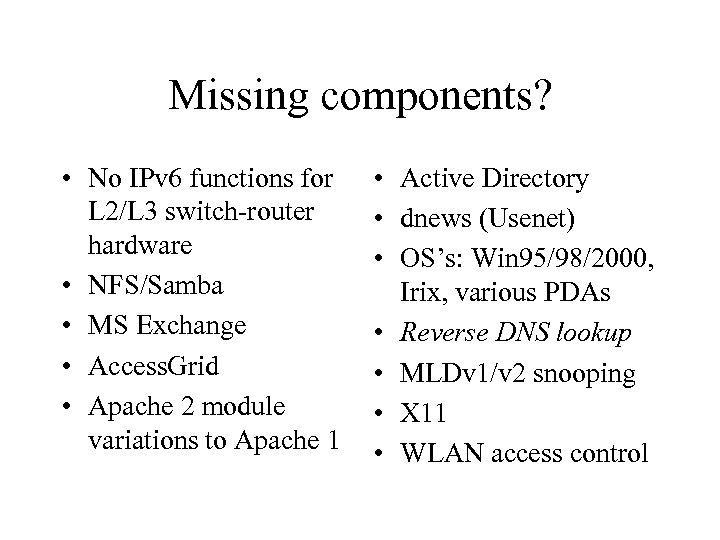 Missing components? • No IPv 6 functions for L 2/L 3 switch-router hardware • NFS/Samba • MS Exchange • Access. Grid • Apache 2 module variations to Apache 1 • Active Directory • dnews (Usenet) • OS’s: Win 95/98/2000, Irix, various PDAs • Reverse DNS lookup • MLDv 1/v 2 snooping • X 11 • WLAN access control
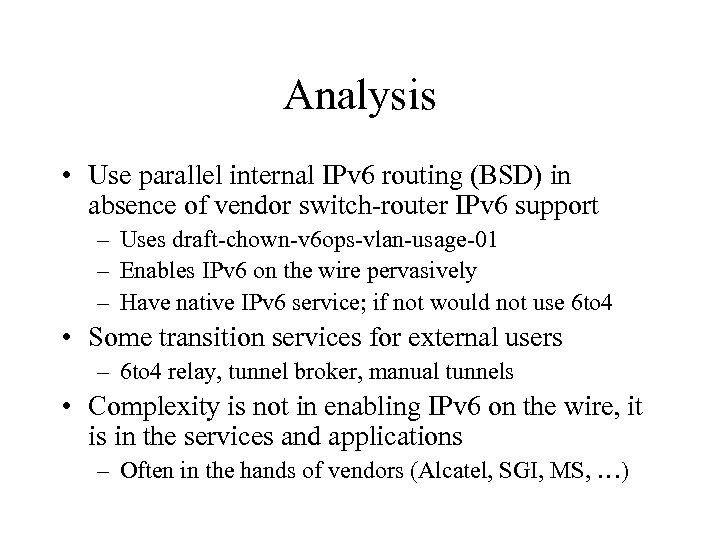 Analysis • Use parallel internal IPv 6 routing (BSD) in absence of vendor switch-router IPv 6 support – Uses draft-chown-v 6 ops-vlan-usage-01 – Enables IPv 6 on the wire pervasively – Have native IPv 6 service; if not would not use 6 to 4 • Some transition services for external users – 6 to 4 relay, tunnel broker, manual tunnels • Complexity is not in enabling IPv 6 on the wire, it is in the services and applications – Often in the hands of vendors (Alcatel, SGI, MS, …)
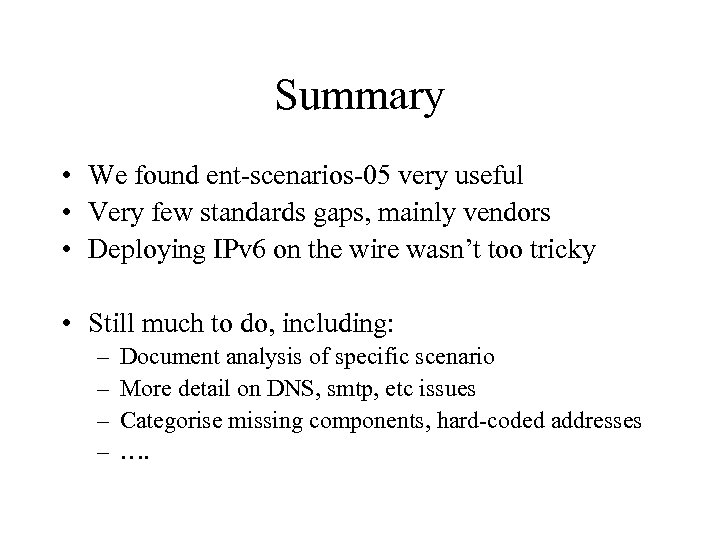 Summary • We found ent-scenarios-05 very useful • Very few standards gaps, mainly vendors • Deploying IPv 6 on the wire wasn’t too tricky • Still much to do, including: – – Document analysis of specific scenario More detail on DNS, smtp, etc issues Categorise missing components, hard-coded addresses ….
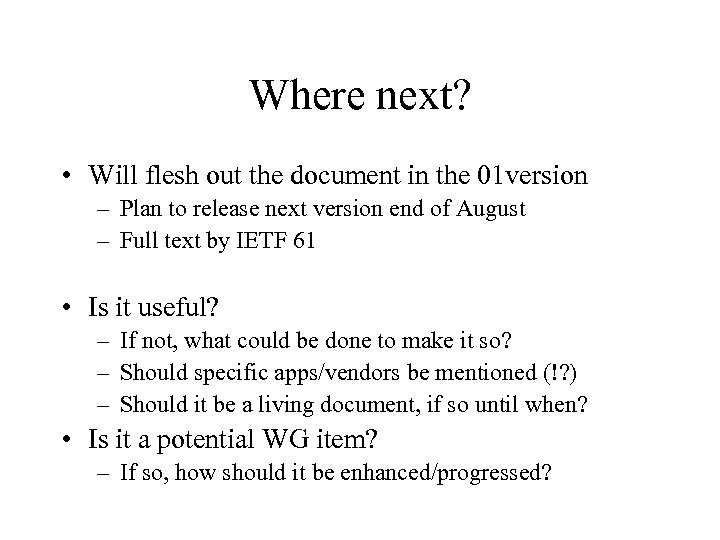 Where next? • Will flesh out the document in the 01 version – Plan to release next version end of August – Full text by IETF 61 • Is it useful? – If not, what could be done to make it so? – Should specific apps/vendors be mentioned (!? ) – Should it be a living document, if so until when? • Is it a potential WG item? – If so, how should it be enhanced/progressed?