Скачать презентацию Dr Suganda Ramamoorthi Associate Prof of Economics Lady
34944cd6113e2e3e42b4e6e2bf3d8049.ppt
- Количество слайдов: 33
 Dr. Suganda Ramamoorthi Associate Prof of Economics Lady Doak College Madurai sugandaramamoorthi@gmail. com
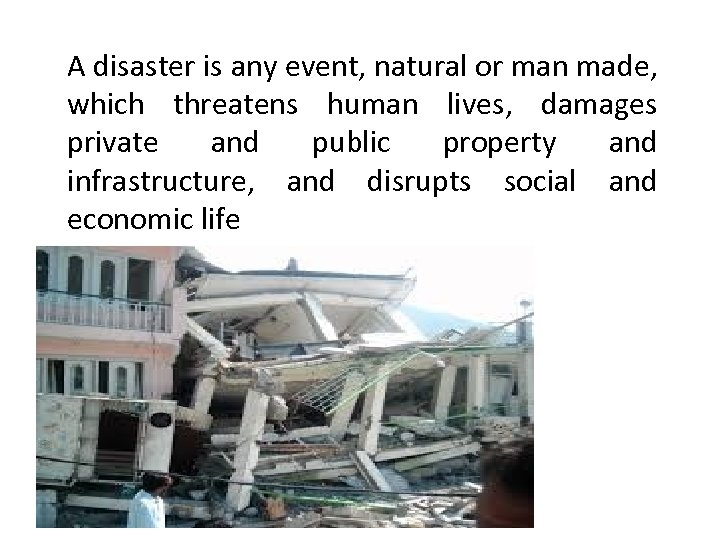 A disaster is any event, natural or man made, which threatens human lives, damages private and public property and infrastructure, and disrupts social and economic life
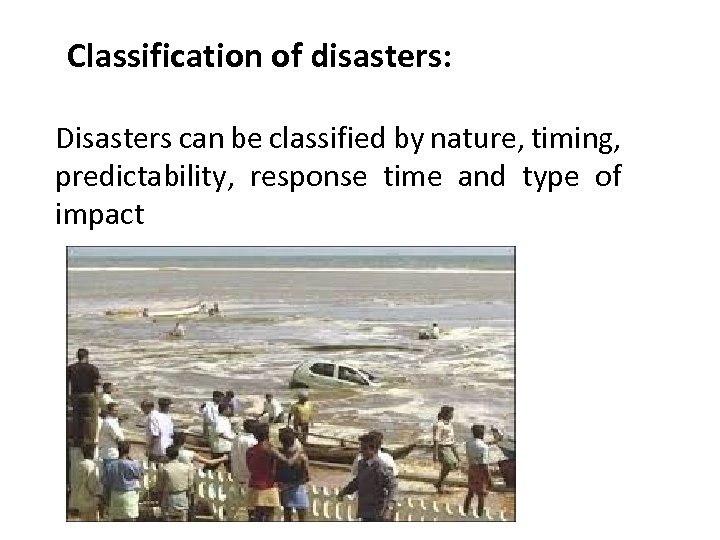 Classification of disasters: Disasters can be classified by nature, timing, predictability, response time and type of impact
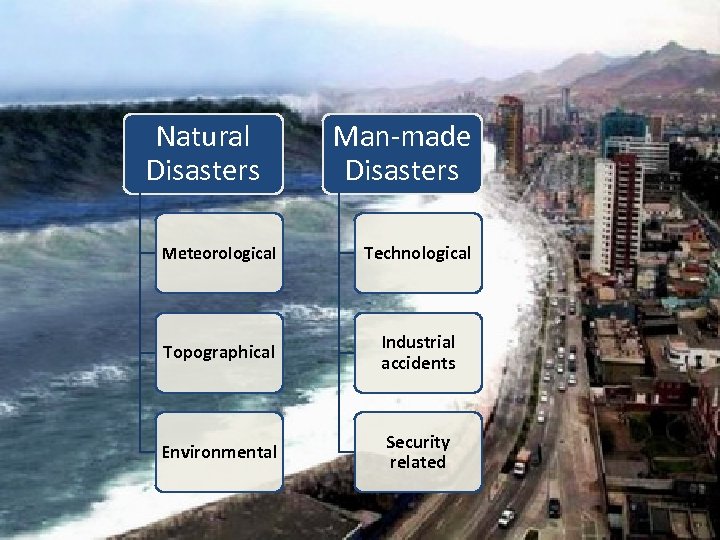 Natural Disasters Man-made Disasters Meteorological Technological Topographical Industrial accidents Environmental Security related
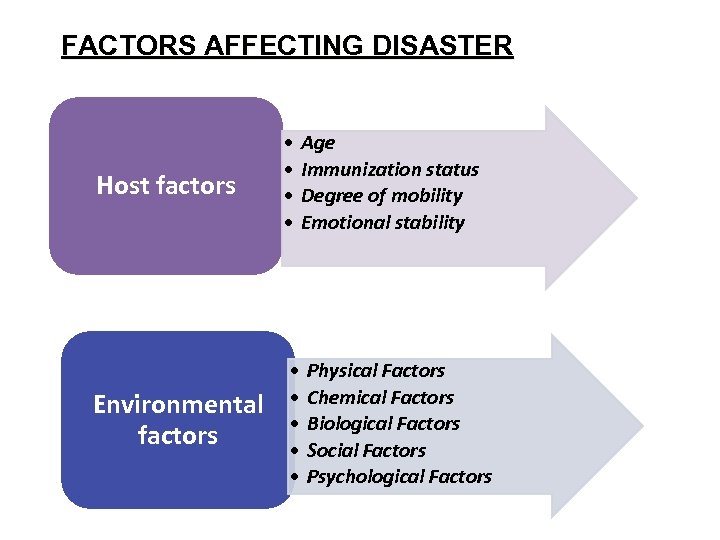 FACTORS AFFECTING DISASTER Host factors • • Age Immunization status Degree of mobility Emotional stability Environmental factors • • • Physical Factors Chemical Factors Biological Factors Social Factors Psychological Factors
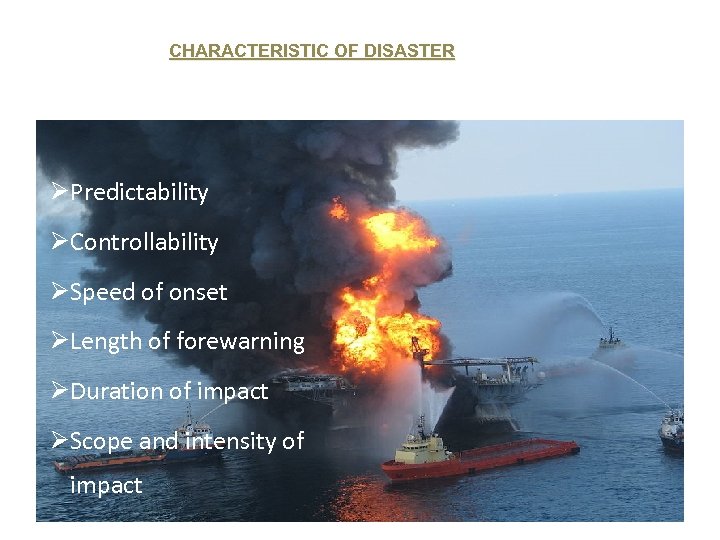 CHARACTERISTIC OF DISASTER ØPredictability ØControllability ØSpeed of onset ØLength of forewarning ØDuration of impact ØScope and intensity of impact
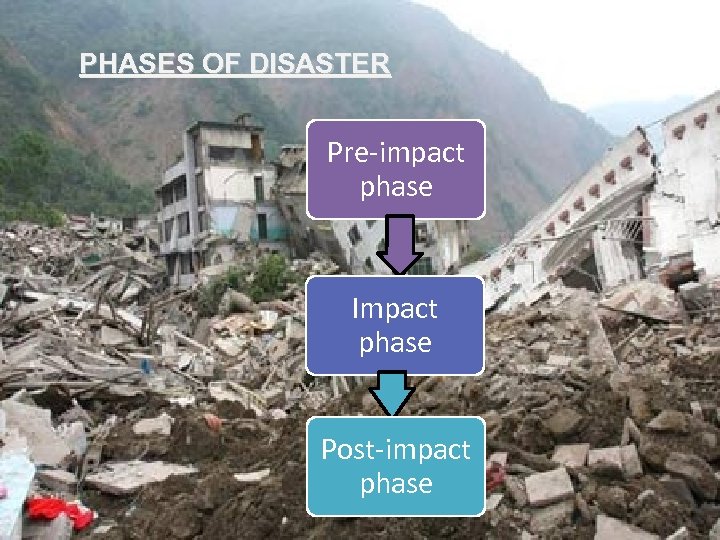 PHASES OF DISASTER Pre-impact phase Impact phase Post-impact phase
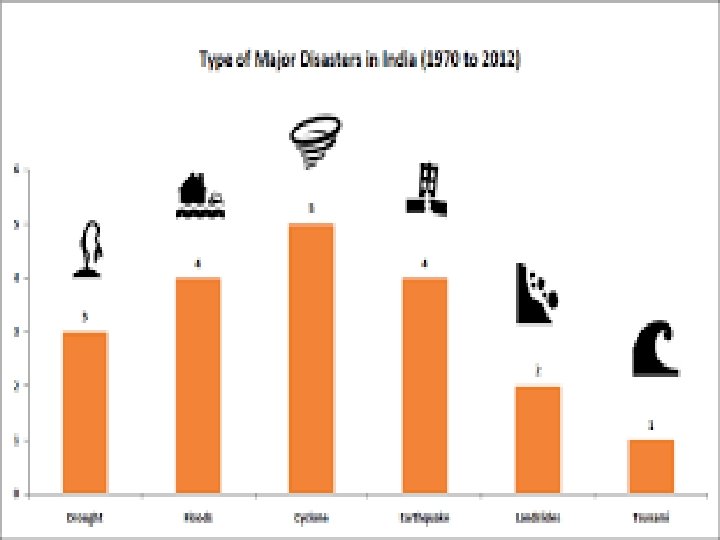
 India’s Vulnerability to Disasters • 57% land is vulnerable to earthquakes. Of these, 12% is vulnerable to severe earthquakes. • 68% land is vulnerable to drought. • 12% land is vulnerable to floods. • 8% land is vulnerable to cyclones. • Apart from natural disasters, some cities in India are also vulnerable to chemical and industrial disasters and man-made disasters.
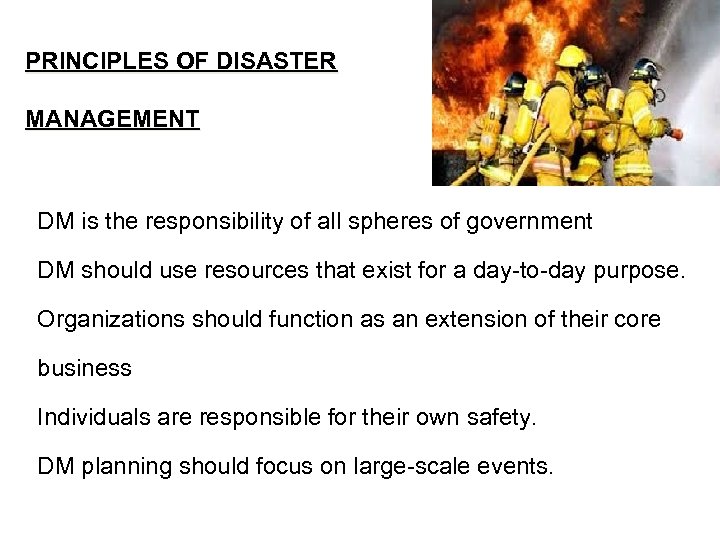 PRINCIPLES OF DISASTER MANAGEMENT DM is the responsibility of all spheres of government DM should use resources that exist for a day-to-day purpose. Organizations should function as an extension of their core business Individuals are responsible for their own safety. DM planning should focus on large-scale events.
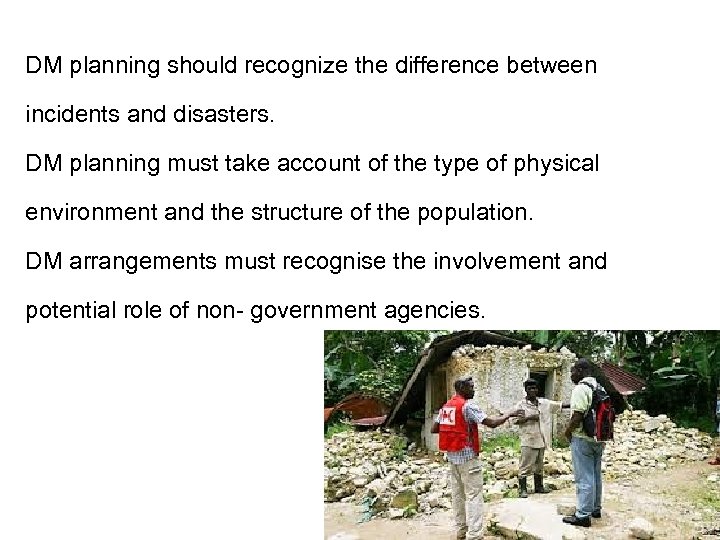 DM planning should recognize the difference between incidents and disasters. DM planning must take account of the type of physical environment and the structure of the population. DM arrangements must recognise the involvement and potential role of non- government agencies.
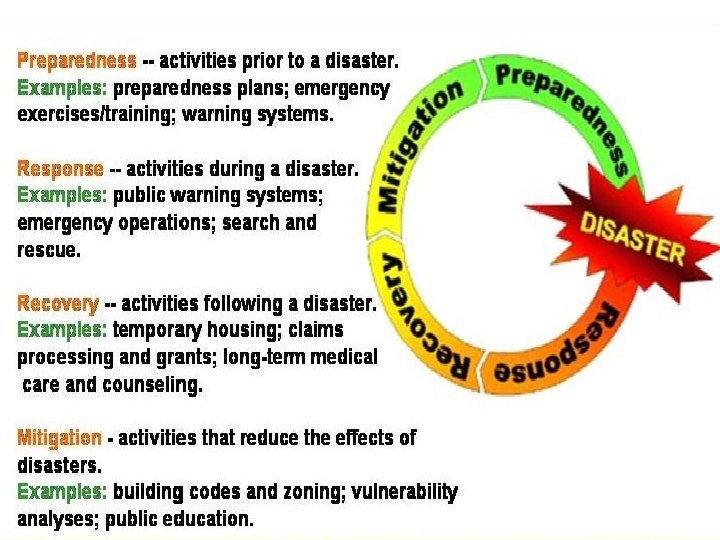
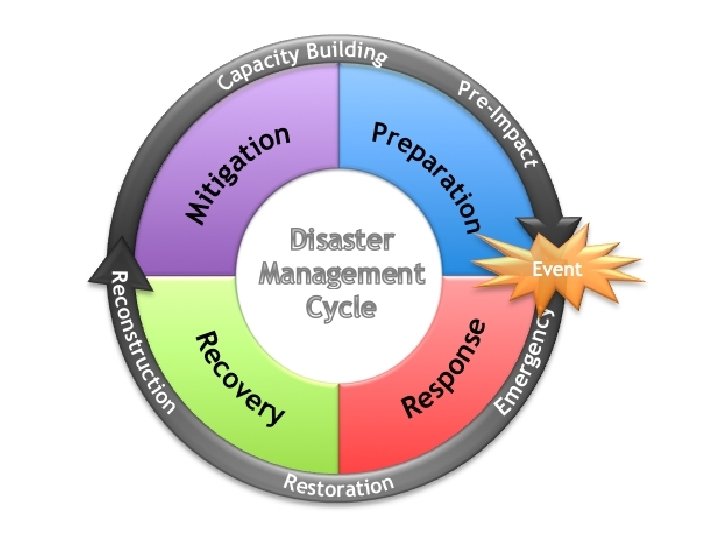
 Group Activity Group –I How to prevent a disasters? Group – II What kind of a response will we give during a disaster? Group – III Suggest recovery measures. Group – IV How can we mitigate the effects of a disaster?
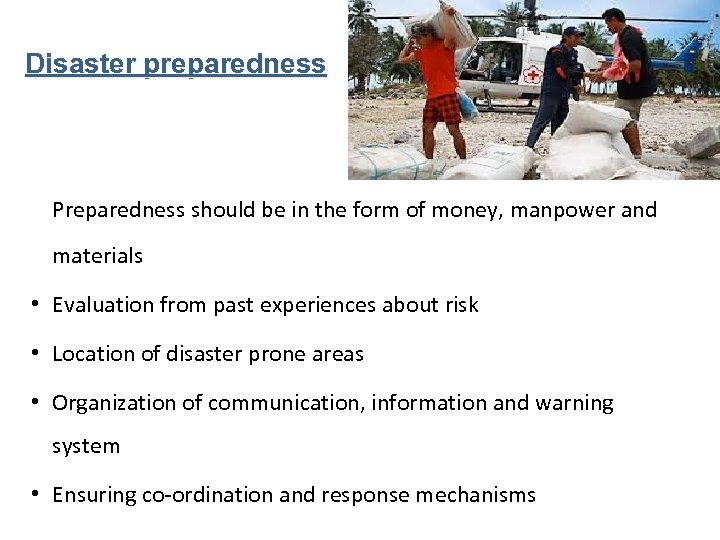 Disaster preparedness Preparedness should be in the form of money, manpower and materials • Evaluation from past experiences about risk • Location of disaster prone areas • Organization of communication, information and warning system • Ensuring co-ordination and response mechanisms
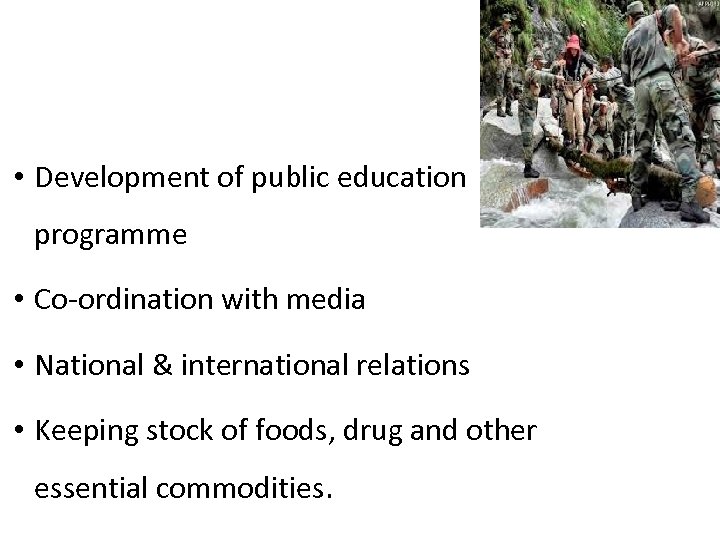 • Development of public education programme • Co-ordination with media • National & international relations • Keeping stock of foods, drug and other essential commodities.
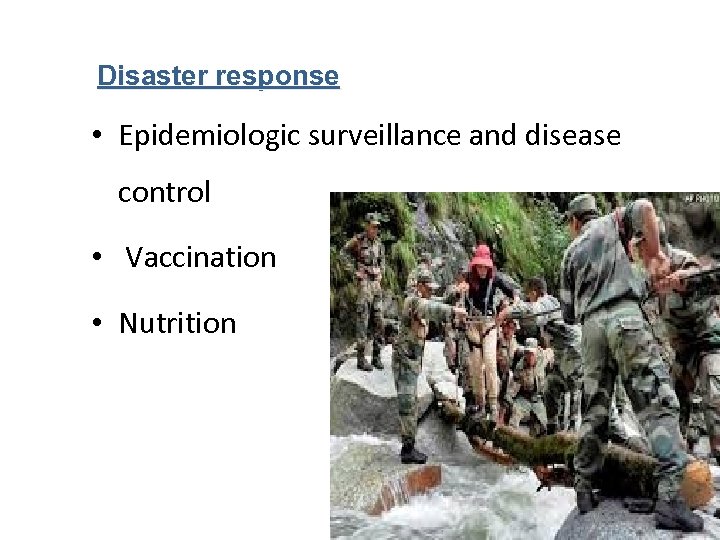 Disaster response • Epidemiologic surveillance and disease control • Vaccination • Nutrition
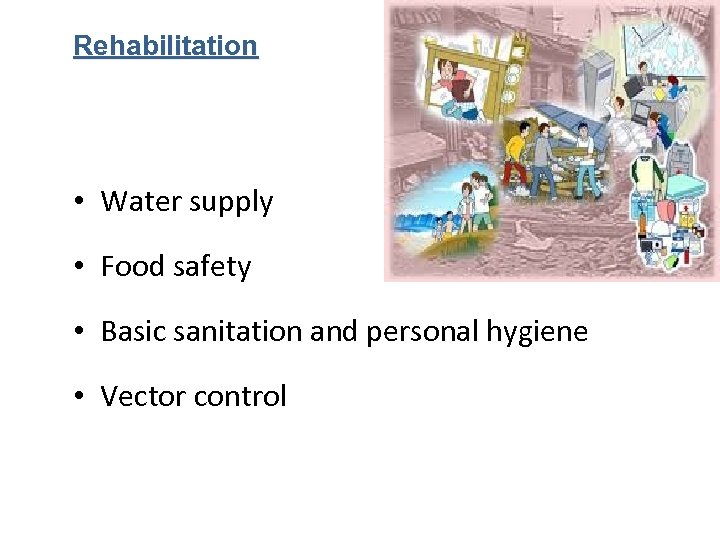 Rehabilitation • Water supply • Food safety • Basic sanitation and personal hygiene • Vector control
 Disaster mitigation • This involves lessening the likely effects of emergencies. • These include depending upon the disaster, protection of vulnerable population and structure. Eg. improving structural qualities of schools, houses and such other buildings so that medical causalities can be minimized.
 Similarly ensuring the safety of health facilities and public health services including water supply and sewerage system to reduce the cost of rehabilitation and reconstruction. This mitigation compliments the disaster preparedness and disaster response activities.
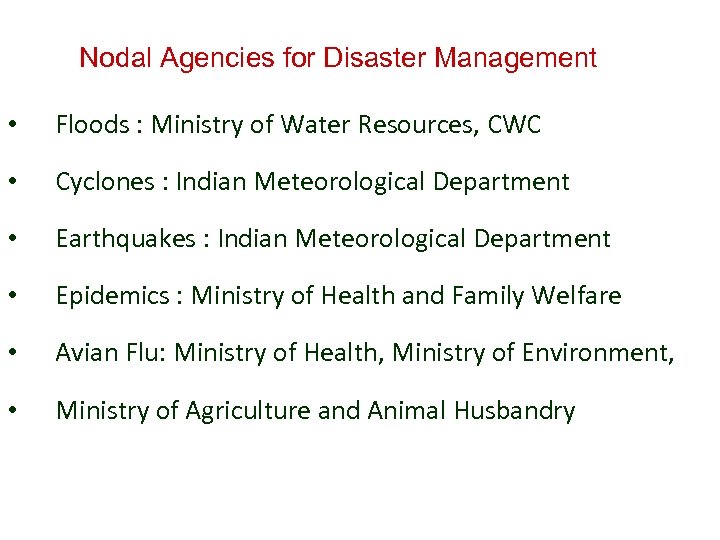 Nodal Agencies for Disaster Management • Floods : Ministry of Water Resources, CWC • Cyclones : Indian Meteorological Department • Earthquakes : Indian Meteorological Department • Epidemics : Ministry of Health and Family Welfare • Avian Flu: Ministry of Health, Ministry of Environment, • Ministry of Agriculture and Animal Husbandry
 Lessons Learnt • Be Prepared : Preparedness and Mitigation is bound to yield more effective returns than distributing relief after a disaster. • Create a Culture of Preparedness and Prevention. • Evolve a code of conduct for all stakeholders
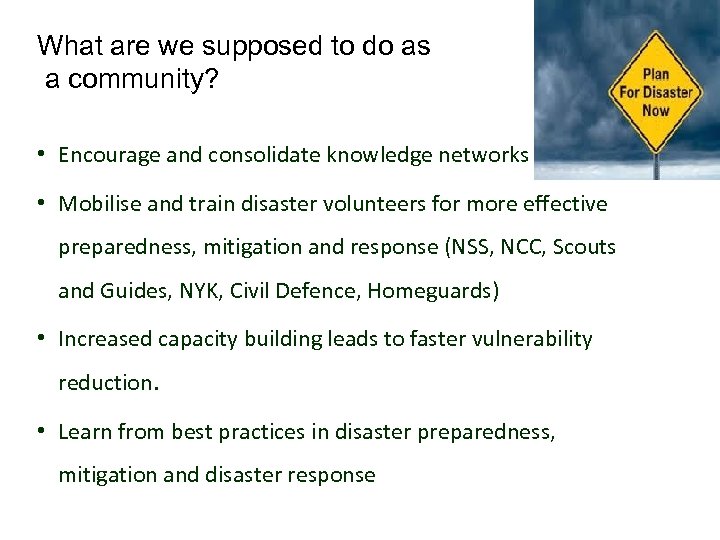 What are we supposed to do as a community? • Encourage and consolidate knowledge networks • Mobilise and train disaster volunteers for more effective preparedness, mitigation and response (NSS, NCC, Scouts and Guides, NYK, Civil Defence, Homeguards) • Increased capacity building leads to faster vulnerability reduction. • Learn from best practices in disaster preparedness, mitigation and disaster response
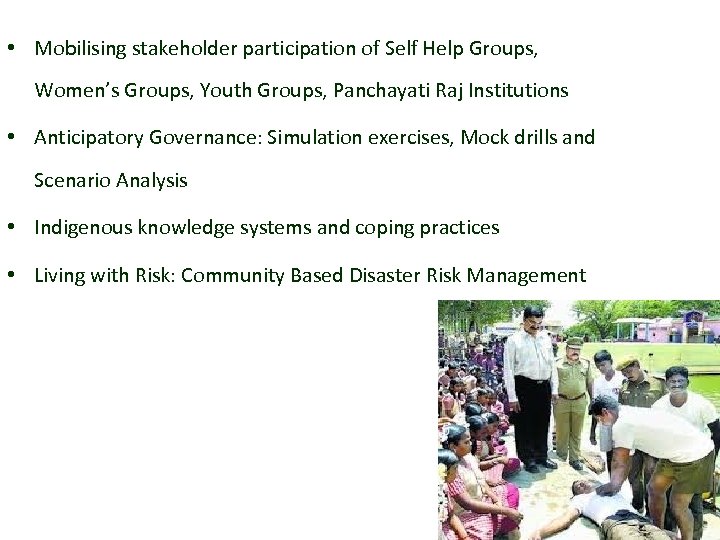 • Mobilising stakeholder participation of Self Help Groups, Women’s Groups, Youth Groups, Panchayati Raj Institutions • Anticipatory Governance: Simulation exercises, Mock drills and Scenario Analysis • Indigenous knowledge systems and coping practices • Living with Risk: Community Based Disaster Risk Management
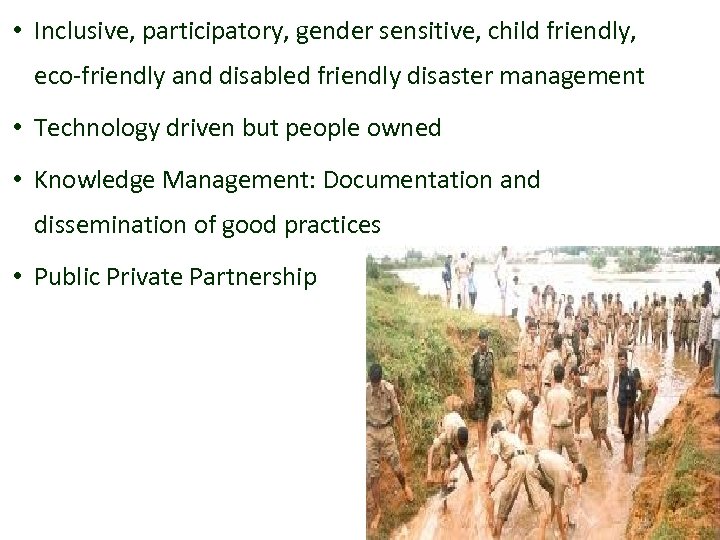 • Inclusive, participatory, gender sensitive, child friendly, eco-friendly and disabled friendly disaster management • Technology driven but people owned • Knowledge Management: Documentation and dissemination of good practices • Public Private Partnership
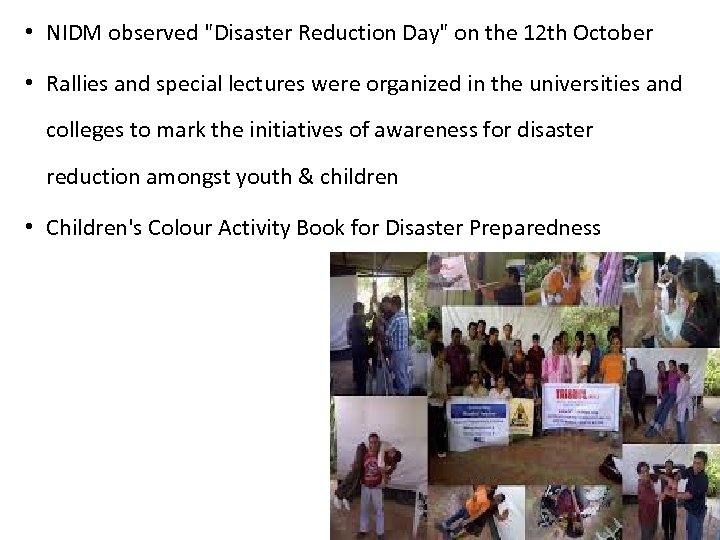 • NIDM observed "Disaster Reduction Day" on the 12 th October • Rallies and special lectures were organized in the universities and colleges to mark the initiatives of awareness for disaster reduction amongst youth & children • Children's Colour Activity Book for Disaster Preparedness
 • FOR INFORMATION ON DISASTERS DIAL TOLL FREE No. 1070 • Log on to http: //www. ndmindia. nic. in
 Disaster prevention: q. Identify and minimize the risks posed by the building, its equipment and fittings, and the natural hazardous areas. q Carry out a building inspection and alter factors which constitute a potential hazard. q Establish routine housekeeping and maintenance measures to withstand disaster in buildings and surrounding areas. q Install automatic fire detection and extinguishing systems, and watersensing alarms. q Take special precautions during unusual periods of increased risk, such as building renovation. q Have comprehensive insurance for the library or archives, its contents, the cost of salvage operations, and potential replacement, re-binding and restoration of damaged materials.
 Phase 2 : Preparedness Getting ready to cope. Ø Develop a written preparedness, response and recovery plan. Ø Keep the plan up-to-date, and test it. Ø Keep together supplies and equipment required in a disaster and maintain them. Ø Establish and train an in-house disaster response team. Training in : − disaster response techniques, − identification and marking on floor-plans and enclosures of irreplaceable and important materials for priority salvage
 Ø Prepare and keep an up-to-date set of documentation including : − Building floor-plans, with locations of cut-off switches and valves. − Inventory of holdings, with priorities for salvage marked on floor-plans. − List of names, addresses, and home telephone numbers of personnel with emergency responsibilities and in-house disaster response team − Arrangements made to access freezing facilities. − Arrangements for funding emergency needs. − Copies of insurance policies. Ø Distribute the plan and documentation to appropriate locations on- and offsite. Ø Institute procedures to notify appropriate people of the disaster and assemble them rapidly.
 Phase 3 : Response When disaster strikes. ü Follow established emergency procedures for raising the alarm, evacuating personnel and making the disaster si te safe ü Contact the leader of the disaster response team to direct and brief the trained salvage personnel ü When permission is given to re-enter the site, make a preliminary assessment of the extent of the damage, and the equipment, supplies and services required. ü Stabilize the environment to prevent the growth of mould. üPhotograph damaged materials for insurance claim purposes.
 Phase 4 : Recovery Getting back to normal. v Establish a programme to restore both the disaster site and the damaged materials to a stable and usable condition v Determine priorities for restoration work and seek the advice of a conservator as to the best methods and options, and obtain cost estimates. v Contact insurers.