


 Скачать презентацию Dr Snezana Trpevska Institute of Communication Studies MK
aa7fc25cebfdad9a592ecdfa38929f46.ppt
- Количество слайдов: 23
 Dr Snezana Trpevska Institute of Communication Studies, MK MEDIA FREEDOM AND JOURNALISTS’ SAFETY IN THE WESTERN BALKANS - COMPARATIVE OVERVIEW Belgrade, December 6 th 2016
 Introduction EC Strategic approach (2014 -2020): DG Enlargement Guidelines for EU support to media freedom and media integrity in enlargement countries, 2014 -2020. (1) enabling environment for free expression and media (2) strengthening journalists’ and media professionals’ organisations as the key drivers of the needed change (3) helping media outlets to improve their internal governance, thus making them more resilient against external pressures and restoring their integrity Main purpose of the study: To enhance the capacity of the JAs to conduct baseline assessments on the level of media freedom and journalists’ safety in their countries, which will be used in their ‘cross-country mechanism for monitoring and advocacy’.
 Methodologies of international organizations (1) Council of Europe: Indicators for Media in a Democracy; (2) UNESCO: Media Development Indicators (MDI) and Journalists’ Safety Indicators: National level; (3) USAID – IREX: Media Sustainability Index; (4) Freedom House: Freedom of the Press Survey; (5) BBC World Service Trust: African Media Development Initiative; (6) Committee to protect Journalists: Violence against journalists; (7) Reporters without Borders: World Press Freedom Index. The specific socio-political context in the WB countries and the specific perspective of the local JAs were also taken into consideration.
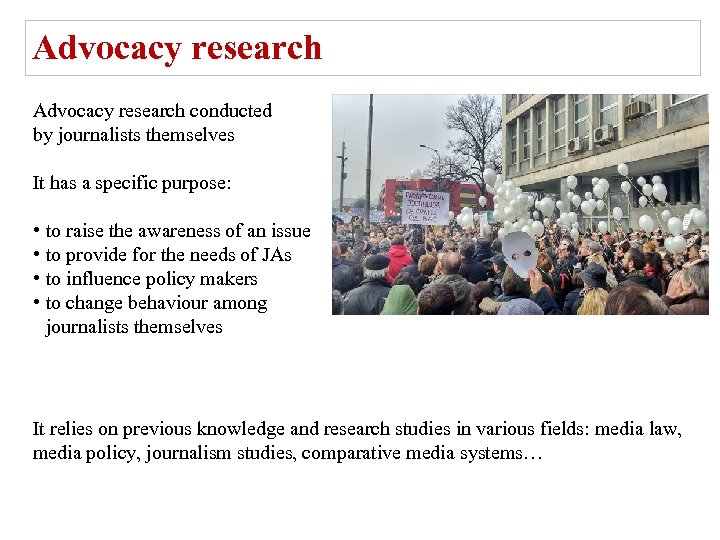 Advocacy research conducted by journalists themselves It has a specific purpose: • to raise the awareness of an issue • to provide for the needs of JAs • to influence policy makers • to change behaviour among journalists themselves It relies on previous knowledge and research studies in various fields: media law, media policy, journalism studies, comparative media systems…
 Research approach and methods 5 national researchers nominated and supported by JAs Lead Researcher provided Methodological Guidelines Mixed Methods: • • Qualitative Documents Analysis (QDA) Qualitative interviews with experts Official statistic data Survey with journalists (quota sample)
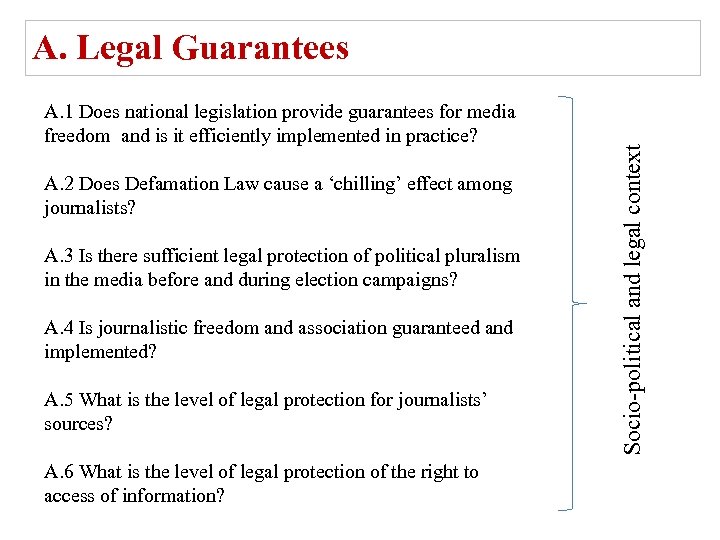 A. 1 Does national legislation provide guarantees for media freedom and is it efficiently implemented in practice? A. 2 Does Defamation Law cause a ‘chilling’ effect among journalists? A. 3 Is there sufficient legal protection of political pluralism in the media before and during election campaigns? A. 4 Is journalistic freedom and association guaranteed and implemented? A. 5 What is the level of legal protection for journalists’ sources? A. 6 What is the level of legal protection of the right to access of information? Socio-political and legal context A. Legal Guarantees
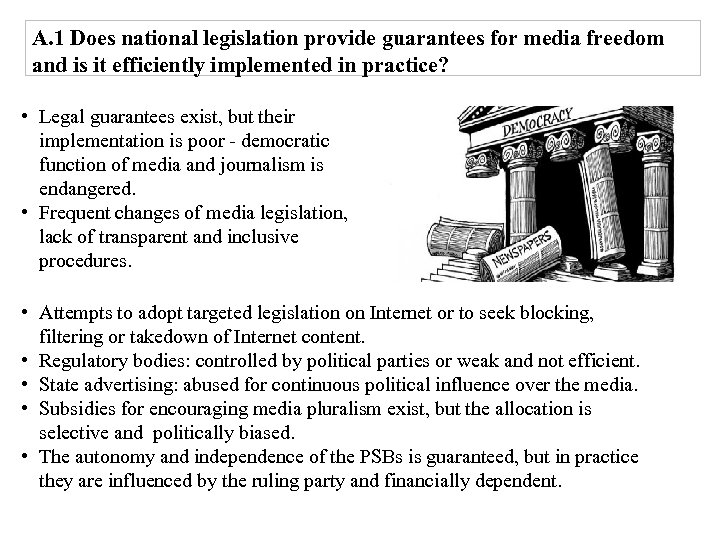 A. 1 Does national legislation provide guarantees for media freedom and is it efficiently implemented in practice? • Legal guarantees exist, but their implementation is poor - democratic function of media and journalism is endangered. • Frequent changes of media legislation, lack of transparent and inclusive procedures. • Attempts to adopt targeted legislation on Internet or to seek blocking, filtering or takedown of Internet content. • Regulatory bodies: controlled by political parties or weak and not efficient. • State advertising: abused for continuous political influence over the media. • Subsidies for encouraging media pluralism exist, but the allocation is selective and politically biased. • The autonomy and independence of the PSBs is guaranteed, but in practice they are influenced by the ruling party and financially dependent.
 A. 2 Does Defamation Law cause a ‘chilling’ effect among journalists? • Defamation is decriminalized in all countries • However, the chilling effect of the new laws is substantial due to large penalties. • The number of lawsuits initiated by state officials against journalists was very high in he last 3 years. • The threat of defamation lawsuit has the most powerful chilling effect in Bi. H (79. 73%), then in Kosovo (44%) and Montenegro (44%).
 A. 3 Is there sufficient legal protection of political pluralism in the media before and during election campaigns? • Political pluralism in the media in the non-election period is determined only as a general principle. • In general, traditional media mostly serve the interests of the parties in power. • Opposition political parties do not have fair and equal access to the media both in the non-election period and during election campaigns.
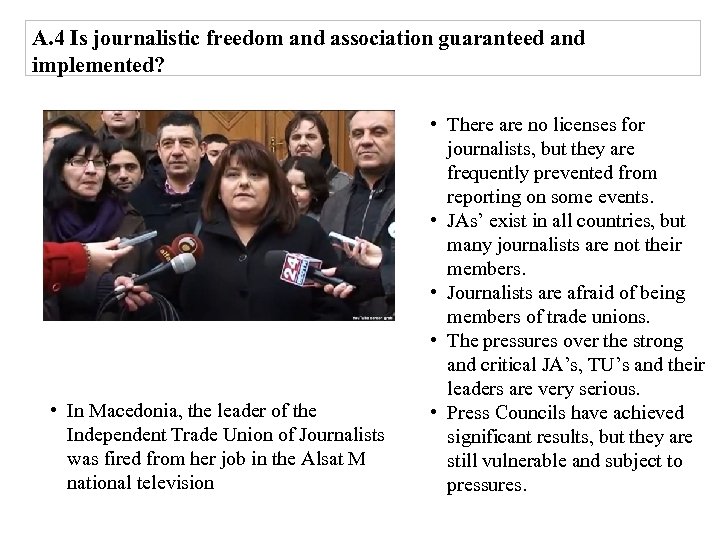 A. 4 Is journalistic freedom and association guaranteed and implemented? • In Macedonia, the leader of the Independent Trade Union of Journalists was fired from her job in the Alsat M national television • There are no licenses for journalists, but they are frequently prevented from reporting on some events. • JAs’ exist in all countries, but many journalists are not their members. • Journalists are afraid of being members of trade unions. • The pressures over the strong and critical JA’s, TU’s and their leaders are very serious. • Press Councils have achieved significant results, but they are still vulnerable and subject to pressures.
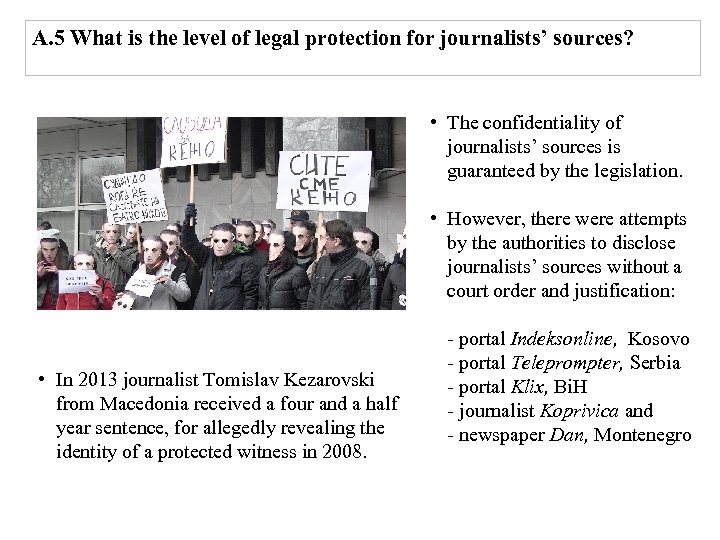 A. 5 What is the level of legal protection for journalists’ sources? • The confidentiality of journalists’ sources is guaranteed by the legislation. • However, there were attempts by the authorities to disclose journalists’ sources without a court order and justification: • In 2013 journalist Tomislav Kezarovski from Macedonia received a four and a half year sentence, for allegedly revealing the identity of a protected witness in 2008. - portal Indeksonline, Kosovo - portal Teleprompter, Serbia - portal Klix, Bi. H - journalist Koprivica and - newspaper Dan, Montenegro
 A. 6 What is the level of legal protection of the right to access of information? • Access to official documents is guaranteed, but legal provisions are not very helpful for journalists. • Significant number of journalists do submit requests to the public institutions, but their requests are very often refused. • Institutions usually wait to provide the required information until the last day of the determined deadline. • The least transparent institution is the government, followed by political parties and politicians in general. • Parliaments seem to be the most transparent and open to journalists.
 B. 1 Is the journalists’ economic position abused to restrict their freedom? B. 2 What is the level of editorial independence from media owners and managing bodies? B. 3 What is the level of journalists’ editorial independence in the PBS? B. 4 What is the level of journalistic editorial independence in the non-profit sector? B. 5 How much freedom do journalists have in the news production process? Organizational context, routine practices and individual attitudes B. Journalists’ position in the newsroom, professional ethics and level of censorship
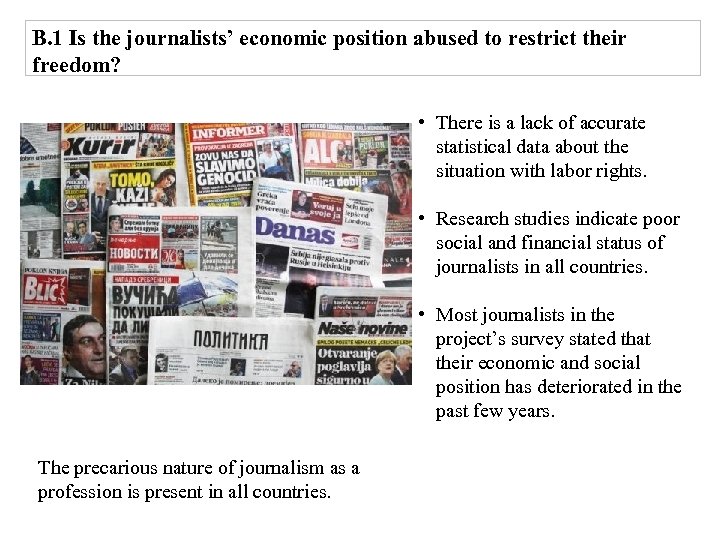 B. 1 Is the journalists’ economic position abused to restrict their freedom? • There is a lack of accurate statistical data about the situation with labor rights. • Research studies indicate poor social and financial status of journalists in all countries. • Most journalists in the project’s survey stated that their economic and social position has deteriorated in the past few years. The precarious nature of journalism as a profession is present in all countries.
 B. 2 What is the level of editorial independence from media owners and managing bodies? • Internal acts that regulate the demarcation of newsrooms from the managerial staff are lacking everywhere. • The owners, program directors and editors in chief are the key actors in deciding whether to publish certain information. • Most frequent direct forms of pressure on journalists are exerted through: low salaries, threats of being fired, mobbing, overtime work etc.
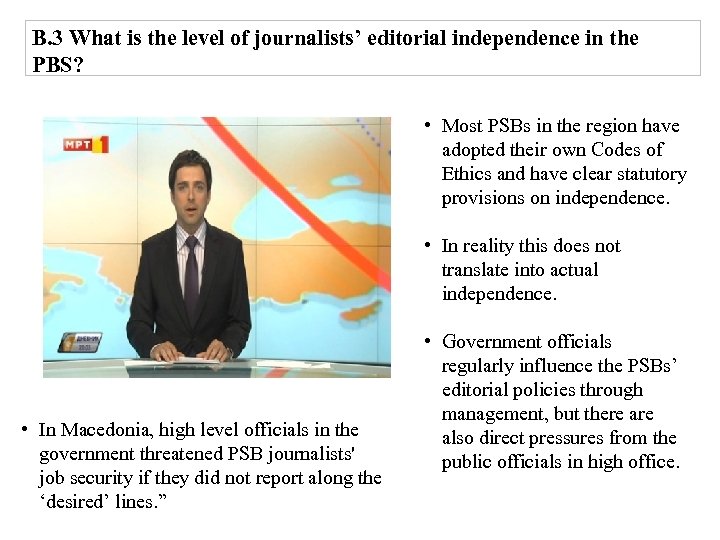 B. 3 What is the level of journalists’ editorial independence in the PBS? • Most PSBs in the region have adopted their own Codes of Ethics and have clear statutory provisions on independence. • In reality this does not translate into actual independence. • In Macedonia, high level officials in the government threatened PSB journalists' job security if they did not report along the ‘desired’ lines. ” • Government officials regularly influence the PSBs’ editorial policies through management, but there also direct pressures from the public officials in high office.
 B. 4 What is the level of journalistic editorial independence in the nonprofit sector? • Not-for-profit media are relatively new phenomenon in the region. • The Internet not-for-profit sector is proliferating. • But, most of them exist in a grey zone with respect to workers’ rights. There are different forms of pressure over the journalists working in news portals who are critical of the Government. They are often attacked by pro-governmental media as "foreign mercenaries" because they are financed by donations.
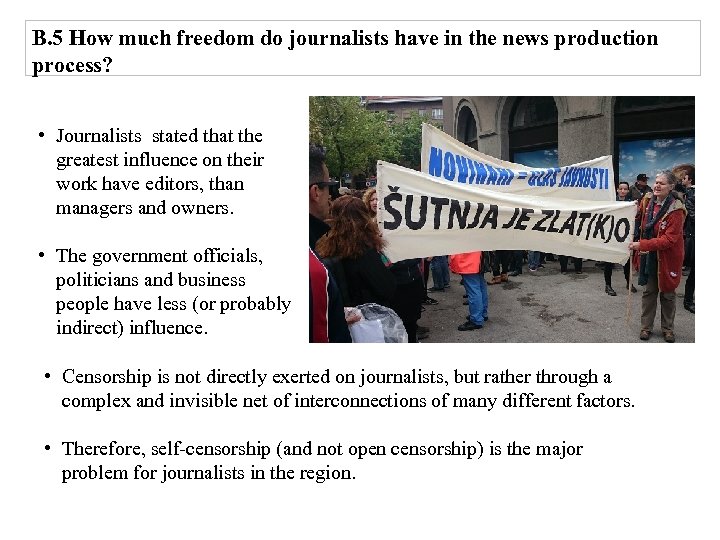 B. 5 How much freedom do journalists have in the news production process? • Journalists stated that the greatest influence on their work have editors, than managers and owners. • The government officials, politicians and business people have less (or probably indirect) influence. • Censorship is not directly exerted on journalists, but rather through a complex and invisible net of interconnections of many different factors. • Therefore, self-censorship (and not open censorship) is the major problem for journalists in the region.
 C. 1 Safety and Impunity Statistics C. 2 Do state institutions and political actors take responsibility for the protection of journalists? C. 3 Does the criminal and civil justice system deal effectively with threats and acts of violence against journalists? State mechanisms to protect journalists C. Journalists’ safety
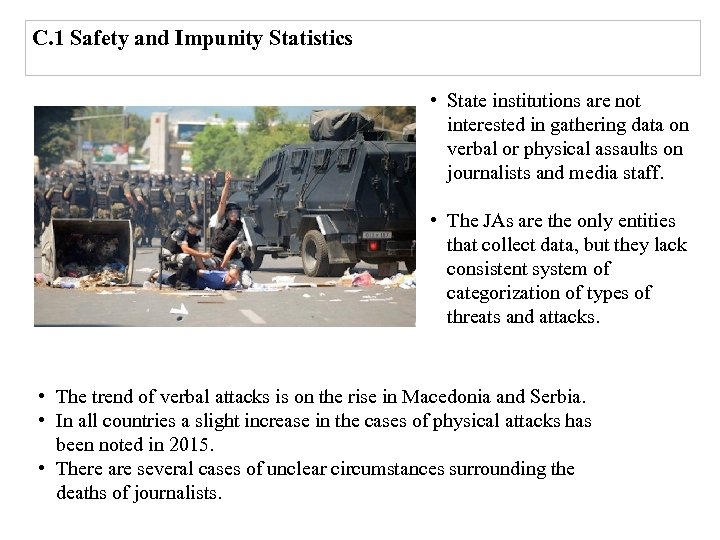 C. 1 Safety and Impunity Statistics • State institutions are not interested in gathering data on verbal or physical assaults on journalists and media staff. • The JAs are the only entities that collect data, but they lack consistent system of categorization of types of threats and attacks. • The trend of verbal attacks is on the rise in Macedonia and Serbia. • In all countries a slight increase in the cases of physical attacks has been noted in 2015. • There are several cases of unclear circumstances surrounding the deaths of journalists.
 C. 2 Do state institutions and political actors take responsibility for the protection of journalists? • Public officials rarely give explicit statements and instances of violence and pressure against journalists are frequently covered up. • Specific policies in support of the protection of journalists almost do not exist. Serbia, draft-Memorandum between JAs and institutions. Bi. H, Activity Plan on Human Rights (Chapter on journalists). Bi. H, amendments to Criminal Code to protect journalists. • There almost no developed state mechanisms for monitoring and reporting on threats, harassment and violence. Kosovo, the Police started preparing a list of threats and attacks Montenegro, State Public Prosecution and Police monitor and keep records Serbia, Instructions on the evidence of crimes against journalists and attacks on Internet sites were adopted in 2015 • In all countries the cooperation between the state institutions with the journalists’ organizations (on journalists’ safety issues) are almost non-existent. • In all countries, there are no appropriate control mechanisms over the bodies which are authorized to apply electronic surveillance.
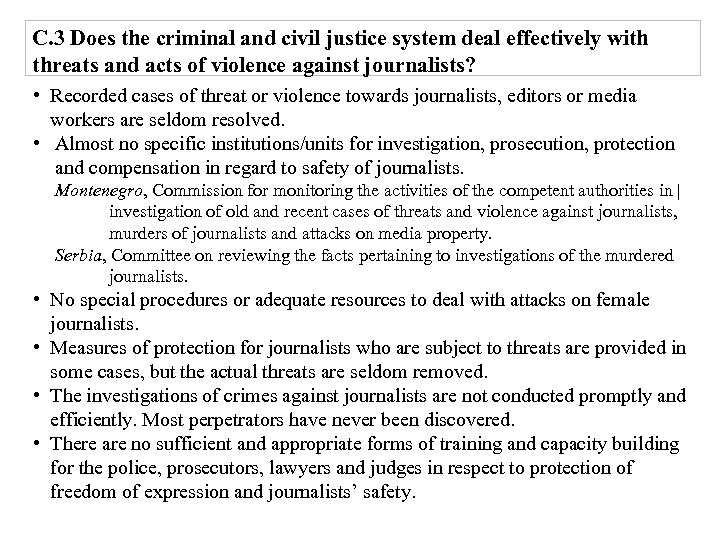 C. 3 Does the criminal and civil justice system deal effectively with threats and acts of violence against journalists? • Recorded cases of threat or violence towards journalists, editors or media workers are seldom resolved. • Almost no specific institutions/units for investigation, prosecution, protection and compensation in regard to safety of journalists. Montenegro, Commission for monitoring the activities of the competent authorities in | investigation of old and recent cases of threats and violence against journalists, murders of journalists and attacks on media property. Serbia, Committee on reviewing the facts pertaining to investigations of the murdered journalists. • No special procedures or adequate resources to deal with attacks on female journalists. • Measures of protection for journalists who are subject to threats are provided in some cases, but the actual threats are seldom removed. • The investigations of crimes against journalists are not conducted promptly and efficiently. Most perpetrators have never been discovered. • There are no sufficient and appropriate forms of training and capacity building for the police, prosecutors, lawyers and judges in respect to protection of freedom of expression and journalists’ safety.
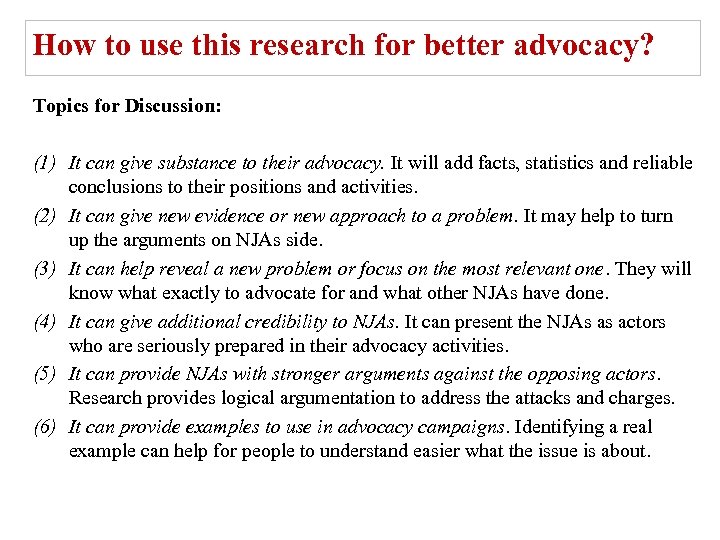 How to use this research for better advocacy? Topics for Discussion: (1) It can give substance to their advocacy. It will add facts, statistics and reliable conclusions to their positions and activities. (2) It can give new evidence or new approach to a problem. It may help to turn up the arguments on NJAs side. (3) It can help reveal a new problem or focus on the most relevant one. They will know what exactly to advocate for and what other NJAs have done. (4) It can give additional credibility to NJAs. It can present the NJAs as actors who are seriously prepared in their advocacy activities. (5) It can provide NJAs with stronger arguments against the opposing actors. Research provides logical argumentation to address the attacks and charges. (6) It can provide examples to use in advocacy campaigns. Identifying a real example can help for people to understand easier what the issue is about.