


 Скачать презентацию Dr Sarma works 1 Fore word Dear Doctor This
09196d28a79ebf06c917dc9f18e9d6dc.ppt
- Количество слайдов: 194
 Dr. Sarma@works 1 Fore word Dear Doctor, This ECG presentation is an attempt to illustrate some of the fundamentals in ECG interpretation. We have advanced level courses also on ECG. In addition, we have several educational resource materials in the form of Power. Point based CD-Rom presentations. Also are available several philosophical and religious works of all time great masters, translated into simple English and presented as Power. Point slide shows on CD-Rom. A list of such materials is appended. Pl. request for your copy of any of them at a nominal cost of Rs. 100/ per CD. Wishing You a happy learning experience !!
 Dr. Sarma@works 2 The Objectives § To sensitize doctors towards learning ECG § To explain the clinical concepts involved § To illustrate them with diagrams, drawings, tables § To show real life ECG charts and interpret § Differential diagnosis on similar looking ECG changes § Spot light on ECG and Ischemic Heart Disease Not Included are § § Electrophysiological basis of ECG changes Details on arrhythmias, conduction disorders Sensitivity and specificity of different patterns Atypical presentations, combination of pathologies
 Dr. Sarma@works 3 ECG Resources consulted § Alan Lindsay’s Cyber ECG learning center (on line) § Interactive Electrocardiography by Novartis – CD Rom § Frank H Netter's medical drawings § American Heart Association (AHA) sites § American Heart Lung and Blood Institute (AHLBI) sites § J. G. Webster’s Cyber ECG library § Braunwald’s text book of cardiology - 6 ed. 2004 § Goldberger’s text book on ECG
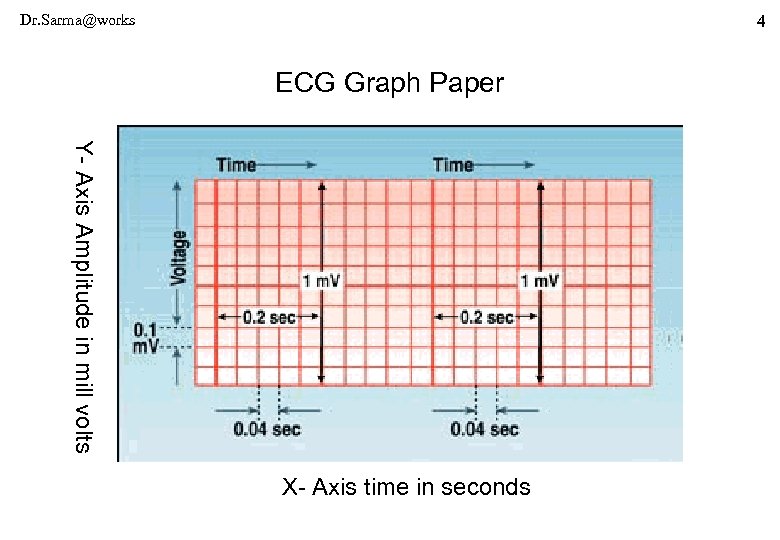 Dr. Sarma@works 4 ECG Graph Paper Y- Axis Amplitude in mill volts X- Axis time in seconds
 Dr. Sarma@works 5 ECG Graph Paper § X-Axis represents time - Scale X-Axis – 1 mm = 0. 04 sec § Y-Axis represents voltage - Scale Y-Axis – 1 mm = 0. 1 m. V § One big square on X-Axis = 0. 2 sec (big box) § Two big squares on Y-Axis = 1 milli volt (m. V) § Each small square is 0. 04 sec (1 mm in size) § Each big square on the ECG represents 5 small squares = 0. 04 x 5 = 0. 2 seconds § 5 such big squares = 0. 2 x 5 = 1 sec = 25 mm
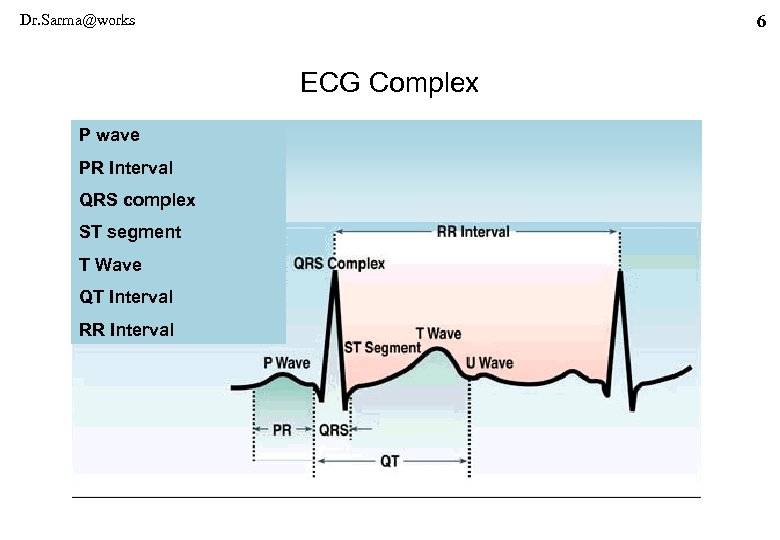 Dr. Sarma@works 6 ECG Complex P wave PR Interval QRS complex ST segment T Wave QT Interval RR Interval
 Dr. Sarma@works 7 ECG Complex § P Wave is Atrial contraction – Normal 0. 12 sec § PR interval is from the beginning of P wave to the beginning of QRS – Normal up to 0. 2 sec § QRS is Ventricular contraction –Normal 0. 08 sec § ST segment – Normal Isoelectic (electric silence) § QT Interval – From the beginning of QRS to the end of T wave – Normal – 0. 40 sec § RR Interval – One Cardiac cycle 0. 80 sec
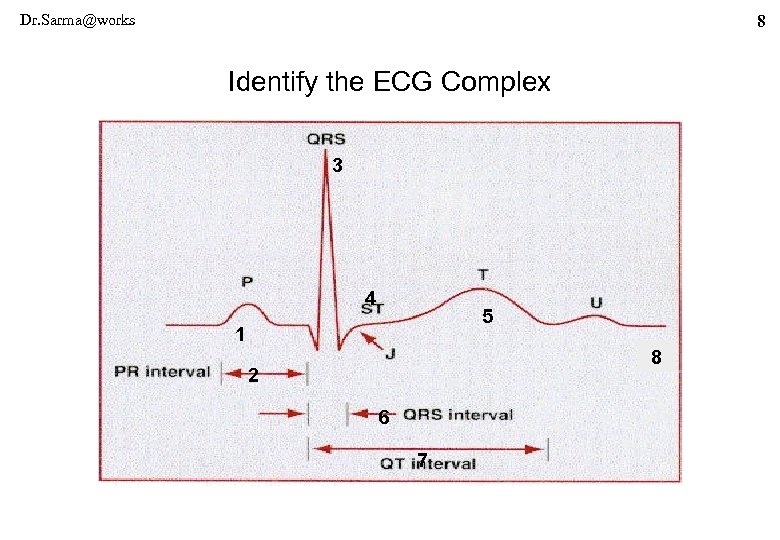 Dr. Sarma@works 8 Identify the ECG Complex 3 4 5 1 8 2 6 7
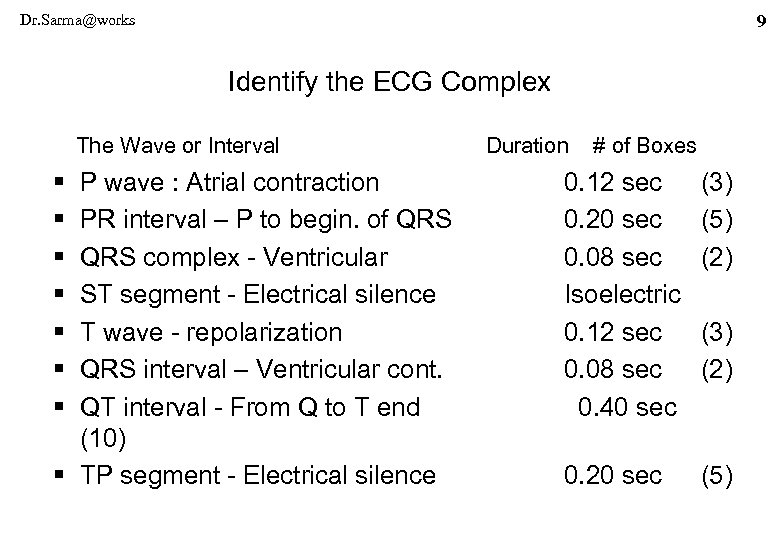 Dr. Sarma@works 9 Identify the ECG Complex The Wave or Interval § § § § P wave : Atrial contraction PR interval – P to begin. of QRS complex - Ventricular ST segment - Electrical silence T wave - repolarization QRS interval – Ventricular cont. QT interval - From Q to T end (10) § TP segment - Electrical silence Duration # of Boxes 0. 12 sec 0. 20 sec 0. 08 sec Isoelectric 0. 12 sec 0. 08 sec 0. 40 sec (3) (5) (2) 0. 20 sec (5) (3) (2)
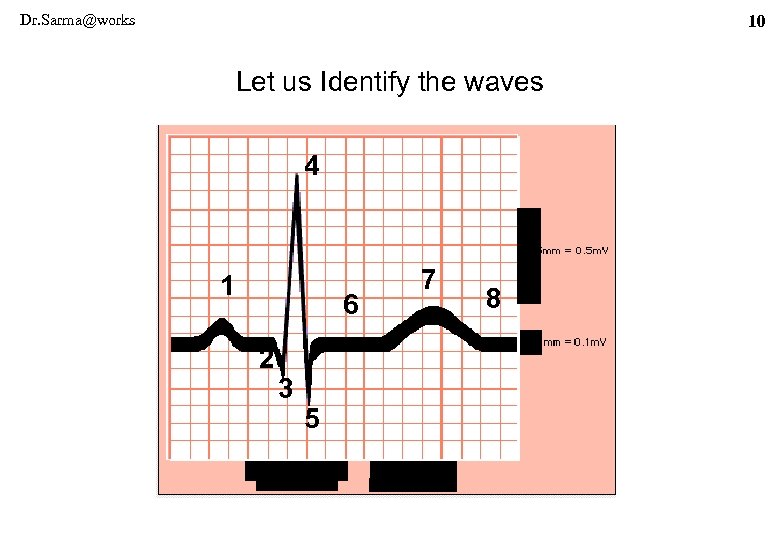 Dr. Sarma@works 10 Let us Identify the waves 4 1 6 2 3 5 7 8
 Dr. Sarma@works 11 Let us Identify the waves § P wave – Atrial contraction = 0. 12 sec (3 small boxes) § PR Interval – P + AV delay = 0. 20 sec (5 small boxes) § Q wave – Septal = < 3 mm, < 0. 04 sec (1 small box) § R wave – Ventricular contraction < 15 mm § S wave – complimentary to R < 15 mm § ST segment – Isoelectric – decides our fate § T wave – ventricular repolarization – friend of ST § TP segment – ventricular relaxation – shortened
 Dr. Sarma@works 12 Important Precautions § Correct Lead placement and good contact § Proper earth connection, avoid other gadgets § Deep inspiration record of L 3, a. VF § Compare serial ECGs if available § Relate the changes to Age, Sex, Clinical history § Consider the co-morbidities that may effect ECG § Make a xerox copy of the record for future use
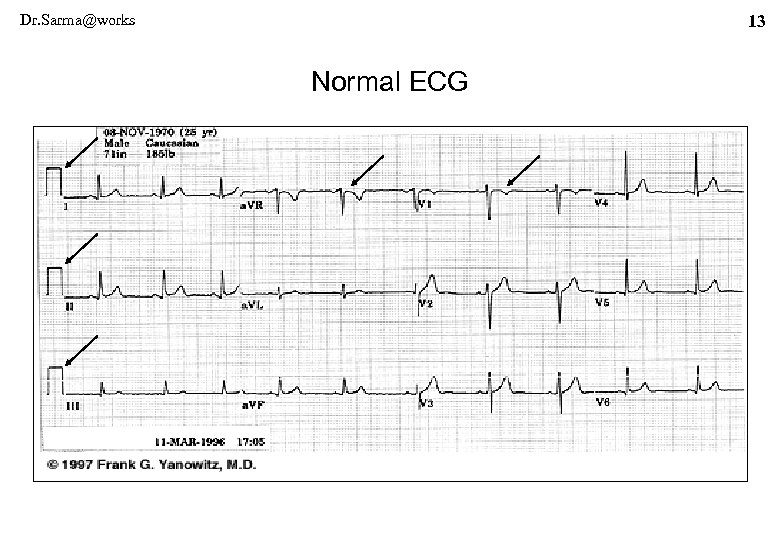 Dr. Sarma@works 13 Normal ECG
 Dr. Sarma@works 14 Normal ECG § Standardization – 10 mm (2 boxes) = 1 m. V § Double and half standardization if required § Sinus Rhythm – Each P followed by QRS, R-R constant § P waves – always examine for in L 2, V 1, L 1 § QRS positive in L 1, L 2, L 3, a. VF and a. VL. – Neg in a. VR § QRS is < 0. 08 narrow, Q in V 5, V 6 < 0. 04, < 3 mm § R wave progression from V 1 to V 6, QT interval < 0. 4 § Axis normal – L 1, L 3, and a. VF all will be positive § ST Isoelectric, T waves ↑, Normal T↓ in a. VR, V 1, V 2
 Dr. Sarma@works 15 Pediatric ECG
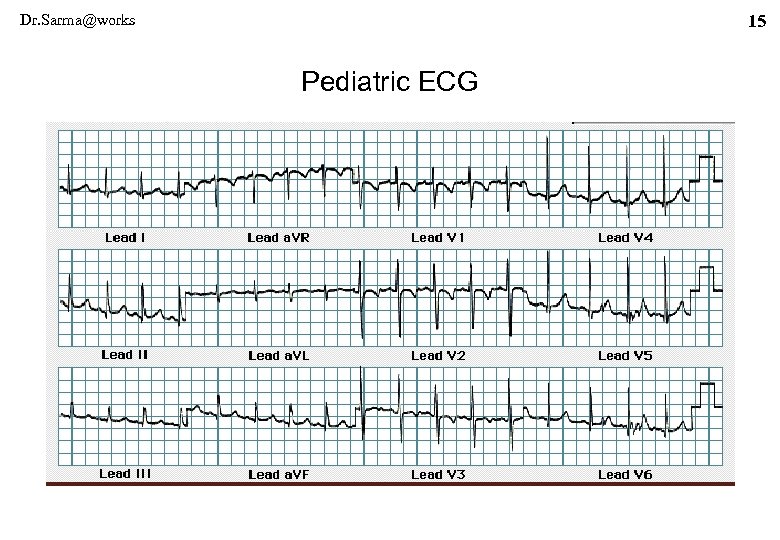
 Dr. Sarma@works 16 Pediatric ECG § This is the ECG of a 6 year old child § Heart rate is 100 – Normal for the age § See V 1 + V 5 R >> 35 – Not LVH – Normal § T↓ in V 1, V 2, V 3 – Normal in child § Base line disturbances in V 5, V 6 – due to movement by child
 Dr. Sarma@works 17 Juvenile ECG
 Dr. Sarma@works 18 Be aware of normal ECG § Normal Resting ECG – cannot exclude disease § Ischemia may be covert – supply / demand equation § Changes of MI take some time to develop in ECG § Mild Ventricular hypertrophy - not detectable in ECG § Some of the ECG abnormalities are non specific § Single ECG cannot give progress – Need serial ECGs § ECG changes not always correlate with Angio
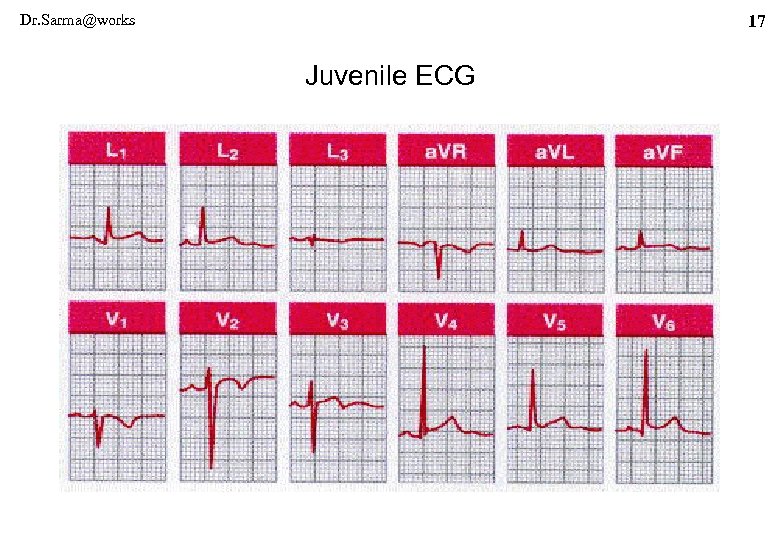
 Dr. Sarma@works 19 Normal Variations in ECG § May have slight left axis due to rotation of heart § May have high voltage QRS – simulating LVH § Mild slurring of QRS but duration < 0. 09 § J point depression, early repolarization § T inversions in V 2, V 3 and V 4 – Juvenile T ↓ § Similarly in women also T↓ § Low voltages in obese women and men
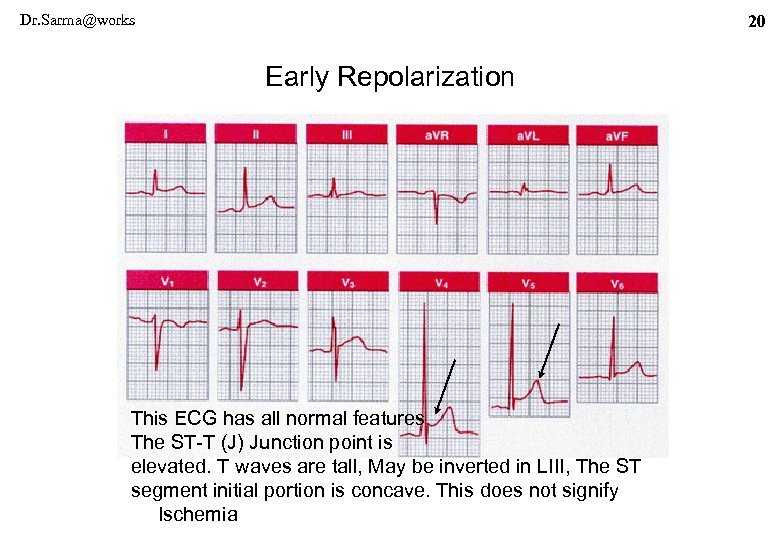 Dr. Sarma@works 20 Early Repolarization This ECG has all normal features The ST-T (J) Junction point is elevated. T waves are tall, May be inverted in LIII, The ST segment initial portion is concave. This does not signify Ischemia
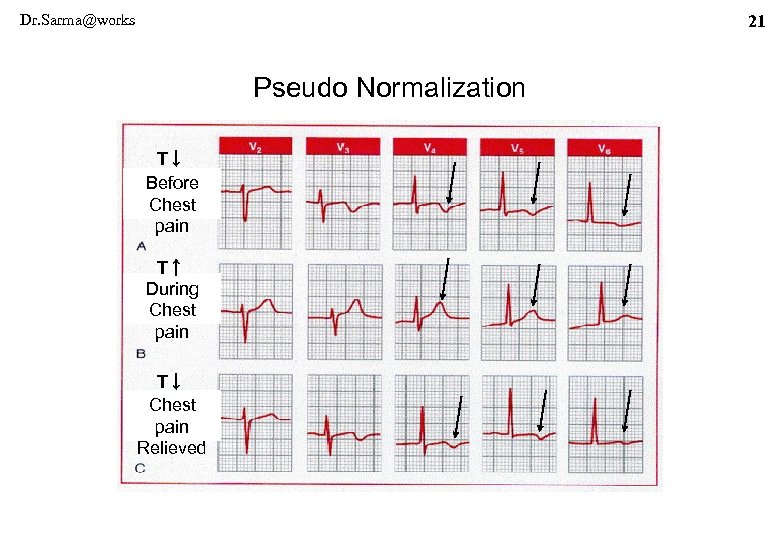 Dr. Sarma@works 21 Pseudo Normalization T↓ Before Chest pain T↑ During Chest pain T↓ Chest pain Relieved
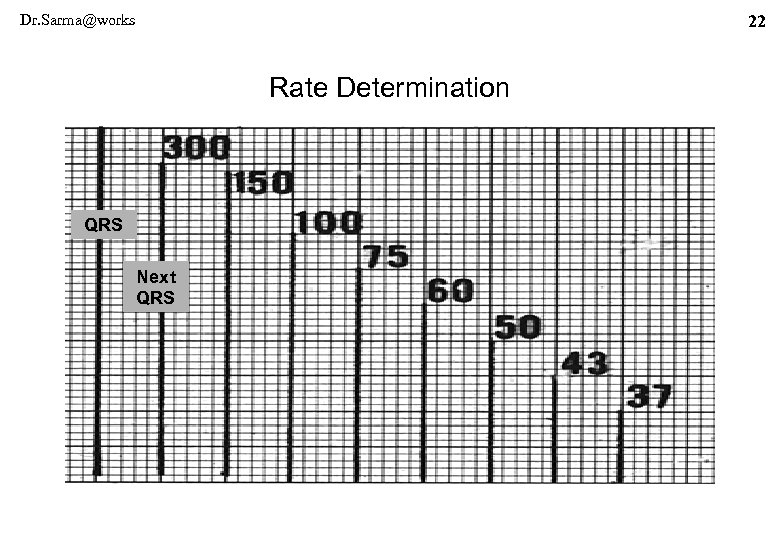 Dr. Sarma@works 22 Rate Determination QRS Next QRS
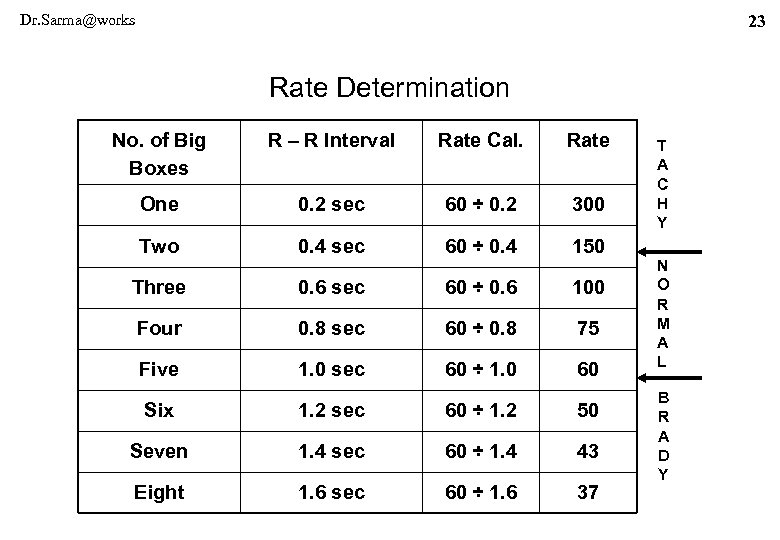 Dr. Sarma@works 23 Rate Determination No. of Big Boxes R – R Interval Rate Cal. Rate One 0. 2 sec 60 ÷ 0. 2 300 Two 0. 4 sec 60 ÷ 0. 4 150 Three 0. 6 sec 60 ÷ 0. 6 100 Four 0. 8 sec 60 ÷ 0. 8 75 Five 1. 0 sec 60 ÷ 1. 0 60 Six 1. 2 sec 60 ÷ 1. 2 50 Seven 1. 4 sec 60 ÷ 1. 4 43 Eight 1. 6 sec 60 ÷ 1. 6 37 T A C H Y N O R M A L B R A D Y
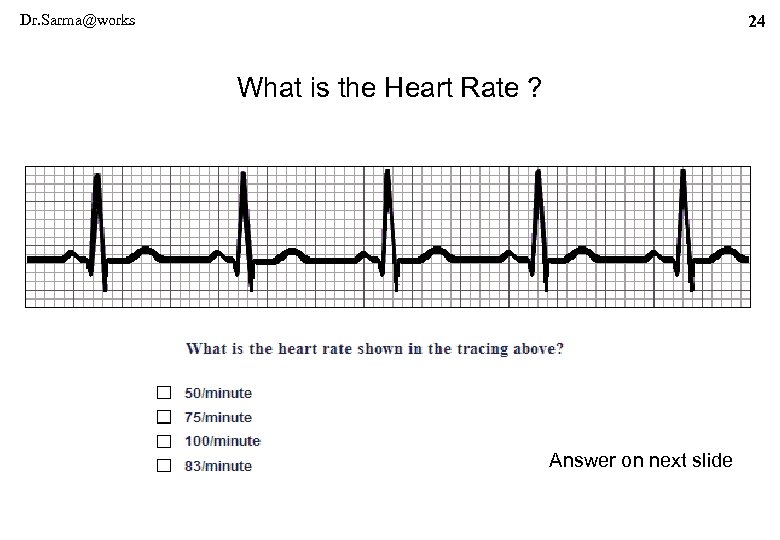 Dr. Sarma@works 24 What is the Heart Rate ? Answer on next slide
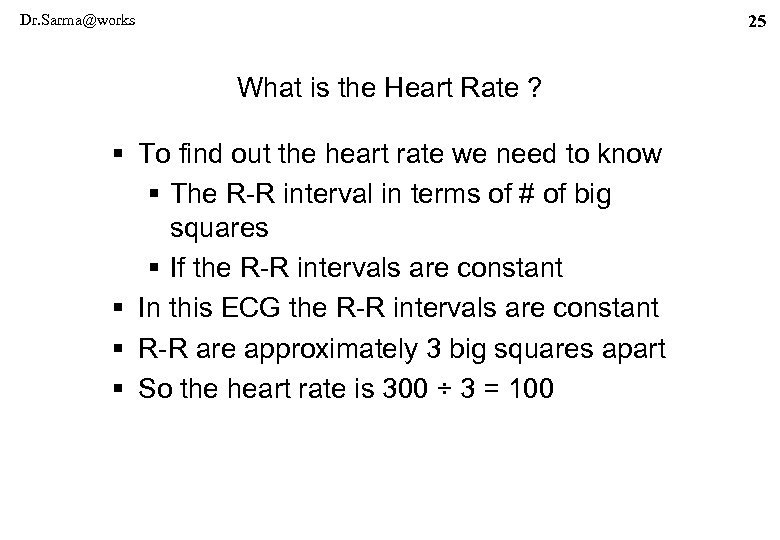 Dr. Sarma@works 25 What is the Heart Rate ? § To find out the heart rate we need to know § The R-R interval in terms of # of big squares § If the R-R intervals are constant § In this ECG the R-R intervals are constant § R-R are approximately 3 big squares apart § So the heart rate is 300 ÷ 3 = 100
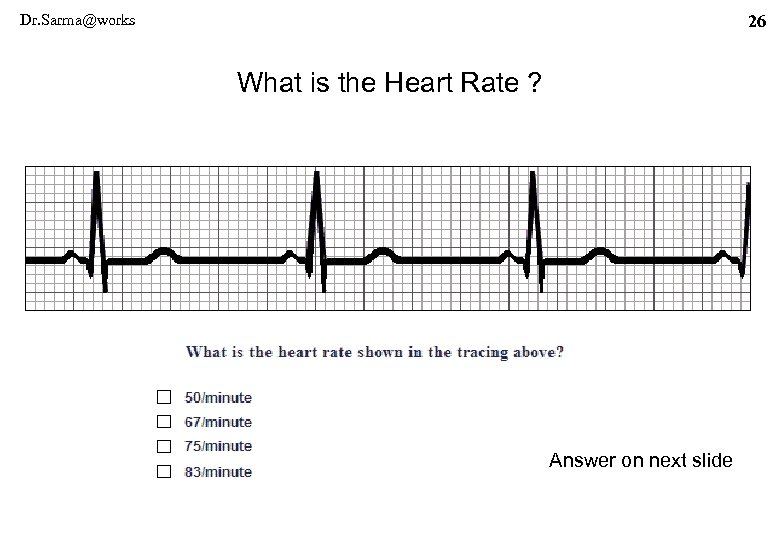 Dr. Sarma@works 26 What is the Heart Rate ? Answer on next slide
 Dr. Sarma@works 27 What is the Heart Rate ? § To find out the heart rate we need to know § The R-R interval in terms of # of big squares § If the R-R intervals are constant § In this ECG the R-R intervals are constant § R-R are approximately 4. 5 big squares apart § So the heart rate is 300 ÷ 4. 5 = 67
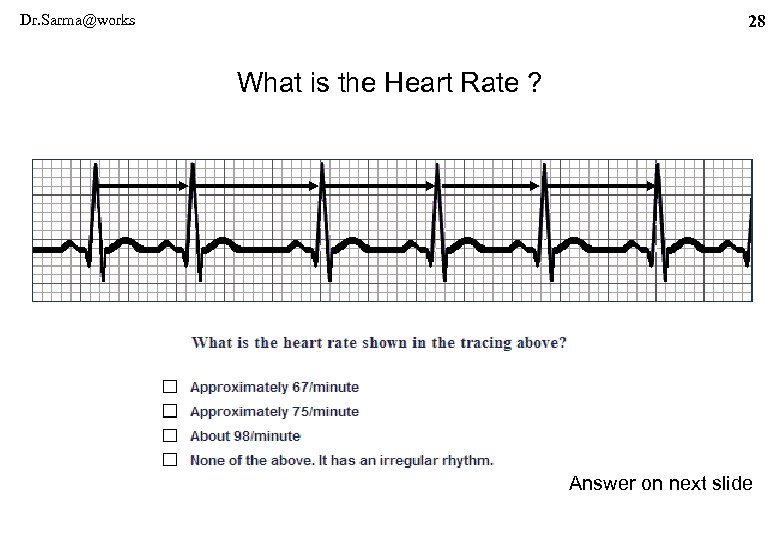 Dr. Sarma@works 28 What is the Heart Rate ? Answer on next slide
 Dr. Sarma@works 29 What is the Heart Rate ? § To find out the heart rate we need to know § The R-R interval in terms of # of Big Squares § If the R-R intervals are constant § In this ECG the R-R intervals are not constant § R-R are varying from 2 boxes to 3 boxes § It is an irregular rhythm – Sinus arrhythmia § Heart rate is 300 ÷ 2 to 3 = 150 to 100 approx
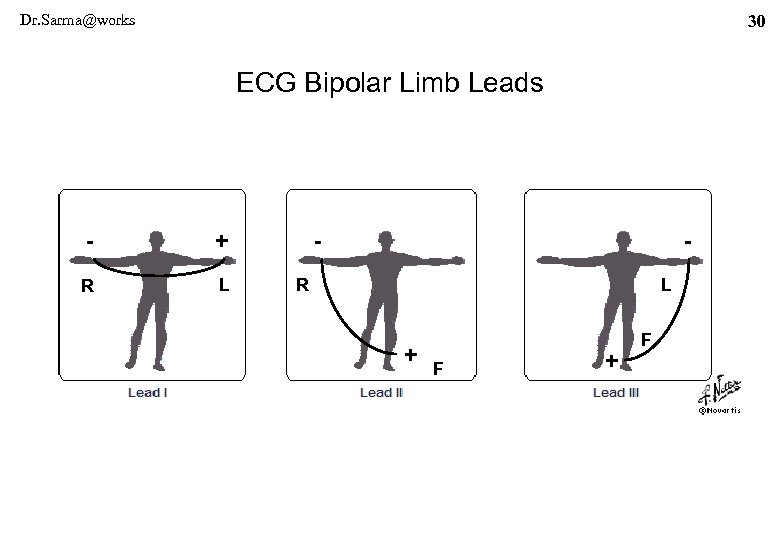 Dr. Sarma@works 30 ECG Bipolar Limb Leads - + R L - - R L + F
 Dr. Sarma@works 31 ECG Bipolar Limb Leads § Standard ECG is recorded in 12 leads § Six Limb leads – L 1, L 2, L 3, a. VR, a. VL, a. VF § Six Chest Leads – V 1 V 2 V 3 V 4 V 5 and V 6 § L 1, L 2 and L 3 are called bipolar leads § L 1 between LA and RA § L 2 between LF and RA § L 3 between LF and LA
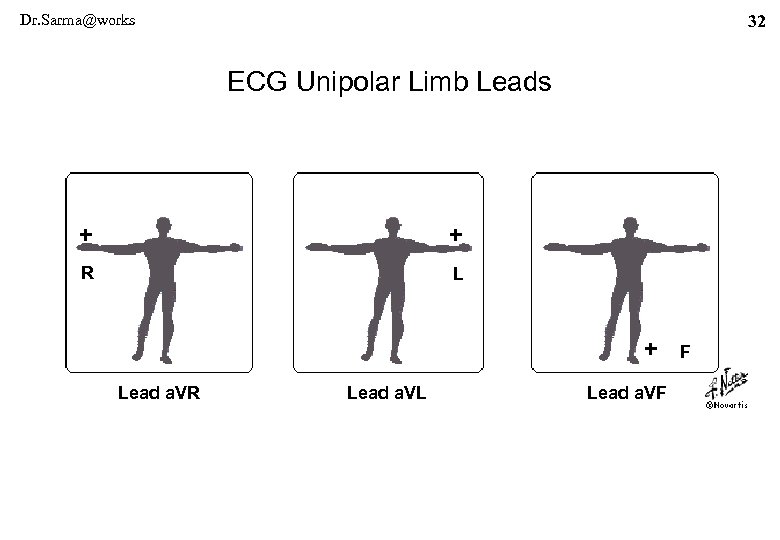 Dr. Sarma@works 32 ECG Unipolar Limb Leads + + R L + Lead a. VR Lead a. VL Lead a. VF F
 Dr. Sarma@works 33 ECG Unipolar Limb Leads § Standard ECG is recorded in 12 leads § Six Limb leads – L 1, L 2, L 3, a. VR, a. VL, a. VF § Six Chest Leads – V 1 V 2 V 3 V 4 V 5 and V 6 § a. VR, a. VL, a. VF are called unipolar leads § a. VR – from Right Arm Positive § a. VL – from Left Arm Positive § a. VF – from Left Foot Positive
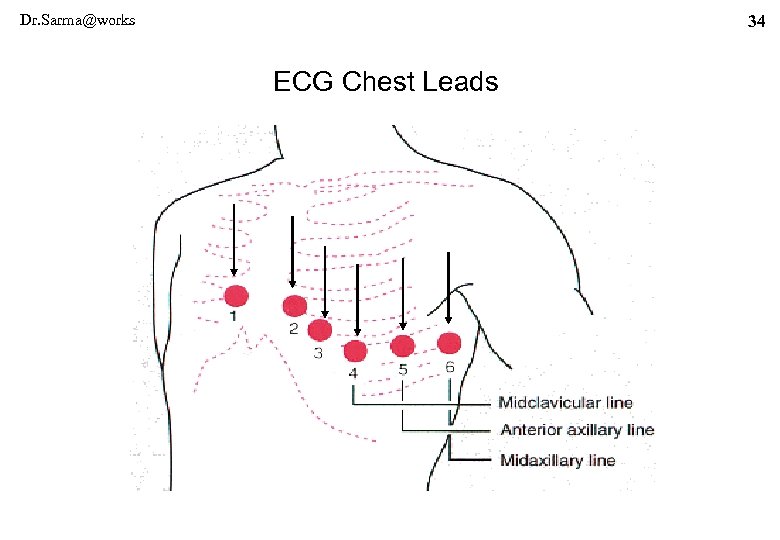 Dr. Sarma@works 34 ECG Chest Leads
 Dr. Sarma@works 35 ECG Chest Leads Precardial (chest) Lead Position § V 1 Fourth ICS, right sternal border § V 2 Fourth ICS, left sternal border § V 3 Equidistant between V 2 and V 4 § V 4 Fifth ICS, left Mid clavicular Line § V 5 Fifth ICS Left anterior axillary line § V 6 Fifth ICS Left mid axillary line
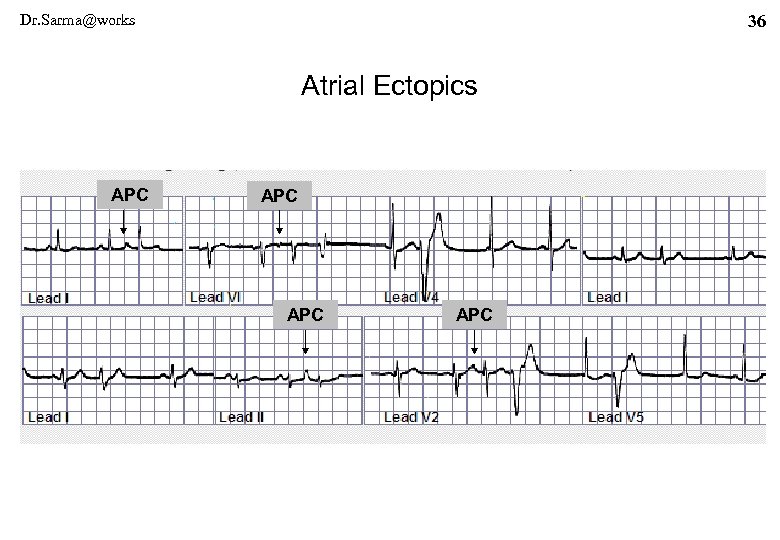 Dr. Sarma@works 36 Atrial Ectopics APC APC
 Dr. Sarma@works 37 Atrial Ectopics § Note the premature (ectopic) beats marked as § APC (Atrial Premature Contractions) § These occurred before the next expected QRS complex (premature) § Each APC has a P wave preceding the QRS of that beat – So impulse has originated in the atria § The QRS duration is normal < 0. 08, not wide
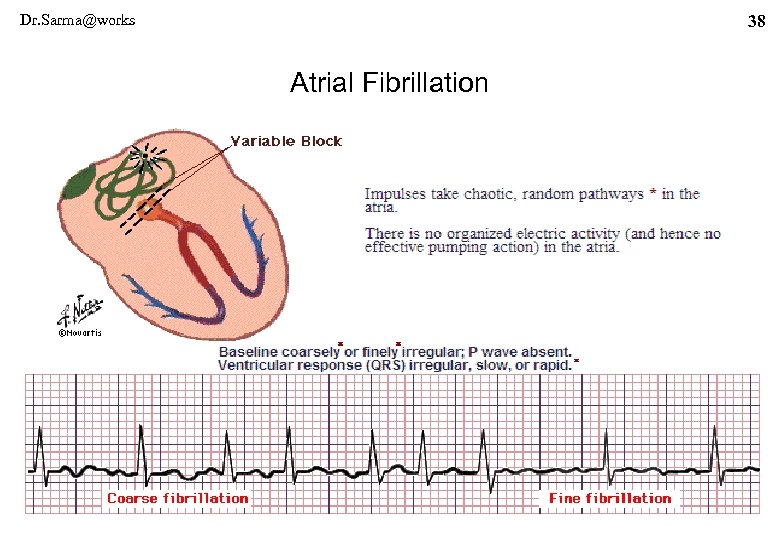 Dr. Sarma@works 38 Atrial Fibrillation
 Dr. Sarma@works 39 Atrial Fibrillation § Note ECG changes of Atrial Fibrillation § The heart rate is irregularly irregular § The R-R intervals are very different from beat to beat § There is narrow QRS tachycardia § There are no P waves – instead small fibrillary waves called ‘ f ’ waves are seen
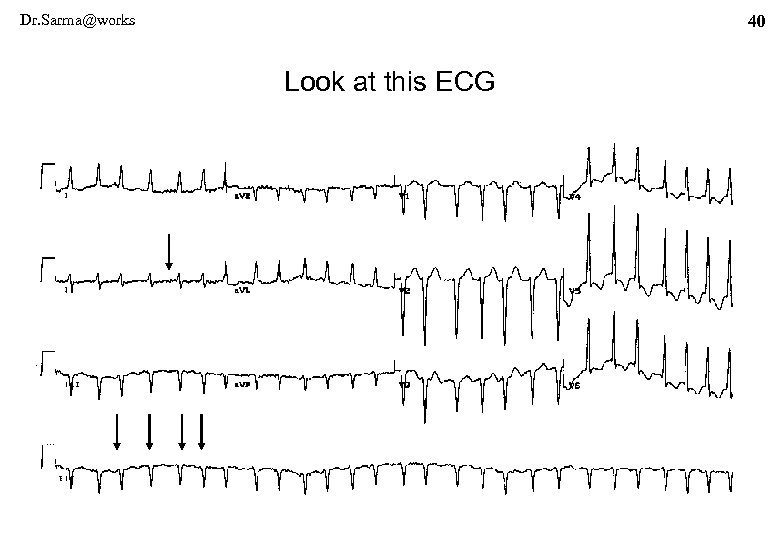 Dr. Sarma@works 40 Look at this ECG
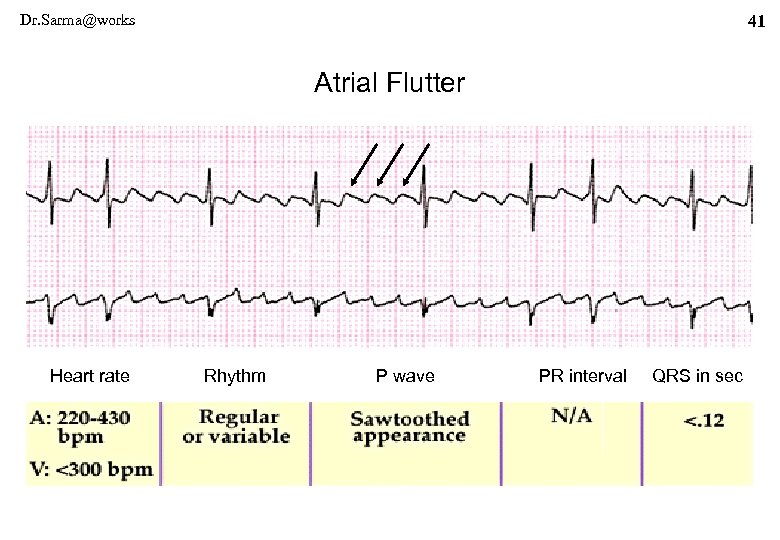 Dr. Sarma@works 41 Atrial Flutter Heart rate Rhythm P wave PR interval QRS in sec
 Dr. Sarma@works 42 Atrial Flutter § § Note ECG changes of Atrial Flutter The heart rate is regular or variable Atrial rate is 300 per minute All P waves are not conducted to ventricles § The R-R intervals very depending on the AV conduction ratio § The QRS is narrow – < 0. 12 sec § The P waves have a ‘saw toothed’ appearance called ‘F’ waves
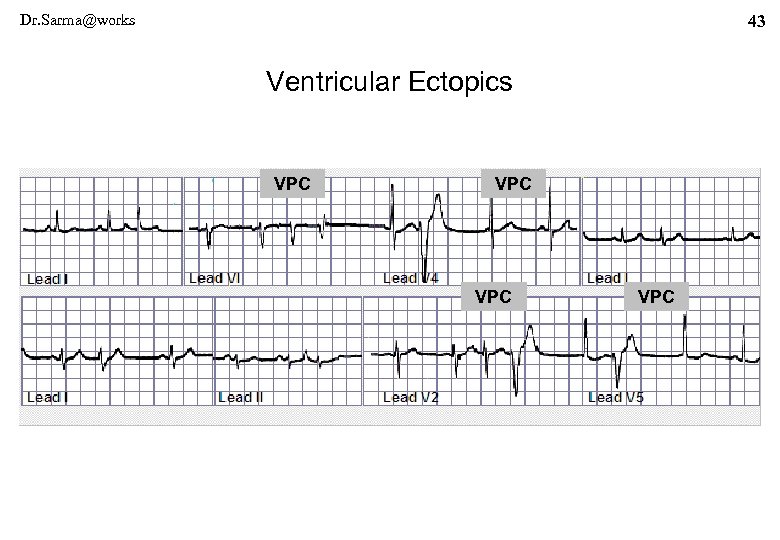 Dr. Sarma@works 43 Ventricular Ectopics VPC VPC
 Dr. Sarma@works 44 Ventricular Ectopics § Note the premature (ectopic) beats marked as VPC (Ventricular Premature Contractions) § These occurred before the next expected QRS complex (premature) § Each VPC has no definite P wave preceding the QRS of that beat – So impulse has originated in the ventricles § The QRS complexes are wide with abnormal duration of > 0. 12 and their shapes are bizarre
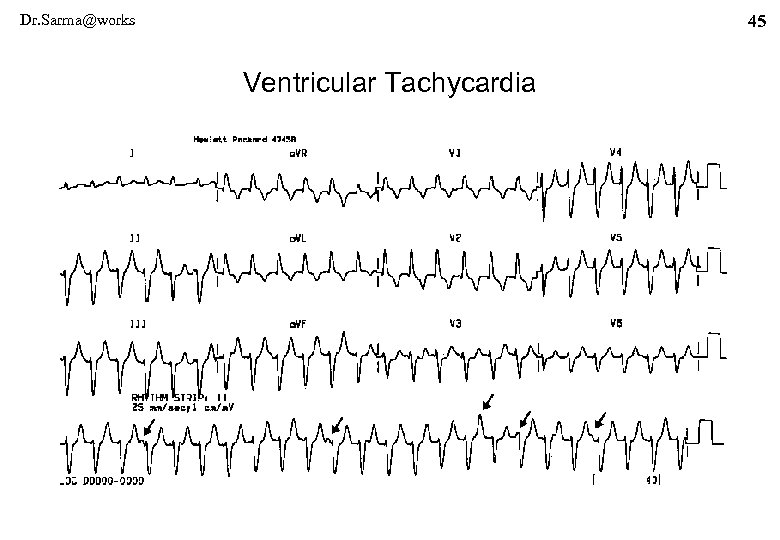 Dr. Sarma@works 45 Ventricular Tachycardia
 Dr. Sarma@works 46 Ventricular Tachycardia § A wide QRS tachycardia is VT until proved § otherwise. Features suggesting VT include § Evidence of AV dissociation § Independent P waves (shown by arrows here) § Beat to beat variability of the QRS morphology § Very wide complexes (> 0. 14 ms) § The QRS is similar to that in ventricular ectopics
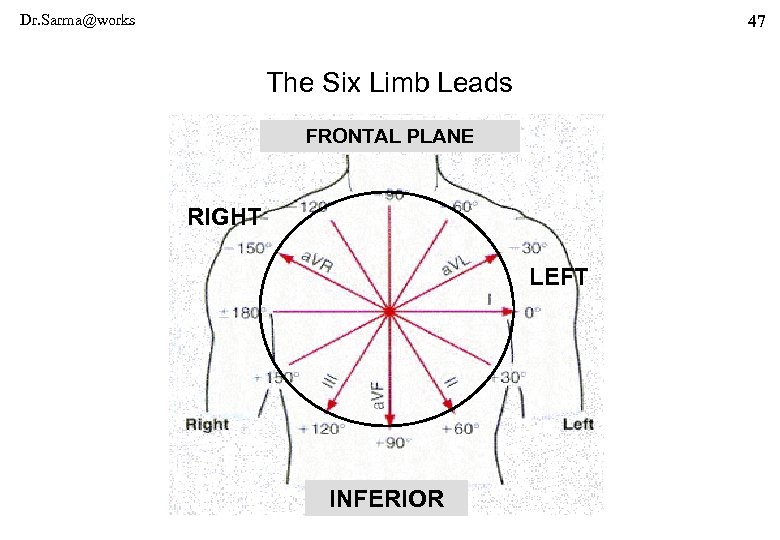 Dr. Sarma@works 47 The Six Limb Leads FRONTAL PLANE RIGHT LEFT INFERIOR
 Dr. Sarma@works 48 The 12 Camera Photography § There SIX cameras photographing frontal plane § Lead 1 and a. VL are horizontal left sided cameras § Lead 2, a. VF, Lead 3 are vertical inferior cameras § a. VR is horizontal Rt. sided camera (cavitary lead) § Lateral Leads – L 1, a. VL, V 5 and V 6 § Inferior Leads – L 2, a. VF, and L 3 leads § Septal Leads – V 1 and V 2
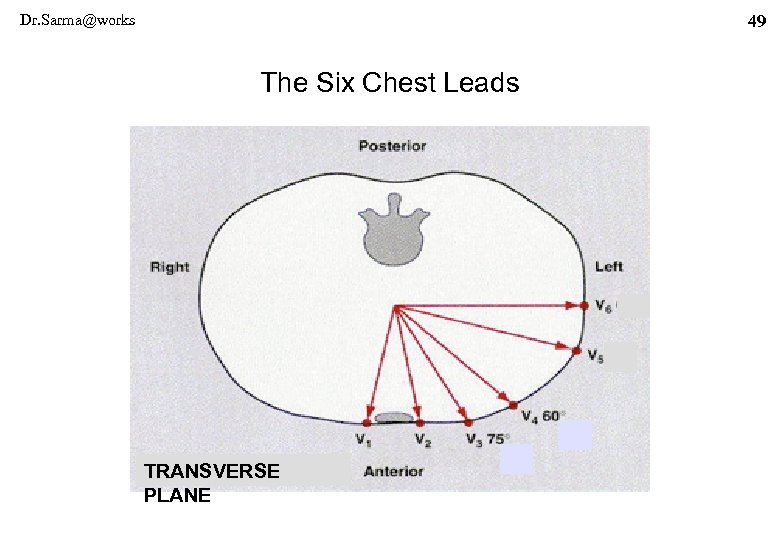 Dr. Sarma@works 49 The Six Chest Leads TRANSVERSE PLANE
 Dr. Sarma@works 50 The 12 Camera Photography § There SIX cameras photographing in transverse or anterio-posterior plane § V 1 and V 2 record events of septum § V 3 and V 4 record events of the anterior wall § V 5 and V 6 record events of left lateral wall § To record right side events V 2 R to V 6 R are needed – In dextrocardia, in RV infarction
 Dr. Sarma@works 51 Cardiac Impulse
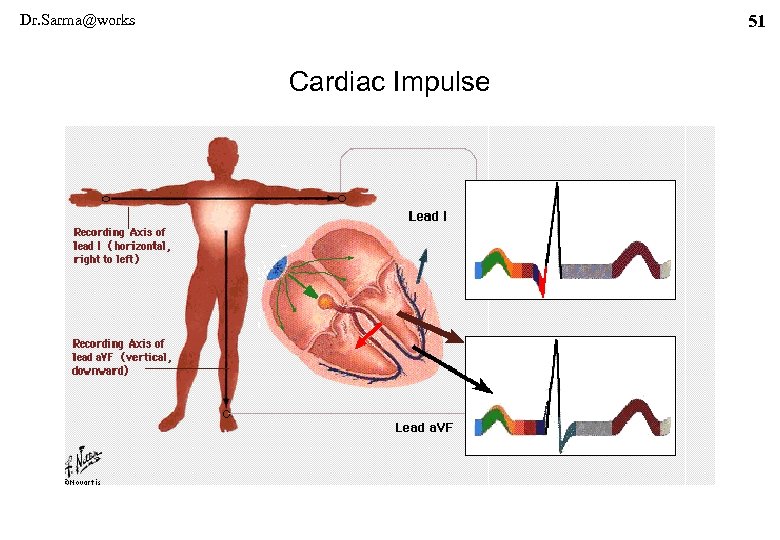
 Dr. Sarma@works 52 Cardiac Impulse § Cardiac impulse originates in the SA node § Traverses the atria simultaneously – no special conduction wires in atria – so the delay § Reaches AV node – the check post – so delay § Enters bundle of His and branches – through specialized conducting wires called Purkinje network - activates both ventricles – quick QRS § First the septum from L to R, then right ventricle and then the left ventricle and
 Dr. Sarma@works NW SW 53 QRS Axis NE SE
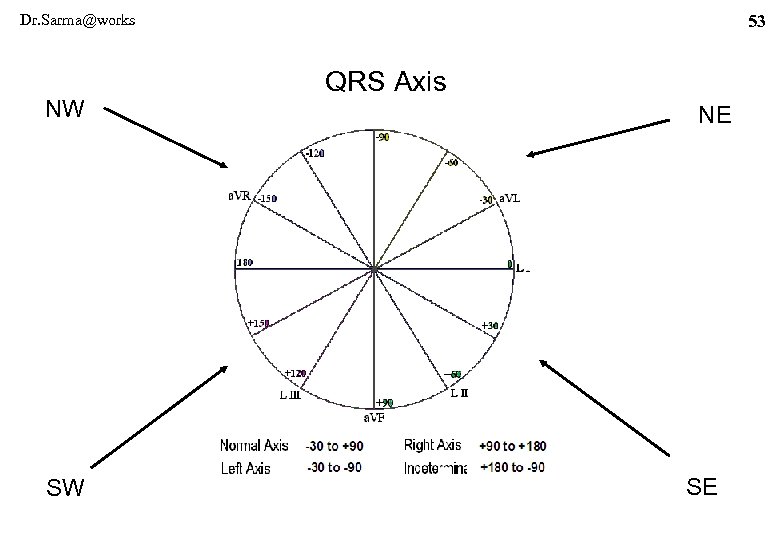
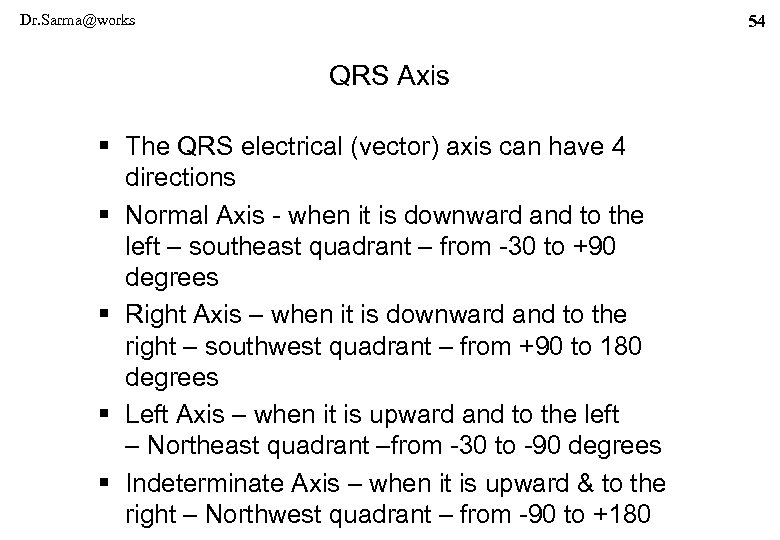 Dr. Sarma@works 54 QRS Axis § The QRS electrical (vector) axis can have 4 directions § Normal Axis - when it is downward and to the left – southeast quadrant – from -30 to +90 degrees § Right Axis – when it is downward and to the right – southwest quadrant – from +90 to 180 degrees § Left Axis – when it is upward and to the left – Northeast quadrant –from -30 to -90 degrees § Indeterminate Axis – when it is upward & to the right – Northwest quadrant – from -90 to +180
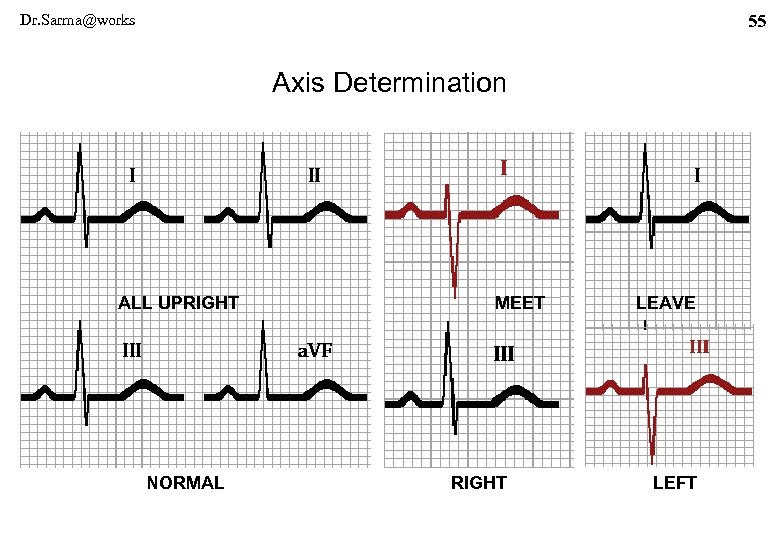 Dr. Sarma@works 55 Axis Determination ALL UPRIGHT NORMAL MEET RIGHT LEAVE LEFT
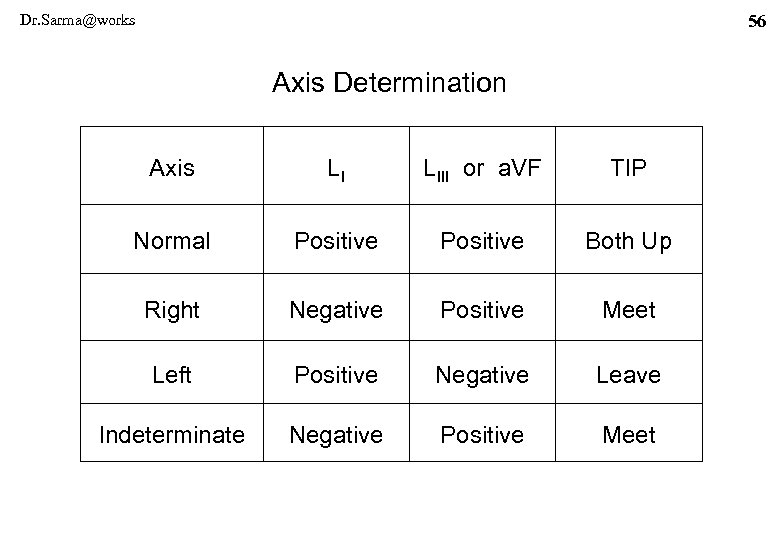 Dr. Sarma@works 56 Axis Determination Axis LI LIII or a. VF TIP Normal Positive Both Up Right Negative Positive Meet Left Positive Negative Leave Indeterminate Negative Positive Meet
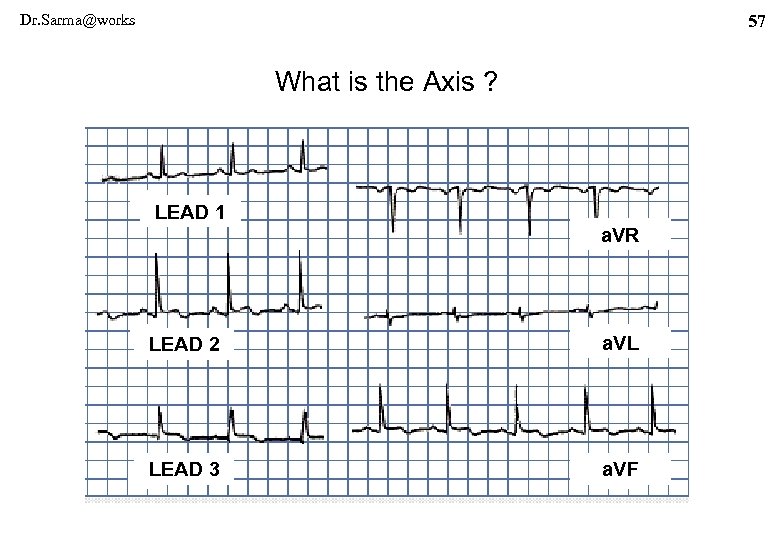 Dr. Sarma@works 57 What is the Axis ? LEAD 1 a. VR LEAD 2 a. VL LEAD 3 a. VF
 Dr. Sarma@works 58 ECG With Normal Axis § Note the QRS voltages are positive and upright in the leads - L 1, L 2, L 3 and a. VF § L 2, L 3 and a. VF tell that it is downward § L 1, a. VL tell that it is to the left § Downward and leftward is Normal Axis § Normal QRS axis
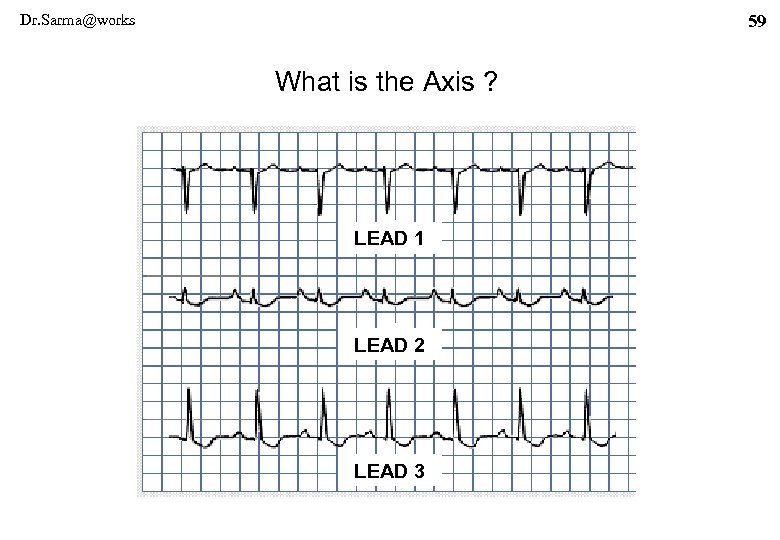 Dr. Sarma@works 59 What is the Axis ? LEAD 1 LEAD 2 LEAD 3
 Dr. Sarma@works 60 ECG With Right Axis § Note the QRS voltages are positive and upright in leads L 2, L 3 § Negative in Lead 1 § L 2, L 3 tell that it is downward § L 1 tells that it is not to the left but to right § Downward and rightward is Right Axis § See the Right –Meet criterion QRS in L 1 and L 3 meet § Right Axis Deviation - RAD
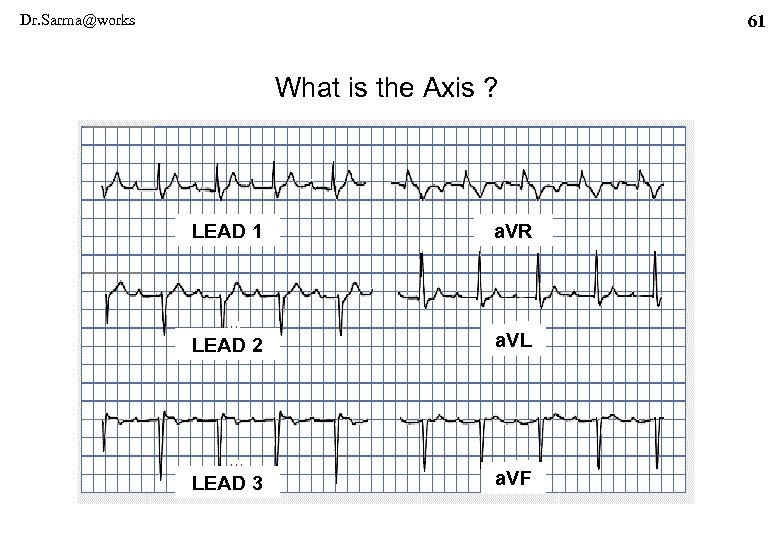 Dr. Sarma@works 61 What is the Axis ? LEAD 1 a. VR LEAD 2 a. VL LEAD 3 a. VF
 Dr. Sarma@works 62 ECG With Left Axis § Note the QRS voltages are positive and upright in leads L 1 and a. VL § Negative in L 2, L 3 and a. VF § L 1, a. VL tell that it is leftward § L 2, L 3, and a. VF tell that it is not down ward - instead it is upward § Upward and Leftward is Left Axis § See the Left - Leave criterion QRS in L 1 and L 3 leave each other § Left Axis Deviation - LAD
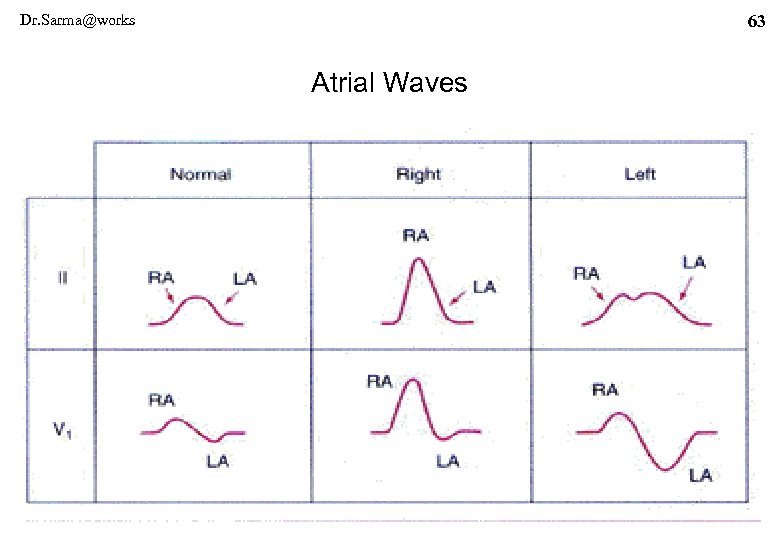 Dr. Sarma@works 63 Atrial Waves
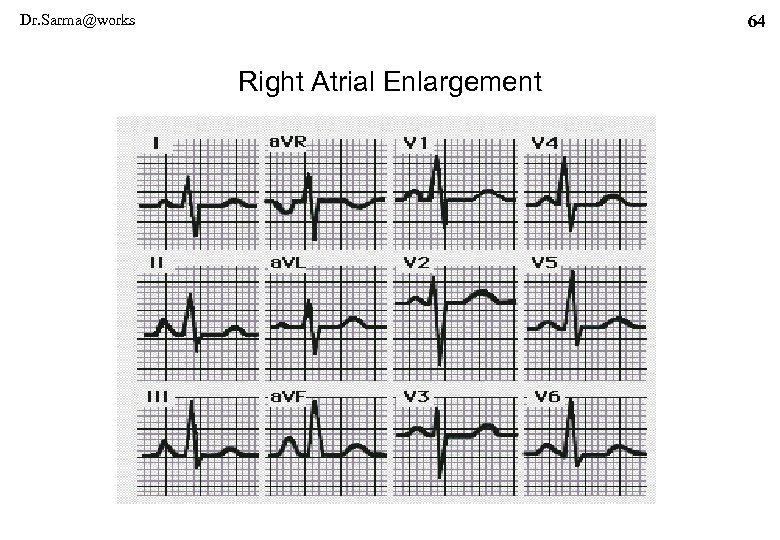 Dr. Sarma@works 64 Right Atrial Enlargement
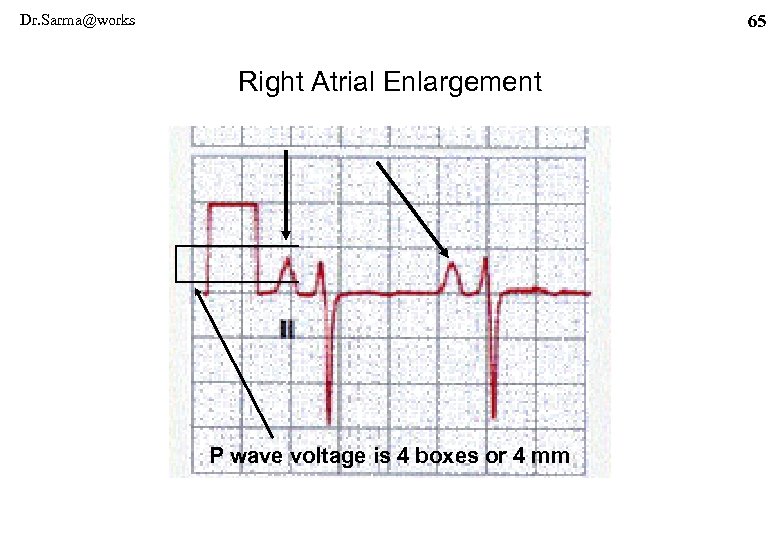 Dr. Sarma@works 65 Right Atrial Enlargement P wave voltage is 4 boxes or 4 mm
 Dr. Sarma@works 66 Right Atrial Enlargement § Always examine Lead 2 for RAE § Tall Peaked P Waves, Arrow head P waves § Amplitude is 4 mm ( 0. 4 m. V) abnormal § Pulmonary Hypertension, Mitral Stenosis § Tricuspid Stenosis, Regurgitation § Pulmonary Valvular Stenosis § Pulmonary Embolism § Atrial Septal Defect with L to R shunt
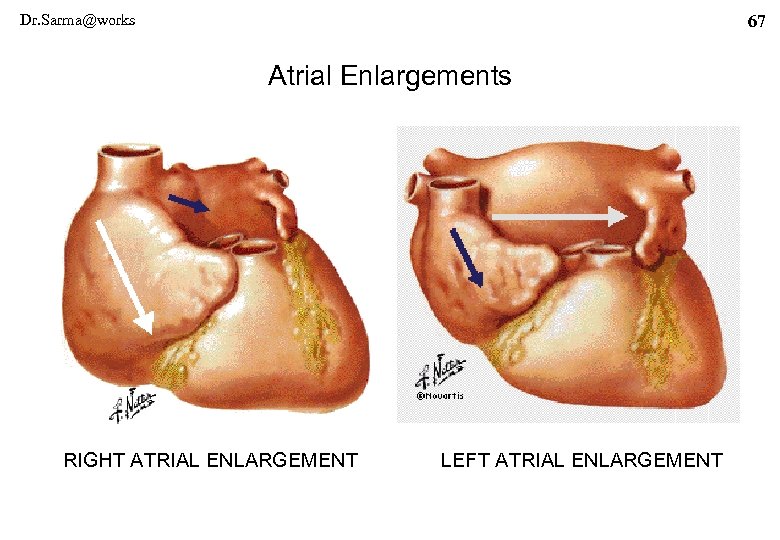 Dr. Sarma@works 67 Atrial Enlargements RIGHT ATRIAL ENLARGEMENT LEFT ATRIAL ENLARGEMENT
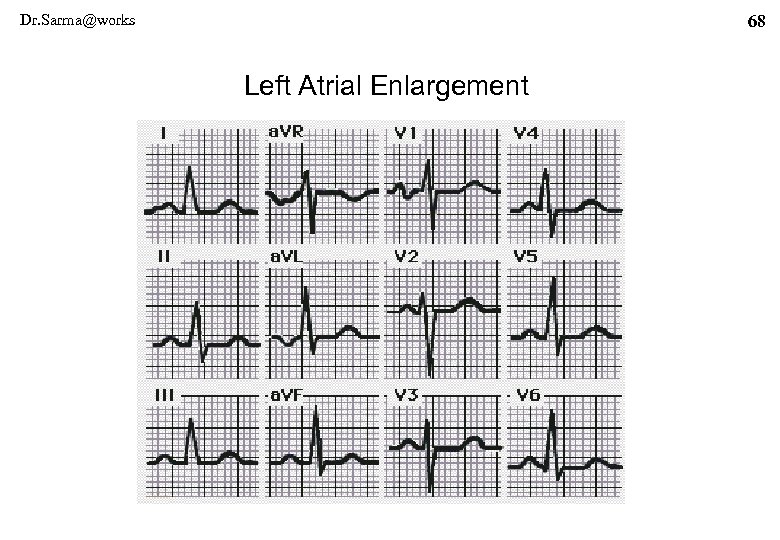 Dr. Sarma@works 68 Left Atrial Enlargement
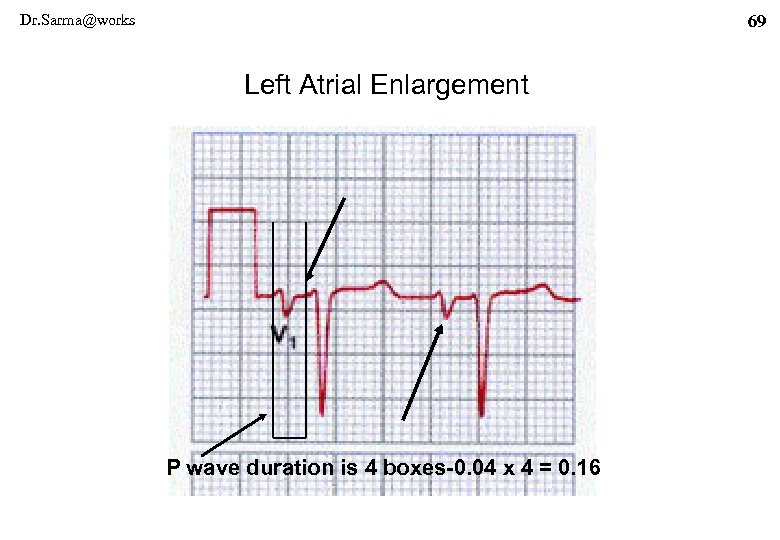 Dr. Sarma@works 69 Left Atrial Enlargement P wave duration is 4 boxes-0. 04 x 4 = 0. 16
 Dr. Sarma@works 70 Left Atrial Enlargement § Always examine V 1 and Lead 1 for LAE § Biphasic P Waves, Prolonged P waves § P wave 0. 16 sec, ↑ Downward component § Systemic Hypertension, MS and or MR § Aortic Stenosis and Regurgitation § Left ventricular hypertrophy with dysfunction § Atrial Septal Defect with R to L shunt
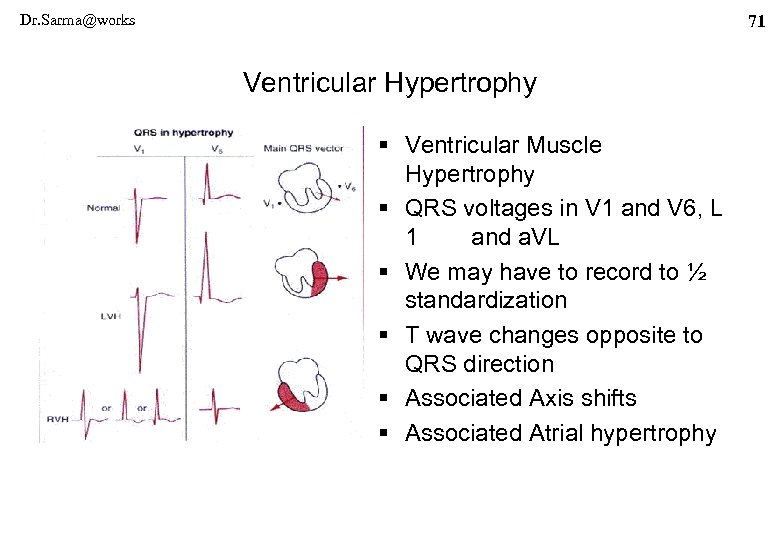 Dr. Sarma@works 71 Ventricular Hypertrophy § Ventricular Muscle Hypertrophy § QRS voltages in V 1 and V 6, L 1 and a. VL § We may have to record to ½ standardization § T wave changes opposite to QRS direction § Associated Axis shifts § Associated Atrial hypertrophy
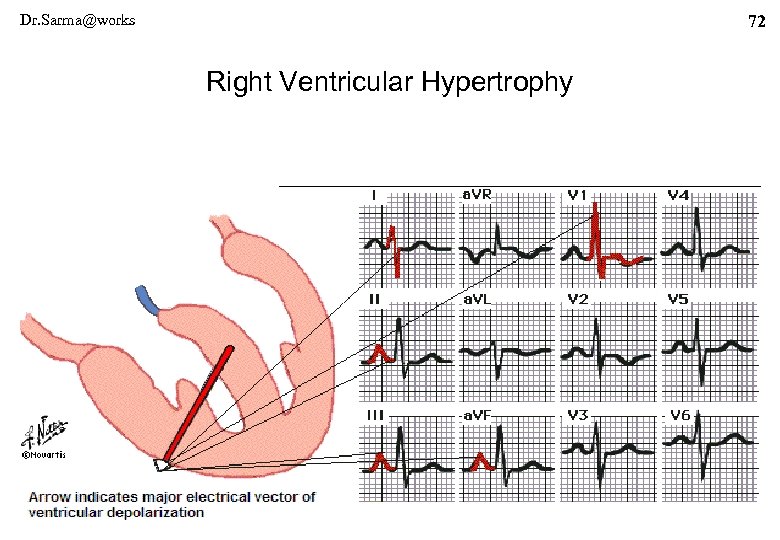 Dr. Sarma@works 72 Right Ventricular Hypertrophy
 Dr. Sarma@works 73 Right Ventricular Hypertrophy § Tall R in V 1 with R >> S, or R/S ratio >1 § Deep S waves in V 4, V 5 and V 6 § The DD is RVH, Posterior MI, Anticlock wise rotation of Heart § Associated Right Axis Deviation, RAE § Deep T inversions in V 1, V 2 and V 3 § Absence of Inferior MI
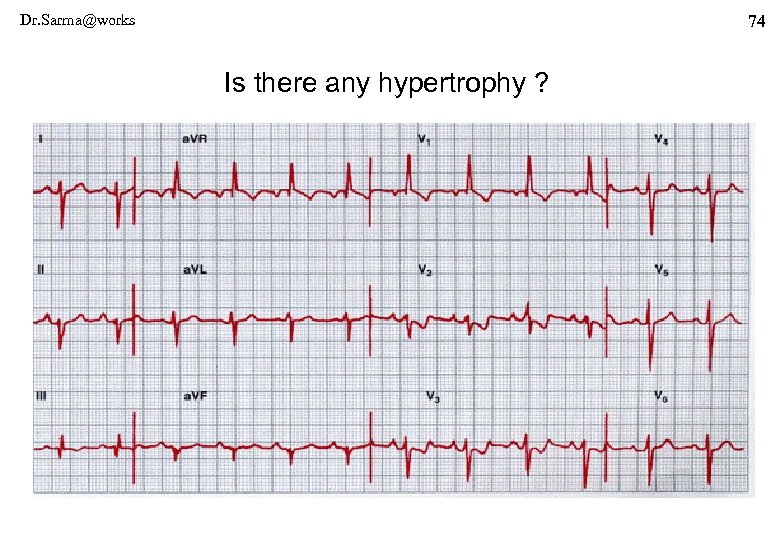 Dr. Sarma@works 74 Is there any hypertrophy ?
 Dr. Sarma@works 75 Criteria and Causes of LVH Criteria of RVH § Tall R in V 1 with R >> S, or R/S ratio >1 § Deep S waves in V 4, V 5 and V 6 § The DD is RVH, Posterior MI, Rotation § Associated Right Axis Deviation, RAE § Deep T inversion in V 1, V 2 and V 3 Cause of RVH § Long standing Mitral Stenosis § Pulmonary Hypertension of any cause § VSD or ASD with initial L to R shunt
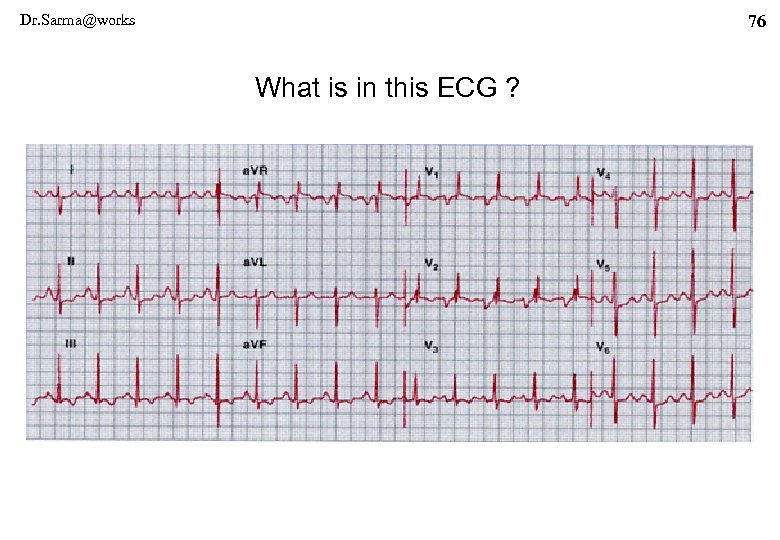 Dr. Sarma@works 76 What is in this ECG ?
 Dr. Sarma@works 77 ECG OF MS with RVH, RAE § § § Classical changes seen are Right ventricular hypertrophy Right axis deviation Right Bundle Branch Block P – Pulmonale - Right Atrial enlargement § P – Mitrale – Left Atrial enlargement § If Atrial Fibrillation develops – ‘P’ disappears
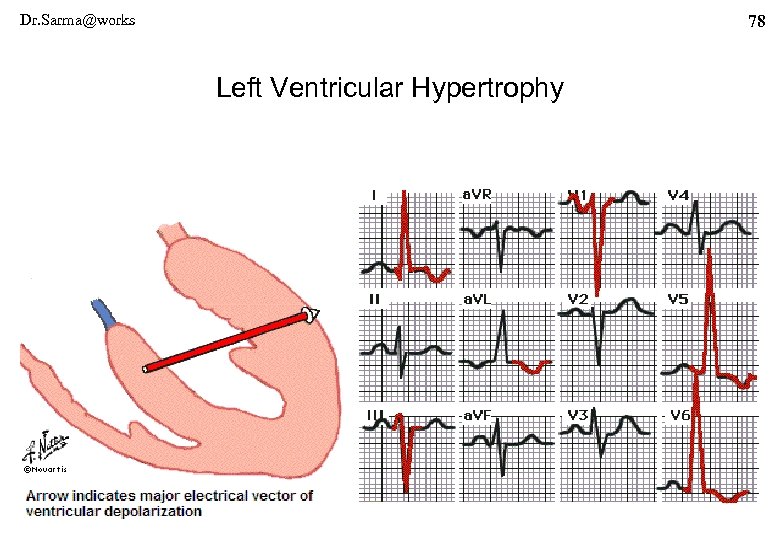 Dr. Sarma@works 78 Left Ventricular Hypertrophy
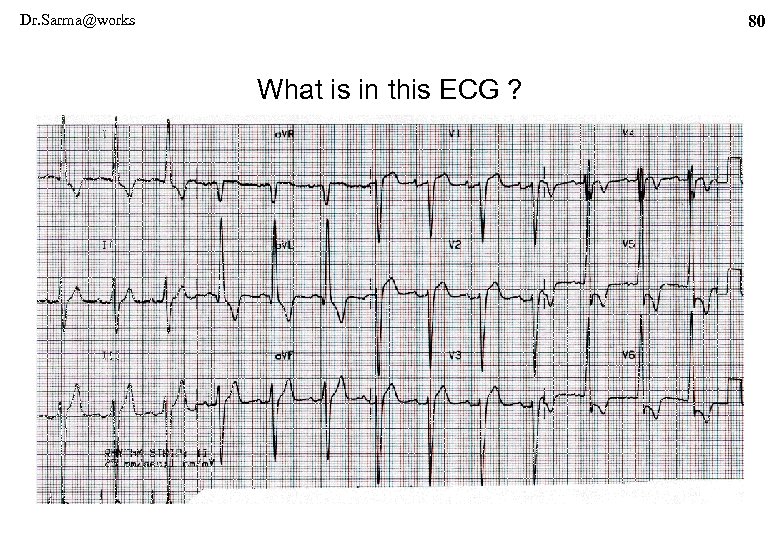
 Dr. Sarma@works 79 Left Ventricular Hypertrophy § § § § High QRS voltages in limb leads R in Lead I + S in Lead III > 25 mm S in V 1 + R in V 5 > 35 mm R in a. VL > 11 mm or S V 3 + R a. VL > 24 ♂, > 20 ♀ Deep symmetric T inversion in V 4, V 5 & V 6 QRS duration > 0. 09 sec Associated Left Axis Deviation, LAE Cornell Voltage criteria, Estes point scoring
 Dr. Sarma@works 80 What is in this ECG ?
 Dr. Sarma@works 81 Causes and Criteria of LVH Causes of LVH § Pressure overload - Systemic Hypertension, Aortic Stenosis § Volume overload - AR or MR - dilated cardiomyopathy § VSD - cause both right & left ventricular volume overload § Hypertrophic cardiomyopathy – No pressure or volume overload Criteria of LVH § High QRS voltages in limb leads § R in Lead I + S in Lead III > 25 mm or S in V 1 + R in V 5 > 35 mm § R in a. VL > 11 mm or S V 3 + R a. VL > 24 ♂, > 20 ♀
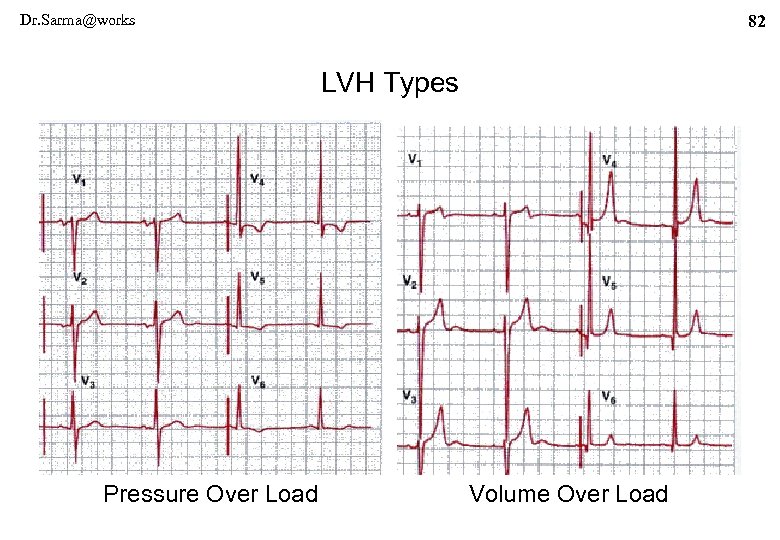 Dr. Sarma@works 82 LVH Types Pressure Over Load Volume Over Load
 Dr. Sarma@works 83 LVH Types Pressure Over load § Like in hypertension, IHD § LV strain pattern – ST depression with T ↓ in V 5, V 6, L 1 and a. VL leads Volume Over load § Like in Mitral or Aortic regurgitation § Shows prominent positive T waves in V 5, V 6, L 1 and a. VL
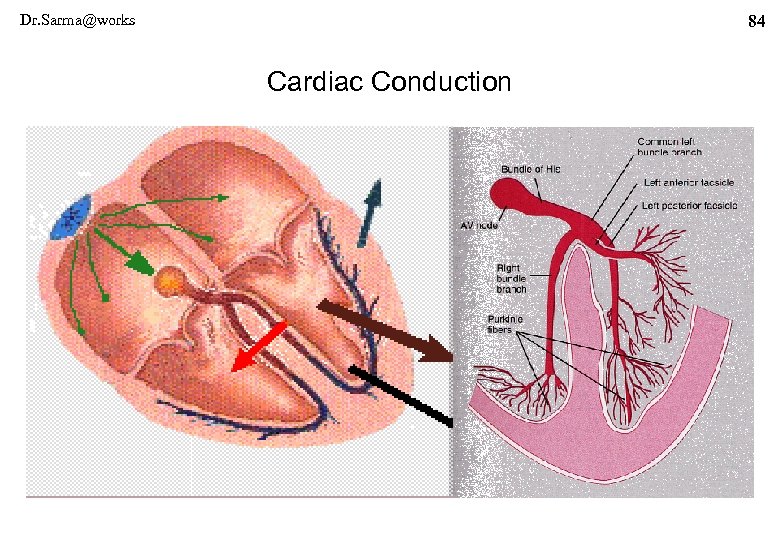 Dr. Sarma@works 84 Cardiac Conduction
 Dr. Sarma@works 85 Causes of Conduction Block § Clinically normal individual § CAD, Acute MI, Remote MI, Pulmonay embolism § Aortic stenosis, SABE + abscesses in conduction § Cardiac trauma, Hyperkalemia, Rapid heart rates § Lenegre's disease (idiopathic fibrosis of conduction) § Lev's disease (calcification of the cardiac skeleton) § Cardiomyopathy - Dilated and
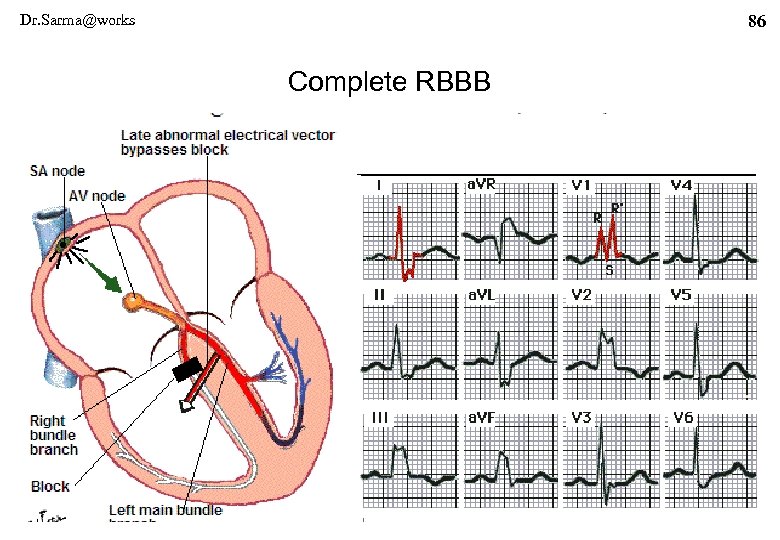 Dr. Sarma@works 86 Complete RBBB
 Dr. Sarma@works 87 Complete RBBB § Complete RBBB has a QRS duration > 0. 12 sec § R' wave in lead V 1 (usually see r. SR' complex) § S waves in leads I, a. VL, V 6, R wave in lead a. VR § QRS axis in RBBB is -30 to +90 (Normal) § Incomplete RBBB has a QRS duration of 0. 10 to 0. 12 sec with the same QRS features as above § The "normal" ST-T waves in RBBB
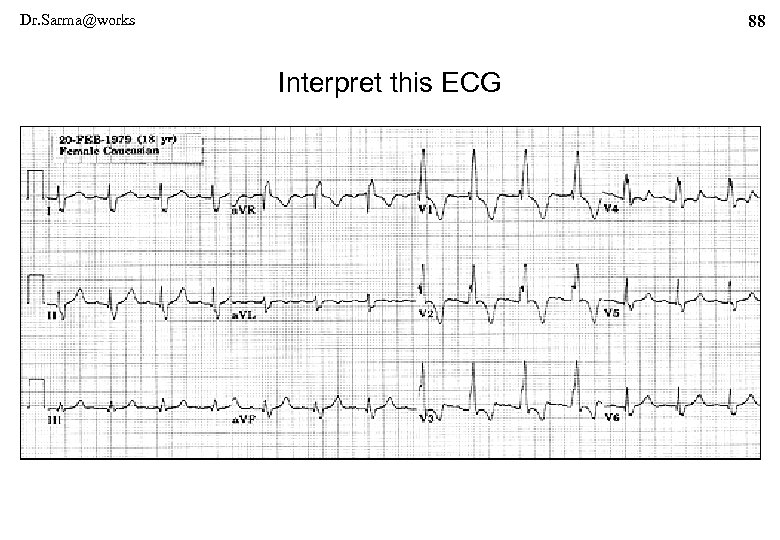 Dr. Sarma@works 88 Interpret this ECG
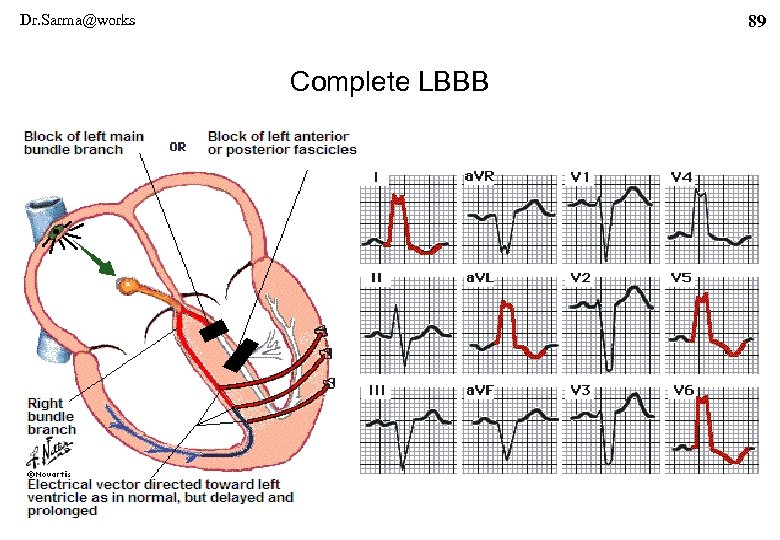 Dr. Sarma@works 89 Complete LBBB
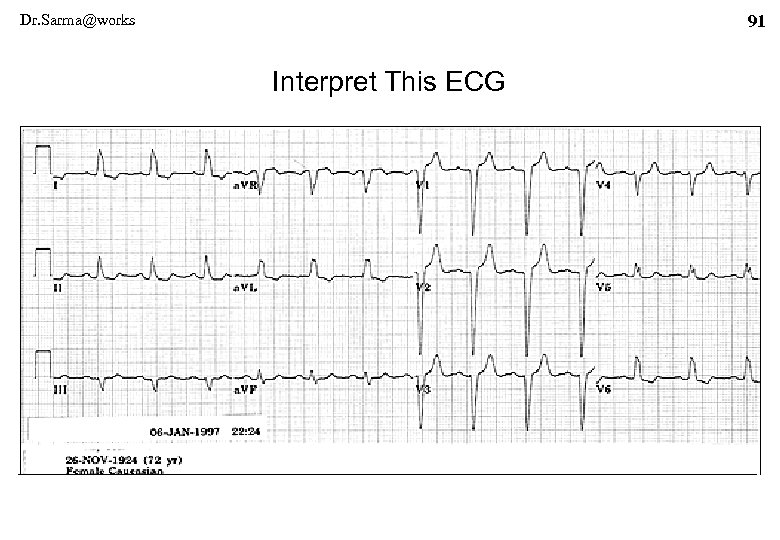
 Dr. Sarma@works 90 Complete LBBB § Complete LBBB has a QRS duration > 0. 12 sec § Prominent S waves in lead V 1, R in L I, a. VL, V 6 § Usually broad, Bizarre R waves are seen, M pattern § Poor R progression from V 1 to V 3 is common. § The "normal" ST-T waves in LBBB should be oriented opposite to the direction of the QRS
 Dr. Sarma@works 91 Interpret This ECG
 Dr. Sarma@works 92 Rate Dependent LBBB
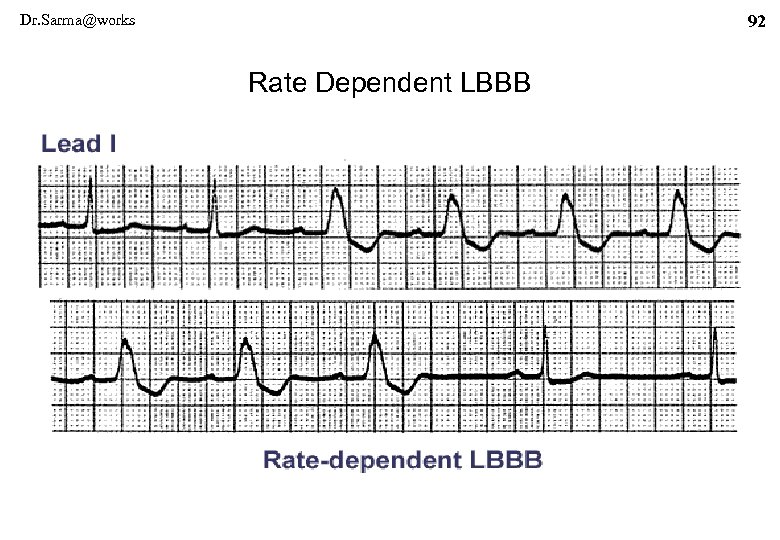
 Dr. Sarma@works 93 Rate Dependent LBBB § Complete LBBB is sometimes rate dependent § See the LBBB pattern when the HR is 75 per minute § But, LBBB pattern disappeared when the HR is < 50 § Some times the LBBB appears and disappears with out any change in heart rate. This is called stuttering LBBB. It signifies underlying Ischemia. § Appearance of new LBBB in a patient with chest pain is enough evidence of MI. It
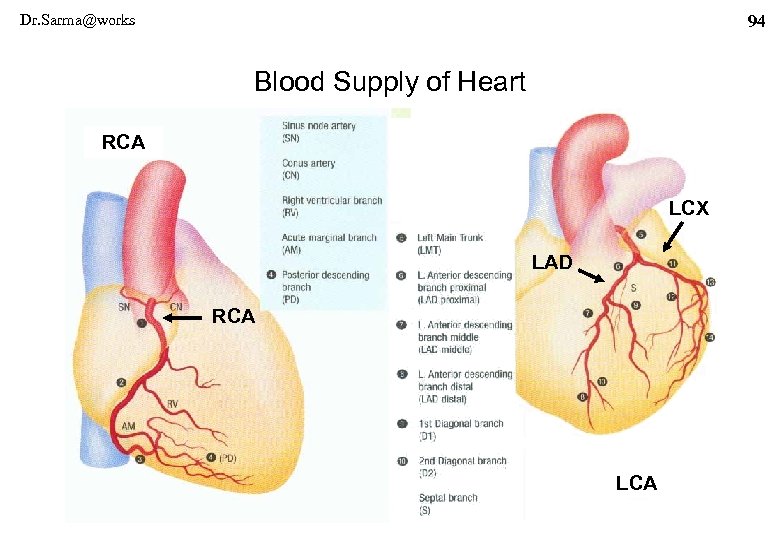 Dr. Sarma@works 94 Blood Supply of Heart RCA LCX LAD RCA LCA
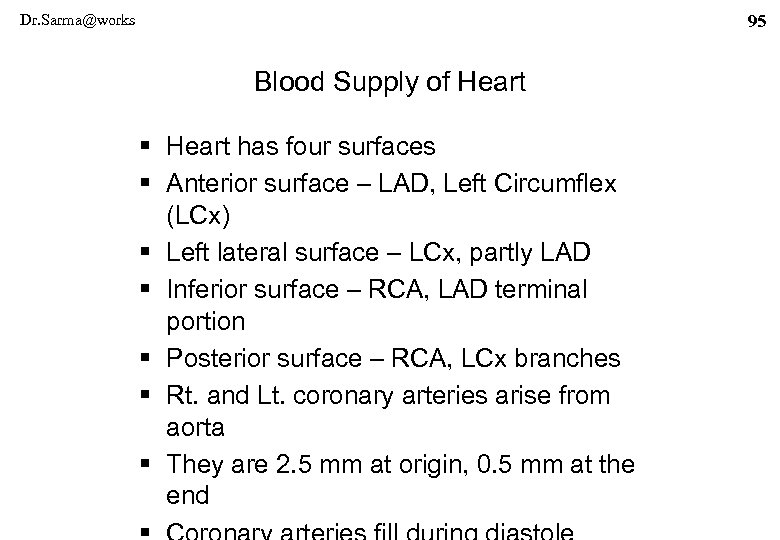 Dr. Sarma@works 95 Blood Supply of Heart § Heart has four surfaces § Anterior surface – LAD, Left Circumflex (LCx) § Left lateral surface – LCx, partly LAD § Inferior surface – RCA, LAD terminal portion § Posterior surface – RCA, LCx branches § Rt. and Lt. coronary arteries arise from aorta § They are 2. 5 mm at origin, 0. 5 mm at the end
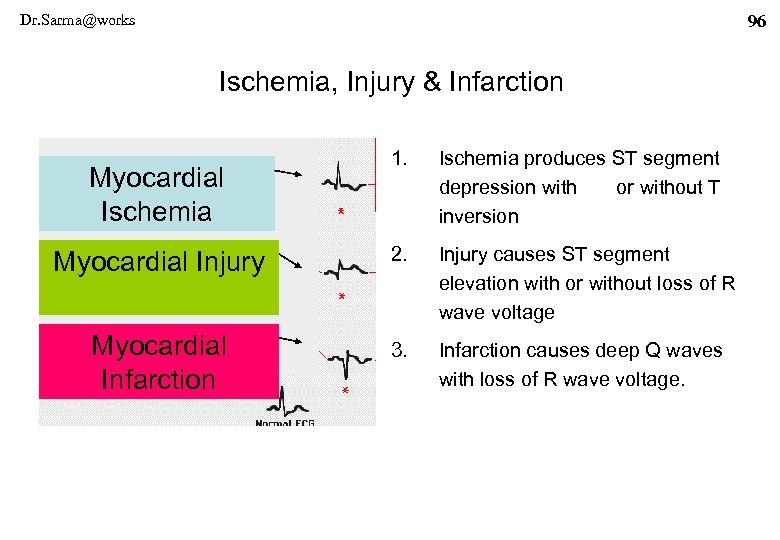 Dr. Sarma@works 96 Ischemia, Injury & Infarction 1. Ischemia produces ST segment depression with or without T inversion Myocardial Injury 2. Injury causes ST segment elevation with or without loss of R wave voltage Myocardial Infarction 3. Infarction causes deep Q waves with loss of R wave voltage. Myocardial Ischemia
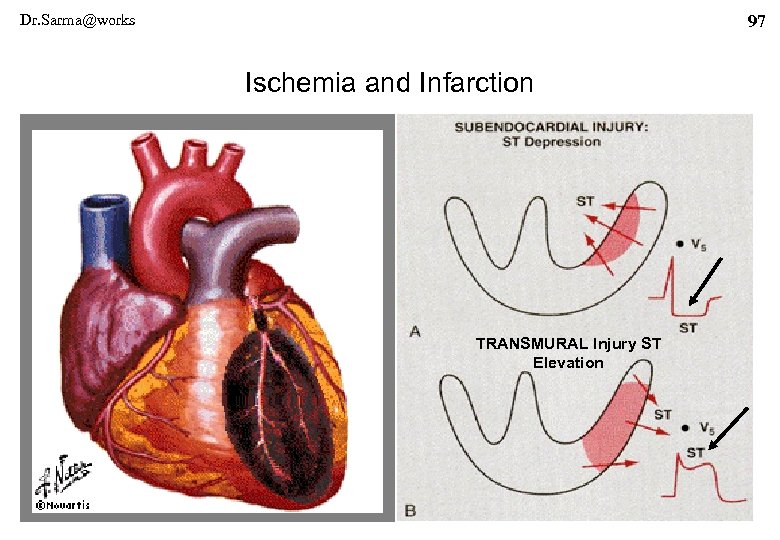 Dr. Sarma@works 97 Ischemia and Infarction TRANSMURAL Injury ST Elevation
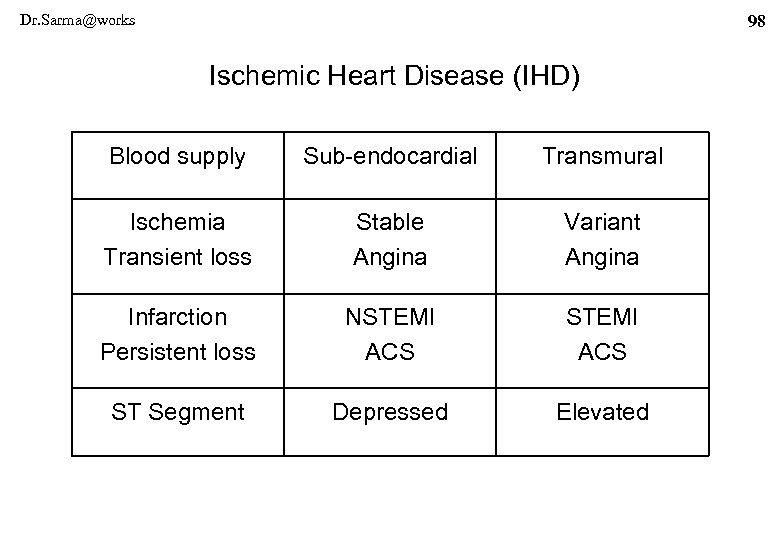 Dr. Sarma@works 98 Ischemic Heart Disease (IHD) Blood supply Sub-endocardial Transmural Ischemia Transient loss Stable Angina Variant Angina Infarction Persistent loss NSTEMI ACS ST Segment Depressed Elevated
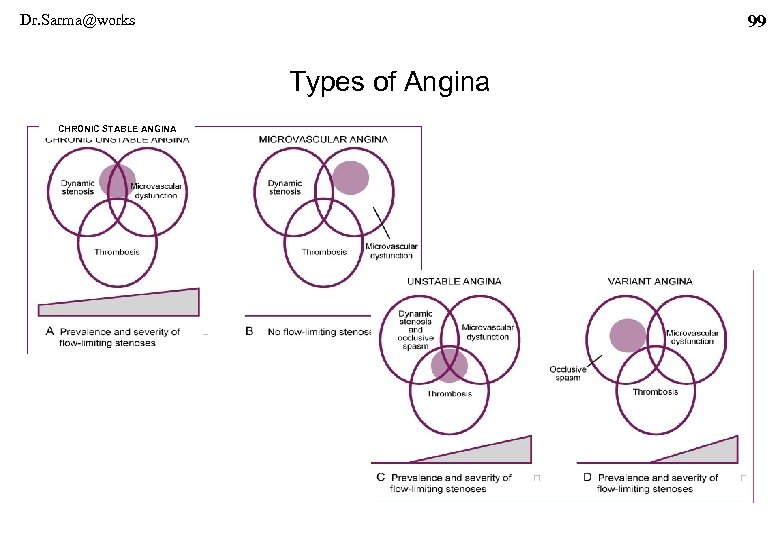 Dr. Sarma@works 99 Types of Angina CHRONIC STABLE ANGINA
 Dr. Sarma@works 100 Types of Angina § Chronic Stable Angina – Dynamic occlusion + Micro vascular dysfunction – Progressive § Micro vascular Angina – No flow limiting stenosis – Angio normal – less severe IHD § Unstable Angina – Dynamic occlusion + Micro vascular dysfunction + Active Thromb § Prinzemetal Angina – Occlusive spasm, No Micro vascular dys, No
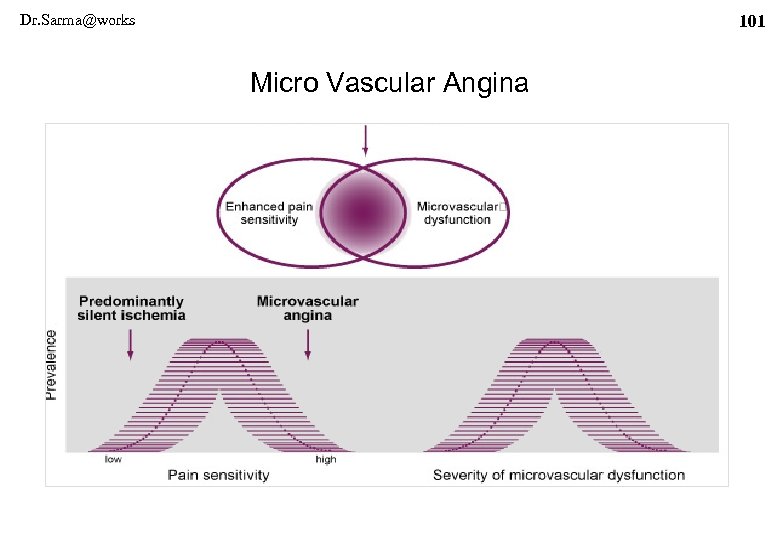 Dr. Sarma@works 101 Micro Vascular Angina
 Dr. Sarma@works 102 Micro Vascular Angina § Normal Coronary blood flow by angiogram § No significant CAD in epicardial blood vessels § Cardiac micro circulation is at fault § Poor collateral connections – younger age § More common in women – Syndrome X § ECG or TMT show ST - T changes repeatedly
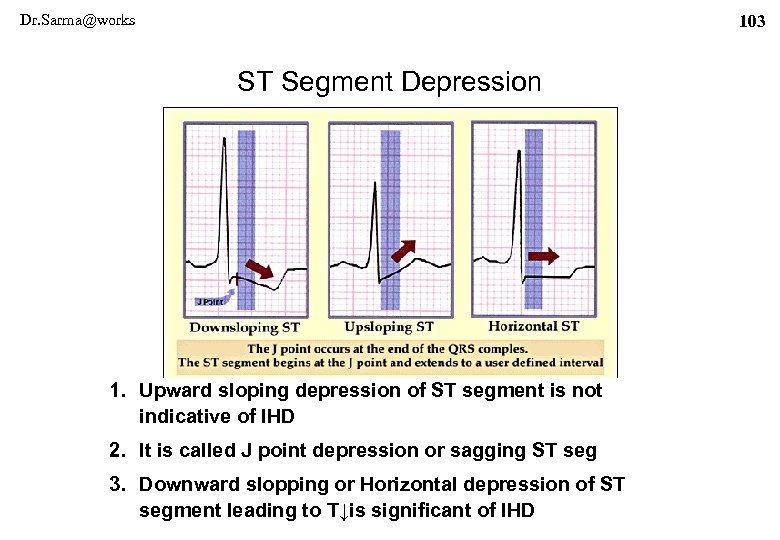 Dr. Sarma@works 103 ST Segment Depression 1. Upward sloping depression of ST segment is not indicative of IHD 2. It is called J point depression or sagging ST seg 3. Downward slopping or Horizontal depression of ST segment leading to T↓is significant of IHD
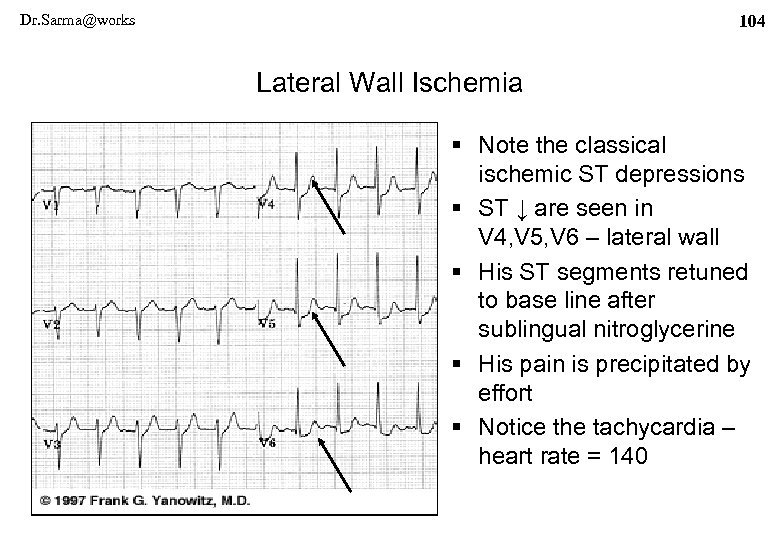 Dr. Sarma@works 104 Lateral Wall Ischemia § Note the classical ischemic ST depressions § ST ↓ are seen in V 4, V 5, V 6 – lateral wall § His ST segments retuned to base line after sublingual nitroglycerine § His pain is precipitated by effort § Notice the tachycardia – heart rate = 140
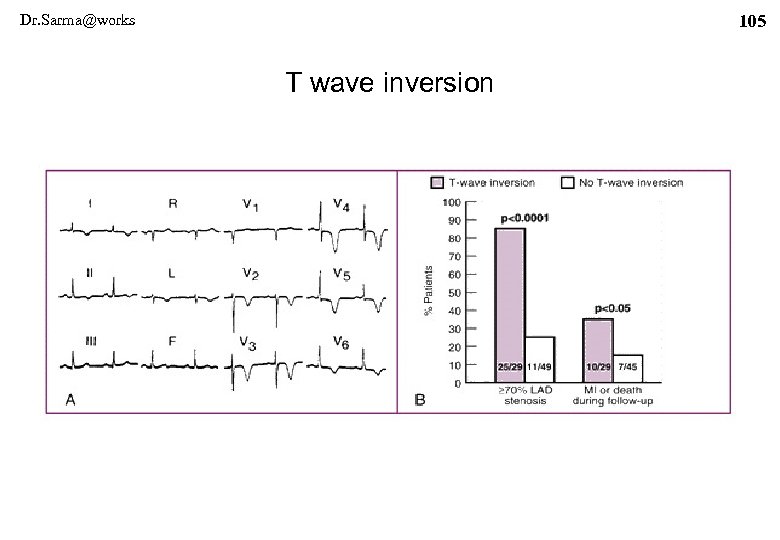 Dr. Sarma@works 105 T wave inversion
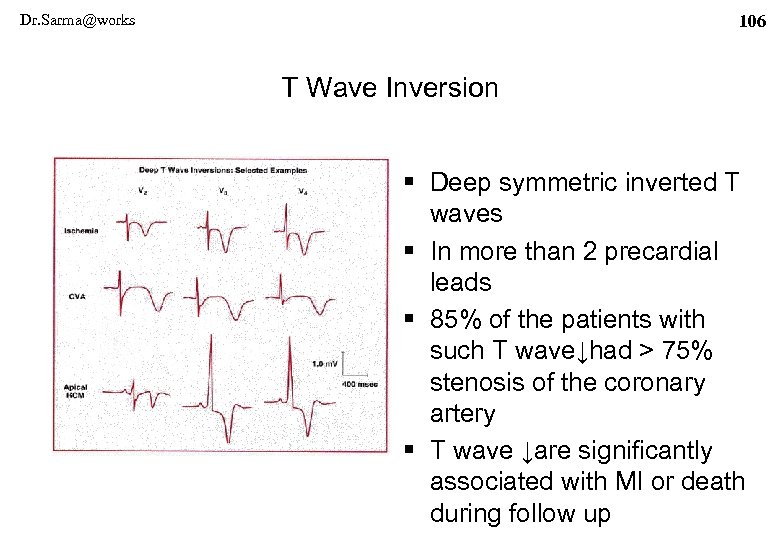 Dr. Sarma@works 106 T Wave Inversion § Deep symmetric inverted T waves § In more than 2 precardial leads § 85% of the patients with such T wave↓had > 75% stenosis of the coronary artery § T wave ↓are significantly associated with MI or death during follow up
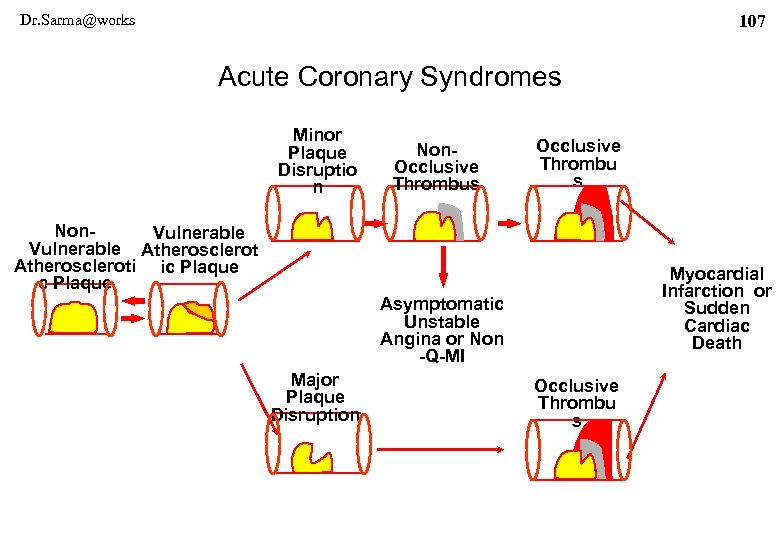 Dr. Sarma@works 107 Acute Coronary Syndromes Minor Plaque Disruptio n Non. Occlusive Thrombus Occlusive Thrombu s Non. Vulnerable Atheroscleroti ic Plaque Myocardial Infarction or Sudden Cardiac Death Asymptomatic Unstable Angina or Non -Q-MI Major Plaque Disruption Occlusive Thrombu s
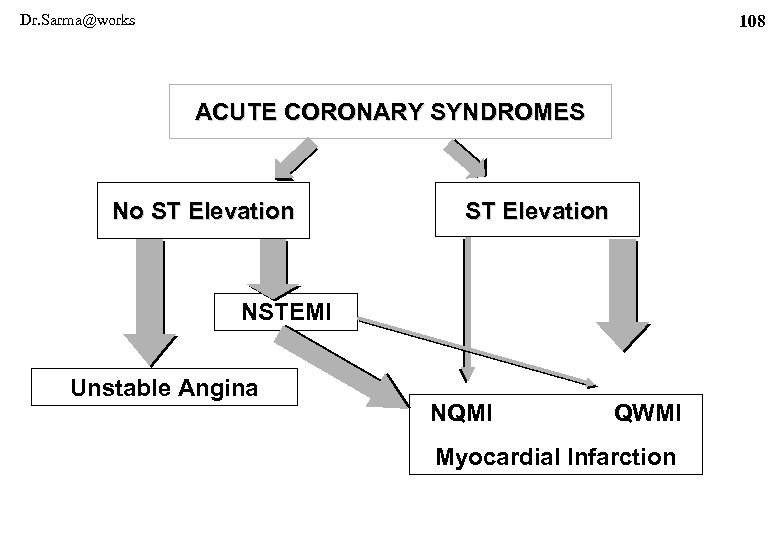 Dr. Sarma@works 108 ACUTE CORONARY SYNDROMES No ST Elevation NSTEMI Unstable Angina NQMI QWMI Myocardial Infarction
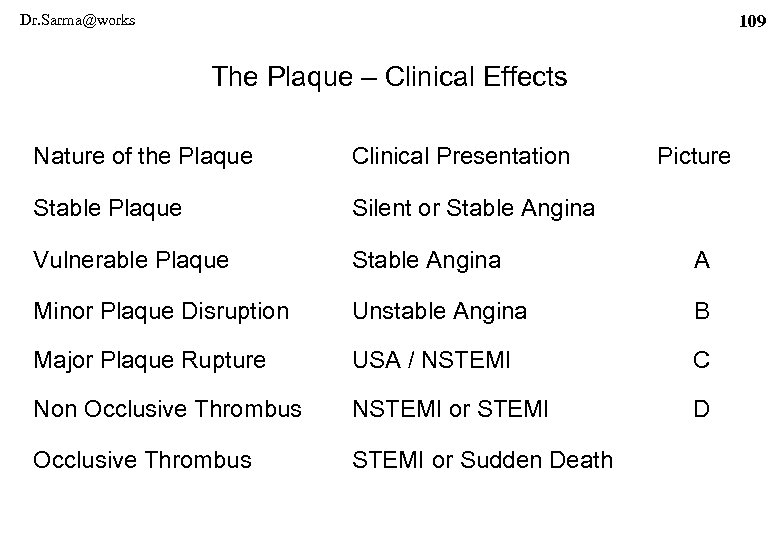 Dr. Sarma@works 109 The Plaque – Clinical Effects Nature of the Plaque Clinical Presentation Picture Stable Plaque Silent or Stable Angina Vulnerable Plaque Stable Angina A Minor Plaque Disruption Unstable Angina B Major Plaque Rupture USA / NSTEMI C Non Occlusive Thrombus NSTEMI or STEMI D Occlusive Thrombus STEMI or Sudden Death
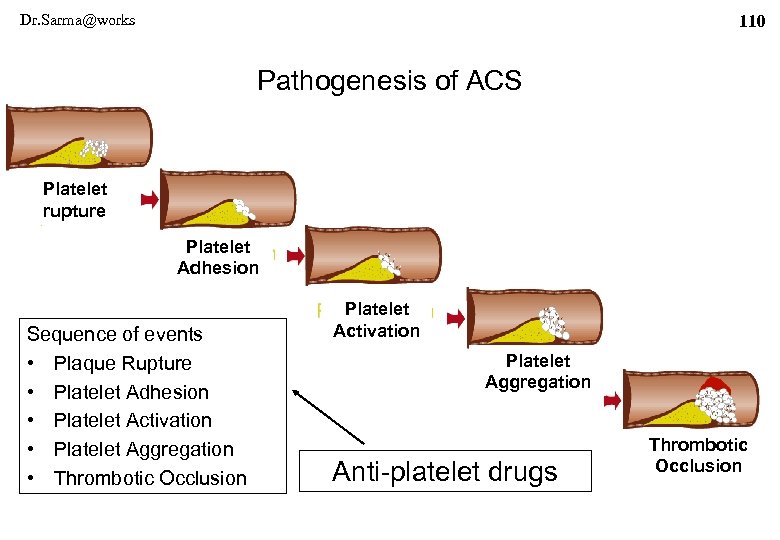 Dr. Sarma@works 110 Pathogenesis of ACS Platelet rupture Platelet Adhesion Sequence of events • Plaque Rupture • Platelet Adhesion • Platelet Activation • Platelet Aggregation • Thrombotic Occlusion Platelet Activation Platelet Aggregation Anti-platelet drugs Thrombotic Occlusion
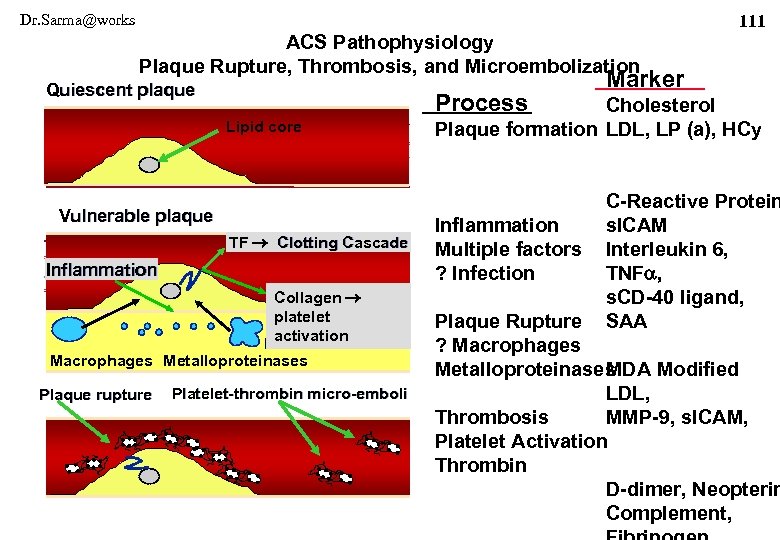 Dr. Sarma@works 111 ACS Pathophysiology Plaque Rupture, Thrombosis, and Microembolization Quiescent plaque Process Lipid core Vulnerable plaque TF Clotting Cascade Inflammation Collagen platelet activation Foam Cells Macrophages Metalloproteinases Plaque rupture Platelet-thrombin micro-emboli Marker Cholesterol Plaque formation LDL, LP (a), HCy Inflammation Multiple factors ? Infection C-Reactive Protein s. ICAM Interleukin 6, TNFa, s. CD-40 ligand, SAA Plaque Rupture ? Macrophages Metalloproteinases MDA Modified LDL, Thrombosis MMP-9, s. ICAM, Platelet Activation Thrombin D-dimer, Neopterin Complement,
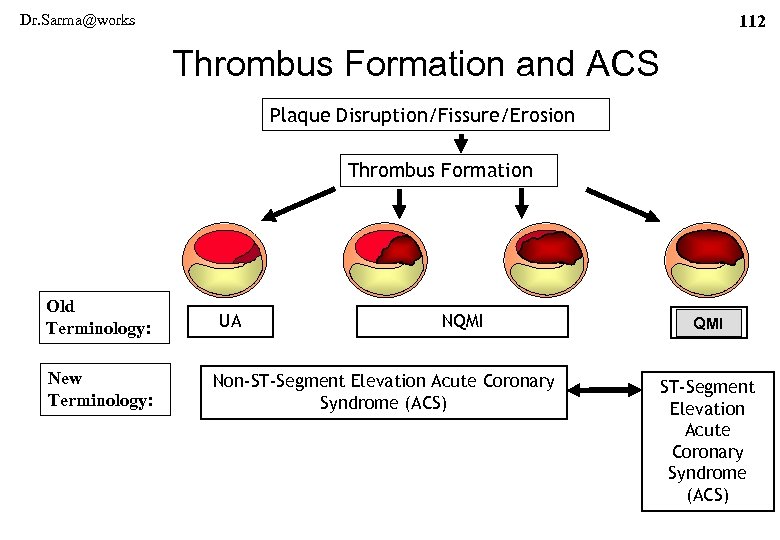 Dr. Sarma@works 112 Thrombus Formation and ACS Plaque Disruption/Fissure/Erosion Thrombus Formation Old Terminology: New Terminology: UA NQMI Non-ST-Segment Elevation Acute Coronary Syndrome (ACS) STE-MI QMI ST-Segment Elevation Acute Coronary Syndrome (ACS) 112
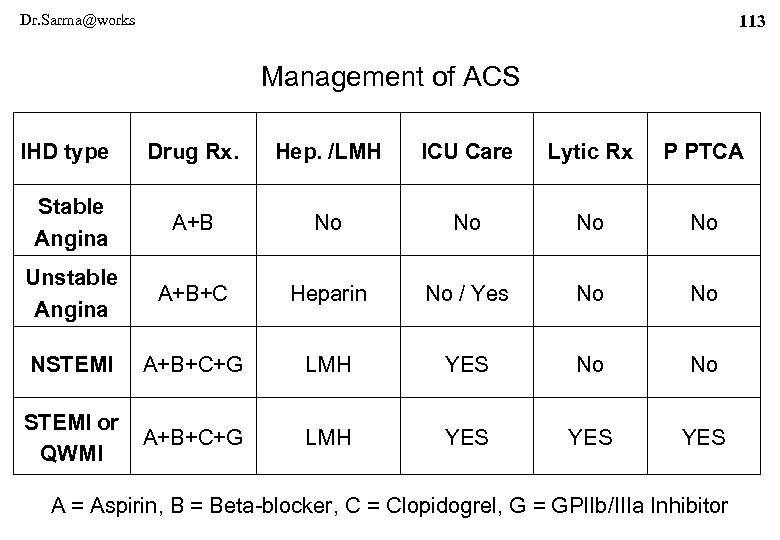 Dr. Sarma@works 113 Management of ACS IHD type Drug Rx. Hep. /LMH ICU Care Lytic Rx P PTCA Stable Angina A+B No No Unstable Angina A+B+C Heparin No / Yes No No NSTEMI A+B+C+G LMH YES No No STEMI or QWMI A+B+C+G LMH YES YES A = Aspirin, B = Beta-blocker, C = Clopidogrel, G = GPIIb/IIIa Inhibitor
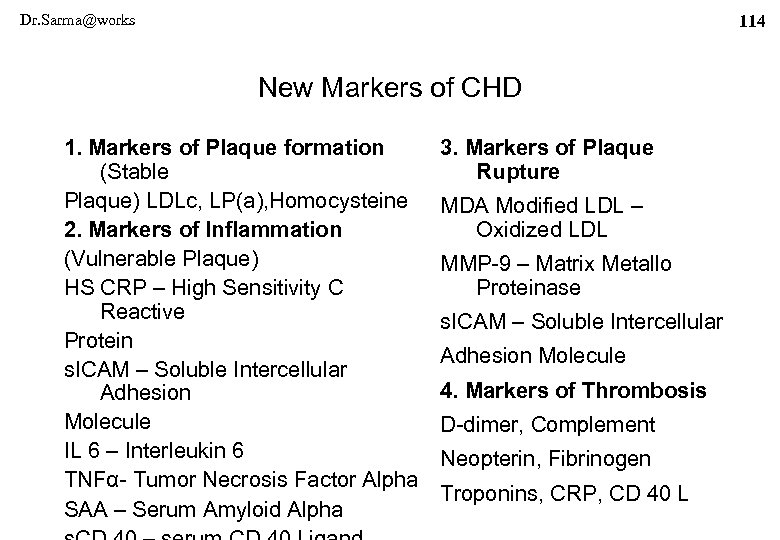 Dr. Sarma@works 114 New Markers of CHD 1. Markers of Plaque formation (Stable Plaque) LDLc, LP(a), Homocysteine 2. Markers of Inflammation (Vulnerable Plaque) HS CRP – High Sensitivity C Reactive Protein s. ICAM – Soluble Intercellular Adhesion Molecule IL 6 – Interleukin 6 TNFα- Tumor Necrosis Factor Alpha SAA – Serum Amyloid Alpha 3. Markers of Plaque Rupture MDA Modified LDL – Oxidized LDL MMP-9 – Matrix Metallo Proteinase s. ICAM – Soluble Intercellular Adhesion Molecule 4. Markers of Thrombosis D-dimer, Complement Neopterin, Fibrinogen Troponins, CRP, CD 40 L
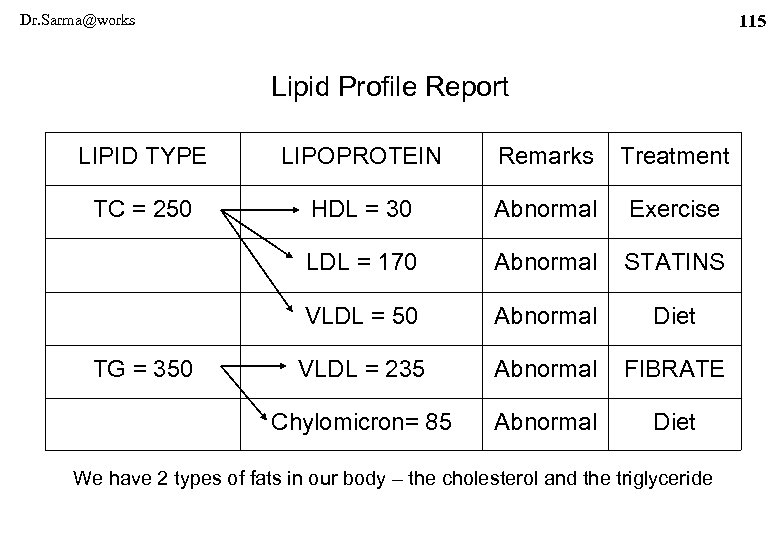 Dr. Sarma@works 115 Lipid Profile Report LIPID TYPE LIPOPROTEIN Remarks Treatment TC = 250 HDL = 30 Abnormal Exercise LDL = 170 Abnormal STATINS VLDL = 50 Abnormal Diet VLDL = 235 Abnormal FIBRATE Chylomicron= 85 Abnormal Diet TG = 350 We have 2 types of fats in our body – the cholesterol and the triglyceride
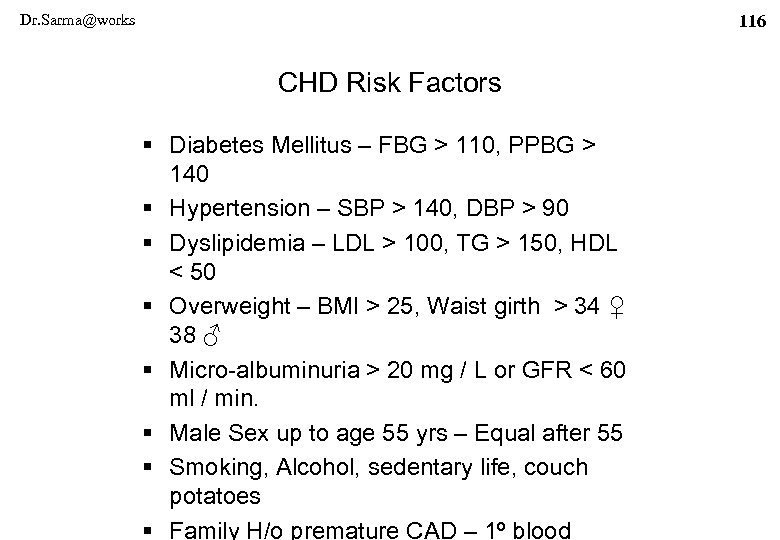 Dr. Sarma@works 116 CHD Risk Factors § Diabetes Mellitus – FBG > 110, PPBG > 140 § Hypertension – SBP > 140, DBP > 90 § Dyslipidemia – LDL > 100, TG > 150, HDL < 50 § Overweight – BMI > 25, Waist girth > 34 ♀ 38 ♂ § Micro-albuminuria > 20 mg / L or GFR < 60 ml / min. § Male Sex up to age 55 yrs – Equal after 55 § Smoking, Alcohol, sedentary life, couch potatoes § Family H/o premature CAD – 1º blood
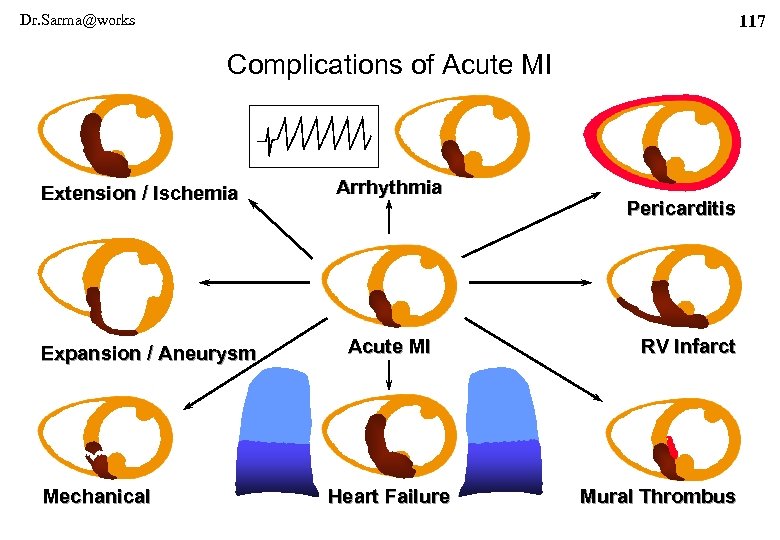 Dr. Sarma@works 117 Complications of Acute MI Extension / Ischemia Expansion / Aneurysm Mechanical Arrhythmia Acute MI Heart Failure Pericarditis RV Infarct Mural Thrombus
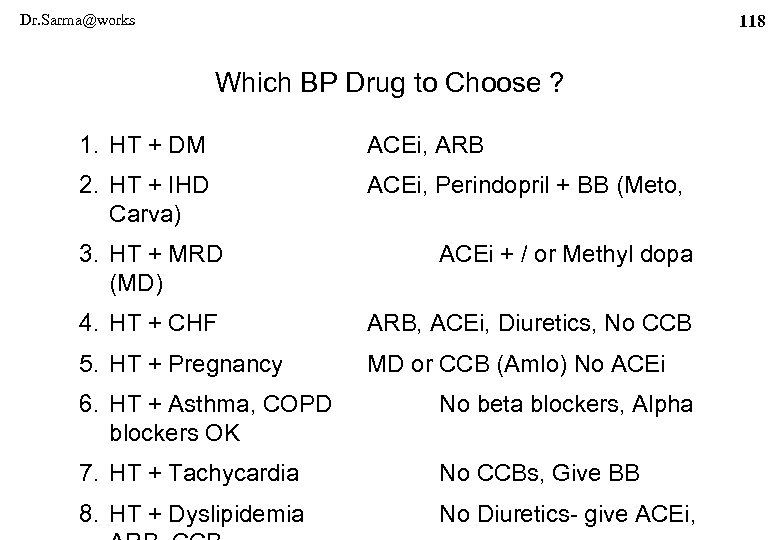 Dr. Sarma@works 118 Which BP Drug to Choose ? 1. HT + DM ACEi, ARB 2. HT + IHD Carva) ACEi, Perindopril + BB (Meto, 3. HT + MRD (MD) ACEi + / or Methyl dopa 4. HT + CHF ARB, ACEi, Diuretics, No CCB 5. HT + Pregnancy MD or CCB (Amlo) No ACEi 6. HT + Asthma, COPD blockers OK No beta blockers, Alpha 7. HT + Tachycardia No CCBs, Give BB 8. HT + Dyslipidemia No Diuretics- give ACEi,
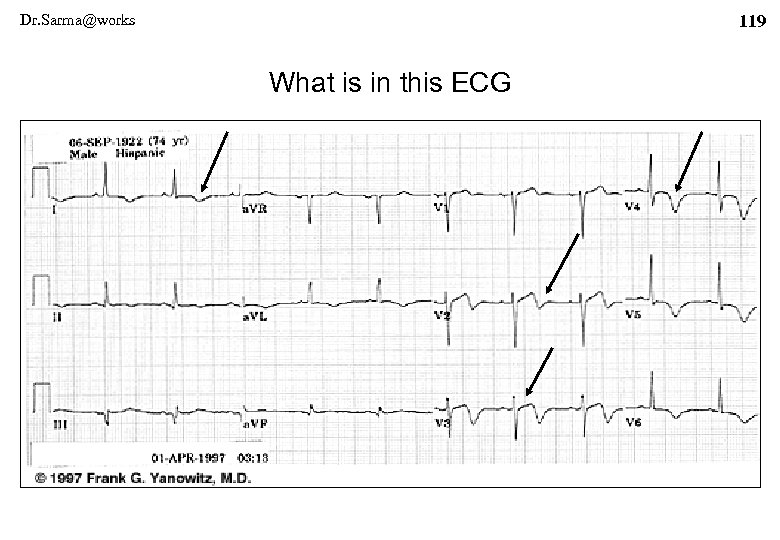 Dr. Sarma@works 119 What is in this ECG
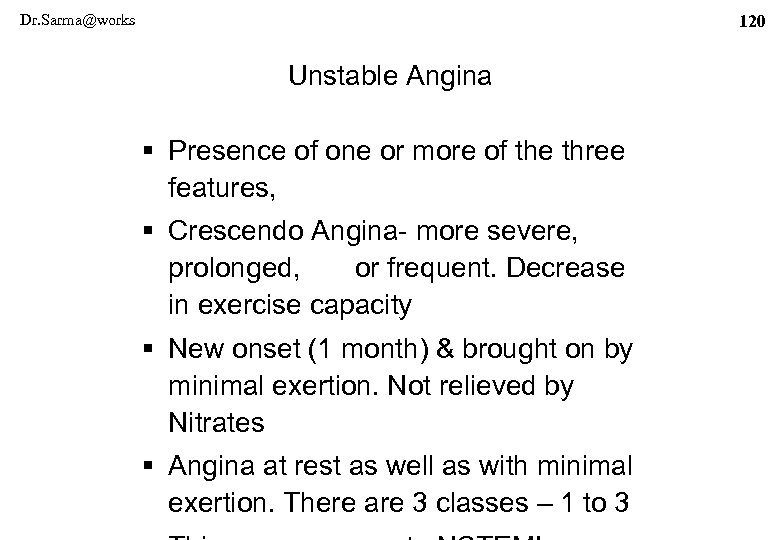 Dr. Sarma@works 120 Unstable Angina § Presence of one or more of the three features, § Crescendo Angina- more severe, prolonged, or frequent. Decrease in exercise capacity § New onset (1 month) & brought on by minimal exertion. Not relieved by Nitrates § Angina at rest as well as with minimal exertion. There are 3 classes – 1 to 3
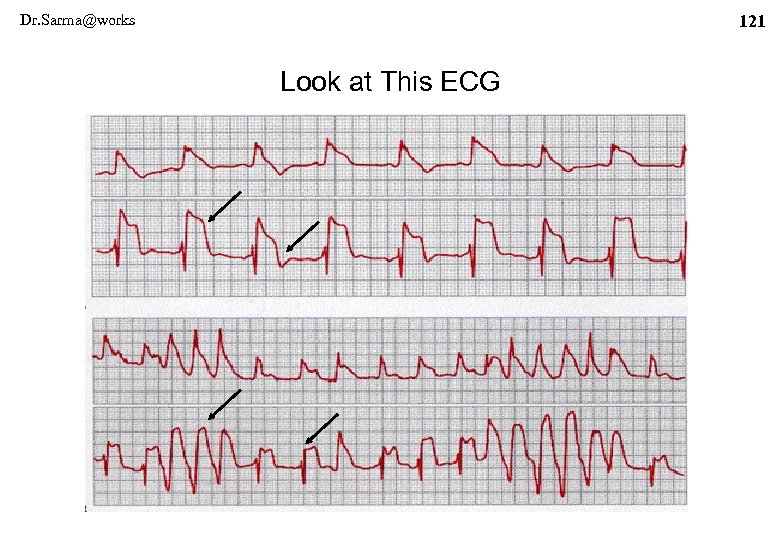 Dr. Sarma@works 121 Look at This ECG
 Dr. Sarma@works 122 Prinzemetal Angina § Transient ST-segment elevation during chest pain due to coronary vasospasm – variant angina § ECG with ST ↑. Becomes normal soon, No Q wave § Intermittent chest pain § often repetitive, usually at rest, early morning § Other vasospasms - syncope, Raynaud’s, migraine
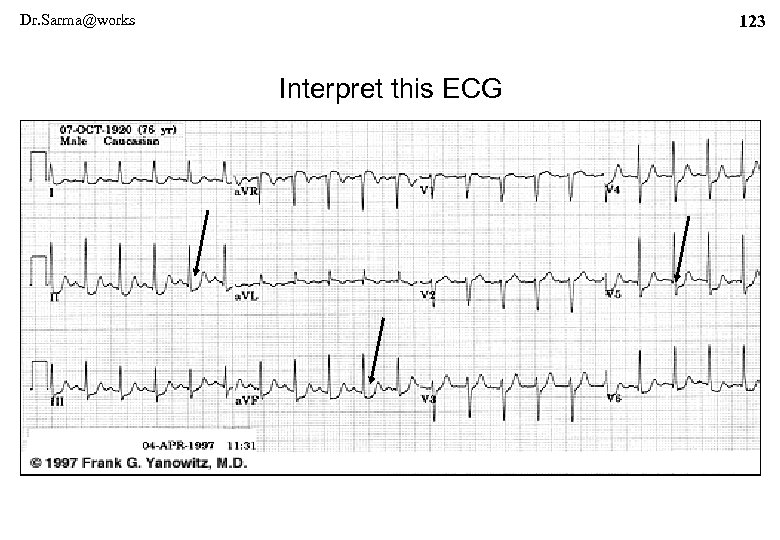 Dr. Sarma@works 123 Interpret this ECG
 Dr. Sarma@works 124 NSTEMI Non ST ↑ MI or NSTEMI, Non Q MI § Or also called sub-endocardial Infarction § Non transmural, restricted to the subendocardial region - there will be no ST ↑ or Q waves § ST depressions in anterio-lateral & inferior leads § Prolonged chest pain, autonomic symptoms like nausea, vomiting, diaphoresis § Persistent ST-segment ↓even after resolution of pain
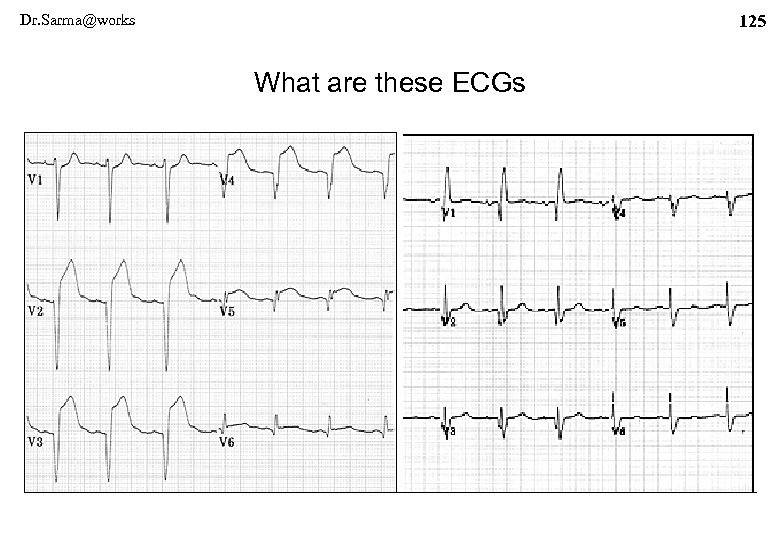 Dr. Sarma@works 125 What are these ECGs
 Dr. Sarma@works 126 STEMI and QWMI § ST ↑ signifies severe transmural myocardial injury – This is early stage before death of the muscle tissue – the infarction § Q waves signify muscle death – They appear late in the sequence of MI and remain for a long time § Presence of either is an indication for thrombolysis
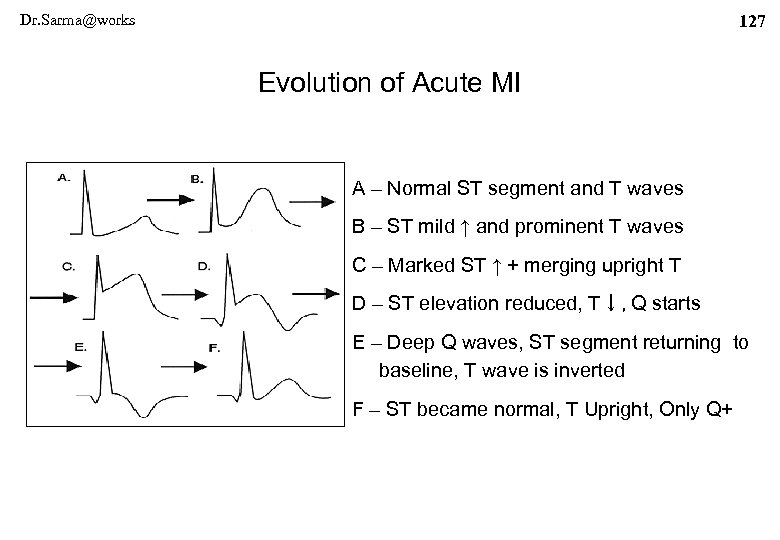 Dr. Sarma@works 127 Evolution of Acute MI A – Normal ST segment and T waves B – ST mild ↑ and prominent T waves C – Marked ST ↑ + merging upright T D – ST elevation reduced, T↓, Q starts E – Deep Q waves, ST segment returning to baseline, T wave is inverted F – ST became normal, T Upright, Only Q+
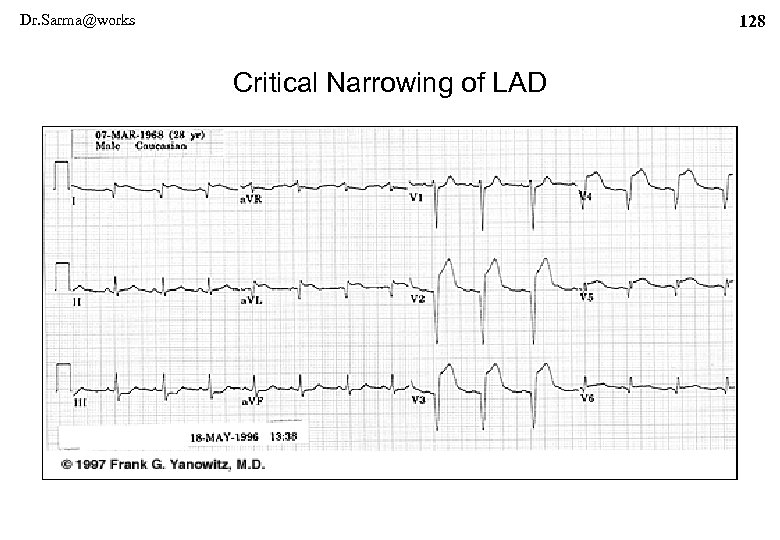 Dr. Sarma@works 128 Critical Narrowing of LAD
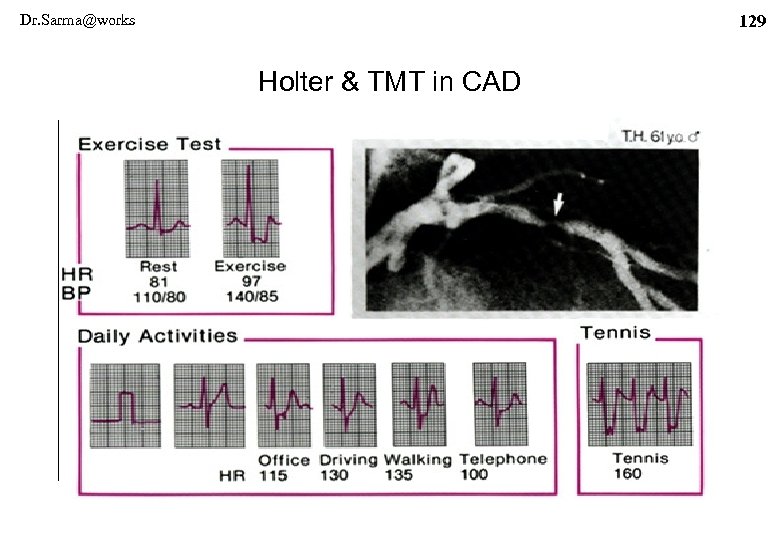 Dr. Sarma@works 129 Holter & TMT in CAD
 Dr. Sarma@works 130 Holter & TMT in CAD § Holter is an ambulatory ECG, BP monitor § Look at the Stress Test – Deep ST ↓ § The Holter recordings show the changing patterns in ST segments and Heart rate during different activities § Worst ST changes during vigorous physical activity like playing tennis
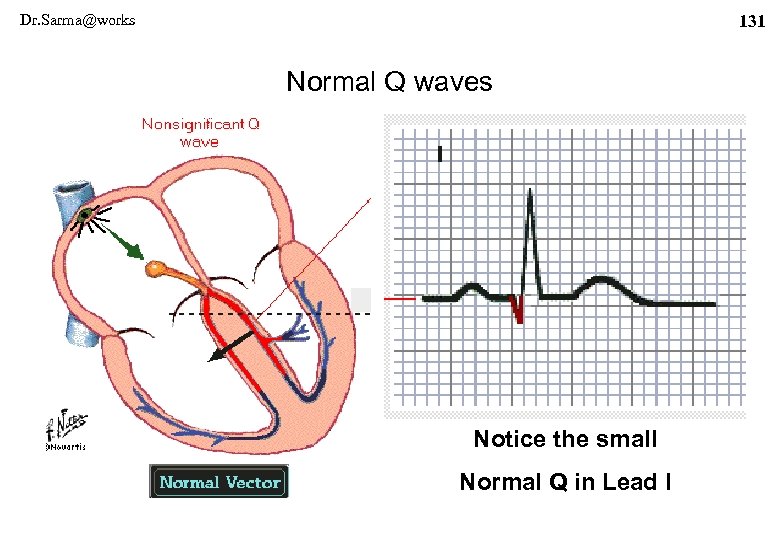 Dr. Sarma@works 131 Normal Q waves Notice the small Normal Q in Lead I
 Dr. Sarma@works 132 Normal Q Waves § The normal Q wave in lead I is due to septal depolarization § It is small in amplitude – less than 25% of the succeeding R wave, or less than 3 mm § Its duration is < 0. 04 sec or one small box § It is seen in L 1 and some times in V 5, V 6
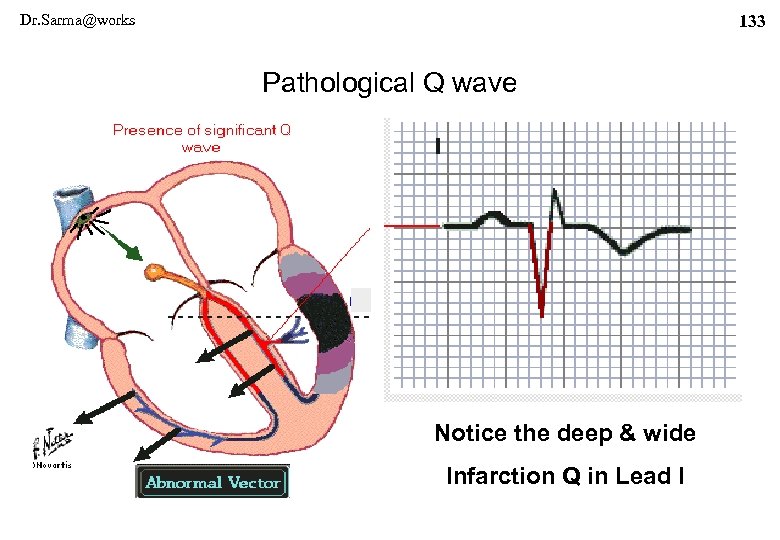 Dr. Sarma@works 133 Pathological Q wave Notice the deep & wide Infarction Q in Lead I
 Dr. Sarma@works 134 Pathological Q wave § The pathological Q wave of infarction in the respective leads is due to dead muscle § It is deep in amplitude – more than 25% of the succeeding R wave, or more than 4 mm § Its duration is > 0. 04 sec or > 1 small box § It is seen in Leads facing the infarcted muscle mass
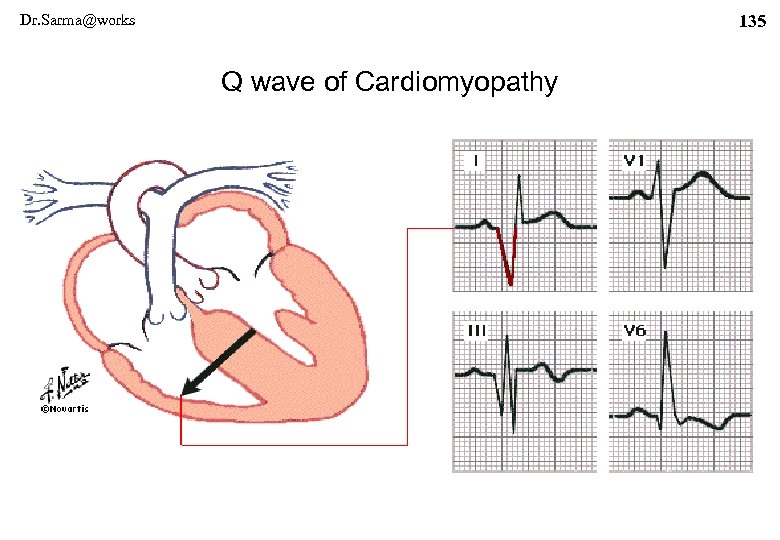 Dr. Sarma@works 135 Q wave of Cardiomyopathy
 Dr. Sarma@works 136 Q Wave of Cardiomyopathy § In idiopathic hypertrophic cardiomyopathy the septal Q wave in lead 1 is deep and prolonged because of excessive septal thickness. Similar to MI Q wave, but § There will be marked LVH evidence and § The R wave amplitude is very tall unlike in infarction – where R waves are reduced
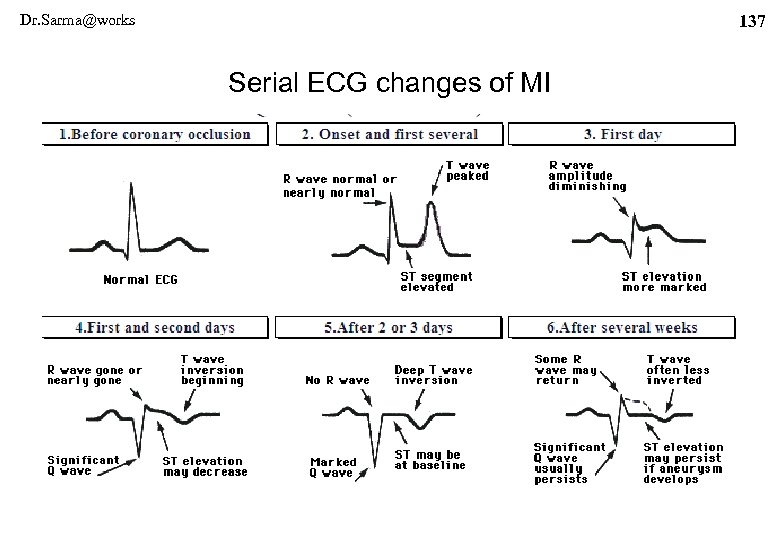 Dr. Sarma@works 137 Serial ECG changes of MI
 Dr. Sarma@works 138 Serial ECG Changes of MI § Normal ECG does not exclude MI or IHD § First few hours of MI – Hyper acute T with ST segment elevation starting § Drop in R wave voltage and ST elevation § Significant Q, R wave none, ST ↑, T↓ § No R, Marked Q, ST baseline, T↓ § Small R starts, Q remains, ST normal, T↓ § In some Q waves disappear, R
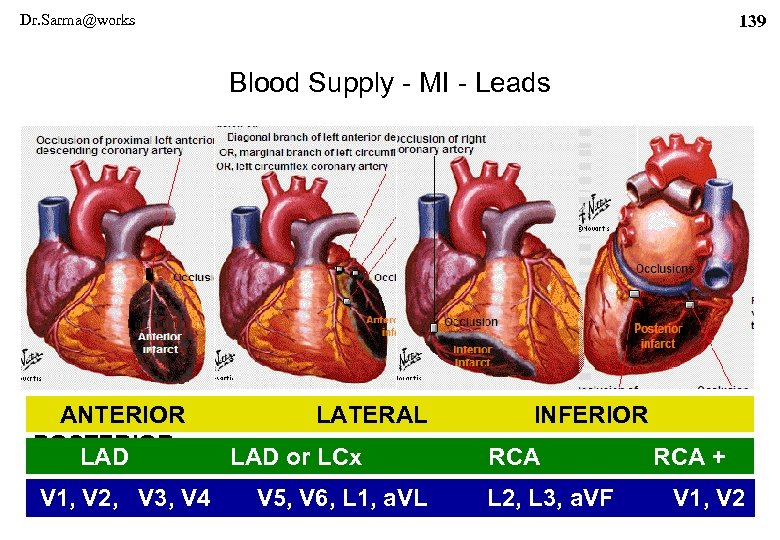 Dr. Sarma@works 139 Blood Supply - MI - Leads ANTERIOR LATERAL POSTERIOR LAD or LCx V 1, V 2, V 3, V 4 V 5, V 6, L 1, a. VL Mirror INFERIOR RCA L 2, L 3, a. VF RCA + V 1, V 2
 Dr. Sarma@works 140 What are the Investigations ? § Resting 12 Lead ECG, Chest X-Ray § Tread Mill Test (TMT) – Provocative stress tests § Troponins (bed side), LDH, CPK isoenzymes § Echocardiography and Doppler § Calcium scoring and CT angiography § Exercise Echo, Dobutamine challenge echocardiography § Perfusion – Stress Thalium, Sistemibi, Dipyridamole
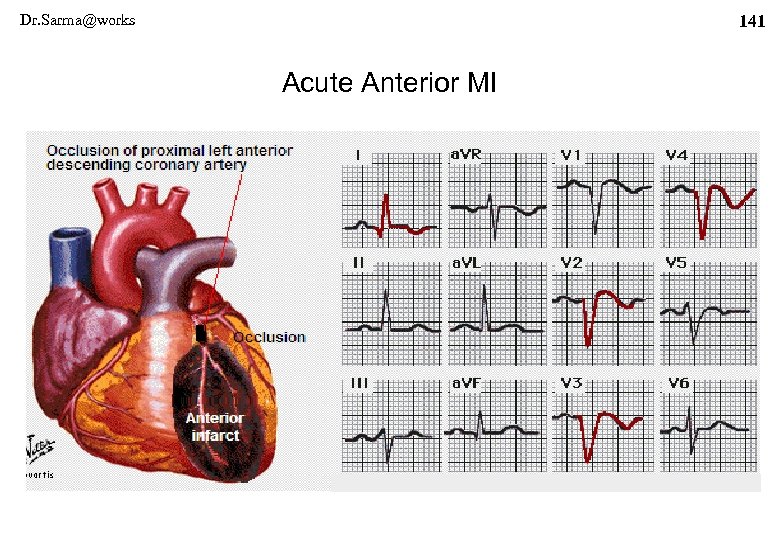 Dr. Sarma@works 141 Acute Anterior MI
 Dr. Sarma@works 142 Acute Anterior Wall MI § Due to occlusion of the proximal LAD § Significant Q waves, ST elevation and T inversions in Leads V 2, V 3 and V 4 § Q waves and T inversion in L 1 § If only V 1 and V 2 show the changes it is called septal MI § Associated with abnormal conduction § Septal perforation with acquired
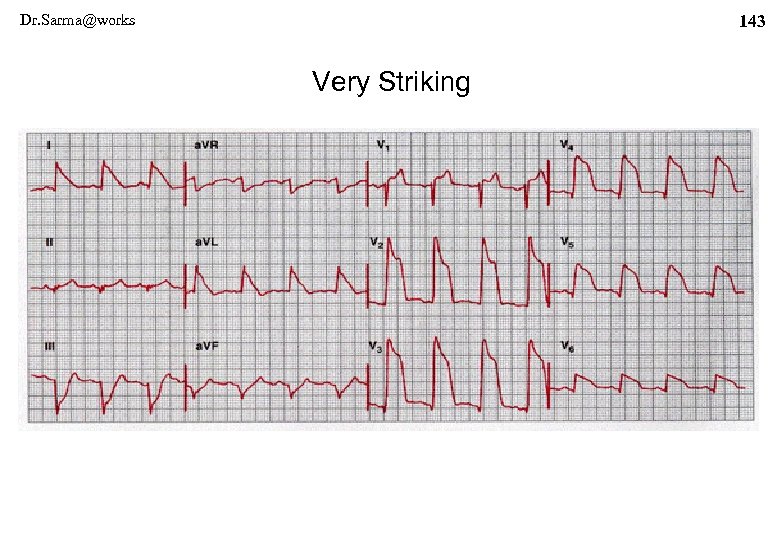 Dr. Sarma@works 143 Very Striking
 Dr. Sarma@works 144 Hyper Acute MI § Note the hyper acute elevation of ST § The R wave is continuing with ST and the complexes are looking rectangular § Some times tall and peaked T waves in the precardial leads may be the only evidence of impending infarct § Sudden appearance LBBB indicates MI
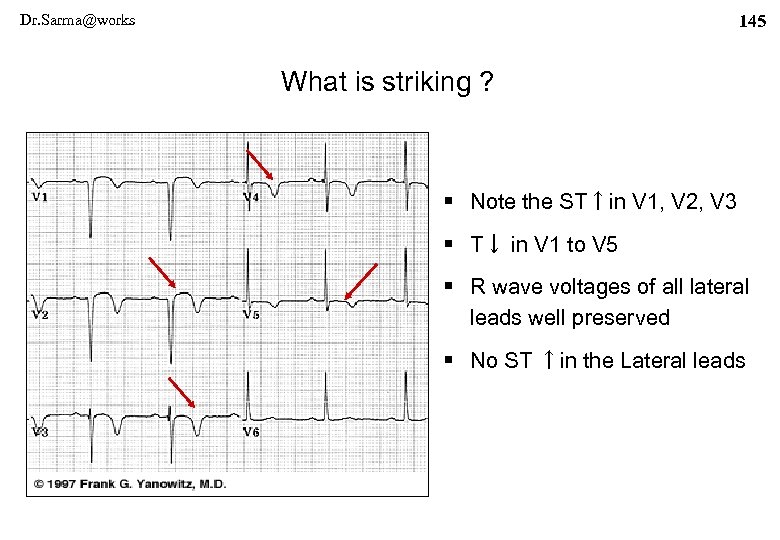 Dr. Sarma@works 145 What is striking ? § Note the ST↑in V 1, V 2, V 3 § T↓ in V 1 to V 5 § R wave voltages of all lateral leads well preserved § No ST ↑in the Lateral leads
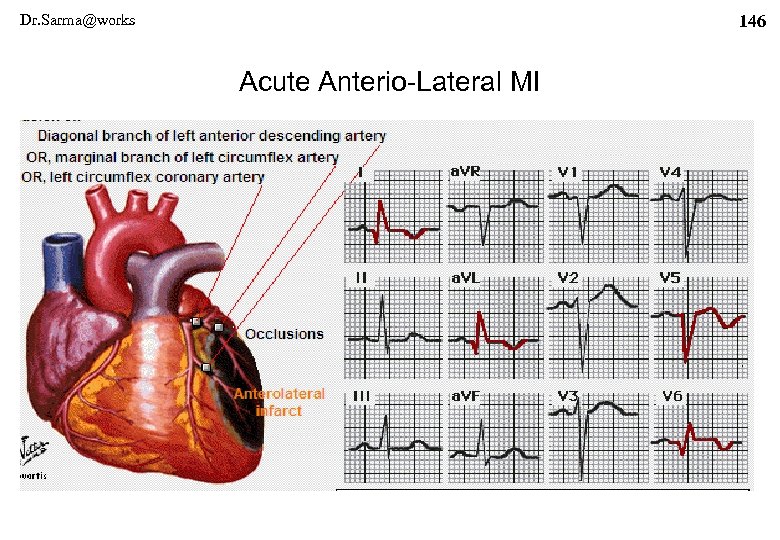 Dr. Sarma@works 146 Acute Anterio-Lateral MI
 Dr. Sarma@works 147 Acute Anterio-lateral MI § Due to occlusion of the marginal branch or the main trunk of Left Circumflex artery § Or due to occlusion of the diagonal branch of Left anterior descending artery § Significant Q waves, ST elevation and T inversions in Lead 1, a. VL, V 5 and V 6 § This is the most common form of
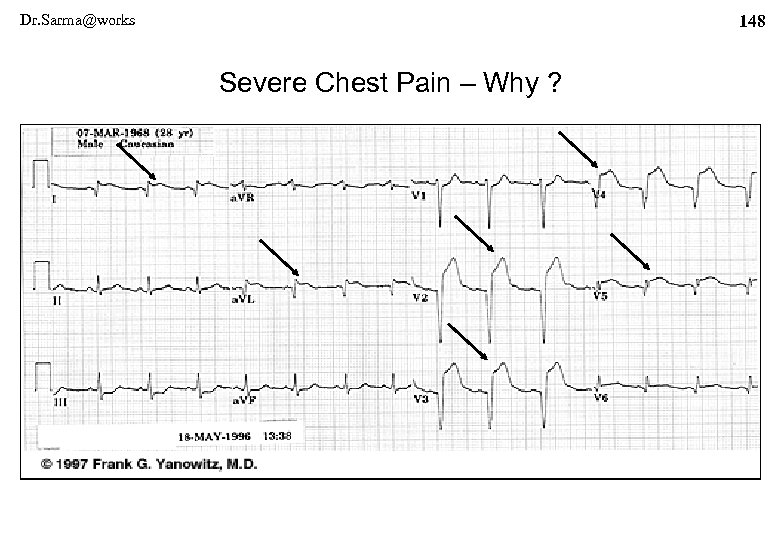 Dr. Sarma@works 148 Severe Chest Pain – Why ?
 Dr. Sarma@works 149 Acute Anterio-lateral MI § Note the marked ST elevations in chest leads V 2 to V 5 and also ST↑ in L 1 & a. VL § T inversions have not appeared as yet § R wave voltages have dropped markedly in V 3, V 4, V 5 and V 6 § Small R in L 1 and a. VL.
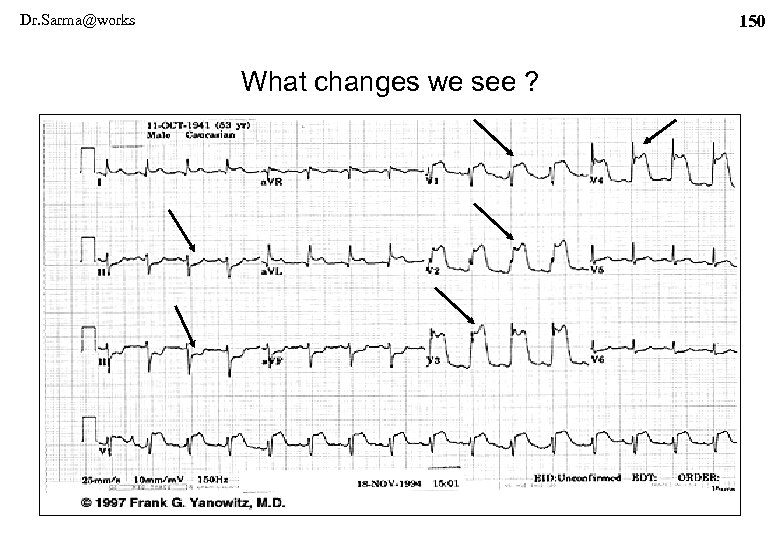 Dr. Sarma@works 150 What changes we see ?
 Dr. Sarma@works 151 Acute Anterio-lateral MI § Note the marked ST elevations in chest leads V 2 to V 5, also ST↑ in L 1 & a. VL § T inversions have not appeared as yet § R wave voltages have merged with ST ↑ markedly in V 3, V 4, V 5 and V 6 § In addition complimentary St ↓in L 2, L 3
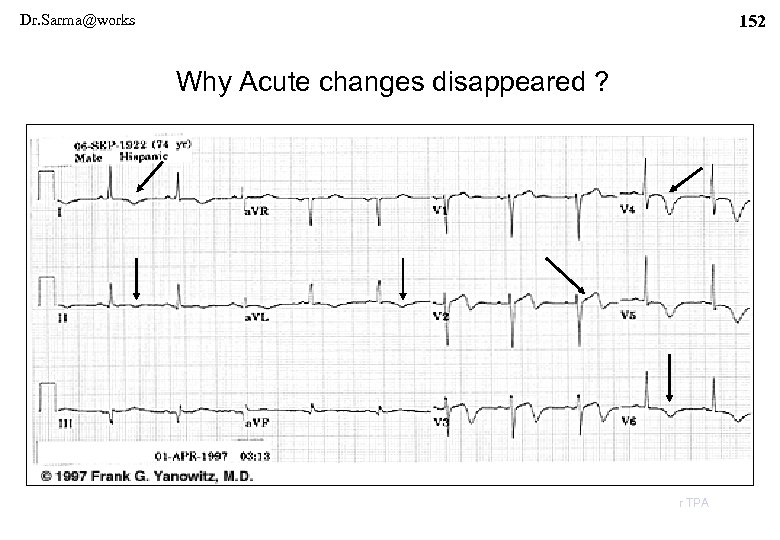 Dr. Sarma@works 152 Why Acute changes disappeared ? r TPA
 Dr. Sarma@works 153 Thrombolysed Anterio-lateral MI § Note the ST elevations in chest leads V 2 to V 5 are returned toward baseline § Deep T ↓have appeared in all leads § R wave voltages have improved in V 2 to V 5 § No residual Q waves seen § This patient was thrombolysed within 2 hours and MI has become stable – Golden period § Thrombolytics – UK, SK, TPA, r-TPA
 Dr. Sarma@works 154 Guess How Old is this MI !
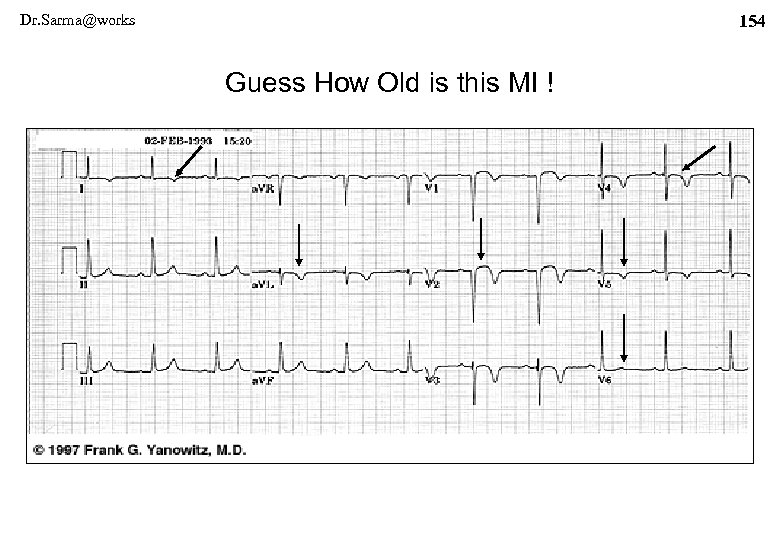
 Dr. Sarma@works 155 Stable Anterio-lateral MI § The coved ST↑ in chest leads V 2 to V 5 almost returned to baseline § T↓are becoming less marked in all leads § R wave voltages improved well in V 4 to V 5 § No residual Q waves seen § This ECG is 4 weeks after the Acute MI
 Dr. Sarma@works 156 Acute Inferior wall MI
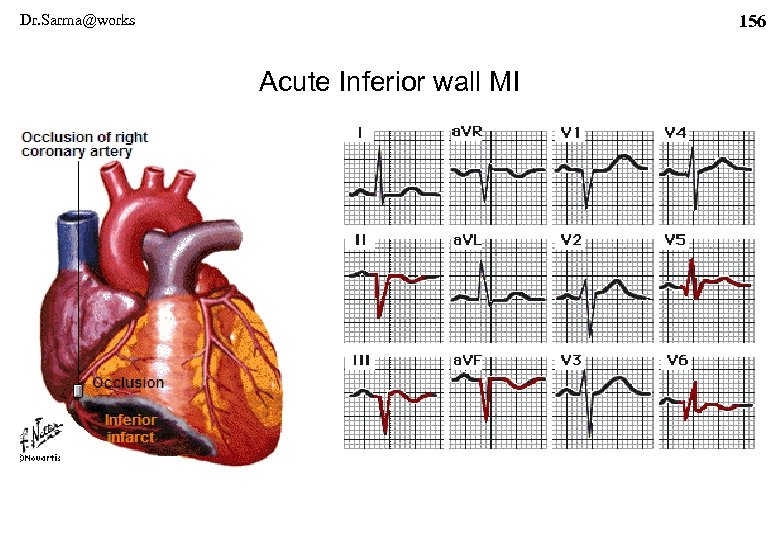
 Dr. Sarma@works 157 Acute Inferior wall MI § Due to occlusion of the right coronary artery § Significant Q waves, ST elevation and T inversions in Lead II, Lead III, a. VF, § This is the associated with arrhythmias
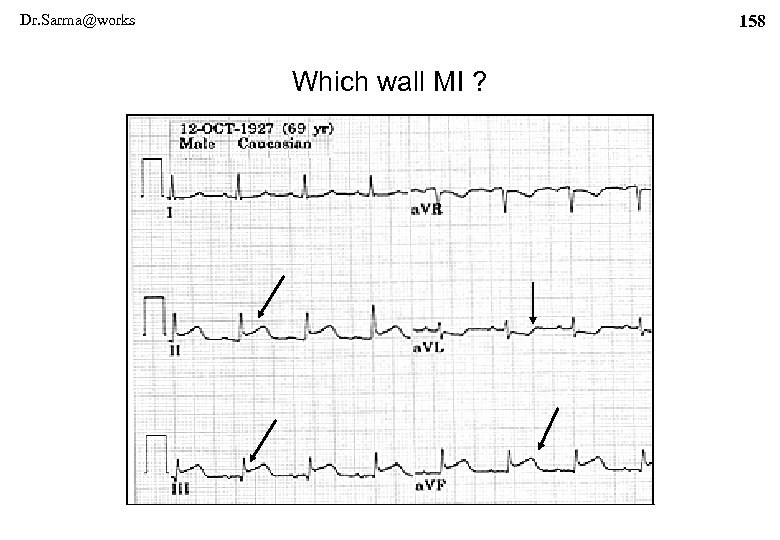 Dr. Sarma@works 158 Which wall MI ?
 Dr. Sarma@works 159 Acute Inferior wall MI § Note the ST elevations in Inferior leads- namely L 2, L 3 and a. VF § T inversions yet to appear § a. VL lead shows complimentary ST↓and T inversion
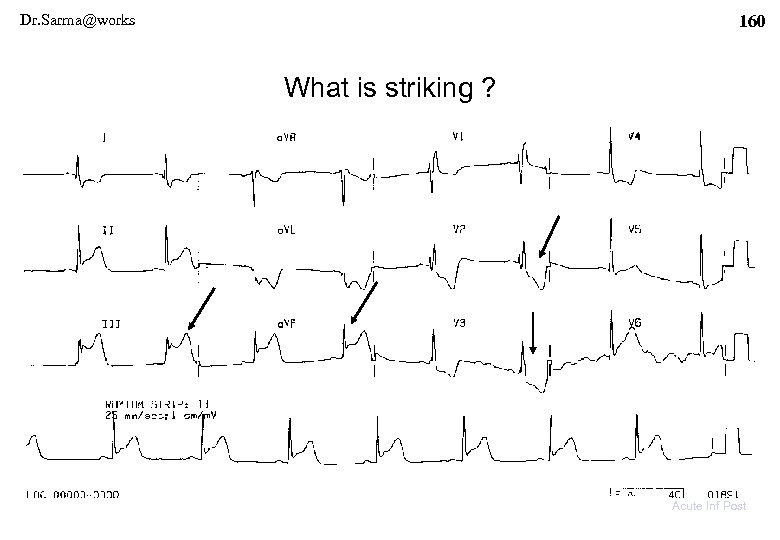 Dr. Sarma@works 160 What is striking ? Acute Inf Post
 Dr. Sarma@works 161 Acute Inferior wall MI § Note the ST elevations in Inferior leads- namely L 2, L 3 and a. VF § Hyper acute T waves merging with ST § V 1, V 2, a. VL lead shows rs. R’ pattern with ST↓and T inversion – Inferior MI § Associated RBBB also is present – QRS is wide > 0. 12 sec
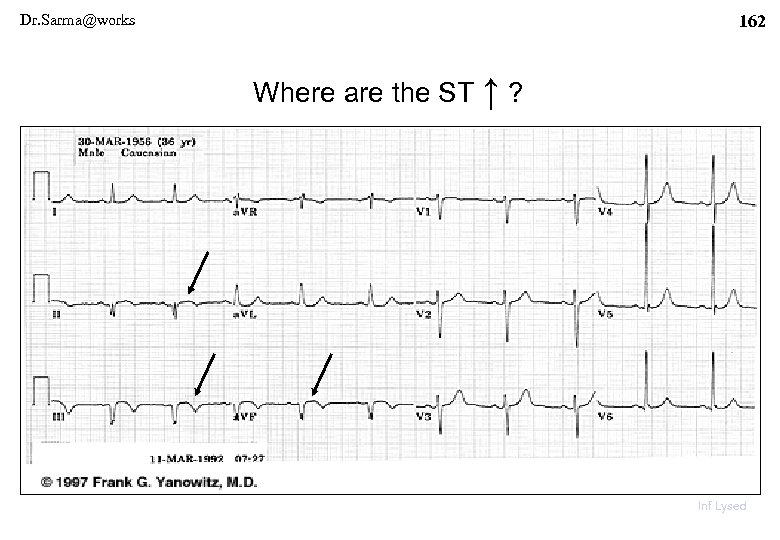 Dr. Sarma@works 162 Where are the ST ↑ ? Inf Lysed
 Dr. Sarma@works 163 Inferior Wall MI - Thrombolysed § A case of inferior wall MI § Thrombolysed with in 2 hours § ST segments returned to base line § Deep T inversions signify residual ischemia § This patient became stable
 Dr. Sarma@works 164 What Can We Infer ?
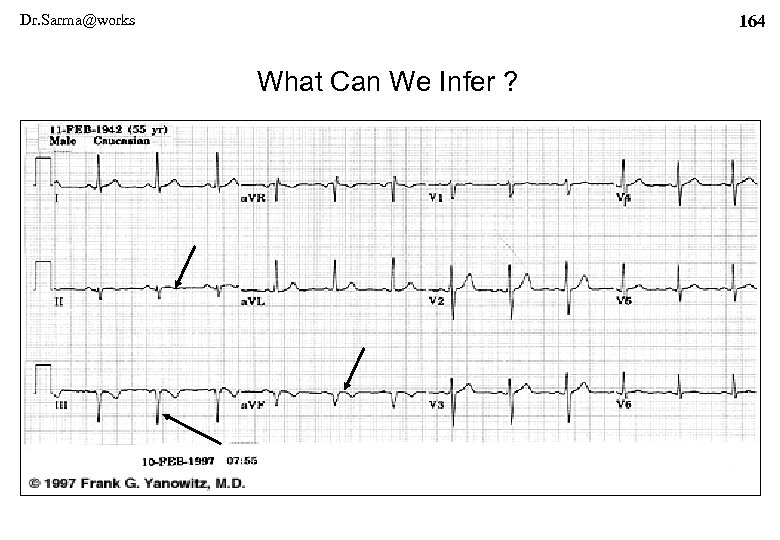
 Dr. Sarma@works 165 Old Inferior wall MI § This is months after the acute event § Patient suffered inferior MI § Residual QS waves in L 3 and a. VF § T inversions in L 3 and a. VF § ST segments are isoelectric § L 3 t inversion became normal § Chest leads R wave voltages are good
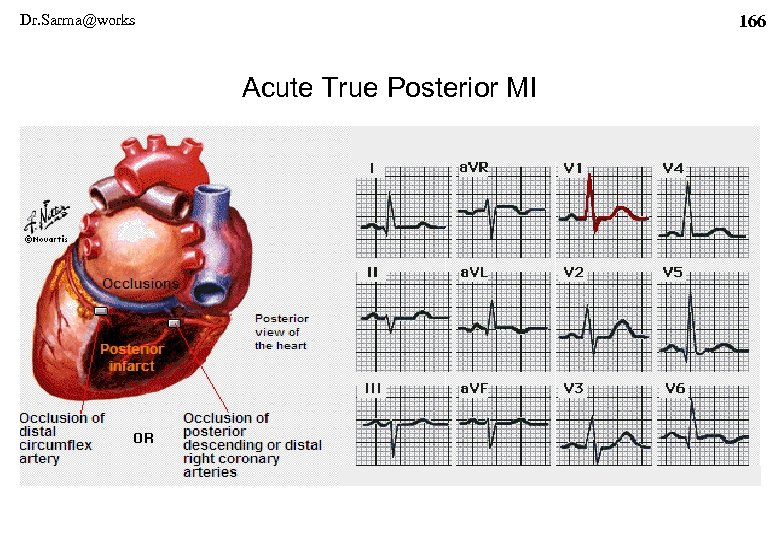 Dr. Sarma@works 166 Acute True Posterior MI
 Dr. Sarma@works 167 Acute True Posterior MI § Due to occlusion of the distal Left circumflex artery or posterior descending or distal right coronary artery § Mirror image changes or reciprocal changes in the anterior precardial leads § Lead V 1 shows unusually tall R wave (it is the mirror image of deep Q)
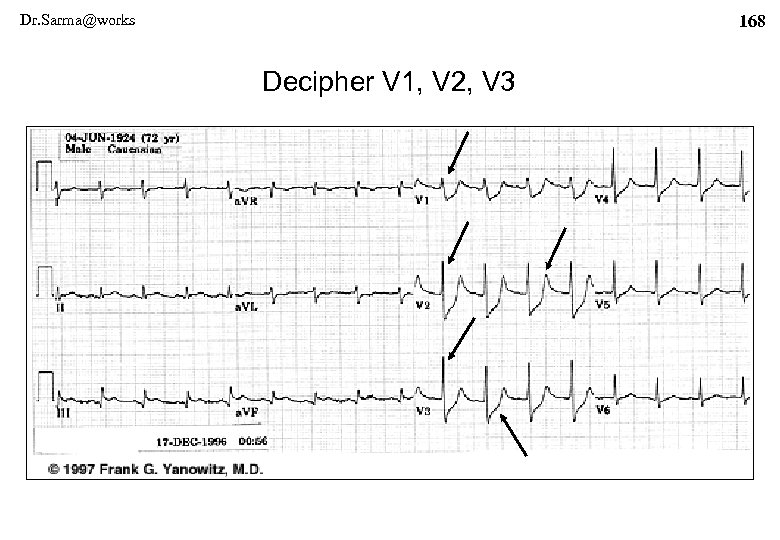 Dr. Sarma@works 168 Decipher V 1, V 2, V 3
 Dr. Sarma@works 169 Acute True Posterior MI § V 2, V 3 show tall R waves, Even V 1 shows R § V 2, V 3, V 1 leads R/s ratio is >> 1 § These R waves are the mirrored MI – Qs § These leads show deep ST depression § This ST↓is in fact the mirrored ST↑of MI § The same leads show sharp T waves
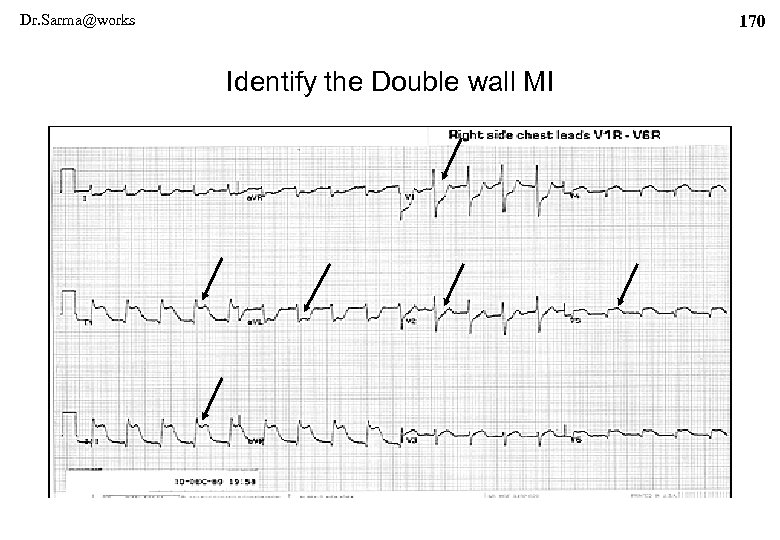 Dr. Sarma@works 170 Identify the Double wall MI
 Dr. Sarma@works 171 Inferio-Posterior MI § V 1, V 2 show tall R waves § V 1, V 2 leads R/s ratio is >> 1 § These R waves are the mirrored MI – Qs § This ST↓ is in fact the mirrored ST ↑ of MI § The T ↓are the mirrored T inversions of MI § L 2, L 3 and a. VF show gross ST ↑ Inferior MI
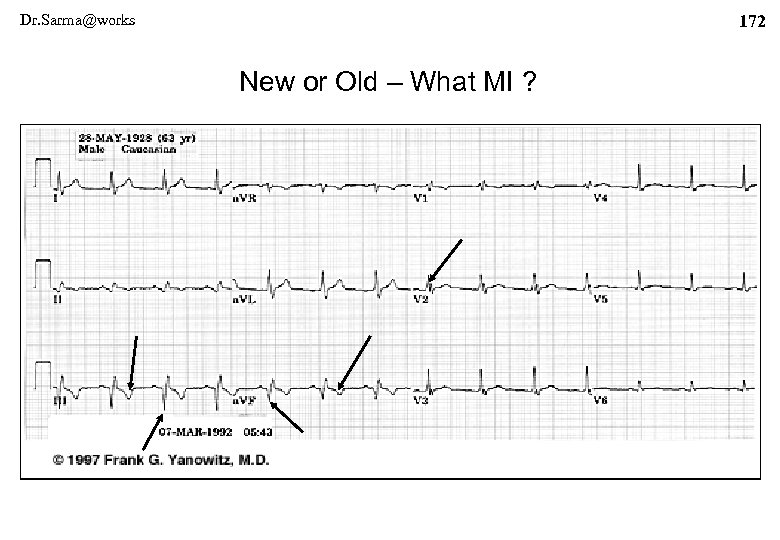 Dr. Sarma@works 172 New or Old – What MI ?
 Dr. Sarma@works 173 Old Inferio-Posterior MI § V 2 shows residual R waves of Posterior MI § V 2 lead R/s ratio is > 1 § The R waves are the mirrored old Qs of MI § This ST↓ is no longer seen – stabilized MI § L 3 & a. VF show deep QS of old Inferior MI § The T ↓in L 3, a. VF signify old
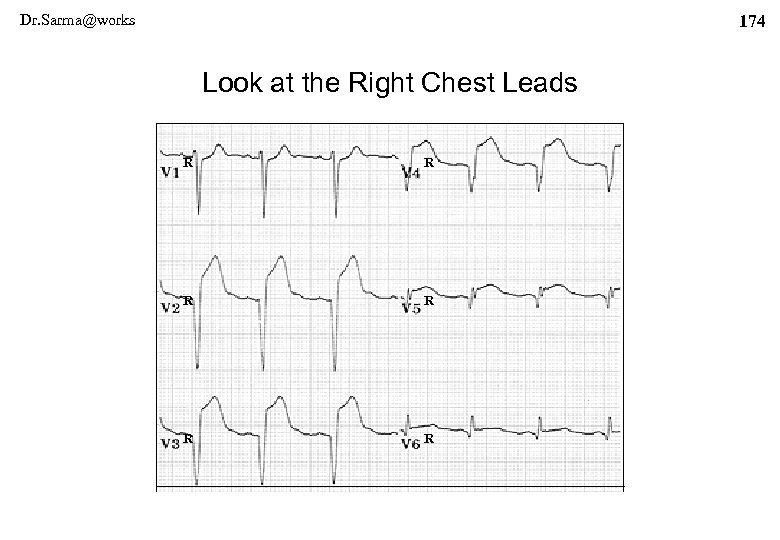 Dr. Sarma@works 174 Look at the Right Chest Leads R R R
 Dr. Sarma@works 175 Dextrocardia and MI § Note the ECG carefully – It is an eye opener § 55 years ♀ is sent for ECG by another doctor § She has dextrocardia of which she is unaware § She has typical clinical features of acute MI § Routine chest leads placed on left chest showed no evidence of MI at all
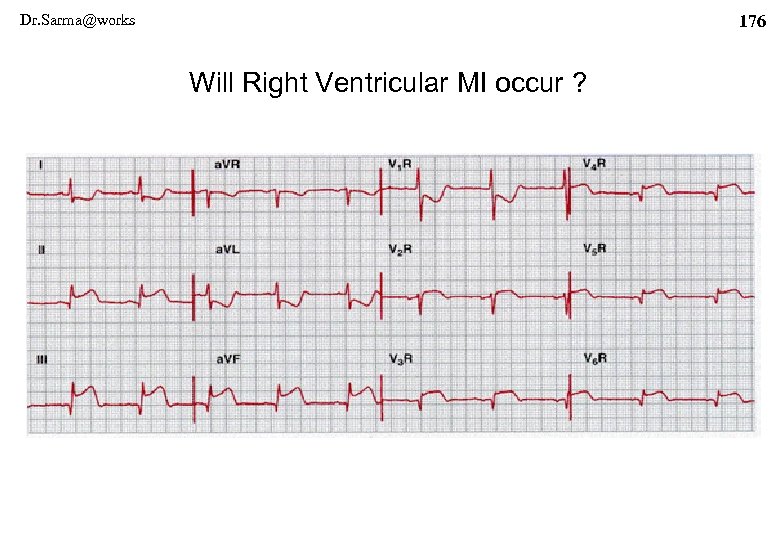 Dr. Sarma@works 176 Will Right Ventricular MI occur ?
 Dr. Sarma@works 177 Right Ventricular MI § Note the ECG carefully – It is an eye opener § 65 yrs ♂ has typical clinical features of acute MI § Routine chest leads placed on left chest showed no MI - but limb leads showed acute Inferior MI § ECG with chest leads on the right chest – V 2 R to V 6 R show typical changes of acute MI of the Right Ventricle. RV MI is associated with Inferior wall MI § His serum troponins were very high
 Dr. Sarma@works 178 Electrical Alternans
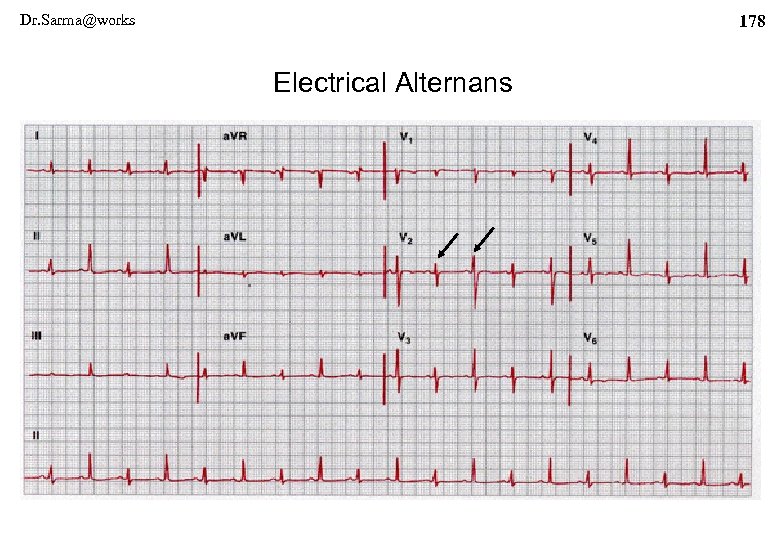
 Dr. Sarma@works 179 Electrical Alternans § Note the typical ECG changes § Every alternate QRS complex has a small and a large amplitude but of sinus origin § The heart rate is 110 per minute § There are P waves preceding all QRS waves § This is a feature of pericardial effusion with cardiac tamponade
 Dr. Sarma@works 180 Ventricular Bigeminy Normal VPC
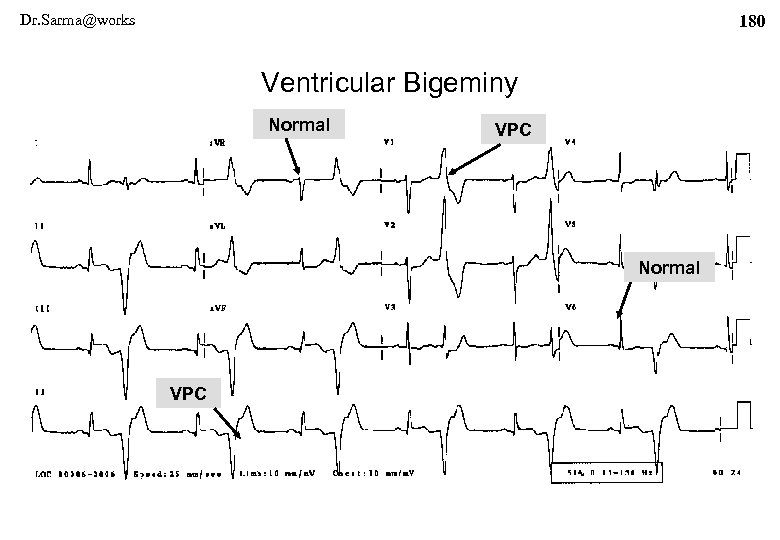
 Dr. Sarma@works 181 Ventricular Bigeminy § Note this typical ECG of bigeminy § Each normal sinus originated ventricular complex with narrow QRS is followed by a § Premature beat with wide and bizarre looking QRS of ventricular origin § Similarly Trigeminy, Quadrigeminy § These ectopics signify heart failure § In this ECG there are features of Inferior MI
 Dr. Sarma@works 182 Myxedema Heart rate 50 Rhythm P wave PR interval QRS in sec
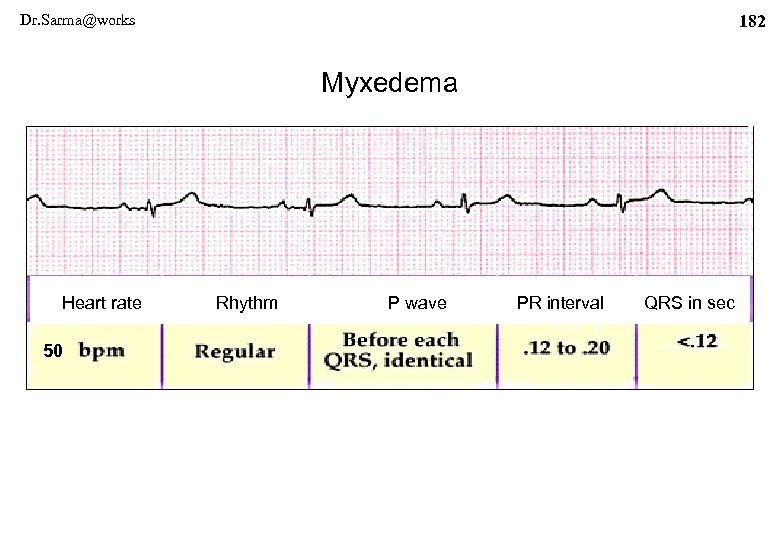
 Dr. Sarma@works 183 Myxedema § Note the ECG changes § Bradycardia – HR of 55 per minute § Low voltages of all complexes § Less than 5 mm Limb leads § Less than 8 mm chest leads § DD of low voltage complexes § Pericardial effusion, Constrictive pericarditis § Severe Emphysema § Pneumothorax or left sided pleural effusion
 Dr. Sarma@works 184 S. A. H. ECG changes
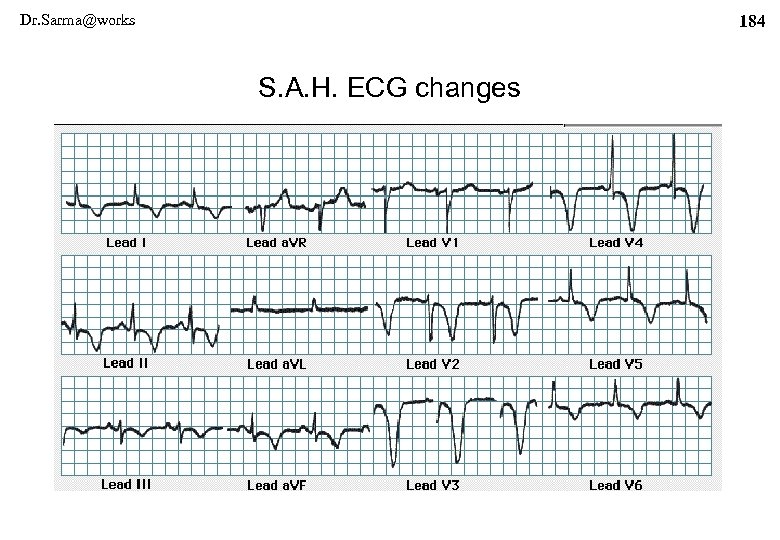
 Dr. Sarma@works 185 S. A. H – ECG changes § Striking ECG changes of Non Cardiac origin § Incredible deep and symmetric T Inversions § In young person with massive Sub Arachnoid Haemorrhage § He has no cardiac disease § Presumably due to autonomic dysfunction § Intense Head ache, Has very high B. P
 Dr. Sarma@works 186 Hyperkalemia
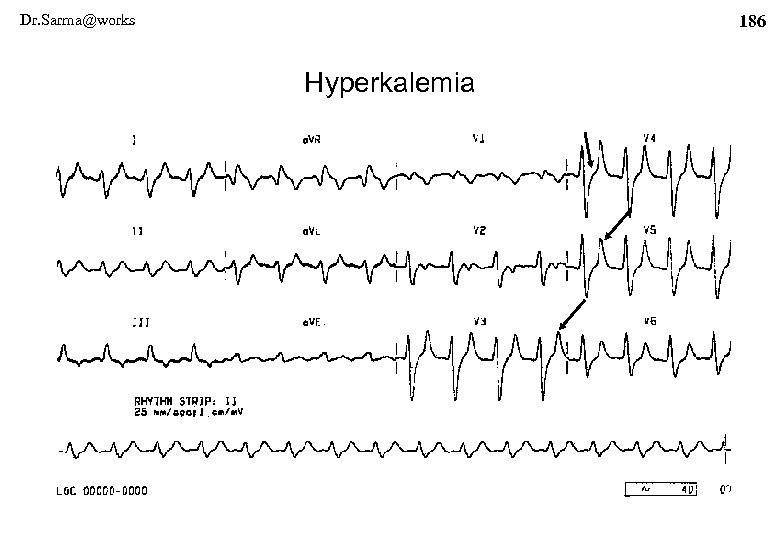
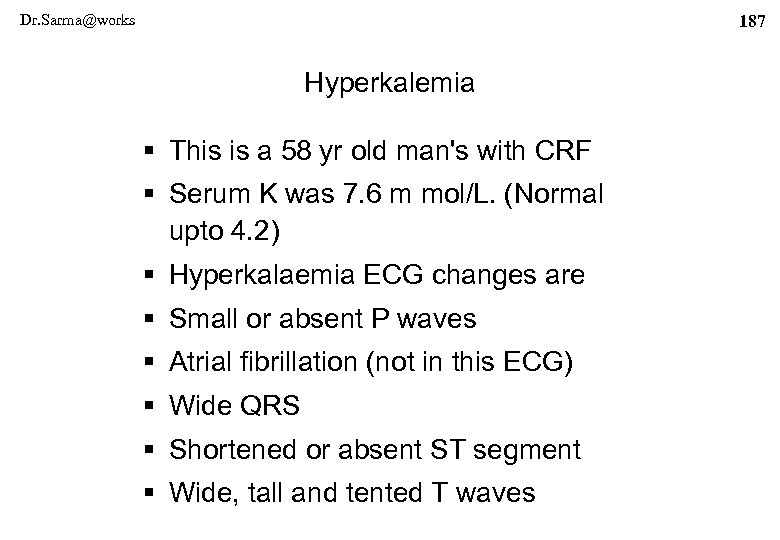 Dr. Sarma@works 187 Hyperkalemia § This is a 58 yr old man's with CRF § Serum K was 7. 6 m mol/L. (Normal upto 4. 2) § Hyperkalaemia ECG changes are § Small or absent P waves § Atrial fibrillation (not in this ECG) § Wide QRS § Shortened or absent ST segment § Wide, tall and tented T waves
 Dr. Sarma@works 188 Hypokalemia
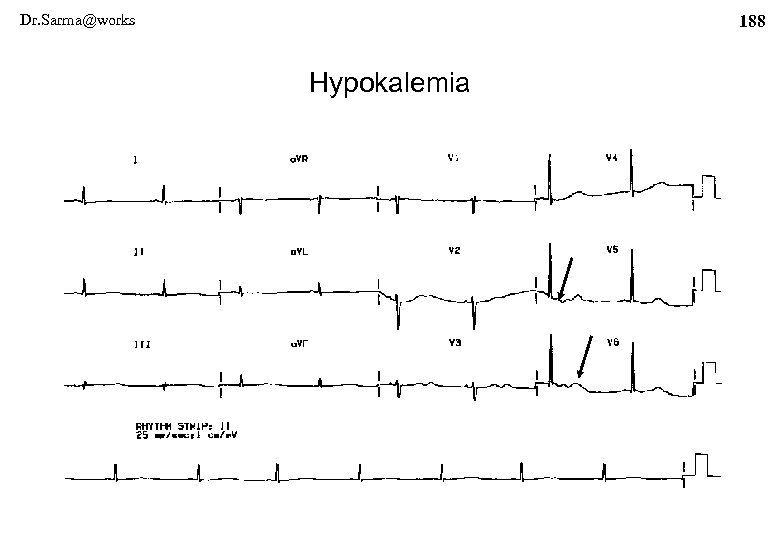
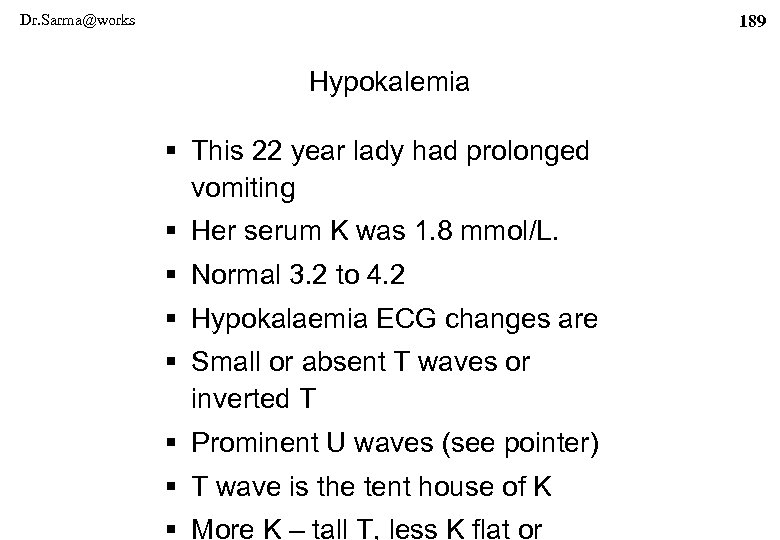 Dr. Sarma@works 189 Hypokalemia § This 22 year lady had prolonged vomiting § Her serum K was 1. 8 mmol/L. § Normal 3. 2 to 4. 2 § Hypokalaemia ECG changes are § Small or absent T waves or inverted T § Prominent U waves (see pointer) § T wave is the tent house of K § More K – tall T, less K flat or
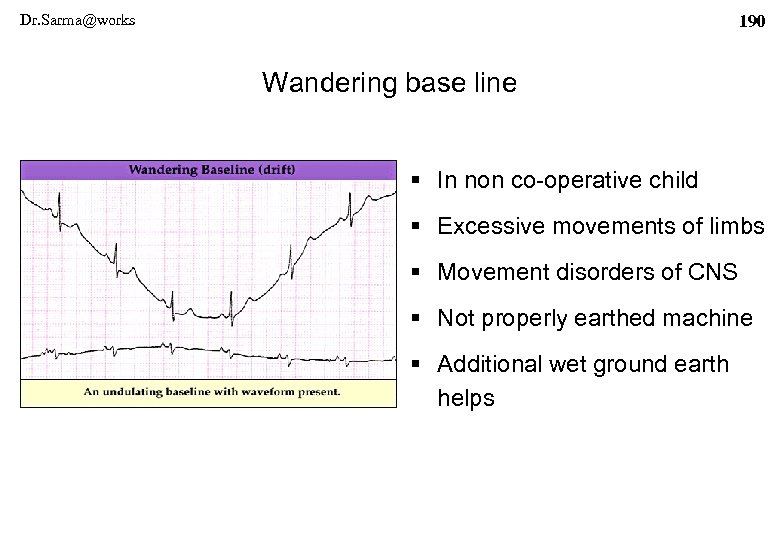 Dr. Sarma@works 190 Wandering base line § In non co-operative child § Excessive movements of limbs § Movement disorders of CNS § Not properly earthed machine § Additional wet ground earth helps
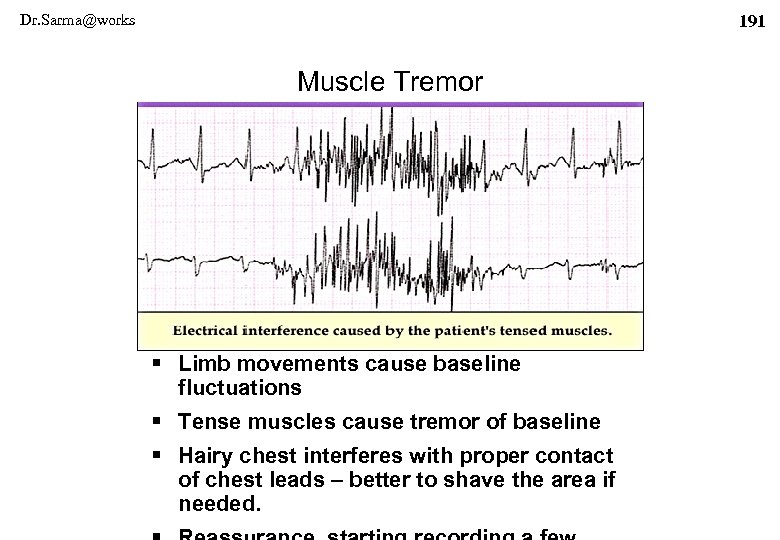 Dr. Sarma@works 191 Muscle Tremor § Limb movements cause baseline fluctuations § Tense muscles cause tremor of baseline § Hairy chest interferes with proper contact of chest leads – better to shave the area if needed.
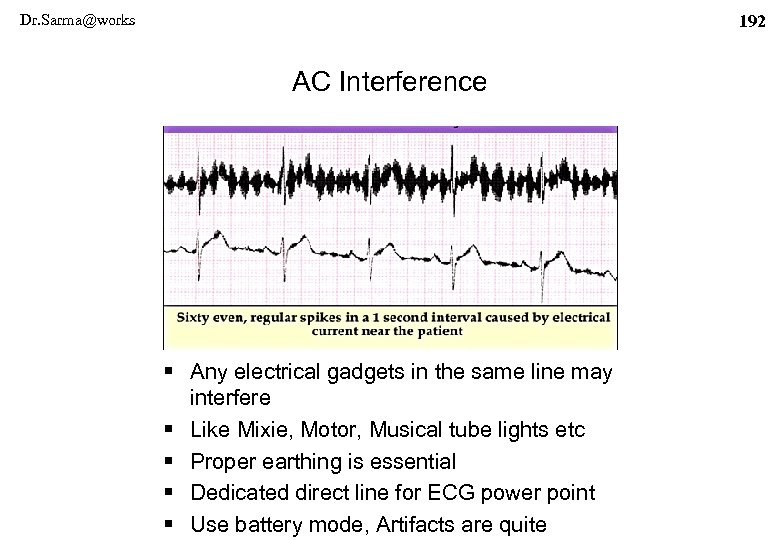 Dr. Sarma@works 192 AC Interference § Any electrical gadgets in the same line may interfere § Like Mixie, Motor, Musical tube lights etc § Proper earthing is essential § Dedicated direct line for ECG power point § Use battery mode, Artifacts are quite
 Dr. Sarma@works 193 Our Other Resources ü We have also an advanced course on ECG ü We have several other educative CMEs prepared ü Please refer to the list at the beginning of this book ü We have several religious and philosophical texts sung, translated and made as Power. Point slides ü Please request what ever you want ü CME talk can also be given if you intimate
 Dr. Sarma@works 194 THIS IS NOT THE END ü This only a beginning and certainly not the end ü We look forward for more learning experiences ü Please write to us what you felt about this ECG ü Contact address and phone are in the beginning Thank YOU and With Warm Regards,