 Скачать презентацию Dr Mohammed Alahmed The Box-Jenkins Methodology for ARIMA
744f9af7ce14959e90aa1dfd031faf99.ppt
- Количество слайдов: 139



Dr. Mohammed Alahmed The Box-Jenkins Methodology for ARIMA Models http: //fac. ksu. edu. sa/alahmed@ksu. edu. sa (011) 4674108 1
• Autoregressive Integrated Moving Average models (ARIMA models) were popularized by George Box and Gwilym Jenkins in the early 1970 s. • ARIMA models are a class of linear models that is capable of representing stationary as well as non-stationary time series. • ARIMA models do not involve independent variables in their construction. They make use of the information in the series itself to generate forecasts. Dr. Mohammed Alahmed Introduction 2
• ARIMA models rely heavily on autocorrelation patterns in the data. • ARIMA methodology of forecasting is different from most methods because it does not assume any particular pattern in the historical data of the series to be forecast. • It uses an interactive approach of identifying a possible model from a general class of models. • The chosen model is then checked against the historical data to see if it accurately describe the series. Dr. Mohammed Alahmed Introduction 3

Introduction 1. Daily closing price of IBM stock 2. Weekly automobile production by the Pontiac division of general Motors. 3. Hourly temperatures at the entrance to Grand central Station. Dr. Mohammed Alahmed • Recall that, a time series data is a sequence of numerical observations naturally ordered in time, such as: 4
• Two question of paramount importance When a forecaster examines a time series data are: 1. Do the data exhibit a visible pattern? 2. Can this be used to make meaningful forecasts? Dr. Mohammed Alahmed Introduction 5

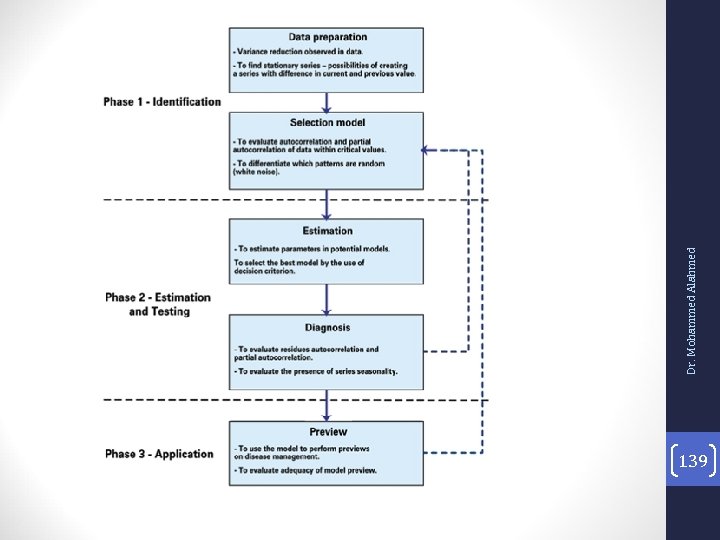
• The Box-Jenkins methodology refers to a set of procedures for identifying, fitting, and checking ARIMA models with time series data. Forecasts follow directly from the form of fitted model. • The basis of BOX-Jenkins approach to modeling time series consists of three phases: Identification Estimation and testing Dr. Mohammed Alahmed Introduction Application 6
Introduction 1. Identification • Transform data to stabilize variance • Differencing data to obtain stationary series b) Model selection • Examine data, ACF and PACF to identify potential models Dr. Mohammed Alahmed a) Data preparation 7
Introduction 2. Estimation and testing • Estimate parameters in potential models • Select best model using suitable criterion b) Diagnostics • Check ACF/PACF of residuals • Do portmanteau test of residuals • Are the residuals white noise? Dr. Mohammed Alahmed a) Estimation 3. Application • Forecasting: use model to forecast 8
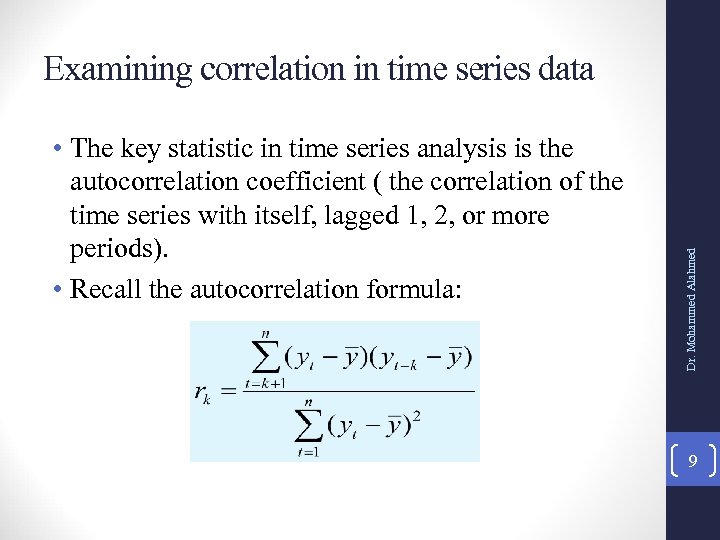
• The key statistic in time series analysis is the autocorrelation coefficient ( the correlation of the time series with itself, lagged 1, 2, or more periods). • Recall the autocorrelation formula: Dr. Mohammed Alahmed Examining correlation in time series data 9
• Recall r 1 indicates how successive values of Y relate to each other, r 2 indicates how Y values two periods apart relate to each other, and so on. • The auto correlations at lag 1, 2, …, make up the autocorrelation function or ACF. • Autocorrelation function is a valuable tool for investigating properties of an empirical time series. Dr. Mohammed Alahmed Examining Correlation in Time Series Data 10
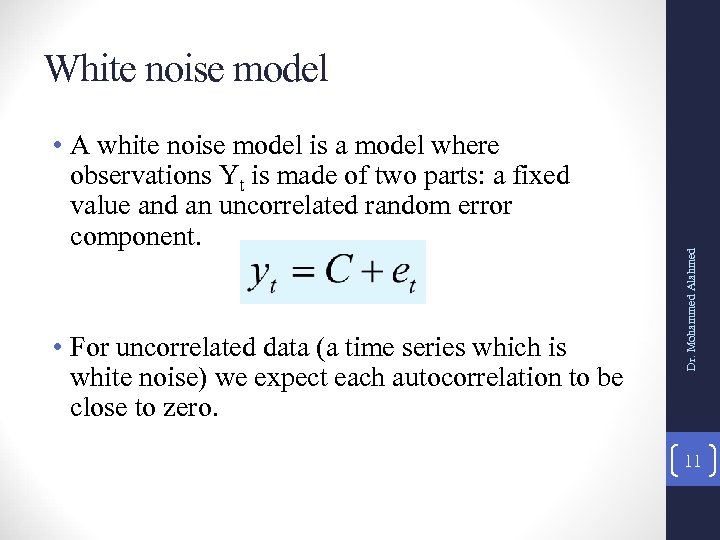
• A white noise model is a model where observations Yt is made of two parts: a fixed value and an uncorrelated random error component. • For uncorrelated data (a time series which is white noise) we expect each autocorrelation to be close to zero. Dr. Mohammed Alahmed White noise model 11
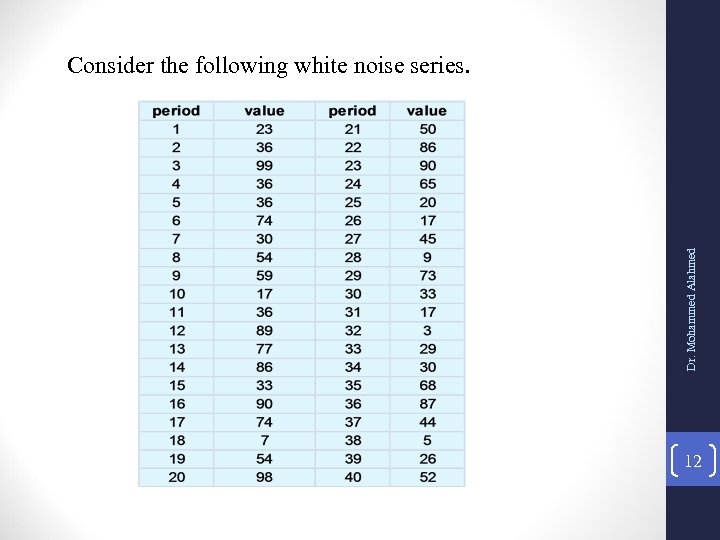
Dr. Mohammed Alahmed Consider the following white noise series. 12
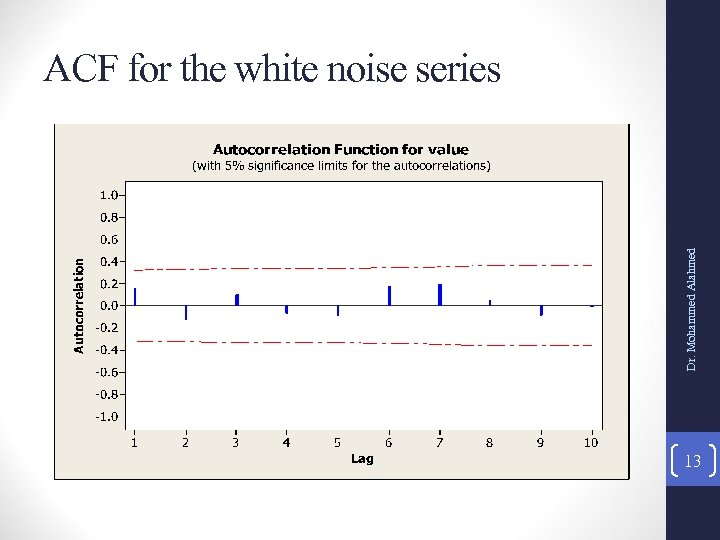
Dr. Mohammed Alahmed ACF for the white noise series 13
• The autocorrelation coefficients of white noise data have a sampling distribution that can be approximated by a normal distribution with mean zero and standard error 1/ n. where n is the number of observations in the series. • This information can be used to develop tests of hypotheses and confidence intervals for ACF. Dr. Mohammed Alahmed Sampling distribution of autocorrelation 14
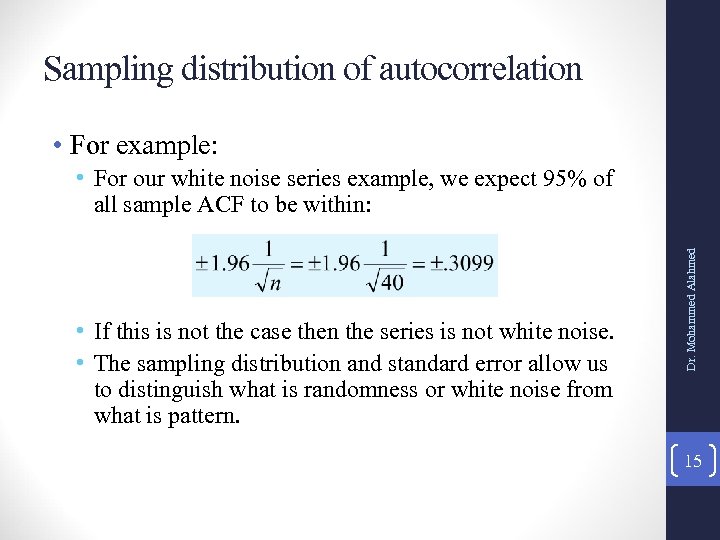
Sampling distribution of autocorrelation • For example: • If this is not the case then the series is not white noise. • The sampling distribution and standard error allow us to distinguish what is randomness or white noise from what is pattern. Dr. Mohammed Alahmed • For our white noise series example, we expect 95% of all sample ACF to be within: 15
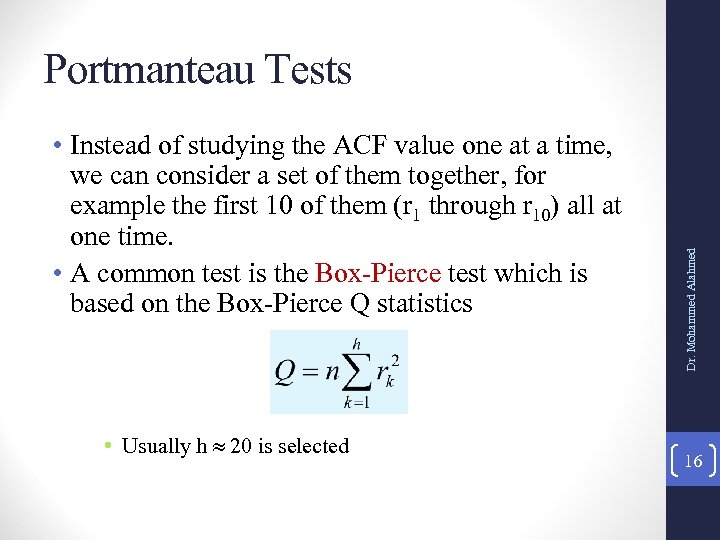
• Instead of studying the ACF value one at a time, we can consider a set of them together, for example the first 10 of them (r 1 through r 10) all at one time. • A common test is the Box-Pierce test which is based on the Box-Pierce Q statistics • Usually h 20 is selected Dr. Mohammed Alahmed Portmanteau Tests 16
• This test was originally developed by Box and Pierce for testing the residuals from a forecast model. • Any good forecast model should have forecast errors which follow a white noise model. • If the series is white noise then, the Q-statistic has a chi-square distribution with (h-m) degrees of freedom, where m is the number of parameters in the model which has been fitted to the data. • The test can easily be applied to raw data, when no model has been fitted , by setting m = 0. Dr. Mohammed Alahmed Portmanteau Tests 17
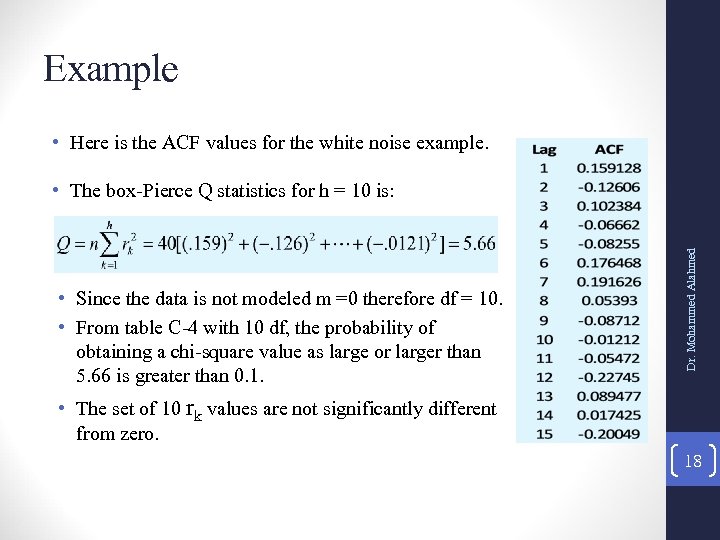
Example • Here is the ACF values for the white noise example. • Since the data is not modeled m =0 therefore df = 10. • From table C-4 with 10 df, the probability of obtaining a chi-square value as large or larger than 5. 66 is greater than 0. 1. Dr. Mohammed Alahmed • The box-Pierce Q statistics for h = 10 is: • The set of 10 rk values are not significantly different from zero. 18
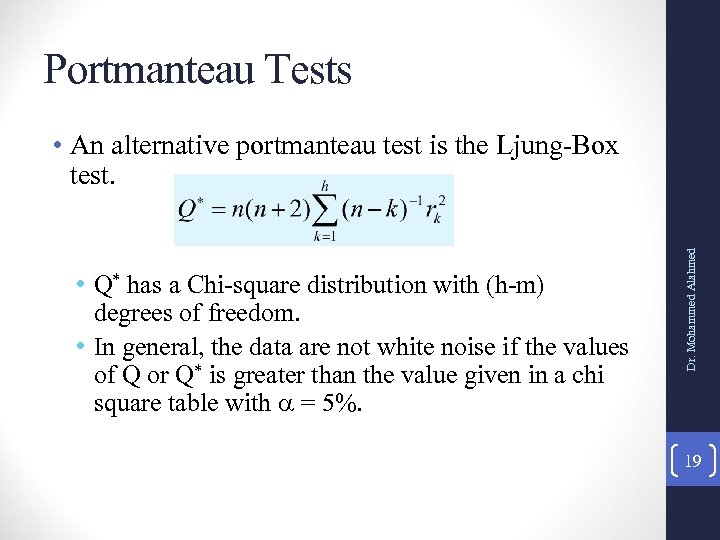
Portmanteau Tests • Q* has a Chi-square distribution with (h-m) degrees of freedom. • In general, the data are not white noise if the values of Q or Q* is greater than the value given in a chi square table with = 5%. Dr. Mohammed Alahmed • An alternative portmanteau test is the Ljung-Box test. 19
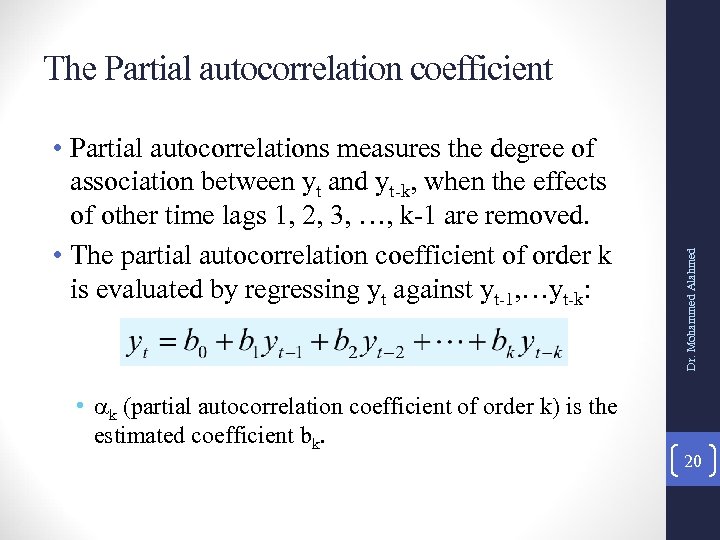
• Partial autocorrelations measures the degree of association between yt and yt-k, when the effects of other time lags 1, 2, 3, …, k-1 are removed. • The partial autocorrelation coefficient of order k is evaluated by regressing yt against yt-1, …yt-k: • k (partial autocorrelation coefficient of order k) is the estimated coefficient bk. Dr. Mohammed Alahmed The Partial autocorrelation coefficient 20
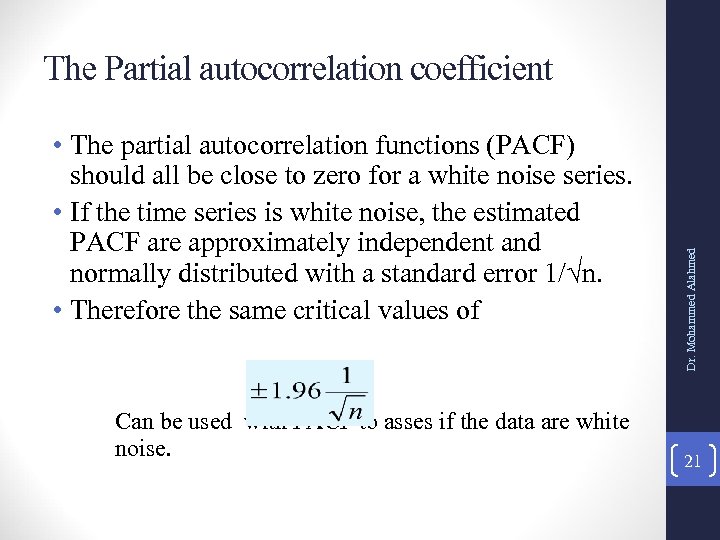
• The partial autocorrelation functions (PACF) should all be close to zero for a white noise series. • If the time series is white noise, the estimated PACF are approximately independent and normally distributed with a standard error 1/ n. • Therefore the same critical values of Can be used with PACF to asses if the data are white noise. Dr. Mohammed Alahmed The Partial autocorrelation coefficient 21
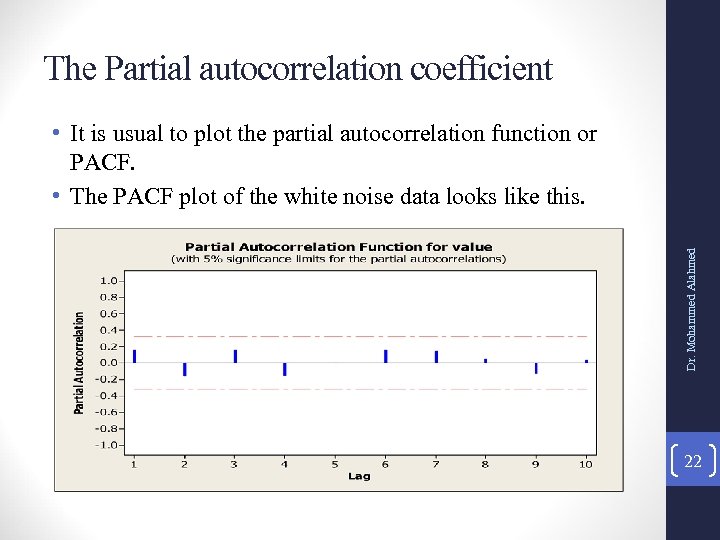
The Partial autocorrelation coefficient Dr. Mohammed Alahmed • It is usual to plot the partial autocorrelation function or PACF. • The PACF plot of the white noise data looks like this. 22
• Stationarity means no growth or decline. • Data fluctuates around a constant mean independent of time and variance of the fluctuation remains constant over time. • Stationarity can be assessed using a time series plot: • Plot shows no change in the mean over time • No obvious change in the variance over time. Dr. Mohammed Alahmed Examining stationarity of time series data 23
Examining stationarity of time series data • • Significant autocorrelation for several time lags and slow decline in rk indicate non-stationarity. The following graph shows the seasonally adjusted sales for Gap stores from 1985 to 2003. Dr. Mohammed Alahmed • The autocorrelation plot can also show nonstationarity. 24
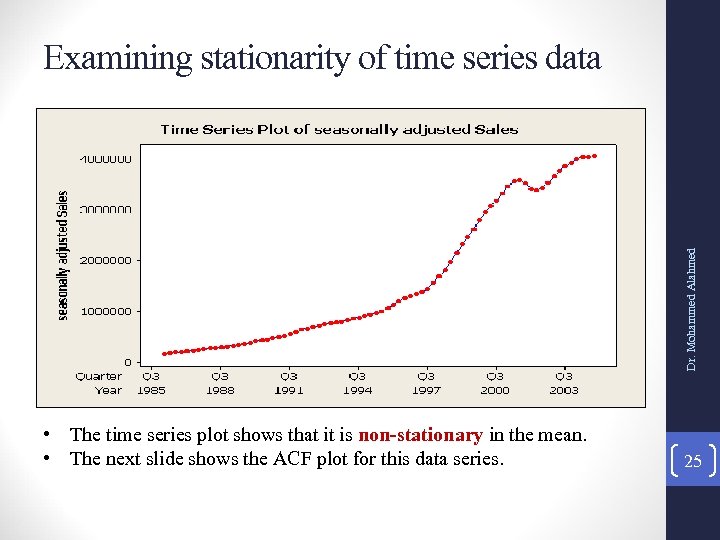
Dr. Mohammed Alahmed Examining stationarity of time series data • The time series plot shows that it is non-stationary in the mean. • The next slide shows the ACF plot for this data series. 25
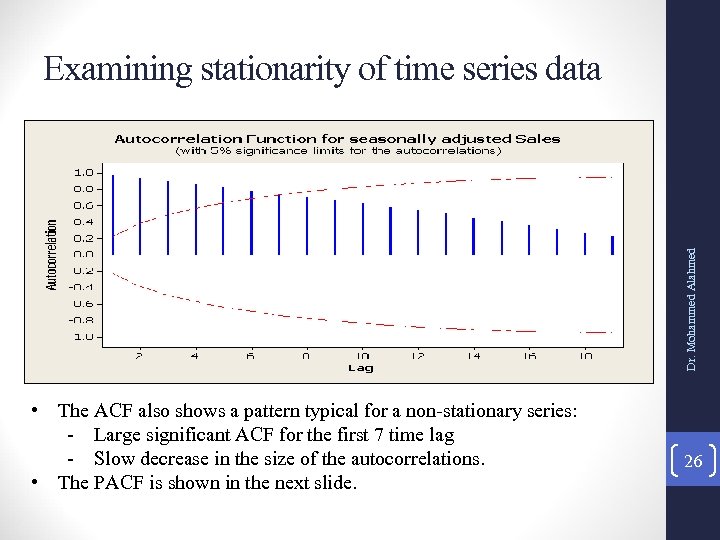
Dr. Mohammed Alahmed Examining stationarity of time series data • The ACF also shows a pattern typical for a non-stationary series: - Large significant ACF for the first 7 time lag - Slow decrease in the size of the autocorrelations. • The PACF is shown in the next slide. 26
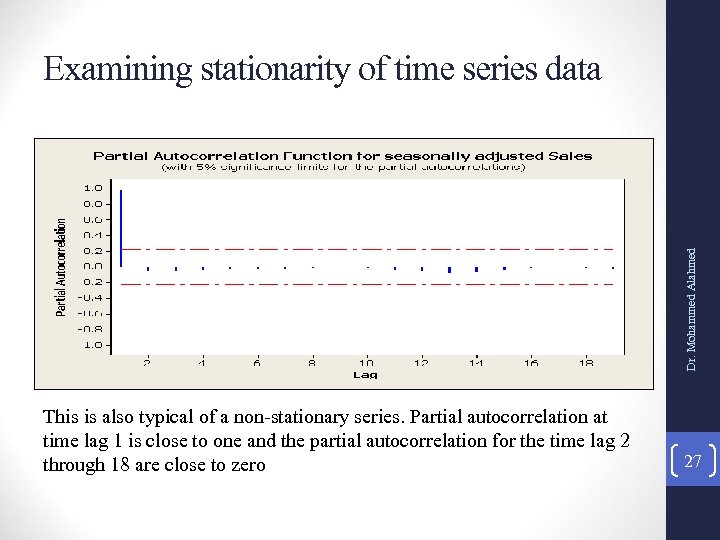
Dr. Mohammed Alahmed Examining stationarity of time series data This is also typical of a non-stationary series. Partial autocorrelation at time lag 1 is close to one and the partial autocorrelation for the time lag 2 through 18 are close to zero 27
• The non-stationary pattern in a time series data needs to be removed in order that other correlation structure present in the series can be seen before proceeding with model building. • One way of removing non-stationarity is through the method of differencing. Dr. Mohammed Alahmed Removing non-stationarity in time series 28
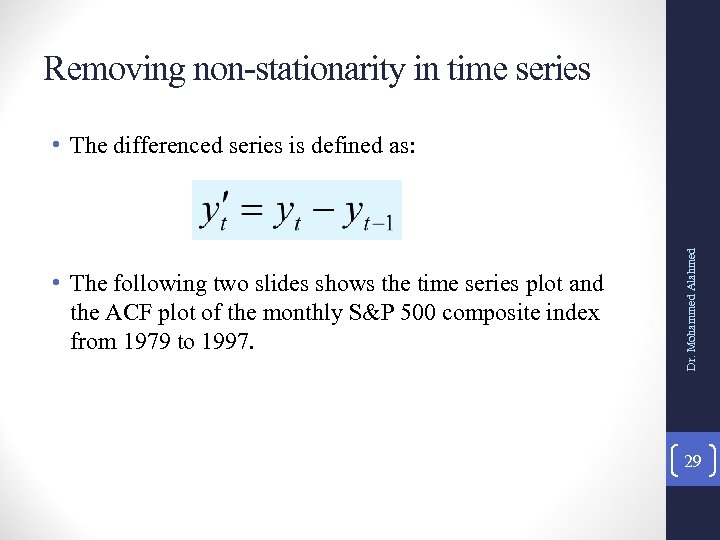
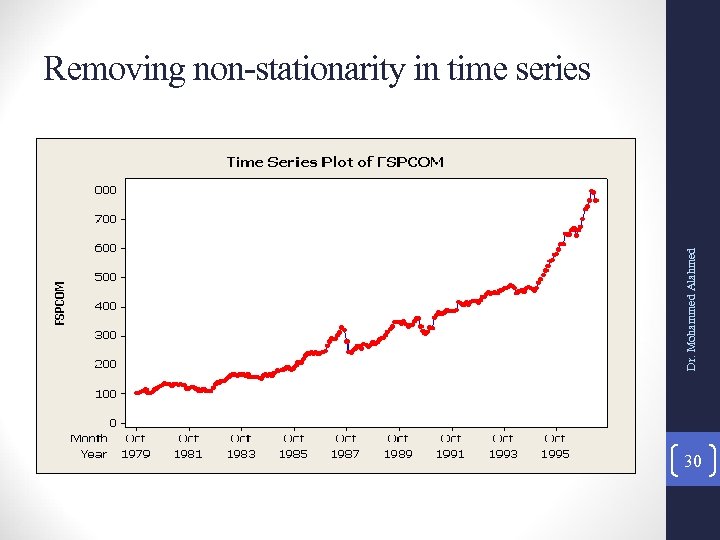
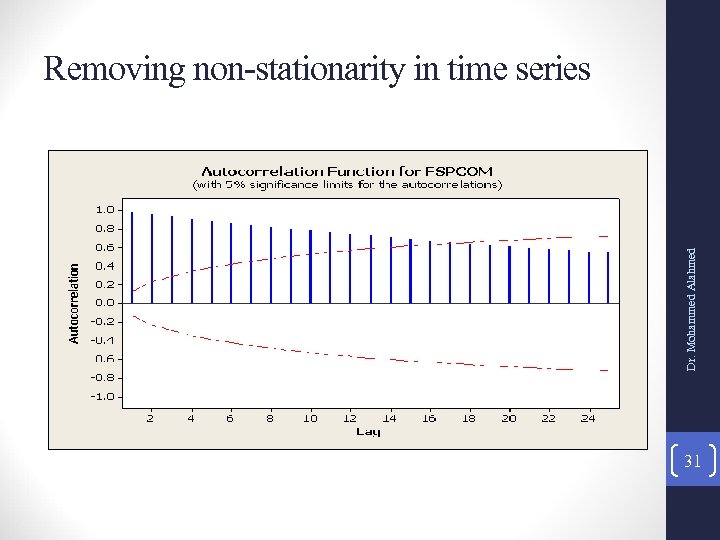
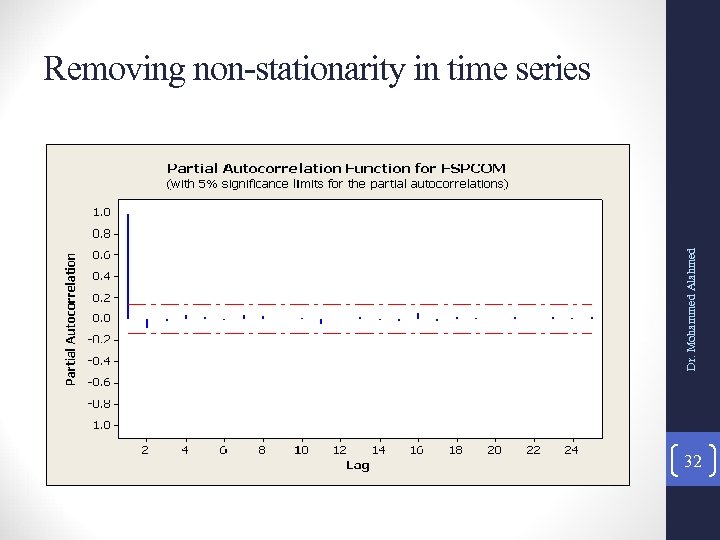
Removing non-stationarity in time series • The following two slides shows the time series plot and the ACF plot of the monthly S&P 500 composite index from 1979 to 1997. Dr. Mohammed Alahmed • The differenced series is defined as: 29
Dr. Mohammed Alahmed Removing non-stationarity in time series 30
Dr. Mohammed Alahmed Removing non-stationarity in time series 31
Dr. Mohammed Alahmed Removing non-stationarity in time series 32
• The time plot shows that it is not stationary in the mean. • The ACF and PACF plot also display a pattern typical for non-stationary pattern. • Taking the first difference of the S& P 500 composite index data represents the monthly changes in the S&P 500 composite index. Dr. Mohammed Alahmed Removing non-stationarity in time series 33
• The time series plot and the ACF and PACF plots indicate that the first difference has removed the growth in the time series data. • The series looks just like a white noise with almost no autocorrelation or partial autocorrelation outside the 95% limits. Dr. Mohammed Alahmed Removing non-stationarity in time series 34
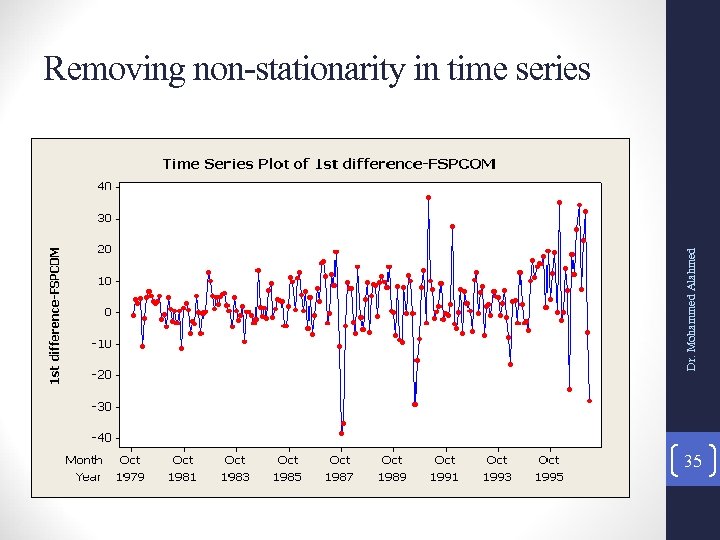
Dr. Mohammed Alahmed Removing non-stationarity in time series 35
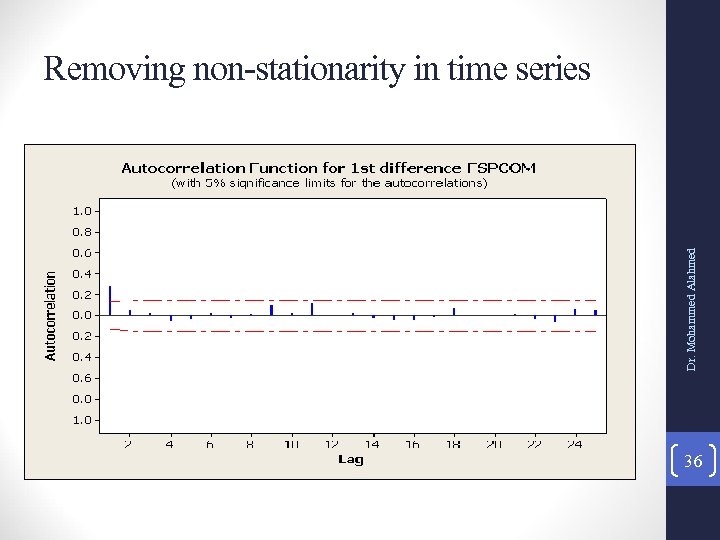
Dr. Mohammed Alahmed Removing non-stationarity in time series 36
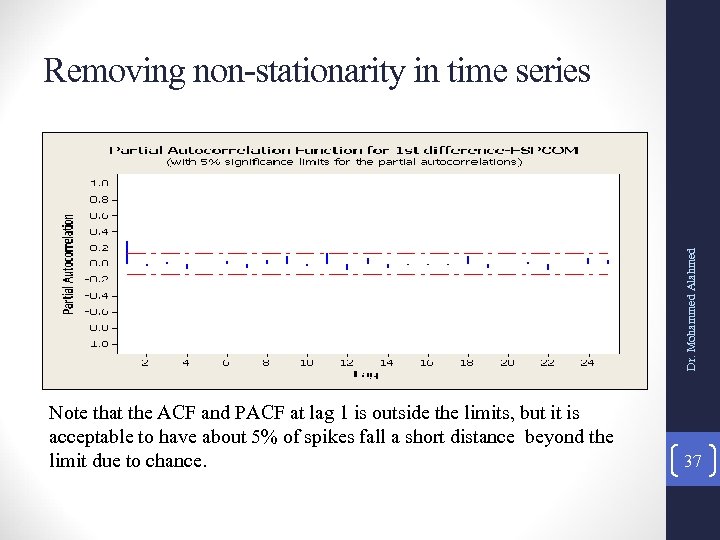
Dr. Mohammed Alahmed Removing non-stationarity in time series Note that the ACF and PACF at lag 1 is outside the limits, but it is acceptable to have about 5% of spikes fall a short distance beyond the limit due to chance. 37
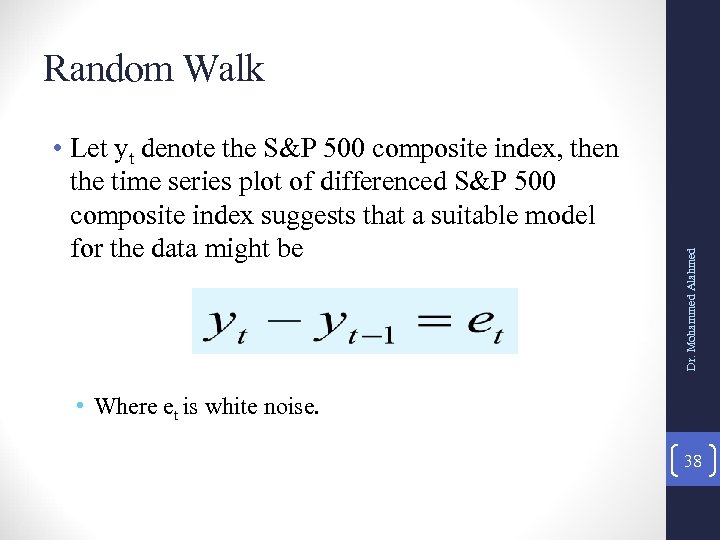
• Let yt denote the S&P 500 composite index, then the time series plot of differenced S&P 500 composite index suggests that a suitable model for the data might be Dr. Mohammed Alahmed Random Walk • Where et is white noise. 38
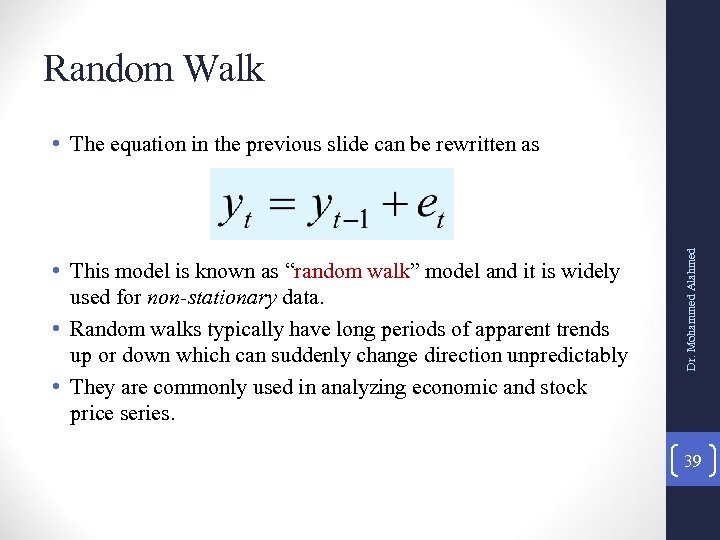
Random Walk • This model is known as “random walk” model and it is widely used for non-stationary data. • Random walks typically have long periods of apparent trends up or down which can suddenly change direction unpredictably • They are commonly used in analyzing economic and stock price series. Dr. Mohammed Alahmed • The equation in the previous slide can be rewritten as 39
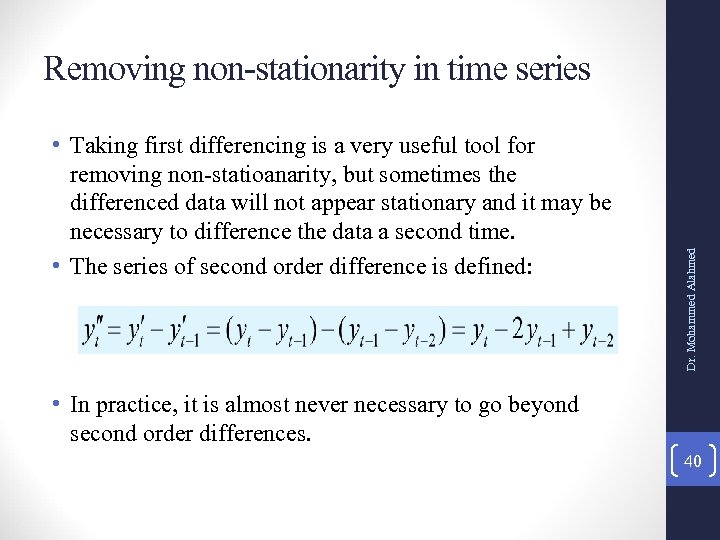
• Taking first differencing is a very useful tool for removing non-statioanarity, but sometimes the differenced data will not appear stationary and it may be necessary to difference the data a second time. • The series of second order difference is defined: Dr. Mohammed Alahmed Removing non-stationarity in time series • In practice, it is almost never necessary to go beyond second order differences. 40
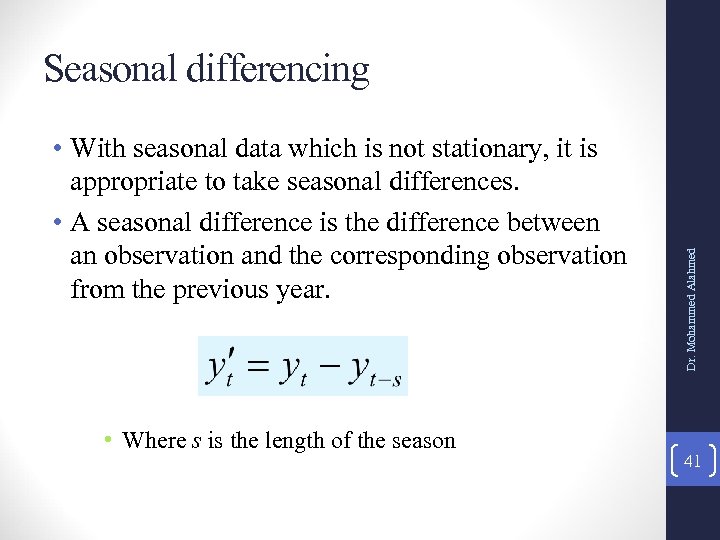
• With seasonal data which is not stationary, it is appropriate to take seasonal differences. • A seasonal difference is the difference between an observation and the corresponding observation from the previous year. • Where s is the length of the season Dr. Mohammed Alahmed Seasonal differencing 41
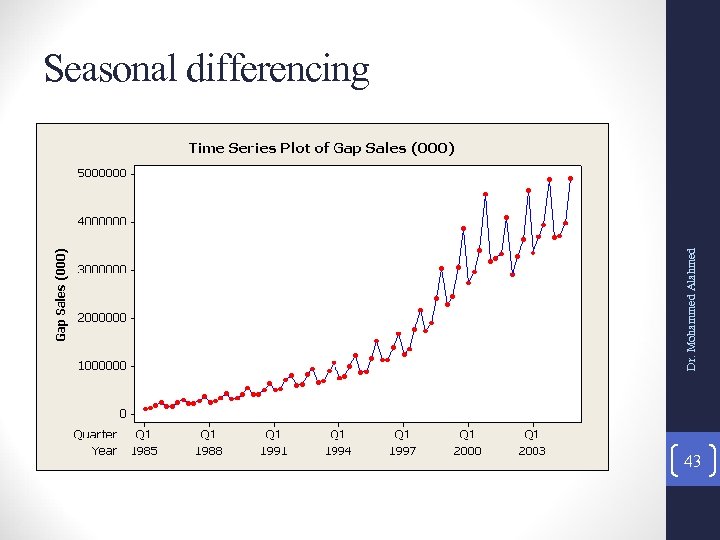
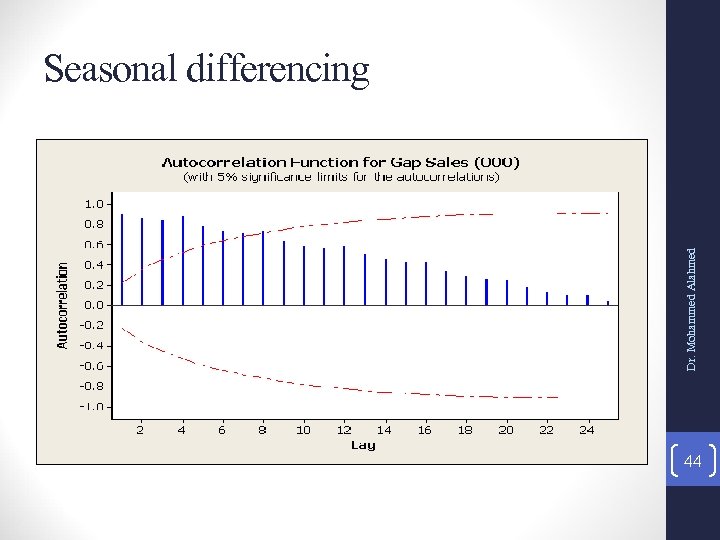
• The Gap quarterly sales is an example of a nonstationary seasonal data. • The following time series plot show a trend with a pronounced seasonal component • The auto correlations show that: • The series is non-stationary. • The series is seasonal. Dr. Mohammed Alahmed Seasonal differencing 42
Dr. Mohammed Alahmed Seasonal differencing 43
Dr. Mohammed Alahmed Seasonal differencing 44
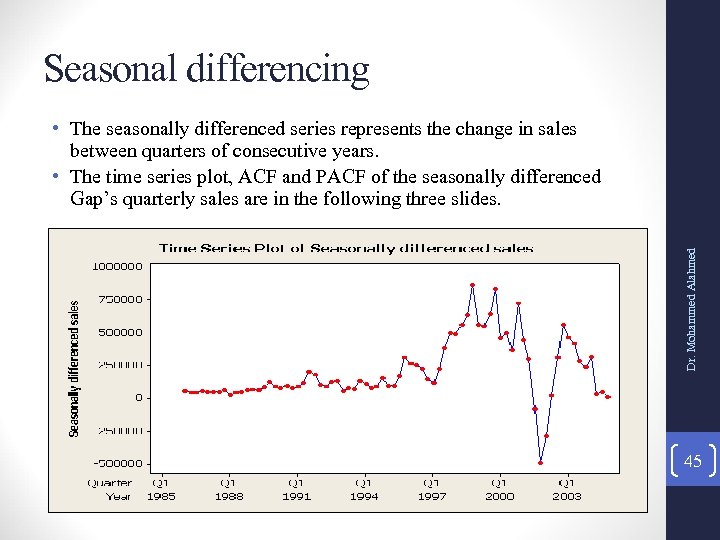
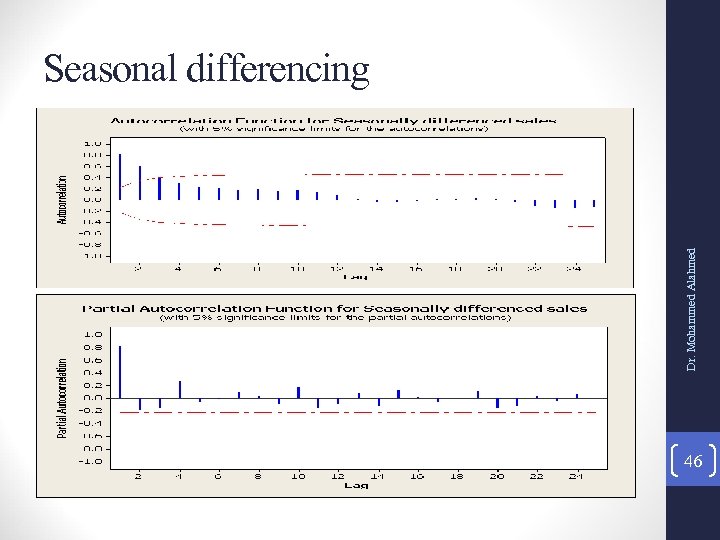
Seasonal differencing Dr. Mohammed Alahmed • The seasonally differenced series represents the change in sales between quarters of consecutive years. • The time series plot, ACF and PACF of the seasonally differenced Gap’s quarterly sales are in the following three slides. 45
Dr. Mohammed Alahmed Seasonal differencing 46
• The series is now much closer to being stationary, but more than 5% of the spikes are beyond 95% critical limits and autocorrelation show gradual decline in values. • The seasonality is still present as shown by spike at time lag 4 in the PACF. • The remaining non-stationarity in the mean can be removed with a further first difference. • When both seasonal and first differences are applied, it does not make no difference which is done first. Dr. Mohammed Alahmed Seasonal differencing 47
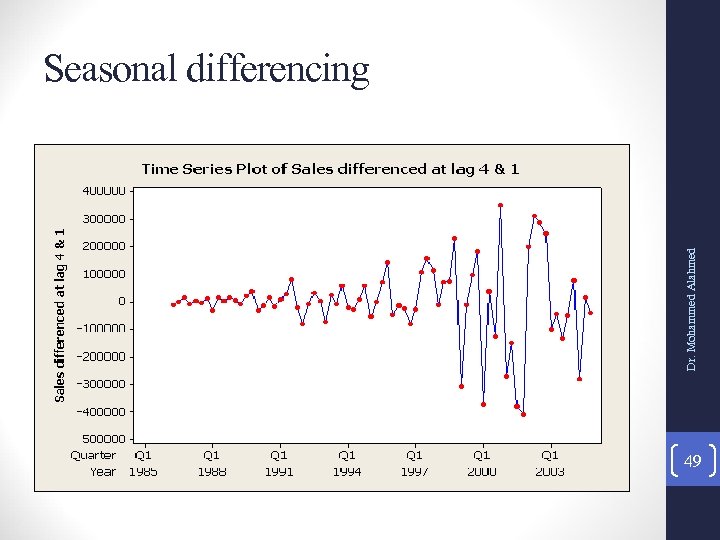
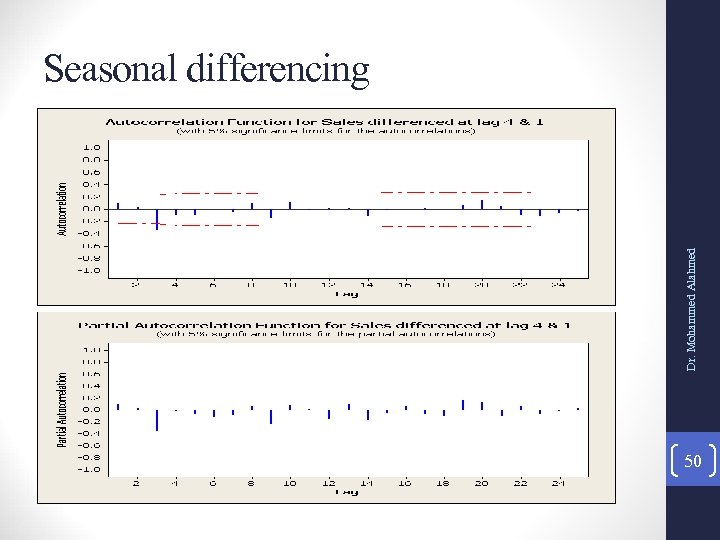
• It is recommended to do the seasonal differencing first since sometimes the resulting series will be stationary and hence no need for a further first difference. • When differencing is used, it is important that the differences be interpretable. • The series resulted from first difference of seasonally differenced Gap’s quarterly sales data is reported in the following three slides. • Is the resulting series white noise? Dr. Mohammed Alahmed Seasonal differencing 48
Dr. Mohammed Alahmed Seasonal differencing 49
Dr. Mohammed Alahmed Seasonal differencing 50
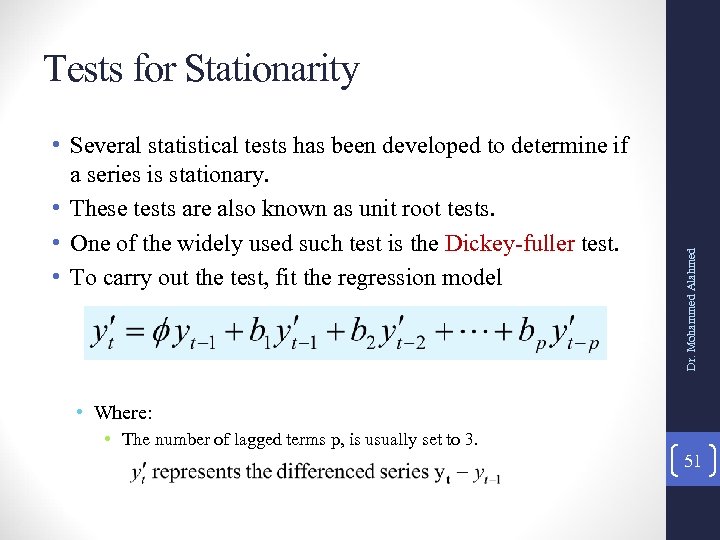
• Several statistical tests has been developed to determine if a series is stationary. • These tests are also known as unit root tests. • One of the widely used such test is the Dickey-fuller test. • To carry out the test, fit the regression model Dr. Mohammed Alahmed Tests for Stationarity • Where: • The number of lagged terms p, is usually set to 3. 51
• The value of is estimated using ordinary least squares. • If the original series yt needs differencing, the estimated value of will be close to zero. • If yt is already stationary, the estimated value of will be negative. Dr. Mohammed Alahmed Tests for Stationarity 52
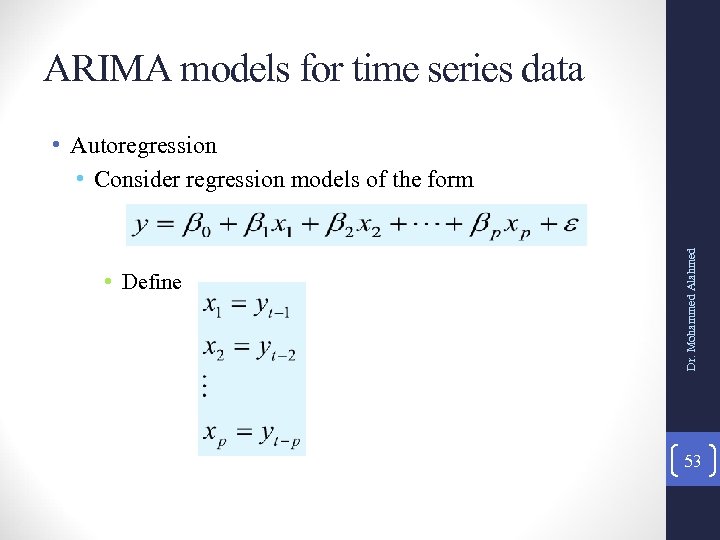
ARIMA models for time series data • Define Dr. Mohammed Alahmed • Autoregression • Consider regression models of the form 53
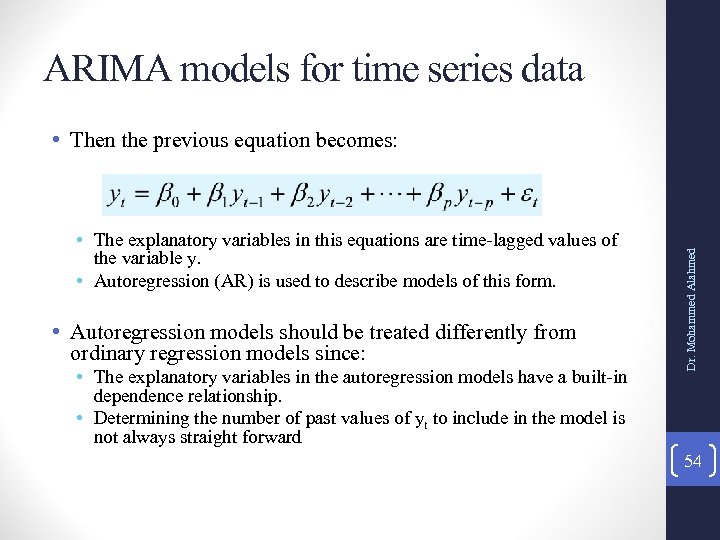
ARIMA models for time series data • The explanatory variables in this equations are time-lagged values of the variable y. • Autoregression (AR) is used to describe models of this form. • Autoregression models should be treated differently from ordinary regression models since: • The explanatory variables in the autoregression models have a built-in dependence relationship. • Determining the number of past values of yt to include in the model is not always straight forward Dr. Mohammed Alahmed • Then the previous equation becomes: 54
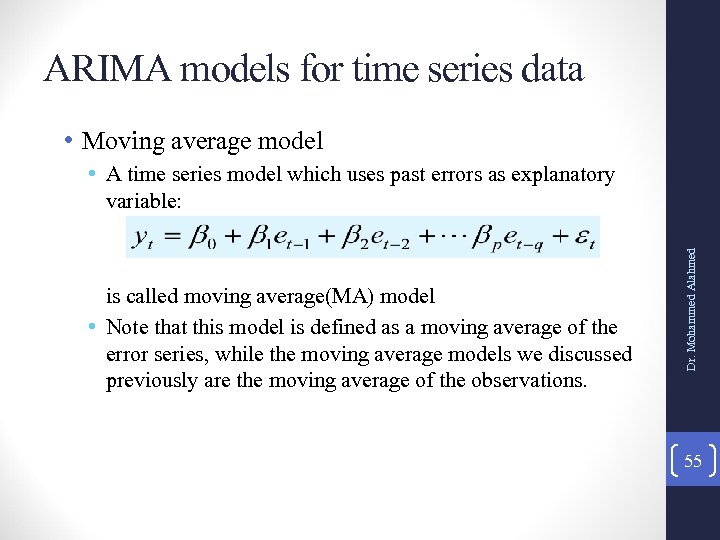
ARIMA models for time series data • Moving average model is called moving average(MA) model • Note that this model is defined as a moving average of the error series, while the moving average models we discussed previously are the moving average of the observations. Dr. Mohammed Alahmed • A time series model which uses past errors as explanatory variable: 55
• Autoregressive (AR) models can be coupled with moving average (MA) models to form a general and useful class of time series models called Autoregressive Moving Average (ARMA) models. • These can be used when the data are stationary. • This class of models can be extended to non-stationary series by allowing the differencing of the data series. • These are called Autoregressive Integrated Moving Average (ARIMA) models. • There a large variety of ARIMA models. Dr. Mohammed Alahmed ARIMA models for time series data 56
• The general non-seasonal model is known as ARIMA (p, d, q): • p is the number of autoregressive terms. • d is the number of differences. • q is the number of moving average terms. • A white noise model is classified as ARIMA (0, 0, 0) • No AR part since yt does not depend on yt-1 • There is no differencing involved. • No MA part since yt does not depend on et-1 Dr. Mohammed Alahmed ARIMA models for time series data 57
• A random walk model is classified as ARIMA (0, 1, 0) • There is no AR part. • There is no MA part. • There is one difference. • Note that if any of p, d, or q are equal to zero, the model can be written in a shorthand notation by dropping the unused part. • Example Dr. Mohammed Alahmed ARIMA models for time series data • ARIMA(2, 0, 0) = AR(2) • ARIMA (1, 0, 1) = ARMA(1, 1) 58
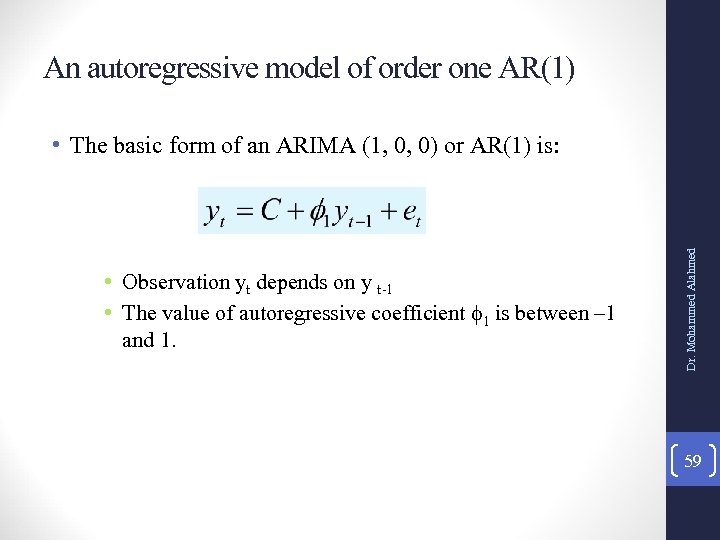
An autoregressive model of order one AR(1) • Observation yt depends on y t-1 • The value of autoregressive coefficient 1 is between – 1 and 1. Dr. Mohammed Alahmed • The basic form of an ARIMA (1, 0, 0) or AR(1) is: 59
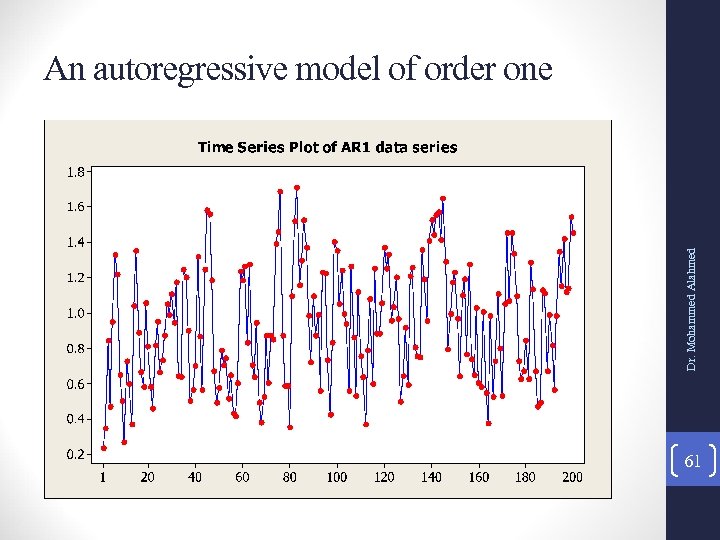
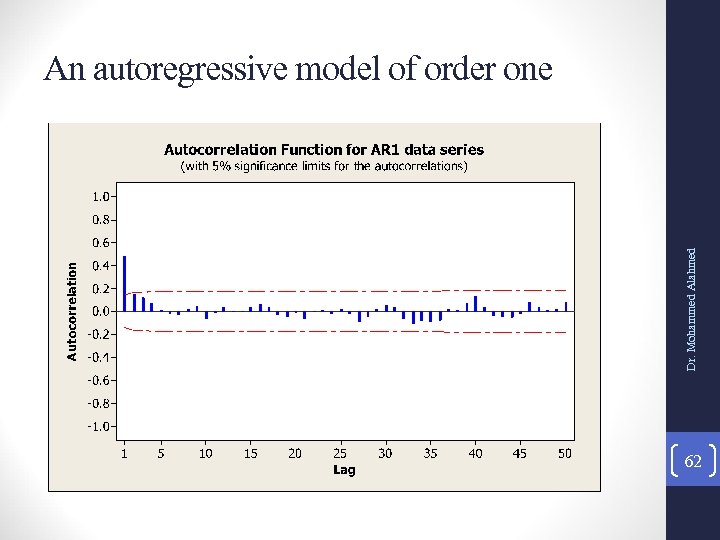
An autoregressive model of order one • When 1= 0, yt is equivalent to a white noise series. • When 1= 1, yt is equivalent to a random walk series • For negative values of 1, the series tends to oscillate between positive and negative values. • The following slides show the time series, ACF and PACF plot for an ARIMA(1, 0, 0) time series data. Dr. Mohammed Alahmed • The time plot of an AR(1) model varies with the parameter 1: 60
Dr. Mohammed Alahmed An autoregressive model of order one 61
Dr. Mohammed Alahmed An autoregressive model of order one 62
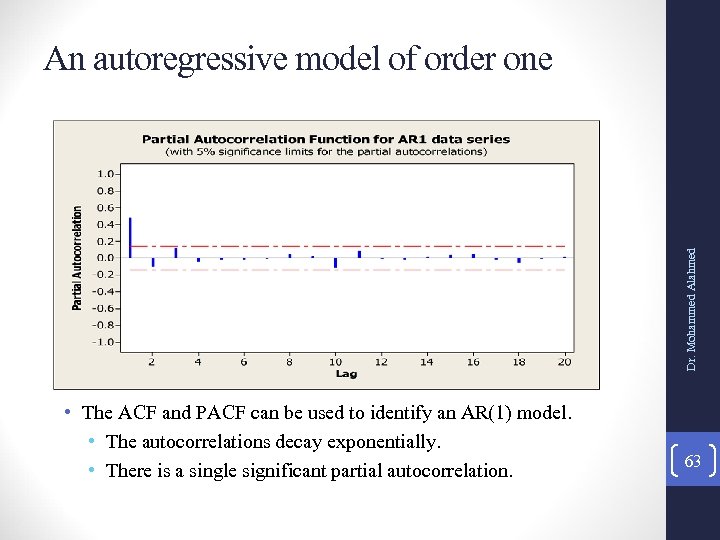
Dr. Mohammed Alahmed An autoregressive model of order one • The ACF and PACF can be used to identify an AR(1) model. • The autocorrelations decay exponentially. • There is a single significant partial autocorrelation. 63
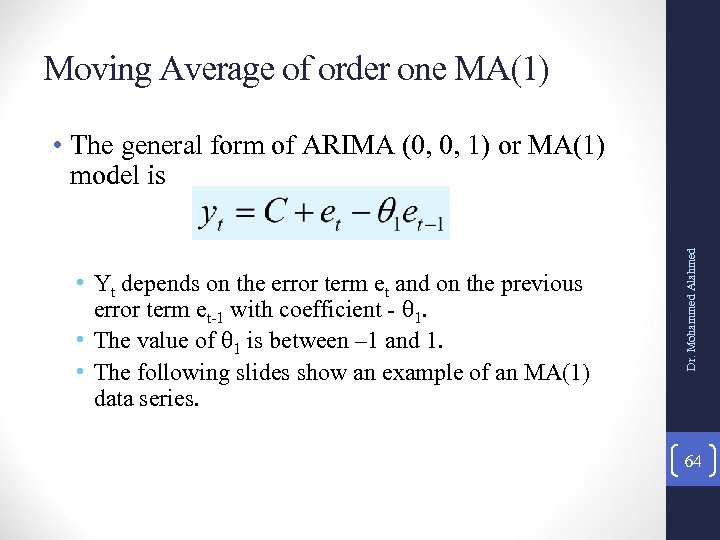
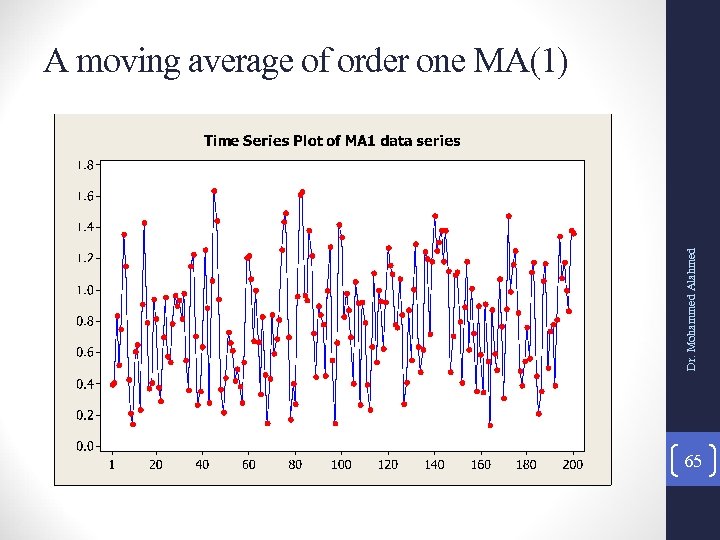
Moving Average of order one MA(1) • Yt depends on the error term et and on the previous error term et-1 with coefficient - 1. • The value of 1 is between – 1 and 1. • The following slides show an example of an MA(1) data series. Dr. Mohammed Alahmed • The general form of ARIMA (0, 0, 1) or MA(1) model is 64
Dr. Mohammed Alahmed A moving average of order one MA(1) 65
Dr. Mohammed Alahmed A moving average of order one MA(1) 66
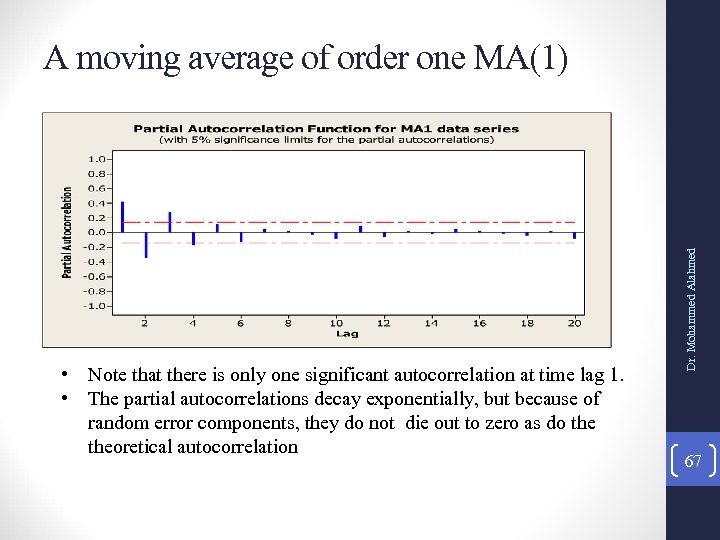
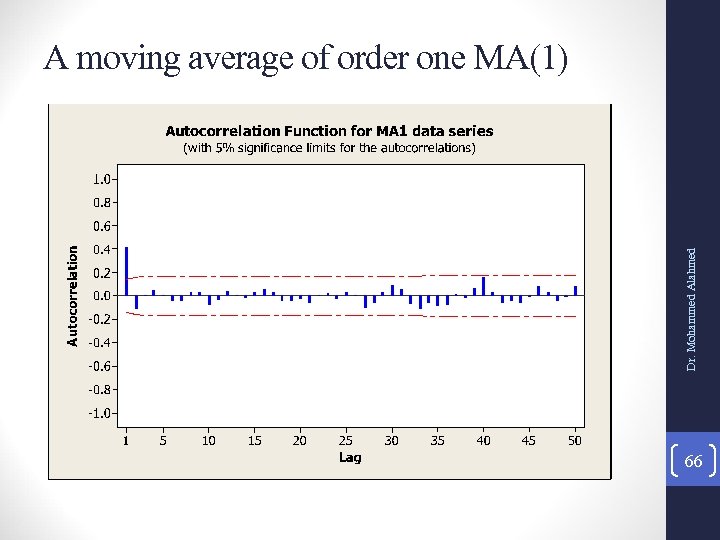
• Note that there is only one significant autocorrelation at time lag 1. • The partial autocorrelations decay exponentially, but because of random error components, they do not die out to zero as do theoretical autocorrelation Dr. Mohammed Alahmed A moving average of order one MA(1) 67
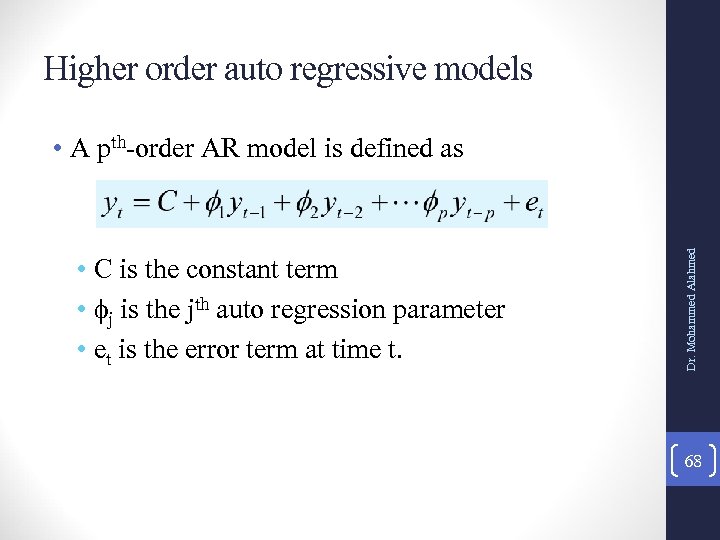
Higher order auto regressive models • C is the constant term • j is the jth auto regression parameter • et is the error term at time t. Dr. Mohammed Alahmed • A pth-order AR model is defined as 68
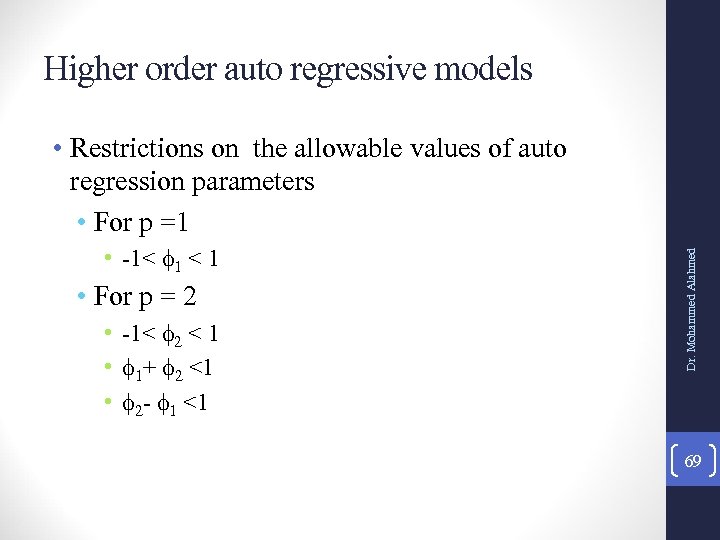
Higher order auto regressive models • -1< 1 • For p = 2 • -1< 2 < 1 • 1+ 2 <1 • 2 - 1 <1 Dr. Mohammed Alahmed • Restrictions on the allowable values of auto regression parameters • For p =1 69
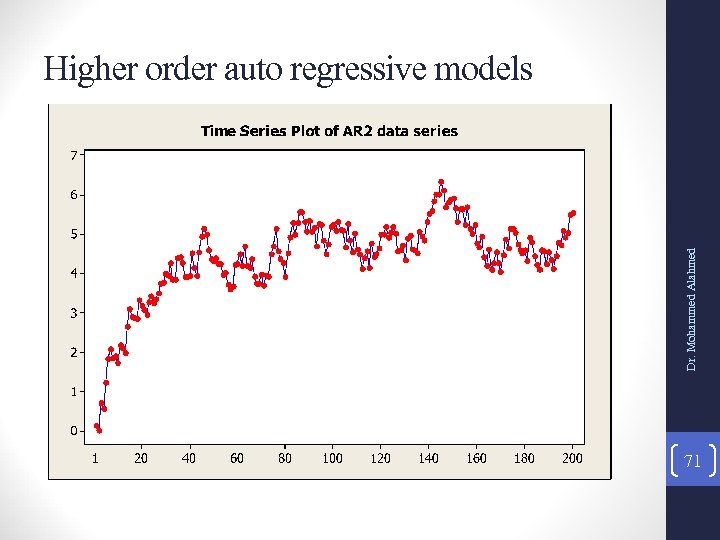
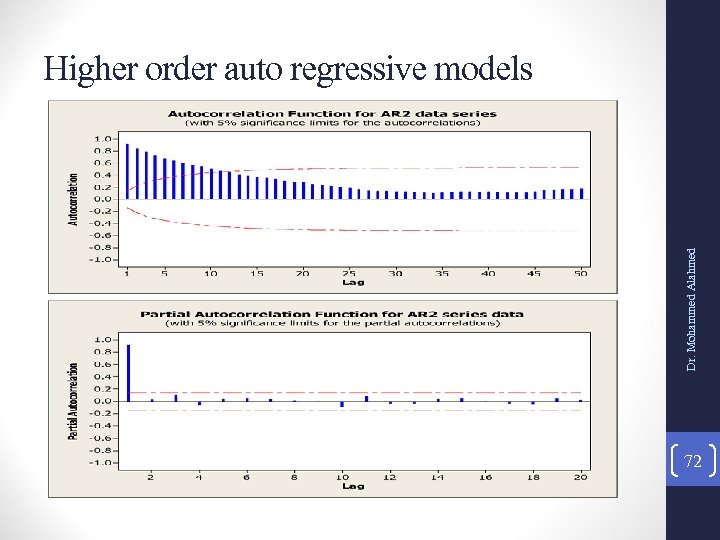
• A great variety of time series are possible with autoregressive models. • The following slides shows an AR(2) model. • Note that for AR(2) models the autocorrelations die out in a damped Sine-wave patterns. • There are exactly two significant partial autocorrelations. Dr. Mohammed Alahmed Higher order auto regressive models 70
Dr. Mohammed Alahmed Higher order auto regressive models 71
Dr. Mohammed Alahmed Higher order auto regressive models 72
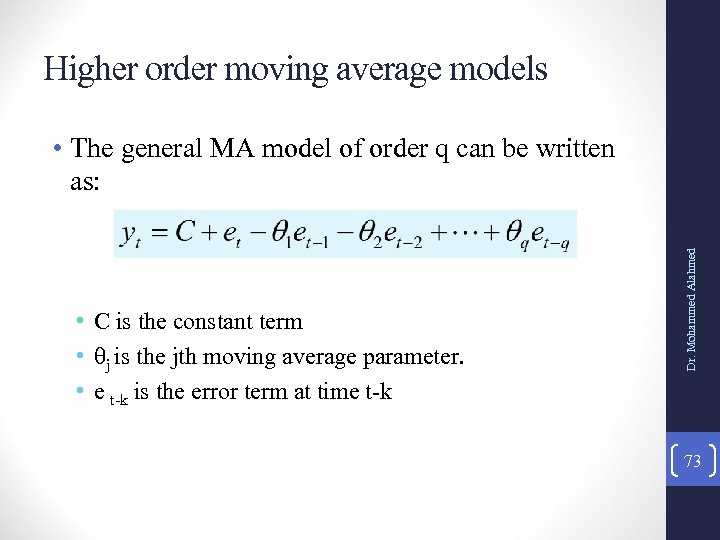
Higher order moving average models • C is the constant term • j is the jth moving average parameter. • e t-k is the error term at time t-k Dr. Mohammed Alahmed • The general MA model of order q can be written as: 73
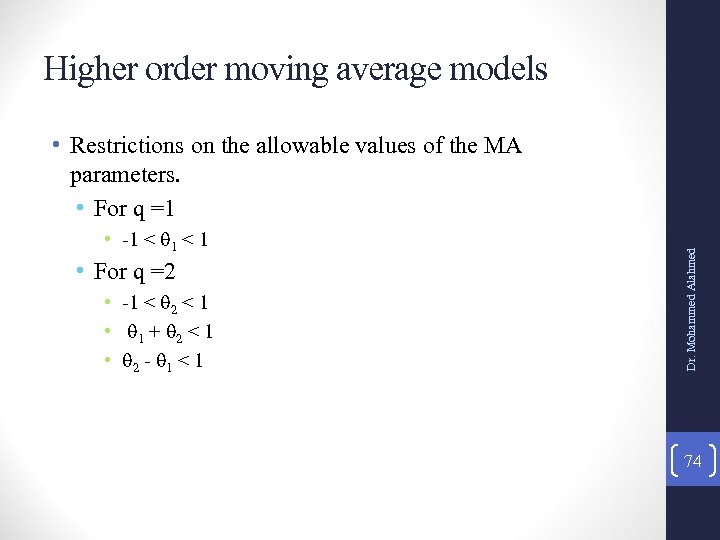
Higher order moving average models • -1 < 1 • For q =2 • -1 < 2 < 1 • 1 + 2 < 1 • 2 - 1 < 1 Dr. Mohammed Alahmed • Restrictions on the allowable values of the MA parameters. • For q =1 74
• A wide variety of time series can be produced using moving average models. • In general, the autocorrelations of an MA(q) models are zero beyond lag q • For q 2, the PACF can show exponential decay or damped sine-wave patterns. Dr. Mohammed Alahmed Higher order moving average models 75
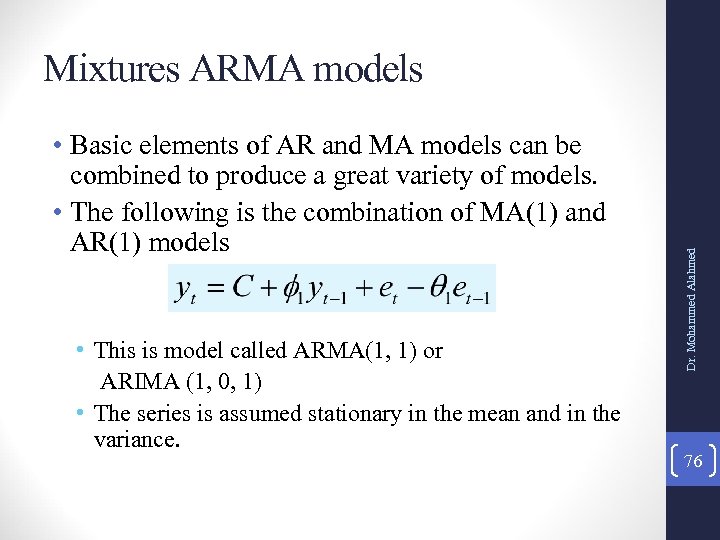
• Basic elements of AR and MA models can be combined to produce a great variety of models. • The following is the combination of MA(1) and AR(1) models • This is model called ARMA(1, 1) or ARIMA (1, 0, 1) • The series is assumed stationary in the mean and in the variance. Dr. Mohammed Alahmed Mixtures ARMA models 76
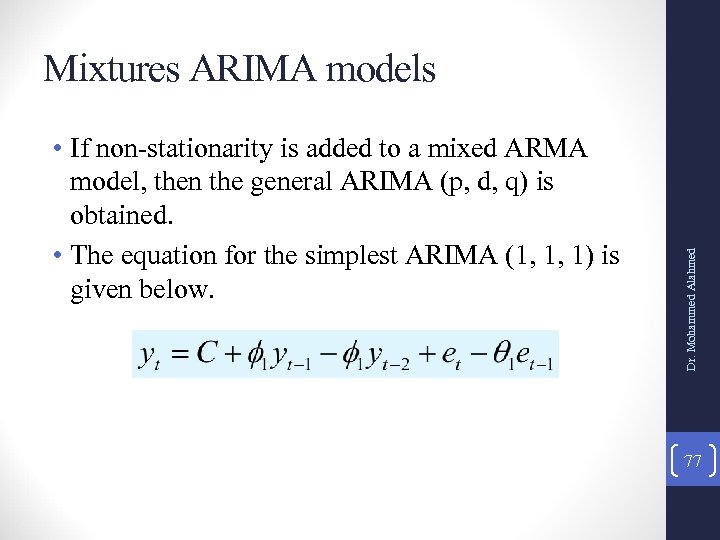
• If non-stationarity is added to a mixed ARMA model, then the general ARIMA (p, d, q) is obtained. • The equation for the simplest ARIMA (1, 1, 1) is given below. Dr. Mohammed Alahmed Mixtures ARIMA models 77
• The general ARIMA (p, d, q) model gives a tremendous variety of patterns in the ACF and PACF, so it is not practical to state rules for identifying general ARIMA models. • In practice, it is seldom necessary to deal with values p, d, or q that are larger than 0, 1, or 2. • It is remarkable that such a small range of values for p, d, or q can cover such a large range of practical forecasting situations. Dr. Mohammed Alahmed Mixtures ARIMA models 78
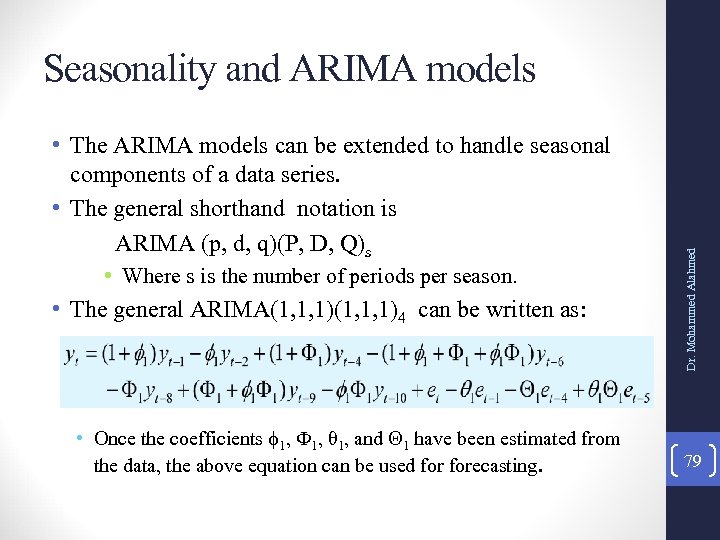
• The ARIMA models can be extended to handle seasonal components of a data series. • The general shorthand notation is ARIMA (p, d, q)(P, D, Q)s • Where s is the number of periods per season. • The general ARIMA(1, 1, 1)4 can be written as: • Once the coefficients 1, Ф 1, θ 1, and 1 have been estimated from the data, the above equation can be used forecasting. Dr. Mohammed Alahmed Seasonality and ARIMA models 79
Seasonality and ARIMA models • ARIMA(0, 0, 0)(0, 0, 1)12 • will show a spike at lag 12 in the ACF but no other significant spikes. • The PACF will show exponential decay in the seasonal lags i. e. at lags 12, 24, 36, … 2. Seasonal AR model: • ARIMA(0, 0, 0)(1, 0, 0)12 • will show exponential decay in seasonal lags of the ACF. • Single significant spike at lag 12 in the PACF. Dr. Mohammed Alahmed • The seasonal lags of the ACF and PACF plots show the seasonal parts of an AR or MA model. • Examples: 1. Seasonal MA model: 80
Implementing the model –Building Strategy 1. Selecting an initial model (model identification) 2. Estimating the model coefficients (parameter estimation) 3. Analyzing the residuals (model checking) • If necessary, the initial model is modified and the process is repeated until the residual indicate no further modification is necessary. • At this point the fitted model can be used forecasting. Dr. Mohammed Alahmed • The Box –Jenkins approach uses an iterative modelbuilding strategy that consist of: 81
• The following approach outlines an approach to select an appropriate model among a large variety of ARIMA models possible. • Plot the data • Identify any unusual observations • If necessary, transform the data to stabilize the variance • Check the time series plot, ACF, PACF of the data (possibly transformed) for stationarity. • IF • Time plot shows the data scattered horizontally around a constant mean • ACF and PACF to or near zero quickly • Then, the data are stationary. Dr. Mohammed Alahmed Model identification 82
Model identification • For no-seasonal data take first differences • For seasonal data take seasonal differences • Check the plots again if they appear non-stationary, take the differences of the differenced data. • When the stationarity has been achieved, check the ACF and PACF plots for any pattern remaining. Dr. Mohammed Alahmed • Use differencing to transform the data into a stationary series 83
Model identification • • No significant ACF after time lag q indicates MA(q) may be appropriate. No significant PACF after time lag p indicates that AR(p) may be appropriate. • Seasonality is present if ACF and/or PACF at the seasonal lags are large and significant. • If no clear MA or AR model is suggested, a mixture model may be appropriate Dr. Mohammed Alahmed • There are three possibilities: • AR or MA models 84
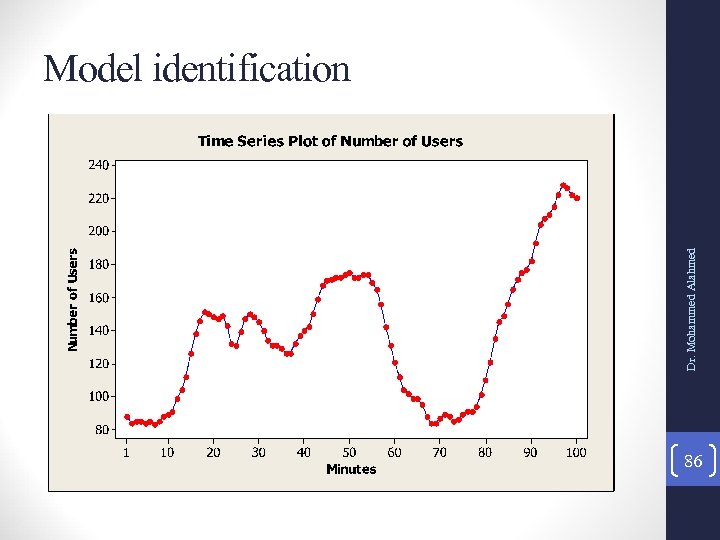
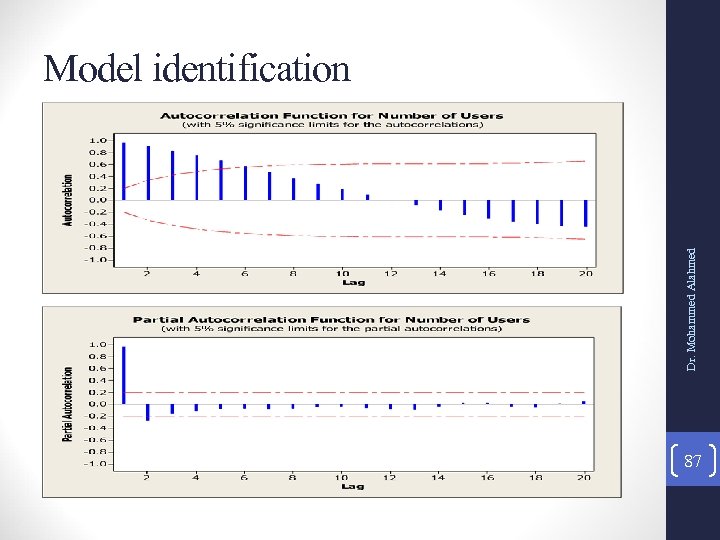
Model identification • The following example looks at the number of users logged onto an internet server over a 100 minutes period. • The time plot, ACF and PACF is reported in the following three slides. Dr. Mohammed Alahmed • Example (1): • Non seasonal time series data. 85
Dr. Mohammed Alahmed Model identification 86
Dr. Mohammed Alahmed Model identification 87
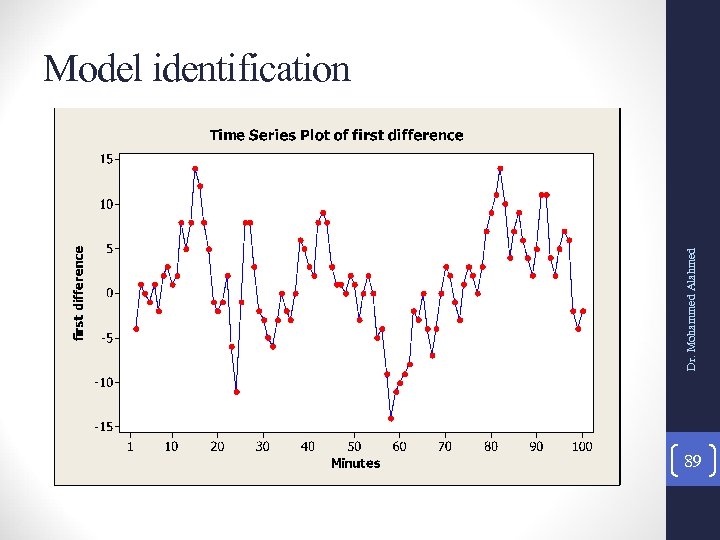
• The gradual decline of ACF values indicates nonstationary series. • The first partial autocorrelation is very dominant and close to 1, indicating non-stationarity. • The time series plot clearly indicates nonstationarity. • We take the first differences of the data and reanalyze. Dr. Mohammed Alahmed Model identification 88
Dr. Mohammed Alahmed Model identification 89
Dr. Mohammed Alahmed Model identification 90
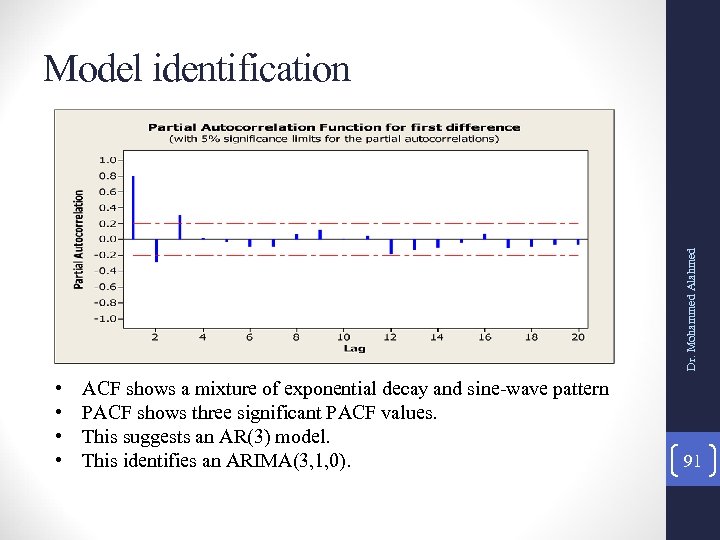
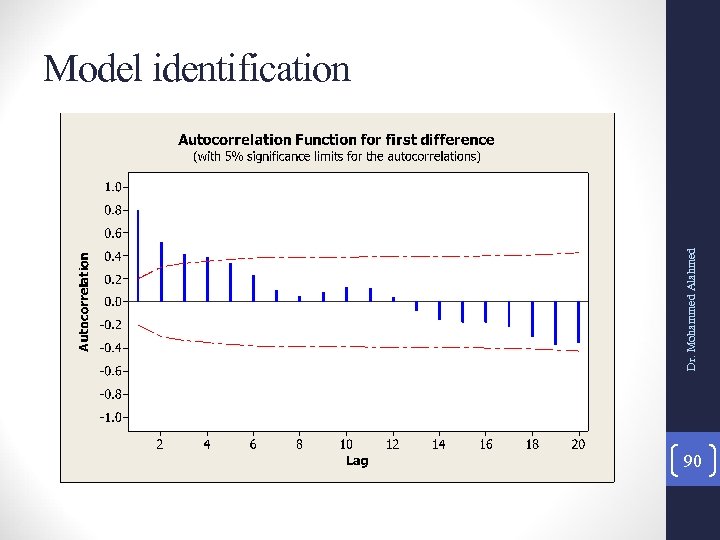
Dr. Mohammed Alahmed Model identification • • ACF shows a mixture of exponential decay and sine-wave pattern PACF shows three significant PACF values. This suggests an AR(3) model. This identifies an ARIMA(3, 1, 0). 91
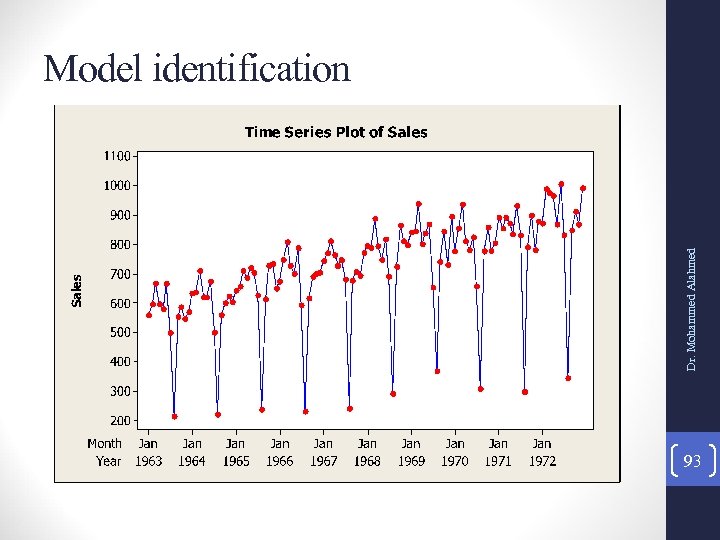
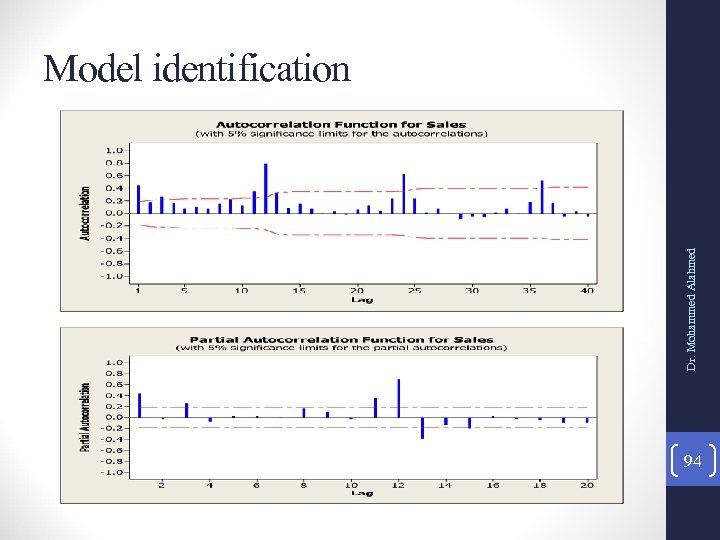
Model identification • The following example looks at the monthly industry sales (in thousands of francs) for printing and writing papers between the years 1963 and 1972. • The time plot, ACF and PACF shows a clear seasonal pattern in the data. • This is clear in the large values at time lag 12, 24 and 36. Dr. Mohammed Alahmed • Example (2): • A seasonal time series. 92
Dr. Mohammed Alahmed Model identification 93
Dr. Mohammed Alahmed Model identification 94
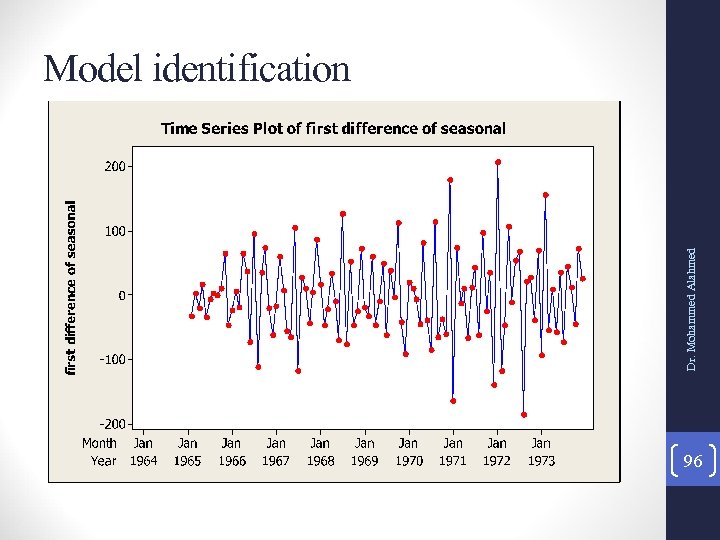
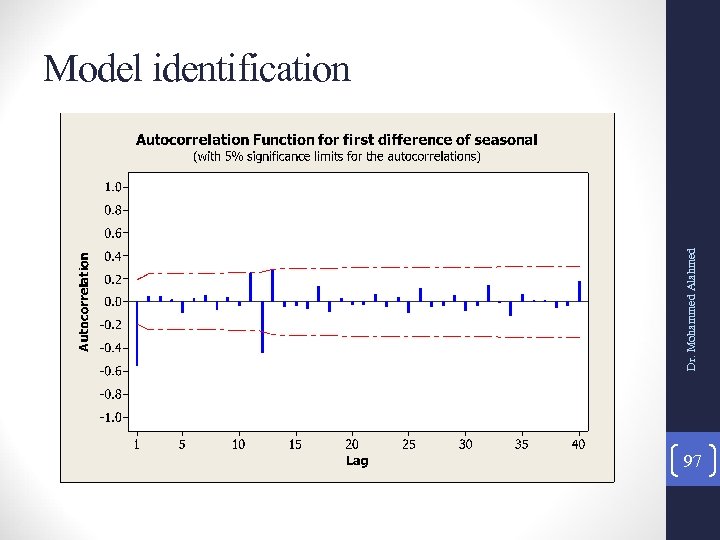
• We take a seasonal difference and check the time plot, ACF and PACF. • The seasonally differenced data appears to be nonstationary (the plots are not shown), so we difference the data again. • the following three slides show the twice differenced series. Dr. Mohammed Alahmed Model identification 95
Dr. Mohammed Alahmed Model identification 96
Dr. Mohammed Alahmed Model identification 97
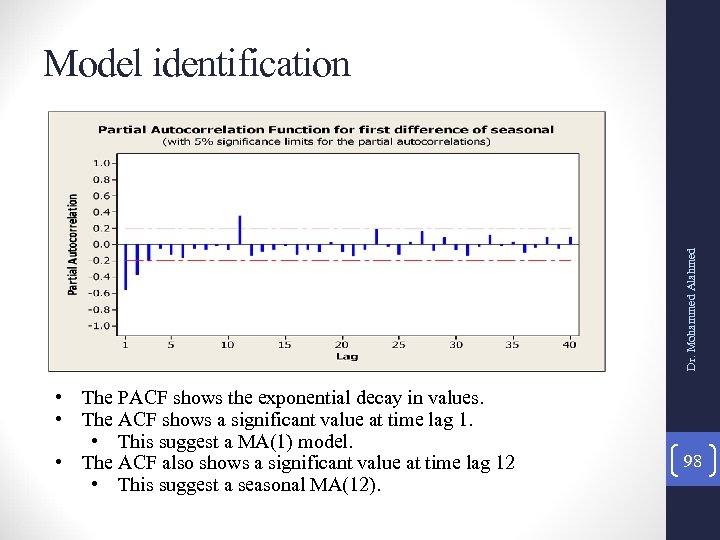
Dr. Mohammed Alahmed Model identification • The PACF shows the exponential decay in values. • The ACF shows a significant value at time lag 1. • This suggest a MA(1) model. • The ACF also shows a significant value at time lag 12 • This suggest a seasonal MA(12). 98
• Therefore, the identifies model is ARIMA (0, 1, 1)12. • This model is sometimes is called the “airline model” because it was applied to international airline data by Box and Jenkins. • It is one of the most commonly used seasonal ARIMA model. Dr. Mohammed Alahmed Model identification 99
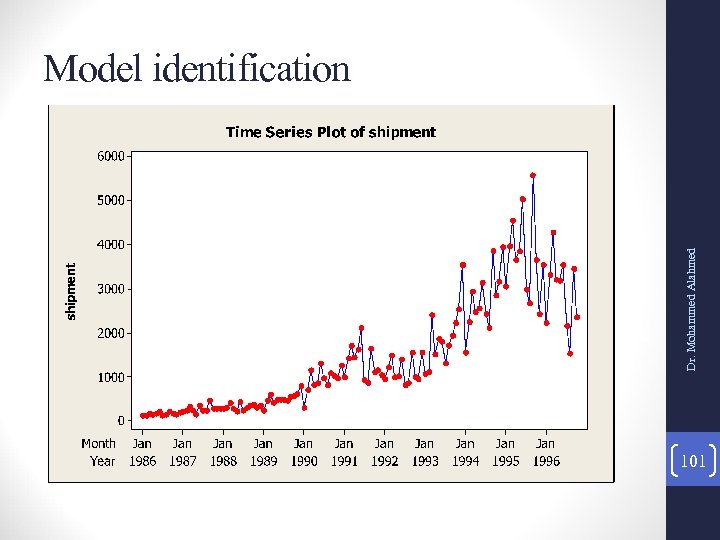
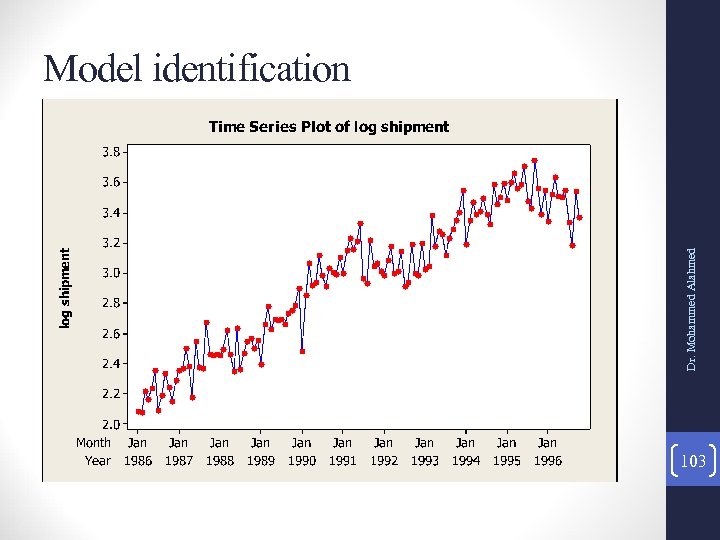
Model identification • In this example we look at the monthly shipments of a company that manufactures pollution equipment • The time plot shows that the variability increases as the time increases. This indicate that the data is non-stationary in the variance. Dr. Mohammed Alahmed • Example (3): • A seasonal data needing transformation 100
Dr. Mohammed Alahmed Model identification 101
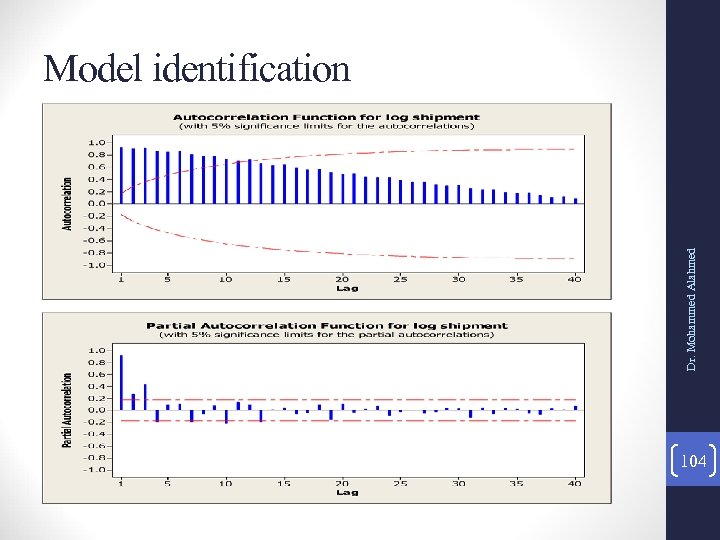
• We need to stabilize the variance before fitting an ARIMA model. • Logarithmic or power transformation of the data will make the variance stationary. • The time plot, ACF and PACF for the logged data is reported in the following three slides. Dr. Mohammed Alahmed Model identification 102
Dr. Mohammed Alahmed Model identification 103
Dr. Mohammed Alahmed Model identification 104
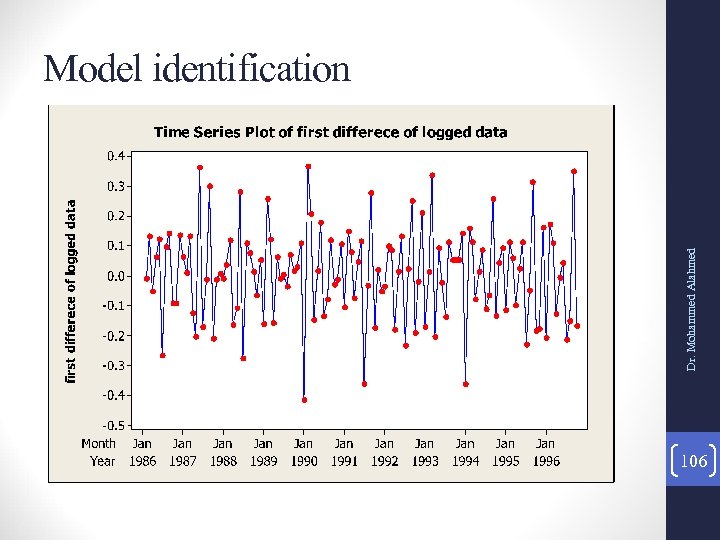
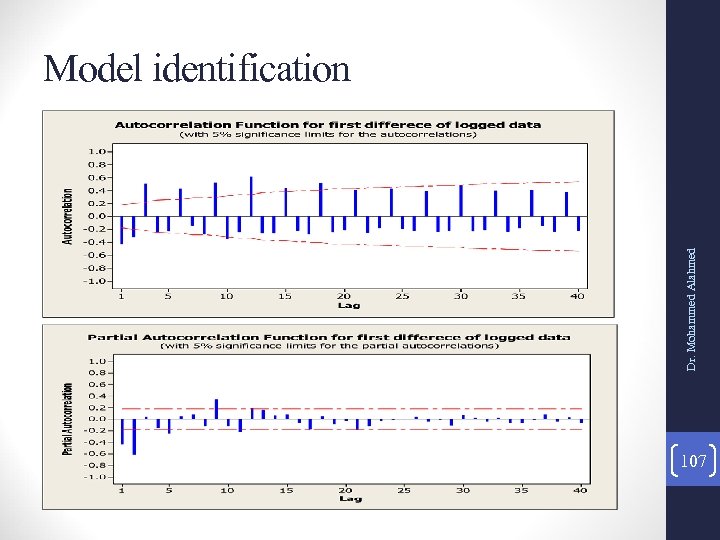
• The time plot shows that the magnitude of the fluctuations in the log-transformed data does not vary with time. • But, the logged data are clearly non-stationary. • The gradual decay of the ACF values. • To achieve stationarity, we take the first differences of the logged data. • The plots are reported in the next three slides. Dr. Mohammed Alahmed Model identification 105
Dr. Mohammed Alahmed Model identification 106
Dr. Mohammed Alahmed Model identification 107
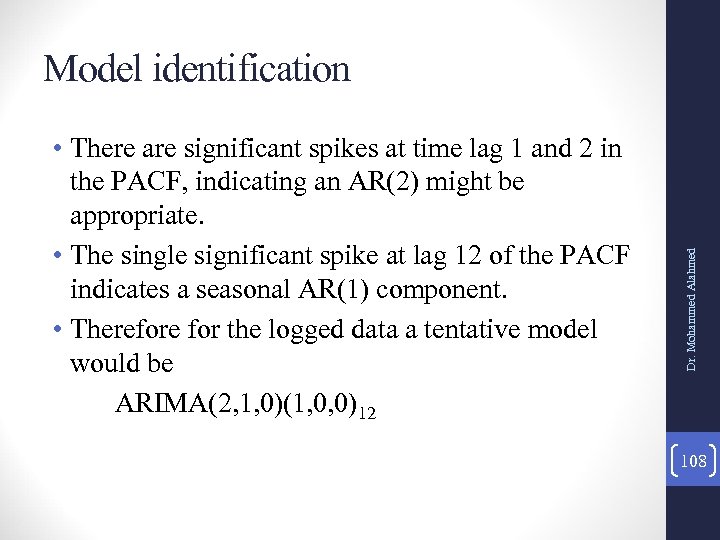
• There are significant spikes at time lag 1 and 2 in the PACF, indicating an AR(2) might be appropriate. • The single significant spike at lag 12 of the PACF indicates a seasonal AR(1) component. • Therefore for the logged data a tentative model would be ARIMA(2, 1, 0)(1, 0, 0)12 Dr. Mohammed Alahmed Model identification 108
• The process of identifying an ARIMA model requires experience and good judgment. • The following guidelines can be helpful: 1. Make the series stationary in mean and variance • Differencing will take care of non-stationarity in the mean. • Logarithmic or power transformation will often take care of non-stationarity in the variance. Dr. Mohammed Alahmed Summary 109
Summary • The ACF and PACF of the stationary data obtained from the previous step can reveal whether MA of AR is feasible. • Exponential decay or damped sine-wave. For ACF, and spikes at lags 1 to p then cut off to zero, indicate an AR(P) model. • Spikes at lag 1 to q, then cut off to zero for ACF and exponential decay or damped sine-wave for PACF indicates MA(q) model. Dr. Mohammed Alahmed 2. Consider non-seasonal aspect 110
Summary • Examination of ACF and PACF at the seasonal lags can help to identify AR and MA models for the seasonal aspect of the data. • For example, for quarterly data the pattern of r 4, r 8, r 12, r 16, and so on. Dr. Mohammed Alahmed 2. Consider seasonal aspect 111
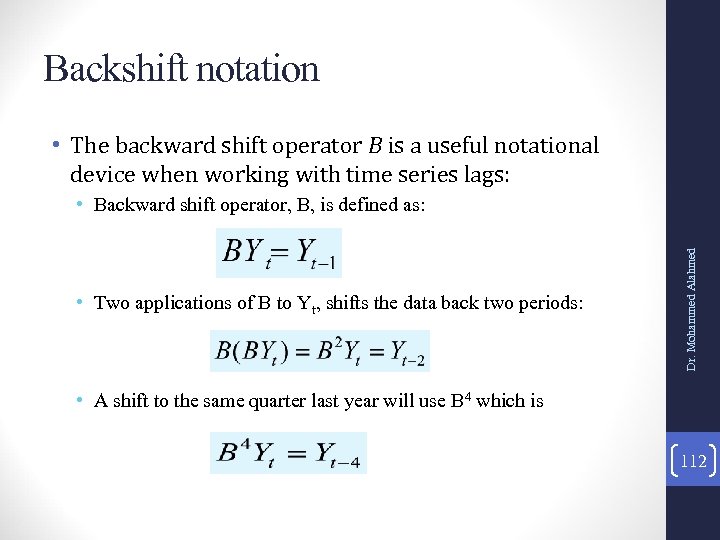
Backshift notation • The backward shift operator B is a useful notational device when working with time series lags: • Two applications of B to Yt, shifts the data back two periods: Dr. Mohammed Alahmed • Backward shift operator, B, is defined as: • A shift to the same quarter last year will use B 4 which is 112
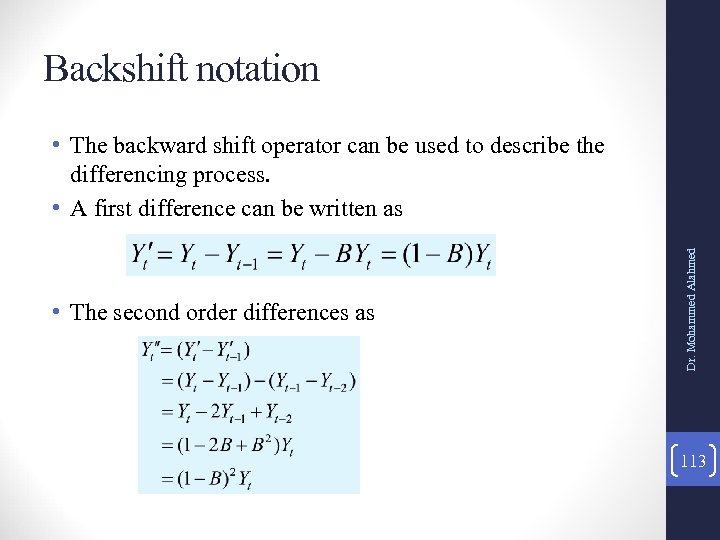
Backshift notation • The second order differences as Dr. Mohammed Alahmed • The backward shift operator can be used to describe the differencing process. • A first difference can be written as 113
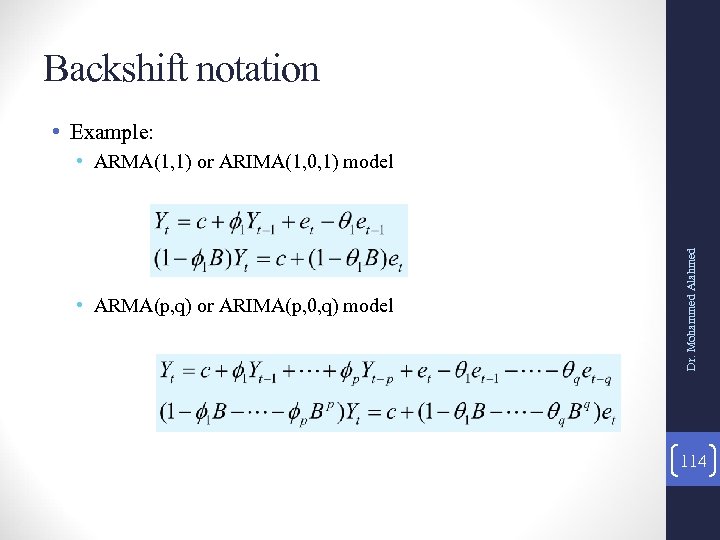
Backshift notation • Example: • ARMA(p, q) or ARIMA(p, 0, q) model Dr. Mohammed Alahmed • ARMA(1, 1) or ARIMA(1, 0, 1) model 114
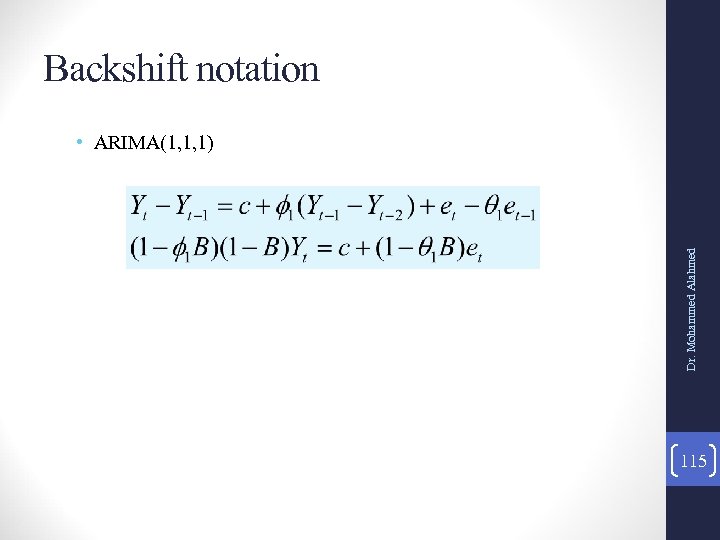
Backshift notation Dr. Mohammed Alahmed • ARIMA(1, 1, 1) 115
• Once a tentative model has been selected, the parameters for the model must be estimated. • The method of least squares can be used for RIMA model. • However, for models with an MA components, there is no simple formula that can be used to estimate the parameters. • Instead, an iterative method is used. This involves starting with a preliminary estimate, and refining the estimate iteratively until the sum of the squared errors is minimized. Dr. Mohammed Alahmed Estimating the parameters 116
• Another method of estimating the parameters is the maximum likelihood procedure. • Like least squares methods, these estimates must be found iteratively. • Maximum likelihood estimation is usually favored because it has some desirable statistical properties. • After the estimates and their standard errors are determined, t values can be constructed and interpreted in the usual way. • Parameters that are judged significantly different from zero are retained in the fitted model; parameters that are not significantly different from zero are dropped from the model. Dr. Mohammed Alahmed Estimating the parameters 117
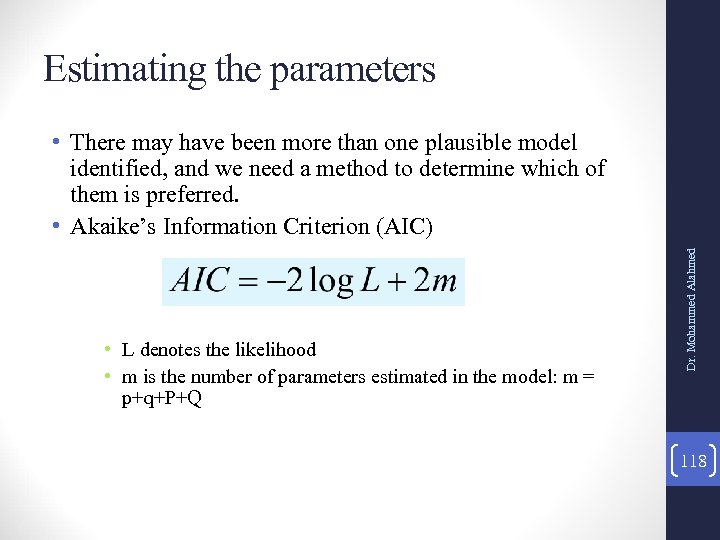
Estimating the parameters • L denotes the likelihood • m is the number of parameters estimated in the model: m = p+q+P+Q Dr. Mohammed Alahmed • There may have been more than one plausible model identified, and we need a method to determine which of them is preferred. • Akaike’s Information Criterion (AIC) 118
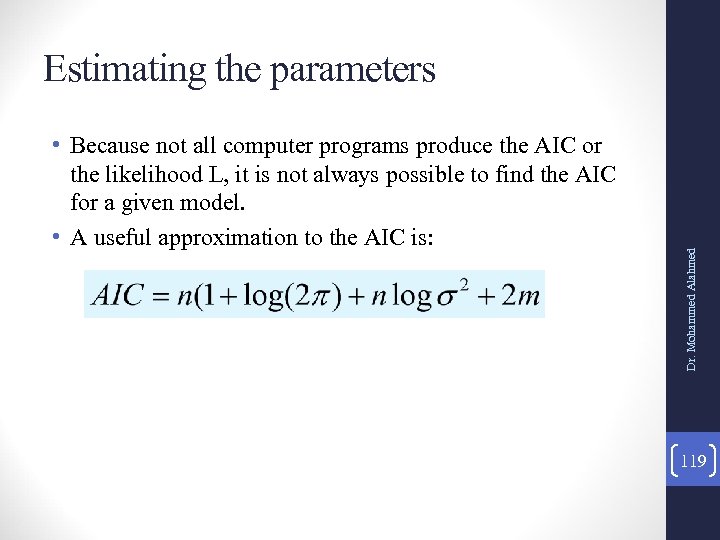
• Because not all computer programs produce the AIC or the likelihood L, it is not always possible to find the AIC for a given model. • A useful approximation to the AIC is: Dr. Mohammed Alahmed Estimating the parameters 119

• Before using the model forecasting, it must be checked for adequacy. • A model is adequate if the residuals left over after fitting the model is simply white noise. • The pattern of ACF and PACF of the residuals may suggest how the model can be improved. • For example • Significant spikes at the seasonal lags suggests adding seasonal component to the chosen model • Significant spikes at small lags suggest increasing the nonseasonal AR or MA components of the model. Dr. Mohammed Alahmed Diagnostic Checking 120
• A portmanteau test can also be applied to the residuals as an additional test of fit. • If the portmanteau test is significant, then the model is inadequate. • In this case we need to go back and consider other ARIMA models. • Any new model will need their parameters estimated and their AIC values computed and compared with other models. • Usually, the model with the smallest AIC will have residuals which resemble white noise. • Occasionally, it might be necessary to adopt a model with not quite the smallest AIC value, but with better behaved residuals. Dr. Mohammed Alahmed Diagnostic Checking 121
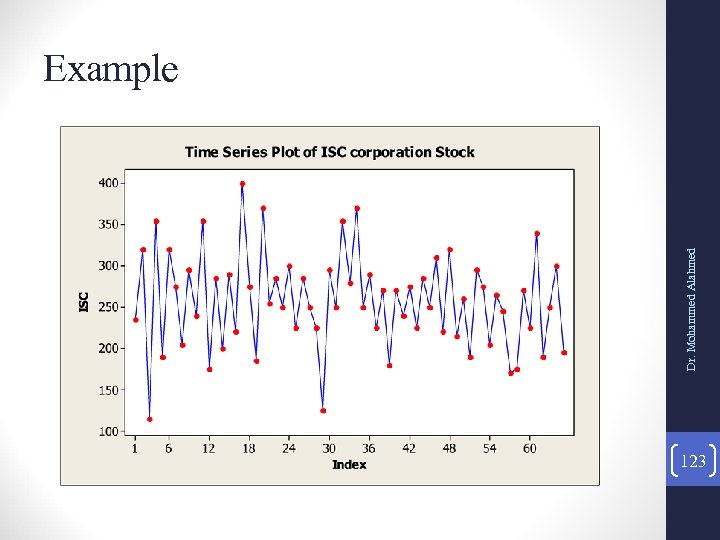
• The analyst for the ISC Corporation was asked to develop forecasts for the closing prices of ISC stock. • The stock has been languishing for some time with little growth, and senior management wanted some projections to discuss with the board of directors. • The ISC stock prices are plotted in the following slide. Dr. Mohammed Alahmed Example 122
Dr. Mohammed Alahmed Example 123
• The plot of the stock prices suggests the series is stationary. • The stock prices vary about a fixed level of approximately 250. • Is the Box-Jenkins methodology appropriate for this data series? • The ACF and PACF for the stock price series are reported in the following two slides. Dr. Mohammed Alahmed Example 124
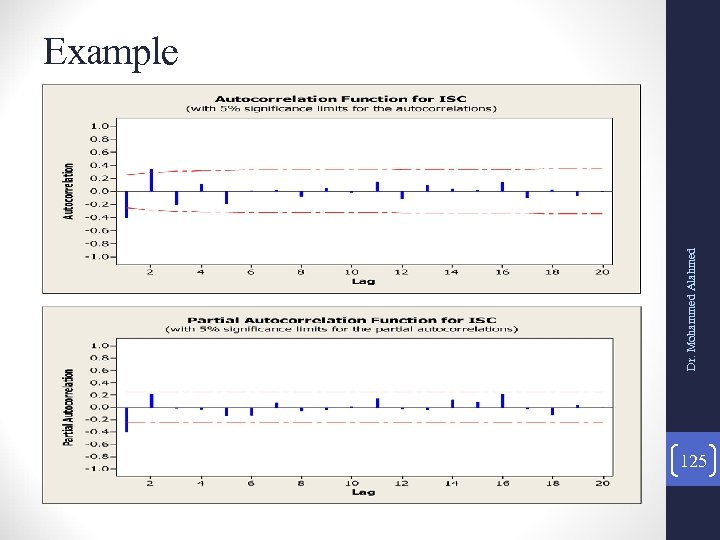
Dr. Mohammed Alahmed Example 125
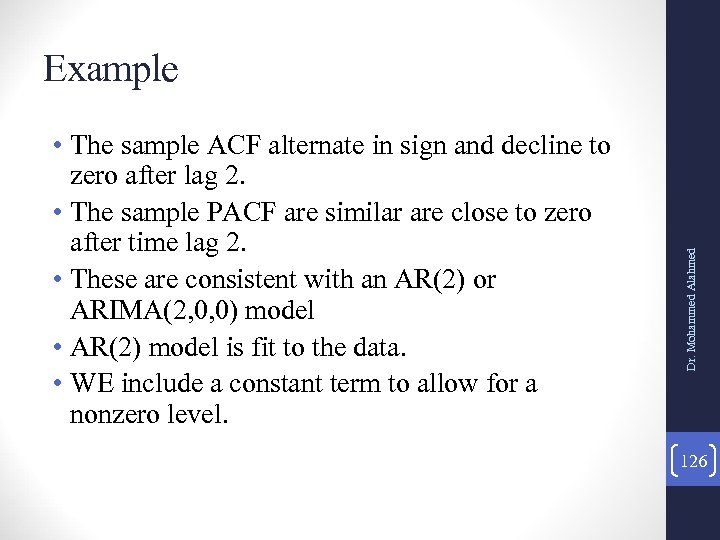
• The sample ACF alternate in sign and decline to zero after lag 2. • The sample PACF are similar are close to zero after time lag 2. • These are consistent with an AR(2) or ARIMA(2, 0, 0) model • AR(2) model is fit to the data. • WE include a constant term to allow for a nonzero level. Dr. Mohammed Alahmed Example 126
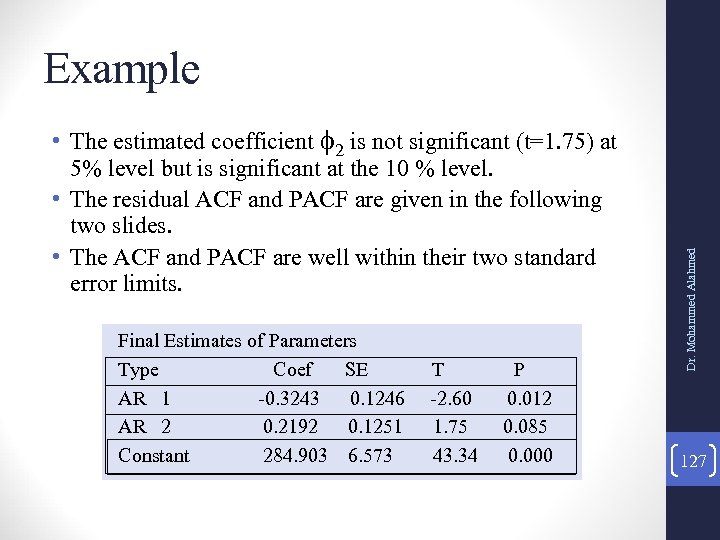
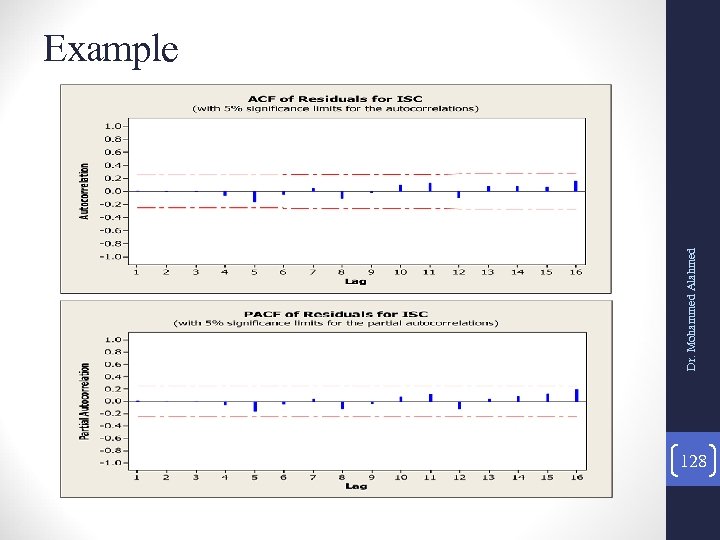
• The estimated coefficient 2 is not significant (t=1. 75) at 5% level but is significant at the 10 % level. • The residual ACF and PACF are given in the following two slides. • The ACF and PACF are well within their two standard error limits. Final Estimates of Parameters Type Coef SE AR 1 -0. 3243 0. 1246 AR 2 0. 2192 0. 1251 Constant 284. 903 6. 573 T -2. 60 1. 75 43. 34 P 0. 012 0. 085 0. 000 Dr. Mohammed Alahmed Example 127
Dr. Mohammed Alahmed Example 128
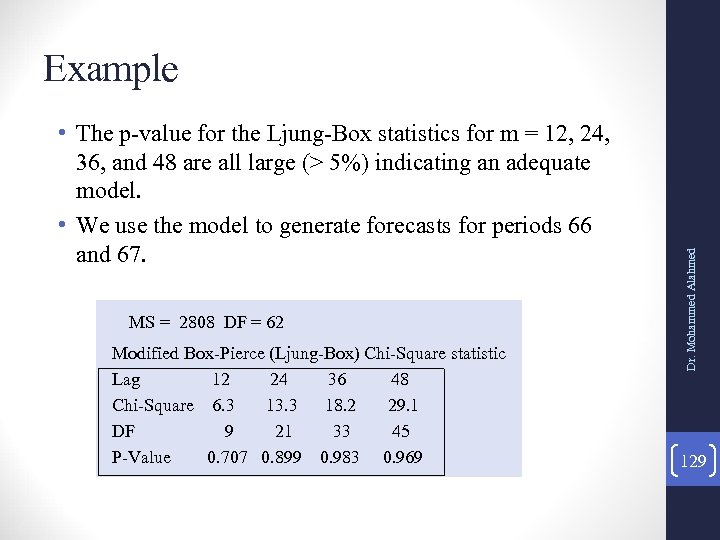
• The p-value for the Ljung-Box statistics for m = 12, 24, 36, and 48 are all large (> 5%) indicating an adequate model. • We use the model to generate forecasts for periods 66 and 67. MS = 2808 DF = 62 Modified Box-Pierce (Ljung-Box) Chi-Square statistic Lag 12 24 36 48 Chi-Square 6. 3 13. 3 18. 2 29. 1 DF 9 21 33 45 P-Value 0. 707 0. 899 0. 983 0. 969 Dr. Mohammed Alahmed Example 129
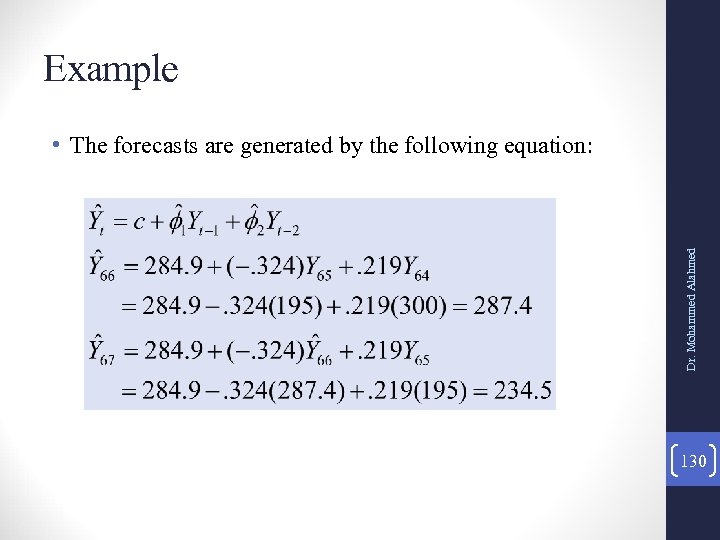
Example Dr. Mohammed Alahmed • The forecasts are generated by the following equation: 130
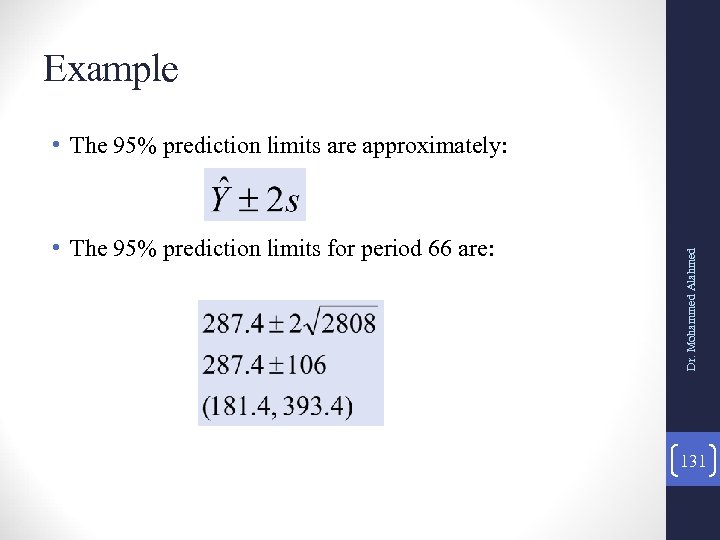
Example • The 95% prediction limits for period 66 are: Dr. Mohammed Alahmed • The 95% prediction limits are approximately: 131
• In ARIMA modeling, it is NOT good practice to include AR and MA parameters to “cover all possibilities” suggested by the sample ACF and Sample PACF. • This means, when in doubt, start with a model containing few parameters rather than many parameters. The need for additional parameters will be evident from the residual ACF and PACF. • Least square estimates of AR and MA parameters in ARIMA models tend to be highly correlated. When there are more parameters than necessary, this leads to unstable models that can produce poor forecasts. Dr. Mohammed Alahmed Final Comments 132
• To summarize, start with a small number of clearly justifiable parameters and add one parameter at a time as needed. • If parameters in a fitted ARIMA model are not significant, delete one parameter at a time and refit the model. • Because of high correlation among estimated parameters, it may be the case that a previously non-significant parameter becomes significant. Dr. Mohammed Alahmed Final Comments 133
Summary of rules for identifying ARIMA models • Rule 1: If the series has positive autocorrelations out to a high number of lags (say, 10 or more), then it probably needs a higher order of differencing. • Rule 2: If the lag-1 autocorrelation is zero or negative, or the autocorrelations are all small and patternless, then the series does not need a higher order of differencing. If the lag-1 autocorrelation is -0. 5 or more negative, the series may be overdifferenced. BEWARE OF OVERDIFFERENCING. • Rule 3: The optimal order of differencing is often the order of differencing at which the standard deviation is lowest. (Not always, though. Slightly too much or slightly too little differencing can also be corrected with AR or MA terms. See rules 6 and 7. ) Dr. Mohammed Alahmed • Identifying the order of differencing and the constant: 134
• Rule 4: A model with no orders of differencing assumes that the original series is stationary (among other things, meanreverting). A model with one order of differencing assumes that the original series has a constant average trend (e. g. a random walk or SES-type model, with or without growth). A model with two orders of total differencing assumes that the original series has a time-varying trend (e. g. a random trend or LES-type model). • Rule 5: A model with no orders of differencing normally includes a constant term (which allows for a non-zero mean value). A model with two orders of total differencing normally does not include a constant term. In a model with one order of total differencing, a constant term should be included if the series has a non-zero average trend. Dr. Mohammed Alahmed Summary of rules for identifying ARIMA models 135
Summary of rules for identifying ARIMA models • Rule 6: If the partial autocorrelation function (PACF) of the differenced series displays a sharp cutoff and/or the lag-1 autocorrelation is positive--i. e. , if the series appears slightly "underdifferenced"--then consider adding one or more AR terms to the model. The lag beyond which the PACF cuts off is the indicated number of AR terms. • Rule 7: If the autocorrelation function (ACF) of the differenced series displays a sharp cutoff and/or the lag-1 autocorrelation is negative--i. e. , if the series appears slightly "overdifferenced" --then consider adding an MA term to the model. The lag beyond which the ACF cuts off is the indicated number of MA terms. Dr. Mohammed Alahmed • Identifying the numbers of AR and MA terms: 136
Summary of rules for identifying ARIMA models • Rule 8: It is possible for an AR term and an MA term to cancel each • Rule 9: If there is a unit root in the AR part of the model--i. e. , if the sum of the AR coefficients is almost exactly 1 --you should reduce the number of AR terms by one and increase the order of differencing by one. • Rule 10: If there is a unit root in the MA part of the model--i. e. , if the sum of the MA coefficients is almost exactly 1 --you should reduce the number of MA terms by one and reduce the order of differencing by one. • Rule 11: If the long-term forecasts* appear erratic or unstable, there may be a unit root in the AR or MA coefficients. Dr. Mohammed Alahmed other's effects, so if a mixed AR-MA model seems to fit the data, also try a model with one fewer AR term and one fewer MA term-particularly if the parameter estimates in the original model require more than 10 iterations to converge. BEWARE OF USING MULTIPLE AR TERMS AND MULTIPLE MA TERMS IN THE SAME MODEL. 137
Summary of rules for identifying ARIMA models • Identifying the seasonal part of the model: • Rule 12: If the series has a strong and consistent seasonal pattern, • Rule 13: If the autocorrelation of the appropriately differenced series is positive at lag s, where s is the number of periods in a season, then consider adding an SAR term to the model. If the autocorrelation of the differenced series is negative at lag s, consider adding an SMA term to the model. The latter situation is likely to occur if a seasonal difference has been used, which should be done if the data has a stable and logical seasonal pattern. The former is likely to occur if a seasonal difference has not been used, which would only be appropriate if the seasonal pattern is not stable over time. You should try to avoid using more than one or two seasonal parameters (SAR+SMA) in the same model, as this is likely to lead to overfitting of the data and/or problems in estimation. Dr. Mohammed Alahmed then you must use an order of seasonal differencing (otherwise the model assumes that the seasonal pattern will fade away over time). However, never use more than one order of seasonal differencing or more than 2 orders of total differencing (seasonal+nonseasonal). 138
139 Dr. Mohammed Alahmed
Скачать презентацию Dr Mohammed Alahmed The Box-Jenkins Methodology for ARIMA
744f9af7ce14959e90aa1dfd031faf99.ppt