


 Скачать презентацию Dr Liz Mear Chief Executive Officer Clinical Transition
53af5f0391861f933c2aef36aa08d84f.ppt
- Количество слайдов: 18
 Dr Liz Mear, Chief Executive Officer Clinical Transition Programme - Presentation to David Nicholson – 12 January 2012
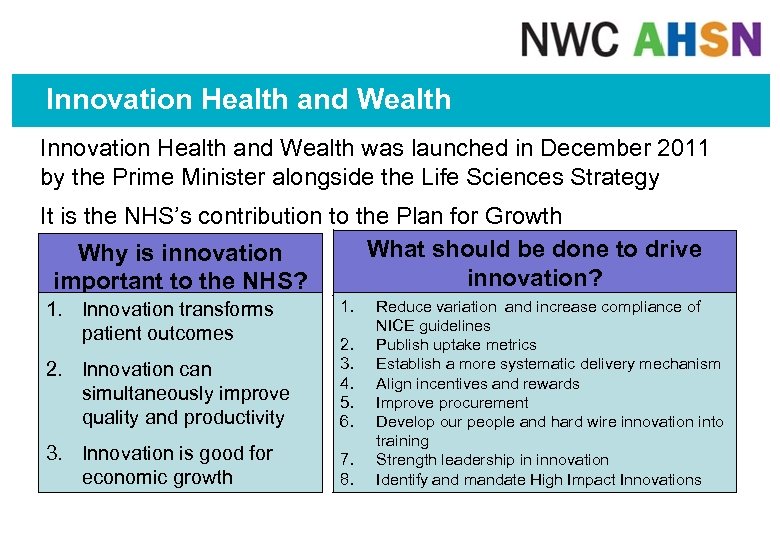 Innovation Health and Wealth was launched in December 2011 by the Prime Minister alongside the Life Sciences Strategy It is the NHS’s contribution to the Plan for Growth What should be done to drive Why is innovation? important to the NHS? 1. Innovation transforms patient outcomes 1. 2. Innovation can simultaneously improve quality and productivity 2. 3. 4. 5. 6. 3. Innovation is good for economic growth 7. 8. Reduce variation and increase compliance of NICE guidelines Publish uptake metrics Establish a more systematic delivery mechanism Align incentives and rewards Improve procurement Develop our people and hard wire innovation into training Strength leadership in innovation Identify and mandate High Impact Innovations Clinical Transition Programme - Presentation to David Nicholson – 12 January 2012
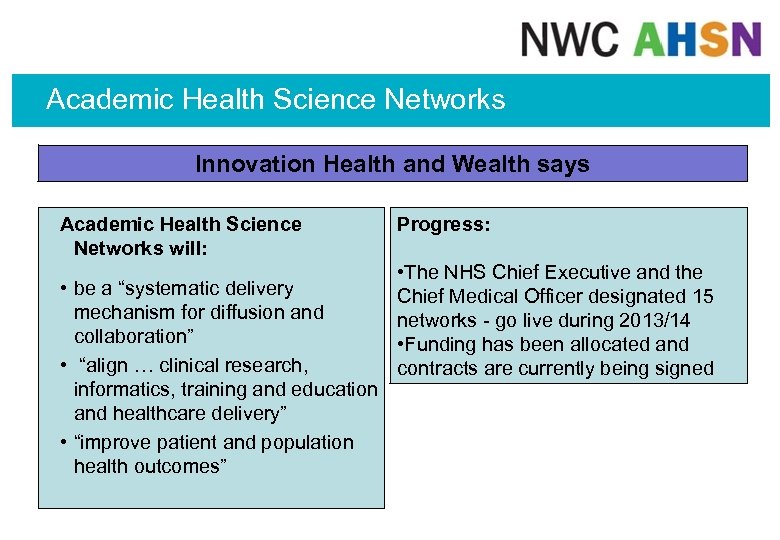 Academic Health Science Networks Innovation Health and Wealth says Academic Health Science Networks will: • be a “systematic delivery mechanism for diffusion and collaboration” • “align … clinical research, informatics, training and education and healthcare delivery” • “improve patient and population health outcomes” Progress: • The NHS Chief Executive and the Chief Medical Officer designated 15 networks - go live during 2013/14 • Funding has been allocated and contracts are currently being signed Clinical Transition Programme - Presentation to David Nicholson – 12 January 2012
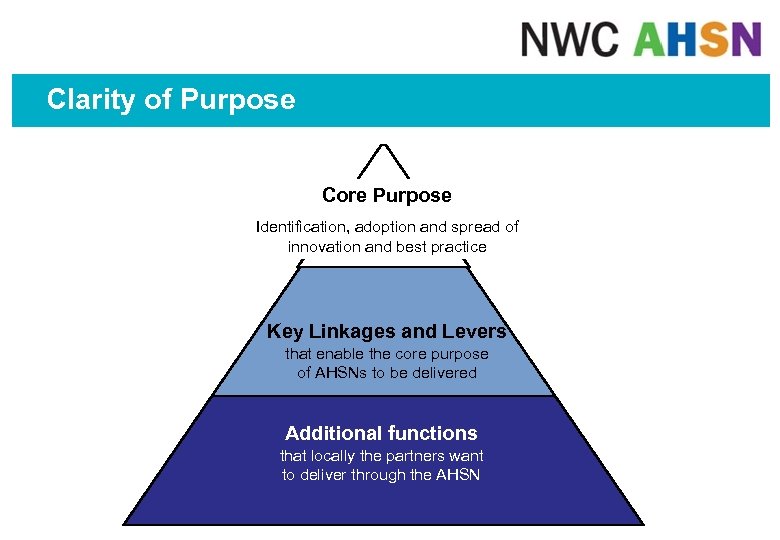 Clarity of Purpose Core Purpose Identification, adoption and spread of innovation and best practice Key Linkages and Levers that enable the core purpose of AHSNs to be delivered Additional functions that locally the partners want to deliver through the AHSN Clinical Transition Programme - Presentation to David Nicholson – 12 January 2012
 Participation in AHSNs (1) 15 nationwide therefore importance of collaboration. Footprint 3 -5 million alignment with other geographies, such as Clinical Senates, Strategic Clinical Networks and Health Education England is essential. Funding from a ‘sunset review’ of other bodies For the NHS opportunity to develop state-of-the art proven innovations and best practice in partnership, benefiting from the sharing of learning and expertise about innovation and best practice in an innovation network Clinical Transition Programme - Presentation to David Nicholson – 12 January 2012
 Participation in AHSNs (2) For industry – helps creates the new relationship that is described in Innovation Health and Wealth and give a point of contact for the NHS For higher education institutions – helps demonstrate impact of research as part of the life sciences agenda but the offer needs to be attractive and tangible AHSNs will work together - to spread innovations and have a national voice Clinical Transition Programme - Presentation to David Nicholson – 12 January 2012
 The licence Five year licence from NHS England to the AHSN that would be: An agreement between the members of the network and the NHS England that they will work together to improve patient care and population health; A “contract” to deliver defined tasks and outcomes for which network will receive funding from the NHS England, including local resources that the members will contribute. AHSNs will be able to bid for other contracts and they may decide to work together to bid for contracts at a national level Clinical Transition Programme - Presentation to David Nicholson – 12 January 2012
 Four licence areas • • Identify and address unmet need Speed up adoption of innovation Identify and enable research Create wealth No ‘blueprint’ Clinical Transition Programme - Presentation to David Nicholson – 12 January 2012
 Success • Having a plan to build local partnerships across autonomous organisations • Shared values • Strong working partnerships – commissioners and providers (CCGs have a legal duty to promote innovation) • Local leadership and energy for working across boundaries • Clarity on operational delivery • National shared purpose across AHSNs • No duplication locally or nationally Clinical Transition Programme - Presentation to David Nicholson – 12 January 2012
 Challenges • • AHSNs give a simpler and supportive landscape but…… Central direction v local determination Developing a culture of implementation across boundaries Developing collaboration across regions for the benefit of residents • Developing whole pathway and whole system metrics Clinical Transition Programme - Presentation to David Nicholson – 12 January 2012
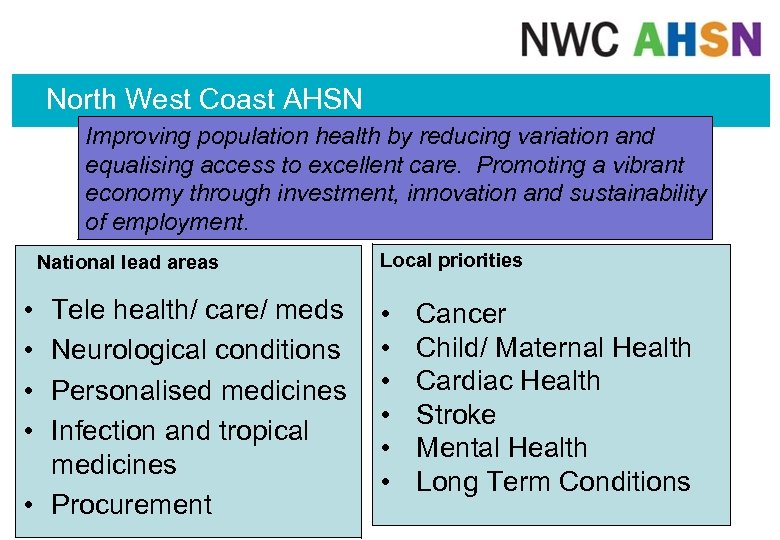 North West Coast AHSN Improving population health by reducing variation and equalising access to excellent care. Promoting a vibrant economy through investment, innovation and sustainability of employment. National lead areas • • Tele health/ care/ meds Neurological conditions Personalised medicines Infection and tropical medicines • Procurement Local priorities • • • Cancer Child/ Maternal Health Cardiac Health Stroke Mental Health Long Term Conditions Clinical Transition Programme - Presentation to David Nicholson – 12 January 2012
 Building up our national workstreams School of Tropical Medicine/UCLAN Neurological research More Independent (Mi) draft document on working together Personalised medicines – SBRI funding for personalised medicines for cardiac Procurement – NHS England the Innovation hub Clinical Transition Programme - Presentation to David Nicholson – 12 January 2012
 Building up our local workstreams Child and maternal health – SBRI, LTSM, genomics Cardiac – SBRI Neurological research Stroke – Year of the Brain possibilities Contribution to local system re-design Clinical Transition Programme - Presentation to David Nicholson – 12 January 2012
 Building up our links nationally and locally Represented on the board for 3 million lives on the NICE assessment panel on the board of the Health Services Research Network Building up links with Health e Research Centre (HERC) and big data companies Contribution to Medilink events and newsletter Presentation for R and D North West, CLRN chairs, national NHS/ Biopharmaceutical Forum Clinical Transition Programme - Presentation to David Nicholson – 12 January 2012
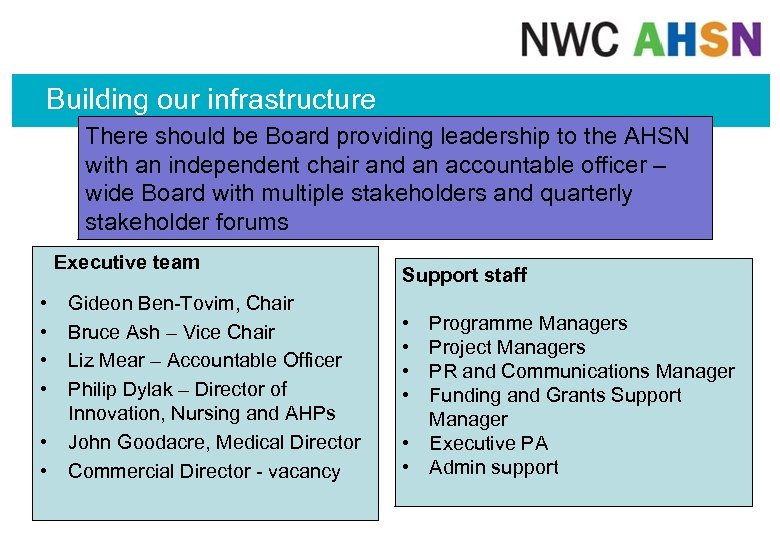 Building our infrastructure There should be Board providing leadership to the AHSN with an independent chair and an accountable officer – wide Board with multiple stakeholders and quarterly stakeholder forums Executive team • • • Gideon Ben-Tovim, Chair Bruce Ash – Vice Chair Liz Mear – Accountable Officer Philip Dylak – Director of Innovation, Nursing and AHPs John Goodacre, Medical Director Commercial Director - vacancy Support staff • • Programme Managers Project Managers PR and Communications Manager Funding and Grants Support Manager • Executive PA • Admin support Clinical Transition Programme - Presentation to David Nicholson – 12 January 2012
 Building up our relationship with local business Commercial strategy Industry group Meet the experts x 4 Medi-link events Individual meetings CRM database SBRI Neurological research Big data Tender for industrial partner Clinical Transition Programme - Presentation to David Nicholson – 12 January 2012
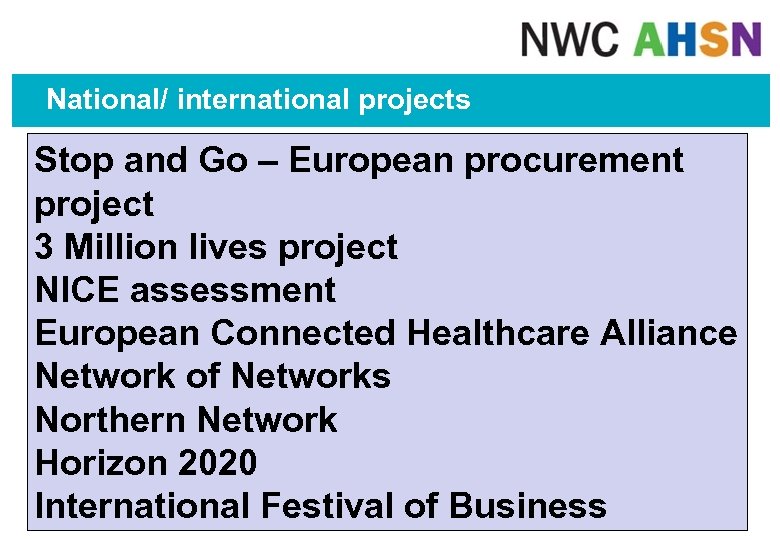 National/ international projects Stop and Go – European procurement project 3 Million lives project NICE assessment European Connected Healthcare Alliance Network of Networks Northern Network Horizon 2020 International Festival of Business Clinical Transition Programme - Presentation to David Nicholson – 12 January 2012
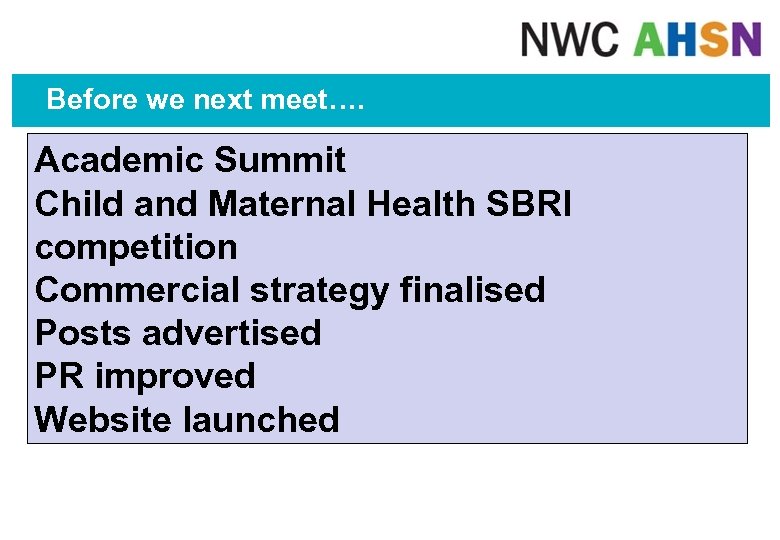 Before we next meet…. Academic Summit Child and Maternal Health SBRI competition Commercial strategy finalised Posts advertised PR improved Website launched Clinical Transition Programme - Presentation to David Nicholson – 12 January 2012