 Скачать презентацию Dr Christoph Bruch Fo I in Germany Six
7c6379c967f08d75be7820fde4cbda61.ppt
- Количество слайдов: 47



Dr. Christoph Bruch Fo. I in Germany Six months after Implementation The Coalition against Corruption
Contents 1. TI Secretariat: Corruption Perception Index 2. TI Germany 3. Fo. I in Germany The Coalition against Corruption
TI Germany: The Organisation • • Registered non-profit, tax exempt association Founding year: 1993 Current membership (6/2006) – 538 individual member – 32 corporative members Steering committee: honorary membership Office – Location: Berlin – Staff • Managing director (full time, paid) • 2 members of staff (part time, paid) • 2 interns (full time) The Coalition against Corruption
TI Germany: How do we finance? • Revenue 2004: ~ EUR 180. 000 • 77% Membership fee + membership donations – – 26 % Individual members 51 % Corporate Members • 15 % Public funding incl. Monetary fines • 8 % Donations by non-members The Coalition against Corruption 7
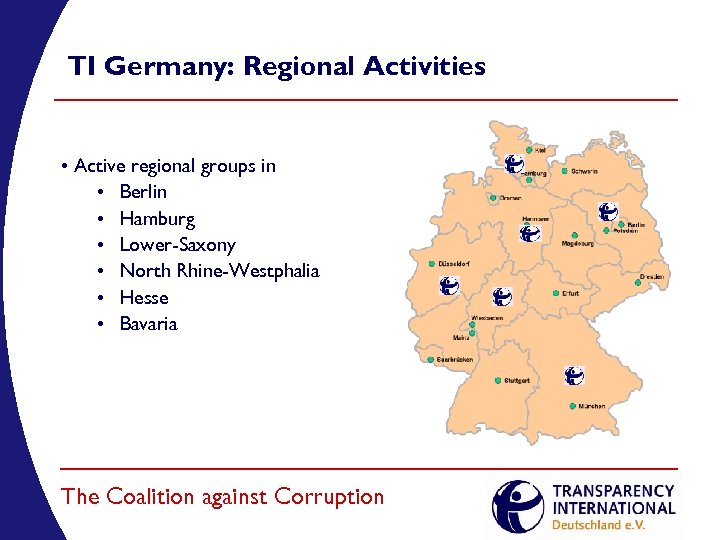
TI Germany: Regional Activities • Active regional groups in • Berlin • Hamburg • Lower-Saxony • North Rhine-Westphalia • Hesse • Bavaria The Coalition against Corruption
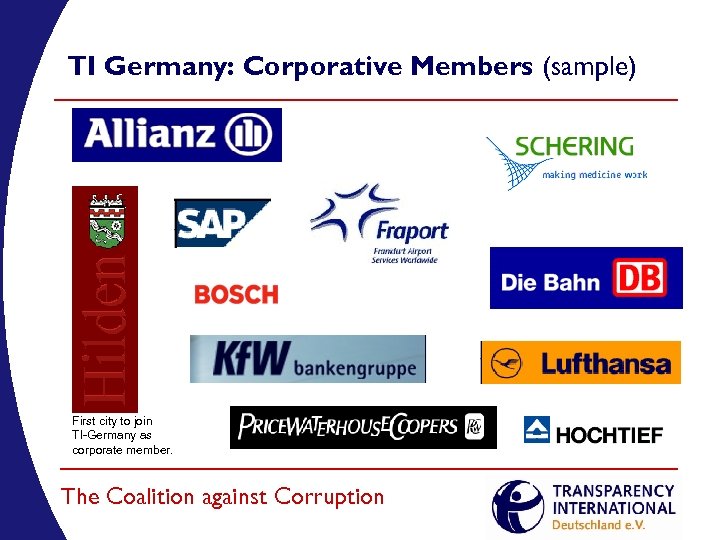
TI Germany: Corporative Members (sample) First city to join TI-Germany as corporate member. The Coalition against Corruption
TI Germany: Corporate Members Corporative members have to commit to certain standards to be accepted – Corruptive action has to ostracised – An internal anti corruption policy has to put in force – Staff has to be educated in measures to prevent corruption – The company is to raise corruption as a topic within its trade association – The Corporate Member Forum meets biannually The Coalition against Corruption
TI Germany: Working Principles • Transparency does not investigate cases of alleged corruption. • It cannot do the job of crown prosecutors, journalists, auditors, and audit courts. • We advocate conditions that are to help these professionals to do their job more effectively. • Lobbying for administrative transparency is part of this campaign. The Coalition against Corruption 11
TI Germany: Aims and Means • Aims – Keep corruption on the public agenda – Sensitize and inform the public – Built structures that prevent or raise the costs for corruption • Means – Use of windows of opportunity – Public relations (Conferences, press releases) – Lobbying (access laws, black lists, transparent contract awarding) – Documentation and research The Coalition against Corruption 12
TI Germany: Key Activities (samples) TI Germany advocates • Build-up of corruption prevention measures (i. e. Fo. I laws) in public administration • Setup special corruption crown prosecution services • Setup of register of companies which have been found guilty of corruption • Limitation party nepotism when filling vacancies in public administration and public companies • Effective rules against bribing of political delegates • Support of German Companies in their effort to fight corruption (Codes of Conduct, Corporate Governance) The Coalition against Corruption 13
Contents 1. TI Secretariat: Corruption Perception Index 2. TI Germany 3. Fo. I in Germany The Coalition against Corruption
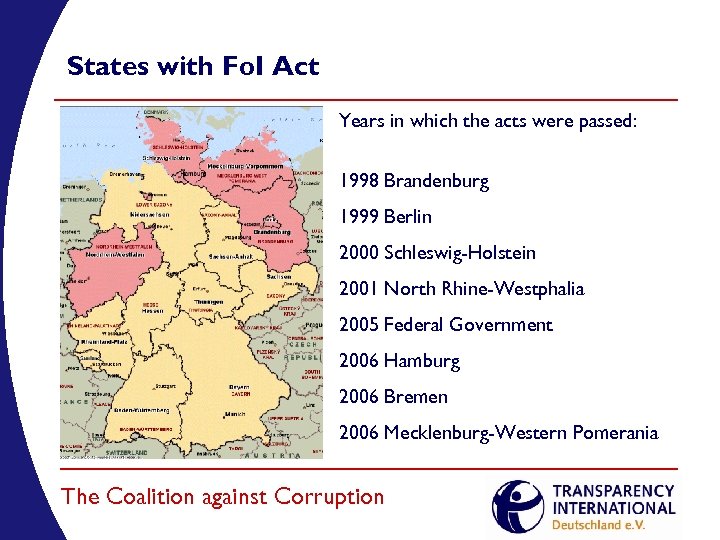
States with Fo. I Act Years in which the acts were passed: 1998 Brandenburg 1999 Berlin 2000 Schleswig-Holstein 2001 North Rhine-Westphalia 2005 Federal Government 2006 Hamburg 2006 Bremen 2006 Mecklenburg-Western Pomerania The Coalition against Corruption
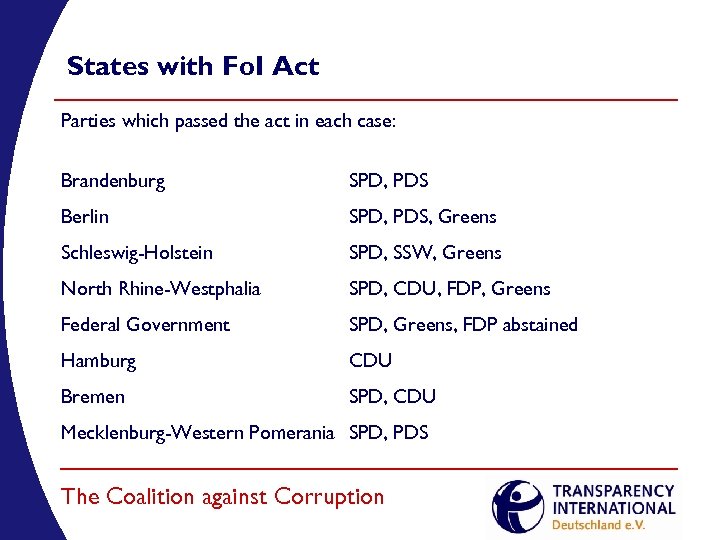
States with Fo. I Act Parties which passed the act in each case: Brandenburg SPD, PDS Berlin SPD, PDS, Greens Schleswig-Holstein SPD, SSW, Greens North Rhine-Westphalia SPD, CDU, FDP, Greens Federal Government SPD, Greens, FDP abstained Hamburg CDU Bremen SPD, CDU Mecklenburg-Western Pomerania SPD, PDS The Coalition against Corruption
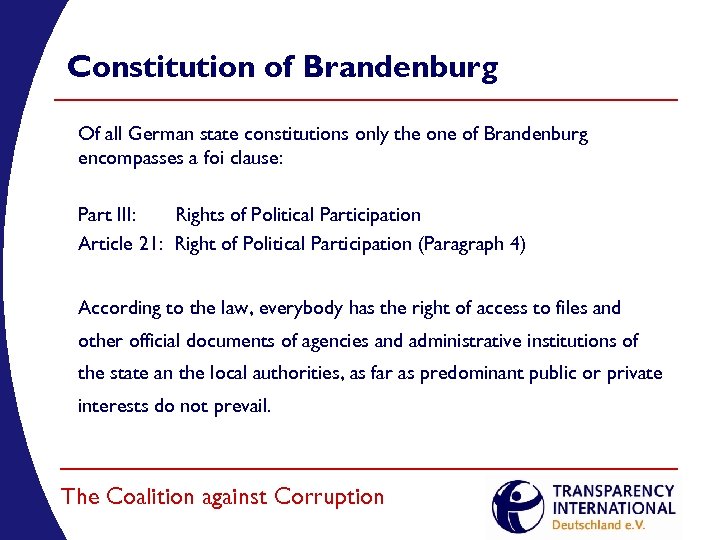
Constitution of Brandenburg Of all German state constitutions only the one of Brandenburg encompasses a foi clause: Part III: Rights of Political Participation Article 21: Right of Political Participation (Paragraph 4) According to the law, everybody has the right of access to files and other official documents of agencies and administrative institutions of the state an the local authorities, as far as predominant public or private interests do not prevail. The Coalition against Corruption
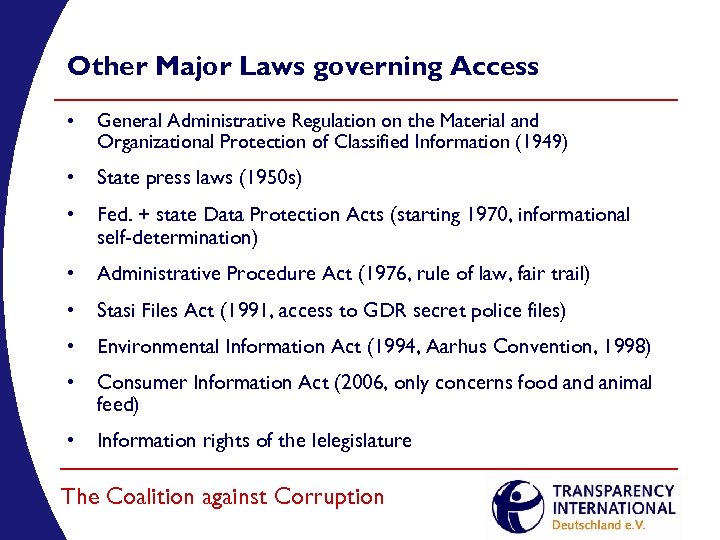
Other Major Laws governing Access • General Administrative Regulation on the Material and Organizational Protection of Classified Information (1949) • State press laws (1950 s) • Fed. + state Data Protection Acts (starting 1970, informational self-determination) • Administrative Procedure Act (1976, rule of law, fair trail) • Stasi Files Act (1991, access to GDR secret police files) • Environmental Information Act (1994, Aarhus Convention, 1998) • Consumer Information Act (2006, only concerns food animal feed) • Information rights of the lelegislature The Coalition against Corruption
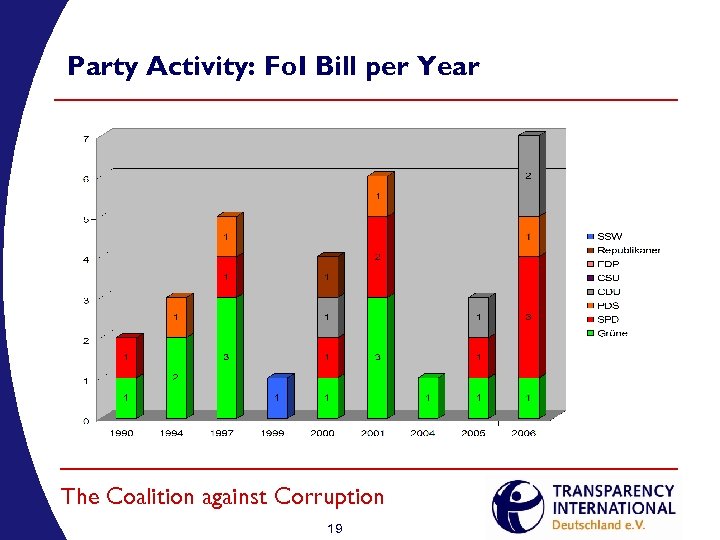
Party Activity: Fo. I Bill per Year The Coalition against Corruption 19
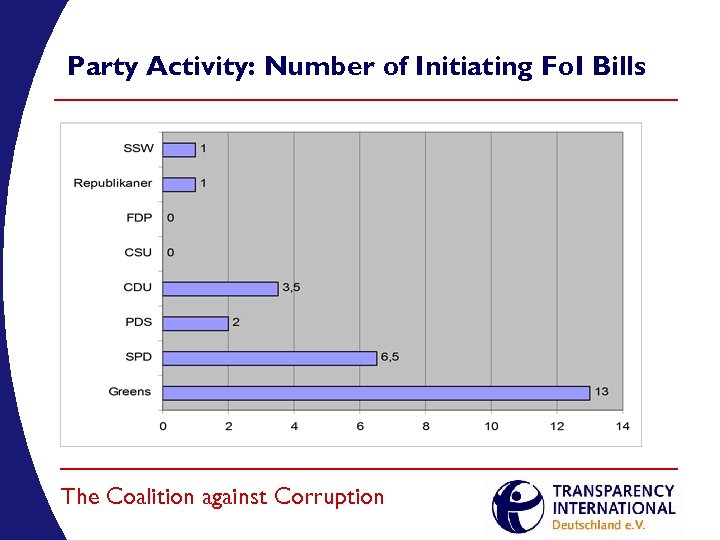
Party Activity: Number of Initiating Fo. I Bills The Coalition against Corruption
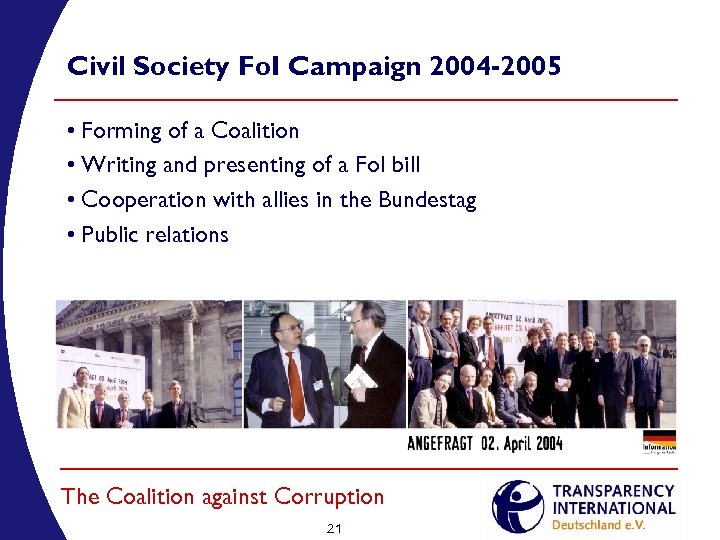
Civil Society Fo. I Campaign 2004 -2005 • Forming of a Coalition • Writing and presenting of a Fo. I bill • Cooperation with allies in the Bundestag • Public relations The Coalition against Corruption 21
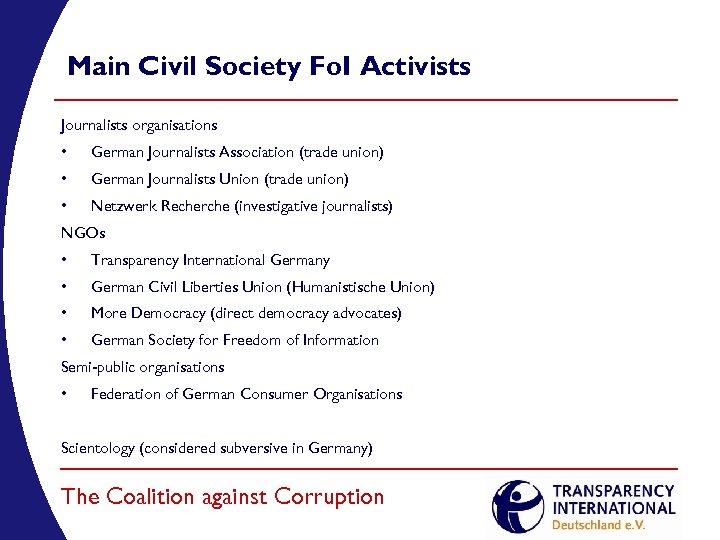
Main Civil Society Fo. I Activists Journalists organisations • German Journalists Association (trade union) • German Journalists Union (trade union) • Netzwerk Recherche (investigative journalists) NGOs • Transparency International Germany • German Civil Liberties Union (Humanistische Union) • More Democracy (direct democracy advocates) • German Society for Freedom of Information Semi-public organisations • Federation of German Consumer Organisations Scientology (considered subversive in Germany) The Coalition against Corruption
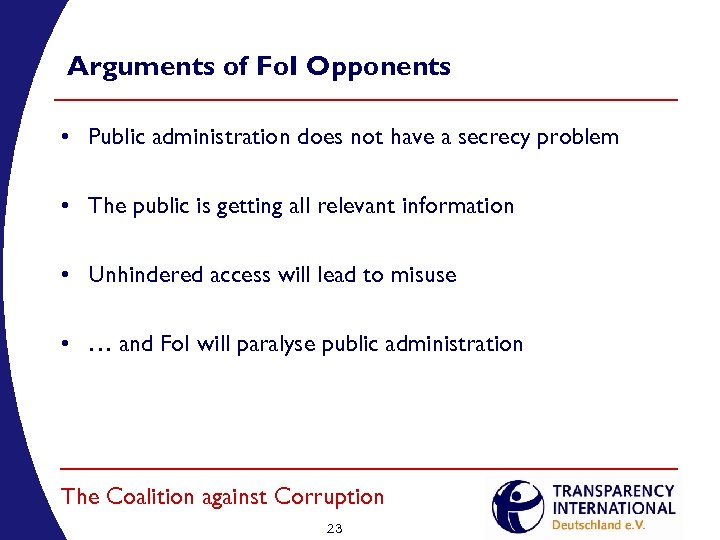
Arguments of Fo. I Opponents • Public administration does not have a secrecy problem • The public is getting all relevant information • Unhindered access will lead to misuse • … and Fo. I will paralyse public administration The Coalition against Corruption 23
Arguments of Fo. I Advocates • Official secrecy as guiding principle does not reflect current understanding of democracy • Germany disconnected from the rest of the industrialised world in respect to Fo. I • Fo. I is a measure against political apathy • Secrecy is a culture medium for mismanagement and corruption • Information rights should not be a journalist privilege The Coalition against Corruption 24
What we got When the federal Fo. I act was passed, the press called it the Federal Fo. I Exemption Act. Exemption Categories 1. special public interests 2. the official decision-making process The Coalition against Corruption 3. 4. 5. personal data intellectual property business and trade secrets
Exemptions for of Special Public Interests There is no right of access to information … 1. if the disclosure of the information could have a detrimental effect on a) international relations; b) military or other sensitive security interests of the German Armed Forces; c) internal or external security interests; d) control or monitoring duties of financial, anti-trust or regulatory authorities; e) matters of external financial control; f) measures to prevent prohibited foreign trade; g) an ongoing legal proceeding, the right of a person to a fair proceeding or the carrying out of criminal, administrative or disciplinary investigations; The Coalition against Corruption
More Exemptions for Special Public Interests There is no right of access to information … 2. if the disclosure of the information could jeopardize public safety; 3. if and as long as a) the required confidentiality of international negotiations or b) agencies' consultations could be impaired; The Coalition against Corruption
More Exemptions for Special Public Interests There is no right of access to information … 4. if the information is subject to – secrecy or – confidentiality regulated by law or by the General Administrative Regulation on the Material and Organizational Protection of Classified Information, – or is subject to a professional or special official secret; The Coalition against Corruption
More Exemptions for Special Public Interests There is no right of access to information … 5. in regard to temporarily acquired information of another public office that shall not be part of the concerned agency's own operations; 6. if the disclosure of the information would be likely to impair the fiscal interests of – the federal government or – the national insurances; The Coalition against Corruption
More Exemptions for Special Public Interests There is no right of access to information … 7. in the case of information gathered or supplied on a confidential basis, to the extent that the third party's interest in confidential treatment continues at the time the application for access to the information is made; and 8. in regard to intelligence services and agencies and other public offices of the federal government that perform duties within the meaning of Sec. 10 (3) of the German Security Screening Act. The Coalition against Corruption
Exemption for the Official Decision-Making Process (1) The application for access to information shall be rejected for – drafts of decisions and – for work and resolutions made for their direct preparation, – insofar and as long as the premature disclosure of the information would prevent the success of the decision or pending official measures. Results of evidence gathering and expert opinions or opinions by third parties do not usually serve the direct preparation of a decision pursuant to sentence 1. (2) The applicant shall be informed when the respective proceeding has been concluded. The Coalition against Corruption
Exemption for Personal Data (1) • Generally balance of interest test for personal data • Particularly sensitive personal data, i. e. documents concerning the third party's employment relationship, are only available if the third party has consented. The Coalition against Corruption
Exemption for Personal Data (2) • • • Name Title academic degree • • • professional and functional designation office address and telecommunications numbers of third parties are accessible • If they provided an opinion in a proceeding as an expert or in a comparable capacity. of staff are accessible • to the extent that they are the expression and result of official activities and do not fulfil any exceptional circumstances. The Coalition against Corruption
Exemption for Intellectual Property Business and Trade Secrets • There is no right of access to information to the extent that it conflicts with protection of intellectual property. • Access to business and trade secrets may only be granted to the extent that the party concerned consents. The Coalition against Corruption
Further Shortcomings of the Fed. Fo. I Act • It does not set a minimum access standard • Virtually no publication duties • Exemption for Information relevant for fight against corruption – financial, anti-trust or regulatory authorities; – external financial control; – Some fiscal action • Absolute protection for business and trade secrets The Coalition against Corruption
Implementation Deficits • Not enough staff for Information Commissioner • No Fo. I education for staff • Fo. I applications are frequently addressed to staff that usually has no customer contact and ne experience in writing official notifications • Almost no advertisement of the new law The Coalition against Corruption
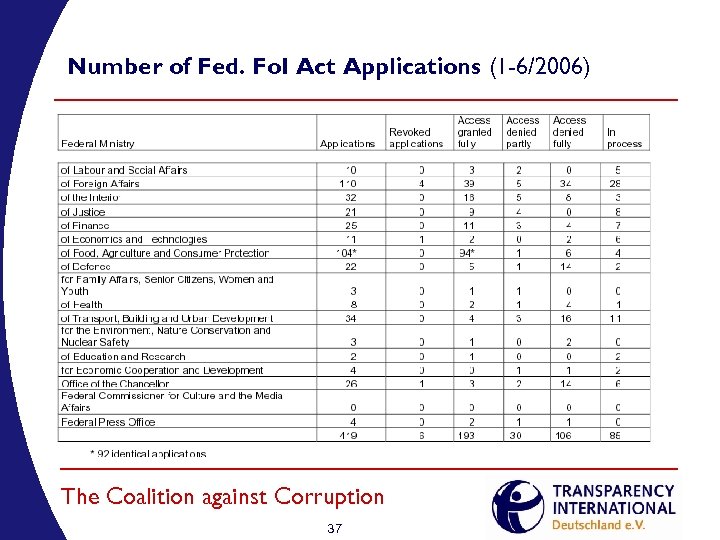
Number of Fed. Fo. I Act Applications (1 -6/2006) The Coalition against Corruption 37
Main Conflict Points • About 120 were referred to the Information Commissioner • Approximate disperse of the Commissioner’s consultancy according to the origin of applications – 20 % Federal Ministry of Economics and Technologies – 10 % Federal Ministry of Health – 10 % Federal Ministry of Transport, Building and Urban Development • Main contentious issues are business and trade secrets • Slowly cases ob non-reaction raise in number • Conflicts over fees are of less importance The Coalition against Corruption 38
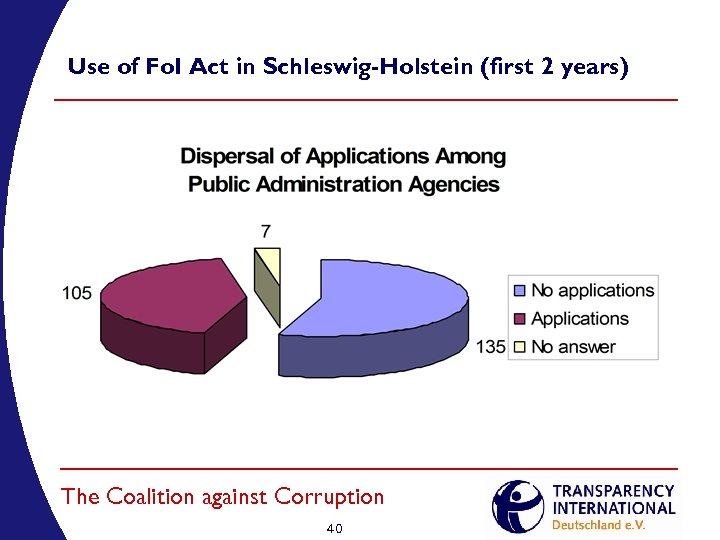
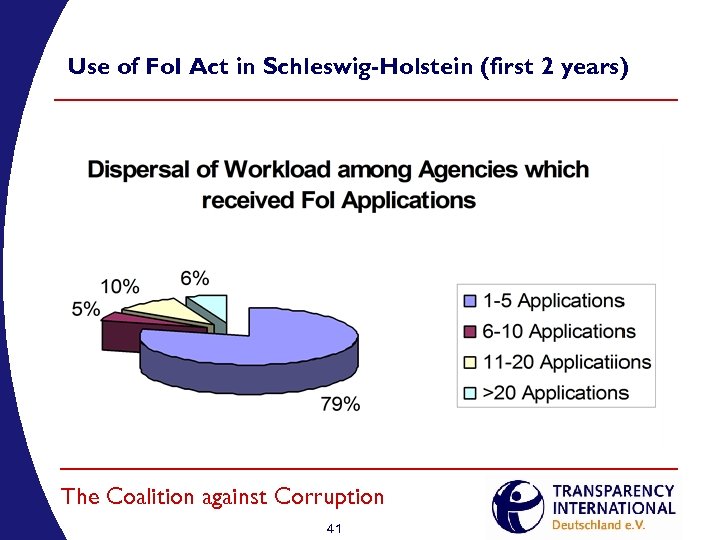
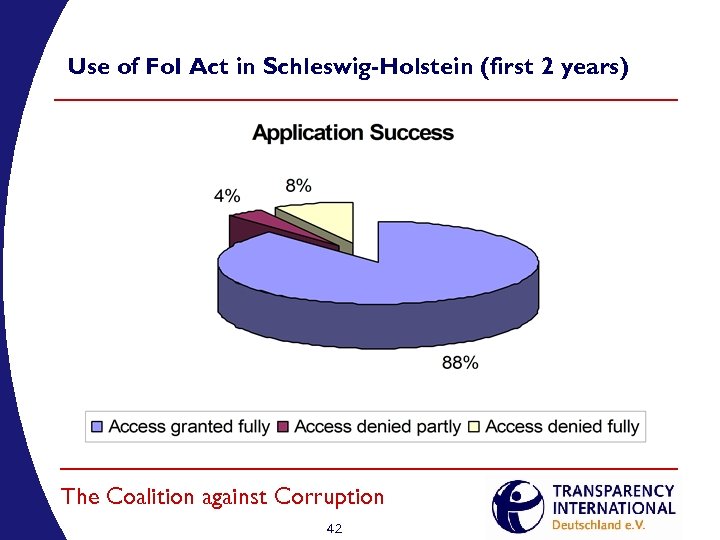
Use of Fo. I Act in Schleswig-Holstein (first 2 years) • About 1150 applications based in Fo. I act during the first 25 months • 950 more were counted as Fo. I application although the act was not mentioned by the applicant • No excessive workload was created • The great majority of application was granted fully The Coalition against Corruption 39
Use of Fo. I Act in Schleswig-Holstein (first 2 years) The Coalition against Corruption 40
Use of Fo. I Act in Schleswig-Holstein (first 2 years) The Coalition against Corruption 41
Use of Fo. I Act in Schleswig-Holstein (first 2 years) The Coalition against Corruption 42
Use of Fo. I Act in North Rhine-Westphalia (1. year) State Government Applicatio ns Deni es Objectio ns Times Action to fees were compel asked 58 25 2 1 1 Regional Authorities 353 169 8 2 4 Local Authorities 576 201 23 9 58 Police 39 14 3 2 0 Judiciary 44 7 0 1 1 Miscellaneous public entities 82 25 6 3 1 1152 441 42 18 65 Totals The Coalition against Corruption 43
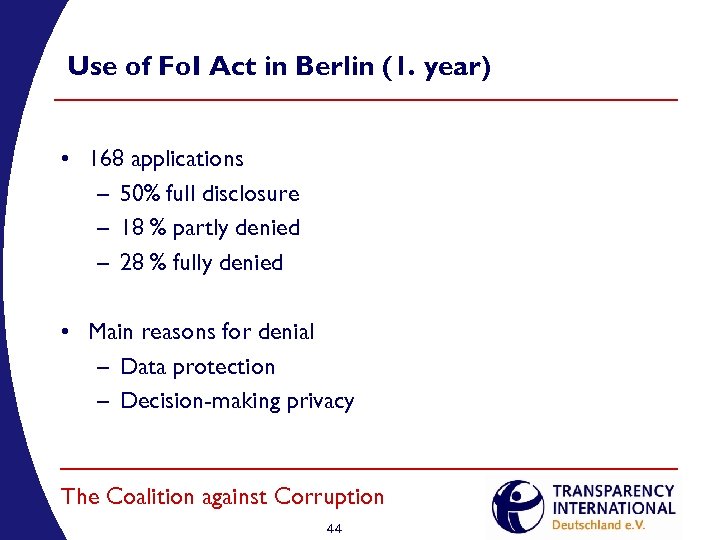
Use of Fo. I Act in Berlin (1. year) • 168 applications – 50% full disclosure – 18 % partly denied – 28 % fully denied • Main reasons for denial – Data protection – Decision-making privacy The Coalition against Corruption 44
Examples for the Use of Fo. I Laws: Federal Government • Contracts between federal government and Siemens, Deutsche Telekom and other to built an electronic system for toll collection The Coalition against Corruption 45
Examples for the Use of Fo. I Laws: Berlin • Access to appointment calendar of governing mayor – Undecided – Justification for denial: Calendar is no file • Access to calculation of water price by semi-public water supply Company – undecided • Access to information concerning a construction project – Granted – Construction Company applies for information in context of law suit for additional payments – According to Agency prime example for misuse The Coalition against Corruption 46
Examples for the Use of Fo. I Laws: North Rhine-Westphalia • Who sponsored the mayors official necklace? – Granted • Access to Information concerning prolonged earthworks – Granted – Information was use to sue local authorities for damages The Coalition against Corruption 47
Examples for the Use of Fo. I Laws: Several States • Schleswig-Holstein – Access to information concerning a construction project – Granted after intervention by information commissioner – Justification for denial • Citizen’s initiative is not a legal person • Speaker of initiative is said to not apply in his own right • several states – Access to names of companies which Under filled food packages – different court decisions in individual states – Agency denied access in every case – Which company cheated its customers was considered a trade secret The Coalition against Corruption 48
Future of Fo. I in Germany • All states without Fo. I law will pass one in the near future. • All will be weak laws as the federal law sets a low standard and even this standard will mostly not be met. • We have seen the first assaults on Fo. I laws this year in Berlin and Schleswig-Holstein. This may start a new trend. The Coalition against Corruption 49
Future of Fo. I in Germany • Germany’s federal government does not favour the idea to pass a transparency convention at the Council of Europe. • Berlin just expanded the information rights of its parliament. Delegates of Berlin to private companies fully or partly owned by he city can now be ordered to report to parliament committees. The Coalition against Corruption 50
Скачать презентацию Dr Christoph Bruch Fo I in Germany Six
7c6379c967f08d75be7820fde4cbda61.ppt