 Скачать презентацию Dr Beatrice Lai 8 April 2011 ICU Pamela
a57576221b3167ecc4e680b3fdbfd2c6.ppt
- Количество слайдов: 37



Dr Beatrice Lai 8 April 2011 ICU, Pamela Youde Nethersole Eastern Hospital, Hong Kong
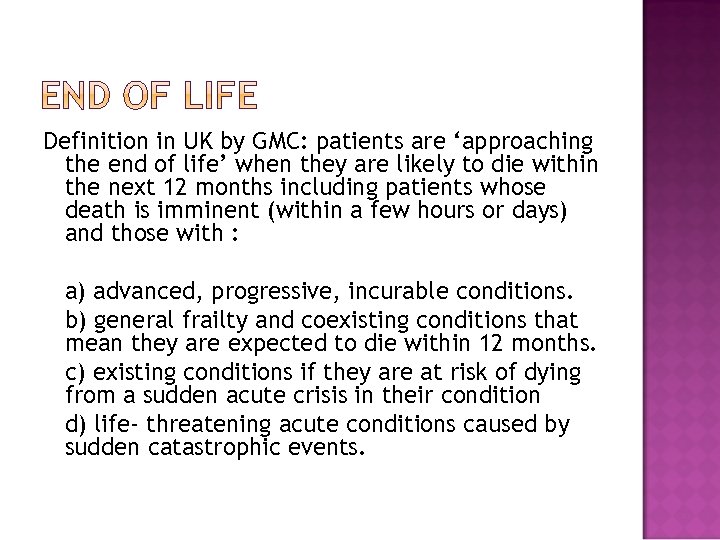
Definition in UK by GMC: patients are ‘approaching the end of life’ when they are likely to die within the next 12 months including patients whose death is imminent (within a few hours or days) and those with : a) advanced, progressive, incurable conditions. b) general frailty and coexisting conditions that mean they are expected to die within 12 months. c) existing conditions if they are at risk of dying from a sudden acute crisis in their condition d) life- threatening acute conditions caused by sudden catastrophic events.
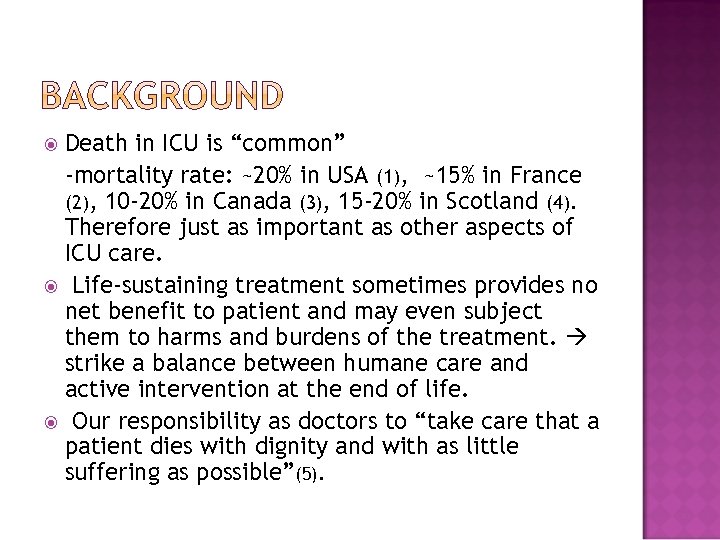
Death in ICU is “common” -mortality rate: ~20% in USA (1), ~15% in France (2), 10 -20% in Canada (3), 15 -20% in Scotland (4). Therefore just as important as other aspects of ICU care. Life-sustaining treatment sometimes provides no net benefit to patient and may even subject them to harms and burdens of the treatment. strike a balance between humane care and active intervention at the end of life. Our responsibility as doctors to “take care that a patient dies with dignity and with as little suffering as possible”(5).
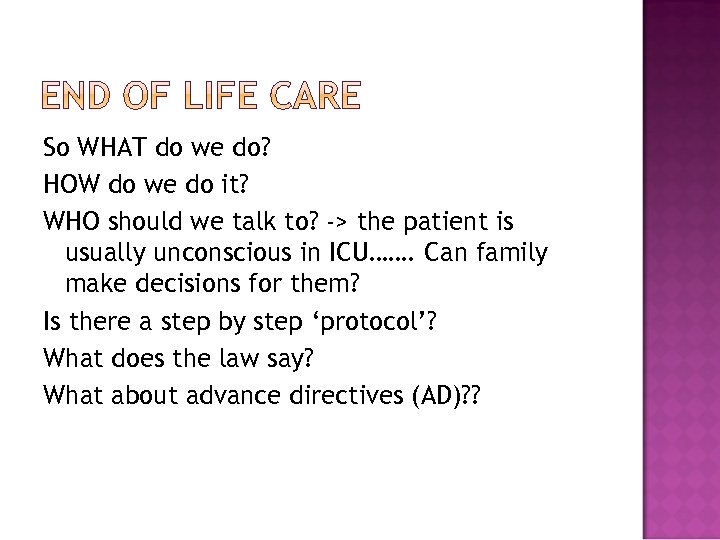
So WHAT do we do? HOW do we do it? WHO should we talk to? -> the patient is usually unconscious in ICU……. Can family make decisions for them? Is there a step by step ‘protocol’? What does the law say? What about advance directives (AD)? ?
From restorative care - palliative care ……. the transition from cure to comfort care is difficult “ First is the widespread and deeply held desire not to be dead. Second is medicine’s inability to predict the future, and to give patients a precise, reliable prognosis about when death will come. If death is the alternative, many patients who have only a small amount of hope will pay a high price to continue the struggle. ” (6)
Clinically complex Emotionally distress Ethical dilemmas Uncertainties about the law Unfortunately no clear cut answers most of the time
In UK, decisions towards the end of life are guided by: - General medical council (GMC) - British medical association (BMA) - Intensive Care Society (ICS) And of course our hippocratic oath and the four ethical principles (beneficence, nonmaleficence, patient autonomy, distributive justice) In HK: - Code of professional conduct by HK medical council - HA guidelines on life-sustaining treatment in the terminally ill (2002).
UK system - guidelines - common practices HK system - guidelines and common practices the US system
Intensive Care Society (ICS) “ Guidelines for limitation of treatment for adults requiring intensive care” http: //www. ics. ac. uk/intensive_care_professi onal/standards__safety_and_quality#Guidanc e (2003) (7) - Actually based on GMC and BMA
Provides a framework for doctors to deal with this complex issue effectively Things doctor you MUST do and things you SHOULD do as a
Principles (key points): Must give patients who are approaching the end of life same quality of care as all other patients. Presumption in favor of prolonging life, yet no absolute obligation to prolong life irrespective of the consequences of patient Presume every adult patient has capacity to make decisions You must provide all appropriate help and support to maximize patients capacity to make each decision If he/she lacks capacity, you must consider what is of overall benefit to the patient and which option would be least restrictive of that patient’s future choices. You must consult those close to the patient to help you reach a view.
Life prolonging treatment can lawfully be withheld or withdrawn from a patient who lacks capacity when starting or continuing treatment is not in their best interests No obligation to give treatment that is futile or burdensome Resource constraint should not be the justification for withdraw or withhold a treatment A legally binding advance directives/refusal must be respected Euthanasia is illegal and plays no part in end of life care
Role of relatives, partners and others: Unless granted legal power as“legal proxy” by the patient or the court, they can not make decision on behalf of the patient. Play significant role in ensuring the patient receives high quality care Relatives’ anxieties should not override your clinical judgment
Decision making models: - If patient has capacity to decide then they have right to accept or refuse an option even though their decision may result in their death - If patient lacks capacity then its more complicated…. .
- Is there legally binding advanced refusals? or if someone else holds legal authority to decide for the patients i. e. “legal proxy”; or If there is no legal proxy, you must take responsibility of deciding which treatment will provide overall benefit to your patient after consulting those close to the patient and other members of the health care team
Legal - proxy Appointed guardian by patient or the court Can make decision on behalf of the patient (not ALL the decisions though and not just medical decisions)
Clinically assisted (artificial) nutrition and hydration (e. g. TPN, NG, PEG, IV or s/c fluid) - Assess nutrition and hydration separately For those who lack capacity and are not expected to die within hours or days: Must provide it if its of overall benefit.
Among all, the single most important and recurring theme of the guideline is…. . COMMUNICATION
Based on GMC guidance In addition: Recognise that death needs to be a managed process in ICU Agree that withholding treatment is ethically equivalent to withdrawing treatment Can consider a ‘time limit trial’ of intensive care treatment on the understanding that it would be withdrawn if ineffective
Methods of withholding and withdrawing: - It is the duty of consultant in charge of ICU to recognise a dying patient. The particular methods remain the prerogative of the ICU clinician. Aim is to relieve the patients pain and distress. Ensure the drugs and doses used could not be regarded as excessive by others Treatments aimed at primarily maintaining organ function but may prolong death should be withdrawn. e. g. withdraw resp support, decrease Fi. O 2, lessen the ventilatory support and eventually when appropriate extubation. Adequate analgesia and sedation Paralysis must always be avoided - -
Care for the terminally ill is guided by HA’s guidelines and code of professional conduct by HK medical council Adopted from UK’s guidelines so very similar viewpoint Affirms that dying is unavoidable for the terminally ill so the goal is to relieve pain and distressing symptoms. This allows dying with dignity
Advance directives (8) is now newly recognised under common law in HK The doctor should not carry out the treatment in the event of a valid AD that refuses treatment. “A health care professional who knowingly provide treatment in the face of a valid and applicable advance refusal maybe liable to legal action for battery or assault” A patient cannot use an AD to refuse basic care or symptom control that is necessary for his/her comfort. Special cases: pregnant women
It is legally and morally appropriate to withhold or withdraw life sustaining treatment if - a) a mentally competent and properly informed adult refuses treatment; -b) when the treatment is futile Definition of life sustaining treatment includes CPR, artificial ventilation, pacemakers, vasopressors, chemotherapy, dialysis, antibiotics.
Some differences: - Chinese culture: The concept of self may be different from the western concept and the role of family in decision making may also be more important (9). - Artificial nutrition issue: withholding or withdrawing this should be subject to additional safeguards, including legal review. Unless death is imminent and inevitable or clearly expressed by a mentally competent patient. All such cases should be reported to HCE/HAHO.
In practice what do HK ICU doctors do? A survey done in PWH in 2004: - Practice of withholding therapy rather than withdrawal of therapy occurs more frequently than in western cultures (10, 11). Seek concurrence on management plan with the family members rather than permission. Most frequent withheld or withdrawn treatment were inotropes, ventilator (decrease Fi. O 2, decrease PEEP), RRT. Very few patients or their relatives requested extubation - -
Hong Kong ICU doctors also more often involve the patient and his or her family in discussion of end of life issues compared with doctors in the West.
Recommendations have been published by the American College of Critical care medicine in 2008 (12). Also great emphasis on patient+family centered care and communications 3 ethical principles: - withholding VS withdrawing - killing VS allowing to die (e. g. withdrawing mechanical ventilation will allow the patient to die) - intended VS merely forseen consequences (the ‘doctrine of double effect’)- “It is widely recognised that provision of pain medication is ethically and professionally acceptable even when the treatment may hasten the patient’s death if it is intended to alleviate pain and severe discomfort, not to cause death” Some practical suggestions on management
Critically review the need of cardiac monitoring Critically evaluate all ICU therapies: Are they making a net positive contributions to comfort of the patient? Abx, vasoactive drugs, dialysis, ventricular assisted devices, IV fluids, nutrition No need for ‘weaning’ of treatment (excluding mechanical ventilation) such as abx, blood products, IVF. They can be aruptly stopped To extubate or not to extubate- no consensus
Use of NIV should be evaluated carefully considering the goals of care: To relieve dyspnoea or if the patient has specifically refused ETT. No neuromuscular blocking drug to be used as no benefit to sedation/analgesia
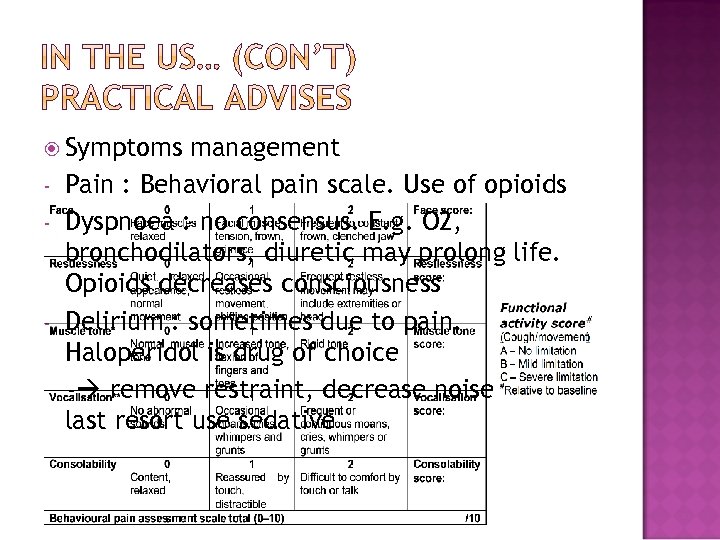
Symptoms - - management Pain : Behavioral pain scale. Use of opioids Dyspnoea : no consensus. E. g. O 2, bronchodilators, diuretic may prolong life. Opioids decreases consciousness Delirium : sometimes due to pain. Haloperidol is drug of choice - remove restraint, decrease noise/light, last resort use sedative
80 yr old Tom , never married ADL-I, walks with stick when out Some support from sister who lives nearby Hx of COPD, HTN, DM Recurrent COPD exacerbation and was admitted to hospitals 4 times last year
Admitted to AED with COPD exacerbation Intubated at AED Transferred to ICU for management • • • Extubated on day 3 Initially well on supplemental oxygen via N/C Gradually deteriorated again needing NIV
Depsite NIV he is deteriorating He has made some passing comment not wanting to be reintubated yesterday to his sister who came to visit He is now too drowsy to comprehend (no capacity to consent).
Current treatment is not helping A patient who has no capacity to consent even with the help of his relative He has not got an advance directives but he had made some comment about not wanting intubation (and what if he DIDN’T make that comment? )
What is patients best interest? Take patients wish into account and not proceed with intubation? Speak to the family (sister) ? What if she wants “active intervention’? What if she doesn’t? If the team decides that it is best to stop NIV and adopt a palliative approach, what would you do?
Similarities and differences in managing end of life care between different countries Dying in dignity End of life care in a terminally ill patient should be actively managed No hard and fast rule in decision making Decisions guided by law and relevant governing bodies Good communication with patients/relatives/carers/among team member/other health professionals is paramount
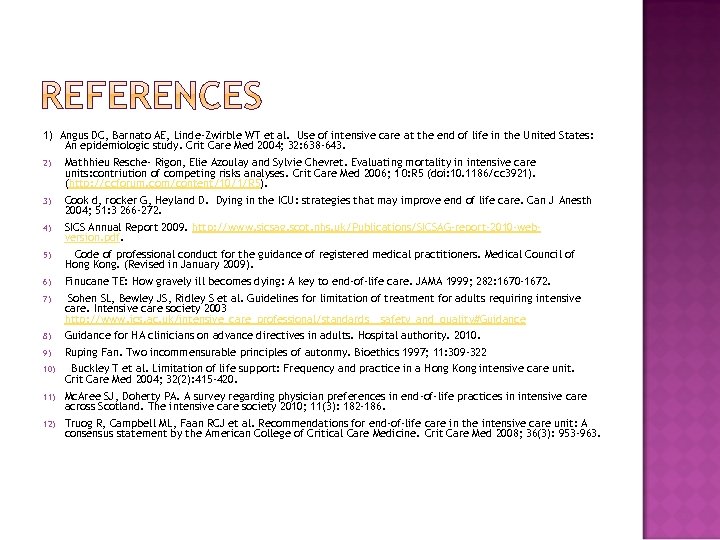
1) Angus DC, Barnato AE, Linde-Zwirble WT et al. Use of intensive care at the end of life in the United States: An epidemiologic study. Crit Care Med 2004; 32: 638 -643. 2) Mathhieu Resche- Rigon, Elie Azoulay and Sylvie Chevret. Evaluating mortality in intensive care units: contriution of competing risks analyses. Crit Care Med 2006; 10: R 5 (doi: 10. 1186/cc 3921). (http: //ccforum. com/content/10/1/R 5). 3) Cook d, rocker G, Heyland D. Dying in the ICU: strategies that may improve end of life care. Can J Anesth 2004; 51: 3 266 -272. 4) SICS Annual Report 2009. http: //www. sicsag. scot. nhs. uk/Publications/SICSAG-report-2010 -webversion. pdf. 5) Code of professional conduct for the guidance of registered medical practitioners. Medical Council of Hong Kong. (Revised in January 2009). 6) Finucane TE: How gravely ill becomes dying: A key to end-of-life care. JAMA 1999; 282: 1670 -1672. 7) Sohen SL, Bewley JS, Ridley S et al. Guidelines for limitation of treatment for adults requiring intensive care. Intensive care society 2003 http: //www. ics. ac. uk/intensive_care_professional/standards__safety_and_quality#Guidance 8) Guidance for HA clinicians on advance directives in adults. Hospital authority. 2010. 9) Ruping Fan. Two incommensurable principles of autonmy. Bioethics 1997; 11: 309 -322 10) Buckley T et al. Limitation of life support: Frequency and practice in a Hong Kong intensive care unit. Crit Care Med 2004; 32(2): 415 -420. 11) Mc. Aree SJ, Doherty PA. A survey regarding physician preferences in end-of-life practices in intensive care across Scotland. The intensive care society 2010; 11(3): 182 -186. 12) Truog R, Campbell ML, Faan RCJ et al. Recommendations for end-of-life care in the intensive care unit: A consensus statement by the American College of Critical Care Medicine. Crit Care Med 2008; 36(3): 953 -963.
Скачать презентацию Dr Beatrice Lai 8 April 2011 ICU Pamela
a57576221b3167ecc4e680b3fdbfd2c6.ppt